Baptism of Jesus – 2026
Matthew 3:13-17
Marian Free
Loving God, open our minds to your word, our hearts to your spirit and our lives to your will. Amen.
There are only five verses in today’s gospel, but they contain so many complexities that I am not sure we will get to the bottom of them today.
If you read all four accounts of the baptism of Jesus you will see that there are substantial differences between them which means that each author, or the communities for whom they wrote, has interpreted the story in a way that was helpful for them. What the accounts have in common, is that Jesus came to John and that something called baptism happened. Also, all four gospels try, in some way or another t play down the role of John the Baptist which reflects a certain embarrassment concerning Jesus’ baptism by John. This is most clearly articulated in Matthew’s gospel in which John says – “I need to be baptized by you, and do you come to me?”
Matthew’s account of Jesus’ baptism raises a number of questions for me including:
What is actually happening here? What were the Jewish practices – if any – of baptism? How much has the early church read their practice into the story? What does Matthew’s account of Jesus’ baptism tell us about his agenda? And, for me, the most challenging question: What does it mean when Jesus says: “Let it be so now; for it is proper for us in this way to fulfill all righteousness.”
The beginning of the first century was a time of religious upheaval in Judea. Many Judeans were disillusioned with the Temple and its rituals not least because the priests were political appointees and therefore owed an allegiance to Rome. The Pharisees responded by developing a practice based more on law than ritual and the Essenes withdrew into the desert to practice a more aesthetic version of Judaism. John, and his call for the people to return to God, is representative of this situation. Like the Pharisees and Essenes, he appears to have believed that there was a need for the nation as a whole to purify itself and he does this by calling people to turn their lives around and to wash themselves in the Jordan. That he touched a chord among the people is evidenced by the fact that people from all over the country, including the Pharisees, Sadducees and even soldiers and tax collectors came to him for baptism.
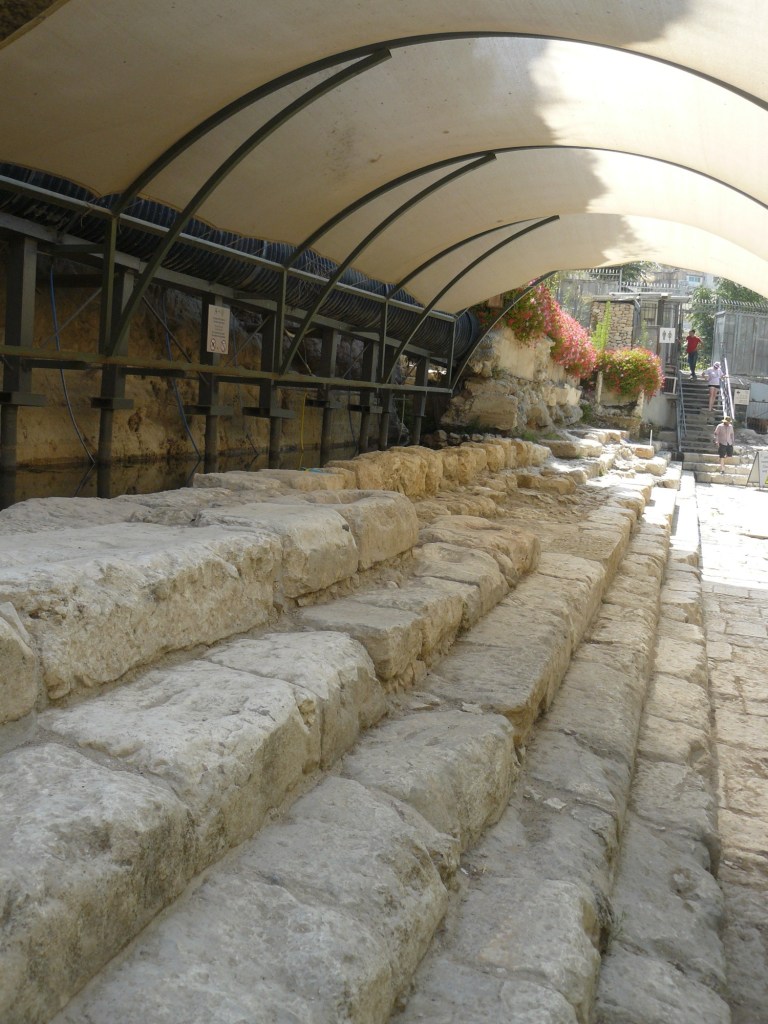
I use the word “wash” because this word more accurately represents Jewish practice and the meaning of the Greek word – baptizo. To really grasp what is happening we have to remember that a person was a Jew by virtue of birth. There is little evidence of Jewish evangelism in the first century and what we call “baptism” was not a rite of entry into the Jewish faith. Immersion in water was a rite of purification and there were a number of pools at the Temple for this purpose. This was a personal action and did not require anyone else to be present. John’s call for people to immerse themselves in the Jordan indicates a rejection of the Temple and its practices. The Jordan had the further advantage in that it symbolised a movement from wandering in the desert to life in the promised land.
John calls the people to “repent because the kingdom of heaven has come near.” “Repent,” the translation of the Greek “metanoia,” is commonly understood to mean being sorry for one’s sins (as it is in our form of the Confession). In its original context however it simply meant to turn around. In calling people to repent John – then Jesus – was challenging people to stop going their own selfish way and to turn around, to return to God. This means that we don’t have to worry about a sinless Jesus being baptised to cleanse him from his sins. Instead, we can see that baptism, immersion in water by or in the presence of John, was for Jesus, a public declaration of his willingness to give his life entirely into the hands of God.
At the beginning of his public ministry, Jesus has come to John in order to demonstrate his complete submission to God and his readiness to live a life directed by God’s will and not his own.
We still have to explain the mysterious statement that we find only in Matthew’s gospel. In response to John’s objection Jesus justifies his baptism by saying that it is “to fulfill all righteousness.” Matthew is fond of both expressions “fulfill” and “righteousness. He wants to make it clear that Jesus is the fulfillment of scripture and also that a key characteristic of the Kingdom of Heaven is righteousness.
Righteousness is a difficult term to define, especially as we commonly use the word to refer to the observance of a religious or ethical norm. Being “righteous” in our minds is associated with being “good.” In Old Testament terms though and in Matthew’s usage, righteousness refers to a quality of God – God’s dispensation of justice and salvation, or as Albright and Mann suggest, it is a term that refers to “the whole purpose of God for his (sic) people”[1]. It is God who makes righteous. Righteousness as Paul makes clear is not earned but is a gift. So, when Jesus states that his baptism by John is to “fulfill all righteousness” he is saying that his submission to the ritual of washing demonstrates his complete identification with God and God’s purpose for God’s people. Through him, God’s purpose for God’s people will come to fruition and as a consequence, “all righteousness will be fulfilled”. Through his baptism, Jesus makes it clear that he is the prototype of the peopel we are all called to be.
Through his baptism by John, Jesus signals his complete submission to the will of God and his desire to have no life of his own but only a life that is given over completely to the will of God, directed by the presence of God within.
Our modern practice of baptism with its emphasis on turning from sin is a poor imitation of Jesus’ baptism. Kingdom people are people who have utterly surrendered their lives and their wills to God.
What are we prepared to surrender in order for God’s righteousness to be fulfilled?
[1] Albright, W. F. and Mann, C. S. (1971). Matthew: A New Translation with Introduction and Commentary. Sydney: The Anchor Bible, Doubleday, 31.
Tags: baptism, corruption, Essenes, immersion, purification, religious upheaval, righteousness, submission, surrender
 Swallowsrest
Leave a comment