Archive for the ‘All Saints’ Category

One with All the Saints

November 1, 2025

All Saints/All Souls – 2025

Luke 6:20-31

Marian Free

In the name of God without beginning or end, and in whose love we are united through love with all who have gone before us and with all who will come after. Amen.

I love this quote from Linda Hogan:

“Walking, I am listening to a deeper way. Suddenly all my ancestors are behind me. Be still, they say. Watch and listen. You are the result of the love of thousands.” (Dwellings)

Hogan reminds us that we are the result of all those who have come before us, those to whom we are related by blood, those whose lives have impacted upon our families in the past and in the present and those whose roles in history have shaped who we have become. We are never alone, but part of a great tapestry of saints and sinners.

Coming as they do on the heels of each other, the Feasts of All Saints and All Souls make me aware of how intimately we are connected with those who have gone before us. Threads of love, community and tradition, even our DNA bind us to past generations and, long after we are gone will link us to those who come after.

Our introduction to confession today quotes from the Book of Hebrews (12:1): “We are surrounded by a great cloud of witnesses.” Our faith in the resurrection assures us that those who have preceded us are not gone forever but are in some way transformed, such that they live on.  We experience their presence through the warmth of the love they shared with us, through the impact they had on our lives and on the lives of those around us, through the memories of their place in our lives, through their heroic acts or through their acts of faithful living.

Within our Christian tradition, we are joined to all the Biblical figures that make up our scriptures.  We are inspired by their courage and heroism and shocked (yet strangely comforted) by their missteps and by their blatant failings.  Figures like Sarah and Abraham, Moses and Deborah, Isaiah and Huldah, Elizabeth and Zechariah, Joseph and Mary are as real to us as if they were here  present. Their stories have been told and retold in such a way that these and the many other people who populate our Bible are as vivid and vibrant in our imaginations as if they had never left us. When we need courage to step out in faith, we can look to Sarah who, without question, followed Abraham as he answered the call of a God whom he did not know. When faced with insurmountable odds, we can look to the boy David who knew that defeating the giant Goliath was not impossible.

We identify with the child Samuel who did not recognise the voice of God calling him in the night and we can wonder at the influence of Deborah – the only woman to be the judge of Israel. Mary’ surprise and timidity assure us that being in the presence of God is truly awesome and Peter’s impetuous ignorance reminds us that it’s OK to be truly human.

Though these characters lived centuries, even millennia ago, they seem to walk beside us as friends and guides, as people whose lives can inform our own, whose fears mirror our fears and whose courage spurs us on. They are so familiar that at times we find ourselves in conversation  –  “What would you have done Peter?” “Mary of Bethany, we’re you afraid of the backlash when you anointed Jesus’ feet?” “Paul, if only I had one fraction of your passion!”

“We are surrounded by a great cloud of witnesses.” The story doesn’t end with the final words of the Book of Revelation. Throughout the centuries there have been thousands whose light has shone a little brighter, whose courage has been more costly or whose teaching has been so wise that we have given them a special place in our hearts and our histories – Joan of Arc, Francis of Assisi, Dietrich Bonhoeffer, Mother Teresa and so many more – speak to us through the ages, reminding us of the costs and the rewards of following Jesus and urging us to try just a little bit more, to be braver, to be kinder, to confront injustice and to alleviate the suffering of the poor.

In our faith communities too the presence of those who have preceded us lingers on in the stories we tell of the past, the traditions we maintain in the present and even in the buildings which they strove so hard to provide. The faithful prayers which sustained them and our community continue exert an influence on our present.

All Saints is not a feast that celebrates those long dead, but a festival that rejoices in the unbroken ties that bind us  together, that recognises all those who continue to walk beside us and who unite with us in a great chain of witnesses. As we celebrate All Souls, we recall the ties of love and the bonds of memory that ensure that we are never separated from those who have gone before us.

This weekend as we celebrate All Hallow’s Eve, All Saints and All Souls Days we give thanks for all those whose lives and witness have contributed to our own lives and faith and to the life of the Church of which we are a part. In our turn we pray that we may  allow ourselves to be woven into the fabric of the faith such that we too become part of this wonderful ongoing story of God’s relationship with God’s people – a story that has no beginning and no end.
 

All Saints

November 3, 2024

All Saints – 2024

John 11:37-44

Marian Free

In the name of God, who created the universe out of nothing, and who gives life to the dead. Amen.

Today we celebrate all the saints who have inspired, challenged and changed the church for the better. These would be saints whether or not we believed in the resurrection.  Their example and faithfulness would be remembered and would stand as a beacon through the ages. We would remember them with fondness and (as best we could), would model our lives on theirs regardless of whether or not we believed that they continued to exist. As it is we are confident of the resurrection, and such can find strength and courage in their continued presence with us.

Because, not only can we be inspired by their lives, but we can continue to be in relationship with them. That relationship will vary depending on our background and our temperament. Many in the Roman Catholic tradition believe that the saints intercede for them. In practice this can take the form of almost superstitious prayers (to St Anthony of Padua to find something that is lost, or to St Christopher to keep a person safe when travelling) or the more profound prayers for healing, support in grief, guidance for the future. In some churches in Italy, tombs of the saints are covered in post it notes and adorned with cards that carry pleas for the saint to intercede for those in need.

In the letters of Paul, everyone who believes is called “αγιος” (holy or saint), but it seems that very early in the life of the church a belief emerged that those who had died continued in some way to be part of the community, these were also called saints. Hebrews for example, tells us that we are surrounded by a great company of saints. “Therefore, since we are surrounded by so great a cloud of witnesses, (martyrs) let us also lay aside every weight and the sin that clings so closely, and let us run with perseverance the race that is set before us, looking to Jesus the pioneer and perfecter of our faith, who for the sake of the joy that was set before him endured the cross, disregarding its shame, and has taken his seat at the right hand of the throne of God” (12:2).

This conviction that there was life after death is significant as the notion of the resurrection to eternal life was a matter of some controversy in the first century. From the gospels we can tell that while the Pharisees believed in resurrection, the Sadducees did not. In fact, the Sadducees tried to trip Jesus up over this very question. According to the Psalms and other Old Testament writings, those who had died did not rise to new life but went to Sheol ,a shadowy place from which a person could no longer worship God. As the Psalmist says: “In death there is no remembrance of you; in Sheol who can give you praise?”  

It was during the exile, when the Hebrews lived in Babylon and were influenced by the culture around them, that ideas of resurrection began to influence the Jewish faith.

Even though the idea of resurrection was not embraced by all people of the Jewish faith, belief in life after death is attested to in the Book of Maccabees an inter-testamental book in which each of seven brothers refuse to eat pork – even under torture. The fourth of the brothers to be tortured states: “One cannot but choose to die at the hands of mortals and to cherish the hope God gives of being raised again by him” (2 Macc 7:14). The mother of the seven young men, who watches her sons tortured to the point of death, encourages them to be steadfast believing that: “the Creator of the world, who shaped the beginning of humankind and devised the origin of all things, will in his mercy give life and breath back to you again” (2 Macc 7:23).

In the beginning of the first century, Jesus’ resurrection confirmed once for all, that the dead would be raised. The raising of Lazarus pre-figures Jesus’ own resurrection, and powerfully demonstrates Jesus’ power over life and death. It also provides an opportunity for Jesus to teach about the resurrection. Lazarus is raised to life in the present, but not for eternity.  The sisters believed that Jesus had the power to prevent Lazarus from dying. Jesus is more concerned that they understand that he is the resurrection and the life, that he is the one who will defeat death once for all. in other words, the raising of Lazarus is but a foretaste of Jesus’ ultimate victory.

The message of Jesus’ resurrection lay at the heart of the proclamation of the gospel, it gave heart to those who were persecuted for their faith and strength to those who were facing difficult times. If this life was not all there was, then anything could be borne.

As the church spread and grew, and as it settled into a more sedentary form of existence, there was less need for courage and strength, but there were still those

whose lives of faith stood out from the crowd. Those whose wisdom, holiness, fortitude,  self-sacrifice set them apart and those whose gifts of prophecy, teaching or healing made them distinct, came to be revered in life and, on their death, to be considered not only as examples to follow, but as saints whose continued presence could influence and sustain the faith journeys of others.

The Feast of All Saints is a reminder that we are not alone in this journey of faith. Those who have gone before us continue to exist, to give us strength when we face dark times (after all many of the saints faced far worse), to give us hope when all seems hopeless (they did not give up when times were tough), to teach us compassion when we are tempted to ignore the suffering around us (they were not afraid to embrace the leper, to feed the hungry), and to seek the peace and joy that comes from within rather than to depend on the things of this world to meet our deepest needs. 

Ghosties and ghouls – All Hallows

November 5, 2023

All Saint’s/All Soul’s – 2023
(Halloween)
Marian Free

In the name of God our Saviour and Deliverer. Amen.

If you can’t beat ‘‘em join ’em. That seems to have been the philosophy of Pope Gregory – well at least something like that. Pope Gregory the Great had been entranced by the fair blond children whom he saw at the slave market in Rome. When he asked who they were, he misheard “Angles “as “Angels”. The children had been brought from the land that we now call England to be sold to the highest bidder. Gregory determined to send missionaries to that land to convert its people to Christianity. For that purpose, he chose Augustine to lead a group of monks. Augustine’s task was not particularly onerous – Christianity had reached those Isles centuries before though it had only taken hold in places. Augustine had the further good fortune to land in Kent where the Queen, Bertha was already a Christian. Her husband, Ethelbert, gave the monks some land where they built a monastery and eventually Canterbury Cathedral.

Augustine wrote several letters to the Pope asking for advice. In one, he enquired what he should do about the sites that the Celts held to be sacred. Gregory replied: “what I have, upon mature deliberation of the affair of the English, determined upon, viz., that the temples of the idols in those nations ought not to be destroyed; but let the idols that are in them be destroyed; let holy water be made and sprinkled in the said temples, let altars be erected, and relics placed. For if those temples are well built, it is requisite that they be converted from the worship of devils to the service of the true God; that the nation, seeing that their temples are not destroyed …may the more familiarly resort to the places to which they are accustomed.” In other words, the Pope, understanding the meaning that such places held for the people of the land, encouraged Augustine to continue to use them, but to infuse them with Christian meaning – to rename the deity whom they worshipped in a place that they already held to be sacred. The Pope’s response – use them. Take advantage of the fact that they are already sacred and infuse them with Christian meaning. (In other words: if you can’t beat them join them.)

I recalled this story as I was reflecting on Halloween which falls on October. 31. Over the past week I have heard a number of reactions to the practice- most loudly ‘it’s American, it’s commercial”, ie we shouldn’t do it, it’s not part of our culture, it’s just a way for business to make money. Some are uncomfortable that the practice of Halloween – ghosts and witches, trick or treating – contradicts Christian beliefs and practices.

It is good to reflect on what it is about our faith that makes us distinct and what sets us apart from the world around us. It is also important to remember that almost from its inception, Christianity began to incorporate practices and traditions from other cultures into its own. Until the mid-fourth century, Jesus’ resurrection was celebrated every Sunday (as it still is). Around the time of the Council of Nicea (325), and the Christianization of the Roman Empire, it was determined that there should be a dedicated celebration and the Sunday after first full moon of the spring equinox (a time associated with rebirth and renewal) was deemed appropriate. The name “Easter” comes from Eostre, the goddess of spring and fertility. Christmas too is the appropriation of a pagan festival. The Romans originally celebrated the birthday of Mithra, the god of the unconquerable sun, on December 25.

The Pope’s advice to Augustine was wise, and it built on many precedents – it did not take much to associate resurrection with a festival new life or for the birth of Jesus to replace the birth of an unconquerable sun.

So where does that leave Halloween. Before there was a Christian festival – All Hallow’s Eve – there was the Celtic feast of Samhaim which marked the turn the seasons, between the lighter warmer half of the year and the darker, colder half. On this night, the Celts believed that the veil between this world and the next was so thin that the spirits of the dead (good and evil) could pass through. On this night, people burnt fires, wore disguises, and made sweet treats to deter, trick and appease the evil spirits so that they would cause no harm .

Over time, the Christians in the British Isles began to celebrate all the Saints on November the first – “All Hallow’s Day”. In the 9th Century Pope Gregory IV incorporated All Saints Day, followed by “All Soul’s Day” into the Christian Calendar. That the old traditions lingered long after the Christians took over the Celtic festival is clear in this prayer from an old Scottish litany: “From ghoulies and ghosties and long leggedie beasties, and things that go bump in the night. Good Lord deliver us.”

Instead of sitting in pious judgement on those who indulge in creating ghostly gardens, who dress up their children in ghoulish costumes to wander the streets and demand treats, we need to see Halloween for what it has become – a time to let down our hair, to indulge in some ridiculous fun and to build a sense of community in a world in which we are increasingly isolated.

We are no longer afraid that the dead will break through the veil to cause havoc in our world. Instead, over three days – All Hallow’s Eve, All Saints Day and All Souls Day, we are gifted with an opportunity to reflect and to give thanks for those whom we have loved and lost, to allow ourselves to be inspired by saints of great courage, and saints of humble prayer, to grieve, to rejoice and to commit ourselves once more to live lives of faithful service.

Blessed are YOU

November 5, 2022

All Saints – 2022
Luke 6:20-25
Marian Free

In the name of God, Creator of the Universe, Sharer of our earthly existence, and Giver of life and love. Amen.

Some decades ago, in experiments that would now be considered to be unethical, infant rhesus monkeys were removed from their mothers at birth and put in cages. with so-called “surrogate mothers”. These “surrogates” were very basic inanimate structures. One consisted of wire and wood and the second was covered in foam over which was a soft cloth. There were two experimental conditions. In one the wire structure had a milk bottle and the cloth one did not and in the other the situation was reversed. In both cases, the infants spent more time with the cloth mother. In both cases the infants were, needless to say, traumatised by the experience.

Touch is an essential component of human well-being, the sense we missed most during COVID. It not only indicates love and compassion, but it is essential to a child’s development – the growth of physical activities, of language and cognitive skills and of social-emotional competency. In adults, touch signifies safety and trust, reduces stress, and allows the immune system to function effectively. Without touch a person can become stressed, depressed, or anxious.

Indeed, the power of touch is such that it is seen to have the ability to heal or to transfer energy from one person to another. Physical touch gives a sense of connection, as if by association, the essence or charism of the other passes to the recipient and they share, for a moment at least, something of the other. (We see this when crowds reach out to touch, albeit briefly – a member of royalty, a rock-star, or say the Dalai Lama. Their desperation to touch suggests that they believe that the contact will mean that something of the status of the other will brush off on them and that their lives will be changed as a result.)

When Jesus begins his “Sermon on the Plain”, he is surrounded by a “great crowd of his disciples and a great multitude of people from all Judea, Jerusalem, and the coast of Tyre and Sidon. They had come to hear him and to be healed of their diseases; and those who were troubled with unclean spirits were cured. All in the crowd were trying to touch him, for power came out from him and healed all of them.”

“Power came out of him and healed all of them.” Everyone wants something from Jesus – they want to touch him, or to be touched by him. They want to be healed by him or they want to feel distinguished from the crowd by virtue of association with him. In other words, they want what Jesus has to give them – whether it is wholeness or a sense of importance.

When we read the Beatitudes in this context, we can see that they are not so much a comforting set of sayings but much more a form of rebuff, a corrective to the crowds’ way of thinking. Jesus is not commending the poor etc as much as he is challenging the crowds to consider what he really means to be one of his disciples and whether they are truly prepared to follow where discipleship will lead.

Luke tells us that the crowds have come to Jesus to hear his teaching and to be healed. They are drawn to him for what they can get out of the relationship. Jesus needs them to know that it is not so simple –something of him may rub off on them – but it will not be what they expect.

Perhaps this is why, when Jesus begins to speak, he focuses his attention his attention on his disciples – those in the crowd who identify themselves as his followers. What he has to say relates directly to them. When Jesus says: “Blessed are you who are poor”, he is not referring to the poor and hungry in general, but to those who are in right front of him – “you”.

His words then are a stark description of what it means to be a disciple, to be one of his followers. Jesus is saying that if some of his charism has flowed from him to them, it is a charism that leads not to glory, but to the cross, not to wealth and distinction, but to deprivation and obscurity. Being a disciple of Jesus will not spare them poverty, hunger, grief, or persecution. It will require resilience, fortitude, being willing to follow Jesus wherever that takes them, and understanding that the fate of the master will be the fate of the follower. But – and this is important – it is this dependence on God, this trusting in God to see one through, that will lead to the blessedness of being able to take life as it comes, to being content with one’s current situation and being able to cope with grief and loss.

In contrast, Jesus warns, those would-be disciples who are seeking notoriety, wealth, or entertainment will not, in the end, be satisfied. They will always be striving for what they do not have, and such striving will, in fact, take them away from the satisfaction, joy, and security that they are seeking. They will be cursed by dissatisfaction, discontent, and disappointment.

Jesus is telling his would-be disciples, and by inference us, that if we want to touch and be touched by him and if we want to share his charism and to be made whole, then we must understand that blessings will be found in suffering as well as joy, in emptiness as well as in satiation, in deprivation as well as in richness and that seeking to escape poverty, sorrow and obscurity will only lead to the very things that we seek to avoid.

Blessed are you if you seek Jesus above all else, for then you will know that you already have all that you need.

In the company of saints

October 31, 2020

ALL SAINTS AND ALL SOULS – 2020

MATTHEW 5:1-12A

MARIAN FREE

In the name of God in whose loving care are the living and the dead. Amen.

‘Blessed are those who mourn for they shall be comforted.”

 The Beatitudes, one of the best-known New Testament passages, are a reminder of the upside-down world that Jesus preaches and which he encourages us to embrace. In a world that values success and happiness, Jesus promotes humility and sobriety and assures his followers that, contrary to popular opinion, grief and poverty are blessings[1]. Over and over again, Jesus contradicts commonly held values and aspirations. Through his choices and his actions, Jesus demonstrates that it is not necessarily those whom society values – the rich, the powerful and the healthy – who have precedence in the kingdom of God. It is the poor and the marginalised who are the focus of Jesus’ ministry – those who have nothing and who have no opportunity, those who by virtue of their disability, their poverty or their powerlessness demonstrate to the rest of us that it is possible to exist in this world and to have faith without the trappings that many of us find indispensable.

Luke’s version of the Beatitudes is even more stark than Matthew’s: 

“Blessed are you who are poor,

                        for yours is the kingdom of God. 

            “Blessed are you who are hungry now,

                        for you will be filled.

            “Blessed are you who weep now,

                        for you will laugh.”

Jesus knows, as we often do not, that absence makes presence even more special and that the acceptance of one’s current situation frees us from striving and stops us from thinking about what we do not have but rather of what we do have allowing us to live in the present and not in some imagined the future. He reminds too us that this life is only a part of the story. 

For many hundreds of thousands of people this has been a year of unbearable grief and loss, often compounded by the inability to visit a dying parent, or even to attend their funeral. Rituals that have existed since the beginning of human existence are forbidden or limited and those things that provide comfort and allow us to properly farewell those whom we love are being denied us. I cannot imagine the agony and anxiety which countless families have endured, and nor can I conceive the ways in which their grief might have been amplified by COVID restrictions.

The Feasts of All Saints and All Souls which fall on November 1st and 2nd respectively provide an opportunity, as best we can, to express our loss for the souls of the departed but also to affirm our confidence in the commonwealth of heaven and the belief that not even death can separate us from those whom we love. 

On All Saints day we honour the lives of all the faithful and on All Souls’ Day we give thanks for and pray for the departed. We do both in the company of other Christians throughout the world. This year, whether we are confined to our homes or able to worship with our faith communities, we can be both comforted and supported in our common prayer and in the knowledge that we are surrounded by “a cloud of witnesses”. As we remember before God those whom we grieve, we can be confident that we do so with countless others who have known loss and in fellowship with all the saints, both living and departed. We can take advantage of these two days to begin to make peace with our grief and lay to rest those whom we love despite the opportunities that we have been denied.

This year and next and for however long it takes, the feasts of All Saints and All Souls can be an occasion to fill the vacuum created by the COVID restrictions on caring for the dying and farewelling the dead. If we have not been able to say “farewell” in the way that we would have liked – with full churches, families and friends – let us say our farewells in a different but vastly greater community of saints – living and dead.

Remember too that the Beatitudes remind us that however difficult our current situation, stiving for that which is not possible will only lead to discontent and misery. The truly blessed are those who can acknowledge and sit with the present, accept things as they are and to place their trust in the God of time and history.


[1] I like to think that he doesn’t mean grinding poverty but rather the absence of excess, of the things that we don’t need.

November 2, 2019

All Saints – 2019

Luke 6:20-31

Marian Free


May the words of my mouth and the meditations of our hearts be always acceptable in your sight, God our strength and redeemer. Amen.

The concept of saint is a complex one. As I pointed out in pew sheet there is no ‘one size fits all’ when it comes to defining sainthood. Those who have been identified as saints by the church have ranged from political to apolitical, from academics to those with no education, from cloistered to engaged with the world. They may have experienced torture and violent deaths, or they may have lived quietly till the end. Even the history of the word ‘saint can be problematic. In the New Testament αγιος (‘holy’) was used by Paul to describe anyone who had come to believe in Jesus as the Christ. He addresses four of his letters to ‘those called to be saints’ (Rom 1:7, 1 Cor 1:2, 2 Cor 1:1, Phil 1:1).

This does not mean that the communities to whom Paul wrote provided examples of holiness for successive generations of Christians to emulate – far from it. According to Paul’s criteria, any baptized person was holy (άγιος – a saint). Included under this umbrella were the believers in Corinth. His first letter to that community reveals that their behaviour was both divisive and immoral – not at all consistent with the image of ‘saint’ with which we are familiar. Paul has to chide members of this congregation for competing with each other, taking each other to court and celebrating the eucharist in ways that discriminated against the poor. One of their number is said to have been sleeping with his father’s wife (a behaviour apparently condoned by the remainder of the community!) and yet Paul writes: “To the church of God that is in Corinth, to those who are sanctified in Christ Jesus, called saints.” In Paul’s world, simply being “in Jesus” made a person holy.

As time passed, and the early flush of enthusiasm disappeared and the founders – the apostles and their followers – passed into memory, the church became increasingly institutionalised and the fire and the passion of the early days settled into more of a routine. Acts of courage and steadfastness were no longer the day to day experience of those who believed and behaving in a “Christian” way came to be second nature. Despite this, there were faithful people who continued to behave in extraordinary ways, to do extraordinary things and to act with extraordinary courage – whether they took themselves off to the desert to pray in solitude or had an ability to teach or to heal or had faced violence against them. These individuals stood apart from the run-of -the-mill Christian. They were sought out for their wisdom, their teaching, or their ability to heal and they were admired for their courage and their fortitude. In the absence of the apostles, such people became the heroes of the faith and they were venerated by those whose faith and the practice of it, did not aspire to such great heights. The title ‘saint’ was no longer applied to everyone, but only to these few whose lives had been an example to all.

Not only were these saints revered in their lifetime, when they died their memory was honoured each year on the day of their death. Over time the number of people revered as saints proliferated to the point that a more formal way of identifying people as such was developed. We know process this as canonization (something we have observed in recent times in the case of Mary McKillop and Mother Teresa among others). The practice of remembering saints on the day of their death continued, but now the number was limited to those recognized by Rome. Despite the Reformation, the Anglican Church continues to honour a somewhat smaller number of saints but, unlike our Roman sisters and brothers, we have not added to that number since King Charles the 1st was identified as a saint in 1660. Instead, every province has the authority to name as “holy” those who lives stand out as an example to us but who would be unknown to people in other parts of the communion.

In Australia we remember Eliza Hassal, a pioneer of the Church Missionary Society, William Broughton, the first Bishop of Australia, Sister Emma SSA, the superior of the Sisters of the Sacred Advent here in Brisbane, Frederic Barker, bishop and pioneer of Moore Theological College, Georgian Molloy, pioneer church leader and botanist and Sydney Kirkby, pioneer of outback ministry and founder of the Bush Church Aid Society.  Our Calendar also includes women and men whose impact has been felt here, even if they have lived in other countries or belonged to other denominations. These include the martyrs of Uganda, Evelyn Underhill, spiritual writer, William Wilberforce, social reformer, Mary Summer founder of the Mother’s Union and the twentieth century martyrs including Archbishop Romero and Dietrich Bonhoeffer.

All of these are remembered on the day of their death so why, you might ask, do we celebrate today as All Saints Day? According to Denis Hamm All Saints Day began as a commemoration of early martyrs who names were unrecorded and who therefore could not be remembered on the day of their martyrdom.

Whatever its origins, today provides an occasion for each of us to reflect on the lives of all those who have gone before us, especially those whose faithfulness, courage and witness have thrown a light on our tentativeness, our timidity and our silence. It is an opportunity to examine our own faith (or lack of it) and to allow ourselves to be challenged and inspired by those who allowed nothing to stand between them and Christ, who faced danger and privation, endured solitude and misunderstanding, who stood up for what is right and who were not afraid to confront injustice and oppression.

Today we thank God for the lives of all the saints – known and unknown. We pray that their lives may influence our own and that our own will not be found wanting.


With all the saints and angels

November 3, 2018

All Saints – 2018

Marian Free

 In the name of God who surrounded by all the saints of heaven. Amen.

I’d like to begin this morning with two stories. The first was told to me by a priest who, early in his career was a priest in the Diocese of Canberra – a place renowned for bitterly cold winters. As is the case in many Anglican Parishes, there was an early morning mid-week Eucharist. In the middle of winter only one older woman attended. On one particularly bleak morning the priest picked up the courage to ask whether, as she was the sole member of the congregation, the woman might consider that the time had come to abandon the service. “But I’m not alone,” the woman replied. “I am surrounded by the communion of saints.” Week after week, month after month, year after year, this woman faithfully joined her prayers with all those who had gone before her, confident that her worship was never an individual but always a collective effort.

The second story was told to me by another priest reflecting on her childhood experience of being a member of the Anglican communion. This woman grew up in an outer suburb of Sydney – or rather a suburb that was developing on what was then the outskirts of Sydney. The church, which was small in number, met in a cottage on land that would later support a hall and a church building. Though the worshippers were few, the priest of the time would remind them that rather than being an insignificant community they were in fact part of a much larger whole – the worldwide Anglican communion andthe communion of saints. My friend reports that, as a result she has always been conscious that the church community is always far greater than those who gather Sunday by Sunday but consists of Anglican Christians throughout the whole world and all who in every time and place call upon the name of the Lord – the communion of saints past and present.

At our baptism we, or our godparents, affirm that we believe in “one holy, catholic church, the communion of saints, the resurrection of the body and the life everlasting.” And whether we are conscious of it or not, every Sunday those who gather for the Eucharist affirm that their worship joins with the company of heaven. Using language from Isaiah and Revelation we are reminded each week that our prayer and praise is not offered in isolation but is united with that of the heavenly host. The introduction to the Sanctus (“Holy, holy, holy Lord”) reminds us that we praise God and sing with the angels and archangels and with all the company of heaven. The words themselves come directly from Isaiah’s vision of God in the temple. He writes, “Seraphs were in attendance above him; each had six wings, with two they covered their faces, and with two they covered their feet and with two they flew. And one called to another and said: “Holy, holy, holy is the Lord of hosts; the whole earth is full of his glory” (Is 6:2,3). These words are repeated in the Book of Revelation in which the author sees winged creatures around the throne singing ceaselessly (6:11f). The same vision sees a vast multitude   of nations before the throne who sing: “Blessing and glory and wisdom and power and might be to our God forever and ever. Amen” words that are echoed in the final acclamation of the Eucharistic Prayer (Rev 7:12). In the Prayer of Thanksgiving we join our voices with all the heavenly host  – angels and archangels, prophets and martyrs and with all who those have been raised from death to life.  We become a part of the ceaseless praise of heaven.

Our worship is not only heavenly, it is corporate.

As we worship, not only do we participate in the continual worship of heaven, we also become part of the endless cycle of praise and prayer that continues day in, day out throughout the world. As the old hymn affirms: “hour by hour fresh lips are making your wondrous doings heard on high[1].” Before we began our worship this morning communities to the east of us had begun their own and before our worship concludes today communities to our west will begin to offer theirs. As the earth makes it way around the sun and as others rise to greet a new day, so prayer and praise will be continuously offered to God this day in almost every nation of the world. Whether we are many or few is irrelevant as we lift our worship in so great a company.

Our worship is not private but communal, not local but global, not earthly but heavenly. Our worship is not an expression of personal piety. It is not a comfortable, cosy gathering with familiar faces. Worship is an action that takes us out of ourselves and beyond ourselves, that transports us beyond our own limitations and unites us to something far, far greater – the world-wide church and the company of heaven.

The Prayer of Confession today will be introduced with the words from Hebrews 12:1: “We are surrounded by a great cloud of witnesses.” As we celebrate the feast of All Saints, let us commit to living this reality and to allowing ourselves to be gathered up with all those who have gone before us as we join with them in songs of never-ending praise.


[1]The day thou gavest Lord has ended. John Ellerton, 1826-93.

Forces for change

November 4, 2017

All Saints – 2017

Luther

Marian Free

 In the name of God who speaks through holy men and women in every place and time to challenge, encourage and renew the people and the church. Amen.

In the early sixteenth century in Germany, a monk of the Augustinian Order had been going through “hell”. Martin Luther was obsessed with his own sinfulness and the impossibility of remembering in his sins in order to confess them, anxious lest he forget and therefore not be forgiven. Trying to work out how to become righteous before God, Luther had tried all kinds of self-abasement – sleeping in the snow and lying almost naked in the belfry tower at night. Nothing seemed to work. Luther felt that he could never do enough to earn God’s favour. Luther could see only God the All Terrible, God the Judge, God the Divine Majesty, God the impossible to please.

Luther’s behaviour was extreme, but we have to remember the context in which he found himself. The Roman Catholic Church (THE Church) was focused on sin and judgement. The Doctrine of Purgatory was based on the idea that imperfection had no place in heaven, and that Christians had to be purged of all sinfulness before they could enter eternity. In purgatory all traces of impurity were burned away making a person fit for heaven. The greater the sin, the longer it took to purge, though prayers on someone’s behalf could reduce the time a person spent in purgatory. In such an environment it was impossible to believe in grace and forgiveness, love and goodness but only in demand and judgement, fear and anxiety about what the future might hold.

Indulgences provided an opportunity for the faithful to repent and thus to have their sin forgiven. The more sin forgiven, the less time spent in purgatory.[1] During the Crusades, indulgences were offered as a carrot to get people to join the Crusades. Over time, the practice spread and indulgences became something that could be purchased by the wealthy. A privileged few, included Luther’s own Prince Frederick, were given the authority to offer indulgences themselves thus increasing their own coffers.In this environment, Luther struggled to overcome his perceived sinfulness and achieve some sort of worth before God.

Luther was an academic and a teacher. In 1515-1516 he was teaching on the Psalms and Romans. This forced him to reflect – first of all on the suffering of Christ (God) and on Christ’s sense of abandonment on the cross, and secondly on the meaning of the righteousness of God.

In his own words: “I greatly longed to understand Pail’s Epistle to the Romans and nothing stood in the way but that one expression, “the justice of God” because I took it to mean that justice whereby God is just and deals justly in punishing the unjust. My situation was that, although an impeccable monk, I stood before God as a sinner troubled in conscience; I had no confidence that my merit would assuage him. Therefore I did not love a just and angry God, but rather hated and murmured against him. Yet I clung to the dear Paul and had a great yearning to know what he meant.

Night and day I pondered until I saw the connection between the justice of God and the statement that “the just shall live by his faith.” Then I grasped the justice of God is that the righteousness by which through grace and sheer mercy God justifies us by faith. Thereupon I felt myself to be reborn and to have gone through open doors into Paradise. The whole of scripture took on a new meaning and whereas before the phrase “the righteousness of God had filled me with hate, now it became to me inexpressibly sweet in great love. This passage of Paul became to me a gate to heaven ….

If you have a true faith that Christ is your Saviour, then at once you have a gracious God, for faith leads you in and opens up God’s heart and will, that you should see pure grace and overflowing love. This is to behold God in faith that you should look upon his fatherly, friendly heart, in which there is no anger nor ungraciousness. He who sees God as angry does not see him rightly but looks only on a curtain, as if a dark cloud had been drawn across his face.“[2]

In searching for the exact meaning of the Greek word “dikaisunē”, Luther came to understand that the word rendered “justice” in English, really meant the process by which sometimes a judge suspends the sentence, places the prisoner on parole and expresses confidence in him. (In other words it was less about being judged and more about being set free.) Further, Luther came to see that justification was not something achieved by the individual, but was God’s gift to us through Jesus. A consequence of this discovery meant that Luther was at last freed from his striving and his sense of inadequacy knowing himself secure in God’s love.

Through his study, Luther was exposed to the spirit of the age, which was demanding a return to a simple faith and in particular a reinstatement of the Bible as the sole source of authority for the faith. By now the Bible had been translated from Latin into the vernacular and many people were reading it in their own language for the first time. There was an air of renewal and reform throughout Europe, a desire to return to the heart of a Christian faith that had been over-laden with ritual, ceremony and artifacts and in which a person’s relationship with Jesus had been broken by intermediaries in the form of a plethora of saints.

In 1517, a monk, Johann Tetzel, began to sell indulgences in Germany with the goal of providing funds to renovate St Peter’s Basilica in Rome. Now that he understood that salvation could not be bought, but came through faith alone Luther was incensed. He penned a response: “Disputation on the Power and Efficacy of Indulgences” and, tradition has it, nailed his 95 Theses[3] to the door of the Castle Church. His ideas spread rapidly and it was not long before he was labeled a heretic, called to Rome and eventually excommunicated.

When at last he returned to Wittenberg, he discovered that his teachings and writings had galvanized a movement that was both theological and political. He himself had little to do with the movement but continued to write until his death.

Luther’s significance cannot be underestimated. His writings captured the spirit of the age and throughout Europe, reform movements sprang up and Protestantism was born. At the centre of this new movement were a firm belief in the Bible as the primary source of authority and that salvation cannot be achieved but only received.

While the Reformation took its own shape in England we as Anglicans heirs and beneficiaries of Luther’s intellect, wisdom and vision.

[1] The practice was, of course, open to corruption and could be used as a source of revenue not only for Rome, but for those whom Rome allowed to dispense indulgences themselves. In the words of the Article XXII of the Anglican Church “the doctrine concerning purgatory …. is a fond thing, vainly invented, and grounded upon not warranty of scripture, but rather repugnant to the Word of God.

[2] Bainton, R. Here I Stand – The Classic Biography of Martin Luther. Sutherland, NSW: Albatross Books, 1978, 65.

[3] http://www.luther.de/en/95thesen.html

Practicing our faith more intentionally

October 31, 2015

All Saint’s Day – 2015

Marian Free

In the name of God who calls us all to live with courage, faith and faithfulness. Amen.

One of the consequences of the Reformation was that the various churches that formed as a result either stopped or curtailed the worship or recognition of saints. The Anglican Church belongs in the latter category. Reformers on the Continent and in England felt that the Church of Rome had overlaid the practice of the faith with a vast number of things that could not be justified with reference to scripture. Some of these are listed in Article XXII that, (in what today would be considered inflammatory language), states: “The Romish Doctrine concerning Purgatory, Pardons, Worshipping and Adoration, as well of Images as of Reliques, and also invocation of Saints, is a fond things vainly invented, and grounded up not warranty of Scripture, but rather repugnant to the Word of God.”

The worship of saints was considered a distraction from the worship of God who, through Jesus, was now directly accessible to every individual through prayer. There was no need for intermediaries, no matter how holy. Anglicans were still happy to recognise that there were among the faithful those who lives were so exemplary that they provided a model for others, but they seriously culled the number who were so acknowledged and since the Reformation have only formally added one person – King Charles I – to the list of saints recognised by Anglican Church.

That is not to say that Anglicans do not recognise that there are those among us whose lives of faith are so outstanding that we might wish to continue to remember them or to follow their examples. To that end a number of people have been acknowledged as “holy men and women” without the requirement of a lengthy process to determine whether or not they have been responsible for a pre-determined number of miracles. Within Anglicanism there is freedom for each Province to add to their yearly Calendar persons of particular significance for their part of the world. There is also within our tradition the possibility of adding to our liturgical year those whose faith-life is deemed to have universal significance – whether or not they belong to the Anglican tradition.

These include a number of twentieth century martyrs – Dietrich Bonhoeffer (a Lutheran), Oscar Romero (a Roman Catholic) and William Wilberforce (an Evangelical Christian). In Australia we pay tribute to many who have made a significant contribution to the life of faith and of the church in Australia. These include – Sister Emma[1], Eliza Darling[2], William Broughton,[3] and John Wollaston.[4][5]

One holy woman whose writings and spiritual direction were a significant part of the twentieth century is Evelyn Underhill. Though a layperson and a woman, Evelyn was much in demand as a Retreat Leader and Spiritual director. She was also a prolific writer, penning some 39 books, 350 reviews and countless letters during her career. Evelyn was unusual in many ways. She was not only an independent thinker, but also an independent woman. At a time when women did not work unless they had to, Evelyn earned money from her writings and had the freedom to leave her husband behind on those occasions when she required time to write or was called upon to lead Retreats and give Seminars.

Not only was Evelyn independent at a time when many women were not, she was also unconventional in her approach to organized religion. She was critical of the church once stating: “not only the Vicar and the Curate and the Mother’s Union Committee …. the Church is an ‘essential service’ like the Post Office, but there will always be some narrow, irritating and inadequate officials behind the counter and you will always be tempted to exasperation by them”[6]. It appears that she had a great sense of fun that sometimes took by surprise those who were expecting a serious spiritual guide.

According to the Christian Classics Ethereal Library, Underhill’s book Mysticism that was published in 1911 remains a “classic in the field”. In it she reflects that one could find the central element of mysticism in the experience of the mystic, which, she thought was “an overwhelming consciousness of God and of his (sic) own soul: a consciousness which absorbs or eclipses all other centres of interest” (p 3)[7]. From this we can gather that Underhill was not interested in the theory of spirituality (as were other writers of the time), but in the practical nature of mysticism and in mysticism as experience. This may have been in part because the book was written to help her explain her own early experiences of the spiritual. In Mysticism, she argues that: (1) mysticism is practical, not theoretical, (2) it is an entirely spiritual activity, (3) the business and method of which is love. (4) Mysticism entails a definite psychological experience.

During the course of her life Underhill influenced a great many people through both through her writing (books and letters) and through personal contact. Through her life and the impact that she had on the faith lives of others, Underhill is a reminder that saints (holy people) are not always quiet, pious people who withdraw from the world to pray. She demonstrates that holiness does not require separation from the world, but can thrive just as well when it engages fully with the world. Importantly, Underhill is just one person who is evidence that saints do not belong to a past era but continue to be raised up in every generation.

Our Articles of Religion may tell us that “the invocation of saints .. is repugnant to scripture” but our tradition reminds us that among us are holy people whose faith and life can support and uphold our own, giving us reasons to explore our faith more deeply and to practice our faith more intentionally.

On this day, we remember all the saints – those known to all and those known only to a few. We give thanks for their lives and examples and endeavour to model our practice and our faithfulness on theirs.

[1] Superior of the Society of the Sacred Advent.

[2] Prison reform

[3] First Bishop of Australia.

[4] Priest and missionary.

[5] For more details put “Holy Persons and Holy Days in Australian Anglicanism” into your search engine or go to this link – https://en.wikipedia.org/wiki/Calendar_of_saints_(Anglican_Church_of_Australia)

[6] Quoted by Oberg, Delroy, in Evelyn Underhill and the Making of “Mysticism”: Celebrating the Centenary of the 1st Edition – March 2, 1911. Self Published by Delroy Oberg, 2015, 14.

[7] Mysticism can be downloaded as a pdf file from a number of sites including: http://christianmystics.com/Ebooks/The_Essentials_Mysticism/teom.pdf

Unsung heroes

November 3, 2012

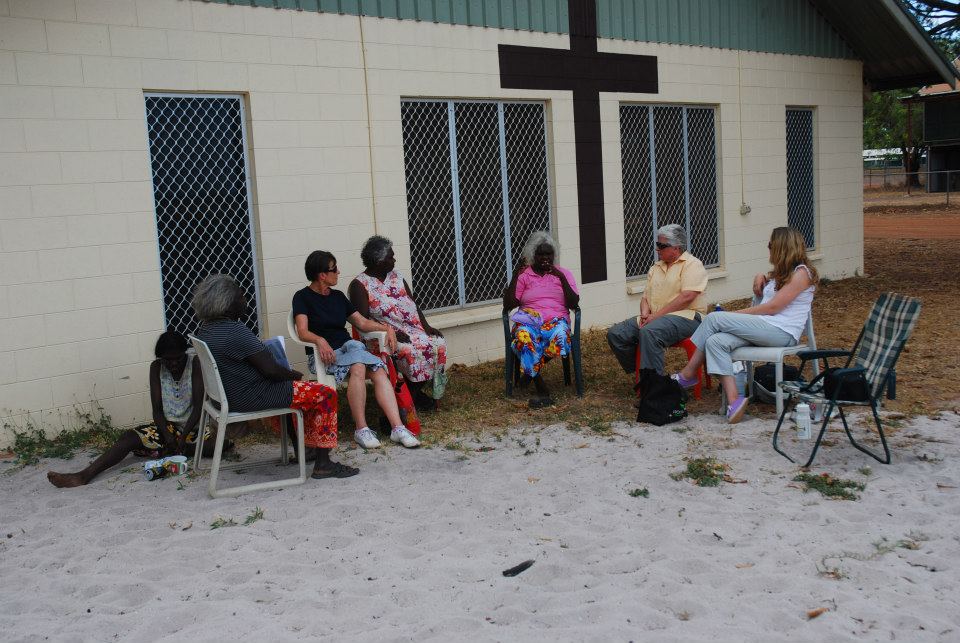
Listening outside the church at Gunbalanya – Lois in pink

All Saints 2012

A Reflection

Marian Free

In the name of God who alone can judge the secrets of the heart. Amen.

Today I’m going to do something a little different. I’m going to speak from the heart. I think most of you know that I spent the first week of my holidays in Darwin. It was my first time there and it was a marvelous experience. Two particular experiences were very confronting and challenging and relate to what are perhaps the most difficult and divisive social issues of our time. So please be clear, I’m sharing how these events touched me, not trying to provide answers, or to tell you how to think.

One experience was this. I was sitting in the Cathedral waiting for the service to begin when the a bus-load of Iranian asylum seekers arrived – five of whom were to be baptised. The issues surrounding asylum seekers are complex and I don’t want to argue the rights and wrongs or even to suggest that I have made up my own mind on the issue. What struck me was that when someone is sharing your pew, it is hard to think that when you are going home, they are going to jail.

The second profound experience occurred during a visit to Kakadu. The Bishop had organized a local priest to take three of us out for the day. After a visit to some rock art, we drove to Oenpelli (Gunbalanya) – that part of Kakadu over which the indigenous people have Native Title. Our purpose there was to meet with the local priest – Lois and some of her congregation – Hagar Lois’s sister who is a teacher at the local primary school, Marlene her sister-in-law and a young woman named Leandra.

Lois’s story is that her family come from a place near Katherine, but they moved to Gunbalanya when she was quite young. Among other things this meant learning another language and a dislocation from her family’s spiritual home.  Despite numerous difficulties in her lifee Lois’s faith remained strong and she was the obvious person to lead the church in her community and is now their priest.

From our host for the day I learned that a major issue confronting Lois in her ministry was the occasional visits to the community by people from a Pentecostal expression of Christianity. These people are very enthusiastic and make wild promises about such things as healing from alcohol dependence. As a result they gather a following from among the residents of the community. When they leave, those they have left behind often discover that the promises had no substance, that they are unable to stay away from drink, that they are not healed of their ailments. As a result, they return to their former ways with the one difference being that now they are disillusioned with the Christian faith. As a priest Lois must do what she can to pick up the pieces and, if she can, restore their faith.

Lois and her friends talked a lot about sharing the Good News and very little about any problems in their community. It was only as we were leaving that Hagar, Lois’s sister grabbed my arm and said, “This is what we need to do more of – talk to each other.” I could only agree. We hear so much about indigenous communities through our media, the problems with alcohol and petrol sniffing, the endemic sexual abuse, the violence and the hopelessness but few, if any, of us have been into these communities or spoken to people who live in them. If we don’t make connections, if we don’t sit down and talk how can we have opinions about policies and decisions that affect their lives?

I often feel helpless in the face of such suffering, especially as I live in a part of Australia in which my contact with aboriginal Australians is so rare as to be almost non existent. I left Gunbalanya feeling incredibly privileged to have shared time, be it ever so brief with Lois and her friends and wondering what if anything I could do to make a difference. In particular I wondered how I could respond to Hagar’s plea.

Saints come in all shapes and sizes, and by far the majority are the unsung heroes who simply get on with their lives no matter how difficult they are. Women like Lois, Hagar and Marlene are Anglican women who remain strong and positive in the face of considerable difficulty and all they asked of me and of you is that we listen to their story. It is hard to know how to help, but, if you look at the envelop that you would have received in your pew sheet last week, you will see a photo of Lois. This year the proceeds of the Archbishop’s November Appeal will be directed to Indigenous ministry in the Northern Territory and Bathurst. (Readers who would like to contribute are directed to the website for the Anglican Board of Missions. http://www.abmission.org)

Gunbalanya is a four hour flight and a three hour drive away from Brisbane. There is little that we can do to respond directly to Hagar’s plea that we talk. However, we can support the work of Lois and others like her by giving generously to this Appeal. It is my hope that this year our donations to this appeal will outstrip all previous years and that we will take any opportunities that come our way to listen to our brothers and sisters in Christ whose lives are so vastly different from our own.