Archive for the ‘Apocalypse’ Category

God is in the here and now

November 15, 2025

Pentecost 22 – 2025

Luke 21:5-19

Marian Free

In the name of God in whose hands are all things. Amen.

We live in particularly unsettled times. It is impossible to be unaware of the fragility of social structures, of national borders and of infrastructure. In some places democracy appears to be under threat; wars in the Ukraine, the Sudan and elsewhere threaten to change the shape of the world and typhoons, hurricanes and earthquakes reveal the vulnerability of our built structures.

For those of us who have lived through at time of relative of security, peace and prosperity  the current state of the world can feel destabilizing and disturbing. We just don’t know how to plan ahead.

Jesus’ disciples knew what it was to live in uncertain times. Most of them lived a hand to mouth existence. Except for a brief period under the Maccabees their country had been under foreign domination for centuries. At this point in the first century Galilee was ruled by a cruel and capricious Herod and the marginally more benign Pilate ruled in Judah. Everything that could be taxed was taxed and punishment for unrest was swift and violent. Their ability to make plans for the future was severely limited.

One point of stability and confidence was the Temple. The Temple, built as it was on the Temple Mount was a magnificent and imposing building. Constructed in 516 BCE to replace the original that had been destroyed by the Babylonians, the Temple had been significantly enhanced by Herod the Great (the father of the current Herod) and was known as Herod’s Temple. For Herod it was a symbol of power and might and control and for the Jews it was a symbol of God’s presence in their midst, a holy place in which the ancient rituals of sacrifice and atonement could be carried out, a place of prayer, a meeting place and a place in which even the Gentiles could worship the God of the Jews. Above all, it was a reminder of the universal nature of God, a sign of solidity, strength and endurance.

The Temple dominated the city of Jerusalem, it would have been almost impossible to imagine that it could be razed to the ground.  

Yet, on overhearing people marvel at the Temple Jesus warns that: “the days will come when not one stone will be left upon another; all will be thrown down.” And in response to the disciples’ question: “When will this be?” Jesus doesn’t answer their questions but continues with a number of seemingly unrelated warnings – about false teachers, wars, insurrections, earthquakes, famines and plagues,  betrayals and persecution.

This section of the gospel is usually referred to as the “little apocalypse”, a litany of what might be expected at the end of time. It is possible that is reflecting  a commonly held view that things are so bad that God will surely intervene and bring the world as it is to an end. If so, he is helping his disciples to make sense of the chaos that they see around them and assuring them that a) they will survive if they hold fast and b) that God will ultimately have the upper hand.

Equally possible is that Jesus, recognising the anxiety of his disciples, is warning them that the future is unpredictable and that God doesn’t work to a time line. Jesus is encouraging the disciples not to waste time by focusing on what might or might not happen but instead to live in the present and to take things as they come, knowing that God will equip them to cope with whatever comes their way – be it political upheaval, natural disaster or persecution. Jesus is reminding the disciples  that they cannot and should not try to second guess God, that they should try to trust that God has things in hand and that the future will unfold in God’s own time.

Jesus is reminding his disciples that life is precarious and the world is unpredictable and that they shouldn’t allow themselves to be caught up wondering what will happen and when. Rather they should concentrate on what they can and cannot do in the present. They should learn to place their trust only in God, because God is the only constant  – not political systems, not buildings and certainly not the natural environment.  Living in the present and leaving the future to God is the only way to cope with uncertainty. Trying to take control is futile. Worrying about the future and trying to create systems and structures that will cushion us from the visiccitudes of existence, keeps us in stasis and prevents us from experiencing life with its joys as well as its sorrows. Obsessing about how one might face a situation (a situation that may not arise) prevents us from seeing and grasping how God is acting right here right now.

Jesus advice is as relevant now as it was two thousand years ago. In uncertain times, he says, we must avoid the temptation to trust in those who make false promises that all will be well. When we are are tempted to read the signs of the times, we must remember that there will always be wars, insurrections and natural disasters and that they are not accurate indications that the end is near, but simply a reflection of the nature of humanity and of the instability of the planet. If we are tempted to see the hand of God behind the awful events in our lives and in the world Jesus reminds us of our limited understanding and asks that we leave the ordering of events to God.

The disciples want Jesus to tell them what the future will hold. Jesus’ response is to tell them not to waste time worrying about the future, not to build up barriers the hope that they can protect themselves from hurt and from harm, but rather to embrace the present with all it difficulties and complexities and to trust in God to give them the confidence to accept what is, the courage to persevere and the words to say.

No one knows what the future will hold so let us trust God in the present rather than placing our hope in an unknown future and being paralyzed by unnecessary fear.
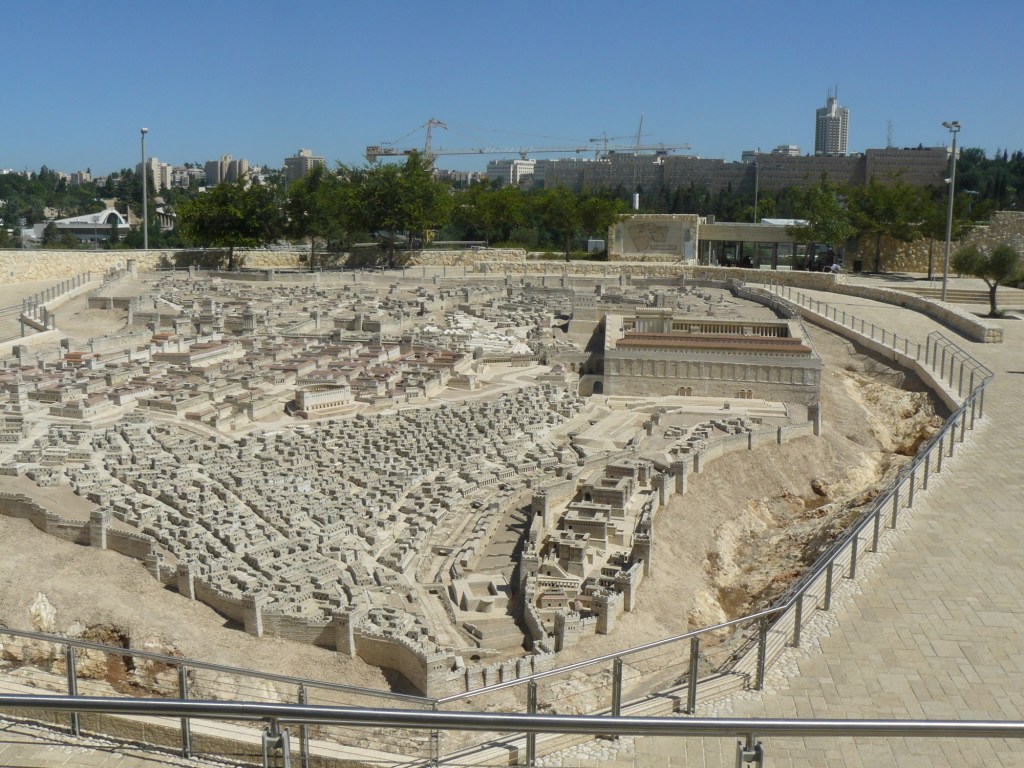


Model of first century Jerusalem

See what large stones! Trusting in the temple or trusting in God.

November 16, 2024

Pentecost 26 – 2024

Mark. 13:1-8

Marian Free

In the name of God in whom we trust. Amen.

One only has to read/watch the news to see the catastrophic state of the world: the unimaginable devastation and loss of life from the floods in Valencia and the wars in the Middle East, Ukraine and elsewhere, the disorder and civil unrest in Haiti, the drug-fuelled violence in Mexico, the displacement of people in the Sudan, Burma and elsewhere, the increasing polarisation between people of the same nation and background and between people who confess the same faith, and the exaggerated rhetoric and personal attacks around differing political views and cultural values – even in countries like our own. 

It is difficult at times not to fall into despair. It is tempting to look at the state of the world, to ask “what is going on?”, to wonder what the future might hold and to ponder where God might be in all this upheaval. Are all these disturbances a sign of more to come (as the changes in climate seem to threaten)? Are we witnessing the end of life as we have known it OR is this really the beginning of the end of the world?

It is human nature to want to make sense of calamity[1]. Collectively, we want to give meaning to the death of a child, the destruction of our home, a life-threatening illness – to any unexpected tragedy or calamity. So great is our need to give meaning to something that has no meaning that we fall into the trap of making up trite, often pious explanations for such events. We are anxious find explanations that cover up our feelings of inadequacy, our inability to find the right words to say, or which to help us to avoid facing the trauma of the inexplicable. 

I’m sure that you know what I mean. You may even have used phrases yourself. “God wanted another angel”, “They are in a better place,” “This will make you stronger” and so on. There are any number of such sayings that have entered our vocabulary to be trotted out when we have nothing better to say.  Sadly, by failing to honestly acknowledge someone’s pain, by not facing the trauma head on, we often increase a person’s sense of isolation and grief. Instead of providing comfort, we reveal our own failure to understand and our unwillingness to engage.  When say these things to ourselves, we withhold permission from ourselves to express our heartache, to sit with our grief until such time as the healing process can begin.

Today’s gospel forms the beginning of what is known as the “Little Apocalypse”, the description of things to come. Very often these are taken to be sign of the end – in fact that language implies that that is what Jesus is saying.

I want to suggest that Jesus’ meaning is much broader and much more related to the present (at whatever time in history that present might be). 

Scholars believe that Mark’s gospel was written to and for a community under threat. It written to reassure believers that their experience is not out of the ordinary, that in fact it was to be expected as a consequence of following Jesus. The gospel is a reminder that 

following Jesus is not a protection against the world’s ills. Faith in Jesus is not some or of amulet that will protect believers from harm. Believers will face the same travails and encounter the same losses as anyone who does not believe.

In our reading this morning the disciples look at the Temple which appears to have been built to withstand any threat. It was by all accounts a magnificent structure, built of huge stones, some of which were fifty feet long and eight foot high and thousands of tonnes in weight. To the disciples – Galileans all – the Temple must have seemed indestructible[2]. At the same time, despite all that Jesus has tried to teach them – about his suffering, about their taking up the cross – they still seem to hold the belief that Jesus has come to Jerusalem to confront the Romans, to restore Temple worship by removing the corrupt priests.

It is possible that for most if not all of the disciples are visiting Jerusalem for the first time. As followers of Jesus, they experienced his triumphal entry into the city and now they can sit and admire the Temple – the meeting place between YHWH and God’s people. “Look, Teacher, what large stones and what large buildings!” 

Jesus’ response would have been entirely unexpected. instead of joining in their wonder, Jesus announces the destruction of the Temple. “Do you see these great buildings? Not one stone will be left here upon another; all will be thrown down.” The Temple is not as indestructible as they think. Like everything else on earth, it is ephemeral and temporary, subject to destruction and decay.

This is too much for them to comprehend. The disciples need details, they need to make meaning out of what Jesus has said, they want to be able to prepare for such a catastrophic event. So they ask: “Tell us, when will this be, and what will be the sign that all these things are about to be accomplished?” It is then that Jesus begins to tell them of all the things that might happen. These, as I have suggested, are not so much signs of the end as Jesus providing a corrective – don’t look for signs even the angels in heaven do not know the time (13:32). Understand (Jesus seems to be saying) that worldly existence is precarious, humans are susceptible to variations in the weather, human bodies are vulnerable to disease and deterioration, and human nature tends towards competitiveness and selfishness. Peace and prosperity, health and fitness are not a given, but a privilege enjoyed by a few.  There are no simple, trite answers to trauma.

Our faith does not protect us from wars, earthquakes, famines, from hardship, poor health, or frailty. What faith does at its best is determine how we react to setbacks, traumas, and loss. What matters is not so much that we are able to interpret the times, but how we respond to what is going on around us. 

As people of faith, we cannot cut ourselves from the realities of human existence, but we can learn to live in the present, accepting what is rather than looking back to an idealized past or striving for an unrealistic future.[3] As people of faith, we are to learn to  place ourselves, our loved ones and the world in entirely in the hands of God, believing – sometimes against all evidence to the contrary, that all things will work for good. In this way, and this way alone, we will be ready for whatever is to come because we will already have placed our trust in things eternal, things that will last.

 Jesus’ comments about the destruction of the Temple are less about the timing of the end, and more a corrective of the disciples’ belief that Jesus has come to overthrow the leaders of Rome and of the Temple. They are a reminder not to look back to an idealised past or forward to an unrealistic future, but to live fully in the present, with all the good and bad that comes with that and to trust that God is with us through it all. 


[1] When my parent’s home was completely covered by flood waters in 1974, my father wandered round in a daze half-jokingly asking why God had asked him to build an ark!

[2] All that remains today are the Temple steps (see photo)

[3] It is important to note that non- resistance does not equal passive acceptance. If we can change things, if by the way we live and the way we act we can make a difference in our lives and in the lives of others, then we should do so.

Jesus’ coming – joyful anticipation or fearful expectation?

December 2, 2023

Advent 1 – 2023

Mark 13:24-37

(Is 64:1-9, Ps 80:1-7, 17-19, 1 Cor 1:1-9)

In the name of God, whose coming we celebrate with joy and whose return we anticipate with trepidation. Amen.

Though it is hard to avoid the fact that the rest of the world is already celebrating Christmas, I continue to love the season of Advent. For me it represents a time of quiet anticipation – a time to focus on the real meaning of Christmas – the gentle in-breaking into our world of God’s chosen one, the vulnerability of God in the infant Jesus, and the courage of Mary and Joseph. It is, for me, a time of wonder and joy, as I ponder the gradual unfolding of the story.

So it is that I am often taken aback by the violence and threat that lie in the gospel set for today, the first Sunday of Advent. We find no quiet waiting in Mark 13. There is no sense of hopeful expectancy. Instead, we are presented with a picture of God’s sudden and terrible explosion into the world.  An eruption that is accompanied by the destruction not only of the earth, but of the cosmos. The sun will be darkened, and the stars will fall from heaven. Without any warning all of the powers of heaven will be shaken. Keep awake, we are warned – for you do not know when the time will come: “in the evening, or at midnight, or at cockcrow or at dawn.” There is no room here for peaceful contemplation on the birth of Christ. Instead, we are placed on edge, forced in a state of constant alertness in which we worry about what it means to keep awake. We are left wondering if we have to live in a state of constant vigilance (never truly living in the present) – always looking over our shoulder for God to surprise us, always straining ahead, always worrying about our every action just in case God should burst in and find us wanting?  

Of course, it would be utterly exhausting live in a state of constant anxiety, to be always on the lookout for something negative to happen, always terrified that we would be caught out. So – what to do? What are we to make of the warnings in Mark’s gospel and how do they inform our observation of the season of Advent?

The answer lies, I believe exactly in the tension – the tension between the unobtrusiveness of Jesus’ first coming and the unmistakable disruption of his coming again; the tension between Christ’s coming as an infant and Christ’s coming again as judge of all; the tension between the powerlessness of the baby and the ultimate power of the Creator of the Universe. Advent –  with its focus on beginnings and endings – highlights the tension between the God who loved us enough to become one of us and the God who will one day ask us to give an account for our lives, the tension between trusting in God’s mercy and not taking it for granted, the tension between knowing God’s love and not taking advantage of that love and the tension between knowing that though our salvation has been won, we still have a responsibility for our salvation..

Advent provides us with a time to look back and to look forward, a time to remember all that God has done for us and a time to ask ourselves what our response to God’s love has been and whether or not we would be pleased to see God now. 

The warning to ‘keep awake’ is not so much to keep us in a state of hypervigilance, but rather a timely reminder that we should not get too comfortable, not to fall into complacency. It is a warning against the assumption that a happy ending awaits us all, just because God has entered into history. 

Learning to live in this in between time, coping with the tension between God’s breaking into the world, and God’s breaking the world apart, teaches us to live with uncertainty, with the “not-knowing” – not knowing the mind of God, not knowing when Christ will return, not knowing exactly how we measure up. Living with the tension between the times keeps us open to what God has to say to us in the present and what God might be doing in our lives right now. In this in-between time, expecting God to appear at any moment, keeps us alert and expectant, enabling us to see the ways in which God is always breaking into the present. Keeping awake ensures that we do not miss any opportunity and ensures that we are prepared for anything that God might reveal or that God might do.

In two thousand years, the sky hasn’t fallen in, the cosmos hasn’t been dramatically. It is difficult to believe in the second coming, to maintain the sense of urgency that pervades this morning’s gospel and yet, we need the message of Mark 13 even more than the church for whom it was written. 

At this time of year, it is easy to get caught up in the sentimentality of Christmas – the stars and angels, the shepherds and wise ones, the hope, joy, comfort and promise of the visible signs of God’s love. The evangelist knew only too well how easy it is to get comfortable, to see the return of Christ as a distant, even unlikely possibility. He knew too, that his own generation had been caught by surprise, had failed to see in the infant in a manger and in itinerant preacher, the one sent by God to save the world. So, with words of dire warning, Mark urges his readers not to get too comfortable, not to assume that because Jesus had not returned that they could start to relax, but to so order their lives that Christ could come at any time and we would be ready.

In this season as we prepare for both our Christian and our secular Christmas, let us be filled with joyful anticipation as we await the birth of Christ and some trepidation, as we expect his coming again.

“Fake News”

November 17, 2018

Pentecost 26 – 2018

Mark 13:1-11

Marian Free

In the name of God who challenges us to be as innocent as doves and as wise as serpents, both trusting and sceptical and always open and expectant. Amen.

Before the 2016 American Presidential election a group of young Macedonians took to Facebook to release sensational ‘news’ stories with headlines such as “Pope Francis Shocks World, Endorses Donald Trump”. Such extraordinary and unlikely “news” went viral which meant that advertisers wanted to cash in. This, apparently, was the goal of the creators of the “news” – not to disrupt the American election but to attract Facebook advertising dollars. As a result of this and similar activity someone coined the expression “fake news”. After the election legitimate news outlets started using the expression and it was not long before Donald Trump and others began to apply the term to any news (or news reporters) whom they did not like, or which threatened their position, their politics or their world view.

Naming something as “fake news” allowed them not only to dismiss information that they found unpalatable, but also to deceive and confuse the consumers of such “news”. Dictators all over the world have adopted the phrase to throw into question reports of their (or their government’s behaviour) – anything that reflects negatively on them – and to discredit the purveyors of such information. 

The advent of social media platforms such as Twitter and Facebook have given us greater access to events as they occur. We can see for ourselves what has happened and form our own opinions. For example, footage and reports of the recent Burke St attack were posted on Social media as the attack was taking place – well before local news channels had time to get reporters to the scene. Social media has allowed us access to information that oppressive governments might otherwise suppress and has given us an insight into what is really happening around the world. Photos taken by people on the spot do not have to face the hurdles of censorship that journalists might have to face.

Social media can give us direct access to the facts, but these platforms have also made it much easier to spread misinformation. Any one, pushing any agenda, can publish their views – no matter how far from the actual truth and however damaging and divisive such views might be. And, because not many of us go to the trouble of verifying the facts or researching the issues, false information can very quickly become the truth for at least a percentage of the population. 

The internet hasmade it much easier and quicker to spread misinformation but “fake news” did not originate with social media. Over the course of history various leaders and individuals, and in recent times traditional news outlets have not been above presenting information in such a way as to ensure support, increase sales or to influence an election result. The church too is not and has not been exempt from this sort of behaviour. At various points in history, it has promoted one or other interpretation of scripture to ensure compliance, to promote causes or to raise income.  

In chapter 13 of Mark’s gospel, of which today’s gospel is a part, Jesus warns believers not to trust in “fake news”. He is responding to a question from the disciples who are keen to know the timing of future events. Jesus does not give them an answer. In fact, he seems to be cautioning them against the desire to know. Even he, Jesus, does not know when the end will come, only that it will come. In the meantime, he is concerned that the disciples should exercise caution and not be deceived by those who falsely claim to be him or by those who insinuate that they know what lies ahead. 

Jesus’ warning is at least as valid now as it was 2000 years ago. So much time has passed that it is easy for us to be complacent. The apocalyptic language in which Jesus’ warning is cast appears over dramatic and unbelievable in our day and age and, if Jesus hasn’t come in the thousands of generations since he walked the earth, it seems very unlikely that he will come in ours. 

As we approach the end of the church year our gospel readings warn us once again that Jesus will come and that his coming will not be at a time of our choosing. Jesus’ warning is as much for us as it was for his disciples. We, like they, are vulnerable to changing circumstances and to those who make exaggerated claims and who promise us the world.

In the in-between time, in the absence of Jesus, we are challenged to protect ourselves against false information and false teaching. We have to exercise caution so that we will not be misled and so that we will not be swayed by those who falsely claim to be Jesus or to know exactly what he would do or say in any given situation. 

Jesus is warning us, as he does his disciples, not to settle for anything less than the real thing – not to be so blinded by our preconceptions or by the images to which we have grown accustomed to that we are unable to tell the difference between Jesus and those who pretend to be him. He is cautioning us not to become so comfortable with our faith and with our lives that we allow ourselves to believe that we have done and are doing all that we can to be faithful followers.

Whether Jesus is returning tomorrow or in hundreds of years’ time, we are all at risk of being misled, of following false trails or of closing our eyes to the truth. If we are to avoid being deceived – by the times, or by those who would claim to have a monopoly on the truth, we must constantly look beyond the surface, open ourselves to the presence of God and take the risk of truly knowing and being known by the Risen Christ.