Archive for the ‘Biblical interpretation’ Category

The truth will set you free

November 21, 2015

Christ the King – 2015

John 18:33-38a

Marian Free

In the name of God who alone is truth. Amen.

Yesterday’s Sydney Morning Herald reported “a genetically engineered fish has been approved by the United States regulators as fit for consumption”. The fish in question is a salmon that grows much faster than its unmodified version and is therefore ready for sale much sooner. A photo shows two fish the same age. The modified fish appears to be four times the size of its unmodified sibling. Despite the obvious advantages and the fact the the FDA has “thoroughly analysed and evaluated the data and information” provided by the company that developed the fish, consumer groups and environmental groups are arguing that many independent scientists are among those who oppose the decision and are adamant that the fish should not have been approved.

The controversy around genetically modified food is just one example of the way in which scientists can draw different conclusions from studying the same phenomena. Scientists disagree with regard to the effect of the mining of coal seam gas on underground water, and they draw different conclusions as to the relationship between human activity and global warming and on it goes. Absolute truth seems to elude us.

In trying to determine what is true and what is not we have a number of methods available to us – the adversarial, the investigative and the scientific. These methods are not restricted to barristers, the police or to scientists, nor is their use limited to court rooms, detective’s meeting rooms or laboratories. Every one of us consciously or unconsciously, applies these techniques every day as we interrogate the variety of information before us and try to determine whether or not it is to be believed.

The adversarial method of determining truth is that of argument – the stronger argument being given the weight of truth. Our legal system allows both a prosecutor and a defendant to put forward the best argument they can to prove that a person did or did not commit the act for which they are on trial. A jury then decides who has the strongest case. In much the same way we often make decisions by putting a positive and a negative argument side by side to see which is the most convincing.

In other legal systems there is no argument. It is the judge who investigates the crime in order to come up with a judgement. Investigatory analysis might also be carried out by police officers or journalists who collect information before drawing a conclusion as to the most probably scenario given the facts they have gathered. We might apply this technique when we are trying to assess wither our teenager is telling the truth about being late home.

The scientific method of determining truth is usually considered the most objective and reliable of the three. The questions asked are more specific and the methodology requires not only that the information is gathered and observed, but also that it is measured and rigorously tested.

No method however is a guarantee that the truth will really come to light – innocent people are sent to jail, the gullible are taken in and apparently objective research can lead to contradictory conclusions.

John’s gospel is particularly concerned with “truth”. From the beginning when we are told that the Word became flesh “full of grace and truth” (1:14), truth is given priority. The Jesus of John says: “you will know the truth and the truth will set you free” (4:23-24) and “I am the way, the truth and the life” (14:6). It should come as no surprise then, that Jesus makes a claim about truth when he is brought before Pilate: “I came into the world to testify to the truth” (18:37). Pilate, puzzled, bored, frustrated, curious or furious asks what is perhaps the most important question in the New Testament: “What is truth?” (18:38).

As the Procurator, it is Pilate’s task to determine the truth of the matters presented to him – in this case an internal dispute among the Jews. Jesus – who looks nothing like the truth of which is being accused – that he is King of the Jews – is brought before him. He has none of the distinguishing characteristics of royalty – he is poor, he is vulnerable and his supporters have deserted him. Pilate must have found it hard to take the dispute seriously. How could the Jews possibly accuse this man of claiming to be a king? How could the man before him be considered a threat to Rome?

Jesus does not deny of challenge the charges against him. On the contrary he claims that his kingdom is not in direct competition with Rome. His kingdom is very different: “it is not of this world”. Pilate understands this to mean that Jesus is a king, but Jesus’ response is confusing: “You say that I am a king. Everyone who belongs to the truth listens to my voice” (18:37). Jesus’ kingdom is like no other. It is a kingdom in which truth is proclaimed and in which truth is believed.

The truth Jesus proclaims is unexpected and controversial. It is a truth that gives union with God priority over all other relationships, that understands that true freedom lies in complete submission and that truth is revealed only when we stop seeking and begin receiving the truth that the Holy Spirit instils in us. Jesus is a king, but the kingdom over which he has dominion bears no resemblance to earthly kingdoms. Jesus’ kingdom is one in which power, status and wealth have no place. It is a kingdom in which surrender takes the place of striving, service replaces leadership and vulnerability is valued over being in control.

All of this Jesus has modelled in his life and he models it again in his trial. Paradoxically, by surrendering himself entirely to God Jesus finds himself in complete control of the situation. He doesn’t have anything to fear from earthly authorities and he has nothing to lose because he has placed himself in God’s hands knowing that God alone has power over heaven and earth. The truth that Jesus lives, the truth that Jesus reveals, the truth that has the power to set one free cannot be found by argument, investigation or research but only by listening to Jesus’ voice, following Jesus’ example and in giving up the pretence that we can know anything or achieve anything by our own efforts. The truth that Jesus teaches, the truth that Jesus models is that of complete surrender – becoming one with God, allowing God to work in us and through us, so that what we know and what we do is God’s truth and not our own poor understanding of what truth might be.

Jesus is a king, but his kingdom is not of this world. He knows that truth is not to be found in things that we can see, and touch and feel. Jesus knows that the only truth is God’s truth and that true freedom lies in complete submission to God.
The Holy Land

June 21, 2015

At this moment I am sitting in the Bethharram Convent in Nazareth. I had thought to post some reflections on the Sunday readings while I was away only to discover that technology has let me down and the texts I had so carefully begun are lost somewhere between my laptop (in Brisbane) and my iPad in Israel. I had thought also that maybe by now I might have seen the Sea of Galillee and could therefore have spoken authoritatively about storms on the lake. Galillee is for another day. It is both exciting and frustrating to be here. There are of course many devotional sites – some of which we have visited – but there is almost nothing that might give a hint of what Nazareth might have been like in Jesus’ time.

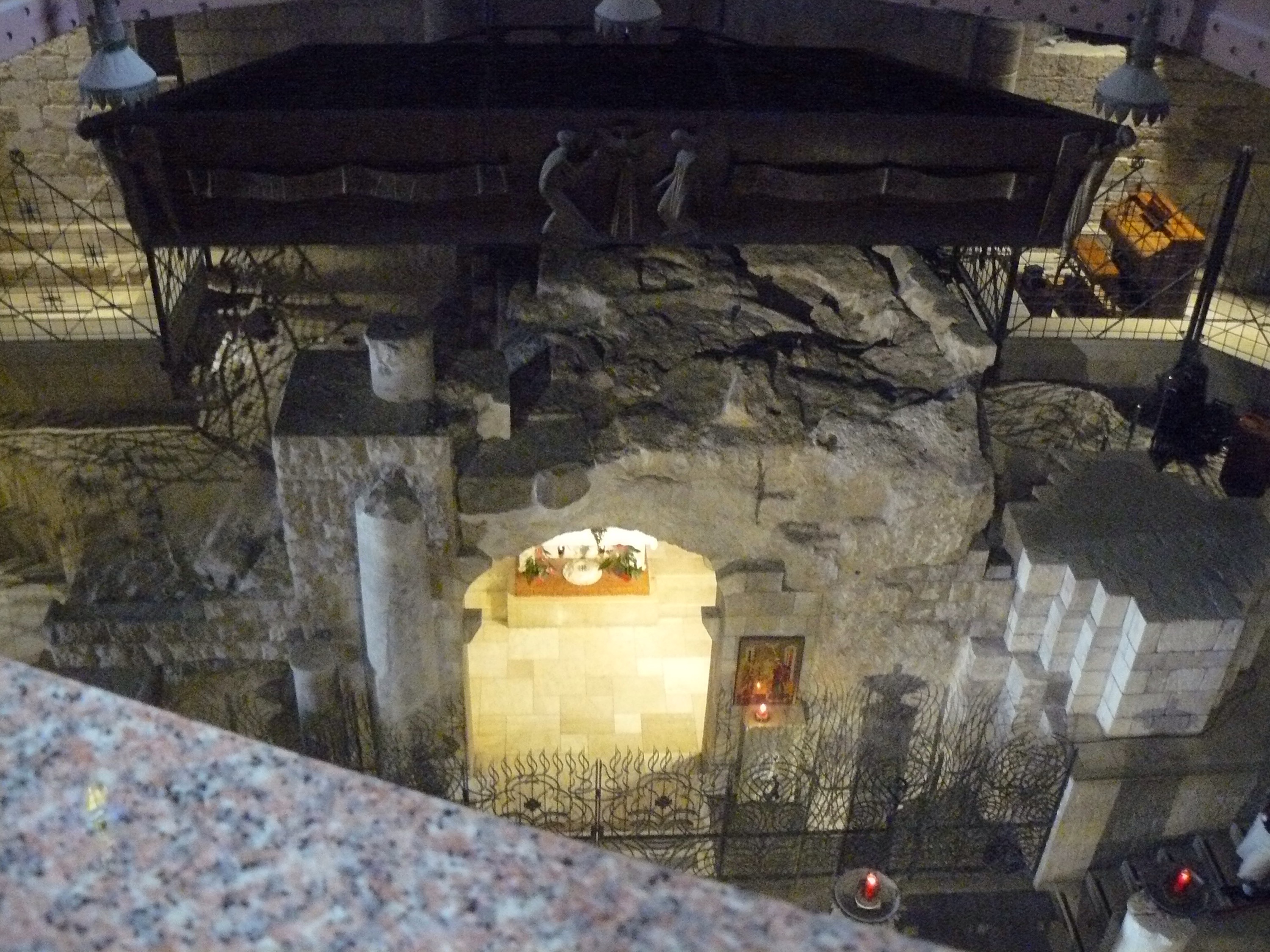
The city has been destroyed on many occasions since the first century and what we see now is a modern, Palestinian city. Many scholars believe that in the time of Jesus, Nazareth would have been a small Jewish settlement (possibly with strong ties to Jerusalem). All the evidence seems to suggest that at this time there might have been only fifteen families resident here – somewhere between 300-500 people. It is probable that they lived in one of the many limestone caves that now lie beneath the city. Some, like that beneath the Church of the Annunciation have been significantly altered as a result of devotional practices, others are more original. The caves are cool and make a great deal of sense for life during hot dry summers.


Limestone cave in Church of the Annunciation

 Understanding the geography and nature of first century Nazareth gives some cause for thought with regard to the way the Jesus’ story is presented in the gospels. For example, while there might have been sufficient men in Nazareth to form a gathering (synagogue), it is extreme unlikely that a structure that could be called a synagogue existed as LUke suggests. Likewise it is equally difficult to imagine the villagers trying to push Jesus off a cliff when the nearest “cliff” is some distance away.

Knowing the geography and learning about the history is wonderful, but we have to be careful, as our guide says that we do not “mortgage truth to history”. By this he means that we should not be so concerned with absolutely provable concrete facts that we lose the truth of two thousand years of faith. 

Will continue to be fascinated with the geography and history of this land, I will be keen to discover as much as I can of the historicity of our faith, but I will never lose sight of the deep insights that are to be found in our scriptures and of the eternal truths which they and our traditions contain.

Taking up our cross

September 15, 2012

Pentecost 16

Proverbs 1.20-33, Ps 19, James 2.18-26,Mark 8.27-38

Marian Free

In the name of God who created us, and who despite our failures and our disloyalty, loved us enough to die for us. Amen.

Last weekend Michael and I attended the great debate that was a part of the Brisbane Writer’s Festival. We went in part because Germaine Greer was one of the speakers and in part because of the topic: “Reading the Bible is good for you.” Sadly it was a little disappointing. First of all, two of the speakers for the affirmative claimed that the Bible was “silly” and no one for the affirmative had a very strong argument for reading the Bible. Secondly, when it came to what was to be a free for all, there was such a degree of self-consciousness among the speakers that instead of an “no holds barred” argument, it simply fell flat.

That said, the third speaker for the negative, Ben Law a local writer and comedian, was witty and insightful. He began by saying that he quite liked the Bible, but that it was a document that could not be read without assistance because it was open to misinterpretation and to abuse. He supported the views of the other speakers for the negative, the first of whom pointed out that the way in which many Americans read their Bible has led to the most punitive of legal systems. The other had reminded us that well-meaning, but often misguided missionaries in this country and elsewhere have destroyed local language, culture and self-respect to impose a Western faith and lifestyle.

We all know that the Bible is filled with wisdom, love and compassion, but we cannot deny that it also contains accounts of God-sanctioned genocide, that its heroes are flawed and include in their number adulterers and murderers, that in the Psalms there are threats to bash babies heads against rocks and that its God constantly threatens wholesale destruction both of God’s people and of their enemies. Using the Bible as their defense Christians have embarked on the crusades, justified the enslaving of members of other races and have even engaged in battles against each other.

At the same time, the Bible has inspired believers to great acts of courage and self-sacrifice. Christians have for millennia cared for the poorest of the poor, fought to ensure the end of slavery, were among the first to respond to the AIDS crisis and have laid down their lives for others. The Bible inspired Bonheoffer to take on Adolf Hitler and Gandhi and Martin Luther King to struggle for justice for their people.

The Bible is a complex collection of writings. Today’s readings are an example of just how difficult and confusing it can be to read the Bible and how easily it can be misunderstood. Let me illustrate:

From the Book of Proverbs we read that God will laugh at our calamity and mock when panic strikes us. The letter to James tells us that the early church was already debating what should be believed with regard to faith and works. Not only that, there is in James a reference to Isaac’s offering of his son Jacob as if willingness to sacrifice a child was a laudable thing to do. Fortunately the Psalm has a much more positive message, but read in a particular way it could be seen to argue that those who keep the law will be rewarded.

Having listened to this morning’s readings what message are you going to take home? If you were asked this afternoon, what would you say about the Bible based on the passages from Proverbs or James? Would you be advising someone to read them without an interpretive aid?

Even today’s Gospel is not without some difficulties. Jesus says: “If any want to become my followers, let them deny themselves and take up their cross and follow me. For those who want to save their life will lose it, and those who lose their life for my sake, and for the sake of the gospel, will save it.” Having announced his own impending death, Jesus urges his followers to understand that a life worth living is a life that is lived for God and for others rather than for oneself. He is trying to help them to understand that being outward looking rather than inward looking is not only a means to eternal life, but is also more rewarding in the present.

Jesus knew only too well that living for God is not necessarily safe or comfortable and that sometimes living for God and for others leads to being marginalised, excluded and even killed. However he encourages us to place our trust and our confidence in God because he knows that a life centred on God is infinitely richer than a life lived without God. That a life that is lived outwards has greater depth and provides more satisfaction than one that is wholly self-absorbed.

Sadly, in popular usage, this important aspect of Christian living has been tamed and domesticated. It has been transformed from something that is live giving, to something that is life denying, from a focus on God to a focus on oneself.  The phrase, “Taking up one’s cross” is used colloquially to imply that there is something praise-worthy in living stoically with pain, with difficult relationships or with disappointment. Used in this way, self- denial all too easily becomes self-absorption and dependence on God becomes dependence on oneself. Instead of taking up one’s cross of one’s own volition the cross becomes something that is imposed from outside, something to be endured, something to be borne. Used in this way, the cross is not the way to life but to a living death.

So, as the church recognised right up until the Reformation, reading the Bible is good for you, but only if it is read with understanding and care, keeping some basic precepts in mind.

When we read the Bible, we have to remember that even the Old Testament is God’s love letter to God’s people, that God, instead of wreaking destruction, constantly holds his hand, that God instead of condemning us for our betrayals, came to us, entered our world and died for us. We have to remember too that the Bible is not an instrument of power to be wielded over others to make them conform to our values and ideals nor is it to be used to enslave or subjugate others. When we read the Bible we have to remember that the Christ who died for us, demonstrated the love and compassion that lie at the heart of God.

Most importantly of all, when we read the Bible we have to read it through the lens of the cross, to remember, through the course of our lives, that it is in dying to ourselves and living to God that true wealth is to be found and that if we take up our cross we do so not to burden ourselves or to prove a point, but because we are confident that it leads to fullness of life both in the present and in the life to come.

How will they hear?

July 7, 2012

Pentecost 6

Mark 6:1-13

Marian Free

In the name of God whose word informs and enlightens our faith. Amen.


In his charge to Synod, the Archbishop spoke with passion about the Bible – the contradictions contained within it and the importance of studying it. (anglicanbrisbane.org.au) The reason that he spoke so strongly is that the Natural Church Development tool that is being used by many of the Parishes in the Diocese has revealed that one of the weaknesses in our Parish life is passionate spirituality – our reading and understanding of the Bible. We all know what we believe and some of us are able to articulate it to others, but when it comes to explaining the central texts of our faith we are on less certain ground.

There are at least two barriers to becoming more familiar with the Bible. One is that academic study of the Bible can be quite challenging, if not confronting. For many, it is a discipline that is demanding and difficult. A second barrier is that of time – in particular the lack of it. In past centuries, the services of Morning and Evening Prayer were designed to provide an opportunity for the Bible to be explained and expounded. Longer passages of the Bible were read during these services and it was expected that the sermon would be up to half an hour in length. In a less pressured world, in which there were fewer forms of entertainment, there was more leisure to spend time in church. Many people attended both Morning and Evening Prayer or Communion and Evening Prayer which provided a larger diet of Bible reading than is possible in the Eucharist alone. Longer readings and longer sermons on Sunday mornings might solve the problem, but would destroy the balance of Word and Sacrament which is central to the Eucharist and perhaps lead to fewer people attending church.

Not only do we have less time to spend expounding the Bible, it is also true that not all members of the clergy have had the confidence or courage to share the latest scholarship with their congregations. What this means is that few lay people have been given the opportunity to keep up with the research of the last 100 years and many are shocked and surprised when informed that scholars have made discoveries that change the way in which familiar stories have been previously taught and understood.

As you know, the Bible study group in this Parish has been studying the gospel of Luke using a commentary written by Brendan Byrne. Over the course of the study, I have become acutely aware of how complex much of Jesus’ teaching is and how difficult it is to understand unless one has the tools with which to interpret it. I think for example of the story of the dishonest steward who is praised by Jesus for acting in a way which will secure his future. At first glance it appears that Jesus is saying that God approves of dishonesty! Then there is the story of the widow who wears down the unjust judge through her persistence. Does this mean that God is like the unjust judge and will not act unless we wear him down with a constant repetition of our requests?

There is a lot more to the New Testament than the wonderful stories and adventures that we learn at Sunday School. Our understanding of our faith is enhanced and our appreciation of our texts is enriched if we take some time to grapple with and to try to understand what the more difficult passages really mean. For example, the story of the dishonest steward is, of course, not a story about God’s approving dishonesty but rather it is Jesus’ challenge to all of us that we make sure that we live our lives in such a way that we will be welcomed into heaven – that, like the dishonest steward, we make provision for our future salvation. The story of the widow and the judge is not about our wearing God down through endless prayer. Rather a reminder that God is not like the unjust judge and will hear our prayer. This means we should not allow ourselves to feel disheartened when times are difficult, but that we should remain confident that God will hear us. In both stories, Jesus is using unsavoury characters to shock us into paying attention to what he is saying.

During my week away I was able to read a book written by a friend of ours – Paula Gooder . In it she explores a wide variety of methods that are used by scholars to study the New Testament. What makes this book easy to read is that it is aimed at those who are new to biblical studies. Not only is each explanation brief but each is followed by an example of how the particular technique is used to interpret a passage of the bible. This means is that the reader not only learns all kinds of interesting things about the New Testament, but is also able to apply what they have learnt.

Today’s gospel consists of two discrete stories both of which contain puzzles for the modern reader. In the first section, Jesus is welcomed by the people of his hometown, but shortly afterwards they are scandalized by him. Why their change in attitude? Secondly, Jesus is identified as the son of Mary. This is quite unusual in first century Palestine – a person would usually be identified by their father’s name. The first puzzle is solved if we understand that the people attribute Jesus’ ability to work miracles not to God, but to some other – possibly demonic-force and so they treat him with suspicion. The second puzzle – that of his name may be a derogatory inference to the fact that his father is unknown. Put together these two explanations help us to make sense of why Jesus was rejected by his hometown.

The second story in today’s gospel relates the sending out of the twelve disciples. In itself, the account is reasonably straightforward unless we are familiar with the ways in which Matthew and Luke record the same account. Not only is Mark’s account briefer, but Matthew and Luke change at least three significant details. Whereas Mark’s Jesus sends the disciples two by two, Matthew and Luke send them out all together, Mark says the disciples may take a staff, Matthew and Luke expressly forbid the taking of a staff and finally, Matthew and Luke enlarge the disciple’s task by adding the healing of the sick to Jesus’ command to cast out unclean spirits. Among other things, these differences have led scholars to believe that Mark was written first and that Luke and Matthew used Mark to write their accounts but added to it details that were known to them.

Our scriptures provide us with an exciting and fascinating glimpse into the life and teaching of our Saviour, they give us insights as to how we should live as followers of Christ and they open doors into the way that Jesus was seen and understood by his contemporaries and those who followed after. Passages that at first seem difficult to understand are often easily explained and others that seem harsh and uncompromising are sometimes a means to shock us into action.How will we know what they mean if we don’t make time to read and understand them? We live in a world that is increasingly divorced from the church and from the teachings of Jesus.

If we don’t know and tell our story who will?