Archive for the ‘Christmas’ Category

Christmas – Shepherds for a change

December 24, 2025

Christmas Eve – 2025

Luke 2:1-14

Marian Free

In the name of God who reveals Godself to the most unlikely, the most uneducated and most despised and who entrusts them with the message of salvation. Amen.

There are so many sub-plots to the Christmas narrative that it is impossible to do justice to all the different elements. 

So where does one start to explore the Christmas narrative –the announcement of Jesus’ birth to Mary or to Joseph, the journey to Bethlehem, the inn keeper who found room, the shepherds, the angels, the magi, the star? We could as some do, let our imaginations go wild and wonder about the reactions of the donkey who carried Mary or animals in the barn where he was born, or we could invent characters like the little drummer boy (What makes anyone think that a sleep deprived mother would be grateful when a young, uninvited guest strikes up a drumbeat in her crowded accommodation?)

This year, I found myself thinking about the shepherds, their place in the story and what they have to tell us.

It is easy to be sentimental about the shepherds, who in our nativity scenes are respectable, if poor men out in the fields protecting their sheep when suddenly they are surprised by not one but a whole host of angels; shepherds who leave everything to race to Bethlehem with white fluffy lambs in the crook of their arms and whose role is to bear witness to Jesus’ birth.

But when we ignore the picture-perfect Christmas cards and pay close attention, we discover that there is much more to the story of the shepherds. The shepherds, whom we are led to believe are and humble, decent men were, in reality, among the most despised people in Jesus’ day. In the ancient Middle East shepherds were usually itinerant workers, moving from place to place in search of work, and taking whatever work they could find. 

Shepherding was not a job of choice. A shepherd was always on the move looking for pasture and a shepherd had to be on guard day and night to protect the sheep from bears, lions, foxes and other threats which might just as well kill a shepherd as a sheep. Shepherds were living and sleeping in the outdoors without proper protection from the elements and were reputed to be thieves, suspected of stealing the sheep they were supposed to protect.  A few, if not all, would take comfort in the bottle to keep them warm at night. 

In short, if you were to draw up a list of people who were worthy to be the first to receive notice of Jesus’ birth, the shepherds would not even make the long list. And yet here they are so they must have something to teach us. When we look at the story with the shepherds in mind we notice a number of things.

First of all, after they overcome their terror, the shepherds believe and respond immediately. There is no hint that they think the angel’s story is too ridiculous to be true. The angel has said that the Saviour, the Christ has been born and so it must be. And, even though the only clue to the baby’s whereabouts is that, like every other baby in Bethlehem, the child will be wrapped in swaddling cloths in a manger, the shepherds leave everything, including their sheep and hurry to Bethlehem to see the child for themselves.

Second, even though the shepherds were usually shunned and ignored, they could not stop themselves from sharing the good news with everyone. This means that, the shepherds, the marginalised and despised, become the first evangelists – the first to share the good news.

Third, the shepherds were so overwhelmed with what they heard and saw that they couldn’t stop praising and glorifying God.

Fourth, the shepherds did not give a moment’s thought as to what might happen to the sheep when they abandoned them to go to Bethlehem – that is they did not look behind them but trusted the sheep to God.

Last, and this is probably Luke’s point, by sending angels to the shepherds, we are shown that God often chooses the least respected, the least equipped, and the least expected to be the first to hear the good news, and that God’s faith in the shepherds was proved right when the excitement and passion of the shepherds gave them credibility which ensured that their message was heard.

It is always tempting for us to believe that the task of evangelism belongs to those who are more articulate, more authoritative, and more attractive than we are. But if God can choose and use those disreputable scoundrels – the shepherds – God can and will choose and use us. And when God does reveal godself to us, the response of the shepherds can be a model for our own reaction. 

Luke tells us that the shepherds are open and receptive to the unexpected presence of the angels, they are not suspicious, butt respond immediately to the angel’s news with joy and enthusiasm, they trust God that what they leave behind will come to no harm, they find the experience of coming face-to-face with God’s messengers so overwhelming that they simply cannot keep the news to themselves and they respond to all that has happened by praising God. 

For us tonight, the story of Christ’s birth lacks the novelty of that first Christmas, but that does not mean that we should not be open and receptive to the possibility of God’s revealing godself to us. When that happens and however that happens, will we be sufficiently open to the possibility that God that we will take heed and respond immediately? Is the good news that brings us here tonight so extraordinary that we. cannot keep it to ourselves? Can we trust God enough to leave the past behind and step into an uncertain future? Do we really believe that God can and will use us to share the story of God’s presence in the world – shepherds and kings, poor and rich, homeless and housed, ignorant and educated?

If we do surely that is certainly cause for praising and glorifying God.
Christmas – the powerlessness of God

December 24, 2024

Christmas Eve – 2024

Marian Free

In the name of God, who comes to us as a vulnerable baby insisting on our cooperation in the building of a just, compassionate and caring world. Amen.

I am conscious that many of us come to this Christmas burdened with the state of the world – the encroaching collapse of democracy,  the internal strife in more nations than I can name, the horrific wars in and between so many nations and the toll they are taking on human lives and on infrastructure, the increasing ferocity of natural disasters – bushfires, hurricanes, tornados, earthquakes and floods –  and of our feelings of helplessness as we  watch tragedies unfold all around us. 

How does the birth of a child speak into this situation? Collectively we seem to be worse off, not better off as a consequence. It is clear that 2025 years ago, God did not sweep in and end injustice, oppression and corruption for all time; just as God did not forever disarm the natural forces of this planet.

In Christ God did not burst on to the scene and make everything right – just the opposite. What God did in Christ was to expose God’s powerless. In Christ, God gives us a glimpse into who and what God is and into what God can and cannot do.

That said, the birth of Jesus is God’s masterstroke, because it is the baby that catches our attention. Few people are unmoved by the vulnerability and the innocence of a newborn.  Most of us are filled with the desire to protect, nurture and love an infant into maturity. More than that, at Christmas time, we are captivated by the humble domestic scene of an ordinary family, and we find ourselves in awe of the miraculous – the star, the angels and the magi. It is no wonder that at this moment that our love of God is at its strongest as we kneel in homage with the shepherds and the magi, and our hearts are warmed by the thought of God’s love for us.

This is as it should be, but the danger is, that this warm glow blinds us the real meaning of Jesus’ birth and that our faith and that our concept of God does not extend much beyond the comfort and hope expressed in many a nativity scene and that we do not grasp what this scene really tells us about God. 

The birth of this child is so much more than the fulfillment of a promise, and so much more than the assurance of God’s presence with us. This birth brings us face-to-face with a confronting truth. This infant is God. God the creator of the universe is here, lying on the straw, totally dependent on Mary and Joseph for his every need and completely defenceless against the wrath of Herod. The one to whom we look for intervention in the world, the one to whom we attribute all the power and might is at this moment in time utterly powerless.

Here perhaps is the nub of Christmas – that the very being to whom we entrust our lives, entrusts us with their life. This baby, the Christ-child tells us that the presence and power of God in the world is in our hands. God is in our hands – not in the sense that we can control, manipulate or coerce God, but in the sense that God is powerless because we have it within ourselves to thwart, obstruct and to sabotage God’s plans for the world and for humanity.

Christmas, the coming of God into the world in such an unexpected, humble and vulnerable manner, is a reminder that we are in partnership with God, that we are co-creators with God and that from the beginning God entrusted us with the world and with each other. That means that if the world is not as we would wish it to be – it is on us, not God. When we wring our hands and bemoan the state of the world and when we wonder why God is not doing more to intervene, we overlook our complicity in the problems of the world and our failure to cooperate with the one who created us. We forget the helplessness revealed in the infant Jesus.

You see, God did not create humankind so that God could spend eternity cleaning up the mess that we make as a consequence of our selfishness, greed, and grasping for power. God created humanity in the hope that we would work together with God to build a just, compassionate and equitable world. God gave us the power to change the world for good or ill and more often than we have let down our side of the equation.

At Christmas, God once more brings us face-to-face with reality, with the gap between the hope offered by the Christ-child and the despair that still afflicts the lives of many, the gap between the innocence of the babe and the corruption that continues to exist in many parts of the world, and the gap between the potential of the Prince of Peace and the conflicts that rage in more places than we can name. 

The infant in the manger has no power to throw down world leaders, to destroy the arms of war, or to end the need for security and comfort that builds barriers between ourselves and others. Yet, what power this child has – the power to enter our hearts, the power to draw from us love and awe, the power to inspire us to work for peace and justice, and the power to remind us of the power that we have been given to work with and for God for the good of all.  

The life of this child is in our hands. The future of the world is in our power. How will we respond?

What will we do with the precious gift that God has given us?

God Incarnate

December 23, 2022

Christmas – 2022
Marian Free

In the name of God who comes among us silently, unobtrusively and unremarkably. Amen.

A73B3131-3B24-4954-8E33-6588DF7BB8A0

In the beginning was the Word, and the Word was with God, and the Word was God. . . . All things came to be through him, and without him nothing came to be. —John 1:1, 3

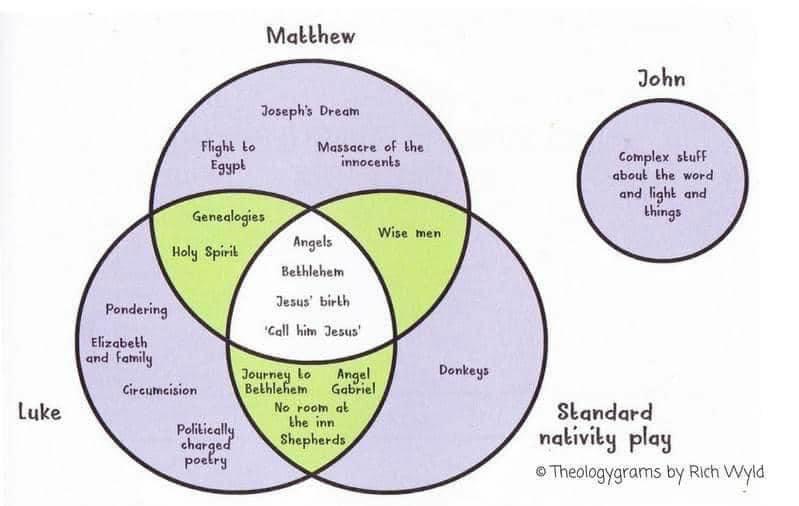
During the week our Bishop posted the above photo in Facebook. It is a light-hearted attempt to compare the accounts of Jesus’ birth in the four gospels. At the same time, it reminds us that when it comes to Christmas, we conflate two versions of the story – our nativity scenes. have the shepherds and the magi even though the shepherds are found only in Luke and the magi only in Matthew. (Mark is missing, because in Mark’s gospel, Jesus bursts on to the scene fully grown.) When the post appeared, discerning viewers noticed at once that Mary was not included in the diagramme. You might like to compare the first few chapters of Luke and Matthew and see if anything else needs to be added. The four gospels begin quite differently and as might be expected, the beginnings reflect the interests of the authors. Matthew is concerned to stress the Jewishness of Jesus and the way in which his early years demonstrate the fulfillment of Old Testament promises. (“This was to fulfill what was spoken by the prophets” occurs 5 times in the birth narrative.) What is more Matthew’s genealogy goes back to Abraham – the founder of the Jewish faith. Luke, on the other hand is more concerned with the universal implications of Jesus’ birth and with the historical context in which the story takes place. Luke includes the census and mentions Herod. His genealogy goes all the way back to Adam – indicating that Jesus is for everyone, not just for a few. Mark, as I said is not concerned with Jesus’ origins and John’s poetic start gives us – not a birth, but a cosmic beginning. From John’s point of view Jesus always was.

Does it matter that we do not have a consistent account to explain Jesus’ presence among us? Do we need to explain the differences? Of course not. Each story tells us something different, helps to satisfy our curiosity about Jesus’ beginnings and enriches our understanding of something that is essentially beyond our understanding. Indeed, Richard Rohr would argue that Jesus’ birth is only one expression of God’s incarnation among us – the account/s of Jesus’ birth are only one expression of God’s presence among us. That is to say, prior to Jesus’ birth, God was not absent in creation, invisible to God’s people or inactive in relation to the world. From the moment God said: “Let there be light” God has been dynamically engaged with creation and constantly in relationship with God’s people.

As Rohr says, we will never know the how, why or when of creation, but most traditions suggest that everything that it is the creation of some “Primal Source, which originally existed only as Spirit.” He goes on to say that “This Infinite Primal Source somehow poured itself into finite, visible forms, creating everything from rocks to water, plants, organisms, animals, and human beings. This self-disclosure of whomever you call God into physical creation was the first Incarnation (the general term for any enfleshment of spirit), long before the personal, second Incarnation that Christians believe happened with Jesus.”

What this means is that from the beginning of creation God has existed/been incarnate within all creation – animate and inanimate. When God ‘became flesh’ in the person of Jesus, God became incarnate in a very particular way – uniting Godself to us. At that point in time, God the creator, with the Logos/Word, fully identified with humankind, proving once and for all, that humanity is created in the image of God and that God is incarnate in and with us – not simply in creation or in some indistinct, immaterial form out of sight and out of reach. God, through God’s incarnation in Jesus that God chooses not only to be incarnate in the beauty of a sunset, the perfection of a flower, the majesty of a mountain, but in the frailty of human flesh, the imperfection of human behaviour, and the weakness of human will. Thanks to God’s coming in flesh – in Jesus – we can see God in one another and in ourselves and, in Jesus, we can see too what it is that we can be.

So, this year, let us not look back with longing to the infant in the stable or forward with anticipation to the coming of the Son of Man, but let us simply look – around and within – so that we might perceive God’s incarnation in its many and myriad forms – in the world and in ourselves. Let us celebrate God, with us throughout all time.

The Feast of Stephen

December 25, 2021

Christmas 1 – 2021
Marian Free

In the name of God who gave everything for us. Amen.

“Good King Wenceslas looked out
on the Feast of Stephen
when the snow lay round about,
deep and crips and even
brightly shone the moon that night
though the frost was cruel
when a poor man came in sight,
gathering winter fuuu-u-u-el.”

I wonder how many of us have sung this popular carol without giving much thought to King Wenceslas or to the feast of Stephen. Apart from the snow (which even in the southern hemisphere signifies Christmas) there is nothing remotely Christmasy about the words of the song. So why is it associated with Christmas and why does it reference the Feast of Stephen? The answer is simple – today (the day following Christmas Day) – is the Feast of Stephen. We often overlook this as we mark Boxing Day or, as is the case this year, we celebrate the first Sunday after Christmas.

Today’s preacher then has a wealth of themes on which to focus – the secular celebration of Boxing Day, the first Sunday of Christmas or the Feast of St Stephen. (One could even stretch to focusing on Wenceslas who was a Duke and not a King and who lived in Bohemia from 907-935. The Duke was known for his piety and his support of the poor and as a consequence was made a saint.)

Because the first Sunday of Christmas follows immediately after Christmas Day it seems too much of a jump to focus on the readings for that day which take us forward 12 years to the account of Jesus -on the verge of adulthood – frightening his parents by staying behind in Jerusalem. So let us instead consider Stephen, the first person to be martyred on account of the emerging faith in the crucified Jesus.

What we know about Stephen comes from the Book of Acts in which Luke provides us with a stylised view of the emerging church. From Acts 1:8 we can see that Luke structures his account in concentric circles. He imagines the gospel spreading from Jerusalem, to Judea, to Samaria to the ends of the earth. The movement is not only geographic, but ethnic – from the centre of Judaism, to the Jews, to the Samaritans (who have something in common with the Jews) and finally to the Gentiles. According to Luke’s telling of the story it is Stephen’s martyrdom that sets this movement in train and which presages the spread of the faith beyond Jerusalem to ‘the ends of the earth.’

Stephen’s story begins in Acts 6 and concludes at the end of Acts 7. According to Luke, the earliest community of believers was led by the Twelve. It becomes clear that they cannot do everything and that the widows of Hellenist (Greek or gentile) believers were being neglected in the daily distribution of food. The Twelve make the decision that they should not be distracted from preaching by waiting on tables and they direct the Hellenists to choose seven men of ‘good standing full of the Spirit and wisdom’ to fulfill this task. Seven were chosen and were formally ‘ordained’ by the laying on of hands and with prayer. Among the seven was Stephen.

As I said, Luke. Uses the appointment of another tier of leadership (the beginnings of the diaconate) to introduce a new period of growth in the church – many come to ‘the obedience of faith’, even priests. Unfortunately, as is often the case, with success came conflict. Members of the synagogue of Freedmen (who themselves appear to have been Hellenists) argued with Stephen and, being unable to compete with Stephen’s wisdom and spirituality, they stirred up others against him and brought false charges of blasphemy against him.

Stephen is brought before the high priest and in response to the accusations gives a long speech (a typical Lucan device) in which he recites the history of the Jews from Abraham to Jesus, recounting the ‘typical’ rejection of the prophets by the people of God. This, as you might imagine, only further enraged his opponents. When Stephen concluded his speech by saying that he saw the heavens opened and Jesus standing at the right hand of God Stephan’s opponents had had enough. They dragged him out of the city and stoned him. Hence Stephen became the first person to be martyred for his faith, to sacrifice his life for Jesus.

In a recent podcast Alexander John Shaia suggests that it is possible to link Boxing Day and the Feast of St Stephen to each other. I share it with you, not because I am convinced, but because it is a novel idea worth pondering. In the northern hemisphere Christmas falls near the winter solstice. It is the depths of winter a time when earth was often covered with snow. Snow or not, it is impossible to grow crops and for the poor there was nowhere to forage for food. On the day after the winter solstice, the Celts had a tradition of teaching boys on the verge of adulthood something about the value of sacrifice – giving of themselves that others might live.

The ritual (which seems barbaric to us) involved killing a wren and letting its blood run into the earth in order that the earth might regenerate after the long hard winter. Shaia argues that the early Celtic Christians saw in this tradition a resonance with their newfound faith. Stephen the first Christian martyr had given his life for the life of others. As was the case with many Celtic traditions, they kept the day but gave it a new meaning. They no longer sacrificed a wren, but adopted the spiritual practice for men and boys to gather and give food and money and clothing to poor and shut ins.

Here Shaia brings us back to the carol which ends:
“In his master’s step he trod,
where the snow lay dented.
heat was in the very sod
which the saint had printed.
therefore, Christian men, be sure,
wealth or rank possessing,
ye who now will bless the poor
shall yourselves find blessing”

Having asked his page who the poor man is and where he lives, the king and page set out in the bitter weather with food and wine and fuel to ease the suffering of the poor man. When the page’s strength fails, the king urges boldness to combat the cold and the carol ends – as we see with a blessing for those who are generous.

Whether we link gift giving and generosity to the wise ones or the tradition of Stephen, it is important that in the midst of our own celebrations, our self-indulgence and our (often) over eating, that we remember those for whom every day is a struggle – the refugee, the poor, the hungry, the lonely, those suffering from the effects of war, civil strife or natural disaster and that we give – not what we can spare – but generously and openly so that our small sacrifice might make the world a better place and ourselves better for the gift.

Just how much does God love us?

December 24, 2021

Christmas – 2021
Marian Free

In the name of God who became human so that we might become divine. Amen.

Sometimes a person will say or do something that changes the way you think or act.

Such was the case for me when I was at Theological College. The scenario was a community meeting at which we were discussing our differences and how we could manage to make the student community a place in which everyone could feel comfortable no matter what their background or church tradition. On this occasion a primary issue was the matter of the daily Eucharist and whether attendance was absolutely necessary for those among us whose tradition made this more of a burden than a joy. Sadly, I no longer remember the name of the student who raised the issue. He explained that for him the Incarnation, not the crucifixion/resurrection was central to his faith and that the Eucharist’s emphasis on the latter did not hold as much meaning for him as did the daily office. God’s becoming one of us was, he felt, more significant than God dying for us.

The event is so long ago that I would not be able to say why an emphasis on the Incarnation was such a revelation. I imagine that until that time I simply had not paid much attention to the significance of Jesus’ birth. If I were to hazard a guess I think that I might have thought that Jesus’ birth was simply a means for Jesus to enter the world – so that he could die and rise again.

Since then I have pondered long and hard on the Incarnation and am filled with wonder and awe that God should enter our human existence. Yes, Jesus was crucified and yes he was raised, but the Incarnation – God with us – is a powerful statement of God’s love for us and of God’s identification with our hopes and joys, our disappointments and our sorrows. If we stress the crucifixion to the detriment of the Incarnation, we lose sight of the fact that in the Incarnation, God is demonstrating the depth of God’s love for us. In becoming one of us, God becomes one with us. In entering our existence God shows that so far from being unworthy, we – with our physical and other limitations -were considered a suitable vessel for God to inhabit.

If, as we believe, Jesus is God then we can be certain that God knows what it is to be human. God, in Jesus, has experienced the full gamut of human emotions. God in Jesus has been idolized and abandoned, has been surrounded by friends and deserted by the same, has known joy and sorrow.

God’s entering the world completely changes the dynamic of our relationship with God (and, with ourselves). For if God did not despise the human form or reject the constraints of being human, then we can be kinder to and gentler with ourselves. If God knows what it is to face the difficulties that we face, then we need never feel alone knowing that God has felt the same.

The conversation at our community meeting came back to me this week when I learned that for the first thirteen centuries of church history the focus was on Easter. It was only when Francis of Assisi entered the scene that Christmas began to hold the significance for the church that it does today. Francis felt that God’s love for us was not limited to the crucifixion but was made clear when God entered the world in the form of the infant Jesus. It was love that propelled God to come to us. It was God’s love that insinuated itself among us. It was love that wanted us to know just how precious we are in God’s sight.

Enjoy Christmas and all the traditions that you observe as a family, but when you look at the tiny vulnerable child in the manger, be sure that you see God and be filled with wonder that God could love you – love me so much – that God would risk everything to share our lives.

A powerless God

December 26, 2020

Christmas 1 – 2020

Luke 2:22-40

Marian Free

In the name of our upside-down God who defies our expectations. Amen.

I can’t imagine that there is anyone for whom 2020 has turned out the way that they expected. Among our acquaintances there are at least six people who had made plans to celebrate their 60th birthdays in style only to have them overturned. One friend planned a cruise and had thought she’d be in Monte Carlo for her birthday. Instead, having spent two weeks off the coast of Perth on board the cruise liner, s celebrated turning 60 while in hotel quarantine. 

No one, even in their wildest dreams, could have imagined a year like this in which plans have been 

thwarted, career trajectories halted or even over-turned, and families separated for months at a time. Who could have envisaged silent airports, empty supermarket shelves, and more sanitiser than we’d ever have thought possible? Turning away families from aged care and hospitals would have been unthinkable a year ago and yet circumstances have dictated that in some places families have not been able to sit with the dying or to attend their funeral. In Queensland, we have been extraordinarily lucky and still our lives have been turned upside down by job losses, business closures and restrictions on who we can or cannot visit, where we can go and how we can worship.

For ten months we have lived in a topsy turvy world in which our expectations have been proven to be unrealistic and in which planning has been impossible. We have found ourselves to be at the mercy of a virus over which we have had no control.

Not having control might be a novel experience for us, but for many it is a state of life – for those living in war zones, for refugees, those living below the poverty line and those who livelihoods are at the mercy of the weather.

It is human to long for certainty, to hope that things will improve, to believe that there is a God who turn the situation around. 

This longing is a characteristic of the prophetic books of the Old Testament, many of which were written during Israel’s time in exile. The Israelites yearn to return to their own land, to the way that things used to be and to having control over their destiny. 

At the turn of the millennia, the time of Jesus, the Israelites are in the home country, but they have been under the dominion of foreign powers for centuries. Once again, they are vulnerable to the whims of another nation. They looked forward to a redeemer (the one promised by the prophets) to restore of the nation to its former glory – the Roman colonists defeated, Temple worship reestablished under the historic priesthood, the land fruitful and a descendant of David on the throne. 

How differently things turned out. God’s redeemer did come among them, but in such a way that he was largely unnoticed and was completely unrecognisable. in fact, Jesus appearance was the reverse of everything that they had come to expect! There were no flashes of lightening, no violent upheavals of the heavens or of earth, no obvious trappings of authority  – just the whimper of a child in an insignificant town, a human infant, not an omnipotent being, a powerless son of a carpenter not a member of a ruling family

No matter how many times one reads Simeon’s speech and the account of Anna, the language jars. 

We would expect Simeon to say: “the rising and the fall” of many and to read that Anna prayed: “day and night” in the Temple. Those would be the usual figures of speech. What Simeon does say is “the fall and the raising” and Anna is said to pray “night and day”. This reversal of what we expect to hear turns out to be a sign what is to come. Jesus may be the “salvation prepared in sight of all peoples” and a “light to the Gentiles” but his life will play out in a very different way. He will be opposed instead of being welcomed. Instead of restoring the institutions of Israel, Jesus will be perceived to be undermining them. Rather than supporting and affirming those in positions of authority, Jesus will expose their hypocrisy and self-centredness and, as a consequence his life will be demanded of him. 

Despite the longings and hopes of the Israelites, Jesus will not be an interventionist Saviour. He will not lead armies or expel the Romans. He will not bring down the corrupt priests who rule the Temple and control the Sanhedrin nor will he denounce tax-collectors, prostitutes and other sinners. From the start he will be a disappointment and he will fall before there is any rising as Simeon predicts. There will be suffering not triumph. Jesus will serve not govern and those with most to lose will seek to destroy him.

“Fall and rising”, “night and day” – the unusual phraseology of this passage alerts us to the fact that this story is not going to go the way we expected. From the beginning to the end of Jesus’ life, our upside-down God confounds, confronts and challenges expectations. Jesus does not, in any way, conform to the image of one who was to redeem Israel. He has not come to judge – not even the Romans and the collaborators. He is anything but powerful and influential and he undermines rather than upholds the religious establishment.

God, in Jesus is utterly at the service of the poor and the marginalised. God in Jesus models how to bring about change and transformation in others. God in Jesus is vulnerable to the fears and desires of those who do not want anything to stand between them and their craving for status and power. 

In fact, Jesus’ life (and death) is a stark reminder that God is powerless against human greed, ambition and selfishness. 

If the world is to change, we have to change. We have to cede our need for control, our desire for power and our yearning for material things. We have to acknowledge our own complicity in and responsibility for the inequities and injustices of this world and with Jesus align ourselves to the powerless, the vulnerable and marginalised. We must fall before we rise, experience night before day and, in immersing ourselves in the suffering of the world find the power that leads to the transformation of the world.

Standing in solidarity

December 24, 2020

Christmas 

Children 

I wonder what you would do if you were God?

Some people would like to punish all the bad people in the world.

Some would like to stop the wars and cure all the disease.

We wonder why God doesn’t do these things.

God is full of surprises. God comes to earth as a tiny baby and lives alongside us.

God shares all our good times and all our bad times. God shows that God care for us and understands us.

God knows that this is how the world will change – not by waving a big stick and threatening to punish us, and not simply by making the bad things go away. God knows that if we change the world will change.

We will change the world if we learn from Jesus. If we learn to try to understand other people, if we are sad with them and happy with them. If we show other people that we care they will change and the world will change!

We need to let the baby Jesus be a part of our lives. Jesus will change us and we will then be able to change the world.

Christmas – 2020 Midnight

In the name of God who does not force us to conform to God’s will, but who enters our world in solidarity with us. Amen.

It might surprise you to know that I’m one of those people who thinks that they know how to solve the problems of the world – well now that I’m older I settle for slightly less ambitious goals. But I do still think I know better than some people. For example, there is a part of my brain that believes that Trump would not have won the election four years ago if only I had been able to share my brilliant insights with Clinton and her team. They would have stopped trying to confront irrational ideas and instead focused on the fears and anxieties that Trump was latching on to. Needless to say, I have no credentials to back up my ideas and no contacts in the US who could have passed them on! On a smaller and more local level, I feel that I have the solution for the new businesses in the street.  So, when I observe a new business owner sitting expectantly in an empty store or barber shop, I think to myself: if only they had had a grand opening and given everyone a free drink or if only they had offered the first ten customers a free haircut or shave. Of course, I’ve never run a business let alone started one from scratch, but believe you me, I think I know what would work. In fact, you wouldn’t believe how many amazing ideas I have to share with an unsuspecting world! 

I suspect that there are times for all of us when we imagine that we could do a better job – than government departments, than schoolteachers, than employers and corporations – maybe we even think we can do a better job than God.

We’ve all heard people say: “Why does God let that happen?” “Why does God allow corrupt governments to flourish?” “Why is there evil in the world?” A part of us expects an omnipotent God to break into the world brandishing a big stick and putting all to rights. When the world seems to be going awry, we long for an interventionist God who will impose God’s will and will bring an end to poverty, war and disease. 

But God does not conform to our expectations or behave as we might want. Instead of forcing God’s will on us, instead of dramatically and violently entering our world to punish the wicked and to put everything to rights, God surprises us by joining us in our struggles, by taking on human form and by showing us how it is really done, how change and transformation really happen – not by force, but through love, not by being over- bearing, or even by being right, but by being present with us and in us and living in solidarity with us through all our triumphs and all our failures.

We will not change others or the world through force, but we might just bring about change them by standing alongside others, coming to understand their struggles and their fears and by demonstrating compassion and understanding. 

It is only when we open ourselves, to the God who enters the world silently and unobtrusively, to the God who arrives among us in a cradle and who stands in solidarity with us, that our lives will be transformed and through us the whole world.

Jesus – truly one with us

December 29, 2018

Christmas 1 – 2018

Luke 2: 41-51

Marian Free

In the name of God whose human existence was real and gritty, not superficial and sanitized. Amen.

Prior to the 1960’s there were no such things as shopping malls in Queensland. All the department stores were in the central city so, when it came to Christmas shopping, it was to the city that my mother took us so that we could spend our pocket money on gifts for each other. On one such occasion – I think I was about five years old – I became separated from my mother. I have no recollection of being anxious or frightened. What I do remember, is that when my mother found me, I was safely ensconced on a trestle table that was being used by a group of women to sell Christmas craft. Then, as now, society in general took it upon itself to take responsibility for children in such situations. The primary goal being to care for the child and to reunite the child with his or her parents as expeditiously as possible..

There are societies, those of the New Guinea highlands and our own indigenous culture for example, in which children are the responsibility of all the members of the community. Mothers can let their children roam free confident that everyone will see it as their responsibility to keep the children safe. The sort of ownership and personal responsibility that we feel for our children would be unknown. I’ve been told of an Australian family who, having come to Townsville from Darwin for a funeral, arrived home without one of their children. Instead of being mortified that a child had been left behind, or angry that the child had stayed behind, this family was utterly confident that the child was safe, would be well-looked after and would rejoin them at the next opportunity. (Thankfully, The Department of Children’s Services understood that this was a cultural practice and took no action against the family whose child was reunited with them as soon as it was feasible.)

It is against this sort of background that we have to read the account of Jesus in the Temple. Mary and Joseph were not careless parents who had failed to check on their child’s whereabouts when they left Jerusalem. No doubt they had travelled from Nazareth with a group of friends and relations to attend the feast. When it was time to return home, they would have simply trusted Jesus to have joined the group when everyone was ready to leave – after all he was nearly a man. They would have assumed that he was with cousins or friends whose parents would have treated him as one of their own. In this context there was no need for them to look for their son until the evening when, presumably, he would have joined his immediate family for dinner. Only then did they begin to worry.

Luke, at least in the beginning of the Jesus’ story, does not allow us to forget that this is an account of a real human situation. Jesus belongs to a real family that has the same hopes and dreams, the same flaws, the same irritations and the same anxieties. It is intriguing that across the four gospels we have only one story of Jesus’ childhood and it is the story of a rebellious teenager, or at the very least, of a young man testing his limits – letting his parents know that he is now an adult who can make his own decisions and that he has a vocation to fulfill in which they have no part. His stinging response to Mary’s anxious reproach is to wonder why his parents did not expect him to be in h

‘his Father’s house’. It is the sort of exchange that might occur in any modern household with teenage children.

Later accounts of Jesus’ birth like the Infancy Gospel of Thomas could not cope with such a messy, earthy, ordinary human start to Jesus’ life. For example, in some accounts, just prior to Jesus’ birth, time stands still, midwives appear apparently out of nowhere, the cave is unnaturally lit – by both the child and by Mary’s face. Mary experiences no birth pangs and the child is born completely clean. The birth does not affect Mary’s virginity and the hand of the skeptical midwife withers. In the History of Joseph the Carpenter, the family are taken into the home of a brigand. There, Jesus is bathed and his bath water bubbles up into a foam. The brigand’s wife keeps the foam and uses it to heal the sick and the dying. As a result the family become rich. In these later accounts not only is Jesus’ birth attended with miracles, the escape to Egypt is facilitated by the miracle of a spider’s web and the young Jesus performs miracles and even strikes dead a child who offends him! These later writers could not bear to think that the child Jesus was any less powerful, capable or wise than the adult Jesus.

The absence of somewhere to stay, the insalubrious surroundings of a stable, the visit of the shepherds and the teenager stretching his wings in the Temple are all reminders that we should not isolate Jesus from his very human beginnings or elevate him to the position of a superhuman being. Luke’s Gospel could not spell it out more clearly – Jesus is fully human, fully immersed in the messiness of human existence, susceptible to the same desires as any other human being and subject to some of the same fears. Luke brings Jesus down to earth, reminds us that in Jesus God fully immersed godself in the mundaneness of human existence and that despite being God, Jesus was not insulated from the reality of being one of us.

Jesus/God knows what it is to be one of us and shows us that it is possible for us, mere human beings, to become as he is. We just have to believe that this frail human body with all it’s complexities and this weak, indecisive mind is capable of great and extraordinary things. One of the messages of Christmas is that Jesus became one of us so that we could become one with him. Let us celebrate our human existence and try to live it to it’s full, divine potential.

Sleeping through Christmas

December 24, 2018

Christmas-2018

Luke 2:1-20

Marian Free

May the child in the manger open our eyes to see God’s presence in unexpected places and in unlikely people. Amen

Our Christmas cards and our imaginations give us a romanticized view of shepherds in first century Palestine. This view is enhanced by images of God as shepherd, and of David as the shepherd king. The reality was in fact quite different. In the time of Jesus shepherds were social outcasts, classed together with ass drivers, tanners, sailors, butchers and camel drivers. Theirs was an occupation for which there was no respect. They had no land of their own and their work kept them away from home at night which meant that they were unable to protect the honour of their wives and daughters (if indeed they could afford to have a family). What is more, because they grazed their flocks on land that did not belong to them they were considered to be thieves. In fact many of them were thieves. They were at the very bottom of the social hierarchy – dishonored and despised – certainly not the sort of people you would welcome into your home or seek to associate with. Yet it was to the shepherds that God revealed the birth of Jesus, it was the shepherds who were the first to respond and to see Jesus and it was the shepherds who were the first to spread the good news of Jesus’ birth.

Extraordinary as all that is, it is consistent with Luke’s view of the world that God would chose a woman of no social status or wealth to bear God’s son, that the son of God would be born in a stable and that God would reveal Godself to a disreputable group of shepherds with no social standing whatsoever. What is even more extraordinary and inexplicable is that, despite the cacophony of a multitude, an army of the heavenly host and the glory of the Lord that attended them, no one else saw or heard anything.

The townsfolk of Bethlehem might be excused for not noticing Jesus’ slipping into their midst, but how could they have been blind and deaf to a sky illuminated by the heavenly host singing praises to God? It almost defies belief. In this instance, God’s presence is not subtle or discrete, but bland at and obvious. Even so the presence of God goes unnoticed by all except a bunch of disreputable shepherds, who not only notice but who act on what they have seen and heard. What is more, having seen for themselves that the what the angel had told them was true, they spread the word and caused amazement to all who heard them.

Christmas is layered with sentimentality – the hay in the stable is clean, the shepherds are respectable, Jesus is worshipped. Beneath the sentiment however, we find rejection, apathy, blindness and even outright hostility (if we add Matthew’s version of events).

Only the angels greet Jesus with the appropriate fanfare and even then no one notices. The great irony of the gospel is that God is fully present among humankind and only a few people (and then not the ‘religious people’) even recognize that God is there.

It is easy for us to fall asleep, to allow ourselves to be complacent– satisfied with our relationship with God, confident that we know right from wrong and certain that we would know Jesus when he returns. The problem is this – if we fail to pay attention, if we stop noticing what is going on around us, if we begin to take God and God’s presence for granted we will find that we, like our first century brothers and sisters are blind and deaf to what is really happening around us. We will miss God’s presence in the unusual, the underestimated and even in the disreputable. We will fail to see God in the manger and God in the cross,

Let us not be like those who, not only through Jesus’ birth, but who failed to be stirred to wakefulness by a whole choir of angels.

Longing to love

December 24, 2016

Midnight Mass – 2016

Marian Free

 In the name of God who longs to be in relationship with us and who willingly forsake power, glory and dominion to try to make that clear. Amen.

During the week I happened upon a movie titled: “Anywhere but here.” It tells the story of how two grown sons cope with the fact that their father is dying. The sons have been brought up in the Jewish faith, but have not been able to embrace its practices and beliefs. One son, Aidan, still has a connection with the synagogue because his father will pay his grandchildren’s school fees if they attend a Jewish school. As with many families there are unresolved issues and tensions that make the grieving process more complicated. At one point Aidan is compelled to go the synagogue and speak to a Rabbi. Aidan is confused because events in his life are leading him to the conclusion that God is trying to tell him something, but he doesn’t believe in God. Thankfully, the young Rabbi is wise. He asks Aidan if he ever feels “a spiritual presence”. Aidan replies that when he is showing his children the stars and trying to explain that the universe goes on forever and ever, that yes, he does get a sense of the spiritual.

The Rabbi responds: “Then think of that spirit leading and guiding you.” The Rabbi knows that Aidan has rejected the traditional ways of thinking about God and he is wise enough not to impose those ideas on him. Instead he asks Aidan to name how he knows and experiences God and runs with that.

Rejecting the God of one’s youth and yet having a yearning to connect with something deeper than the material is not unique to a person who has grown up in the Jewish faith. One of the problems that the church faces today is that there are many people who have walked away from the faith and yet have a sense of something other. There are many long to make contact with their spirituality but their search is blocked by language, dogma or ideas that offend or that no longer work or make sense to them.

If truth be told most of the ideas of God that people reject are ideas that we too reject, but it is possible for some to hear only one thing and a selective reading of the bible (by a preacher or by the reader) can give the impression of an angry, demanding, interventionist God, a selective God who expects conformity at least and obedience at best. It is relatively easy for to abandon this false idea of God, especially if that idea of God has been used to manipulate and control or to appear be remote from human affairs and indifferent to suffering and pain.

Christmas exposes that God for who and what it is – a false God based on a misunderstanding of both the Old Testament and the New.

At Christmas we are confronted, year after year with the God who is not strong or powerful, but who enters the world as a baby – vulnerable, helpless and utterly dependent. When God could not get through to us, when we had turned away from God or turned God into something that God is not, when we lost sight that God’s primary desire is to be in relationship with us, God in Christ came to us. God came among us not with lighting and thunder, waving a sword to condemn and destroy, but as a new-born child a child whom God hoped would demonstrate once and for all God’s love for all humankind – the good, the bad, the engaged and the indifferent, the kind and the unkind. That first Christmas God became powerless and impotent so that we would at last understand the depth and passion of God’s love and that we would see for ourselves God’s complete and total engagement with humanity and God’s participation in both our sorrows and our joys.

This is why we are here this and every Christmas. Our presence is not simply a result of habit or sentimentality. We are here, because we know that the child in the manger is God, that God chooses not to be remote, but to be an integral part of all that this life has to offer. The child in the manger and the man on the cross expose God for who and what God really is – an expression of the deepest love, the utmost compassion and the greatest longing to be in relationship, to be one with all creation.