Archive for the ‘Christmas’ Category

God and slugs

December 24, 2015

Christmas 2015

Some thoughts

Marian Free

 In the name of God who could chose to be anything and yet chose to become one of, one with us. Amen.

 From time to time, I dip into a collection of daily readings that uses the writings of C.S. Lewis[1]. Recently, in the readings for December, I came across this statement: “The Eternal being, who knows everything and who created the whole universe, became not only a man but (before that) a baby, and before that a foetus inside a woman’s body. If you want to get the hang of it, think how you would like to become a slug or a crab[2].” I have to admit, that as much as I have pondered the nature of the Incarnation, I had never grasped the enormity of God’s decision as clearly. Lewis’s comparison really puts the concept of the Incarnation into perspective. In fact, as I absorbed the new point of view, it occurred to me that the difference between divinity and humanity is so vast that even Lewis’s distinction may not be sufficient to capture the chasm that exists. In fact it is almost certainly impossible to come up with an image that does the notion justice, but it might be more useful to consider our becoming an amoeba, a mould or some other microscopic life form.

It is beyond imagining that a human being would voluntarily trade their human form for something so base and so insignificant as a single-celled organism. Is there any circumstance under which a human being would make that choice? Is it conceivable that there would be a situation that would draw out the sort of love and compassion that would compel a person to make such a radical sacrifice?

I suspect that there is no way that any one of us would willingly choose to give up our independence, our rational thought, our self-determination. There is no imaginable state of affairs that would cause us to make a choice that would leave us completely at the mercy of the elements, adrift in the world with no power to change our position or to influence the direction that our lives might take. Human beings can and do make enormous sacrifices for others, but it is hard to imagine any human being giving up their humanness for any cause whatsoever.

Yet, God, the source of life and love, God who could and can do anything, who could choose to be anything at all and who could determine any number of ways to save the world, made the choice to fully and completely enter our existence. There were no half measures. God did not appear to become human. Jesus was not merely similar to us. God took on human flesh with all its frailty. God abandoned power and glory, imperishability and immortality to fully enter the human race. In so doing, God exposed Godself to all the indignities associated with being human. God sentenced Godself to all the restrictions, all the limitations of the human form – the spewing, mewling, incontinent state of infancy and old age, the vulnerability to disease and accident, the risk of being emotionally abused or abandoned.

We cannot come close to envisaging the cost of God’s abandoning the glories of Paradise for the uncomfortable realities of life on this planet. We cannot take lightly God’s love, commitment and compassion for the human race.

This is what the Incarnation, what Christmas is all about. God’s desire that we should be saved that is so powerful and so overwhelming, that what to us is an unimaginable decision becomes a realistic solution. God could see no other way to demonstrate God’s love and to bring us to our senses than to share our existence and to show us our real potential. I have no desire to become an amoeba or even a slug, but I will for this life and the next be overawed and filled with gratitude that God should love so much that God would become one of us.


Christmas 2015

Family service

If you could be anything at all when you grow up, what would it be?

(Take responses and comment – something like there are some pretty ambitious and amazing goals there. I hope that you work hard enough to make them a reality. If there are no outrageous comments, mention some that came up at our grandson’s Kindy graduation – princess, batman, Prime Minister)

God can do or be anything that God wants, and what did God decide to be? (Wait for answers or simply provide the answer.) Yes, God decided to be a baby. God could be anything at all, and yet God became a baby – a baby that cries, that needs its nappy changed, that throws up after it is fed. Yuk! Why would God want to become a baby? Why? Because God loves us so much, that God will do anything to get our attention. Why? Because God knew that we wouldn’t really trust God unless God became like us and that if God was to become like us, then God had to be just like us – starting as a baby. Why? Because God knows that everyone loves a baby and God hoped that if we loved the baby, we might learn to love God.

So Christmas is all about the baby, and the baby is all about love – God’s love for us that is bigger than anything we can begin to imagine.

God loves us, and hopes that we will learn to love God.


[1] In C.S. Lewis. The Business of Heaven. Ed Walter Hooper. Great Britain: Fount Paperbacks, 1984.

[2] op cit 300.
The teenage years – the adolescent Jesus

December 29, 2012

Christmas 1

Luke 2:41-52

Marian Free


In the name of God, who nurtures and encourages us, and who sets us free to make our own way in the world. Amen.

We all know that a parent bird literally forces a fledgling out of the nest so that it learns how to fly. If it is not pushed, it may never stretch its wings and become independent. It will be unable to survive unless the parent birds plan to lay no more eggs and feed the baby bird forever.

One of the things that I learnt as a parent was this – that good parenting, or at least reasonably good parenting, involves the costly task of letting go. That is, if we do the task of parenting well, what we are doing is preparing our children not to be parented. We engage in the task of ensuring that our children do not need us. The role into which we put so much energy and love is one that if done well inevitably leads to hurt, loss and separation. Our task, difficult as it may seem, is to prepare our children for independence – to love them so much that instead of holding on to them we set them free.

There are at least four stages of separation before our children actually leave the nest.

Each of these stages can create pain, stress and disharmony within the family as the relationships between parent and child are forced to change and adapt to the shifting situations. At least in recent history, it appears that unlike birds, we do not have an in-built trait which is automatically triggered when our children reach a particular stage of development. Our instinct is often to maintain control rather than to let go. Wehave to struggle with the process of our offspring’s growing maturity. Most of us find it difficult to be totally gracious about our children’s growing independence – or at least about the unsettling way in which their quest to separate themselves disrupts what has been a comfortable family life.

All separation is painful. Not only is the process of birth agonizing in a physical sense, but a mother also has to accept that the child, which was an integral part of her, can now exist – at least breathe and eat – independently. She is still needed, but she has to adapt to being needed in a different way. After two years, a child begins to exert pressure to be further identified as an independent individual. The so-called “terrible twos” are simply part of the process as a child makes the journey from dependence to independence. For many families this is a difficult time as parents try to find the balance between giving the child an opportunity to express themselves and at the same time creating boundaries so that the child learns the limits and gains a sense of security.

If this stage is negotiated successfully there may be a time of relative tranquility until the child reaches adolescence. Then, once again, the child will test the limits, make demands for independence and disrupt the pattern of relationships which have been developed and which have allowed the family unit to operate smoothly. Unlike the terrible twos, this is a stage which may extend over a number of years and which may force the final stage to come sooner rather than later. Teenagers often have no understanding of and certainly no sympathy for their parent’s concerns. They know that they will be safe at their friend’s party. They are sure that no harm will come to them if they go out with their friends and so on. On the other hand, parents often do not readily accept that their child is responsible or that their child is capable of making sensible decisions and looking after themselves. Parents know what can happen and take some time to accept that their child is ready for the world.

Finally, the young person is ready to step out on their own, to make their way. Tears at weddings reflect pride, but also a recognition that the person into whom so much was poured can now go it alone. All the love, all the nurture that the parent has provided have led to their child going off on their own.

Today’s gospel has many parts, of which one is Jesus’ adolescence. In this episode the twelve year old Jesus is demonstrating his growing awareness of who he is, he is asserting his independence, separating from his birth family and shifting his allegiance to another cause. In other words he is being a typical adolescent. Jesus has been brought by his parents to Jerusalem – as he has been for the past eleven years. As a twelve year old he has presumably been given some independence which he uses to make up his own mind that he does not need to leave at the same time as the rest of the family. His parents, who have trusted him to be responsible are, not surprisingly, filled with anxiety when they realize he is not with the return party and they begin an anxious search for him.

When they finally discover him, Jesus behaves like a normal adolescent. He cannot understand why they should have been so worried. He knew that he was perfectly safe and capable of looking after himself! Jesus’ response to his mother’s question is one of surprise: “Why were you looking for me?” He dismisses his parent’s anxiety, and as other adolescents have done since, accuses them of ignorance: “Didn’t you know?” This is a typical twelve year old who believes that he is all grown up and who thinks that his parents (who are stupid) should have caught up with that fact.

It is very easy to read the story of Jesus in the Temple in a pious way, but it is just as valid to see this account as further evidence of Jesus’ humanity.

Certainly, the author of Luke uses the account to make a transition from the story of Jesus’ birth to the beginning of Jesus’ public ministry. He is also making the Temple a central character as he does at both the beginning and end of the Gospel, he is introducing the reader to Jesus’ superior wisdom, suggesting Jesus’ strong ties to God the Father, making links with the birth narrative (Mary treasured all these things in her heart) and with Simeon’s prediction (a sword will pierce your own heart). None of these must be allowed to paper over the picture of Jesus’ behaving as any other teenage boy asserting his independence, trying to break free of the parental shackles and seeking to be treated as an adult.

It is clear that “in the memory of the Lukan community, Jesus appeared not only as the son of the divine Father, but also in complete humanity, as a maturing boy[1].”

God as Jesus fully identified with our human situation in order that God might redeem our humanity and restore our divinity. In our own quest for divinity, we need not reject our humanity, but embrace it and, with God’s help make what we can of it.


[1] Bovon, Francois. (Trans Christine M. Thomas). Luke 1. Minneapolis: Fortress Press, 2002, 113.

The vulnerability of God

December 24, 2012

Christmas Eve 2012

Marian Free


In the name of God who gave up all power and authority to create and then to re-create us. Amen.

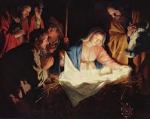
I often think that the infant in the cradle, “wrapped in cloths”, distracts us from the reality of the situation. We are drawn to the baby as we are drawn to all babies and our hearts are filled with love and a longing to wrap our arms around the child. In the depictions of the Nativity, we see a loving family, comfortably gathered and surrounded by the shepherds and wise men who come to worship.

What we don’t always see is the raw, naked vulnerability of the child – the child who is God and who at this point in time is completely powerless to control his destiny and who is utterly dependent on those around him – on Mary and Joseph, on Herod and the political circumstances of the  country which he finds himself.

Thinking of God as a defenceless child can be startling and a little confusing. It goes against our expectations and forces us to see God from an entirely different perspective. A vulnerable, powerless God does not conform to our concept of a God who is omnipotent and all-powerful, who directs and determines, who judges and condemns. To think of God as a helpless baby challenges everything we might have thought about God. And yet, from the inception of Christianity this is one of the images of God – a God without power, a God unable to intervene and God unable to force God’s will on anyone.

In fact, from the very beginning of the Judeo-Christian faith, the image of God is of a God who instead of keeping all authority to himself, chooses to give that power to humankind. In the Garden of Eden, God the creator gave humanity the freedom to choose. God who could have determined the future of humankind, ceded that power to human beings who used that power to choose to compete with, rather than serve God.

When it all went horribly wrong God chose, not to force humankind to change, but to trust humankind to change themselves. In order to do that, God put himself in our hands and risked everything in the hope that we would rise to the occasion, in the hope that our response to the infant Jesus and to the man, would serve to bring salvation to the world.

God still depends on us to get it right, trusts us to return the world to the idyllic state of the garden. God is still powerless unless we co-operate. The vulnerable God in the cradle depends on the people around him for his survival. The powerless God depends on us to change the world.

The powerlessness of God is demonstrated in the vulnerable and suffering of our own time. Until we accept the vulnerability of the baby, the helplessness of the child in the manger, we will not recognise our responsibility to be those who empower God’s saving work in the world. We will not change the situation of

–       the children of Syria and throughout the Middle East who are dependent on warring parties sitting down at the negotiating table and committing to a lasting peace.

–       the children of Niger, the Sudan and countless other nations who are dependent on our goodwill for food,

–       the millions of children who are victims of the AIDS epidemic who are dependent on education programmes and access to health care,

–       the children working in sweat factories and mines, who are forced into slavery and prostitution who are dependent on enough international advocacy will to set them free,

–       the children of Sandy Hook whose lives along with the 20,000 other young people killed by guns in the US are totally dependent on the will of a nation to give up a love affair with guns.

Until we are willing to change our lives, until we are willing to give us some of our comforts, until we are determined to engage our political leaders and to confront world leaders, until we in our turn become vulnerable and dependent on each other, God remains powerless to intervene in world affairs. Because God is dependent on us, God can only do what we are prepared to do in God’s name.

Next time you look in the manger, see beyond the comforting image of a well-fed, well clothed, well-loved baby and see in that child’s eyes, the eyes of God doing the only thing God knows how to do to change the world around – to give himself utterly and completely to us, hoping against hope that we will give ourselves to God and to each other.


Let us pray

Holy God,

give us grace and courage to acknowledge our contribution to the suffering in the world. Help us to become vulnerable as you became vulnerable that we may be part of the solution and not of the problem.

Powerless God,

make us aware of your presence in and around us. Help us to have the grace to open ourselves to you, that your presence may be made known through us.

Living God,

be with all who live life in the shadow of poverty and despair,

especially those in our own community whose needs often are overlooked

as we look further afield in our desire to ease the suffering of others.

Give hope to the lost and support to the powerless and make us sensitive and responsive to needs and concerns of those around us.


Healing God,

in Jesus, you shared the pain of the sick, you knew what it was to face death. Be with all who at this time are in need of comfort and healing. Encourage and strengthen those who are ill and recovering from surgery, support those who are dying and be with all whose task is to bring about healing.


Dying and rising God,

as you shared our existence, may we strive to share yours, that at our end we may             join you and all the saints for eternity.

The God-child, the child-God

December 22, 2012
Baby Jesus

Baby Jesus

Advent 4

Hebrews 10:5-10

Marian Free


In the name of God, who as Jesus, became fully human in order to fully redeem human beings. Amen.

There is a television programme which I do not watch, but which I have caught glimpses of in advertisements. It is called something like: Our embarrassing bodies. From what I can glean from the promotions it is about ghastly and disfiguring afflictions and, I presume, it is about ways to deal with them. It is a reminder that the human body is a fascinating and complex organism and it has many parts, functions and characteristics that we tend to consider unspeakable, embarrassing and even disgusting.

Somehow, it is much easier to believe that baby Jesus is a real baby than it is to accept that the adult Jesus was flesh and blood like us.  It is difficult to accept that God could really inhabit a human body, to believe that Jess really did experience all the bodily functions. It would be more palatable to imagine that Jesus, even as a human being somehow occupied a different plane form the rest of us, that somehow his humanity was tempered by a body that didn’t behave in the same way as ours – that Jesus had no primal urges, that he didn’t sweat or burp or do anything that might be considered improper or unbecoming.

The problem of Jesus’ humanity is not a new one. The early church was torn apart by controversy regarding the nature of Jesus. There were some who thought Jesus was just a supremely virtuous person whom God adopted as the “Son of God”. Others believed that Jesus remained God even though he appeared to be human. Still others thought that it was only when he was resurrected from the dead that the human Jesus became God.

In the fourth century matters were brought to a head by a popular preacher from Libya called Arius who denied the divinity of Christ. His ideas were so compelling that they convinced many of the bishops of the time. The Emperor, Constantine was so dismayed by the disunity in the church that he called the Council of Nicea and demanded that the bishops come to some agreement as to what Christians believed. The result was the declaration expressed in the Nicean Creed that:“ We believe in one Lord, Jesus Christ, eternally begotten of the Father, God from God, light from light, true God from true God, begotten, not made, of one being with the Father through him all things were made … he was incarnate of the Holy Spirit and the Virgin Mary and became truly human”.

Jesus’ fleshly nature was already an essential component of New Testament theology – it was not an invention of the Council of Nicea. Writers as different as the apostle Paul, the writer of the gospel of John and the author of the book of Hebrews all attest to an early belief that Jesus truly inhabited human flesh, just as he was truly God on earth.

That Jesus was fully human, that he did really take on human flesh is important for a number of reasons which are different but complementary.

It was only as a human being that Jesus could work salvation for humankind. The obedience of the human Jesus’ was the only way to undo Adam’s disobedience. In the flesh, Jesus was able to redeem the flesh. By taking on human form, Jesus demonstrated that it is possible for human beings to be all that God created us to be. If Jesus as fully human can submit to God, we know it is not our flesh that prevents us from being obedient, but what we choose to do with it. Jesus’ humanity reminds us that, despite all the evidence to the contrary, human beings, inhabiting human flesh can be truly godly.

The fact that Jesus became fully human means that Jesus redeemed human flesh with all its weaknesses, its urges and its passions. Jesus’ humanity is evidence that our whole person is redeemed not just that part of us which might consider untainted and sinless. Our whole person is redeemed not just a part of it. Jesus’ being fully human demonstrates that God values our physicality as well as our divinity.

Jesus’ becoming human confirms that we cannot pay God off or placate God with sacrifices. God wants us – heart, soul and body not our deeds or our gifts. Jesus as a human being gave his whole self and showed that we should give nothing less.

As we come to the end of Advent and enter into the season of Christmas, we come face to face with the child in the manger. It is not difficult to identify the baby Jesus as a real baby.  The challenge that faces us year after year is to accept that the real child in the cradle grows into a real human being – a human being with longings and desires, weaknesses and strengths, just like us.

As Jesus became one with us, so we should strive to become one with him, and through him become agents of redemption in the world.