Archive for the ‘discipleship’ Category

Stormy waters

August 8, 2020
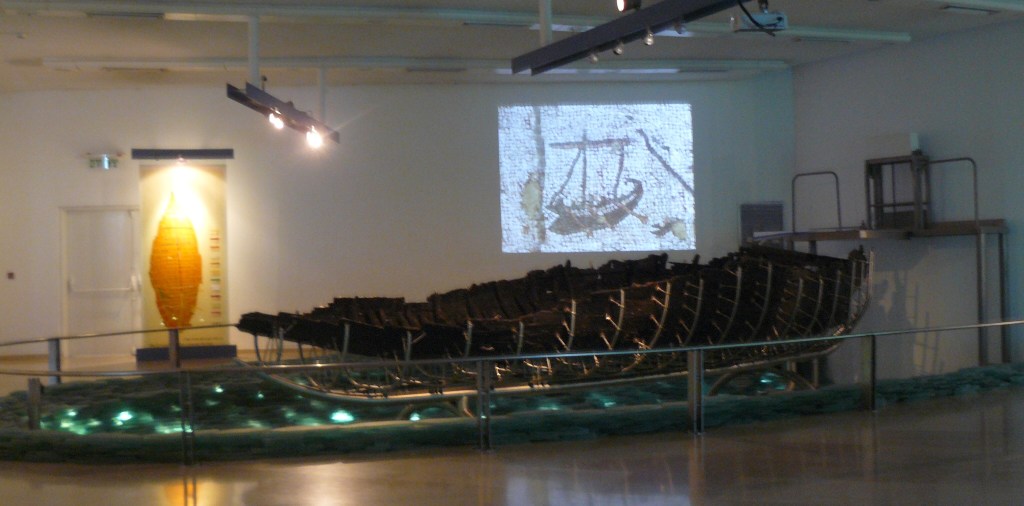
The Jesus boat

Pentecost 10 – 2020

Matthew 14:13-21

Marian Free

In the name of God who understands our deepest fears and who overlooks our multiple weaknesses. Amen.

The most visited tourist destination in Israel is Kibbutz Ginosar on the shores of Galilee. It was here, in 1986 that two brothers, Moshe and Yuval Lufan, found the remains of a first century boat. That year the water levels were particularly low and the brothers – who spent a great deal of time looking for artifacts – came across a rusty nail which, on inspection belonged to a boat, buried in the mud beside the water. Recovering the boat was a mammoth task. Archaeologists had to work out how to excavate the boat without damaging or destroying it. This meant keeping the timbers wet, moving the fragile structure in one piece, cleaning off the mud without touching the boat, and finding the right fish to keep the bacteria away. Thankfully the hard work was rewarded with success and the boat can now be seen in a museum close to where it was found.

Boats are a feature of the gospels. Jesus calls four fishermen to follow him, he teaches from a boat, is responsible for an extraordinary catch of fish from a boat and he himself seems to criss-cross the Galilee in a boat. The discovery of the “Jesus boat” puts flesh on the gospel stories and enables us to visualise Jesus and his disciples as they sail from one side of the lake to another. The popularity of the “Jesus boat” lies in the fact that it is probably the most intact structure that can be related directly to Jesus’ life and ministry. 

Fishing, in the time of Jesus was regulated by the Roman government – delegated to local officials. Anyone who wanted to fish needed to purchase fishing rights and a proportion of the catch was subject to tax. Fishermen were at the mercy of the brokers and tax-collectors. They were also vulnerable to the vagaries of the sea – a good catch was never guaranteed and the sea could whip up into a storm at any moment. Most fishermen could not swim, and, as the sea was considered to be the home of demons, falling overboard was doubly dangerous. No wonder the disciples were terrified when they found themselves on the lake, at night, in the middle of a storm.

An account of Jesus calming the sea is one of the few stories that occurs in all four gospels – sometimes twice. In Matthew, Mark and John it follows Jesus’ feeding of the 5,000.  Matthew and Mark have included an account of Jesus’ walking on the water. In every instance, the event illustrates Jesus’ power over nature and over the demonic forces, but the authors use the story in very different ways. (Only Matthew chooses to include Peter’s attempt to walk on water – his initial confidence and his ensuing doubt.) 

In Mark, Matthew and John, Jesus is not in the boat when the storm blows up. He has stayed behind. Later, during the storm, he walks across the water towards the boat. A comparison of Mark and Matthew is interesting and illustrates the different purposes of the gospel writers and the different ways in which they depict the disciples and the disciples’ reaction to the stilling of the waters[1]. In Mark, the incident is directly related to Jesus’ feeding of the 5,000, specifically the bread. When Jesus enters the boat and the wind ceases the disciples are utterly astounded, but there is no expression of faith because: “they did not understand about the loaves, but their hearts were hardened.”[2] Matthew reports an entirely different reaction. When Jesus and Peter get into the boat (after Peter’s failed attempt to walk on water) and the wind ceases, the disciples worship Jesus as the Son of God. 

In Mark’s gospel, the disciples never identify Jesus as God’s son. Indeed, other aspects of Mark’s telling of the story, suggest that the question of Jesus’ identity remained a secret until the resurrection. Throughout that gospel the disciples are consistently depicted as foolish and lacking in understanding. In contrast, Matthew suggests that despite the fact that the disciples do recognise Jesus as the Son of God, they constantly waver between doubt and faith (even after the resurrection – Mt 28:17). 

We will never know for certain the purpose of the authors. (We have nothing except the gospels on which to base our conjectures). Is Mark, the first of the gospel writers, describing the disciples as they really were and did Matthew, dismayed that the founders of the church were presented as such poor role models, remodel their failings from misunderstanding to doubt? Or did the community for whom Mark was writing need models that shared their misunderstanding, and did Matthew’s community need to feel that even the disciples had moments of doubt? 

Whatever the truth of the matter, the writers of the gospels have given us disciples with whom we can relate, real people with real fears and failings. This means that if we are confused, we can be reassured that the first disciples were confused. When we are afraid, we can identify with disciples, who despite being in the presence of Jesus still experienced fear.  At those times when our faith wavers or when we are overwhelmed by the circumstances in which find ourselves, we can be comforted in the knowledge that the disciples too had moments of doubt. 

Our gospel writers did not gloss over the failings of the disciples, nor did they present them as exemplary models. In our gospels we find disciples with whom we can identify. Through them we are assured that God does not expect perfection but will find ways to use us – however weak our faith, however wavering our courage and however poor our understanding. 

There is one thing of which we can be sure that, whether we falter or not, whether we are uncomprehending or not, whether we are brave or not God’s love for and confidence in us is steadfast and unwavering.


[1] Read Matthew 14:22-33, Mark 6 45-52 (John 6:16-21 Jesus doesn’t calm the storm, but he does walk on the water.)

[2] Hard to know just what this means!

Who gets the water?

June 27, 2020

Pentecost 4 – 2020

Matthew 10:40-42

Marian Free

In the name of God who empowers us with the Holy Spirit to be Jesus’ presence in the world. Amen.

Matthew concludes his ‘missionary discourse’ with a rather confusing and apparently disconnected set of sayings. I have to confess that I have always found this passage difficult and disconcerting. Chapter 10 is primarily about Jesus’ sending out of the disciples, his instructions to them and his warnings as to what they might expect from the world. Suddenly, at the end of the chapter, it appears that Jesus is addressing a different audience: “Whoever” and he introduces prophets, righteous ones and little ones when he had been speaking about the disciples. 

For me, the confusion lies both in Jesus change of direction, and also in the way that the passage is usually interpreted. As the Collect for today suggests: “O God, your Son has taught us that those who give a cup of water in his name will not lose their reward: create in us generosity of heart, that we might share our bounty with others,” the last verse in particular is interpreted as an exhortation to extend generosity to others. Generosity towards others, particularly the poor can be interpreted as generosity towards Jesus (see for example, Harrington, 154)[1]. But that is not how the passage reads. If the four sayings are a whole, then the last verse, as the first, must relate to the disciples not to an undefined “little one”. The cup of water must be offered to a disciple, not to the poor.

If we take the sayings in order, it is clear that the first phrase “Whoever welcomes you, welcomes me” refers to the disciples (or to the twelve) – those whom Jesus has “sent out” at the beginning of this discourse. In the final line, the “whoever gives a cup a water” must refer to the “whoever” and of the first line and the “you” must be the same “you” of that line. In verse 40, the “whoever” is the party whom Jesus is now addressing and the “you” refers to the disciples. In other words, Jesus is referring to the generosity that people can and should offer to the disciples and not to what the disciples might or might not do for others! 

Mark uses the phrase about the cup of water in a completely different context, but he makes it very explicit that the disciples receive (not give) the water: “whoever gives you a cup of water to drink because you bear the name of Christ will by no means lose the reward.” (Mk 9:41). 

This is why I find the passage disconcerting. The usual direction of generosity is reversed. Instead of the disciples giving relief to others, they are the recipients of generosity. Further, these statements undermine our understanding that discipleship is about service. They suggest instead that discipleship is about being honoured, respected and served.

Puzzles such as this cause us to be grateful for the scholarship of others. Luz points out that first four sentences have the same form and that key words are repeated (up to six times as in the case of “received”)[2]. This makes it clear that that the last three verses elaborate on the “you” of the first verse. We know that Jesus has been addressing the disciples which tells us that they are the “you” about whom speaks. This means that the “prophets”, “the righteous ones” and “the little ones” all refer to the disciples whom Jesus has sent. The actions described are the actions that the “receivers”, the “welcomers”, and the “givers” do towards or for  the disciples – not the actions that the disciples themselves engage in. 

As the disciples are Jesus’ representatives, the way in which people respond to them is indicative of their response to Jesus. The way in which they respond to Jesus determines their response to God and their place in the kingdom (their reward).

Here the gospel writer (or Jesus) employs a Rabbinic principle: a person’s representative is like the person himself (sic). Receiving the representative is the same as receiving the person.  Further, both the person and his/her representative may share the same fate. This principle is particularly pronounced in the gospel of John – “Whoever has seen me has seen the Father” (Jn 14:9).  Jesus’ identification with God is replicated in the disciples’ representation of Jesus and Jesus’ fate is the fate that the disciples can expect. Perhaps more importantly, John’s gospel makes it very clear that judgement is not related to good or bad behaviour but is determined by a person’s response to Jesus (and therefore to Jesus’ disciples).

Here in Matthew, we have one of the few instances of a parallel with the fourth gospel. The one sent (the disciple) is to be seen as the representative of the one who sends (Jesus) and the treatment received by the one sent (disciple) is a reflection of the esteem in which the sender (Jesus) is held and of the relationship between the one receiving the message and the sender (Jesus). In other words, the way in which a person receives a disciple is indicative of their relationship with God. If the disciples are received as if they are Jesus, a prophet, a righteous person or a little one (a member of Matthew’s community (Mt 18)) the one who receives them, welcomes them or gives them sustenance is thereby demonstrating their positive (or negative) response to the gospel. A positive reaction to the disciples and to their message indicates a positive relationship with God and the “rewards” are the benefits (including eternal life) that devolve from that relationship. 

The primary point of the passage then, is not generosity – either towards the poor, or towards the disciples. The primary point of the passage is the reception (or not) of the message – spread first by Jesus and then by the disciples. The chapter begins with Jesus’ sending out of the disciples and concludes by alerting those to whom they take the message that they will be judged by how they receive it and how they react towards those who bring it. 


[1] Harrington, Daniel, J. S. J. The Gospel of Matthew. Collegeville, Minnesota: The Liturgical Press, 1991.

[2] Luz, Ulrich. Matthew 8-20. Minnesota: Fortress Press, 2001, 119f.

Graduation speech?

June 20, 2020

Pentecost 3 – 2020

Matthew 10:24-39

Marian Free

In the name of God Earth-maker, Pain-bearer, Life-Giver. Amen.

In 2015, the actor Robert de Niro addressed the graduands at the New York University Tisch School of the Arts Commencement ceremony. He began by saying: “Tisch graduates you made it and you’ve had it.[1]

The speech in full is available on Youtube. This is an excerpt.

“You’ve had it. The graduates from the College of Nursing, they all have jobs. The graduates from the College of Dentistry – fully employed. The Leonard Stern graduates of Business Studies, they’re covered. The School of Medicine graduates, each one will get a job.

Where does that leave you? Jealous? I doubt it. Those accountants they all had a choice. I suspect they used reason, logic and common sense to give them a career that would give them stability. Reason, logic and common sense at the Tisch School of Arts? – are you kidding me? But you didn’t have a choice did you. When it comes to the Arts common sense doesn’t come into it. You have a talent; a passion and you chose to pursue it.

“That’s not a bad place to start. Your place is clear – not easy, but clear. A new door is opening for you, a door to a lifetime of rejection. How do you cope? I hear that Valium and Vicodin block the pain, but you don’t want to block the pain too much – without the pain what would we talk about?” 

“Rejection may sting but my feeling is that very often it has nothing to do with you. You have to be true to yourself. I presume you didn’t pick this life because you thought it would be easy. Don’t be afraid to fail. Take chances, you have to be bold and go out there. You are not responsible for the whole project, only your part in it. You learn to trust each other and depend on each other, because you are all in this together.”

It would only take a little adaptation to turn de Niro’s words into Jesus’ graduation speech to his disciples. There are two major differences. One is that I am not entirely sure that the disciples chose their path. Sure, they have followed Jesus willingly – but he asked them, not the other way around. The second is that the Tisch graduates (judged by their wholehearted laughter) have some idea that the way ahead will not be easy – and may in fact be extraordinarily difficult.

Today’s gospel continues that begun last week – Jesus’ sending out of the disciples. Last week Jesus provided a list of instructions to the twelve – what not to take and where not to go. If these instructions weren’t daunting enough, Jesus continues by informing the disciples what they might expect. Up until now, I imagine, the disciples will have been caught up in the excitement and novelty of being followers of Jesus, with little to no thought that it might be dangerous or costly. Jesus teaching may have in parts been difficult, even harsh, but there has, up until now, been little hint that the path that they have chosen will lead to persecution or to the cross. 

And now – just before Jesus sends them out on their own – he spells out the consequences of following him. Graduates of the Tisch School of Arts might face unemployment and rejection. Disciples of Jesus can expect to be handed over to the authorities, betrayed by their own families and hated by all. They must even be prepared to lose their lives for Jesus’ sake. 

I can’t help wondering if the disciples realised that this was what they had signed up for. In fact, did they think that they had signed up for anything at all? And, even if the twelve had made a choice, if they had signed up for discipleship, did they really know what it entailed? Did they understand that one day Jesus would simply send them out (on their own) into a hostile world – a world of hatred and rejection, a world filled with violence and persecution, a world that would turn its back on them and which might even put them to death? I suspect that this was all news to them. 

At that point, I would not be surprised to discover that the disciples were frozen in fear, unable to go forwards or backwards. Our Arts graduates have their talent and their passion to fall back on. The disciples had no such resources. Only Matthew could be considered to have been a “man of the world”, someone who knew how cruel and unforgiving it could be. Thankfully, Jesus’ warnings are interspersed with assurances. Despite promising the disciples that he has come to set “a man against his father and a daughter against her mother” Jesus insists that they need not be afraid because their very association with him is the protection and strength that they will need. He may not be able to keep the disciples from harm, but he can assure them that when they are at a loss for something to say, the Spirit of the Father will speak through them. Their lives may be at risk, but Jesus can give them the affirmation that their lives are of such value that even the hairs of their head are all counted.  Jesus doesn’t promise that it will be easy, but he does promise that even if they lose their lives they will find them.

In the light of this passage, Jesus’ “graduation speech” we may all have to reconsider our understanding of discipleship. If we had thought that following Jesus comprised conformity to a code of behaviour and a peaceful coexistence with our fellow human beings, then – this passage tells us – we are very much mistaken. Jesus has come not to bring peace but a sword. His very presence was divisive and confrontational, and he expects that our presence will extract the same reaction. Where there is injustice, we are called to confront it. Where there is oppression, we are called to challenge it. When people are excluded, marginalised or stereotyped because of their race, religion, colour, gender or sexuality; we are called to stand for and with them whatever it may cost.

Disciples of Christ – you are done for! Wherever you go from here may be dangerous and frightening. It may cost you your family, your friends and your life! In the end, though, it does not depend entirely on you. You are not alone, and you are not “responsible for the whole project.” With other disciples of Christ, you are in this together and you are supported and upheld and given voice by the Spirit of the Father. 

The way ahead may not be easy, but in the end, would you have made any other choice?


[1] Not his word. He used a word that got attention, but which I didn’t feel I should repeat.

Taking Responsibility

June 13, 2020

Pentecost 2 – 2020

Matthew 9:35-10:8 

Marian Free

In the name of God who calls, equips and sends us into the world. Amen.

A number of you will have received and returned the Parish Survey – thank you. The Wardens wanted to get a sense of your expectations as we prepare to re-open the church for public worship. If you have completed the survey you will know that most of the questions are quite straightforward – where you are most comfortable worshipping, how you have found the isolation, what are you most looking forward to when you return and how you see St Augustine’s (what does it mean to you). I imagine that no one had difficulty with any of these questions and, from the answers we have received so far, it is clear that a majority of people have been reasonably happy with what we have been doing in the past and are keen to resume face-to-face worship in much the same way as it was before.

After answering the more general questions you might have been caught by surprise (as I confess, I was) when it came to the last statement on the survey: My vision for my spiritual future looks like:…. Most of the other questions were somewhat general and impersonal. They allowed us to place responsibility for the life of the Parish elsewhere: on the Parish Council or on the ministry team. But, as I read it, this last statement asked us to take responsibility for ourselves and for our own spiritual journey. “My vision for my spiritual journey.  The statement challenged us to reflect on our own spiritual health, to consider whether or not it will look any different in the future and, if we think it will look different, what we are going to have to do to make that future a reality. 

It is a quite confronting and even demanding statement, especially for traditional Anglicans who are not used to articulating their inner experiences or sharing their spiritual practices with others. It is a reminder too, that in the end it is we as individuals (not the Parish as a whole) who will have to answer to God for the way in which we have responded or not to the presence of God within us. As members of this Parish we may have to justify how we have or have not built the Kingdom of God in this place, but how we do that will depend in part on how we have responded to God’s call in us.

In the end how we move forward as a community depends not on the Ministry Team or the Parish Council, but on each one of us. Together we make up the congregation of St Augustine’s or of the Parishes of which we are a part. Our individual spiritual health contributes to the health of the congregation as a whole. Our commitment to grow in our faith and to develop good spiritual practices will in turn ensure the health of our Parish. The depth of our relationship with God and with each other will be a sign of hope in the wider community which will in turn draw others to faith.

Taking responsibility is at the heart of today’s gospel. Jesus sends the disciples out to do the very things that he has been doing: “preaching the good news, curing the sick, raising the dead, cleansing the lepers and casting out demons”. Jesus “sends them”. He doesn’t go with them to ensure that they get it right. He doesn’t give them explicit instructions as to what to do or what to say. In fact, he sends them out with very little – except their faith in him and his confidence in them. Jesus trusts his relationship with them and theirs with him. His mission and its future depends absolutely on his ability to trust the disciples to take responsibility for the healing, life-giving good news that he himself proclaimed. 

So, Jesus sends them out – on their own. He doesn’t go with the disciples and hold their hands. He doesn’t hand them a script and expect them to follow it word-for-word. He doesn’t give them a check list that they have to tick off. He doesn’t look over their shoulders to ensure that they are getting it right. Jesus simply sends them out believing that they are up to the task while he himself gets on with his own teaching and proclaiming. 

We know that the disciples were a mixed collection of foolish, ambitious, cautious (even cowardly) men yet Jesus has complete confidence that they are up to the task and the disciples, despite their human frailty, trusted Jesus (or the Holy Spirit that Jesus bestowed on them) to empower and lead them to complete the mission they had been given. 

So, it is with us. Jesus gives us the responsibility to trust that the Holy Spirit that each of us received at our baptism will lead, inspire, direct and encourage us to complete our mission – in our life as a community and in our individual spiritual lives. Jesus will not give us a detailed list of instructions or a specific road map of the way ahead. He won’t continually check up on us but will treat us as adults as people who have their own agency and their own free will to respond to his call on our lives and to carry out the mission to which he has assigned them.

It is somewhat unnerving I admit. The future is not clearly spelt out for us, it is not written down step by step. It will simply unfold as we continue to place our trust in Jesus and in Jesus’ trust in us. 

If you found the last statement in our survey confronting or challenging that is not necessarily surprising. Our spiritual future is something of an open book – one that is dependent in part on God’s plan for our lives, but one that will not come to fruition unless we continue to place our trust in God and to place our lives entirely in God’s hands. 

If we truly trust God, we can trust God with our doubts

January 13, 2018

Epiphany 2 – 2018

John 1:43-51 (Some thoughts)

Marian Free

In the name of God whose shoulders are broad and who will not turn a doubter away. Amen.

My father did not tell many jokes and those he did tell, he told over and over again. One that I particularly remember was about an Irishman named Paddy. Paddy was a Council worker who was working with a group of men on a road outside a village. It was a hot day and at lunchtime the group sent Paddy into the village to buy some beer. Paddy got to the pub and ordered the beer. The publican asked where he was going to put it. Paddy thought for a minute, took off his hat and said: “Put it in here.” The publican filled the hat, but there was not enough room for all the beer. He asked Paddy where he would put the rest. “No problems,” said Paddy as he swiftly turned the hat over so that the remaining beer could be poured into the crown of the hat. Walking very carefully so as not to spill the beer, Paddy made his way back to his workmates. Seeing the beer in the crown of Paddy’s hat, his astonished workmates asked him if that was all that he got for the money they had given him. “Of course not,” said Paddy, as he turned his hat over once again.

Of course, today we are careful not to cause offense and we avoid making jokes that are based on country of origin, gender and hair colour or any other stereotype. In the past though every nation and subgroup had their jokes about other cultures or sub-cultures. (Apparently if you were in France you would tell my Father’s joke but substitute a Belgian for an Irishman and so.) One of the ways that we use to set ourselves apart or distinguish ourselves from others is to demean or to make jokes about them. If Irishmen/Belgians/New Zealanders are foolish then by inference the person telling the joke is not.

In first century Palestine, a person might tell jokes about the Galileans – those unsophisticated yokels from up north who knew little to nothing of the real world. That helps us to understand Nathanael’s response to Philip. Nathanael reports that: “We have found him about whom Moses in the law and also the prophets wrote, Jesus son of Joseph from Nazareth.” To which Nathanael replies: “Can anything good come out of Nazareth?”

Can anything good come out of Nazareth? Nathaniel can be forgiven his skepticism. Nazareth was, archeologists think, a village of 2-300 people (and no I didn’t leave off a zero). Nazareth consisted of 40-60 families at the most. These families lived in limestone caves that dotted the hillsides (and which form warrens under modern-day Nazareth). It was extremely unlikely that anyone of any note would emerge from such an environment – let alone the long-expected Christ. Nazareth was close to many significant Roman cities including Sepharis. Nathaniel came from Bethsaida which like Capernaum was a fishing village whose residents lived in stone homes, not holes in the ground. From his point of view Nazareth, and anyone who came from Nazareth was not deserving of any attention.

Undeterred by Nathaniel’s disbelief, Philip insists that Nathaniel come and see Jesus for himself. Instead of berating Nathaniel for his doubt, Jesus commends him for his honesty – “Here is truly an Israelite in whom there is no deceit!”

There is a tendency among some Christians to believe that doubt is the antithesis of faith, that doubt suggests disbelief or a failure to truly trust in God. Those who doubt sometimes feel guilty or are made to feel guilty by those who claim certainty. Others (afraid that any form of doubt will bring the castle of belief tumbling down) hold on to their certainty in the face of evidence that contradicts all that they hold dear. They dare not ask questions or allow others to ask questions for fear that that will lead to other questions. Their confidence in God and in themselves seems to be insufficient to allow even the smallest doubt to put a chink in their armour.

The results of a closed, unquestioning faith are manifold. People who cannot or will not ask questions are sometimes left holding conflicting ideas in tension, are forced to defend positions that science has proved to be untenable or are placed in a situation that can both stultifying and stagnant. Their faith cannot grow in part because it is too weak to withstand the rigor of challenge.

Perhaps what is worst of all is that those who are too anxious to question their faith demonstrate, not their trust in God, but their fear of God. They hold on to a belief that God demands unquestioning loyalty and obedience. They are afraid that at any sign of doubt God will cast them out of God’s presence. This attitude leads to an unhealthy and often dishonest relationship with God. Someone who is afraid to question God may bury his or her discontent (because one can’t question what God does or doesn’t do), accept the unacceptable without demur (because it is God’s will) and explain away any inconsistencies with platitudes that may or may not provide real satisfaction (because everything has to be accepted on faith). This attitude can lead to a relationship with God that is constrained and limited and which, as a result, fails to benefit from the sort of relationship that benefits from honesty, from robust discussion and seeking to grow through exploration.

Jesus’ reaction to Nathaniel’s doubt demonstrates that rather than dismissing those who ask questions, Jesus/God embraces and responds to them. From the time of Adam and Eve, through Abraham, Moses and the prophets, God has made it clear that God seeks to be in a strong, honest and real relationship with God’s people. God has broad shoulders and is not easily offended or put out – certainly not to the extent of casting people off. Nathaniel’s reaction to Jesus’ acceptance was to recognise Jesus as the Son of God. Jesus’ reaction to Thomas’s doubt was to provide him with the answer that he sought. Thomas’s reaction was to worship Jesus as: “Lord and God”.

Like human relationships, our relationship with God must be built on mutual trust, a willingness to say what we think and the sort of confidence in each other that allows us to work through any difficulties.

If we truly trust God, then we must know that we can trust God with our doubts.