Archive for the ‘Identity of Jesus’ Category

The God-child, the child-God

December 22, 2012
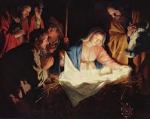
Baby Jesus

Baby Jesus

Advent 4

Hebrews 10:5-10

Marian Free


In the name of God, who as Jesus, became fully human in order to fully redeem human beings. Amen.

There is a television programme which I do not watch, but which I have caught glimpses of in advertisements. It is called something like: Our embarrassing bodies. From what I can glean from the promotions it is about ghastly and disfiguring afflictions and, I presume, it is about ways to deal with them. It is a reminder that the human body is a fascinating and complex organism and it has many parts, functions and characteristics that we tend to consider unspeakable, embarrassing and even disgusting.

Somehow, it is much easier to believe that baby Jesus is a real baby than it is to accept that the adult Jesus was flesh and blood like us.  It is difficult to accept that God could really inhabit a human body, to believe that Jess really did experience all the bodily functions. It would be more palatable to imagine that Jesus, even as a human being somehow occupied a different plane form the rest of us, that somehow his humanity was tempered by a body that didn’t behave in the same way as ours – that Jesus had no primal urges, that he didn’t sweat or burp or do anything that might be considered improper or unbecoming.

The problem of Jesus’ humanity is not a new one. The early church was torn apart by controversy regarding the nature of Jesus. There were some who thought Jesus was just a supremely virtuous person whom God adopted as the “Son of God”. Others believed that Jesus remained God even though he appeared to be human. Still others thought that it was only when he was resurrected from the dead that the human Jesus became God.

In the fourth century matters were brought to a head by a popular preacher from Libya called Arius who denied the divinity of Christ. His ideas were so compelling that they convinced many of the bishops of the time. The Emperor, Constantine was so dismayed by the disunity in the church that he called the Council of Nicea and demanded that the bishops come to some agreement as to what Christians believed. The result was the declaration expressed in the Nicean Creed that:“ We believe in one Lord, Jesus Christ, eternally begotten of the Father, God from God, light from light, true God from true God, begotten, not made, of one being with the Father through him all things were made … he was incarnate of the Holy Spirit and the Virgin Mary and became truly human”.

Jesus’ fleshly nature was already an essential component of New Testament theology – it was not an invention of the Council of Nicea. Writers as different as the apostle Paul, the writer of the gospel of John and the author of the book of Hebrews all attest to an early belief that Jesus truly inhabited human flesh, just as he was truly God on earth.

That Jesus was fully human, that he did really take on human flesh is important for a number of reasons which are different but complementary.

It was only as a human being that Jesus could work salvation for humankind. The obedience of the human Jesus’ was the only way to undo Adam’s disobedience. In the flesh, Jesus was able to redeem the flesh. By taking on human form, Jesus demonstrated that it is possible for human beings to be all that God created us to be. If Jesus as fully human can submit to God, we know it is not our flesh that prevents us from being obedient, but what we choose to do with it. Jesus’ humanity reminds us that, despite all the evidence to the contrary, human beings, inhabiting human flesh can be truly godly.

The fact that Jesus became fully human means that Jesus redeemed human flesh with all its weaknesses, its urges and its passions. Jesus’ humanity is evidence that our whole person is redeemed not just that part of us which might consider untainted and sinless. Our whole person is redeemed not just a part of it. Jesus’ being fully human demonstrates that God values our physicality as well as our divinity.

Jesus’ becoming human confirms that we cannot pay God off or placate God with sacrifices. God wants us – heart, soul and body not our deeds or our gifts. Jesus as a human being gave his whole self and showed that we should give nothing less.

As we come to the end of Advent and enter into the season of Christmas, we come face to face with the child in the manger. It is not difficult to identify the baby Jesus as a real baby.  The challenge that faces us year after year is to accept that the real child in the cradle grows into a real human being – a human being with longings and desires, weaknesses and strengths, just like us.

As Jesus became one with us, so we should strive to become one with him, and through him become agents of redemption in the world.


Bread of life

August 11, 2012

Pentecost 11

John 6:35, 41-51 

Marian Free

In the name of God who sustains and fulfils us. Amen.

 Some years ago there was an advertisement for a (then) popular deodorant. The ad featured a beautiful woman holding up various essential items and saying things like: “I can do without my iPhone, I can do without my hair dryer, I can do without my first cup of coffee, but I can’t do without my Mum.” Of course, it’s a play on words. Our minds immediately leap to the conclusion that she can’t do without her mother, but in fact Mum is the brand name of the deodorant that she is promoting! It was a clever piece of advertising – not only because obviously I still remember it, but also because for a while, the phrase: “I can’t do without” passed into common use.

In the scale of things, deodorant is a particularly superficial item to be unable to go without. People are starving and dying of disease every day, surely we can go without something that is not vital to our well-being, but only to our vanity. However, the goal of advertising is to convince us that we simply cannot do without the latest fashion, the latest kitchen items, the latest phone or computer. Many of us today have lives cluttered with things that we do not absolutely need, but which seemed a good idea at the time. It gives pause for thought. What do we really require for a reasonable life? What things are absolutely essential for our well-being and what things are essentially luxuries?

Some of the things we need are obvious. We simply cannot survive without water, oxygen and a certain amount of food. Warmth and shelter are also good but not necessary. In 1943 a man named Abraham Maslow published a seminal paper in which he identified a hierarchy of needs. All these years later psychology students would be familiar, if not with his work, then with the hierarchy to which he gave his name. The hierarchy he developed suggests that a person’s basic needs must be met in order for them to be creative and moral. So at the bottom of the hierarchy are things like breathing, food, water, sex. When those needs are met a person may becomes aware of the need for safety (both physical and economic). When one is fed and safe, love and belonging become important for happiness. These are followed, Maslow would say, by the need for self-esteem (confidence, achievement, respect form others). It is only when all these underlying needs are met, he claims, that a person is able to achieve self-actualisation – creativity, spontaneity, lack of prejudice and so on.

There are some flaws in Maslow’s argument. A number of creative people are creative, not because they have reached some higher dimension of existence, but precisely because their needs for love or something else have not been met. Their art is drawn not from their self-fulfilment, but from their suffering. Likewise we often witness people who to us, seem to be living in the most dire of circumstances and yet who are able to express surprising joy and inclusiveness.

Today’s gospel is part of a long discourse on bread in which Jesus claims to be both the bread of life and the living bread that has come down from heaven. For many people bread is one of the staples of life. Jesus appears to be claiming that he is both essential for life and that a relationship with him is the key to eternal life. In contrast to Maslow’s hierarchy, Jesus places himself at the bottom of the pyramid and implies that all else in life is built on faith in him.

As he does so often, Jesus seems to be challenging his audience to consider where their priorities lie and where they place their relationship with him in comparison to their other needs and wants. By claiming to be the bread of life and by comparing himself with the manna in the wilderness, Jesus is suggesting that his listeners need to place him at the centre of their lives, to have the confidence that if they put him at the heart, all else will fall into place. Jesus is claiming that faith in him is essential to the well-being of all people. It is not an optional extra that can be drawn on only when it is absolutely needed, rather it is the central requirement for a life that is rich and satisfying.

This is more difficult that it appears – especially for Jesus listeners. Many of them have known him all his life, they know his parents and they know that he didn’t come down from heaven, but was born in the usual way. For Jesus’ audience accepting that he was who he said he was meant suspending their rational minds and allowing themselves to trust that what Jesus said was indeed true and that he could supply all their wants. Further, it meant letting go what they had believed until now and trusting that God was indeed doing something new in Jesus, that they faith they had held was being enlarged to include all that Jesus did and taught. For many this was an impossible task. They simply could not make the leap. They could accept Jesus as a miracle worker, but not as the source of their being or the most essential part of their lives.

This sort of faith is no easier for our generation. Faith still does involve a suspension of the rational and a belief in something that ultimately cannot be proven. The faith that Jesus demands is not new to us as it was to Jesus’ first century listeners. We are not caught by surprise as they were. However, that does not mean that it is easy. For ourselves, accepting Jesus as the bread of life entails trusting Jesus with one’s whole life and not just with part of it. It means relying on Jesus (and not on our own strength) when things get tough. It means learning to be grateful for all that we have and knowing that Jesus will give us those things that we really need. It means that Jesus is the one thing in life that we simply cannot do without.

What is the one thing in life that you cannot do without? Is your answer Jesus?

Knowing Jesus – being part of the story

July 28, 2012

Pentecost 9

John 6:1-21

Marian Free

In the name of God who is the end of all our stories. Amen.

 There is a wonderful movie called “When Harry met Sally”. It is about two graduates who share a ride to New York, separate, meet again, separate and finally admit that they want to spend their lives together. I watched the movie again recently and was reminded that one of Harry’s habits was that he liked to read the end of a book first. He couldn’t stand the suspense of waiting until the end to see how everything worked out, so he would read a few pages at the beginning and then turn to the end before going back to where he had left off.

When I first saw the movie I couldn’t believe that any one could spoil a good read by jumping ahead in that way. However, I have to acknowledge that there are times when I’ve been compelled to ask someone whether or not a book ends well because the suspense is too much for me. I don’t want to know the ending exactly, but I do want to prepare myself to know if, for example, the central characters are going to completely damage their relationship or whether they eventually get it together. If I know that it is all going to end well, then I can cope with the stresses along the way! I have to confess that on one occasion it took me several weeks to read the end of a book, not because I was anxious about the ending, but because I had guessed what the ending was going to be and knew that it would spoil the whole book!

For most of us, knowing the end of a story spoils our enjoyment of it. In fact, reviewers now have an expression: “here comes the spoiler”‘ which acts as a warning for us to stop listening, watching or reading because the end of the story is about to be revealed.

John’s Gospel should perhaps come with such a warning. Throughout John’s gospel we are given a glimpse of the community in the present – the risen Jesus, the Jesus known by believers in the present – makes his presence known in the gospel as much, if not more than, the Jesus of history. This is because the author of John, unlike the authors of Matthew, Mark and Luke, writes from the perspective of a community which understands the historical Jesus as a result of knowing the risen Christ. Jesus is understood and taught from the perspective of those who know the risen Jesus. That is, the end of the story determines the way in which the story is told. That is not to say that the communities of the other gospels did not know the risen Christ and that they did not read that knowledge back into the story as they told it. It just means that they wrote their gospels from a different perspective. The writers of the Synoptic Gospels knew the end of the story but they wrote, by and large, as if they did not.

The account of feeding of the five thousand occurs in all four gospels. In fact in some gospels there are two accounts of miraculous feedings – the feeding of the five thousand and the feeding of the four thousand. Likewise in all four gospels the account of Jesus’ walking on the water is attached to the feeding of the five thousand.

John’s account has some marked differences from the other three. His detail of where the event occurred is more specific. He tells us that the Passover was near – a symbol that is associated with Jesus’ death. In John two disciples, Philip and Andrew, are mentioned by name. The emphasis in John is on the abundant provision of bread rather than the miracle itself. After the feeding, the disciples choose to go on ahead while Jesus withdraws by himself. There is a strong wind, but the disciples are more frightened of Jesus than they are of the storm.

A number of other factors in John’s re-telling stand out. These are what lead scholars to believe that the story is being interpreted in the light of the present situation – that of a community which knows the risen Christ. For example, in John’s account Jesus is completely in control. He is not trying to escape the crowds and they don’t reach the spot before him. It is Jesus, not the disciples who notices the hunger of the crowds and he doesn’t send the disciples to buy food to feed them.

In John’s gospel, Jesus sees the crowds coming, takes the initiative and asks Philip where they can buy bread. However, he does not expect an answer, because he already knows what he is going to do. The Jesus of John doesn’t waste time. As soon as he sees the crowds coming he wonders about feeding (not teaching) them. After they are fed, the crowds declare Jesus to be the prophet who is to come into the world. All this is in contrast with the other gospel writers who emphasize Jesus’ compassion, have Jesus teach and heal before the crowds are fed, and who stress the fact that the disciple’s misunderstand the meaning of the bread.

John’s concern in re-telling the story is less with the miracle itself and more with the question of the identity of Jesus. Even though they get it wrong, the recognition of Jesus by the crowds is an important part of the story. The crowds identify Jesus not just as a miracle worker, but as the prophet who is to come into the world. Mistakenly, they seek to make him king, but he is not the sort of king that they expect.

At the same time, the multiplication of the loaves provides an opportunity for teaching  – something that is a common feature in John’s gospel.  The Jesus of John doesn’t teach and heal the crowds and then feel obliged to feed them because he has kept them so late. In John the crowds are fed first. The miracle of the feeding provides the illustration and sets the scene for the teaching that is to come. (For the remainder of this very long chapter, Jesus will explain the meaning of the bread, claim to be the bread of life and demand that people identify completely with him by eating his flesh and drinking his blood. In fact, as we will discover the teaching is so difficult that it separates the Jesus’ true followers from those who just want what Jesus can do for them.)

As in Matthew and Mark, John’s account is followed by Jesus’ walking on the water. Again there are a number of differences in John which suggest an interpretation by the post-resurrection church. Two features stand out – Jesus comes to the disciples (as he does after the resurrection) and the key to the story is the recognition of Jesus by the disciples (they don’t mistake him for a ghost). When Jesus walks towards the boat the disciples are terrified, but when they know it is Jesus, they try to get him to come into the boat with him.

Their recognition of Jesus also serves to separate the disciples from the rest of the world. The disciples recognise Jesus for who he is, whereas the crowds see him as they want to see him. The crowds judge Jesus by worldly not other-worldly categories, they can see him only in earthly terms. The disciples know the deeper, spiritual significance of Jesus, and understand that as a result of such knowing they are set apart as the community that follows in his name.

Like the gospel writers, we too know the end of the Jesus’ story. Like the community for whom John’s gospel was written, our lives and our understanding of Jesus are determined as much by the Jesus who is present with us, as they are by our knowledge of the historic Jesus. The story of the historical Jesus is essential for our understanding of our faith, but it is the risen Jesus who informs, teaches, challenges and guides all that we do in the present.

Our present is the end of the story so far, our past is already a part of the story, and our future will determine how the story is told. In fact our future may determine whether or not the story continues to be told.

May we live in such a way that the story known through us is a story which is filled with the transforming power of the risen Christ in our lives.

(I am indebted to L.Th. Witkamp “Some Specific Johannine Features in John 6:1-21.” in Journal for the Study of the New Testament, 40 (1990) 43-60. for some of the ideas above.)