Archive for the ‘Indigenous Australians’ Category

Sit down, Shut up, Listen up

July 9, 2022

Pentecost 5 – 2022
Luke 10:25-27
NAIDOC Week
Marian Free

In the name of God who shows no distinction but values all people. Amen.

At the beginning of the year Professor Josh Mylne, the Chair of the planning committee for the International Congress on Plant Molecular Biology (IPMB) tweeted a poster for the upcoming Conference. The poster featured head shots of all the headline speakers and the chairs for the various sessions – over 90 people in total. Professor Mylne, who had been working on the Conference since 2018 was proud of the line-up, especially the diversity that it displayed. As he told the ABC programme Science Friction: “We had one of the best gender balances I’d seen, career-stage diversity with younger and older scientists, so much different science — more than ever before — chairs from all around the world, including for the first time Africa and India.”

The poster had been shown to hundreds of people before it was tweeted, all of whom responded positively. It was not surprising then that Professor Mylne was taken aback when one of the responses to the tweet was: “International, and no Africans.” Professor Mylne had just cycled home and, instead of stopping to think, he quickly replied: “Look harder”, directing the tweeter to the one African face among the 94.” Of course, potential attendees did look harder, and discovered that not only was there only one person from an African nation. While Asia was well-represented and there was a good gender balance, African and South America speakers were notable by their absence. A closer look also revealed that the website for a conference that was to be held in Australia failed to include an acknowledgement of country.

Instead of dampening the fire, Mylne’s response ignited a blazing fire with the eventual result that one of the sponsors withdrew their support and the Conference itself was postponed.

By taking the tweet personally and by responding hastily, Mylne made the sort of mistake that many of us make. Instead of recognising the hurt (and sense of exclusion) behind the critical tweet, Mylne responded defensively which turned the hurt into outrage. His response was interpreted as “disrespectful” and “tokenistic”. The situation was only made worse when an email was sent to one of the critics suggesting that it was up to people of colour to fix the problem.

It would be good to report that a occurence such as this is unusual, that seeing a situation only from one’s own perspective was a rare occurrence in today’s Australia, but sadly the failure to listen carefully is illustrative of a common reaction towards those who are different from ourselves – migrants, refugees and most egregiously our indigenous community. Our best efforts – when they do not include diverse voices – can be experienced as paternalistic and condescending. Our responses to criticism often demonstrate a failure to hear and an unwillingness to adequately address the concerns of those who outside our field of vision. When our failures are drawn to our attention, we too often become defensive instead of being open, and graciously listening and responding to the grievances of those whom we have (deliberately or inadvertently) excluded, patronised, or offended.

Not being heard or having one’s concerns ignored or carelessly dismissed are experiences that our first Nations people know only too well. There have been amply opportunities (particularly in the past 50 years) for white Australians, policy makers and members of industry to respond to the injustices wrought upon indigenous Australians for generations, and yet our responses have been inadequate at best and detrimental at worst.

To mention just a few – despite the apology, children of indigenous families are still being removed in greater numbers than children of other Australians, despite the Royal Commission into Aboriginal deaths in custody people of indigenous background are still over represented in our prisons, despite laws protecting sacred sites it was still possible to blow up the Juukan caves in Western Australia, despite commitments by the former Federal Government and the Uluru Statement from the Heart, first Nations people are still waiting to be recognised in our constitution and given a voice in government.

Since colonisation, we have not only forced indigenous people from their land, taken away their culture and their language, removed their children from their care, but we have also failed to listen to their wisdom, to appreciate their history and to value their knowledge of this land.

We cannot say that we have not been told – and told – what the problems are and how they can be solved. I was shocked, for example, when I heard Rachel Perkins deliver the Boyer Lecture of 2019 and hear her raising issues that had been raised by Professor Marcia Langton AO when she gave the Boyer Lecture in 2012. Nothing, it seemed had changed in the seven years between those lectures. It was a sad indictment on our failure to truly hear what was said or, if we had heard, our failure to respond in ways that demonstrated that we had heard and understood.

There will be no discernible change in this nation until we truly listen to the members of the indigenous community, to their rage, their indignation, their sense of injustice, their grief and their grievances, their sense of loss and dispossession and until we recognise their willingness to work with us and understand that they know better than we do, what the solutions for their own people might be.

Of all the meanings of today’s parable of the good Samaritan, the one that speaks to us today is that the outsider, the despised and the oppressed have much to teach us about generosity, inclusion and forgiveness, and about seeing and responding to the needs of those who are different from themselves no matter how badly the other has treated them.

The theme for NAIDOC week this year is Get up! Stand up! Show up!

Perhaps for white Australians it should be: “Sit down! Shut up! Listen up!”
Who would God choose?

December 18, 2021

Advent 4 – 2021
Luke 1:39-55
Marian Free

In the name of God who overturns the structures of power, wealth and status and who chooses the poor and the vulnerable to bring God to life in the world. Amen.

This year I received a Christmas card on which the image was a reproduction of a painting by Australian artist Rod Moss. I have to say that it is the most realistic image of the Holy Family that I have ever been privileged to see. Rod Moss has adapted a painting by Caravaggio and has used as his model an indigenous family and a central Australian setting. What stands out to me is the fact that the scene is not sentimental, nor has it been sanitised or primped. It is posed to be sure, but the models are real people – people who are almost certainly more like Mary and Joseph than any other representation that I have seen.

The background is likewise unadorned – it is bare and plain – a simple corrugated iron structure, a family of dogs and an angel that is not overtly “angelic”.

From the image one can deduce that this is a family who have little to spare. Mary is dressed simply in a blue, ill-fitting, open-necked polo shirt paired with a bright patterned skirt. Her long hair is not covered, and strands have broken loose from her ponytail. Not for this Mary the spotless white head covering or perfect blue robe in which she is usually depicted. Joseph wears a shirt that is a bit too big for his narrow frame and his longish hair is tousled rather than neatly brushed unlike the tidy, well-groomed Joseph of most nativity scenes.

The baby is lying (arms outstretched) on a bed.

Moss’s image provides what to me is a realistic picture of Mary and Joseph – a couple from a poor rural town who have travelled by foot for several days only to discover that there is nowhere for them to stay when they arrive at their destination. The painting is a stark reminder that neither Mary or Joseph came from families of privilege, wealth, status or power.

An image such as this – one that doesn’t gloss over the poverty and the hardships faced by Mary and Joseph – gives power and meaning to Mary’s song. “He has brought down the powerful from their thrones, and lifted up the lowly” (Lk 1:52). In response to Elizabeth’s blessing, Mary seems to grasp the implications of what God has done – that in choosing her to bear God’s anointed, God has clearly demonstrated God’s preference for the poor. Mary has no position or heritage that sets her apart, a fact that is further amplified by the fact that she is a woman, yet she is the one whom God has chosen to bring God into the world. In choosing Mary, God has acted contrary to expectation that God will enter the world with power and might and God has made it clear that justice and equity are at the heart of God’s relationship with the world.

Our English translation does not do justice to grammar of the text. As O. Wesley Allen Jn. Allen points out Luke shapes the Magnificat by having Mary speak of God’s actions in the past tense: “God looked, did great things for me, showed strength, scattered the proud, brought down the powerful, lifted up the lowly, filled the hungry, sent the rich away empty, and helped Israel (verses 48–54). English translations render the verbs in the perfect tense (for example, “has looked”) implying an action in the past that continues into the present. But the Greek verbs are all aorist, indicating actions completely completed in the past .”

In the words of her song, Mary is saying that God has (already) acted. God’s choice of Mary is proof positive of God’s preference for the poor, the marginalized and the dispossessed. It is not something that is going to happen – it has happened. God has acted. God has demonstrated God’s preference, has provided a glimpse of the kingdom values.

God’s choice of Mary is a slap in the face of all who think that their power, their influence or their wealth comes from God, who think that their place in the world implies that they are better than those who do not share their privilege, or who think that because they are richer and more powerful that it is within their right to exploit or to oppress others.

Dietrich Bonhoeffer describes the Magnificat this way: “It is at once the most passionate, the wildest, one might even say the most revolutionary Advent hymn ever sung. This is not the gentle, tender, dreamy Mary whom we sometimes see in paintings…. This song has none of the sweet, nostalgic, or even playful tones of some of our Christmas carols. It is instead a hard, strong, inexorable song about the power of God and the powerlessness of humankind.”

Mary’s song is an indictment against a church that has become institutionalised and that has aligned itself with the cultural norms and values of the world in which it finds itself. It critiques a church that has become contented with its place among the establishment, the respectable and the comfortable. It puts the lie to the idea that God needs beautiful churches and well-dressed congregations, and it challenges all of us who believe that we are doing all that we can to bring about God’s kingdom.

Mary’s song is an uncomfortable song and echoes down the ages with a message for us all.

What does God’s choice tell us about our attitudes and dispositions, our value judgments, our position in the world? I wonder who God would choose today and how comfortable would God’s choice make us feel?

Unsung heroes

November 3, 2012

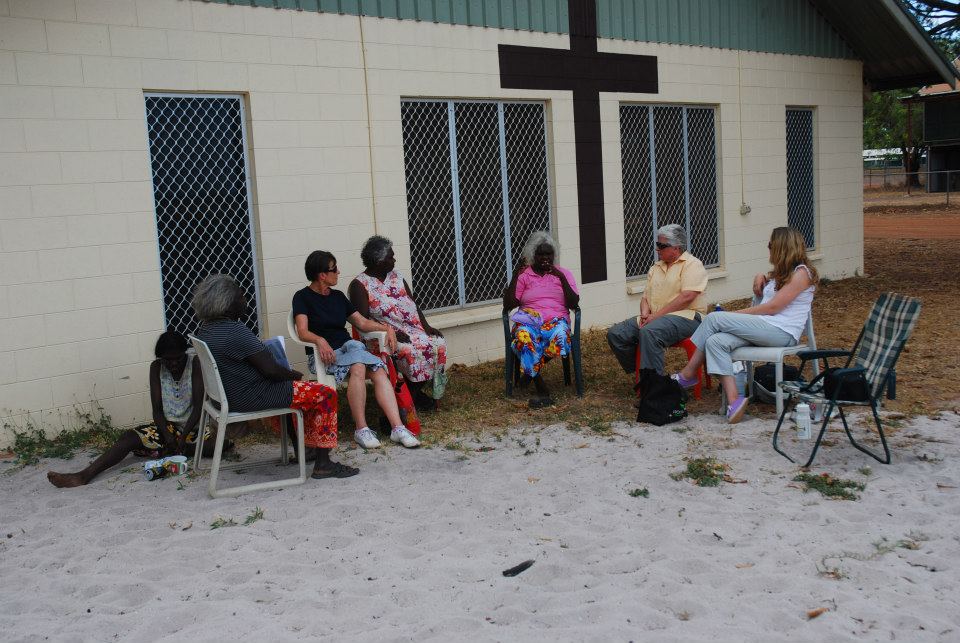
Listening outside the church at Gunbalanya – Lois in pink

All Saints 2012

A Reflection

Marian Free

In the name of God who alone can judge the secrets of the heart. Amen.

Today I’m going to do something a little different. I’m going to speak from the heart. I think most of you know that I spent the first week of my holidays in Darwin. It was my first time there and it was a marvelous experience. Two particular experiences were very confronting and challenging and relate to what are perhaps the most difficult and divisive social issues of our time. So please be clear, I’m sharing how these events touched me, not trying to provide answers, or to tell you how to think.

One experience was this. I was sitting in the Cathedral waiting for the service to begin when the a bus-load of Iranian asylum seekers arrived – five of whom were to be baptised. The issues surrounding asylum seekers are complex and I don’t want to argue the rights and wrongs or even to suggest that I have made up my own mind on the issue. What struck me was that when someone is sharing your pew, it is hard to think that when you are going home, they are going to jail.

The second profound experience occurred during a visit to Kakadu. The Bishop had organized a local priest to take three of us out for the day. After a visit to some rock art, we drove to Oenpelli (Gunbalanya) – that part of Kakadu over which the indigenous people have Native Title. Our purpose there was to meet with the local priest – Lois and some of her congregation – Hagar Lois’s sister who is a teacher at the local primary school, Marlene her sister-in-law and a young woman named Leandra.

Lois’s story is that her family come from a place near Katherine, but they moved to Gunbalanya when she was quite young. Among other things this meant learning another language and a dislocation from her family’s spiritual home.  Despite numerous difficulties in her lifee Lois’s faith remained strong and she was the obvious person to lead the church in her community and is now their priest.

From our host for the day I learned that a major issue confronting Lois in her ministry was the occasional visits to the community by people from a Pentecostal expression of Christianity. These people are very enthusiastic and make wild promises about such things as healing from alcohol dependence. As a result they gather a following from among the residents of the community. When they leave, those they have left behind often discover that the promises had no substance, that they are unable to stay away from drink, that they are not healed of their ailments. As a result, they return to their former ways with the one difference being that now they are disillusioned with the Christian faith. As a priest Lois must do what she can to pick up the pieces and, if she can, restore their faith.

Lois and her friends talked a lot about sharing the Good News and very little about any problems in their community. It was only as we were leaving that Hagar, Lois’s sister grabbed my arm and said, “This is what we need to do more of – talk to each other.” I could only agree. We hear so much about indigenous communities through our media, the problems with alcohol and petrol sniffing, the endemic sexual abuse, the violence and the hopelessness but few, if any, of us have been into these communities or spoken to people who live in them. If we don’t make connections, if we don’t sit down and talk how can we have opinions about policies and decisions that affect their lives?

I often feel helpless in the face of such suffering, especially as I live in a part of Australia in which my contact with aboriginal Australians is so rare as to be almost non existent. I left Gunbalanya feeling incredibly privileged to have shared time, be it ever so brief with Lois and her friends and wondering what if anything I could do to make a difference. In particular I wondered how I could respond to Hagar’s plea.

Saints come in all shapes and sizes, and by far the majority are the unsung heroes who simply get on with their lives no matter how difficult they are. Women like Lois, Hagar and Marlene are Anglican women who remain strong and positive in the face of considerable difficulty and all they asked of me and of you is that we listen to their story. It is hard to know how to help, but, if you look at the envelop that you would have received in your pew sheet last week, you will see a photo of Lois. This year the proceeds of the Archbishop’s November Appeal will be directed to Indigenous ministry in the Northern Territory and Bathurst. (Readers who would like to contribute are directed to the website for the Anglican Board of Missions. http://www.abmission.org)

Gunbalanya is a four hour flight and a three hour drive away from Brisbane. There is little that we can do to respond directly to Hagar’s plea that we talk. However, we can support the work of Lois and others like her by giving generously to this Appeal. It is my hope that this year our donations to this appeal will outstrip all previous years and that we will take any opportunities that come our way to listen to our brothers and sisters in Christ whose lives are so vastly different from our own.