Archive for the ‘Luke’s gospel’ Category

How good, Lord to be here.

March 2, 2019

Transfiguration – 2019fullsizeoutput_133a

Luke 9:28-36

Marian Free

In the name of God, transcendent yet immanent, awesome yet comforting, distant and yet as close as a breath. Amen.

“How good Lord to be here!” Whenever I choose the hymn with which we began this morning, I think that we should sing it every week! How good it is to be here! You may not realise this, but Michael and I have now been a part of this Parish for over eleven years – eleven years. That is long enough for you and I to be comfortable each other, way past the time when I might do something unexpected or surprising. With some exceptions, we do the same things week after week, year after year. We sing more or less the same hymns and we have the same preacher. It would not be surprising if, after all this time, our weekly worship might just be “more of the same”. Not at St Augustine’s! One of the real joys of serving this community is that more Sundays than not, at least one person leaves the church saying something to the effect of, “that was wonderful this morning”. To which I reply: “It always is.”

What a privilege and joy to be part of a community that finds our regular, repetitive Anglican gathering uplifting and joyful! How good it is to be here!

Why is it so good? It is good I believe, because in this place and at this time, we are transported out of our day-to-day lives into an experience that is transcendent and transformative. From the moment we enter the church we are confronted by the beauty and grandeur of the building and of the windows. It is obvious that we are in no ordinary place. Even someone with no faith at all cannot fail to be overwhelmed by the soaring roof, the warm timbers and the glorious colours. St Augustine’s is magnificent but in no way is it imposing or unwelcoming. Many who see the interior for the first-time comment on the beautiful feeling that seems to emanate from the walls. We are blessed to worship in a space that is both transcendent and familiar, in which we are both filled with awe and made to feel at home.

How good it is to be here. While our corporate worship might be formal and uplifting it is also comfortable and relaxed. Individually and corporately, we experience the presence of God through our hymns, our readings and, of course, through the Eucharist. Our familiarity with the words and with the pattern of the liturgy does not blunt our awareness of what it is that we do, nor are we allowed to forget that the God whom we worship is both here with us and yet just beyond our grasp. Our worship is moving, uplifting, informative and joyful. It is comforting and reassuring as much as it is awe-inspiring.

Yet though we might be transported by the beauty of our surroundings or deeply moved by the experience of worship, we are also grounded and in touch with the world from which we have been drawn. This helps us to maintain the balance between the transcendent and the immanent (to use the technical terms), to remember who we are and who and what God is. We have to be careful that we are not so enchanted with the experience of God’s presence, not so caught up in the transcendence of the moment that we lose sight of our mission to the world. Our experience of worship may seem to take us to another dimension but that must not cause us to lose sight of the fact that God is as present in our day-to-day living as God is present in our “mountain-top” experiences.

In today’s gospel it is Peter who says: “How good for us to be here!” Peter, with James and John has accompanied Jesus up a mountain to pray. Before their very eyes, not only is Jesus transformed, but Moses and Elijah appear and speak with him. It is as if heaven itself has opened up and gathered the disciples in. Peter’s awe-struck response is to try to capture the moment, to freeze it in time so that he with James and John, can spend the remainder of their lives caught up in this extraordinary moment – never again to have to engage with the nitty gritty of everyday existence.

Peter has yet to understand the reality of Jesus’ ministry, a reality that will be played out in his own life of discipleship. To be a follower of Jesus, he will learn, is not to live one’s life on an exalted spiritual plane but to be fully engaged with the human experience. Peter will come to know that moments of transcendence such as this are not to be held on to, but are to inform and energise the mundane, difficult and sometimes dangerous day-to-day work of being a follower of Jesus.

This morning’s hymn ends: “How good, Lord, to be here, yet we may not remain; but since you bid us leave the mount, come with us to the plain.”

However good it is to be here, our call is to take our knowledge of God into the world, to fully engage with everyday realities, both good and bad. We come here week by week for our mountain-top experience. Consciously and deliberately we bring ourselves into the presence of God. For this one hour we focus intentionally on our relationship with God. In this time and place we allow ourselves to be inspired, fed and nurtured so that reinvigorated, renewed and transformed, we can go into the world and live lives that are infused with the presence of God and the knowledge of God’s presence.

Upside down, back-to-front Kingdom of God

February 23, 2019

Epiphany 7 – 2019

Luke 6:27-38

Marian Free

In the name of God who asks from us only what will serve our own sense of well-being and wholeness. Amen.

Some forty years ago there was a movie about the life of Jesus. It is so long ago that I cannot remember the name of the movie or on which gospel it was based. I do remember two things. One, the language used in the film was that of the King James Bible which sounded clumsy and archaic. The second is the way in which the movie portrayed Jesus teaching the parable of the sower. Time has probably clouded my memory somewhat, but as I recall, Jesus was speaking as he walked through a crowded market. What that meant was that those who heard the beginning of the parable didn’t hear the ending and those who heard the ending had no idea how the parable began. The image jarred at the time, and it jars now as I recall it. The gospel writers don’t describe Jesus walking and talking. Mark depicts Jesus teaching from a boat. In Matthew’s gospel the bulk of Jesus’ teaching occurs in the Sermon on the Mount and in Luke Jesus’ teaching is presented in the Sermon on the Plain and during the journey to Jerusalem. Whenever Jesus is teaching, he appears stationary.

That said, while those who were present would have been able to hear the beginning and the end of the story, if Jesus teaching consisted of a string of sayings such as we have in today’s gospels, I imagine that the crowds would have scratched their heads and wandered away in confusion. Just as Jesus almost certainly did not walk as he taught, so too, it is unlikely that he stood up before a crowd and presented a series of unconnected aphorisms such as we find in today’s gospel. The gospels indicate that Jesus was a good teacher. He able to gain and hold the attention of the crowds who surrounded him, and he taught in such a way that many came to understand that he was the anointed one. No proficient teacher would include such diverse and unconnected material in one lecture as we have before us today.

Love your enemies, give your coat and your shirt, don’t complain if someone takes away all your goods, lend to those who can’t pay you back, forgive, don’t judge and give generously. No doubt, over the course of his ministry Jesus said a number of things in a variety of different contexts – over meals, as he and the disciples walked along and at times when Jesus was teaching a crowd. He may have been responding to a question from the disciples, commenting on the behaviour of the Pharisees, making an observation or simply repeating Old Testament wisdom. What is almost certain is that Jesus didn’t say all of these things at the same time.

After Jesus’ death, his followers will have recalled and repeated Jesus’ teachings. At some point, and being anxious to keep Jesus’ memory alive, someone has gathered his sayings together and created some sort of order. For example, today’s gospel suggests that the collator of the material has grouped similar sayings together – the sayings about non-resistance are placed with sayings about love of enemies, the saying about being merciful is connected with that about not judging and the saying about giving more than what is asked is put in the same context as that of giving abundantly.

This means that we don’t have to insist that the sayings in this morning’s gospel fit together neatly nor do we have to worry about their relationship one to one another.

Like the beatitudes which on the surface are counter-intuitive, the sayings reverse our usual way of thinking. Jesus insists that poverty, grief and persecution are to be seen as a blessing not as an affliction, that they are life-giving and not soul-destroying. Jesus goes on to demand that we live in ways that are counter-cultural, non-reciprocal, non-judgemental, selfless and generous. In other words, we are to behave in ways that are contrary to our natural instincts and which have the potential to set us apart from the society in which we live. Like it or not, Jesus tells us to love our enemies, to give to those who can give us nothing in return, to refrain from retaliation, to forgive and not to condemn.

Contrary to expectation, applying these values to our lives does not leave us impoverished, down-trodden, taken advantage of or abused – just the opposite. Self-sacrifice, love of those who do not love us and generosity towards others rewards us in ways we cannot begin to imagine. If we live according to these principles, we will discover that instead of being small and petty, jealous and judgemental, we become expansive and open-handed, gracious and understanding. We are not called to make sacrifices for the sake of sacrifice. We are called only to let go of those things that limit us and to relinquish those things that have us in their power. God does not make demands that are burdensome and life-denying. God seeks only our well-being, our development and our wholeness. Indeed, when we learn to graciously accept what life throws at us and when we focus more on others than on ourselves, our world-view is enriched and enlarged, our anxieties are diminished, our hearts are expanded and our sense of satisfaction with our lives and our place in the universe is increased beyond our imagination.

In the upside down, back-to-front kingdom of God what we give up is more than compensated for by what we get back.

Try again

February 9, 2019

Epiphany 5 – 2019

Luke 5:1-11

Marian Free

In the name of God who challenges us to go our of our depths to see who, with the help of Jesus, we can be. Amen.

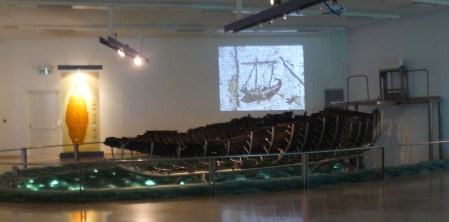
The most popular attraction in Israel is, perhaps surprisingly, a first century fishing boat. The boat in question was discovered by two brothers from Kibbutz Ginnosar who used to trawl the shore of the Sea of Galilee looking for artifacts. On one such occasion they discovered the outline of a boat. The story of raising and preserving the boat is fascinating and, thanks to the care taken with it’s restoration, we have an almost complete boat from the time of Jesus. It could hold up to fifteen men and their catch. The one located and preserved at Ginnosar had been repaired on many occasions during the course of its life and archeologists have identified a huge variety of timbers that, over time have been used to repair the boat. While the archeological significance of the discovery is immense and adds a great deal to our understanding of the craft of boat building in the first century, the discovery has the added weight of giving us a truer idea of the sort of vessel into which Jesus might have climbed in today’s gospel.

As with many of the accounts in our gospels, the story of the miraculous catch can be read in a variety of ways and on many different levels. We can notice the difference between this version of Peter’s call and that of the author of Mark, or we can compare the story with the post-resurrection catch of John’s gospel. Time could be spent comparing Peter’s reaction to Jesus with that of the prophets who, in the presence of the divine, recognize their limitations and frailties and protest their unworthiness. What did Jesus teach from the boat and what does it mean to ‘catch people alive’ we might wonder? Why does Peter address Jesus as ‘master’ before the catch and as ‘lord’ after the catch? And why does Luke use the language of ‘catching people alive’ (or enthralling them) when Matthew and Mark tell us that Jesus commissions the first disciples to ‘fish for people’.

These eleven verses, that on the surface recount the call of Peter, James and John, are filled with meanings and nuances that are both obvious and subtle. It could take hours for us to unpack the various complexities of the scene!

Today, I’d like to explore the possibility that the the story of the miraculous catch is a metaphor for our own time, that Jesus urges us to try again when we have lost hope and when feel that we have done all that we can.

We live in an age in which many of have grown weary of trying to win people for Christ and in which too often we fall into despair at the decline in church attendance and at our our inability to prevent the church’s slide into irrelevance. It is a time in which religion is often used to defend conservative values at the cost of compassion and to the detriment of the gospel message of love and in which the political and social landscape is undergoing great change. It is easy to be overwhelmed by the hopelessness of our situation and to simply give up.

Peter, James and John were, according to Luke, professional fishermen. They owned their boats and were in a business partnership. Almost certainly their fathers were fishermen before them and from an early age they would have understood the lake and the times at which the fish were most likely to be running. After an unfruitful night they would have been tired and frustrated and possibly anxious about the loss of revenue and in no mood to have another go. There would have been no reason for them to respond to a tradesman from Nazareth who knew nothing of the ways of fish or of the sea. Yet Jesus’ word is authoritative enough to persuade Peter to go back to the deep and to try one more time. He is rewarded with a catch so large that it begins to break the nets and Peter is forced to call for help.

The world of Peter was no more benign or settled than our own. Peter, James and John were not carefree fishermen, plying their trade and selling their catch. Rome overshadowed all their lives. The state would have demanded that they pay a tax or a levy for the right to fish and Rome’s representatives may have demanded a proportion of the catch. Life would have been difficult and the conditions oppressive and there would have been no reason to imagine that the situation was about to change. Tomorrow would be more of the same, but the certainty of their lives, hard as they were, would surely have more allure than the uncertainty of trusting in let alone following Jesus.

Jesus approached fishermen who were disillusioned and tired and he told them to try one more time. He ignored Peter’s protestations that he was a sinful man and without so much as a ‘by your leave’ he assured Peter that from now on he would hold people enthralled.

Many of us in the church are exhausted and disheartened. We feel that we have done all that we can to bring about growth in our congregations. We are conscious too, that collectively we are tainted by scandal, blemished by the compromises we have made and held in scorn because we have been unable to change and adapt.

When we feel that we have reached the limit of our reserves, Jesus comes to us, takes his place with us and says: ‘Try again. Take heart, go out once more into the midst of a world that is complex and hostile. Throw out your nets one more time. You will be amazed at what I can do with you – sinners that you are. Don’t be afraid, with me you will hold people enthralled.’

Spoiling for a fight?

February 2, 2019

Epiphany 4 -2019

Luke 4:21-30

Marian Free

In the name of God who challenges cultural norms and who asks us to see the world in a different way. Amen.

The movie Once Were Warriors depicts in very graphic terms a family caught in a cycle of violence, unemployment and neglect. It could be about any society but in this instance it is about a Maori family – hence the title. The husband loses his job, the wife is abused and, partly as a consequence of the dysfunction in the family, a son ends up in jail. There is worse, but I will spare you that. One particularly confronting scene is that in which the wife goads the husband until, unable to bear it, he lashes out at her.

What is it that causes some people to spoil for a fight? Why would one person try to so antagonize another that the other would respond with force? I can only guess that in this case the woman was trying to expose her husband’s weakness. That she seemed to think that if she could get him to hit her it would prove to them both that he was less than a man. In other words it was her way of putting him down and perhaps of building herself up. He beat her because his masculinity was threatened. Ironically, by using violence he proved her right.

There are all kinds of reasons why people deliberately antagonize another. One is to prove moral superiority. Another is just the opposite – if a person can get someone to attack them (verbally or otherwise) it reinforces their own low-esteem. They can think: “Of course they would attack me – I’m worth nothing more.” People who are very sensitive to criticism are always on the defensive. They are spoiling for a fight because that they feel that if they can get in first, they will have the upper hand in any argument that results. Someone who is angry might be looking for a fight just in order to release the tension that has built up inside them. If they have been put down or criticized by someone they might pick a fight with the next person they see in order to release the anger they feel or to restore their own sense of worth.

Others provoke fights in order to demonstrate their own strength in comparison to someone else. (I think for example of the shortest boy in my year at high school. He was forever egging on the taller boys so that he could engage them in battle and show that, even if he was small, he was at least as strong or as tough as they.) Similarly, someone with low self- confidence might try to prove themselves to their friends by seeming to take on someone else. Some of us may have been in the uncomfortable situation of having a complete stranger call out: “Hey, what are you looking at?” when we didn’t think we were looking at anything at all.

A rash response to a perceived threat or a desire to big-note oneself in front of one’s friends can have tragic results – especially if the person concerned is under the influence. So called ‘one punch’ attacks are usually brought on by someone consciously or unconsciously looking for a fight.

What, you might wonder, does any of this have to do with today’s readings?

If you look or listen carefully you will notice an apparent disconnect between what the people say of Jesus and his response to them. In verse 22 we are told that all “the people spoke well of Jesus and were amazed at the gracious words that came from his tongue.” Jesus’ response though is not one of quiet pleasure – just the opposite. He goes on the attack. He says: ““Doubtless you will quote to me this proverb, ‘Doctor, cure yourself!’ And you will say, ‘Do here also in your hometown the things that we have heard you did at Capernaum.’” “Truly I tell you, no prophet is accepted in the prophet’s hometown.”

What has caused this outburst from Jesus? Is he, as it appears, spoiling for a fight?

To solve the problem of Jesus’ harsh reaction we have to seek the help of social scientists .

The highest form of social currency in first century Mediterranean society was that of honour. Honour was something that was bestowed by birth and could only be increased by taking honour from another (by putting them to shame). One’s honour had to be protected at all costs.

This appears to be the issue here. Jesus is not spoiling for a fight – but he senses that his listeners just might be and he tries to cut them off at the pass. You see, Jesus hears what we do not. He understands that the words of praise are qualified by a subtle attack: “Is this not Joseph’s son?” they ask – simple words that contain an underlying anxiety,

Jesus’ honour, his place in his community, was determined by that of his father, and by extension the community to which he belonged. The cultural norms of the time dictated that Jesus should follow in his father’s footsteps and that he should not seek to change his place in the world. No wonder Jesus’ self identification as a prophet causes great consternation in his home town. Jesus’ claim to more honour than that which is his due inevitably diminishes the honour that is available to his fellow villagers – an increase in his status leads to a reduction in theirs. In a world in which honour is a limited and precious resource this is in fact a matter of life and death.

Jesus’ apparently unwarranted aggression may in fact be evidence that Jesus wishes to avoid the fight that his listeners want to bring on. This view is reinforced by Jesus’ refusal to fight back when they attempt to drive him over a cliff. Indeed the remainder of the gospel will demonstrate most vividly that, rather than seek status honour for himself, Jesus does those things which bring him into disrepute. He mixes with outcasts and sinners and submits to the most shameful of deaths.

Here, at the start of his ministry, he refuses to give his listeners satisfaction. He will not contend with them for honour. In life and in death Jesus will show that the kingdom of God operates according to different standards and measures a person’s place in the world by different norms.

Jesus will not be drawn into the narrow confines of their way of thinking, he will not be controlled by the restrictive cultural norms of his day. He slips through the crowd who threaten him and goes on his way proclaiming the good news of a kingdom that is not governed by human limitations.

Knowing our audience

January 26, 2019

Presentation of Christ in the Temple – 2019

Luke 2:22-40

Marian Free

In the name of God who has no beginning and no end. Amen.

Consciously or not, we all use rhetoric to ensure that our point of view is heard or that others are brought around to our way of thinking. The use of rhetoric in the modern world is perhaps most obvious in politicians and preachers whose futures may depend on their ability to sway their listeners. In ancient Greece rhetoric was highly prized and there were many schools of rhetoric and a vast number of books on the subject. Assessment in the subject was pass or fail. A student who had complete the course would be sent to their home town to give a speech. If they convinced their friends with their argument, they received a pass, if they did not, they failed. This was not as harsh as it sounds. The life of a philosopher was not an easy one.  They wandered around the countryside peddling their particular view of the world. Their success or failure depended entirely on their ability to command an audience and to persuade them that their arguments were valid. Success would ensure that they would have a bed for the night and food for the journey. It might even mean that they would secure a patron who would supply their every need.

Paul was a skilled rhetorician as were the gospel writers. In the first century the stakes were high. Those who followed Jesus were convinced that faith in him was the means to salvation, a source of liberation, peace and joy. They didn’t want to simply tell people about Jesus, they wanted their audiences to believein Jesus. It was not easy, they often came under attack and had to defend their faith. One way to do this was to demonstrate to their critics that the faith was rational, that it did not emerge in a vacuum but had a solid and respectable history. (In rhetoric terms this is known as an apology[1]– not in the sense of being sorry for something, but in the technical sense of mounting a defense.)

Luke uses this skill subtly, but to great advantage.

The third gospel is addressed to Theophilus who may be a high official in the Roman Empire, ora generic personage who represents Gentile (non-Jewish) readers. Either way, this and other clues suggest that Luke’s gospel was directed at a gentile audience. For example, in today’s gospel Simeon claims that Jesus is “a light for the revelation to the Gentiles and for glory to your people Israel” and the Lucan Jesus is the Saviour as the world, not of the Jews alone[2]. Only Luke’s gospel includes the parable of the Good Samaritan and only in Luke do we have the account of the Samaritan leper who returns to give thanks. Luke’s inclusion of these stories ensures a receptive hearing among Luke’s gentile audience.

The author of Luke must do more than prove that Gentiles have a place in the faith. If he wants to convince people to give up their ancestral religions and practices to embrace faith in Jesus, he must also establish the credentials of the Christian faith – to demonstrate that this is not a religion that has sprung up from nowhere, but which has a deep and respectable place among the religions of the world[3]. Luke manages to weave these two goals seamlessly into his story.

Luke defends the gospel’s Jewish heritage in a number of ways. Unlike the other gospel writers, Luke begins and ends the gospel in the Jerusalem – the centre of the Jewish faith and worship. At the start we find Zechariah in the Temple when the angel appears to him and at the conclusion instead of returning to Galilee (as they do in the other gospels), the disciples remain in Jerusalem which is where Jesus appears to them. Zechariah and Elizabeth both come from long established priestly families and Mary and Joseph are shown to be pious Jews – Jesus is circumcised on the eighth day, presented at the Temple “when the time came for their purification”, and taken to Jerusalem every yearfor the festival of the Passover (2:41). It is on one of these occasions that Jesus stays behind in the Temple and impresses the teachers with his answers. More than in other gospels, Jesus is found teaching in the synagogues.

In this way, Luke makes it clear that the faith he propounds is not new and superficial but is connected to one that has a long and noble heritage. In other words, Luke’s gentile readers can trust what he is saying.

Our world is both less complex and more complex than that of the first century. In the first century, those who preached the gospel, did so against a background of multiple competing gods and philosophies and had to claim a place, indeed a priority among the religions and ideas of the ancient world. In our day, the panoply of gods has shrunk but there has been an increase in indifference, agnosticism, atheism, scepticism and even antagonism towards faith in general and the Christian faith in particular.

From the writer of Luke’s gospel, we learn that if we believe that our faith is worth sharing it is vital that we understand the context in which we preach. It is essential that we know our audience and how to engage and persuade them, that we understand our history and that we are equipped to tell our story convincingly and well.

Ours is a great story, a transformative story. Our task is to understand those among whom we find ourselves so that we can tell that story in ways that are compelling and convincing and that show that we have taken the trouble to know those to whom we speak.


[1]It is not a recent publication, but Guerra’s book provides a comprehensive discussion of apologetic and its use in the New Testament. Guerra, Anthony J. Romans and the apologetic tradition: The purpose, genre and audience of Paul’s letter.Cambridge: Cambridge University Press, 1995, SNTS 81.

[2]This become even more obvious in Luke’s second volume: The Book of Acts in which the gospel spreads in concentric circles from Jerusalem to Rome (the end of the world).

[3]Matthew, who we believe is writing for a largely Jewish audience, establishes the faith’s credentials by demonstrating the ways in which the life of Jesus fulfils OT prophecies.

Jesus – truly one with us

December 29, 2018

Christmas 1 – 2018

Luke 2: 41-51

Marian Free

In the name of God whose human existence was real and gritty, not superficial and sanitized. Amen.

Prior to the 1960’s there were no such things as shopping malls in Queensland. All the department stores were in the central city so, when it came to Christmas shopping, it was to the city that my mother took us so that we could spend our pocket money on gifts for each other. On one such occasion – I think I was about five years old – I became separated from my mother. I have no recollection of being anxious or frightened. What I do remember, is that when my mother found me, I was safely ensconced on a trestle table that was being used by a group of women to sell Christmas craft. Then, as now, society in general took it upon itself to take responsibility for children in such situations. The primary goal being to care for the child and to reunite the child with his or her parents as expeditiously as possible..

There are societies, those of the New Guinea highlands and our own indigenous culture for example, in which children are the responsibility of all the members of the community. Mothers can let their children roam free confident that everyone will see it as their responsibility to keep the children safe. The sort of ownership and personal responsibility that we feel for our children would be unknown. I’ve been told of an Australian family who, having come to Townsville from Darwin for a funeral, arrived home without one of their children. Instead of being mortified that a child had been left behind, or angry that the child had stayed behind, this family was utterly confident that the child was safe, would be well-looked after and would rejoin them at the next opportunity. (Thankfully, The Department of Children’s Services understood that this was a cultural practice and took no action against the family whose child was reunited with them as soon as it was feasible.)

It is against this sort of background that we have to read the account of Jesus in the Temple. Mary and Joseph were not careless parents who had failed to check on their child’s whereabouts when they left Jerusalem. No doubt they had travelled from Nazareth with a group of friends and relations to attend the feast. When it was time to return home, they would have simply trusted Jesus to have joined the group when everyone was ready to leave – after all he was nearly a man. They would have assumed that he was with cousins or friends whose parents would have treated him as one of their own. In this context there was no need for them to look for their son until the evening when, presumably, he would have joined his immediate family for dinner. Only then did they begin to worry.

Luke, at least in the beginning of the Jesus’ story, does not allow us to forget that this is an account of a real human situation. Jesus belongs to a real family that has the same hopes and dreams, the same flaws, the same irritations and the same anxieties. It is intriguing that across the four gospels we have only one story of Jesus’ childhood and it is the story of a rebellious teenager, or at the very least, of a young man testing his limits – letting his parents know that he is now an adult who can make his own decisions and that he has a vocation to fulfill in which they have no part. His stinging response to Mary’s anxious reproach is to wonder why his parents did not expect him to be in h

‘his Father’s house’. It is the sort of exchange that might occur in any modern household with teenage children.

Later accounts of Jesus’ birth like the Infancy Gospel of Thomas could not cope with such a messy, earthy, ordinary human start to Jesus’ life. For example, in some accounts, just prior to Jesus’ birth, time stands still, midwives appear apparently out of nowhere, the cave is unnaturally lit – by both the child and by Mary’s face. Mary experiences no birth pangs and the child is born completely clean. The birth does not affect Mary’s virginity and the hand of the skeptical midwife withers. In the History of Joseph the Carpenter, the family are taken into the home of a brigand. There, Jesus is bathed and his bath water bubbles up into a foam. The brigand’s wife keeps the foam and uses it to heal the sick and the dying. As a result the family become rich. In these later accounts not only is Jesus’ birth attended with miracles, the escape to Egypt is facilitated by the miracle of a spider’s web and the young Jesus performs miracles and even strikes dead a child who offends him! These later writers could not bear to think that the child Jesus was any less powerful, capable or wise than the adult Jesus.

The absence of somewhere to stay, the insalubrious surroundings of a stable, the visit of the shepherds and the teenager stretching his wings in the Temple are all reminders that we should not isolate Jesus from his very human beginnings or elevate him to the position of a superhuman being. Luke’s Gospel could not spell it out more clearly – Jesus is fully human, fully immersed in the messiness of human existence, susceptible to the same desires as any other human being and subject to some of the same fears. Luke brings Jesus down to earth, reminds us that in Jesus God fully immersed godself in the mundaneness of human existence and that despite being God, Jesus was not insulated from the reality of being one of us.

Jesus/God knows what it is to be one of us and shows us that it is possible for us, mere human beings, to become as he is. We just have to believe that this frail human body with all it’s complexities and this weak, indecisive mind is capable of great and extraordinary things. One of the messages of Christmas is that Jesus became one of us so that we could become one with him. Let us celebrate our human existence and try to live it to it’s full, divine potential.

Sleeping through Christmas

December 24, 2018

Christmas-2018

Luke 2:1-20

Marian Free

May the child in the manger open our eyes to see God’s presence in unexpected places and in unlikely people. Amen

Our Christmas cards and our imaginations give us a romanticized view of shepherds in first century Palestine. This view is enhanced by images of God as shepherd, and of David as the shepherd king. The reality was in fact quite different. In the time of Jesus shepherds were social outcasts, classed together with ass drivers, tanners, sailors, butchers and camel drivers. Theirs was an occupation for which there was no respect. They had no land of their own and their work kept them away from home at night which meant that they were unable to protect the honour of their wives and daughters (if indeed they could afford to have a family). What is more, because they grazed their flocks on land that did not belong to them they were considered to be thieves. In fact many of them were thieves. They were at the very bottom of the social hierarchy – dishonored and despised – certainly not the sort of people you would welcome into your home or seek to associate with. Yet it was to the shepherds that God revealed the birth of Jesus, it was the shepherds who were the first to respond and to see Jesus and it was the shepherds who were the first to spread the good news of Jesus’ birth.

Extraordinary as all that is, it is consistent with Luke’s view of the world that God would chose a woman of no social status or wealth to bear God’s son, that the son of God would be born in a stable and that God would reveal Godself to a disreputable group of shepherds with no social standing whatsoever. What is even more extraordinary and inexplicable is that, despite the cacophony of a multitude, an army of the heavenly host and the glory of the Lord that attended them, no one else saw or heard anything.

The townsfolk of Bethlehem might be excused for not noticing Jesus’ slipping into their midst, but how could they have been blind and deaf to a sky illuminated by the heavenly host singing praises to God? It almost defies belief. In this instance, God’s presence is not subtle or discrete, but bland at and obvious. Even so the presence of God goes unnoticed by all except a bunch of disreputable shepherds, who not only notice but who act on what they have seen and heard. What is more, having seen for themselves that the what the angel had told them was true, they spread the word and caused amazement to all who heard them.

Christmas is layered with sentimentality – the hay in the stable is clean, the shepherds are respectable, Jesus is worshipped. Beneath the sentiment however, we find rejection, apathy, blindness and even outright hostility (if we add Matthew’s version of events).

Only the angels greet Jesus with the appropriate fanfare and even then no one notices. The great irony of the gospel is that God is fully present among humankind and only a few people (and then not the ‘religious people’) even recognize that God is there.

It is easy for us to fall asleep, to allow ourselves to be complacent– satisfied with our relationship with God, confident that we know right from wrong and certain that we would know Jesus when he returns. The problem is this – if we fail to pay attention, if we stop noticing what is going on around us, if we begin to take God and God’s presence for granted we will find that we, like our first century brothers and sisters are blind and deaf to what is really happening around us. We will miss God’s presence in the unusual, the underestimated and even in the disreputable. We will fail to see God in the manger and God in the cross,

Let us not be like those who, not only through Jesus’ birth, but who failed to be stirred to wakefulness by a whole choir of angels.

Listen, process, change, share

December 22, 2018

Advent 4 – 2018

Luke 1:39-45

Marian Free

In the name of God who overwhelms us with goodness and love. Amen.

Do you remember tumbling in the door after school bursting with news of the day? Or bringing home a special purchase eager to share your pleasure with whoever might be there? Or waiting anxiously for a partner to return from work so that you can tell them the amazing news about your infant’s triumphs during the day? When we have good news we can’t keep it to ourselves. Somehow the joy is intensified by the sharing of it. We also have a need to share bad news, but then we are hoping that the pain will be lessened if someone else knows how we are feeling.

Mary has news. She may not really know if it is good news or bad news. It is certainly momentous news, news that she simply can’t keep to herself. If Luke is to be believed, on hearing the angel’s words, Mary sets out at once for the hill country to share the news with Elizabeth. We will never know exactly why she does this. It is possible that Mary wants to avoid the prying eyes, snide suggestions and pointed questions that will surely meet her if she remains at home. Mary might be worried by the censure of her extended family and the potential for violent attack if her story is not believed. Elizabeth lives far enough away that Mary could find refuge until things settle down at home. Furthermore, Mary can expect if not a warm welcome, at least some understanding from her cousin who, like her, has experienced what God can do, and whose news was, almost certainly, met with suspicion at worst and confusion at best.

Perhaps Mary needs time to process the news, to work out what it means to be pregnant. Her body will have begun to change – tender breasts, morning sickness, aversion to certain foods and a longing for others. In a small village Mary may know what the other women go through and not be surprised by the changes, but for her the pregnancy is unexpected and she may not be entirely ready. We have to imagine that Mary will also need to process what it means to be the mother of the Son of the Most High, who “will inherit the throne of David”. Unlike us Mary does not know the end of the story. Who knows what is going through her mind. Does she imagine that the child will be a mighty warrior who will wage war against the Romans or that in the same miraculous way that she became pregnant, her child will simply find himself crowned king? Is her mind filled with images of royal palaces, power and wealth or is she simply curious as to what this all might mean for her?

It is equally possible that Mary, filled with amazement and joy wants to share that feeling with someone who will really understand, someone who, like her, has had the most extraordinary experience of God. Their age difference melts away. God has blessed the one with a long-awaited child and the other with a totally unexpected child. Both children have a role to play in the coming of God’s kingdom.

All that is simply speculation we don’t know what Mary thought or why she raced off to see Elizabeth. Luke’s beginning is designed to set the scene for what is to come – John’s place in the story, Jesus’ Jewish credentials and the place of the Holy Spirit in the coming of the Kingdom. Luke wants us to know that the angel speaks to Mary and Mary responds – by saying ‘yes’ and by sharing the news.

If we pay attention we will know that God speaks to us in many and varied ways. Sometimes the news will be momentous and at others times a gentle nudge. We may be asked to move beyond our comfort zone, to take on a difficult task or simply to let go of a behaviour or attitude that is preventing our growth.

When God asks something of us we need time to think about how the change in our life might impact on or affect those around us. We might wonder what others will think of us and whether we have the courage to pursue the course. We will probably need time to process the impact a change of direction will have on our lives and to consider what changes we need to make in order for it happen and we will want to share the news with a trusted friend or a spiritual director – if not with the whole world.

Advent challenges us to be alert to God’s presence and to be ready to respond.

Listen, process, change, share.

Wake up – before it is too late

December 15, 2018

Advent 3 – 2018

John 3:7-18

Marian Free

You snakes, you brood of vipers! What are you doing here? Is this your insurance policy against death? Do you presume that coming to church will save you from the wrath that is to come, that your baptism alone makes you right with God? Not so! Faith does not consist of outward observance, sticking to the rules or belonging to the church. Your whole lives need to be turned around. You must turn your back on the world and worldly things and give yourselves entirely to God. God is not taken in by externals. God knows the state of your hearts. God can discern the godly from the ungodly.  You must do all that you can to be counted among the godly for God is surely coming and God will know whether you are sincere or whether your faith is purely superficial. Repent and believe in the gospel!

I imagine that you are pleased that I don’t begin every Eucharist by attacking your sincerity, your faith or your behaviour. You will be equally pleased to know that I believe that you are here because you want to acknowledge your dependence on God, express your gratitude for all that God has given you and, in the company of those who share your faith, worship God and deepen your understanding of and your relationship with God. In truth I do not question your authenticity, nor would I dare to cast aspersions on your behaviour.

John the Baptiser had no such qualms. He was very happy to attack the crowds who came to him seeking to be baptised. It didn’t concern him that those who came to him were not the religious leaders but ordinary people, including soldiers and tax-collectors most of whom would have travelled a considerable distance, across sometimes difficult terrain, to seek baptism from this wild man on the banks of the Jordan. How could he question their intentions? The only reason that anyone would have come all this way into the wilderness would be to repent and to seek John’s baptism for forgiveness.

Yet, instead of welcoming the crowds, John attacks them. He challenges their sincerity and suggests that they have come to him out of a sense of self-preservation rather than from a genuine sense of remorse and a desire to change.

But the crowds are sincere. They do not stamp away in high dudgeon, offended by John’s insinuations. Instead they hold their ground and engage John in conversation: “What should we do?” ask the crowds. “What should we do?” ask the tax-collectors. “What should we do?” ask the soldiers. Their desire to turn their lives around is real, John’s rudeness and insolence will not deter them. Because they stay, because they seek to know more, John is forced to accept that their desire to repent is authentic. Their questions demonstrate that the crowds (including the tax-collectors and soldiers) understand that intention must be accompanied by action and that repentance is meaningless unless it is lived out in changed behaviour. “What should we do?” they ask.

And how does John respond? He tells the crowds: “Don’t do just enough – do more than enough.” To the soldiers and the tax-collectors he says: “Don’t use your position to take advantage of others or to treat them badly. Don’t behave in the ways that others expect you to behave – surprise them by refusing to act according to the norm.” To everyone he says: “Don’t conform to the world around you, conform instead to the values and demands of the kingdom. Demonstrate in your lives that you belong to another world, that you belong first and foremost to God.”

It is easy to relegate the story of John the Baptist to history, to believe that his words, his attack on insincerity and hypocrisy belongs to his time and place – to the ingenuous, to the hypocrites and to the unbelievers of the first century. But to make that assumption would be a mistake. John speaks to the crowds, to those who have sought him out. John is addressing people who, like you and I, are trying to do the right thing and to live out their lives faithfully and true. John’s assault on the crowds is like a test. It is intended to shock them into thinking about their lives and to examine their motives. Do they mean what they are doing or is their presence at the river only for outward show? Are they there because they really intend to change or are they there for the circus that is John’s strange appearance and behaviour?

In our age his words challenge us to ask ourselves similar questions. Does our outward behaviour truly represent the state of our hearts? Do we do things for show or because we really mean them? Do we do just enough or do we go over and above to serve God and serve our neighbour?

“You brood of vipers!” the voice of John the Baptist is a wakeup call for us all. In the time before Jesus comes again, John insists: “Don’t take God for granted. Don’t imagine that just because you keep the Ten Commandments and go to church that your place in the kingdom is guaranteed. Don’t allow yourself to think that just because God has set you apart that God can’t and won’t choose others. Examine yourselves and ask whether or not you need to turn your life around.”

Advent is a wakeup call. It is reminder that we cannot afford to be complacent and that we cannot make assumptions about what God will and will not do. It is an invitation to rethink our relationship with God and to ask ourselves whether or not it is in the best shape possible.

Wake up! Repent! Advent is here! Jesus is coming! Are you ready??

Speaking truth to power

December 8, 2018

Advent 1 – 2018

Luke 3:1-6

Marian Free

In the name of God who is not separate from, but fully engaged with world. Amen.

During the apartheid era in South Africa, ardent sports fans argued that politics and sport had nothing to do with each other – a point of view that failed to see that politics ensured that the majority population of that nation were excluded from representing their country. Similarly, we are often told that the church should not be involved with politics – that is the church should refrain from commenting on or critiquing government policies even when they disadvantage the poor and the vulnerable. The argument is usually raised when the the church speaks uncomfortable truths to power. I’m not a sociologist or a social historian but my superficial, uneducated observation suggests that, in recent times, the waters have become very muddied and confused on this score . If I were to put a finger on the reasons I would suggest that the wider public are disappointed with and disaffected by politics as it is currently playing out. I offer two examples. With regard to the question of refugees we have, on liberal side of the equation, those who feel strongly about off-shore detention and who, when the church takes action, as for example with the Sanctuary movement, are all too willing to support the church’s stand and challenge government policy in this area. With regard to gay marriage the government seems anxious to try to appease the more conservative members of the community and branches of the church by trying to enshrine in law the freedom to not employ gay teachers. In other words on some issues the community supports the church’s interference in politics and on the others the government appears to accept the interference of the church.

In reality it is impossible to separate church and politics. For one thing we live in a society which, while increasingly secular (and even anti-religion), has been formed and shaped by the Judea-Christian tradition. For another, the church has a clear imperative to speak out against injustice and corruption. It is equally foolish to believe that the church itself has not been shaped and influenced by the community – social and political – in which it finds itself. For example, it was Christian women who led the struggle for the vote and later it was a changing attitude to the role of women that led to the church admitting women to the ordained ministry. Rubbing shoulders as we do, living side-by-side means that (at least for the present) the state influences the church and the church influences the state.

The impact of the political situation on the emerging faith was not lost on the author of Luke’s gospel. From the very beginning of the gospel Luke provides us with the the political and religious context in which the Christian faith emerged. He tells us that the story is set in the time of King Herod and he makes sure that we are aware of the Jewish pedigree of Elizabeth and Zechariah – both members of priestly families going back even to Aaron. The reader, (in particular Theophilis), is to infer that this is a story set in the heart of Judaism and in the shadow of the empire. As we begin the story proper the situation is spelled out even more clearly. Luke tells us that it is the “fifteenth year of the Emperor Tiberius, when Pontius Pilate was governor of Judaea, and Herod was the ruler of Galilee, and his brother Philip ruler of the region of Ituraea and Trachonitis, and Lysanias ruler of Abilene, during the high priesthood of Annas and Caiaphas” (Lk 3:1).

Apparently Luke does not believe that the story of Jesus cannot be told in isolation. It has to be understood against the political and religious currents of the time. Luke’s lengthy introduction to the story of John not only alerts the reader to the fact John and Jesus are “players on the world stage” but also creates an air of foreboding. The Emperor was known to be cruel and unpredictable – a person so insecure in his position that he destroyed anyone me whom he deemed to be a threat. Tiberius was also the Emperor who had exiled the Jews from Rome in 19CE. Pilate, Tiberius’ representative in Judea, also had a reputation for cruelty and oppression. Herod, as we know, was the ruler who would order John’s beheading. While Philip and Antipas were more benign figures, the effect of the long list of rulers is to show how thoroughly Judea is under the power of Rome. Finally, the high priest, though a representative of the faith, was himself was a Roman appointment – answerable to the Empire.

It is in this hostile political environment that the lives of John and Jesus will be played out. Vulnerable leaders with a tenuous grasp of power will do all within their means to stifle and destroy any hint of opposition and John and Jesus will forfeit their lives by refusing to conform. Speaking the truth to power will cost them both their lives.

We who follow in Jesus’ footsteps must not abrogate our responsibility to promote the values of the kingdom, to take the side of the poor and the oppressed and to question laws that are unjust and we must acknowledge that our freedom to worship and to live lives consistent with our faith may be challenged and even curtailed by unsympathetic powers.

Centuries ago Luke recognized that it was impossible for people of faith to exist in isolation. We are affected by and must recognize and work within the constraints and protections of our political, social and religious context.