Archive for the ‘Mary Magdalene’ Category

Whose ministry – Mary’s or Martha’s

July 19, 2025

Pentecost 6 – 2024

Luke 10:36-42

Marian Free

In the name of God who calls us to different roles and responsibilities and who encourages us to use our different gifts and abilities in the sharing of the gospel. Amen.

I am sure that I don’t need to tell you that Peter, James and John were part of Jesus’ inner circle. They were witnesses to his transfiguration and were close to him in the Garden of Gethsemane. Peter identifies Jesus as the Christ.  It may surprise you to know that these three are largely absent from the Gospel of John. In that Gospel, the significant players – those with a speaking part – are Andrew, Phillip and Thomas. This leads to the conclusion that peter, James and John played a significant role in the communities behind the Synoptic Gospels but not in the community from which the Gospel of John emerged.

The different characters suggest that in the emerging communities behind the Synoptic gospels Peter, James and John were people of some significance but that in the Johannine community others – specifically Andrew, Phillip and Thomas – were leaders for it is these three who have speaking roles in the fourth gospel.  

In a similar way, if women are given a significant role in a gospel it suggests that they also had an important role in the emerging church.  In a society in which women were relegated to the margins, the fact that they are mentioned at all is significant. This is most clearly demonstrated in John’s gospel, in which nearly half a chapter is devoted to the role played by Mary Magdalene as a witness to the resurrection. What is more Mary is given the responsibility of telling the disciples that Jesus is risen which making her the Apostle to the Apostles. 

It seems that at the time the gospels were written the memory of those who played foundational roles in the early communities is still fresh. Even though the church is settling down and conforming more to the world around it, women who played important roles in the early communities cannot easily be written out of the story.

This is particularly evident when it comes to the sisters Martha and Mary who are mentioned twice in the gospels – here in the gospel of Luke, and in connection with the raising of Lazarus in John’s gospel. In both accounts the women are depicted as women who make up their own minds and in John it is Martha not Peter, who identifies Jesus as the Christ, the Son of God. 

Unfortunately, thanks in part to our translators, in Luke, the roles of Martha and Mary are domesticated and circumscribed. It is easy to read the account of Jesus’ visit as a silencing of both women – Mary who passively sits and listens and Martha who is described as distracted. The translation and the subsequent stereotyping of the two women creates a binary between action and contemplation that continues to this day and suggests that the role of women is either passive listening or busy organising.

The account of Jesus’ visit to the home of the sisters takes up only seven verses, so there is much that we do not know. We do not know for example how old the women were, what their financial status was or why there is no male in their household. Nor do we know if Jesus turned up alone or (more than likely) in the company of the twelve, whether he dropped in for a meal or planned to stay for a day or two. What we do know is that the culture of the time placed a high value on hospitality – think for example of the man who wakes his neighbour in the middle of the night so that he can have some bread for an unexpected guest.

Clearly, in the absence of a brother or husband, Martha is the householder. It is her responsibility to ensure that Jesus and those with him are made welcome and fed. As the householder, she naturally expects Mary to help.

Our translation leads us to believe that Jesus chides Martha for her preoccupation with getting ready when in fact Jesus may be offering her sympathy in recognition of the demands of her ministry. Margaret Wesley translates verses 40 and 41as: “But Martha was overwhelmed by many ministry responsibilities, so she came to Jesus and asked, “Lord, don’t you care that my sister has left me to do all the ministry by myself? Tell her to help me.” But the Lord answered her, “Martha, Martha, you are going to so much trouble and you have so many responsibilities to worry about!” 

But does Jesus chastise Martha for wanting to determine Marry’s choice – yes perhaps. Note that the Greek tells us that Mary is commended for choosing the good (not the better) portion, that of a student. Martha’s fault, if she has one, is that of not recognising that it is not her role to determine Mary’s path. God’s call on Mary is not for Martha to determine. Both women are called to and assume ministry roles – one of deacon, one of student – neither is better than the other, both are necessary. 

Before we consign Martha to the role of easily distracted, shallow woman and elevate a silenced Mary to the ideal model of womanhood, we need to unpack Luke’s purpose in telling the story, the blinkers worn by translators, and the preconceptions we bring to the tale from the ways in which we have heard the story in the past.

Before we apply stereotypes to anyone in our society, before we assume that know their interests and their capabilities, before we limit and define their roles and their contribution, we need to be sure that we know the full story, we need to understand the lens through which we see and the assumptions that we bring to bear.

We are all called to serve in a multitude of different ways. The one who calls and equips is never one of us, but always God.
Loving and letting go – Mary Magdalene

July 24, 2021

Mary Magdalene – 2021
John 20:1-18
Marian Free

In the name of God who frees us from the grief and pain of the past and who sends us to proclaim hope to the world. Amen.

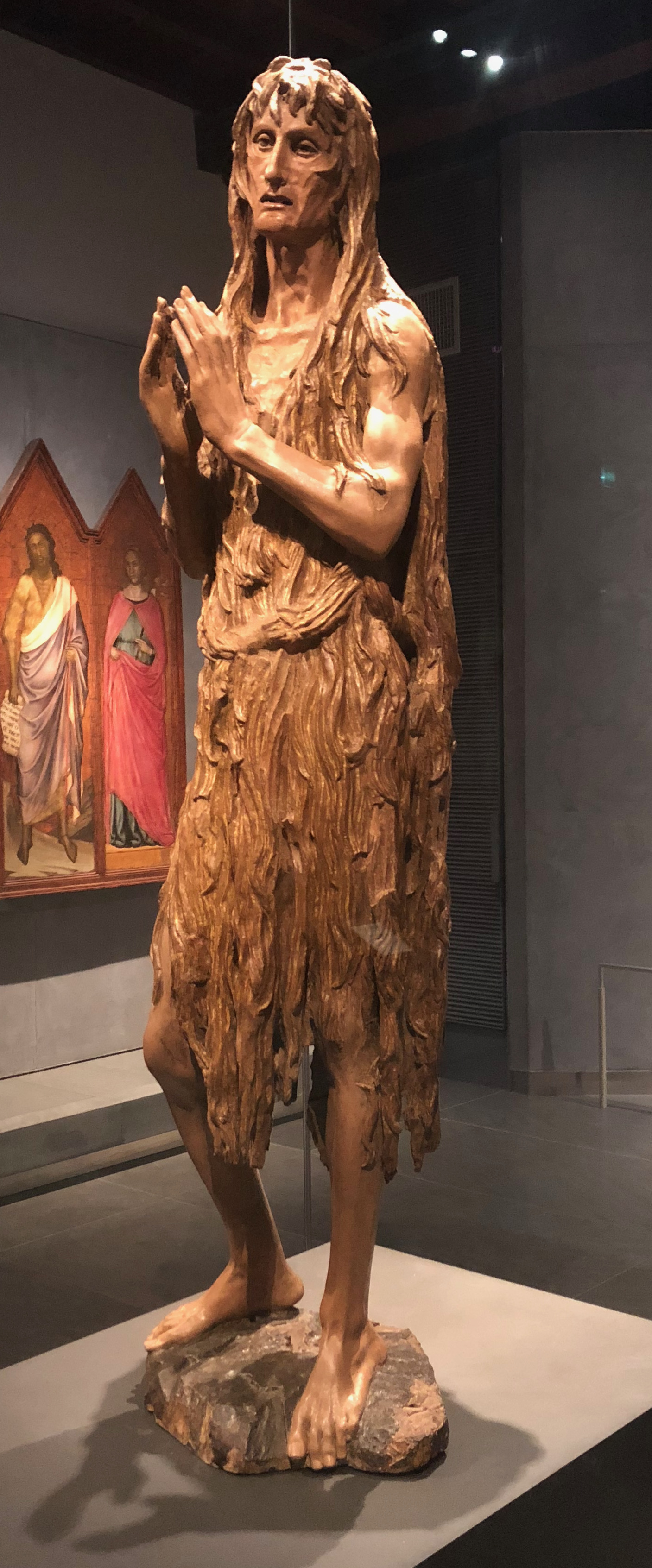
I was so lucky! Imagine being able to spend seven weeks overseas with not a care in the world. You will remember that in 2018 I was fortunate enough to spend seven weeks in Europe for my long service leave. As part of that holiday, I had two weeks in Florence. Before travelling I met with David Henderson who has lived in Italy. He told me what would be his top five places to go, things to do. I was so grateful, it meant that instead of trying to fit everything in, I could focus on just a few special experiences and do the remainder if I had time. One of his suggestions was that if I did nothing else that I should see Donatello’s Mary Magdalene in the Museo dell’Opera del Duomo.

I am so grateful. The Penitent Mary Magdalene has a room to herself and is so extraordinary and so moving, that, had there been a chair, I could have spent half a day contemplating the figure. As it was I was so moved that finally I had to tear myself away. I have included a photograph in the Pew Sheet, but it is hard to do her justice. Donatello has carved a figure that is utterly bereft, completely desolate. His image is of a woman who is so stricken with grief, that she has lost all sense of pride. She looks haggard, her hair has grown to her ankles, teeth are missing, and she looks as though she has been wandering around the countryside, living in the open .

The idea of a penitent Mary stems from end of the 6th century when Pope Gregory 1 made the association between Magdalene and the sinful woman from the street who anointed Jesus’ feet (in Luke 8). There are many reasons why these cannot be the same woman. It is true that we are told that Mary Magdalene was the one from whom 7 demons were cast out but that suggests that she was suffering from a physical ailment or a mental illness, not that she was making her living from prostitution. Mary was among the women who supported Jesus from their own incomes, she was at the foot of the cross when all the disciples had fled and, as every gospel records, she was at the tomb early in the morning of the third day. That Mary’s role in the ministry of Jesus was remembered (at a time when women were being written out of the story) is indicative of the role that Mary went on to play in the early church. This is further supported by the fact that Mary is mentioned in the Gospel of Philip in which Jesus is said to have shared secrets with her and to have kissed her on the lips.

The Biblical Mary is someone who has been empowered by Jesus, not someone who was overwhelmed by guilt. Indeed, Mary is often called the “apostle among apostles” as it was Magdalene who was commissioned by Jesus to tell the disciples that he had risen from the dead . For this reason, it is impossible for me to marry the Mary that I know, with the Penitent Mary popular with artists in the 15th and 16th centuries.

When I saw Donatello’s sculpture, I knew only that it was his Mary Magdalene, and it is only in preparing for today that I discovered the ascription “Penitent” given to the sculpture by the artist . It was because I knew the Mary of the New Testament that Donatello’s Mary spoke to me of grief and not of penitence, of despair and not of guilt. In fact, for me Donatello’s Mary comes straight from this morning’s gospel. Mary has come to the tomb alone. Having discovered that Jesus was not there she has run and told Peter and the disciple whom Jesus loved. They ran to see for themselves and, having seen, returned to their homes.

Mary stayed, weeping – utterly alone, utterly disconsolate. It is this desperate grief that I see in Donatellos’ sculpture – a woman who has lost, apparently forever – someone who had loved her and affirmed her and whom she had loved in return. This Mary knew that nothing would ever fill the void that filled her heart at that moment. Her life, which for a time had had meaning and purpose at this moment stretched out, empty, before her. Now, even his body had gone. Now there was no grave, no place where she could go to mourn him.

Lost in her thoughts and overwhelmed by sorrow, Mary could not recognise the risen Jesus until he called her name. Then, apparently fearing that she would lose him for a second time, Mary – physically or metaphorically – clung to him. But the future that she imagined cannot be. Jesus tells her to let go. He must leave and she, Mary must take on a new role – that of apostle, one sent by Jesus to spread the gospel.

Our story is very different from that of Mary, but over the last twenty months we have said good-bye to many of our hopes and dreams, we have endured separations from those whom we loved, some of us have experienced financial hardships and all of us find ourselves facing a future that is very different from that which we had expected. Our lives will never be the same but, like Mary, we cannot cling to the past, we cannot put our lives on hold, hoping that they will return to what they were. We must move forward, impelled by our faith and confident that Jesus, our risen Saviour goes before us, having faced his own demons, experienced the worst that life can throw at him and come out triumphant on the other side.

Grief is a natural response to loss, but we cannot allow it to hold us forever in its grip for none of us know what the future may hold.

Penitent Mary Magdalene, Donatello, Museo dell’Opera del Duomo

From being unknown to being knownm

July 20, 2019

The Feast of Mary Magdalene – 2019
John 20:1:18
Marian Free

God of boundless love whose ways are not our ways and whose thoughts are not our thoughts. Amen.

In the 7th century, Pope Gregory the First made the assertion that Mary Magdalene was a prostitute. He came to this conclusion by conflating Magdalene with Mary of Bethany who anointed Jesus’ feet before his death. In turn, Mary of Bethany was confused with the unnamed ‘sinful’ woman of Luke who interrupted a dinner party in order to anoint Jesus’ head. The problem (apart from the fact that there is no reason to think that these three women are one and the same) is, that even if Magdalene could be proven to be the ‘sinful’ woman who anointed Jesus, we are not provided with a single clue that would allow us to draw a conclusion about the nature of that woman’s sin. There is nothing in our gospels, except perhaps the suggestion that Mary was a woman of independent means, to suggest that she was a prostitute. Yet, despite the lack of evidence, it has been almost impossible for Magdalene to shake that image and for centuries Mary has been depicted as a prostitute in art and in commentaries.

Indeed, our biblical evidence for Mary Magdalene is scarce. That said, she is mentioned by name on twelve occasions which is more times than any of the apostles are mentioned! She presumably came from Magdala and, according to Luke, she was one of the three women who provided for Jesus out of their own resources (8:2-3) and one from whom seven demons had gone out (cf Mark16:9). All four gospels agree that Magdalene was one of the women who went to the tomb on the first Easter Day and that with them she was commissioned to tell the disciples (who were men) that Jesus had risen. In John’s gospel, Mary’s role is even more significant. She goes to the tomb alone, and it is to Mary, and only Mary, that Jesus speaks and commissions. Mary’s place in the gospels then, and especially her position in the Gospel of John, implies that (whatever her demons may have been) she had a leadership role in the early community.

This view is supported by the position that Mary is given in the non-canonical writings – the most tantalising of which is the Gospel of Philip. In these books Mary’s closeness to Jesus is a cause of tension with other disciples – in particular with Peter. We read: “For it is by a kiss that the perfect conceive and give birth. For this reason we also kiss one another. We receive conception from the grace which is in one another.

There were three who always walked with the Lord: Mary, his mother, and her sister, and Magdalene, the one who was called his companion. His sister and his mother and his companion were each a Mary.

And the companion of the [Lord was?] Mary Magdalene. [He?] loved her more than all the disciples, and used to kiss her often on her [mouth?]. The rest of the disciples said to him “Why do you love her more than all of us?” The Savior answered and said to them, “Why do I not love you like her? When a blind man and one who sees are both together in darkness, they are no different from one another. When the light comes, then he who sees will see the light, and he who is blind will remain in darkness.”

Here and elsewhere we are told that Mary is not only given information that is given to no other disciple, but that she is particularly intimate with Jesus. The closeness of the relationship between Mary and Jesus (both in the non-canonical writings and in today’s gospel reading) has led some scholars to speculate that Mary and Jesus were married. They suggest that the wedding at Cana was in fact the celebration of the marriage between Jesus and Mary. Why else, they ask, would Mary the mother of Jesus, take such an interest in the catering and presume to have authority to instruct the servants? (No one – even today – would presume to give orders to another person’s staff and a woman in the first century had no authority, let alone in the home of someone else.)

Magdalen’s role as the apostle to the apostles in John’s gospel and her significant place in the synoptic gospels, along with the references to Magdalene in the Gospel of Philip and elsewhere combine to suggest that Mary had a significant leadership role in the early community and a closeness to Jesus not extended to anyone else. It would have been easy for the gospel writers to exclude her from the story or to downplay her part in the resurrection appearances. By the time the gospels were being written the place of women in the Christian community was being substantially diminished (but that is a story for another day). The gospel writers could have easily named members of the twelve disciples as the first to see Jesus and as those who were commissioned to tell the others of the resurrection. That Mary retains this role in the gospels suggests that her position within the community and her contribution to the life of the community was such that the memory of her was still strong and that any attempt to write her out of the story would have been met with resistance.

Of course, we will never be able to properly separate fact from fiction or speculation from evidence, but there are some things that we can say with some certainty. Mary, who was possessed by seven demons, was set free. Having been set free, she not only followed Jesus, but she supported him financially. Alone, or in the company of others, Mary went to the tomb on Easter Day, and alone, or as one of three, she was instructed to proclaim the resurrection to the disciples. She journeyed from darkness to light, from exclusion to inclusion, from being unknown to being fully known, from being held captive to demons to being captivated by Jesus’ love and from being no one, to being the bearer of the good news.

Being in relationship with Jesus is life-changing. We too are brought from darkness to light, from the outside to the inside, from isolation to relationship, from captivity to freedom and ignorance to proclaimers of the gospel.

Faith is both a privilege and a responsibility. We are called into a relationship and sent out to share the good news.

Boxed in

July 21, 2012

Mary Magdalene 2012 (Pentecost 8)

John 20:1-18

Marian Free

In the name of God who values us all, created as we are in the image of God. Amen.

On Friday evening Michael and I attended a play at the Cremorne Theatre called: “Head full of Love”. The play chronicles the friendship that develops between two unlikely women – a Northern Territory Aboriginal suffering from renal failure and an anxiety-ridden white woman who has run away from her over-bearing son. As the two women circle around, trying to understand each other, the dialogue between them exposes the sorts of prejudices and false assumptions that many white people make of the original inhabitants of this land and how difficult it can be to overturn those prejudices, even when contrary evidence stares you in the face.

Lilly requires five hours of dialysis five times a week. Nina naturally assumes that her kidney problems are a result of alcohol abuse. She blunders around trying to get Lilly to admit that this is true and initially refuses point blank to accept that Lilly has never drunk alcohol. It takes some time for Lilly to convince Nina that she, like many other indigenous people are simply born with underdeveloped kidneys, often as a result of low birth weight. Nina has absorbed one type of folklore about aboriginals which she unquestioningly applies to Lilly. When that view is challenged she finds it difficult to change her mindset and to see the issue through a different set of lenses.

Nina is not alone. When people do not have a wide variety of experience, or a personal knowledge of those who are different from themselves, they tend to accept the prevailing view as not only valid, but as characteristic of a whole group of people. So there are those who accept the view that all boat people are terrorists, or that all welfare recipients are lazy and don’t want to work, or that all members of Generation Y are unreliable and flighty. . The world is much simpler to understand and manage if we categorise people according to their gender, their age, their profession, their race or by any other characteristic that they might have in common. Once we have grouped people together we begin to see the ways in which they are the same and become blinded to the ways in which those within the group exhibit a huge variety of ability, intention and behaviour.

The human need to classify is as true with regard to individuals as it is to groups of people.

Our opinion of someone is formed on the basis of what we observe to be true and we find it hard to change that opinion even when all the evidence indicates that we were wrong or that the person has changed. No one expects an ugly duckling to become a swan, or the leopard to change its spots.

Mary Magdalene is one such person who has been defined and categorised to the point that many of us assume that we know all there is to know about her. Yet Mary remains an enigma. Over the past two thousand years she has been cast in many roles. She has been identified as sinner, lover, witness to the resurrection and more. Scholars and novelists have made her a person of interest – building on or breaking down the mythology that surrounds her. For example, scholars have made the claim that Mary was married to Jesus and Dan Brown has used her to forward an argument that Jesus produced children and that Jesus’ descendants continue to walk the earth.

Given the degree of interest in her that is shown in art, scholarship and fiction, it is interesting to note that Mary is mentioned rarely in the gospels. Most of the mythology that surrounds her is based on conjecture. Luke mentions Mary as one of the women who supported Jesus in his ministry  (8:1-3, cf Mark 14:40-43) and all four gospels include Mary in the accounts of Jesus’ death and resurrection. She is the woman from whom seven demons are cast out (Lk 8:2) and the one who announced the resurrection to the disciples (Jn  20:18).

Even though the gospels contain so few references to Mary, she has been identified with at least two of the unnamed women – the sinful woman who anointed Jesus and the woman caught in adultery. In the sixth century, Pope Gregory the Great sealed her fate by identifying Mary as the repentant sinner who washed Jesus’ feet. For centuries Mary Magdalene became Mary the reformed prostitute. It was only in the last century that feminists, determined to rescue her from this unwarranted position of subjugation, tried to reclaim her. In so doing they found the Mary of John’s gospel and the Mary of the Gospel of Philip. Mary Magdalene – the apostle to the apostles – had been buried under centuries of complacent presupposition even though she had had a prominent and leading role in the early Christian community.

Pope Gregory made Mary into a fallen woman – the perfect foil the other Mary, the Virgin who remained pure and sinless. These two women became images for womanhood -woman is either fallen or pure. Feminists may have redeemed Magdalene, but their weakness was to imply that Mary had value only when she could be demonstrated to hold a position of authority within the early church. Neither categorisation is satisfactory. The problem with both approaches is that they serve to colonize and to appropriate Mary to serve a particular purpose, rather than allow her to be herself – whatever that may be. If Pope Gregory relegated Mary to the role of repentant sinner, the feminists have inadvertently implied that for a person to be deemed as significant, they must be shown hold a position of authority.  In this way Mary is redeemed at the expense of the millions of Christians throughout the ages who have not aspired to or attained leadership roles with the Christian community.

Whatever scholars uncover about the Mary of history – and that will not be very much, we can be sure that she was a unique individual who brought to the early church a variety of gifts and talents and that her past – whether as sinner or leader – did not continue to define her. We can learn from the treatment of Mary throughout history and even in recent times, that we do a great injustice to people – individuals and groups- when we attempt to define them or when we use a few basic characteristics to classify and to categorise them.

If we believe that all people are created in God’s image and that everyone is precious in God’s sight it is incumbent upon us all to create environments that allow people from all races, genders and backgrounds to reach their full potential. It is important to value all people – especially those who are different from ourselves -, to help them to find and name their own identity – not one we have imposed on them, and to recognize and treasure the gifts that each person brings to the body of Christ.

We are all so many things, family and friend, teacher and student, helper and helped. None of us would like to be known for only one aspect of who we are and none of us would like to think that something from our past continued to define us in the present.

Life might be easier if we put individuals and groups into neat little packages, however, we do no one a service if we do not allow them to continually surprise or astonish us. We will find ourselves the poorer if we box people in and expect them to always behave in a consistent way and we will be guilty of failing to recognize the wonder and diversity of God’s creation if we hold on to our prejudices in the face of information which conflicts with what we think we know.

Centuries after Jesus walked on earth, the true Mary continues to elude us.

May she be a reminder to us that we do not always see all that there is to see and may we accept the challenge to be ready, open and willing to learn about and from those whom today we do not fully understand.