Archive for the ‘Matthew’ Category

Fighting is not the solution

September 9, 2017

Pentecost 14 – 2017

Matthew 18:10-20

Marian Free

In the name of God who, through Jesus shows us a way to confront wrongdoing without causing embarrassment or shame. Amen.

I would not be surprised to discover that more than a few of us have been made quite anxious not only by North Korea’s testing of a hydrogen bomb but also in relation to the world’s response to that test. An escalation of threats on one side has led to an escalation of activity on the other and so it goes on – a never-ending cycle in which each side tries to cow the other. It is difficult to see how the situation can end well. North Korea fires a bomb, the United States and others urge more punitive sanctions. North Korea threatens to bomb the United States, the United States threatens a massive military response and so on. Neither party wants to back down. Backing down would be a source of embarrassment and would be seen as a sign of weakness[1].

A willingness not to use force to solve a conflict and not put down the other party not only leads to a different outcome, but provides a solution in which neither party is made to look weak or is exposed to embarrassment or shame. On Friday, Richard Filder interviewed Jonesy – a single mother, truck-driver, trainer and company director. Heather Jones drives enormous B-double, or B-triple trucks in Western Australia. A few years ago, Jonesy was called in to mediate in a situation that looked as though it was going to get out of hand. A woman from Ballina had taken it on herself to expose truck drivers whom, she had concluded were all dangerous and irresponsible drivers. “Bothersome Belinda” as she became known, set up a website asking for people to dob in a truck driver. Her campaign caused distress among all the truck drivers who drove responsibly and carefully and who often put their own lives at risk to avoid accidents. Jonesy was called in by her fellow truckies to see if she could help – single mother to single mother.

At the first meeting, Belinda’s body language said it all. Her views were fixed: truckies were the enemy and she was not ready to give an inch. Jonesy was not deterred. Over a number of meetings she continued to reach out to Belinda until the point that they became good friends. The eventual outcome was that the offending website was taken down and, to Jonesy’s surprise, Belinda got her truck license and came to work for her.

Two quite different ways of dealing with offense and two quite different results!

In a culture governed by notions of honour and shame and in which aggression and tit for tat was a way of life, Jesus showed that there was another way.

In the Sermon on the Mount, Jesus made the stunning claim that: “Blessed are the peacemakers,” and “Blessed are the meek”. He not only counselled against aggression, he also gave practical examples of ways in which his listeners could end disputes without exposing the other person or oneself to shame or dishonour. He said: “You have heard that it was said to those of ancient times, ‘You shall not murder’; But I say to you that if you are angry with a brother or sister, you will be liable to judgment; So when you are offering your gift at the altar, if you remember that your brother or sister has something against you, leave your gift there before the altar and go; first be reconciled to your brother or sister, and then come and offer your gift.”

This is a theme that runs throughout Matthew’s gospel. Jesus refused to meet violence with violence, he refused to grandstand, to promote himself at the expense of others, and finally he submitted to violence and death rather than respond to hostility with aggression.

In today’s gospel Jesus provides a practical example of how conflict or sin within the Christian community might be dealt with without exposing the offender to embarrassment and without creating a situation that would lead to an escalation of the problem. Jesus does not appear to think that conflict is something to be avoided at all costs. It will occur in the Christian community as in any other. When it does, the matter should be addressed, but it should be addressed in a way that does not expose the offender or cause the offender to lose honour in the sight of the community. Jesus suggests three strategies that can be used if tensions arise, or if someone hurts someone else or behaves in a way that is contrary to the values of the community.

In the first instance the one who is sinned against is to speak quietly to the offender – thus causing no embarrassment. Only if this doesn’t work are others to be involved. The second stage involves witnesses, which suggests that it is more of a legal process. Again, the problem is dealt with privately so that the offender does not lose honour. Only as a last resort is the offender brought before the entire community. If the offender still refuses to acknowledge his or her fault, they have demonstrated that they do not really belong and, at least in the short-term, must be designated as an outsider – in the same class as a tax-collector or a Gentile.

I am not naïve. History has demonstrated that sometimes the only way to confront and to stop evil behaviour has been to react with force. What Jesus is suggesting is that this should not be a way of life. Confrontation and violence should never be the starting point, but rather dialogue and an attempt at mutual understanding. Only when these fail should we begin to seek out other means of resolving the tension.

Within the Christian community relationships are likely to be tested, people are going to rub up against each other in the church as in other situation and people are going to fail to live up to everyone’s expectations. What is important, is not that conflict is avoided, but that when it does occur it is dealt with in such a way as to avoid exposing people to embarrassment and shame and that it follows an orderly process to try to resolve the issue and, as we shall see as the chapter progresses, the Christian community should be more ready than other communities to forgive – not once but over and over and over again.

[1] To be fair, imposing sanctions has been used as a way of avoiding conflict and war, and it may be difficult to have conversations with the leadership of North Korea.

Winning isn’t everything

September 2, 2017

Pentecost 13 – 2017

Matthew 16:21-28 (Romans 12:9-21)

Marian Free


In the name of God who asks for nothing less than our whole selves and who gives us more than we can imagine in return. Amen.

 During the past week I became aware of an event that occurred at the Special Olympics held in Seattle. The story relates to the 100-yard dash. “The nine contestants, all physically or mentally disabled were assembled at the starting line.  At the gun, they all started out, not exactly in a dash, but keen to run the race to the finish and win.  All, that is, except one boy who stumbled on the asphalt, tumbled over a couple of times and began to cry.  The other eight heard the boy crying.  They slowed down and looked back.  Then they all turned around and went back.  Every one of them.  One girl with Down’s Syndrome bent down and kissed him and said, “This will make it better.”  Then all nine linked arms and walked together to the finish line.  Everyone in the stadium stood, and the cheering went on for several minutes.  People who were there that day are still telling the story.”[1]

In that race no one was a winner in a convention sense. Not one of the nine children had abandoned the others to streak ahead for the glory of a gold, a silver or even a bronze medal. Yet, as the applause demonstrated, everyone in the race was a winner. Each participant experienced (and shared with the crowd) the joy and privilege of coming to the help and rescue of another, of working together to achieve a common goal and of sharing, rather than competing for, the victory. The actions of these special children reversed the usual expectations of the Olympics, the Par-Olympics or the Special Olympics which is to pit contestants against one another, to separate out the winners from the losers and to measure people by their achievements rather than by their character.

From the time Jesus began preaching, he advocated an alternate view. He confronted the values and norms of the world and challenged the disciples (all who would follow him) to live by the values of the kingdom – values that are very often diametrically opposed to the values of the world. In this Jesus was uncompromising. In the Sermon on the Mount he announced: “Blessed are the meek,” “Blessed are those who mourn,” “turn the other cheek” and “love your enemies and pray for those who persecute you”. To those people who are set on achieving wealth, fame such values make no sense at all. To those who want to see justice done by exacting retribution Jesus’ values are appear as weaknesses that leave one vulnerable and unprotected.

The implication of Jesus’ teaching is that wealth or fame that are achieved at the expense of the welfare of others provide only temporary satisfaction; that those whose happiness or sense of identity depends on externals such money, recognition, or success may find that they are never satisfied but are always struggling to stay on top, striving to be ahead of the game and constantly measuring themselves against others. Jesus (in his teaching and his life) made it clear that vengeance does not put an end to violence, but only creates a never-ending circle of violence.

In today’s gospel Jesus informs the disciples that the road ahead leads to suffering and death. In a direct reversal of the disciples’ expectations, Jesus was not going to Jerusalem to claim a crown, to gather an army or to confront the authorities. He was going to Jerusalem so that they could kill him! Peter’s response indicates that for the disciples, this was not only unexpected, but unacceptable! It was impossible for Peter to believe that the one whom he has just identified as the Christ has come only to suffer and die! Jesus had turned Peter’s hopes on their head – a Saviour who doesn’t save makes no sense at all! Nothing has prepared the disciples for a Christ who is weak and vulnerable, a Christ who would suffer and die. The one whom Israel expected was meant to take charge and to be in control. He was not supposed to be someone who ceded that power to others.

“Those who want to save their life will lose it, and those who lose their life for my sake will find it”. Jesus did not allow the disciples to process what he has said about himself before he made it clear that following him meant that their lives, at least metaphorically, must be modelled on his. In order to be fully alive in kingdom terms the disciples must relinquish what, up until now, they have considered as the norm. From now on they must live according to the upside down values that Jesus has preached and will continue to preach. Only by living in such a way will they be truly alive, truly content, truly at peace. The life that they will lose is only a half-life and the life that they gain will give them all that they need in the present and in the future it will give them life for all eternity.

That Paul (and the early church) understood this principle of reversal is evident in Paul’s letters and we see it expressed in our reading from Romans today: “Bless those who persecute you”, “do not repay evil for evil”.

It comes down to this: are we governed by what God thinks of us or what others think of us? is our happiness determined by being better than others, having more than others or by exacting what we consider is our due from others? do we get more satisfaction from winning at all costs or from ensuring that others have an opportunity to achieve their goals (whether it be success in their careers or simply providing for their families)?

It is in giving up our striving and allowing ourselves to be weak and vulnerable, dependent on others and, more importantly, dependent on God that paradoxically will we find ourselves to be most truly alive, most satisfied and most joyful. By learning to rest in God in the present, we will be preparing ourselves to rest in and with God forever.


[1] From a sermon by Br David Vryhof, SSJE, https://www.ssje.org/2007/02/11/blessings-and-woes/

Doubt and authenticity

August 27, 2017

Pentecost 12 – 2017

Matthew 16:13-24

Marian Free

 In the name of God who respects our doubts and welcomes our questions. Amen.

Some time ago I met a man who was, I think, in his fifties. We were at a conference on spirituality in the workplace and after dinner we were discussing the opening paper. I mentioned that I was disappointed that the speaker used the platform to sideline the Christian faith (while at the same time using some of Christianity’s key concepts to make his point). My conversation partner (Jack) defended the speaker and in doing so shared something of his own story. He had, he said, attended an Anglican boarding school in country Queensland. At age fifteen Jack had asked a teacher to explain the virgin birth. The teacher’s reply was that the boy had to accept the virgin birth by faith. As Jack recounted the story, his eyes welled with tears. He had been a young person who was keen to understand and desperate to believe. The response of his teacher left him feeling that he been fobbed off, not taken seriously. Worse, Jack felt that questions were out-of-place and this led him to query the depth of his own faith – which, the teacher had implied, was in some way lacking.

Obviously this man had been a serious and thoughtful young man seeking for answers. A consequence of the teacher’s dismissive and unsatisfactory response was that my new friend abandoned his search for truth within the Christian faith and over, the course of his life had explored alternative ways to meet what was obviously a deep spiritual need. Some thirty years later, his tears clearly indicated his feeling of betrayal and the pain that he had experienced as a result of the dismissive reaction to his questioning and exploration.

I still can’t think of Jack’s story without a sense of grief – for Jack and for the church that has lost so many people because they have been made to feel that they do not belong. A common mistake from both within and outside religious traditions is to confuse faith with certainty. It is sometimes assumed that people who confess a particular faith adhere to if not rigid, certainly to reasonably fixed ideas. From this point of view doubt and or questioning can be interpreted as a lack of faith. Confusing faith with certainty and questioning with a lack of faith has served to exclude and alienate many who, with a little encouragement might have come to see that while there are sometimes no easy answers that asking questions can be the beginning of a deep and satisfying experience of the relationship with God.

The idea that faith and doubt are incompatible is incompatible with a great deal of scripture, the Old Testament is very clear that God doe not reject those who question God. In Genesis Abraham challenges God about God’s plan to destroy Sodom () and as we heard a couple of weeks ago, Jacob struggles with God all night. Moses is constantly questioning God’s response to Israel’s unfaithfulness and more than one of the prophets questions God’s wisdom. In the New Testament, in the gospels in particular, doubt and faith seem to go hand in hand (Matthew 28:17).

What is clear is that neither in the Old Testament or the New does God revile or reject those who dare to question, those who are not satisfied with simple or simplistic answers.

Two weeks ago when we looked at the story of Jesus (and Peter) walking on the water (August 13) we saw that, rather than demonstrating Peter’s faith, the story revealed Peter’s doubt, his unwillingness to believe unless he had absolute proof. We saw too that Peter’s language: “If it is you”, put him in the same category as Satan and Jesus’ opponents. According to today’s gospel, it is Peter who claims that Jesus is the Christ. Jesus calls Peter “the rock on which he will build his church” and gives to Peter the keys of the kingdom. However, within moments Jesus is accusing Peter of being Satan because, once again, Peter demonstrates that he simply does not understand the sort of Christ Jesus is to be.

Jesus calls Peter out, but he does not reject him nor does he hold him to account. Jesus accepts Peter as he is with his doubts, his questions and his need for absolute proof. If that is not an indication that doubt and questions are an acceptable part of the faith journey, I don’t know what is.

Faith and doubt are not so easily separated. Peter’s struggle to believe demonstrates that the two can be held in tension. Our questions and our struggles are often necessary to bring us to a deeper understanding of and a closer relationship with God. When we refuse to take things at face value we are led beyond the obvious and the superficial to find meaning in the things and issues that puzzle us. We are free to engage in the sort of exploration that is content with the journey itself and that understands that ultimately God will always elude us. As T.S. Eliot expresses the mystery: “We shall not cease from exploration, and the end of all our exploring will be to arrive where we started and know the place for the first time.”

Peter’s doubt does not exclude him from a relationship with Jesus, but rather demonstrates the sort of authenticity that reveals an openness and a trust that allows the relationship to grow and develop. Rather than isolate him from God, Peter’s freedom to be himself, to question and to challenge, eventually leads Peter to believe with such conviction that he will willingly give his life for what he believes.


Everyone has a place at the table

August 19, 2017

Pentecost 11 – 2017

Matthew 15:21-28

Marian Free

In the name of God whose goodness and mercy include all who seek it. Amen.

Movies/TV shows are a great way to learn about the culture of another country without having to go there. For example, there is a movie simply titled “Water”. It is set in India and follows the lives of two widows – one who appears to be only twelve years old and the other who seems to be in her twenties. In Hinduism widows are reviled; their husband’s assets revert to his family and any assets the woman might have had become the property of her family. As a result, widows find themselves destitute. At the same time they are considered to be bad luck – as if their husband’s untimely death has somehow tainted them. It is little wonder that, when it was legal, some widows willing threw themselves on their husband’s funeral pyre. Those who choose life are confined to an Ashram in which they are expected to live a religious life and never to remarry. They are totally dependent on the charity of others and often live in quite impoverished circumstances.

The older of our two widows is very beautiful, even in her simple white garment. It is hard to imagine that she is an object of disgust who must be avoided at all costs, but this is her fate. One of the more confronting moments of the movie occurs when someone accidentally brushes up against the young woman, immediately recoils and hurls a string of abuse at the widow whose responsibility it seems is to remain invisible and to steer clear of those who do not share her despised status. (It is her job to ensure that she does not contaminate them, not theirs to avoid her.)

It is easy to cast judgement on what, to us, appears to be the inhuman and insensitive treatment of widows and indeed of the caste of “untouchables” within the Hindu religious and cultural system. But before we pat ourselves on the back for our “enlightened” attitudes it is important to remind ourselves of our own heritage. Most cultures and religions have holiness or purity laws that serve to distinguish and separate people and things into holy or profane. This was certainly true of the Old Testament people and of the Jewish culture into which Jesus was born. Some of these regulations are spelled out in the book of Leviticus that identifies the holy and profane, the clean and unclean. This was important in a religious sense because those who were contaminated by the unholy and unclean could not enter the Temple (the place in which God met with the people of Israel). In some instances that which was profane or unclean were considered to be in some way contagious – that is that contact with the person or item rendered the other profane or unclean[1].

Fear of contamination explains why, in the parable of the Good Samaritan, the Priest and Levite avoid the injured man. If he is in fact dead, they will become unclean and will have to purify themselves before they enter the Temple (to which we presume they are walking). Gentiles (non-Jews) were considered to be unclean and to have unclean practices. This was the reason that their inclusion in the new community caused so much dissension (as is attested especially by Paul’s letters to Galatia and to Rome).

Purity and holiness laws served to set the Jews apart. By observing the rules and by engaging in prescribed behaviours and by avoiding those who did not observe them Jews in the first century could maintain their sense of difference and their belief in their own distinctiveness and holiness. When Jesus enters the picture he blows all those constructs apart and makes it clear that holiness is not a matter of external behaviours, but is entirely dependent on the state of one’s heart.

We can see this in the context of Matthew’s account of Jesus encounter with the Canaanite woman. Matthew places the story immediately after the Pharisees and scribes challenge Jesus with regard to what is clean and unclean. In response, Jesus redefines the concepts making it clear that it is not externals that make a person clean or unclean, but their acceptance of and faith in Jesus. That Matthew’s placement of the story is not accidental is suggested by the fact that Jesus (without any particular justification)– Jesus travels from wherever he is into what is very clearly Gentile territory – the region of Tyre and Sidon. The woman who approaches Jesus is clearly (from the Pharisaic perspective) an outsider who is also unclean. Jesus doesn’t recoil. Engaging with the woman will not contaminate him. Instead (after initially ignoring her) Jesus allows the woman to engage him in debate and then accedes to her request. The woman’s recognition of Jesus as “Lord, Son of David”, confirm to the reader that no matter how the Pharisees might view her, she is no longer an outsider and as such no longer unclean. Following this meeting, Jesus returns to Galilee (of the Gentiles) where he heals, without discrimination, all those who are brought to him. Like the woman they too make it clear that they are no longer outsiders by praising “the God of Israel”.

Through the way in which he has organized the material available to him, Matthew seems to be describing a progression from a ministry and mission that was directed solely to Israel (10: 6, 15:24) to a ministry and mission that is directed towards and fully inclusive of the Gentiles (28:19). An essential part of this programme is a re-framing of the concepts of clean and unclean, holy and profane. In the new economy, the barriers between the sacred and profane have no meaning and the divisions between Jew and Greek have been broken down.

From the genealogy, through the coming of the magi, Matthew has been making it clear that through Jesus the rules have changed – the definitions of holy and profane have been recast. Holiness no longer refers solely to those who were born Jews, to those who observed the purity laws and maintained a comfortable distance from the unclean and the profane. In the new economy, holiness/purity knows no boundaries. Inclusion is no longer determined by race or gender, class or skin colour. Everyone who recognises Jesus as Lord has a place at the table.

[1] (The use of iron tools to cut a stone altar made it unfit or unholy – Exodus 20:22, contact a corpse would exclude a person from the Temple until they had purified themselves and so on.)

We are not meant to walk on water

August 12, 2017

Pentecost 11 – 2017

Matthew 14:22-33

Marian Free


In the name of God who dares us to believe and refuses to perform tricks to prove that God exists. Amen.

Recently Michael and I watched the movie “War Machine”. It features Brad Pitt as a gung-ho Four Star American General who is a veteran of the war in Iraq. He is sent to Afghanistan to bring an end the war or at least to find a way to bring the troops home. In order for him to do this the General, Glen McMahon, has been given wide-ranging powers. He is convinced that he, not those with years of experience in the country, knows just how to bring the Taliban to heel. He decides (against his explicit brief) that with more troops he can take Helmand Province, an area which in fact has little strategic or political value and which is a notoriously difficult area in which to carry out any sort of military operation. McMahon uses some underhand methods to gain public support for his plea for more troops and launches his offensive with disastrous consequences – for civilians, for his troops and for the war effort as a whole.

The movie is a good depiction of the sort of self-absorbed person who believes that they and only they are the solution to a problem and who will do anything to prove their invincibility. McMahon is so self-obsessed and so determined that he can do what is required that all objections and rational discussions are swept aside. The accepted wisdom is meaningless to him because he is sure that he knows better.

It is important to have people who challenge the accepted wisdom of their time. Without such people we would not have landed on the moon, explored the depths of the sea, discovered electricity and developed life-saving and life-changing surgery. We need people who see the world differently to provide leadership, to push-boundaries and to ensure that we do not stagnate. At the same time questioning the existing situation simply for the sake of seeking glory, in order to prove someone wrong or simply for the sake of it can expose the character of the contender, lead to harm to some if not many and may put a movement or discovery back years or decades.

Peter was many things – he was impetuous, thoughtless, he didn’t always think through the consequences of his actions and it took him a long time to accept that Jesus’ ministry was not about dramatic miracles and interventions, he wasn’t going to be particularly extraordinary and nor was he going to present as some sort of heavenly being. Today’s gospel is a good example of this aspect of Peter’s character. It demonstrates his overwhelming desire that Jesus be something special or that prove himself to be who he says he is. He couldn’t accept things as they were. He needed to push the boundaries to provide himself with some sort of evidence that Jesus really was who Peter hoped him to be.

Because Peter cannot simply accept things as they are, he puts God (in this case Jesus) to the test. In so doing, Peter reveals his lack of faith, need for absolute proof, and worst of all, his propensity to share the view of Jesus’ opponents that if Jesus is really the Christ, he should demonstrate it in such a way that it would be clear and easy for him to accept.

It is early morning – somewhere between 3:00am and 6:00am. The disciples have been on the lake all night. No wonder their tired, unsuspecting eyes believe that the figure walking towards is a phantom. When they cry out in fear Jesus tries to reassure them. He says: “Take courage, I AM, do not be afraid.” The expression: “Take courage” is one that Jesus has used twice before (9:2, 22) and “Do not be afraid” is an expression that is often on Jesus’ lips in Matthew’s gospel. “I AM” may simply mean “It is I”, but it is also the language used for God in the Old Testament. Eleven of the disciples appear to be satisfied with this response – the familiar language and the “I AM” statement assure them that this is no phantom, but Jesus coming towards them. Peter is not so easily satisfied. He cannot accept things at face value. He challenges Jesus to provide proof of his identity. “If it is you,” he says. “If it is you.” These are the words that Satan uses when he challenges Jesus in the wilderness (4:3,6). They are the words used by the High Priest at Jesus’ trial (26:63) and the words of those who mock Jesus at the crucifixion (27:40). “If it is you[1].” Even before Peter has even left the boat, he has put himself in the same league as Satan and Jesus’ earthly opponents all of whom demand: “Prove yourself, show us what you can do, demonstrate that you are not like the rest of us, and then maybe we’ll believe”.

Peter leaps out of the boat into the waves, not because he trusts Jesus but because he doesn’t trust Jesus. Peter sinks, not because he loses focus but because he didn’t believe it was Jesus in the first place. He puts himself at risk in the hope that Jesus will rescue him and that his doubts about Jesus will be put to rest.

The problem for Peter is that Jesus is not a conjuror. He doesn’t perform miracles to prove himself or to gain status and power. Satan couldn’t persuade Jesus to win over the world by doing astounding feats; Jesus will not perform miracles to win over the High Priest and he will not free himself from the cross just to attain temporary glory. Jesus will not put God to the test by doing something stupid like jumping from the top of the Temple and hoping that God will send angels to catch him.

We are not meant to walk on water, nor are we to take heedless, pointless risks in order to prove to ourselves, or to others, that God exists, or to test whether or not God will get us out of difficult and dangerous situations. God is beyond our ability to comprehend or to manipulate. We have simply to accept that God is, and no matter what happens around us, to hold fast believing that God will come to us over the waves and the winds that buffet us will cease.


[1] I am grateful to Mark G. Vitalis Hoffman for these insights. workingpreacher.org

Our “nothing” will be more than enough

August 5, 2017

Pentecost 8 – 2017

Matthew 14:13-21

Marian Free


In the name of God who believes in us and pushes to believe that we can share in God’s work. Amen.

We are so familiar with the story of the feeding of the five thousand that we may not have noticed that Matthew, Mark, Luke and John each tell the story somewhat differently. There are many differences, but today I want to focus on the conversation between Jesus and the disciples. Matthew, Mark and Luke agree that the disciples urge Jesus to send the crowds away to find food (and lodging) and all three are agreed that Jesus turns the situation around and says to the disciples: “You give them something to eat.” If there are five thousand men, there may well have been ten or twenty thousand people if they had all brought one wife and two children. Five thousand mouths to feed would have been overwhelming, ten or twenty thousand would have presented and absolutely unimaginable feat. (The disciples must have wondered what Jesus was thinking!)

According to Mark the disciples respond to this extraordinary instruction by saying: “Shall we go and buy two hundred denarii worth of bread?” In Luke also the disciples suggest shopping for bread: “We have no more than five loaves and two fish – unless we are to go and buy food for all these people.” According to Matthew the disciples make no mention of buying bread. They say: “We have nothing, except five loaves and two fish”.

This is one instance in which John includes material that is found in the other three gospels, but in John’s account the conversation is quite different. According to John, Jesus takes the initiative. Before the crowds have even reached Jesus and the disciples, Jesus turns and asks Philip: “How are we to buy bread for all these people?” Philip, like the disciples in Mark, considers buying bread and like those disciples recognises that six months wages would not buy enough bread to give each person even a small amount.

John’s gospel gives a clue that may help us to understand what is happening here. He suggests that Jesus is testing the disciples. Now perhaps “test” is too strong a word for what is happening in Matthew, Mark and Luke, but it does seem possible that Jesus is putting the disciples on the spot, encouraging them to take responsibility for their own ministry and stretching them to see what they can do. The disciples are so used to Jesus taking the initiative that instead of doing something themselves they come to Jesus with their problem and expect him to do something about the impending dark and the need to manage such a large crowd. They have seen a need; they should use their own resources to try to meet it. So, instead of responding to their concern, Jesus put the responsibility back on them. “You do it,” he says. Was Jesus just worn out or did he, as John suggests, have another purpose in mind when he refused to act on the disciples’ request?

Let’s try to imagine the scenario as Matthew presents it. Jesus has just heard of the grisly death of John the Baptist. He needs time to grieve – and to process what this means for himself. Jesus tries to escape the crowds and takes a boat to a “lonely place”. However, by now the crowds know what he can do for them, and having seen the direction in which Jesus was heading, make their way there by foot. Jesus’ compassion overrides his need for time alone and he heals those who are sick. Evening arrives and the disciples begin to think about practical matters. Unless the crowd is dispersed now, it will soon be dark. The disciples seek Jesus out and tell him that he should send the crowds away to buy food before it gets too late.

Maybe Jesus has reached the limits of his endurance, maybe he is tired of the burden of responsibility or, more likely, Jesus wants the disciples to begin to take ownership of their ideas instead of expecting him to do everything. Either way, Jesus turns the situation around saying to the disciples: “You give them something to eat”.

The response of the disciples is contradictory: “We have nothing, but five loaves and two small fish.” Five loaves and two small fish is not nothing – it is something and, as we shall see it is something from which Jesus can make something much, much more.

How often do we depend on God to do or to fix something instead of doing what we can to help? How often do we think that we have nothing to offer instead of trusting God to use what we have? How often do we underestimate our own abilities instead of recognising the gifts God has given us? How often are we frozen in indecision instead of believing that God will guide and direct us if only we start moving?

In other words we have no excuse for sitting back and thinking that we are not worthy, or that we are not talented, or that we have nothing to offer, or that we do not have what God wants or needs. Our “nothing” is always something and, as so long as we have the confidence to offer it for God to use, God will ensure that it is always more than enough.


Good citizens or bad?

July 29, 2017

Pentecost 8 – 2017

Matthew 13:30-33, 44-52

Marian Free

In the name of God who refuses to be bound by the limits of the human imagination and who challenges us to go outside our comfort zone to be part of God’s kingdom. Amen.

In our society used-car salesmen and real estate agents are, in general, held in suspicion. There is a belief (based on the experience of some people) that a used-car salesman will use all his persuasive power to convince an unsuspecting buyer to purchase a “bomb” and that real estate agents will in the same vein exert pressure to induce someone to buy a home that may or may not be what they were looking for. Naïve and not so naïve buyers can find that they have spent more than they intended on a car or house that fails to live up to their expectations or that costs them more than it was worth.

Every age has stereotypes that are imposed on members of certain professions, cultures and social classes regardless of whether or not they are an accurate representation of all the people who could be included in a particular category. In every age there are those who contradict or confound the expectations of those around them. Not all used-car salesmen take advantage of their customers’ trust and not all real-estate agents behave in ways that cause alarm.

Today’s gospel consists of five parables, the first four of which have in common that Jesus uses an image that has a negative connotation and turns it around so that it says something that is positive. In order to understand the parables of the mustard seed, the leaven, the treasure and the pearl, we first need to know something of the culture of Jesus’ day.

In first century Palestine, mustard was a noxious weed. Farmers would routinely pull it out of their fields. Leaven was an agent caused decay and while used correctly it could cause bread to rise, it was also an image for evil or corruption. In the absence of banks, treasure was often buried to keep it safe from robbers and marauders. The hidden money is no surprise then, but to whom does it really belong – the owner of the land or the person who has been illegitimately digging around in a field that does not belong to him? Finally, we have a merchant and a pearl. Merchants occupied the place that used-car salesmen and real estate agents occupy in our time. In other words, they would try to purchase goods at the lowest possible price and to sell them for as much as they could persuade someone to pay.

Parables that in the first instance appear to us as bland and almost self-evident, take on quite a different flavour when seen in the light of the culture of Jesus’ time. In comparing the kingdom of heaven to a weed, an agent of corruption, a thief and a merchant, Jesus is giving status to things and people that would normally be considered as contemptible. He is subverting the normal cultural view and suggesting that the kingdom of heaven is very different from anything that his listeners might have envisioned.

Can you imagine the response of Jesus’ listeners when they heard these four parables? No doubt they, like us, had in their heads some sort of idea as to the nature of the kingdom of heaven and what it might take for someone to attain it. I suspect that they, like us, associated the kingdom of heaven with righteousness and good behaviour. They assumed that it was a place (an existence) in which all corruption, unscrupulousness, dishonesty and all that was worthless had been weeded out. A place not too dissimilar to the world with which we are familiar, minus all the things that in our eyes are not “good” or not “worthy” of the kingdom.

Jesus’ parables often contain contradictions that force Jesus’ listeners to see the world and to see the kingdom in a new and different way. Wheat that can yield thirty, sixty or a hundred fold, weeds that are left to grow among the wheat, a Samaritan who is good or a father who welcomes back a son who wished him dead. Here as elsewhere Jesus turns convention on its head reminding us that no matter how hard we try we will not be able to put ourselves in God’s place or to begin to dream what God sees, what God thinks and what God plans for the future.

In other words, so long as we think according to the conventions of our time, we will be blind and deaf to the possibilities of the kingdom. Jesus is suggesting that sometimes being a good citizen of heaven means being a “bad citizen” in terms of the world. Standing up for justice, confronting evil and corruption or challenging unfair, discriminatory practices may mean putting ourselves on the “wrong side” of the law, outside the boundaries of so-called respectable society and challenging the status quo. By behaving in a way that is non-conventional, by operating in ways that differ from the standards of the world Jesus implies, we may in fact discover that we are conforming to the values of the kingdom.

Jesus tells parables, not to provide comfort, not to give us nice stories to tell our children and certainly not to help us to “fit in” to the culture of our time. Jesus tells parables to shock us out of our complacency, to challenge the arrogance of our preconceptions and to open our eyes to the endless possibilities of the kingdom, possibilities that far exceed our ability to imagine. Parables force us to ask ourselves whether, by concentrating on being good citizens of this society, by conforming to the values of the world around us and by fitting in with our culture, we are in fact squandering our opportunity to learn what it means to be good citizens of the kingdom of heaven.


Ending the cycle of violence

July 22, 2017

Pentecost 7 – 2017

Matthew 13

Marian Free

In the name of God who has no scores to settle, no records to keep, and who knows that goodness will have the final word. Amen.

On my father’s side my family tree is littered with convicts – transported for any number of things from petty theft, to bigamy to high treason. As was often the case, many of these men (they were all men) went on to lead respectable lives after they had served their time or were pardoned. One such man had been send to Van Dieman’s Land when he was just a teenager. As an adult, he decided to stand for Mayor in a town in country Victoria. During the campaign his opponent threatened to expose my relation’s convict past. Instead of being threatened or nonplussed by the threat, my ancestor simply said something to the effect that someone standing for public office could expect that his past would become public knowledge. This apparently silenced his opponent, who realised that if he went down this track there was a possibility that he too might be exposed to embarrassment if elements of his own past were revealed.

Trying to embarrass, intimidate or humiliate another person comes with the attendant risk that not only might it backfire, but that it might also lead to an endless stream of mud-slinging, trading of insults, character assassinations and put downs in which no one ends up a winner. By refusing to get caught up in the game, my forebear put an end to such behaviour before it had an opportunity to take root. His refusal to play the game left his opponent with nowhere to go.

Such might be the point of the first of today’s parables. If we leave aside the interpretation, that almost certainly does not go back to Jesus, we have a tale of a farmer whose enemy has attempted to ruin his crop by sowing weeds in a field of wheat.

As we see day after day on the news the Middle East is no stranger to conflict. In the first century as now, conflicts constantly flare up and grudges are held against those who cause offense – often for generations. It would have been no surprise to Jesus’ listeners that the farmer who had an enemy. In this instance the enemy is not a foreign power, but someone who lives close by. In this case it is possible that the enemy refers a member of a family with whom the farmer’s family may have been feuding for so long that they may well have forgotten what started it all[1].

In a culture bound by the notions of honour and shame, an effective way to get the better of another person was to bring shame upon them. The plan in this case is to make a fool of the farmer by planting zizinia or darnel among the wheat. This would either force the farmer to pull out the crop (wheat and darnel being indistinguishable when seedlings) or to leave both wheat and weed together until it was possible to recognise the difference. No matter what the farmer did he would be exposed to ridicule – either because he had been forced to destroy his entire crop, or because he had allowed weeds to grow up among his wheat. Jesus’ listeners may have laughed to themselves sensing that the farmer has been exposed and brought to shame.

But the farmer has the last laugh. He knows that he will be an object of ridicule whatever he does, but is confident that the wheat will be able to survive the competition represented by the weeds. What is more, if the darnel is left to grow to maturity, it will provide much-needed fuel. At harvest time it is not the farmer who looks foolish, but the enemy. Instead of causing inconvenience and embarrassment, he is exposed as the more foolish of the two. Instead of causing the farmer’s crop to fail, he has provided him with a bonus – fuel to stoke his fires during the cold of winter.

This very different look at the parable reveals it as something of a joke. We can imagine Jesus’ listeners smiling to themselves or laughing out loud at the enemy’s prank (“what a good joke”). We can guess their bemusement and confusion when the farmer refuses to retaliate or to extract revenge on his enemy, but not only goes about his business, but profits from the enemy’s actions. Seen in this way, and without the interpretation, this is a parable that confronts the existing cultural norms and that shows a way out of the vicious cycle of retaliation and revenge. By refusing to react and to pay back his enemy for what he has done, the farmer has broken the cycle of violence. He has demonstrated that a quiet confidence in himself, that does not come from humiliating, injuring or intimidating another has a greater chance of ensuring that his endeavours are successful, that his status in the eyes of his neighbours is not compromised and most importantly that by demonstrating the impotence of the enemy he has exposed the foolishness of perpetuating violence for the sake of violence.

This interpretation of the parable may seem a little far-fetched until we realise that in the Sermon on the Mount (5:21-end) there are six other illustrations that show how someone can break the pattern of violence that characterized first century existence. “You have heard it said: You shall love your neighbour and hate your enemy. But I say to you, Love your enemies and pray for those who persecute you.” “You have heard it said: “An eye for an eye and a tooth for a tooth. But I say to you, Do not resist an evil doer.”

Repaying evil with evil ensures that evil will continue to thrive. But if, like the farmer, we have the courage and the self-confidence to say: “Enough is enough”, we will not be condemned or shamed for our weakness, but we will be commended for our restraint. More than that, our own lives will be the richer for it, and our forbearance will have made our neighbourhood, our community and the world a better place.

[1] I am indebted to John Pilch for pointing me in this direction.

God’s wild abandon

July 15, 2017

Pentecost 6 – 2017

Matthew 13:1-9

Marian Free

In the name of God who with wild abandon, gives the gospel to all the world. Amen.

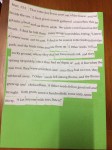
[To prepare, I made two copies of Matthew 13:1-9 in large print, pasted it on board and then cut out each word (a). I made another copy, cut out each word and pasted the words on card (b). Begin by introducing the gospel, and then toss one set of words (a) indiscriminately into the congregation. Call out: “catch! catch!” Conclude with “For the Gospel of the Lord”].

Props

I’m sure that you’d agree that was most unsatisfactory and not the most effective way of sharing the gospel. If I were to present the gospel in this way every week it wouldn’t be long before you began thinking of me as reckless and irresponsible and you would be right. Today, as it happens, I have a copy of the gospel that I prepared earlier. It reads like this (read Matthew 13:1-8).

The discerning among you may have noticed a) that I haven’t read what the lectionary has set down for the day and b) that that means that I have omitted the interpretation of the parable. I’ve left out the interpretation for two very good reasons. Firstly – most scholars do not believe that the interpretation originates with Jesus. Secondly the interpretation throws a very different light on the way in which the parable is heard. The allegorical explanation focuses on the way in which the word is received. In other words, it takes the responsibility away from the sower and places the emphasis on where the seed falls. When we pay particular attention to the response of the seeds to their environment, or interpret the different types of ground as belonging to different types of people we overlook the miraculous growth of the seeds. Even though the seeds are sown indiscriminately they still manage to produce a crop that is over and above even the most optimistic of expectations.

You see, in first century Palestine the usual yield of a crop was a modest seven-fold increase on what was planted. In comparison even a thirty-fold yield is extraordinary. A, sixty-fold or a hundredfold yield would be beyond comprehension! Jesus’ listeners would have been absolutely startled by what they were hearing. They would have been stunned by the reckless and irresponsible behaviour of the sower who, through carelessness wastes precious seeds. Then they would have been completely taken by surprise by the yield – grain that has been sown with wild abandon, not only produces a decent yield, but a yield that exceeds their wildest imagination..

What then is Jesus trying to say? Jesus is reminding the disciples that God does not discriminate. God throws the seed in any and every direction heedless of where it might land and certain that there is good soil in which God’s gifts will take root, grow and produce abundantly. God is not careful or sparing with the gifts that God has to offer the world, but generous and reckless, confident that the response to God’s actions will be overwhelming – beyond imagination

God showers the world with love, compassion and goodness, confident that it will land and take root and reproduce those gifts in abundance.

We have no need to worry ourselves about the future of the church, God will ensure that in one way or another people will continue to respond to God and in this way, God’s love, compassion and goodness will spread throughout the whole world.


For the children – something like this

The Parable of the Sower (or God’s wild abandon)

I ask the children to come forward. Toss some glitter into the air so that it lands on everyone. Ask if they all got some. Ask if I was careful how I threw it (hopefully they will say I wasn’t). Did I try to make it land on the eldest, or the cleverest or the one who was the best behaved? (Again, hopefully they will say I didn’t.)

Wonder aloud how long it will take to come off. Suggest that they will sparkle all day – just a tiny bit of glitter will catch the light. Tell them that whenever someone sees the glitter it will make them smile.

Tell them that God’s love is like that. God throws love at everyone – the good and the bad, the clever and the not so clever, the old and the young. If we know that God loves us, we will love ourselves and everyone else in the world. Just like our tiny sparkles of glitter make people smile, our love will make other people feel loved and God’s love will grow and grow and grow until the whole world is filled with love.

Not up to our expectations?

July 8, 2017

Pentecost 5 -2017

Matthew 11:15-19, 25-30

Marian Free

 In the name of God who defies and exceeds our expectations. Amen.

Some things just don’t live up to our expectations. For example, I found the musical: “Phantom of the Opera” truly disappointing. I had gone with high expectations, but the show left me feeling that something was lacking. “Les Miserables” on the other hand, has never failed to impress whether it be musical or not, stage or film.

The same is true of people. We build up a picture in our mind of someone we have never met, only to find when we meet them or come to know more about them our ideas were quite wrong. A week or so ago the TV programme Compass featured the controversial Anglican priest from Gosford. Rod Bower is known for the sign outside his church that sometimes makes it into

Example of Sign at Gosford Anglican Church

the national news and frequently features in my Facebook feeds. With no information other than Rod’s slogans, I had formed the idea that he had to be something of an extrovert. Compass began with a clip of him setting up the sign and clips of him leading and speaking at demonstrations – both of which suggested to me that he was happy to put himself out there, to engage with people and to be a public figure. However when the journalist interviewed him, he revealed himself to be intensely introverted – to the extent that he found joining parishioners for coffee after church difficult. In reality, Rod was the complete opposite of what I had expected.

It is human nature to create expectations about people and events. By and large we don’t like to be caught by surprise so we prepare ourselves. If we are traveling or attending an expensive show, we do a certain amount of research to ensure that our money is well spent and that we won’t be disappointed. If we are inviting a speaker to a conference we do a certain amount of background research to ensure that they will deliver. In the case of someone whom we have never met, we use the information to hand to create a picture in our imagination. If the person is very different from our expectations we might find ourselves either disappointed or pleasantly surprised.

Jesus found himself in a lose/lose situation. He did’t seem to fit any existing expectation. If he had behaved like John the Baptist – neither eating nor drinking – he would have been rejected as a “wowser” or a “party-pooper”. On the other hand, if he came eating and drinking, he would have been accused of being a party-animal or libertine. At this distance, we have no really clear idea what the first century Judeans expected of one sent by God. Some, it appears, thought that John the Baptist really did fit the bill. He was an ascetic, a prophet who challenged the status quo. People flocked to hear him and to be baptised by him, but the establishment who found both his message and his life-style too confronting did not accept him. Jesus on the other hand appeared to be too ordinary, too much “one of the people” to be the “holy one of God”. It is not that he couldn’t please some, Jesus felt as though he couldn’t please anyone.

Even though Paul and our gospel writers have done a great job of combing through the Old Testament looking for texts that demonstrate that Jesus does conform to the expectations of the anointed of God, their efforts demonstrate never-the-less that it is impossible to find an exact fit for Jesus. Nowhere in the Old Testament does it say explicitly what the people of Israel should be looking for. In fact, some of the expectations contradict each other – the suffering Servant of Isaiah for example, is the opposite of a king of the line of David. As a result of the confusion, by the beginning of the first century there were a variety of expectations. These are evident in the Dead Sea Scrolls or other inter-testamental writings. People variously thought that God might send a king or a prophet or a priest or perhaps that Elijah would return to save the people. Even so, given their rejection of Jesus, it does seem that above all the people of Judah expected a king or at least a soldier – someone who would free them from the foreign oppressors – the Romans.

Despite what our gospels imply, there was at that time no one, fixed, expectation of the “one who was to come”. It was no wonder that Jesus was not universally accepted as the Christ, no wonder that the crowds found it so easy to turn against him when it seemed that it was all going sour.

Jesus simply didn’t fit. He was not a king, or a soldier or a priest. He was not convincing enough to gain the approval of the leaders of the faith and as a result was ultimately unable to maintain the loyalty of the ordinary citizens.

I am sometimes asked: “Why didn’t the Jews believe that Jesus was the Messiah?” The answer lies in today’s gospel – Jesus was not what they expected him to be. Despite everything – his teaching, the healings, the miracles – Jesus did not live up to their expectations or their hopes. He didn’t gather the nation together as a united front against Rome, against the Gentiles, against the hypocritical leaders or even against those who failed to keep the law in its entirety. As a Messiah Jesus was nothing short of disappointing and, to cap it off, his mission ended with his ignominious death.

Expectations – we all have them. What if our expectations of Jesus are the wrong ones? Would we do any better than the first century Jews if Jesus were to come again today or tomorrow?

Our task is to let go of our expectations and to develop a sense of openness to whatever God might do next, whenever and wherever that may be.