Archive for the ‘Matthew’ Category

Heaven can’t make it right

September 5, 2020

Pentecost 14 – 2020

Matthew 18:15-20

Marian Free

May I speak in the name of God, in whom we have our beginning and our ending. Amen.

Those of you who have written a eulogy for a loved one will know how difficult the task can be. If the deceased has lived a long and rewarding life it is impossible to condense that life into just a few paragraphs. If the deceased is young, it is even harder. How do you make sense of the lost potential and find words to honour a life that was too short? Perhaps the most difficult eulogies to write are those for people whose lives have caused pain and trauma for others. I attended one such funeral. The deceased was known to have been an abusive person and I waited uneasily for the eulogist to stand and extol them, to gloss over their defects and to make out that theirs had been a good and worthy life. Thankfully, I need not have worried – what was said was an honest reflection of the life of the deceased. It referred to the usual things: birth, marriage and work and while it did mention the person’s achievements, it didn’t shy away from mentioning their negative characteristics. While the eulogy didn’t directly name the abusive behaviour, it did make clear that the deceased had at times acted in such a way as to cause harm to those closest to them. The eulogy allowed us to farewell someone whom we knew – not some idealised figment of the imagination.  

Clearly, I believe that honesty at a funeral is important. Those present need to feel they are saying farewell to someone whom they know, not to a romanticised stranger. That said, a funeral is not, I believe, a place to settle scores or to air dirty linen – something that Bill Edgar has turned into a successful business. Edgar, a private detective, has morphed his role into what he calls “a coffin confessor”[1]. Clients can employ him to gatecrash funerals where he exposes the secrets and the hypocrisy – not of the deceased, but of the living. For a figure of $10,000 Edgar will attend a funeral to interrupt a eulogy and inform the congregation that the eulogist was trying to have an affair with the wife of the deceased. Or, he might be paid the same amount to escort from the church members of the family who had not visited the deceased for thirty years or more. If anyone tries to prevent Edgar from carrying out his instructions, his client will have pre-empted the situation and have authorised him to take the body away for a private ceremony.

Edgar justifies his role by saying that he has to respect his client’s wishes and by asking: “how many funerals have you been to and listened to absolute rubbish?” 

Surely though, funerals are for the living and not for the dead, they are an opportunity to honour a life and to draw a line in the sand that helps family and friends to acknowledge their loss and to begin to adapt to absence. They are not the place to open or to rub salt into wounds, to exact some sort of retribution or to expose unresolved issues. Employing a “coffin confessor” in the end says more about the person employing him than those whom they see as having caused the injury.

As a culture we are not very good at dealing with conflict – but imagine reaching your deathbed being so bitter and so angry that you would want to cause irrevocable harm after you have gone. Imagine nursing a festering wound for months or years, not wanting it to heal but instead unleashing all its pain when the relationship has no opportunity to be restored, when no redress can be made, and no apology offered? Imagine how unhappy a person must be at the point of dying if they have stored up the hurts and grievances of a lifetime instead of confronting them? I wonder what satisfaction they think that they will get from exposing the perpetrators of that harm, when they themselves are no longer around to see the effects of their action? 

One wonders what sort of vision such a person has of the afterlife? Do they really expect to spend eternity filled with malice and unhappiness – nursing their grievances but secretly pleased that they have been able to unleash havoc on those whom they hold responsible for their pain? Indeed, do they believe that there is a place in heaven for those who wish to lick their wounds and to gloat over the retribution that they have exacted on those whom they have left behind? 

Today’s gospel points out the danger of not resolving conflict in this lifetime. In dealing with differences in the community, Jesus seems to be suggesting that what we bind and loose in the present is somehow bound and loosed for eternity; that there are some things that heaven itself is unable to undo. He implies that those issues that we do not deal with in the here and now cannot be dealt with in the hereafter but remain an integral part of who we are forever. The hurts we inflict, the injustices we create or sanction and the injuries that we harbour stay with us unless we are able to seek and to offer forgiveness, to work through our differences, and most importantly to let go of our egos. 

There is no room in heaven for the sort of self-centredness that demands retribution from the grave and that wishes harm on others. Heaven cannot and will not make it right and it will be too late for us to make changes once we are dead. Any bitterness, resentment, frustration, fear, hurt or self-righteousness that we carry to the grave will remain with us. The endless joy and peace that we had hoped to inherit may be out of our reach in the future if in the present we are unable to find ways to be at peace with ourselves and with each other.  

Let that not be us. May our deaths find us to be the people we hope to be for eternity.


[1] https://www.abc.net.au/news/2020-09-02/coffin-confessor-bill-edgar-reveals-secrets-of-dead-at-funerals/12619946

Order and chaos

August 29, 2020

Pentecost 13 – 2020

Matthew 16:16-21

Marian Free

In the name of God who shatters our certainly and our preconceptions and who continually reforms us in God’s image. Amen.

In his daily reflections over the past three weeks, Richard Rohr has been examining the theme of Order, Disorder and Reorder.[1] He writes: ‘It seems quite clear that we grow by passing beyond some perfect Order, through an often painful and seemingly unnecessary Disorder, to an enlightened Reorder or resurrection. This is the universal pattern that connects and solidifies our relationships with everything around us.’ Rohr argues that this pattern is found in all the world religions. In Christianity this pattern is expressed/lived out in the life, death and resurrection of Jesus or in Paul’s confidence that “in Christ everything old has passed away; see, everything has become new!” (2 Cor 5:17) or that we must be “transformed by the renewal of our minds” (Rom 12:2). 

It is impossible to live in a world in which everything is constantly changing, in which our footing never seems secure. We all need some stability and consistency if we are to develop trust and confidence, if we are to build a sense of self and to grow. Thankfully a great many of us have that experience as children and adolescents. The problem is that a sense of order and security can be so comfortable that some of us never want to leave it. A few people stay in a state of perpetual childhood, terrified of facing the real world. Others put up strong defences to protect them from hurtful or damaging experiences. Still others rigidly hold on to “truths” learned when they were young even though all the evidence proves them to be lies. By surrounding themselves with a safety net, many people avoid pain, but they also deny themselves the opportunity to grow and to experience the richness that life has to offer – love/loss, achievement/failure, order/chaos and so on.

In a spiritual sense as well, holding on to the past can be both stultifying and life-denying. A reliance on order and security can lead to an over-dependence on self or on worldly things such as wealth, recognition or power. It is only when that sense is unsettled or disturbed that that dependence can be broken, and (ideally) a person is forced to turn once again to God and to those things that really matter – the things of the kingdom. In the same way a failure to more from the simplistic teachings of our Sunday School days leaves us ill-equipped to face the complexities of the world. (How many people have lost their faith because the image of God brought over from their childhood failed them as adults?)

I have found these past three weeks of reflections particularly useful for two reasons. One is that they have nicely complemented my reflections on the gospel readings for those weeks and the second is that of course, the pattern of Order, Disorder and Reorder perfectly fits the current situation in which certainty and security have been stripped from all of us. Thanks to COVID few of us have control over our lives in the way that we used to and many of us are wondering what the future will look like. None of us know how, let alone when, the virus will leave us. In this situation – brought upon us by external circumstances that affect the whole world – not many have the capacity or the tools to predict, let alone determine our futures.

It is perhaps not surprising that the movement from order through disorder to reordering is reflected in our gospel readings for this same period. After all the theme of life, death and resurrection lies at the heart of the gospels. 

On August 16 we heard once again the account of the Canaanite woman who changed Jesus’ mind. She challenged Jesus’ long-held convictions of right and wrong, about who belongs and who does not. Jesus’ inherited beliefs were challenged, shattered and replaced. Through this process Jesus’ understanding that his ministry was only for the house of Israel was torn apart and replaced by a view that the gospel was for all people. 

Last week Peter, in response to Jesus’ question, “Who do you say that I am?” responds that Jesus is “the Christ, the Son of the Living God”. However, today’s gospel makes it quite clear that despite his declaration, he has no idea what this really means. His understanding of “the Christ” has been determined by the teachings of the synagogue and the community in which he lived. Even though he was the first disciple to be called and has been a part of Jesus’ inner-circle, Peter’s views and expectations have not been shattered to the point at which he is able to relinquish the past and envision a new sort of future. As we can see, the idea that the Christ might suffer is completely abhorrent to Peter – so much so that he tries to dissuade Jesus from this trajectory.  (In fact, Peter’s determination that things stay the way that they have always been is tenacious. His thinking will not change until he is completely unmade by his denial of Jesus.)

Life does not always run smooth. Its ups and downs will, if we let them, build us into people of compassion, wisdom and resilience. 

Jesus does not promise us that discipleship will spare us from trouble, pain or sorrow. Just the opposite. Jesus asks his disciples to give up everything that until now has given their lives meaning – family, occupation, reputation and he tells them that they must take up their cross if they are to follow him. In return he offers them only the hope of a kingdom that they cannot see and which they do not as yet understand. 

As disciples of Christ, we are challenged to place our trust not in the comfort, security and safety of the values of this world, but to open ourselves to the abundant love of God and to trust that in following Jesus we will be enriched and rewarded in ways far beyond our ability to comprehend.

At this time, we can (and often will) look back to the ways things have been, but the lesson of the gospels is that our lives will be far more productive if we can let go of the past and make our first tentative steps into whatever it is that the future will be. 


[1] You can sign up for the daily meditations on the CAC website.

Context is important

August 22, 2020
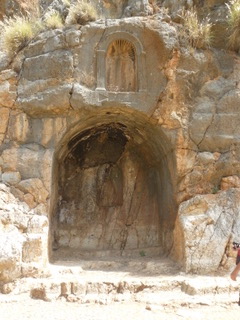
Pan’s Cave Caesarea Philippi

Pentecost 12 – 2020

Matthew 16:13-20

Marian Free

In the name of God who knows what we need to hear and speaks to us where we are. Amen.

Context is everything. Some years ago, the well-known broadcaster and journalist, Philip Adams was invited to address the VFL[1] Grand Final breakfast, this, despite his well-known aversion for the game. Attendees at the breakfast included die-hard fans, high-ranking officials and very often even the Prime Minister of the day. Strangely, for such an experienced writer/speaker, Adams chose that venue and that audience to mock the sport that they all held dear. Adams reports that he “explained to the crowd that Aussie Rules was, in fact, an ancient fertility rite. Like Easter”, he said, “it is all about eggs. The footy is an egg. The game is played on an egg-shaped oval. The goal posts are there to be impregnated” and so on[2]. Needless to say, no one thought that he was remotely funny. Adam’s address was met with horrified silence.  He had completely misjudged his audience. There might have been a place to mock Australian Rules Football, but this was not it. 

If we want to get our message across, if we want people to laugh at our jokes, or to be shocked into changing their ideas or to be comforted by our platitudes we have to be sensitive to our audience. We have to ask ourselves – what is their starting point? what can I say that will speak to their situation? what language will help them to understand what I want to say? Will my words be helpful, or will they add to someone’s pain? 

The gospel writers were masters of context. Each author tailored their retelling of Jesus’ story in a way that they felt would speak directly to their listeners, that would meet them where they were in their faith journey and would draw them into a deeper understanding of that faith.  Their goal, as the gospel of John specifically says: “These are written so so that you may come to believe that Jesus is the Christ, the Son of God, and that through believing you may have life in his name” (Jn 20:31). 

In other words, the gospel writers knew the importance of setting out their accounts in such a way as to give the listeners the best chance of grasping the message of Jesus the Christ. At the same time, they could confront, through their re-telling of Jesus’ stories and miracles, the anxieties and the shortcomings of the communities. Matthew, Mark and Luke were writing to completely different communities – to people with different backgrounds, different experiences of the world and people whose contexts differed greatly. Being sensitive to the needs and experiences of their listeners, each author ordered his account and adapted his story-telling to ensure that the communities for whom they wrote heard what they needed to hear in their current situation – a situation that was vastly different from the time of Jesus and which had its own challenges for the emerging believers. 

Mark’s version of today’s gospel with that of Matthew for this reason. Both authors place Peter’s confession in the vicinity of the city of Caesarea Philippi but there are subtle and not so subtle differences in the telling. Mark emphasises movement not place, journey not destination. His language implies movement. “Jesus was asking (the question is repeated) his disciples while they were on the way (Jesus and the disciples are moving from one place to another).” Movement is an important of Mark’s setting, but so too is his language. “On the way,” is a phrase that Mark uses repeatedly as shorthand for discipleship. Mark presents Peter’s recognition of Jesus as a stage in the journey of discipleship. As we shall see, despite Peter’s declaration that Jesus is the Christ, he has no idea what this means. His declaration is a stage in the journey, not the end of the story.

Matthew’s emphasis is primarily on place or at least the significance of place. Jesus has come into the district of Caesarea Philippi. He is stationary not moving. Caesarea Philippi was close to a cave and a spring that were dedicated to the Greek god Pan and was believed to be the entrance to the underworld. Herod the Great had built a Temple to Caesar Augustus here to curry favour with the Emperor. The region was inherited by Herod’s son Philip who made it his administrative headquarters and dedicated it to the then Caesar. Caesarea Philippi was important for other reasons. It was near a major trade route and it was the place to which the commander of the Roman army had returned to celebrate with his troops after they had crushed Jerusalem. In other words, it was a place that was redolent with symbolism – of power, religion and economic viability. 

Whereas in Mark, Jesus’ question: “Who do you say that I am?” is primarily a question about Jesus’ identity, in Matthew the question has more to do with allegiance. Matthew’s readers are being challenged to ask themselves in what and in whom do they trust. Are they over-reliant on their economic security? Are they tempted by their culture’s latest fancies? Do they place their trust in the power of secular rulers? Where – in the midst of all the worldly distractions – does their loyalty lie – with earthly powers or with the power revealed by Jesus, “the Christ, the Son of the living God”? 

The gospel writers knew their communities and understood their needs. They knew when to challenge and when to comfort their audience. Mark wants to move the community along the road to belief, Matthew wants them to consider where their true loyalty lies.   

Context is important. If we want to share the gospel with our contemporaries we need to understand where they are coming from. We need to recognise and understand their longings and their fears, their strengths and their weaknesses so that we can speak in a way that will touch their hearts, utter a message that responds to their deepest needs and offer a word that will bring them into the presence of the living God.


[1] For overseas readers, VFL in those days highly parochial. Most Melbourne suburbs had their teams and followers were fiercely loyal even fanatical in the way of many soccer fans.

[2] Reported by Phillip Adams The Australian Magazine, August 15-16, 2020.

Hearing the cries of the oppressed

August 15, 2020

Pentecost 11 – 2020

Matthew 15:21-28 (some thoughts)

Marian Free

In the name of God who is dynamic and active not confined by human imagination. Amen.

Sometimes it takes spontaneous movements to bring about institutional change (the Arab spring for eg) and sometimes it is the quiet persistence of just one person that sets a ball rolling that starts a chain of events that lead to real and lasting change.  In 1955, on a bus in Montgomery, Alabama Rosa Parkes refused to stand for a white man. Her action inspired the Montgomery Bus boycott which lasted for over a year at the end of which the United States Supreme Court ruled that segregation was unconstitutional. In turn the boycott gave courage to the millions of disenfranchised and disenchanted black Americans who under Martin Luther King began the civil rights movement. Later, in 1977 Harvey Milk was elected as a city supervisor in the city of San Francisco. Milk had become increasingly politicized – in particular by the prejudice and discrimination he witnessed and experienced as a gay man. It has been claimed that Milk was the most famous and significant  LGBT official elected in the United States. His time in office was short lived. Milk was assassinated by a disgruntled city supervisor eleven months after being elected to office. Milk served almost eleven months in office, during which he sponsored a bill banning discrimination in public accommodations, housing, and employment on the basis of sexual orientation. His impact was acknowledged in 2009 when he was awarded the Presidential Medal of Freedom.

Parkes and Milk and numerous others demonstrate that quiet, firm persistence, an awareness of one’s own worth and an insistence that that worth be recognized can overturn unjust institutions and prejudicial laws.

The woman from Canaan was one such person. Jesus’ refusal to respond to her request did not deter her. She had a clear sense of her own value (and that of her daughter). Neither Jesus’ silence nor his disciples’ demand that Jesus send her away had the capacity to make her feel underserving of his notice. She would not allow them to ignore or demean her. Even when Jesus tried to defend his response – claiming that her daughter’s distress was not his problem, the woman stood firm, she engaged him in debate and in so doing convinced Jesus of the justness of her cause. As a consequence of the actions of the woman, the whole course of history was changed. Jesus’ claim that he was sent ‘only to the lost sheep of Israel’ was successfully challenged and, as the letters of Paul make clear, the definition of Israel was broadened to include not only those of Jewish descent, but all those who believed in Jesus.

We are all created in the image of God. None of us should feel that we deserve to be demeaned, put down or put upon. Confident in God’s love, each of us should be able to be certain of our place in the world and entitled to claim it. More importantly, those of us who are privileged by virtue of our place of birth, our education or our income should be willing to hear the voices of the oppressed, the marginalised, the disadvantaged and the disenfranchised.

Despite his hesitation, Jesus responded to the woman’s plea and to her argument. So we too should be open to having our opinions, our values and our prejudices challenged and changed.

If through our own parochialism, ignorance or arrogance, we remain deaf to the cries of others, we may find ourselves thwarting the will of God.

Stormy waters

August 8, 2020
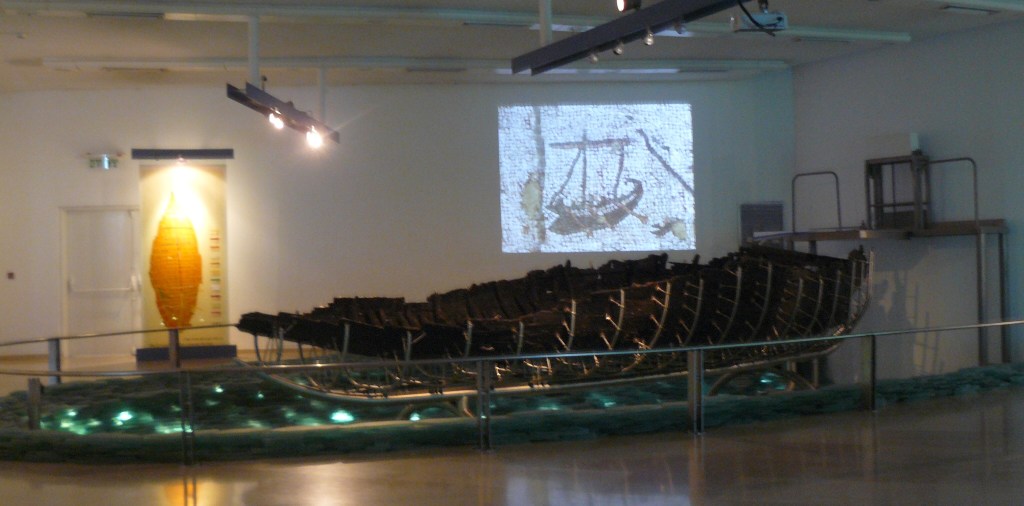
The Jesus boat

Pentecost 10 – 2020

Matthew 14:13-21

Marian Free

In the name of God who understands our deepest fears and who overlooks our multiple weaknesses. Amen.

The most visited tourist destination in Israel is Kibbutz Ginosar on the shores of Galilee. It was here, in 1986 that two brothers, Moshe and Yuval Lufan, found the remains of a first century boat. That year the water levels were particularly low and the brothers – who spent a great deal of time looking for artifacts – came across a rusty nail which, on inspection belonged to a boat, buried in the mud beside the water. Recovering the boat was a mammoth task. Archaeologists had to work out how to excavate the boat without damaging or destroying it. This meant keeping the timbers wet, moving the fragile structure in one piece, cleaning off the mud without touching the boat, and finding the right fish to keep the bacteria away. Thankfully the hard work was rewarded with success and the boat can now be seen in a museum close to where it was found.

Boats are a feature of the gospels. Jesus calls four fishermen to follow him, he teaches from a boat, is responsible for an extraordinary catch of fish from a boat and he himself seems to criss-cross the Galilee in a boat. The discovery of the “Jesus boat” puts flesh on the gospel stories and enables us to visualise Jesus and his disciples as they sail from one side of the lake to another. The popularity of the “Jesus boat” lies in the fact that it is probably the most intact structure that can be related directly to Jesus’ life and ministry. 

Fishing, in the time of Jesus was regulated by the Roman government – delegated to local officials. Anyone who wanted to fish needed to purchase fishing rights and a proportion of the catch was subject to tax. Fishermen were at the mercy of the brokers and tax-collectors. They were also vulnerable to the vagaries of the sea – a good catch was never guaranteed and the sea could whip up into a storm at any moment. Most fishermen could not swim, and, as the sea was considered to be the home of demons, falling overboard was doubly dangerous. No wonder the disciples were terrified when they found themselves on the lake, at night, in the middle of a storm.

An account of Jesus calming the sea is one of the few stories that occurs in all four gospels – sometimes twice. In Matthew, Mark and John it follows Jesus’ feeding of the 5,000.  Matthew and Mark have included an account of Jesus’ walking on the water. In every instance, the event illustrates Jesus’ power over nature and over the demonic forces, but the authors use the story in very different ways. (Only Matthew chooses to include Peter’s attempt to walk on water – his initial confidence and his ensuing doubt.) 

In Mark, Matthew and John, Jesus is not in the boat when the storm blows up. He has stayed behind. Later, during the storm, he walks across the water towards the boat. A comparison of Mark and Matthew is interesting and illustrates the different purposes of the gospel writers and the different ways in which they depict the disciples and the disciples’ reaction to the stilling of the waters[1]. In Mark, the incident is directly related to Jesus’ feeding of the 5,000, specifically the bread. When Jesus enters the boat and the wind ceases the disciples are utterly astounded, but there is no expression of faith because: “they did not understand about the loaves, but their hearts were hardened.”[2] Matthew reports an entirely different reaction. When Jesus and Peter get into the boat (after Peter’s failed attempt to walk on water) and the wind ceases, the disciples worship Jesus as the Son of God. 

In Mark’s gospel, the disciples never identify Jesus as God’s son. Indeed, other aspects of Mark’s telling of the story, suggest that the question of Jesus’ identity remained a secret until the resurrection. Throughout that gospel the disciples are consistently depicted as foolish and lacking in understanding. In contrast, Matthew suggests that despite the fact that the disciples do recognise Jesus as the Son of God, they constantly waver between doubt and faith (even after the resurrection – Mt 28:17). 

We will never know for certain the purpose of the authors. (We have nothing except the gospels on which to base our conjectures). Is Mark, the first of the gospel writers, describing the disciples as they really were and did Matthew, dismayed that the founders of the church were presented as such poor role models, remodel their failings from misunderstanding to doubt? Or did the community for whom Mark was writing need models that shared their misunderstanding, and did Matthew’s community need to feel that even the disciples had moments of doubt? 

Whatever the truth of the matter, the writers of the gospels have given us disciples with whom we can relate, real people with real fears and failings. This means that if we are confused, we can be reassured that the first disciples were confused. When we are afraid, we can identify with disciples, who despite being in the presence of Jesus still experienced fear.  At those times when our faith wavers or when we are overwhelmed by the circumstances in which find ourselves, we can be comforted in the knowledge that the disciples too had moments of doubt. 

Our gospel writers did not gloss over the failings of the disciples, nor did they present them as exemplary models. In our gospels we find disciples with whom we can identify. Through them we are assured that God does not expect perfection but will find ways to use us – however weak our faith, however wavering our courage and however poor our understanding. 

There is one thing of which we can be sure that, whether we falter or not, whether we are uncomprehending or not, whether we are brave or not God’s love for and confidence in us is steadfast and unwavering.


[1] Read Matthew 14:22-33, Mark 6 45-52 (John 6:16-21 Jesus doesn’t calm the storm, but he does walk on the water.)

[2] Hard to know just what this means!

Besides women and children

August 1, 2020

Pentecost 9 – 2020

Matthew 14:13-21

Marian Free

“And those who ate were about 5,000 men, besides women and children.” Matt 14:21

In the name of God who by becoming one of us affirms the dignity of all humanity. Amen.

Some time ago I watched a rather harrowing movie – The Whistle-blower – starring Rachel Weisz. The movie is based on the real story of Kathryn Bolkovac, a police officer in Nebraska, who was recruited by an American company, DynCorp International. DynCorp had a contract with the United Nations to hire and train police officers for duty in Bosnia and Herzegovina. Kathryn had not been in Bosnia long when she came across Raya, a young Ukrainian woman, who had managed to escape from a brothel where she was being sexually exploited and abused. Raya had been trafficked across the border by the uncle of a friend who had persuaded both girls that he had found them a job in a hotel. It was a sophisticated operation. He had brochures of the hotel and job descriptions but in reality, he was preying on their financial vulnerability and their trust in him. When the girls arrived in Bosnia, they discovered that they had been sold into prostitution. If the movie was accurate, the conditions in which the women were kept was appalling and the brutality they experienced at the hands of their “keepers” was horrendous. 

Bolkovac endeavoured to find a place of safety for Raya only to discover that her employer, DynCorp was facilitating the sex trafficking and worse, that the international peacekeepers knew of the operation but chose to turn a blind eye. As a consequence, Raya’s whereabouts was leaked, she was recaptured, violently punished. Within a few weeks was shot dead as an example to others. Kathryn tried to bring the situation to the attention of the United Nations and as a result she received death threats and was fired. She took her employers to court for unfair dismissal and won, but while she reported that the company was involved in prostitution, rape and sex-trafficking, only local employees were prosecuted as UN contractors had immunity from prosecution.

The deliberate, calculating trafficking of people for profit is endemic. Despite the efforts of William Wilberforce and others in the late 18th, early 19th century, slavery is far from dead. At any one time in 2016 there were an estimated 40.3 million people held in slavery. Over 40 million people – that is 5.4 people for every thousand person on the planet! The statistics are horrendous:  

  • 51% of identified victims of trafficking are women, 28% children and 21% men
  • 72% people exploited in the sex industry are women
  • 63% of identified traffickers were men and 37% women
  • 99%  percent of all women and girls who are trafficked are trafficked into the commercial sex industry.[1]

Australia is not immune to this trade in human beings. In 2018, Anti-Slavery Australia helped over 123 people who had been trafficked to or from Australia.[2]  A study by the Australian Institute of Criminology published in February last year estimated that in 2015-16, 2016-7 the number of people trafficked or forced into slavery in Australia was between 1,300 and 1,900 meaning that for every person who is identified as being trafficked or enslaved, there are another four who are not identified.[3]

Trafficking is only the beginning of a lifetime of exploitation, torture and abuse.

There are millions of stories of trafficking, exploitation and abuse – slavery in the 21st century.

The human capacity to denigrate, dehumanise or ignore others is almost beyond comprehension. The ability to be blind to the talents, hopes and dreams of those who are different from ourselves almost defies belief. And yet, as is evidenced by modern day slavery, both are very real human characteristics. 

Whenever we view another person or group of people as lesser than ourselves, we are in danger of dehumanising them – as if there were gradations of being human. When we consider that another person is of less value than ourselves, we free ourselves to disregard their needs, their feelings and their ambitions which in turn frees us to treat them in ways that are cruel, degrading and exploitative. When we take the view that a person or group of people exists primarily as a source of our own comfort or our own enrichment, we become blind to their needs for comfort and security. Whenever people are put to use to improve the lifestyles of others, they are vulnerable to financial exploitation or to physical or sexual abuse. 

Failing to take notice of the gifts, talents and capacities of people whose race, background or economic status are different from our own, impoverishes all of us. We not only lose the contribution they could make to our society; we also allow our own selfishness free rein. At the same time, we also excuse ourselves from taking responsibility for their well-being, and fail to advocate on their behalf. 

In today’s gospel it is the women and children who are unnoticed. Jesus fed 5,000 men we are told by Mark and Luke to which Matthew adds as something of an afterthought: “besides woman and children”. Only John includes everyone in the story.

Throughout history many people have been left out of our story – women and children, the poor, the disenfranchised, the disadvantaged, the prisoner, people of colour, people whose faith is different from our own, people whose sexual orientation or gender identification does not conform – on and on it goes. 

If slavery and exploitation are to end, it has to begin here, with us – with our own attitudes, beliefs and values. 

Who are the people whom we leave out of the story and whom are we abandoning to potential abuse and exploitation by our ignorance, our blindness, our selfishness and our desire to pay less than a product is truly worth?

In other words, who are the “besides” in our story and what will it take from us to ensure that they are included?


[1] https://www.antislavery.org/slavery-today/human-trafficking/

[2] https://theconversation.com/human-trafficking-and-slavery-still-happen-in-australia-this-comic-explains-how-112294

[3] https://www.aic.gov.au/publications/sb/sb16

The seduction of the kingdom

July 25, 2020

Pentecost 8 – 2020

Matthew 13:44-58

Marian Free

In the name of God whose thoughts are not our thoughts and whose ways are not our ways. Amen.

There is something seductive about religious experience. Being filled with the Holy Spirit or feeling as though one is in the presence of God is such an amazing feeling that many people try to recreate it. In the process they forget that God is not at our disposal to be summoned at will. The same is true of preaching. My own experience is that there are times when I speak with such passion that I can feel the impact my words are having. While it is tempting to make this a regular habit, I am aware that it would take me down the track of insincerity. I would become more concerned about the effect of what I was saying rather than the content. I would be relying on my own ability to move people rather than on the Holy Spirit. This tendency to self-congratulation can, I think, be seen in some evangelists who almost certainly begin with good intentions, but who become convinced of their own power to move people and end up build empires that are really about themselves not God.

Over the last two weeks we have been exploring the interpretation of parables. I have suggested that the purpose of parables is not – as the biblical interpretations suggest – clear and accessible. Parables are, we believe, intended to jolt us into a new and different way of thinking. I suggested that a good example of this is the parable of the Good Samaritan. Jesus’ listeners (ordinary Jews) would have been expecting that the third person along the road would have been one of them. First, the Priest, then the Levite – the next one would surely be a person to whom they could relate. Imagine the listener’s surprise when the third character on the road is not one of them but a despised Samaritan. It is he, the enemy, who stops to help the injured Jew. This is the sting in the tail, the unexpected twist that forces the audience to reconsider their long-held prejudices and challenges their accepted ideas as to who does or does not belong in the kingdom of heaven.

Today’s parables are no less shocking, in particular the one about the field. Again, because the parable is so familiar and because we are so used to hearing it in the context of the parable of the pearl, we hear it in the positive sense of giving up everything for the sake of the kingdom. In so doing, we miss the blatant immorality of the parable and give no thought to the possibility that the one buying the field is enriching himself – potentially at the expense of another. Selling everything in order to achieve the kingdom might seem to be a noble action but even in today’s society, buying property without disclosing information regarding its true worth would be regarded as devious and self-seeking. 

“The kingdom of heaven is like treasure hidden in a field, which someone found and hid; then in his joy he goes and sells all that he has and buys that field” (Matt 13:44).

In the ancient world burying treasure or items of value was a common practice – especially in the context of war and exile. It was not unusual for the person who hid the treasure to forget where they hid it, to die without sharing its location or to be in a position from which they never returned home. Ownership of found treasure was a matter for discussion among the rabbis which suggests that it was not an unusual circumstance.

In the case of the parable, it is clear that the treasure does not rightfully belong to the finder and that the finder buys the field with the intention to deceive – why else would he hide the treasure having found it? As Crossan points out: “If the treasure belongs to the finder, then buying the land is unnecessary. But if the treasure does not belong to the finder, buying the land is unjust.” This is not the only issue that the parable raises. In order to purchase the field, the finders sells all that he has an action that potentially leaves him impoverished. He may have the treasure but in all likelihood,  he cannot use it[1]. What then does the treasure have to do with the kingdom?

Scholars like Crossan and Scott believe that the key word in the parable is “joy”. They suggest that there is a lawlessness to joy, to the kingdom, something that disrupts the normal flow of events, a force which is freely given and distributed, but which cannot then be constrained or refrained. (Think of the sower who throws the seed with wild abandon – heedless as to where it might land and how it might – or might not – grow.) No thought is given to the recipient of the treasure. There is no test of character, no limits placed on the use of the gift. The seed is thrown, the treasure brought to our attention, whether the recipient deserves it or not.  It is, they suggest, the very “lawlessness”, the unexpected nature of the treasure-finding that means that it has the capacity to both bring joy and to corrupt.

Here is the sting. The idea that the kingdom has the power to corrupt pulls us up short. If it is the kingdom of God, how can it be anything but pure and moral and yet the examples with which I began indicate that that it is possible for the weak to be seduced by the gifts and the power of the Spirit and to use them for their own ends rather than for the advancement of the kingdom. 

The parable may tell us about giving up everything to achieve the kingdom, but this seems too self-evident. It is more likely that Jesus tells it to shock his listeners out of their complacency, to challenge their beliefs that God’s gifts are given only to the deserving, to undermine their desire to see only the positive aspects of God’s gifts and most importantly, to warn us against relying on our own egos rather than being totally dependent on the presence of God with us.

The kingdom of God is like treasure – once it is given, God does not demand it back. Be careful how you use it. 


[1] We have to remember that this is not a true story. There are a lot of unanswered questions – if the man does not own the field, what is he doing digging in it? If he is there legitimately as a day-labourer or a slave, what can he possibly have to sell?  

Leaving it up to God

July 18, 2020

Pentecost 7 – 2020

Matthew 13: 24-30, 36-43

Marian Free

In the name of God who sends rain on the just and the unjust and causes the sun to shine on both the evil and the good. Amen.

The events of recent times – Covid 19 and “Black Lives Matter” – have brought out both the best and the worst in human nature and have revealed deep divisions in our society and more particularly in that of the United States. To give one example, the legislated wearing of face masks seems to have touched a deep chord in the people who are objecting to the ruling. In Florida, an enquiry into the legislation heard the most extraordinary, and emotive reasons as to why the wearing of masks was, among other things, satanic. Passions are running so high on this subject that in the United States people have been spat on, a man has been charged with making terrorist threats and woman who was asked to wear a mask in a store began throwing her groceries everywhere. In Gosford in Australia, friends of mine were rudely told to remove their face masks by a young passer-by. These reactions, though unpleasant, pale into insignificance compared with the young bus driver in France who was hauled from his bus and kicked to death simply for asking four passengers to comply with the requirement to wear masks.

The pandemic has exposed vastly different attitudes to authority, competing interests with regard to health and to the economy and opposing views about the nature of freedom. At the extremes of some of these positions are people who are so convinced that they alone are right, so threatened by change, so worried about the impact on their personal freedom that they are taking matters into their own hands with, as we have seen, tragic results. 

In these difficult times, differences and divisions between different elements of society are highlighted and exaggerated leading to parochialism and partisanship. People are divided into them and us with “them” being everyone who holds a different view or behaves differently from ourselves. 

Parables such as the one I have just read play right into this tendency to divide society into those who agree with us and those who do not, those who hold our faith and those who don’t, those who are rigid adherents of the law and those who are not. The way that this parable is usually understood  – thanks to Matthew’s addition of an interpretation – can lead to self-satisfaction on the one hand and condemnation of the other on the other hand. If we are wheat (which of course we are!) then those who are different from ourselves must be weeds and by definition must be destined for destruction.

However, as Rosemary reminded us last week, Jesus’ parables are primarily about the Kingdom of God (or Kingdom of Heaven). They are not about us. 

I have said on many occasions that parables are not neat and self-explanatory (as Matthew’s interpretations suggest). Jesus doesn’t tell parables to affirm the way we see the world but rather to challenge our preconceptions, to shake us up and to move us to a new way of thinking. In other words, rather than confirm our world view, Jesus tries to help us to view the world from another, completely different perspective – that of the Kingdom of Heaven.

Take today’s parable for example – the sower is not, as might be expected, a poor share farmer, a day-laborer or a slave but a householder. We learn that the sower owns both land and slaves. Jesus’ audience would have pricked up their ears. Why, they would have thought, didn’t the householder delegate the task of sowing to his slaves? This is not the only aspect of the story that would have jarred with common practice or experience. Jesus listeners might have wondered why an enemy would plant darnel – a weed so commonplace that it would most likely have sprung up by itself and why would the householder instruct the slaves to leave it to grow when good agricultural practice would have been to weed the crop? You certainly wouldn’t allow these weeds to grow – the seeds of darnel are poisonous. Harvesting the plants together would have risked mixing the two thereby making the wheat worthless.

What to us, who are so far removed from first century Palestine, seems like a possible scenario, would, to Jesus’ listeners, have been a reversal of normal practice – slaves plant the seeds and crops are weeded as necessary. In the Kingdom of Heaven Jesus suggests, the good and bad exist together – separated only at the harvest.

Left to stand alone the parable exemplifies the complexity of human existence and the fact that Christians and non-Christians alike comprise the good and the bad, the saintly and the unsaintly, those with open and receptive hearts and those who are narrow and mean-spirited. Discerning who belongs in which camp can be as difficult as determining which is wheat and which is weed. As individuals and as community, we represent the breadth and depth of human experience and of human behaviour – the best and the worst together. 

The point of the parable seems to be this – that the world and its people are full of complexities, and it is not up to us to make distinctions based on our ideas of right and wrong, good and bad. Only God can truly discern the purposes of our heart. Only God can recognize what has made us who and what we are. Only God is in a position to determine who is good and who is not. Judgement will happen in its own time and without our intervention. 

If the wheat and the tares are left to grow together, if the good and the bad in ourselves and others are part of the reality of our existence and if rooting out the bad has the potential to damage the good, then perhaps the lesson is that we should be more gentle with ourselves and more understanding and compassionate of others.

Above all, in today’s turbulent times, perhaps we should humbly mind our own business and leave to God the matter of judgement. 

The profligacy of God

July 11, 2020

Pentecost 6 – 2020

Matthew 13: 1-9, 18-23

Marian Free

In the name of God who created the universe from nothing and whose boundless generosity is strewn with wild abandon throughout the world. Amen.

The parable of the sower is something of a golden oldie. Almost from our first encounter with church we learn this story and its interpretation. The imagery is graphic and simple – weeds choking, sun burning and birds eating. It makes a great Sunday School lesson. Children can be presented with pictures of seeds landing in bad or indifferent places and growing or not growing as a result. They can be encouraged to think about what sort of soil they might be and made to feel guilty because they are not disciplined enough, not brave enough.

This is a problem which not helped by the attached interpretation which is found in all three gospels – which draws our attention away from the sower to where the seed lands. However, when we are distracted by the soil – good, bad and indifferent, we fail to be astounded by the randomness – some would say thoughtlessness – of the thrower. In other words, concentrating on where the seed falls leads to our focussing on ourselves – on the state of our own spiritual ground instead of looking to where the seed comes from.  We find ourselves wondering about the state of our spiritual lives and, in the worst-case scenario, having judged ourselves we turn outwards and judge others. (Which of us represents the seeds on the path, the seeds on the rocks or the seed among thorns?) How often have we in the church thought to ourselves or out loud, that the reason that our churches are empty is because everyone else has become distracted by the cares of the world? 

Interestingly, scholars generally agree that the interpretation of the parable is a later addition – an explanation added by the early church to provide justification for the indifference of non-believers or the lack of courage or failure of commitment on the part of some who had come to faith but fallen away. This interpretation could be used to affirm members of the believing community, who could, as a consequence of their steadfastness, consider themselves to be the good soil.

Parables were, by and large, intended to stand alone. They usually said something unusual or shocking that challenged a traditional way of thinking and forced the listener to consider the world in a new way or to change their conventional way of thinking. (Think for example of the parable of the Good Samaritan – a contradiction in terms for a self-respecting first century Jew. There was no such thing as a Samaritan who was good.) The point of a parable came in the unexpected “sting” or surprise at the end – a mustard seed that becomes a tree, a farmer that sells everything for one pearl.

Further support for this argument lies in the fact that parables are usually intended to tell us something about God or about the kingdom of God. Most parables begin: “The kingdom of God is like …” To make this parable about the seed and the soil is to make the parable about ourselves rather than about God. It leads us to dwell on ourselves and our reaction to the word of God rather than directing us to consider the action and nature of God – an action that is wildly extravagant and which stands in stark contrast to the action of a careful, prudent first century farmer[1]

According to the parable, the sower tosses scarce and precious seed with gay abandon; is utterly heedless as to where it might land and gives no thought as to the condition of the ground where it might fall or the waste that might result. This sower, it appears, is not fixated on the final crop, nor is the sower concerned about giving each individual seed the best chance of growing and producing fruit. Rather, this sower seems to be more anxious that the seed is spread as widely and generously as possible – regardless of where it might fall and whether or not it will be able take root and grow. Here’s the point though – what seems extraordinary and rash to a prudent farmer is not as foolish as it seems – the crop that results from such carelessness is not pitiful it is enormous! The seed that does take root and grow produces grain in abundance – one hundredfold, sixtyfold and thirtyfold! 

The significance of such a crop would not have been lost on Jesus’ audience. In first century Palestine the expectation would have been that a crop would produce sevenfold – tenfold at best. Even thirtyfold would have been an amazing result, 60 would have been extraordinary and 100 would have been simply unbelievable. 

When we concentrate primarily on the interpretation of the parable – the seed and the soil – we are tempted to make the parable about us, to become self-absorbed and mean spirited, seeing primarily ourselves and our various reactions to God’s words and God’s actions as the point of the parable.

When we take our focus off the ground and place it on the sower where it belongs, we are forced to be less egocentric and less concerned about how we, or anyone else reacts to the word of God. Paying attention to the parable rather than to the interpretation enables us to see the wanton extravagance of God and God’s confidence that God’s word – spread without thought and without restraint will land on good soil, will take root and will produce abundantly.

The challenge of today’s gospel is to stop navel-gazing and to turn our attention outwards to the boundless, senseless, heedless profligacy of God.  


[1] There are more technical reasons to believe that the interpretation is a later addition, in particular the fact that the structure of the interpretation does not match the structure of the parable.

Not dancing or mourning

July 4, 2020

Pentecost 5 – 2020

Matthew 11:16-19,25-30

Marian Free

In the name of God who defies all our expectations. Amen.

In February 2006 a woman at a University bus stop in Brisbane was left face down in her own vomit for 5 ½ hours. Delmae Barton, an internationally renowned opera singer had been on her way to work when she had a stroke and a mild heart attack. For five and half hours she lay in 35 degree heat while people walked around and past her and even sat in the bus-stop beside her. Not one of up to a thousand commuters or one of several bus drivers thought to call an ambulance and not one person stopped to offer help. Finally, two Japanese men stopped and asked if she needed help and offered her a glass of water.

Delmae was well-dressed and was on her way to a university job which in most circumstances would have given her respect and status on campus, if not in the broader community. She was well-educated, well-travelled and well-regarded, and she was left to die in broad daylight, in a public place frequented by many people. It seems unbelievable, until you realise that Delmae is aboriginal and that the colour of her skin led people to assume that she was drunk – apparently a good enough reason not to offer assistance or even to ask if she was OK. 

Like most university campuses, this one is off the beaten track. There was no reason to think that anyone would be there unless they were related to the university – whether students or staff – but it seems that no one stopped to think of that. Those who chose not to assist Delmae were blinded by their prejudices and their stereotypical images of first nation people. They could not imagine that the person lying in front of them was a university lecturer. They were unable to see her as a fellow human being, let alone as a woman of stature in Australian society. 

The colour of Delmae’s skin led passers-by to make assumptions about her condition and those assumptions freed them from any sense of responsibility towards her.

Expectations and stereotypes are not limited to people of different races or cultures. We are all guilty of categorising those who are different from ourselves and of placing realistic and unrealistic expectations on groups of people. Stereotypes free us from thinking and allow us to make broad generalisations that may or may not fit anyone in a particular group, let alone each individual person. 

Stereotypes simplify our lives and are useful when they help us to understand people and cultures that are different from ourselves, but they also confine and limit those people to specific roles and behaviours and can prevent us from seeing each person as an individual in their own right and from understanding that for every person who fits the stereotype there is another who does not. 

It is this all too human tendency to classify and stereotype that Jesus is challenging in today’s gospel. “This generation”, presumably Jesus’ fellow countrymen and women, seem unable to recognise either John the Baptist or Jesus for who they are – people sent by God, whether prophet or anointed one. John’s austerity is associated with demon possession and Jesus’ more relaxed behaviour leads him to be called a glutton. Both have been characterised, demonised and rejected on the basis of one aspect of their behaviour – their attitude to food and drink. Neither, it appears fit their generation’s expectation of a saviour – whatever that was. 

In all likelihood, Jesus’ contemporaries would have had great difficulty identifying him. As the parable suggests they would not have recognised Jesus as God’s anointed if he had been less like them and they didn’t recognise Jesus because he was too much like one of them. John was too different for them to relate to and Jesus was too ordinary to be seen as someone extraordinary.

Jesus is making is clear that he is in a lose-lose situation. No matter how he behaves, no matter what he does, he will not meet the expectations of his contemporaries. Even Jesus’ followers will need the benefit of hindsight to see that Jesus’ teaching and actions were consistent with God’s promises. 

You and I can trawl through the scriptures and locate all the references relating to how God will work or will be revealed in the world and we will not be able to pin them down to one or even two possibilities. This is because God refuses to be categorised or restricted. The very nature of God is that God cannot be pinned down or confined by human imaginations. No matter how creative or free-thinking we are, God will always beyond our horizons. We will catch glimpses of God’s presence from time to time, but never be able to fully grasp the enormity or the awesomeness of God. 

Jesus’ condemnation of his generation is a warning to us – a reminder that our understanding is always limited and that however much we think we know there is always more to know. We cannot afford to be complacent, nor can we afford to stop exploring and searching – for this is a journey that has no end point except death. God will always be just beyond our reach until we are finally face-to- face. Until that time our task to retain an openness to God’s presence in the most unlikely people and places. Through prayer and contemplation, we must let go of our stereotypes and expectations and allow God to be God and not who or what we think God to be. Or else we will play the flute and be disappointed that God does not dance, or wail and be frustrated that God does not mourn and we will miss the fact that God has been right there in front of us all the time.