Archive for the ‘Palm Sunday’ Category

Standing out from the crowd

April 12, 2014

Palm Sunday – 2014

Matthew 26:14-27:66

Marian Free

In the name of God who challenges us to discern right from wrong and to have the courage to stand out from the crowd. Amen.

Anyone who has ever been to a concert or a sporting match knows that it does not take long to snap into sync with the crowd. Being part of a group can be extraordinarily compelling and energising. The sense of sharing a common interest holds together people who are very different from each other and causes them behave as one.

Crowds are notoriously difficult to control – in part because of this sense of unity and in part because as a result, they take on a life of their own. In many instances – especially in the case of spontaneously formed crowds – the group morphs into a self-organizing system. There is no need for central control – the common purpose holds them together. In the case of a sporting event or concert, there is no one with a megaphone saying “now!” Everyone simply cheers (or boos) together. They know instinctively how to behave. They are absorbed into the behaviour of the crowd and act as one. Even when a crowd has a leader, a crowd mentality can take over making the leader powerless – for example, surging forward despite being urged to stop or rioting when the intention was a peaceful protest.

Crowds can be sinister or positive. It is easier to be brave (or foolish) when you know that you are acting in a manner that is consistent with those around you. Being part of a group creates a feeling of solidarity, a feeling of empowerment, a belief that the many can make a greater difference than one. Being part of a crowd can be also liberating and disinhibiting. The sense of anonymity, the adrenaline rush provided by being in a crowd can provide just the excuse for someone to behave in a lawless manner, when at other times public opinion (or their own conscience) would prevent them from doing the same thing.

A crowd can work together for good – changing an unjust government or law or cleaning up after a natural disaster. But a crowd can just as easily work for bad. Crowds can turn ugly in a moment. The same mentality that had a group protesting peacefully can be turned into the opposite by the action of a few. Crowds can determine the fate of a nation, but they can just as easily decide the fate of an individual.

It can be difficult to hold one’s position, to be the person standing out from the crowd, the one shouting: “stop!”, when everyone else is shouting: “go!” Only truly courageous people have the courage to act unilaterally – to go against the flow, to stand up for a principle or ideal when no one else can yet see the need.

It is not surprising that crowds were drawn to Jesus’ arrival in Jerusalem. That he was on a donkey was calculated to attract attention. According to Zechariah, this was how the promised King would arrive. No doubt some people noticed and, thinking the prophecy fulfilled began to gather and cheer. Soon others would have joined. As the excitement built, more and more people would have wanted to be part of the excitement (perhaps so they could tell their grandchildren that they had been there). It is not surprising that the Romans and the leaders of the Jews were anxious – they knew from bitter experience how little it took for a crowd to become a riot.

It is not surprising that after Jesus’ arrest, the crowds gathered to see what would happen next. Many would have been wondering who Jesus really was and whether – if he were the King – he would find a way out of the predicament in which he found himself. Moreover, for those who have little to look forward to, a trial breaks the monotony of everyday life. It has the potential to create drama and intrigue and the outcome is never certain. Once a crowd had gathered, it could be easily manipulated. The chief priest (or others) would not have found it too difficult to incite the crowd to shout: “Barabbas” or “crucify him!” Those who did not want to join in would have found it hard to remain silent.

Because we know the story, it is easy to believe that we would have behaved differently, that we would have resisted the pressure of the crowd, and that – heedless of the consequences – we would have taken a stand to prevent an innocent person condemned to death. However, there is no reason to believe that we would have behaved any differently, that, in the circumstances we would have found the courage to stand-alone against a crowd.

Let us hope that we will not be put to the test and that if we are, we will not be found wanting.
March 23, 2013

Palm Sunday 2013

The Passion According to Luke

Marian Free

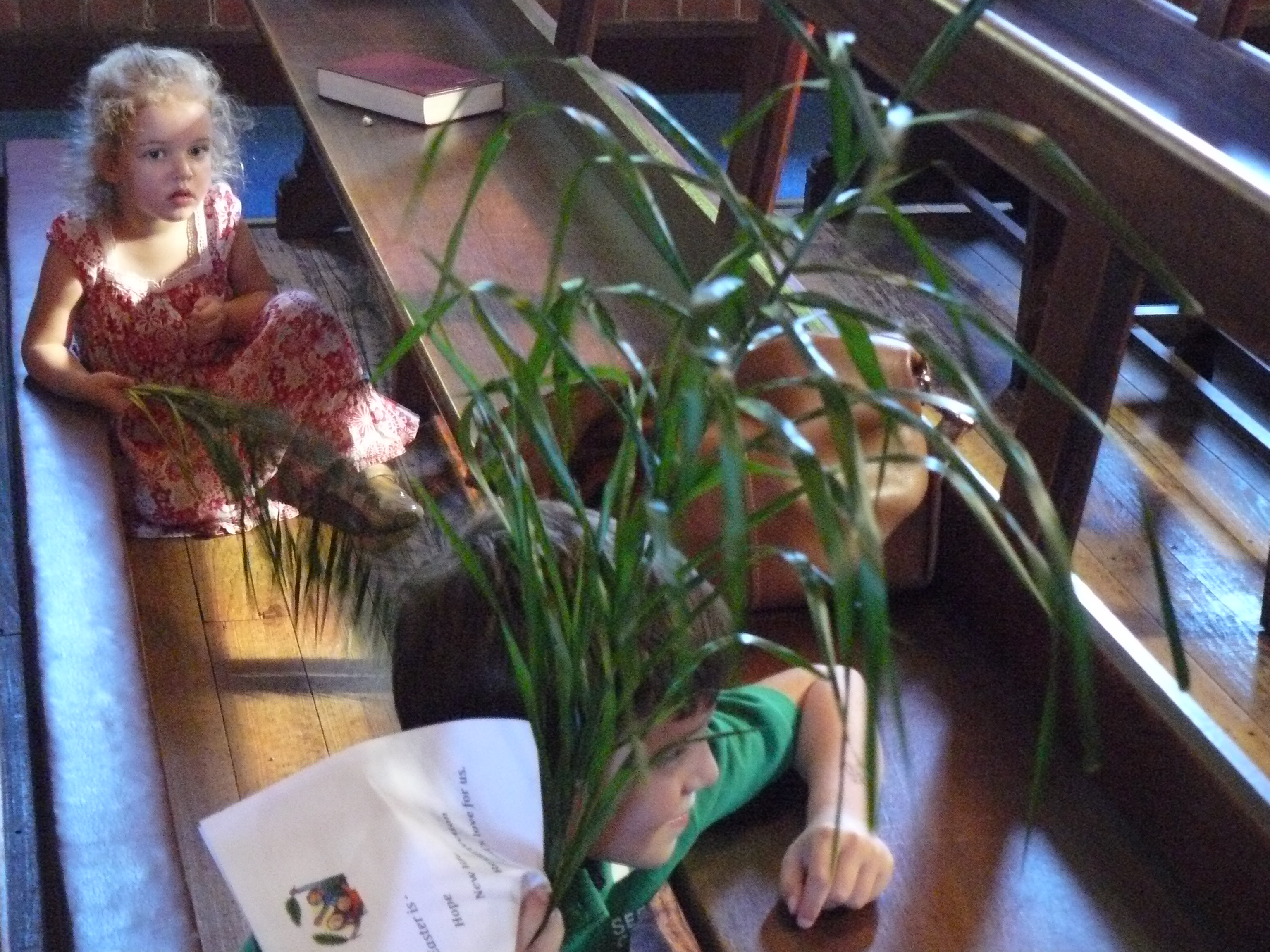
Palm Sunday, Children's Easter Service 2013

Palm Sunday, Children’s Easter Service 2013


In the name of God who asks us to be true to ourselves and faithful to God. Amen.

Imagine Australia, defeated and occupied by an oppressive and exploitative foreign power. A puppet Government has been installed under the supervision of a foreign governor. Former political and business leaders have of course maintained their wealth and status by collaborating with the foreign overlords and the onetime patriotic media has become their mouthpiece. The old Australian flag has been suppressed and replaced and the old national anthem banned. Resistance has been largely crushed apart from a few underground terrorist groups and some freedom fighters in isolated rural areas. The churches have become quiescent and fallen into line, in exchange for some measure of freedom to engage in purely spiritual activities. Occasionally a firebrand would-be nationalist leader appears and gathers some support but the police and army easily put such movements down and their followers are rounded up and disappear.

The old Australia Day weekend is coming up. It is now of course carefully orchestrated by the new regime as a means of both gaining support and diffusing nostalgia for the past and everybody hopes there will be no terrorist incidents to destabilize the situation. 

Suddenly, out of nowhere, one of these popular leaders appears, riding in an old government limo, flying the old flag and accompanied by a few rag-tag supporters. Suddenly the crowds begin to swell on the foot paths and as more and more flags begin to appear, the crowds burst spontaneously into the old national anthem. The security troops are caught totally unprepared and before they can intervene, the car swings into the square and draws up before City Hall and the young leader gets out and marches insidehe must be stopped.[1]

It’s hard to imagine what it was like to be in Palestine in the first century. We have to remember that since the exile Israel had never recovered its former glory. The nation has, with a brief respite in the time of the Maccabees, been under foreign control and the current situation has seen the leaders of the nation and of the church sell out to Rome. High priests are political appointments – no longer members of the ancient tribe of Levi. Herod is a puppet King and Pilate has been sent to this outpost of the Empire to keep the peace. Jerusalem is ripe for rebellion, the countryside is filled with people who, with their followers, incite rebellion and who are claimed to be the Messiah. Everyone, it seems, is looking for a Saviour who will free them from the yoke of oppression.

Into this mix rides Jesus, a man who has made a reputation for himself as a healer and teacher, who is reputed to have drawn large crowds to him and whom some believe to be the awaited Redeemer. He has unsettled the political and religious leaders to the extent that, from the time he enters the city, he is in their sights and they are looking for a way to kill him (19:47).

The problem, for the people and for the leaders of the people, is that contrary to their hopes or, the case of the leaders – their fears – Jesus is not the person they expected. The Israelites are looking for someone who will free them from the yoke of the Romans, someone who, like his ancestor David will lead them in battle, someone who will restore Israel to nation it once was. What they discover is that Jesus is not a fighter. For all that his entry into Jerusalem is staged to look like a fulfillment of the words of Zechariah, Jesus is a disappointment. He does not intend to raise an army and he is more critical of the leaders of his own people than he is of Rome. His mission is not so much to restore independence to Israel, but to restore the nation’s relationship with God.

A number of scholars argue that rather than supporting an uprising, Jesus actually cautions against it. When Jesus “predicts” the destruction of Jerusalem, it is because he can see the likely outcome of a revolution. Rising up against the Romans will, he believes, lead to defeat. Worse, a rebellion will lead to the destruction of all that the Jews hold precious – the Temple, the centre of their faith, the place in which their festivals are marked and celebrated, the site where all their rituals are carried out will be destroyed. If they challenge Rome, all that will be gone – never to be replaced.

Rome may be a problem, but the greater problem is the hypocrisy of the religious leaders who have made compromises of faith to keep the peace. It is this that Jesus confronts and condemns.

So Jesus enters Jerusalem, but from the start, his purpose is misinterpreted and misunderstood. The religious leaders fear that he will incite the crowds to riot which will mean that their freedoms will be curtailed. They are also frightened that his influence on the crowds will affect their influence in religious matters. The governing powers are also anxious. These people (the Jews) are notoriously difficult to contain, Jerusalem is at its most populous and this is the festival most associated with national identity. If the people are allowed to get out of control there is not telling what will happen. The role of the occupying forces is to maintain the peace at any cost.

From the moment he enters the city, Jesus’ life is at risk.

And so it plays out. Judas, for whatever reason, sides with Jesus’ opponents. Jesus (who does not intend to lead the resistance) goes quietly. What is more, given the opportunity to defend himself, Jesus remains mute, thus allowing himself to be subject to one of the most horrifying forms of punishment and death.

Through it all though, Jesus’ faith remains steadfast. In the face of corruption and compromise Jesus maintains his integrity and his independence. Despite the adulation of the crowd, he refuses to be seduced into changing his purpose. Given the opportunity to make an easy exit, Jesus refuses to sell out. Whatever the consequences for himself, he will not be turned from his certainty that the only way forward is for the nation and for himself to put themselves completely in the hands of God.

And so it is that he will not turn from his call, he will maintain his commitment to his cause. Nothing will persuade him from his course which is to reestablish Israel’s relation with God. For he knows that nothing less than complete trust in and dependence on God will do. It may not keep him safe from harm, but it will and does lead to a life such that cannot be known by any other means.


[1] From a sermon preached by The Rev’d Alan Dale at St Thomas’s Toowong on Palm Sunday 2007.