Archive for the ‘Presentation’ Category

One story or many?

December 31, 2022

The Naming and Circumcision of Jesus/The Epiphany of our Lord
Luke 2:15-21/Matthew 2:1-12
Marian Free

In the name of God who is always revealing Godself in new and unexpected ways. Amen.

The lectionary offers us two possibilities for this Sunday – the Epiphany of our Lord (the coming of the magi) or the Naming and Circumcision of Jesus. In some ways it is a shame that we cannot celebrate both today as together they give us an insight into the different ways in which Matthew (magi) and Luke (circumcision) approach their accounts of Jesus and provide a model as to how we might share the gospel today.

We believe that Matthew is writing for a largely Jewish audience. For this reason, he emphasises the ways in which Jesus fulfills scripture, has Jesus insist that the disciples go nowhere among the Gentiles and does not include encounters with, or parables about, Samaritans. Yet, it is very clear that Matthew writes with an understanding that Gentiles will come to believe in Jesus. At the Gospel’s beginning, John the Baptist reminds the Pharisees that God can raise up children of Abraham from the very stones and at its close the disciples are sent into all the world insinuating that God’s vision is broader than the people of Israel. Matthew’s inclusion of the account of the coming of magi – non-Jewish astrologers – is a further indication that he is softening up his readers for the idea that Gentiles will come to worship God’s anointed one and will therefore be included among the chosen people.

In comparison, Luke is writing for an audience that is primarily Gentile. He adapts his telling of the story to ensure a reception among those who do not come from a Jewish background. Luke does include stories about Samaritans – the parable of the Good Samaritan and the account of the Samaritan leper who returns to give thanks. It is important that Luke gives credibility to what appears to be a new religion. The Romans were reasonably tolerant of the national religions of the nations that they conquered, but they were less inclined to accept a new and novel religion. Indeed, any new belief was viewed as a superstition. A religion that had apparently appeared out of thin air would struggle to be taken seriously. This explains why Luke, though writing for Gentiles, goes to some length to present Jesus (and his family) as faithful Jews – observing the Jewish rituals of circumcision and Temple observance.

The ways in which the gospel writers configure their telling of the story of Jesus to ensure that it will be received by their audience is informative. Intuitively they knew that faith in Jesus did not depend on rigid adherence to a collection of dry historical “facts”, but that faith in Jesus was a living and vibrant relationship with the risen Christ. Indeed, a reading of the letters of Paul reminds us that from the very beginnings of the Christian mission different emphases were placed on, for example circumcision, depending upon the needs and backgrounds of those being addressed. In Corinthians, Paul goes so far as to say that he became all things to all people, that he might by all means save some (1 Cor 9:19 -23).

In many ways, Paul was passionate and uncompromising and yet he understood that accepting Jesus as Lord and Saviour was more important than the observation of ancient Jewish customs. In his letters he worked out a theology that addressed the tensions between those who came to faith from Judaism and those who came from Gentile backgrounds. In so doing, he did not believe that he was compromising the faith, but that he was making it accessible to all people.

Vincent Donovan, a Jesuit missionary, came to the same conclusion when he was working among Masai in Kenya . The Jesuits had been in Kenya for 100 years when an enthusiastic young Donovan descended on them. In that time, not one single person had embraced the Christian faith. Having received the blessing of his superiors and the permission of the local chiefs, Donovan began sharing the gospel according to Mark with the Masai. As he did so it became patently obvious to him that stories of sowing and harvesting would fall on deaf – if not hostile – ears. The Masai were pastoralists who at times found themselves contesting the use of land with others who were agriculturalists. As Jesus used imagery that was familiar to his audience so Paul, the gospel writers, and Donovan used imagery and ideas that enabled them to connect to their listeners and to draw them into a relationship with the resurrected Jesus.

In the 21st century, we have much to learn from our forebears in faith and in mission.

Sharing the faith does not mean rigid adherence to fixed statements of “fact”, but an openness to the Holy Spirit, an understanding of the central tenets of the faith and a willingness to listen to those with whom we would share the gospel. As Jesus listened to and reacted to the Canaanite woman – changing his mind about who does and who does not belong – so we should listen to those around us and allow ourselves to understand and to respond to those who are hungering to hear the gospel today.

(Donovan, Vincent. Christianity Rediscovered. Maryknoll, N. Y. :  Orbis Press, 1982.

A summary may be found here https://www.newcreationlibrary.org.au/books/pdf/284_ChristianityRediscovered.pdf)
Seeing what is in front of us

February 1, 2020

Feast of the Presentation – 2020

Luke 2:22-40

Marian Free

May I speak in the name of God, Earth-maker, Pain-bearer, Life-giver. Amen.

Sacramental worship in first century Palestine was a very different proposition from that in Brisbane today. Whereas we are used to celebrating Holy Communion every week in our Parish Churches, the Hebrews might, if they were able, attend the Temple for major feast days or to observe specific rituals that could only be carried out in the Temple. Passover seems to have been a must for most Israelites, but it is possible that not everyone was able to make these pilgrimages on a yearly basis.

It is difficult to know how many towns or villages had synagogues, but from the biblical evidence that Jesus taught in their synagogues and that the early believers came together every week, we can assume that it was the practice (of the men at least) to gather weekly to read from scripture, say or sing the Psalms and to expound on the biblical text. But as there was only one Temple, anything that required the services of a priest took place there, in Jerusalem.

In setting the scene for his gospel, the author of Luke is careful to establish Jesus’ Jewish credentials. This seems strange for a person who was writing for a Gentile audience, but the Roman Empire was suspicious of anything novel, in particular of different belief systems which they regarded as superstitions and as a threat to the Empire. Judaism was accepted and even respected by the Romans because of its long, established history. By making it clear that Jesus was a member of this ancient faith Luke establishes the credibility (and the heritage) of what, to many, appeared to be a new religion.

Luke builds up the picture of Jesus’ Jewish credentials in a number of ways. The parents of John the Baptist (Jesus’ cousin) are described as coming from ancient priestly families and Zechariah is in the Temple offering the sacrifice when an angel announces John’s conception. Mary and Joseph fulfil the obligation under the law to circumcise Jesus on the eighth day. Forty days after Jesus’ birth they make the long journey to Jerusalem to offer a sacrifice to redeem their first-born son and to undergo the rite of purification. Later, when Jesus is twelve years old, the family will return to Jerusalem for the Passover Festival. Five times in today’s the author refers to the law, the basis of the relationship between God and God’s people and Luke’s gospel both begins and ends in the Temple – the centre of the Jewish faith. In other words, the Gentile readers of this account of Jesus’ life (in particular Theophilus) are left in no doubt that this emerging faith has its roots firmly based in Judaism and is in fact nothing new but a continuation of that ancient religion.

In describing the presentation of Jesus in the Temple Luke moves the story forward. He suggests that the time of the prophets has ended. What God has promised to Israel has come to pass. Led by the Spirit, Simeon recognises the child as the Lord’s anointed – the one who will be the instrument of God’s salvation – a light to the Gentiles and the glory of God’s people Israel. Without labouring the point, Luke establishes that God has acted in the world and that going forward, Gentiles as well as Jews will be included in God’s acts of salvation.

Luke has established that this apparently ‘new’ faith has an age-old history. Now he makes it clear that, with the birth of Jesus, the faith is moving from one era into another. It is a continuation of the old while at the same time it is leaving the past behind and forging a new path. John the Baptist provided the bridge between the past and the present. From now on the focus will be on Jesus and God’s actions in the world through him. All this, the reader is led to believe, is completely in accord with God’s plan.

Luke moves the story forward in another way as well. Simeon’s words to Mary give us a foretaste of what it to come. Jesus’ presence will not be welcomed by all. His teachings and actions will be a source of division. People’s reaction to him will reveal where they stand in relation to what God is doing in the world and a once unified faith will be divided to the point of separation.

When I read this account, what strikes me is the wisdom, openness and spirituality of Simeon and Anna and their very different responses to Jesus. Both are near the end of their lives and seem to have led lives of prayer such that their connection to God is strong and their awareness of God’s presence in their lives is real and powerful. Mary and Joseph would have been little different from other parents visiting the Temple that day, that week or that year. They were poor (as is indicated by the sacrifice of a dove not a lamb) and had travelled from an insignificant village in the Gentile region of Galilee.  Yet Simeon, guided by the Spirit, comes into the Temple at the very moment that they do and recognises in Jesus the child whom God had promised he would see. Simeon’s reaction is to take the child and give thanks. Anna appears to be already in the Temple and has presumably seen or heard something. She wastes no time with the child and his parents but exuberantly praises God and announces the presence of the child to everyone who is ‘looking for the redemption of Jerusalem’.

As their lives come to a close, Anna and Simeon demonstrate a depth of faith that enables them to sense what God is up to and to recognise God’s presence in the world. They display an openness to the possibility that God might do the unexpected and they reveal their confidence that God will do what God has promised. May we too live such lives of faith and faithfulness that our relationship with God will make us aware of God’s presence in our lives and in the lives of others and may we live in expectation that God will act in the world.

Standing with our feet in two worlds

February 4, 2017

Candlemas – 2017

Luke 2:22-40

Marian Free

Candlemas

         Candlemas

Loving God, light in our darkness; give us the courage to allow your light to reveal the darkness in our lives. Amen.

Today we celebrate the feast of the Presentation of Jesus in the Temple – an event in Jesus’ life that is recorded only by Luke. As early as the fourth century, the Church Fathers considered that this was an event of such significance that it needed its own feast day. At that time, the Presentation was marked on the fourteenth of February – 40 days after the feast of the Nativity on the 6th of January. Four hundred years later, sometime after the celebration of Christmas had been moved back to December 25, the feast of the Presentation was moved to February 2 where it remains to this day.

It appears that around that time, in the 700s, influences from the pagan festival of Imbolc began to creep in to the Christian celebration. Imbolc is the word for ewe’s milk in old Irish. In Northern Europe Imbolc marked the midpoint between the winter solstice and the spring equinox. In a world in which winters were dark and bleak, the lengthening of days and the first signs of spring growth were a cause for celebration. They were proof yet again that the darkness had not triumphed over light and that the earth would once again bring forth life and growth. It was a time of promise and possibility. White candles were lit as a symbol of purifying fire and of the rays of the sun.

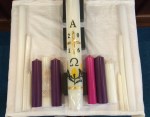
Imbolc took place at the same time as the feast of the Presentation – on February 1st or 2nd. It appears that the church absorbed the practice of lighting candles into its own practice. The liturgy incorporated a procession of candles followed by a blessing of the candles for use that year hence the alternate name for the feast – Candlemas.

Just as Imbolc marked a mid-point in the astronomic calendar, in the Christian practice, Candlemas signified a movement away from the wonder and joy of Christmas and Epiphany and a movement closer to the sobriety of Lent and thus to the shadow of the cross. The changing seasons and longer days encouraged spring cleaning and the preparation of the ground for sowing and in the church Candlemass signified a movement away from festivity and feasting towards self-reflection and fasting.

Today’s gospel clearly depicts the tensions of being caught between celebration and solemnity, joy and apprehension, between Christmas and Good Friday. When Mary and Joseph brought Jesus to the Temple, Simeon’s gratitude and relief was matched by Anna’s exuberance and excitement as they both responded in their own ways to the encounter with their long-awaited Saviour. The joy of the meeting was tempered by Simeon’s warning and sense of foreboding as he says to Mary: “This child is destined for the falling and the rising of many in Israel, and to be a sign that will be opposed so that the inner thoughts of many will be revealed—and a sword will pierce your own soul too.”

Simeon might have identified Jesus as the one who was promised as “light to the gentiles and the glory of God’s people Israel” but at the same time he cautioned that God’s promised salvation is not without cost.

Light, you see, is a mixed blessing. Light is threatening and benign, welcome and unwelcome. Light lifts the burden of darkness and enables us to see clearly. It allows us to walk without stumbling, but it has the potential to expose the dark corners and secret places of our lives – the cobwebs and dust that have built up over a long winter of neglect, the self-deception and arrogance that have been allowed to hide in the shadows, the inner thoughts that we would prefer to keep to ourselves.

When Simeon announced that Jesus was “the light to the Gentiles” he was fully aware that not everyone would welcome his presence among them. There would be many who would prefer to remain in the shadows rather than have their shallowness exposed and their self-deception revealed. He predicted that they would resent, resist and even oppose Jesus whose very presence would show them up for the charlatans that they were. The light of Jesus’ goodness and love would be greeted with delight by those who, like Simeon have looked forward to a time when God’s presence will be more fully known and who would feel the warmth and glow of that presence in Jesus. That same love and goodness, would serve to reveal the complacency, self-satisfaction and blindness of those who thought that neither the world nor themselves needed changing and who experienced the light as a scorching flame and a glaring beam that must be extinguished so that their lives could remain the same and their falsehoods unchallenged.

For those who recognise that the world lies in darkness, light is a welcome relief, but that same light is perceived dangerous and threatening by those who recognise that the light will shake and shatter their place in the world.

Today, as we celebrate Candlemas and the Presentation of Jesus in the Temple, we stand as it were with our feet in both worlds – between Jesus’ birth and the cross, between joy and sorrow, between the darkness and the light. As we follow the church calendar from Epiphany to Lent, we have time to consider whether we will allow our darkness to be exposed to the light or whether, content with the way things are and unwilling to accept that different could be better, we will turn our backs on the promise of change and renewal and consign ourselves to the shadows.

God knows!

January 30, 2016

Presentation of Christ in the Temple – 2016

Luke 2:22-39

Marian Free

 In the name of God who gives Godself to us completely and utterly. Amen.

I happened to read a women’s magazine during the week. One of the stories was of a career woman who had had no intention of having a child, but at forty-five had given birth to her first child. Like so many other public figures she said that the experience had changed her life. “I have this fierce mother instinct – it’s quite fierce and protective.” For many of us, holding a newborn is one of the most amazing experiences. The child in your arms is so vulnerable and so dependent. Even if the child is not your own, you are often overcome with the urge to protect the child and there is a sense of foreboding in regard to all of all that could go wrong – in the present and in the future. What if someone drops the child? What if they don’t hold his/her head in just the right way? Will the child be settled or unsettled? Are the new methods of wrapping, feeding, bathing really better than they way that they used to be done? All of those thoughts can go through our minds in an instant – the wonder, the joy, the fear and the anxiety together.

After the initial excitement has passed, we might begin to consider what sort of future the child might have. If the child is our own, a grandchild, a niece or nephew, most of us would be secure in the knowledge that she/he would be well loved and parented well. If not, we might have fears for the safety and well-being of the child. And the distant future – well that is purely the subject of our imagination, fuelled by our own desires and concerns our fears and anxieties. Will the child be able to escape tragedy in his/her life? Will the education system/the health system be sufficiently well-funded to ensure that the needs of the child are met? Will the child have the resilience to resist peer pressure – avoid drugs and alcohol? Will the environment be able to sustain another generation on the planet? Will we, particularly in today’s violent and unstable climate be able to protect this child from acts of terror or from war?

So many unknowns lie ahead of every child and the best parenting in the best environment is not enough to prevent tragedy or disaster – whether of the child’s own making or from external causes.

Jesus is still an infant when his parents bring him into the Temple to present him to God as demanded in the Book of Exodus (13). The Temple is a bustling place, especially the outer courts which are open to men and women of every nation and where, as we learn later, the exchange of money occurs and the animals to be used in thank offerings are sold. Into this crowd come two very ordinary people bringing with them their infant son. Somehow Simeon (who has been drawn to the Temple precincts by the Spirit) identifies this couple and knows immediately that their child is the anointed one for whom he has waited his whole life.

Without so much as a: “by your leave”, Simeon scoops the child into his arms and before his surprised parents bursts into a song of praise in which he identifies this baby as the one who is to bring glory to Israel and to be a light to the Gentiles. Perhaps Mary and Joseph are not totally surprised by this. Luke’s introduction leads us to believe that they know full well who Jesus is and what he is to become. They might be surprised to hear that not only will he save his people, but that the Gentiles will also come to faith through him, but the angel has already told them that: “he will be great, and will be called the Son of the Most High, and the Lord God will give to him the throne of his ancestor David. He will reign over the house of Jacob forever, and of his kingdom there will be no end.” It may be that they have already begun to imagine their future and that of their son – the honour and respect that might ensue once he became known for who he really was!

Imagine their shock when Simeon concludes: “This child is destined for the falling and the rising of many in Israel, and to be a sign that will be opposed so that the inner thoughts of many will be revealed—and a sword will pierce your own soul too.” “The rising and falling”, “A sign to be opposed” –suddenly a sense of foreboding is introduced into what had been a situation of joy and hope and expectation. Simeon’s words suggest that Jesus’ future will not be all smooth sailing, not everyone will share their confidence that Jesus is the Son of God.

Simeon’s prediction includes an element of threat and a warning – Jesus’ life will not conform to expectations. It is possible that he will not be a triumphant king. that his teaching and actions will not always be positively received. Instead of glory, there is a possibility that he will experience suffering and defeat. For Mary and Joseph, the confidence of the angel’s words must have come into question. They must have wondered what they could expect of this child? What would the future really hold? We can only speculate, but I imagine that Mary and Joseph will have left the Temple with a very different and much less certain view of how Jesus’ future would play out.

In order to save humankind, to bring us to our senses, God was prepared to enter our world fully and completely, vulnerable and unprotected. In Jesus, God completely abandoned divinity becoming fully human, completely vulnerable, completely dependent and susceptible to the same dangers and difficulties as the rest of humankind. It is for this reason that Hebrews can record: “For we do not have a high priest who is unable to sympathize with our weaknesses”.

Life may not go the way that we expected for ourselves – or for our children. Not even God is able to protect us from the things that living in this world entails, but through good times and bad, disaster and triumph there is one thing of which we can be sure – that God in Jesus chose not to be shielded from the accidents of fate, the cruelties of human beings and the indifference of the planet. God, in Jesus knows that there is no certainty in this life except the certainty of God and of God’s overwhelming love for us that allowed God to immerse Godself so completely in our existence that it would be impossible for us to say: “God does not know what I am going through.”


(If you have taken up the challenge to explore Luke’s gospel. Note: Luke’s concern with the Temple, his determination to demonstrate continuity with Judaism – the family undergo the Jewish rites – the presence of the Spirit and the gospel for the Gentiles.)