Archive for the ‘Uncategorized’ Category

Together on the road

April 25, 2020

Easter 3 – 2020

Luke 24:13-35

Marian Free

In the name of God who walks beside us on the road. Amen.

The story of the road to Emmaus is one of my favourite Easter stories. Luke’s retelling captures my imagination and I feel as if I am walking with Cleopas and his companion (his wife?) trying to work out what had happened over the past few days. Even though I know the end of the story, I am caught up in their grief and confusion, their intrigue as to who the stranger might be and finally in their recognition of Jesus. As Luke tells the story, I am there on the road and at the table. I don’t immediately recognise who it is beside me but on reflection realise that I had known it was Jesus all along.

Cleopas and his companion were not Galileans (as were the twelve) so they had probably not accompanied Jesus to Jerusalem. Their hopes and expectations about Jesus were almost certainly based on their experiences during his week in the city. Along with many others, they would have been caught up in the excitement surrounding Jesus, impressed by his teaching and filled with the hope that he was the one who was to come. Jesus’ crucifixion and death had thrown all this into question, yet it seems that they had not completely lost hope but had waited in Jerusalem to see if he would be raised as he had predicted. (“It has been three days,” Cleopas says.)

Otherwise, why would they have lingered? Emmaus was only a couple of hours walk away and there was no need to remain in the city once the Passover festivities were over. Indeed, it might have been dangerous to stay if they could have been identified as followers of Jesus. Yet, they had remained.

It is clear that they had heard reports that morning, that the tomb had been found empty by the women (something that had been verified by Peter). They may have been reminded, as the women were, that Jesus would rise on the third day. This would explain why they delayed going home, leaving Jerusalem mid-afternoon instead of in the cool of the morning. If Jesus was alive (as the angels had said), surely they would hear of it and be able to see him for themselves. Finally, they can wait no longer and with heavy hearts they begin the journey home.

Even so, they cannot stop thinking about the events of the past few days. As they walk, they are absorbed in conversation, analysing what has happened, trying to make sense of it all and wondering how they could have been so mistaken as to think that this man who was crucified was the one sent by God to save them. It is no wonder that they do not recognise Jesus when he comes alongside them. Presumably they imagine that he is just another pilgrim returning home from the festival and they don’t pay him much attention. They were certainly not expecting to see Jesus. Three days had passed, and he hadn’t been seen alive and, if he was alive, there would have been no reason for them to have expected him to leave Jerusalem at least not without his disciples. What is more, Cleopas and friend may never have seen Jesus without the crowds and may never have had a close enough look to recognise him in the absence of his friends.

Never-the-less, they expect this stranger to be a mind-reader and they jump to the conclusion that if he had been in Jerusalem he must certainly be as concerned about the recent events as they were. Interestingly, though they are surprised at Jesus’ apparent ignorance, they are not at all surprised that he should have such a good grasp of scriptures and that he should be able to explain and to interpret Jesus’ death.

We are not told whether or not Jesus’ words convinced them that the Christ had to die, or whether his explanation provided them any comfort. After all, the stranger had not told them that Jesus was alive only that the Christ had to suffer and then enter his glory. The stranger’s interpretation might have gone some way in explaining the events of the past few days, but it will have told them nothing about the present or the future or the impact that Jesus would have on their lives or on the lives of others who had believed in him. They might have wondered what use was a Christ who died and entered his glory and how was it possible that  such a Christ could change anything and would that Christ make any difference in the long term or would he be, as he seemed, just a moment in history.

Cleopas and friend are still confused when they reach their home, but their sense of hospitality will not allow the stranger to continue his journey in the dark. They invite him to stay with them. At the meal table the stranger “took bread, blessed and broke it, and gave it to them”. In so doing he was repeating the actions of Jesus at the Last Supper when he took bread, blessed and broke it and gave it to the disciples. Only then do the two really see the stranger, and seeing him, recognise him and, recognising him, realise that they knew who he was all along.

In difficult and uncertain times, we too get caught up and become self-absorbed in our own troubles. We try to figure things out for ourselves, wonder what has happened and worry about the future. We can forget that Jesus is always with us, and often, it is only with hindsight that we understand that he has been walking beside us all the way.

It is now a full month since our last service together in the church and we have no idea when the lock-down will end or what the future will look like. As we travel our own paths in these strange times, let us pray that we will be attentive to the presence of Jesus, open to all that this experience has to teach us and eager to share with each other what we have learned when we are together again.
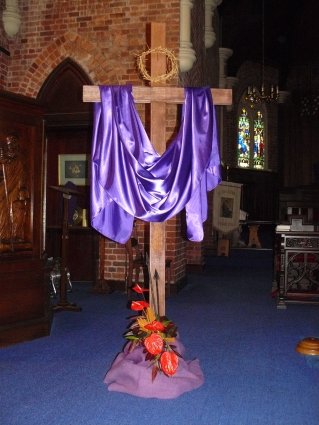
 

Good Friday – 2020

April 9, 2020

Good Friday 2020

Service of the Passion
and
Recognition of the Cross

2009_good-friday


Hymn: 345 Were you there?

Greeting:
The Lord be with you.
And also with you.

Let us pray:

God of life and death,
we come before you with all our complexities –
the good and bad in ourselves,
our certainties and our anxieties,
the joys and sorrows in our lives,
our triumphs and our failures.
Open us to the possibilities that life offers,
give us strength for life’s journey
and draw us always into your presence. Amen

Collect:

God who shares our suffering,
give us courage to face abandonment, loss and insecurity.
Remind us that you walk beside us on the way, sharing our pain and holding us fast.
Help us to live through this and other adversities
so that we with Christ might rise to newness of life
in the present and for eternity.
We ask this through Jesus our Saviour
who lives and reigns with you and the Holy Spirit, one God forever and ever. Amen.

Poem: Sheila Cassidy – “Starting over – fighting back”

Sheila Cassidy, who quotes this poem, was an Australian born English doctor who was practicing in Chile when she was arrested, held without trial and tortured for 59 days . This verse seems to fit our times.
We without a future,
Safe, defined, delivered
Now salute You God,
Know that nothing is safe,
Secure, inviolable here.
Except You,
And even that eludes our minds
at times.

Reflection

“My God, my God why?”
a God who is absent,
who allows suffering
can confuse, disappoint and dismay.
We have to hold on through the darkness, however bleak
confident of coming to the resurrection morn.

Ministry of the Word

Isaiah 52:13 – 53:12

Psalm 22

My God, my God, why have you forsaken me:
why are you so far from helping me
and from the words of my groaning?
My God, I cry to you by day, but you do not answer:
and by night also I take no rest.
But you continue holy;
you that are the praise of Israel.
In you our forebears trusted:
they trusted and you delivered them.
To you they cried and they were saved:
they put their trust in you and were not confounded.
But as for me, I am a worm and no man:
the scorn of all and despised by the people.

Those that see me laugh me to scorn:
they shoot out their lips at me
and wag their heads, saying,
“He trusted in the Lord – let him deliver him:
let him deliver him, if he delights in him.”
But you are he that took me out of the womb:
that brought me to lie at peace on my mother’s breast.
On you have I been cast since my birth:
you are my God, even from my mother’s womb.
O go not from me, for trouble is hard at hand:
and there is none to help.
Many oxen surround me:
fat bulls of Bashan close me in on every side.
They gape wide their mouths at me:
like lions that roar and rend.
I am poured out like water,
and all my bones are out of joint:
my heart within my breast is like melting wax.
My mouth is dried up like a potsherd:
and my tongue clings to my gums.
My hands and my feet are withered:
and you lay me in the dust of death.
For many dogs are come about me:
and a band of evildoers hem me in.
I can count all my bones:
they stand staring and gazing upon me.
They part my garments among them:
and cast lots for my clothing.
O Lord, do not stand far off:
you are my helper, hasten to my aid.
Deliver my body from the sword:
my life from the power of the dogs;
O save me from the lion’s mouth:
and my afflicted soul from the horns of the wild oxen.
I will tell of your name to my companions:
in the midst of the congregation will I praise you.
O praise the Lord, all you that fear him:
hold him in honour, O seed of Jacob,
and let the seed of Israel stand in awe of him.
For he has not despised nor abhorred
the poor man in his misery:
nor did he hide his face from him,
but heard him when he cried.
The meek shall eat of the sacrifice and be satisfied:
and those who seek the Lord shall praise him –
may their hearts rejoice forever!
Let all the ends of the earth remember
and turn to the Lord:
and let all the families of the nations worship before him.
For the kingdom is the Lord’s:
and he shall be ruler over the nations.
How can those who sleep in the earth do him homage:
or those that descend to the dust bow down before him?
But he has saved my life for himself:
and my posterity shall serve him.
This shall be told of my Lord to a future generation:
and his righteousness declared to a people yet unborn,
that he has done it.

1 Corinthians 1:18-31

For the word of the Lord.
Thanks be to God.

Hymn: 342 When I survey

The Gospel of our Lord Jesus Christ according to John Chapter 18 beginning
at verse 1.
Glory to you Lord Jesus Christ.

For the Gospel of the Lord.
Praise to you Lord Jesus Christ.

Intercessions:

Let us pray for the world and for the church (please add your own prayers here).

Response: Loving God, hold our hands when we weep.
And give us strength to continue.

Lord’s Prayer: Accept our prayers through Jesus Christ our Lord,
who taught us to pray:
Our Father in heaven,
hallowed be your name,
your kingdom come,
your will be done,
on earth as in heaven.
Give us today our daily bread.
Forgive us our sins
as we forgive those who sin against us.
Save us from the time of trial
and deliver us from evil,
for the kingdom, the power, and the glory are yours
now and forever. Amen.

Confession:

Though the world might be confusing and hard to control, God never abandons us. God comes to us in human form, sharing our experiences and revealing a depth of understanding and sympathy for our condition.
Let us then have confidence to admit our weaknesses, the ways in which we have failed God and ourselves.

Crucified Saviour,
with your disciples we abandon you
and the world for which you suffered,
seeking our own safety and
meeting our own desires.
Through our selfishness and greed
we inflict needless suffering on others
and wreak destruction on the planet.
Forgive us.
Give us grace to look beyond ourselves
and a willingness to be part of the solution and not the problem. Amen.

Absolution:

God who formed you and who suffered for you,
loves you unconditionally and forgives your sins.
Be set free to change and to grow. Amen.

Recognition of the cross:
Hymn: 341 My song is love unknown.
(Recognition of the cross. At this time you might like to reflect on the cross and Jesus’ willingness to suffer. Ask yourself if you are prepared to sit with pain to see what it has to teach you.)

Blessing:

Hymn: 351 Lift high the cross.

Copyright. Marian Free, 2020

From Richard Rohr

All great spirituality is about what we do with our pain. Creation has a pattern of wisdom; and we dare not shield ourselves from it, or we literally will lose our soul. We can obey commandments, believe doctrines, and attend church services all our lives and still daily lose our souls if we run from the necessary cycle of loss and renewal. Death and resurrection are lived out at every level of the cosmos, but only one species thinks it can avoid it—the human species.
I am afraid that many of us with privilege have been able to become very naïve about pain and suffering in the United States and the Western world. We simply don’t have time for it. However, by trying to handle all suffering through willpower, denial, medication, or even therapy, we have forgotten something that should be obvious: we do not handle suffering; suffering handles us— in deep and mysterious ways that become the very matrix of life and especially new life. Only suffering and certain kinds of awe lead us into genuinely new experiences. All the rest is merely the confirmation of old experience.
It is amazing to me that the cross or crucifix became the central Christian logo, when its rather obvious message of inevitable suffering is aggressively disbelieved in most Christian countries, individuals, and churches. We are clearly into ascent, achievement, and accumulation. The cross became a mere totem, a piece of jewellery. We made the Jesus symbol into a mechanical and distant substitutionary atonement theory instead of a very personal and intense at-one-ment process, the very reality of love’s unfolding. We missed out on the positive and redemptive meaning of our own pain and suffering. It was something Jesus did for us (substitutionary), but not something that revealed and invited us into the same pattern. We are not punished for our sins, we are punished by our sins (such as blindness, egocentricity, illusions, or pride).
It seems that nothing less than some kind of pain will force us to release our grip on our small explanations and our self-serving illusions. Resurrection will always take care of itself, whenever death is trusted. It is the cross, the journey into the necessary night, of which we must be convinced, and then resurrection is offered as a gift.
In this time of suffering we have to ask ourselves, what are we going to do with our pain? Are we going to blame others for it? Are we going to try to fix it? No one lives on this earth without it. It is the great teacher, although none of us want to admit it. If we do not transform our pain, we will transmit it in some form. How can we be sure not to transmit our pain onto others? (Daily meditation, March 30, 2020. Sign up for daily emails from the Centre for action and spirituality)

EASTER CELEBRATIONS

We will live-stream a service on Easter Day at 8:30am.

ANZAC DAY

There will be no service to commemorate Anzac Day – a candle will be lit and the names of those for whom we’ve been asked to pray will be read out at 8:00am.

(If there is anyone for whom you would like us to pray,
Please call Marian or the office.)

A frightened, angry Jesus

April 9, 2020

Maundy Thursday – 2020
John 13:1-17,31b-35 (1 Cor 11:23-26)
Marian Free

In the name of God, Earth Maker, Pain Bearer, Life Giver. Amen.

Several years ago, I came across an extraordinary video titled Coach Trip to Calvary. The video followed a mixed group of travellers in the Holy Land and their Palestinian driver. As the small tour group visited the sites of some of the biblical stories, they became a part of the story. In other words, there were two parallel narratives – that of the tourists and that of the events of Jesus’ life – but the characters remained the same. The biblical story was transported into the present and the tourists entered into it as themselves which made the story incredibly real, if a little confusing.

The scene that remains with me is that of the last supper. In this scene the Palestinian bus driver takes on the role of Jesus and the tourists the role of Jesus’ disciples. The group are in a cheap café, seated on benches at a trestle table. The lighting is low, and the meal consists of shared plates, pita bread and wine. Without warning, the driver (who has morphed into Jesus), takes the bread and violently tears it. “This is my body which will be given for you”, he says angrily, handing the bread to the surprised disciples. It is a confronting scene – a far cry from the peaceful domesticity depicted by such artists as Leonardo da Vinci. As I watched, I cringed, whether from embarrassment, discomfort or fear I’m not sure, but this was not the Jesus I knew, the Jesus with whom I was comfortable, the Jesus whom the gospels describe as going quietly to his death. The Jesus presented here was an angry, hurting Jesus, an all too human Jesus, Jesus who knew what lay ahead and who was expressing his fear and anguish that it had come to this.

I suspect that my discomfort lay here. I had allowed myself to think that while Jesus did have some qualms he was relatively accepting about his fate, willing to do what was required (or willing to accept the consequences of his actions). The very domestic setting of the last supper in the gospels lulled me into the belief that Jesus’ final meal with his friends was relatively calm. My reading of the text and my experience of the Eucharist had conveniently ignored the sense of foreboding at that meal and the hint of the violent and the gruesome death that would follow. Witnessing Jesus’ angry, violent tearing of the bread shocked me into a recognition of my complacency and of my comfortable, armchair view of Jesus’ trial and persecution.

I was brought up short and I cannot help but wonder why the disciples were not so moved by Jesus’ distress that they were able to stay awake, to stand by him, to be identified as a disciple and if need be to share his death.

Tonight, we remember that night. We are challenged to hear Jesus’ pain, to stay awake, to watch while he prays and, if need be, to walk with him to the cross.


A matter of timing

March 28, 2020

Lent 5 -2020

John 11:1-45
Marian Free

In the name of God Earth-Maker, Pain-Bearer, Life-Giver. Amen.

In Year A our Lenten readings come from the gospel of John. I have always felt that over the course of Lent, these readings rise to a crescendo before everything comes tumbling down. We begin with Nicodemus’ question in the dead of night, which is followed by the debate with the Samaritan woman at noon, the healing of the blind man and now, today we witness the raising of Lazarus. In John’s gospel debates about who Jesus is are followed by the opening of eyes and the the revelation that not even death is an obstacle to Jesus’ compassion and his ministry. We seem to be soaring towards victory – is there any Jesus cannot do! And yet, as we go on to see, Jesus’ triumph is only temporary and it leads not to glory, but to the cross.

As is the case with John’s gospel as a whole, this chapter has many layers and can be seen from many different angles. On the surface is the story of Lazarus – his illness, his death and his being brought back to life. A closer look reveals the import role of the two women, his sisters – Martha (who names Jesus as the Christ) and Mary who has anointed Jesus for burial. Their place in the story suggest that they were leaders in their community.

When we look deeper and consider this passage in the light of the gospel as a whole, we can see that the situation surrounding the raising of Lazarus is much more complex than at first appears. Underlying the retelling of the miracle and the relationship between the women and Jesus, there is an atmosphere of foreboding. Jesus knows that the closer he gets to Jerusalem, the closer he gets to those who wish to kill him. The more he is exposed to the religious authorities, the more his life is in danger.

From almost the beginning of John’s gospel John makes it clear that Jesus is perceived as a threat to the establishment and that his own life is in jeopardy as a consequence. While the crowds might be drawn to him, the religious leaders see him as a menace. Why else would Nicodemus have come to Jesus at night? The leaders are disturbed that Jesus is making more disciples than they which forces Jesus to leave Jerusalem. Then when he returns, Jesus gets into even more trouble because he heals a lame man on a Sabbath. As a result, not only do the the Judeans begin to persecute him (5:15) but they ‘were seeking all the more to kill him’ (5:18). The establishment were affronted because Jesus blatantly ignored the Sabbath law and even worse, identified himself with God! Such heresy could not be accepted or condoned. Jesus does not defend himself but instead seems to deliberately antagonize the religious leaders. He accuses them of not understanding the prophets or the testimony of scripture and of not having the love of God in them! It is little wonder that they wanted to be rid of him.

Later, despite the urging of his brothers, Jesus is reluctant to return to Jerusalem to attend the Festival of the Booths (7:1f). He is aware that the Judeans are seeking to kill him, and he would rather stay in Galilee where he is safe. In actual fact he does go up but in secret not, as his brothers had hoped so that ‘his disciples could see the works that he was doing’. While there, even though he knows himself to be at risk, Jesus does teach in the Temple further alienating the religious authorities who try to arrest him but fail. When, at the end of the eighth chapter, Jesus claims to have existed before Abraham, the Judeans pick up stones to throw at him.

All this tells us that Judea in general and Jerusalem in particular are places to be avoided by Jesus at all costs and explains why Jesus takes two days before deciding to go to see his friend. Bethany (the home of Lazarus) is too close to Jerusalem for comfort. Even Thomas is aware of the potential danger, announcing, “Let us also go, so we may die with him.” Jesus might be able to save Lazarus but in doing so, he will sign his own death warrant. It is not a journey to be taken lightly. The raising of Lazarus might be the high point of his ministry, but it will also be the final nail in Jesus’ coffin (cross) – for which of the religious leaders will be able to cope with such blatant competition?

There is yet another layer or another thread to this story and the gospel as a whole. Jesus’ life might be in danger, but he remains in control of the situation. As was the case when his brothers encouraged him to go to Jerusalem, Jesus will go to Bethany in his own time and on his own terms. It is not fear or arrogance or laziness that keeps him away. As with everything in his life, for Jesus the timing must be right – not his timing but God’s. (‘My time has not yet come’ 2:4, 7:6, 8 is a constant refrain.)

We are living in unprecedented times. Many of us are anxious and unsettled. We cannot see the future and feel as if we have lost control of aspects of our lives.

Jesus took control by ceding control to God. He refused to be pushed and pulled into doing what others wanted him to do but remained focused on his mission. He placed himself entirely in God’s hands and, having made that decision, did not waver no matter what the temptation (to save his friend, to save his own life). There are things at this time that are beyond our control – who we see, whether we can work, how far we may travel. What we can control is how we respond, how we feel and how much we trust God to bring us through.

If we have never faced anything like this then we have been truly blessed. In the midst of this anxious and confusing time, let us hold fast to our faith, place our lives in the hands of God and understand that his timing is not our timing and his ways are not our ways.


Until we meet again

March 20, 2020

Lent 4 – 2020– the day on which we closed the church for the first time in 100 years
John 9:1-41
Marian Free

In the name of God who sustains us through the darkness of night to the dawn of a new day. Amen.

COVID 19 is anything but funny, but there are a number of people who are refusing to lose their sense of humour and who are bringing smiles to our faces. On Facebook a couple of weeks ago someone posted the statement: “I didn’t think I’d have to give up this much for Lent.” Those of us who have decided to forgo alcohol or chocolate during Lent, are now giving up, or being forced to give up, our social activities and our food choices are limited by the panic buying of others. “I didn’t think I’d have to give up this much for Lent.”

Today as we gather in person for the last time for who knows how long, Lent provides the most apt metaphor for this experience. For the sake of each other and for the safety of our community we are being asked to give up something that for many of us is our life-blood – the nourishment through Word and Sacrament that sustains us and the community that supports us.

For most of us these are unprecedented times and the virus is only a part of it. We ourselves do not yet know the effect of having the virus or knowing someone who has it, but we cannot be unaware of the economic strain that physical separation is being faced by a great number of our community, including, I imagine many of you. Employers are reluctantly letting go of casual staff as they face the possibility that their own source of income has dried up. Those who work in businesses that require close proximity to their clients will have to close their doors. People who have never been out of work may find themselves at Centre-link and those who rely on the stock market are finding their incomes drastically reduced.

Socially and personally there are costs. As Aged Care Centres go into lock-down, families are separated from loved ones who may be past the stage of using social media – if they ever could and are finding themselves unable to offer the care that they would wish to. In this Parish we are having to put into recess some of the activities that connect lonely and vulnerable people with the wider community. Social isolation for those who live alone or the pressure of spending more time with each other for those who don’t will undoubtedly have serious consequences.

For many it is already a time of anxiety on many fronts and for some recovery might be slow and long. We must pray daily that those who are suffering financially, physically or socially are given the resources to survive and the strength to continue.

And still, we are among the lucky ones. We live in a country with a well-resourced health system, and a stable government. The inconveniences and losses we will experience cannot compare with those of the millions who are languishing in refugee camps or living in war zones with little food and little to no medical support.

It causes me great sadness to forbid you to come to worship, but I have come to see that this is a novel and extraordinary way to spend Lent, even if it is a longer Lent than we had expected. A time of separation from those things that sustain us, a time in the wilderness is a gift that we don’t often allow ourselves in the midst of our day-to-day lives. Now that we are being forced to stay away from our usual social and spiritual activities, we have an opportunity connect with God at an even deeper level and to reaffirm our trust in God through good times and through bad.

It is true that we probably won’t be able to gather for Good Friday this year, but that will make it the most extraordinary and profound Good Friday ever – going without the one thing that really makes it Good Friday! We don’t need to be here to intentionally stop and reflect on that moment when God seemed truly absent. The loss and grief of being unable to gather in this place will help us to share Jesus’ cry: “My God, my God, why?!” and to reflect on Jesus’ willingness to give up everything so that we might have life.

And Easter – what will it be like to celebrate Easter without gathering together to sing those wonderful triumphant hymns that are a reminder that we have pulled through the darkness to the light on the other side? It may feel so empty and even joyless, but I would encourage you to think of this as an extended Lent that will end when the crisis is deemed to be over. Then what celebrations will there be! Easter and new life will never have seemed so real and we will affirm for another year that: “Jesus lives! Thy terrors now can no more O death enthrall us!” and join in singing other hymns that assert Jesus’ victory over the grave.

This is an unusual moment in time and your clergy team, your wardens and Parish council will do all that we can to support you through it.

My friends be strong, be careful, care for each other, be safe and above all keep the faith until we meet again to proclaim the new life that awaits, to remind ourselves that nothing, not even death, can separate us from the love of God and that not even the grave could contain Jesus our Saviour and our friend.

Knowing and not knowing

March 7, 2020

Lent 2 – 2020

John 3:1-17 (Thoughts)

Marian Free

In the name of God who shines light in the darkness, exposing our weaknesses and our failure to really believe. Amen.

John’s gospel is deceptively simple, but a closer look reveals that it is full of hidden depths and secret meanings. The gospel operates on two levels – the superficial and the symbolic. From the point of view of the gospel writer it is only those who believe in Jesus who can understand the secret code and who can fully grasp the significance of Jesus and what Jesus is saying.

Underlying the gospel as a whole is a cosmic struggle between light and darkness, truth and untruth, knowing and not-knowing, eternal life and perishing and between heaven and earth. It is a struggle that Jesus ultimately wins by “conquering the world” (16:33). In the meantime, the readers or listeners to the gospel are challenged to choose – to expose themselves to the light or to stay in the dark, to open themselves to new ways of knowing or to remain in ignorance, to grasp life or to choose death.

Hidden meanings are revealed through symbolism. Double entendres (words or phrases that can be understood in one of two ways) confuse the reader exposing his or her ignorance. Misunderstandings provide Jesus with an opportunity to explain himself and encourages the listener to see things differently to be open to new ways of thinking and new ways of being. Judgement takes the form of a person’s reaction to Jesus which indicates whether they have accepted or rejected him; whether they are willing to come into the light or determined to stay in the darkness.

The purpose of this gospel, as is made clear in its final verses is to encourage people to choose Christ.[1] “Now Jesus did many other signs in the presence of his disciples, which are not written in this book. But these are written so that you may come to believe that Jesus is the Christ, the Son of God, and that through believing you may have life in his name” (20:30-31). Throughout the gospel, readers are challenged to make a decision for Christ. Anyone who fails to come to Jesus demonstrates that they are happy to remain in the dark, that they are among those who do not know and therefore are those who are perishing.

Today’s gospel is something of a microcosm of the gospel as a whole. The richness of the symbolism and the double meanings in Jesus’ speech reveal hidden depths to what at first glance seems like a simple meeting between two educated men – Nicodemus and Jesus. Nicodemus comes to Jesus at night, suggesting that he belongs to the darkness. He is attracted to Jesus, but not so much that he is prepared to risk his reputation or his standing in the community. He comes at night to avoid being seen. Even though he has begun to understand that Jesus has come from God he is not yet prepared to acknowledge that Jesus is God, to move from the darkness to the light, to choose life rather than death.

Night or darkness in this gospel is not only the opposite of life but is also a symbol of unbelief or at least the wrong kind of belief (3:19-21). Nicodemus is a Pharisee. He believes in the God in whom Jesus believes, he shares Jesus’ Jewish faith, but as we seem his understanding is limited and constrained by what he knows. He is unable to open his mind to new possibilities of knowing. He has seen the signs that Jesus has done but cannot bring himself to accept that Jesus’ signs are meant to challenge his way of seeing the world and to encourage his way of practicing his faith. When Jesus explains that: “no one can see the kingdom of God without being born from above”, Nicodemus simply cannot see Jesus’ hidden meaning. His understanding is limited to his earthly experience – being born in a physical, human sense. He is confused by the literal meaning of Jesus’ statement – it is impossible to “enter a second time into the mother’s womb and be born”.  His thought processes are not flexible enough to grasp Jesus’ invitation to change from an earthly way of thinking to one that is heavenly. At this point in time, Nicodemus remains in darkness because of his failure to understand the double-meaning behind Jesus’ words and his unwillingness to grasp spiritual truths.

John’s gospel is clear. We are either for Jesus or against him. We are either in the light or in the dark. We either understand or we do not understand.

Through its dualism, symbolism and hidden meanings, the gospel challenges us to surrender our conventional ways of thinking, to let go of our preconceptions, to abandon the safety of the tried and true, and with eyes wide open and hearts full of trust to walk confidently into the new and heavenly experience that comes from truly knowing and understanding Jesus.


[1] Many scholars believe that chapter 21 is an addition.

Family values

February 29, 2020

Lent 1 – 2020

Matthew 4:1-11

Marian Free

In the name of God who has created us in God’s image. Amen.

Even though I am not a royalist I am as curious as anyone else about the current buzz around Harry and Meghan. On the ABC website on Saturday (29th February) there was some commentary about their future, in particular the future of their branding. The point was made that if the pair want to make their own way in the world, they will have to find a way to brand themselves that attracts engagements and/or sponsors that will create an income stream. That goal may be difficult, the writer points out, now that they are no longer able to use the title or the brand “Royal”. By going their own way, they have cut themselves off from the family/the brand and from the responsibilities, privileges and roles of being part of that brand. To ensure a public presence and to create their own brand they may have to seek the very thing that they were trying to avoid – publicity. In the past Harry’s identity was tied to that of the Royal family, none of us know what it will be like now that he has cut those ties[1].

What does it mean to be a part of the Christian family? More particularly, what does it mean to be the Son of God, a child of God? This is the question that Jesus’ temptations attempt to answer (for Jesus first of all and for Matthew’s readers second). Jesus is led into the wilderness as a direct consequence of his baptism at which a voice from heaven declared: “This is my son, the Beloved, with whom I am well pleased.” Matthew has gone to great lengths to establish Jesus’ identity as a member of the people of Israel whose lineage goes all the way back to Abraham. What is more, Matthew makes it clear that Jesus is the fulfillment of God’s Old Testament promises.

Jesus’ baptism takes this process of identification one step further, Jesus is named as the son of God. That is, he is integrally related to God, a member of God’s family (part of God’s brand even!)

Jesus’ temptations tease out the meaning of this title and Jesus’ entitlement to claim his place in the family. The tempter is encouraging Jesus to strike out on his own, to make his own way in the world. “If you are the Son of God..” Three times the tempter or Satan confronts Jesus with these words. If you are the Son of God turn stones into bread, throw yourself off this high place, fall down and worship me. If you are the Son of God. If you are the Son of God, prove it. Perform miracles, demonstrate that no harm can come to you, take over the world! Make your own way in the world, you know you can do it!

In the mind of the tempter (and perhaps in the minds of the readers of the gospel] being the Son of God means having the power to do all these – working miracles, doing dangerous things and coming to no harm and using one’s power to rule the world. Thankfully, Jesus is clear that being the Son of God means remaining close to God, taking on the responsibilities and demands that come with being God’s Son and conforming to the image of God, whatever that might cost. Despite the temptation to do so, Jesus will not do cheap tricks, take an easy path or seek power for himself. To do so would place him in competition with God and would cut him off from the source of his life and power.

As the Son of God, Jesus has to trust God, to believe that God knows what is best (for him and for the world) and to understand that if he wants to be a part of God’s family he has to accept and conform to the family norms and values. This is what the tempter does not understand. Coming from the position of someone who challenges and resists God, the tempter believes that Jesus will fare much better if he strikes out on his own – if he chooses his way and not God’s way.

On a superficial level this seems to be the case, especially in the first instance. It is completely within Jesus’ power to turn stones into bread – after all, doesn’t he feed the five thousand? Jumping off the Temple without being hurt would certainly draw people’s attention – and be an easy way to ensure that people followed him. And ruling the world – isn’t that what it is all about, getting the world to follow him?

Jesus understands that being severed from God will not in fact benefit anyone but himself (if it does that). He resists the seduction of an easier path. He places his relationship with God above his personal needs and desires and he trusts that, whatever lies ahead, reliance on God, trust in God, submission to God and above all his intimate relationship with God are the only way to achieve God’s goals for him (and for the world).

Being a child of God means aligning oneself with the values of the family of God, accepting that (however difficult the present may be) God has our best interests (and those of the world) at heart and that the future God has planned for us is one that we will not find if we choose any other way.


[1] In what follows, I am not suggesting that Harry and Meghan have given into temptation, just that their current situation illustrates what it means to separate oneself from the culture and norms of a family.

Seeing what is in front of us

February 1, 2020

Feast of the Presentation – 2020

Luke 2:22-40

Marian Free

May I speak in the name of God, Earth-maker, Pain-bearer, Life-giver. Amen.

Sacramental worship in first century Palestine was a very different proposition from that in Brisbane today. Whereas we are used to celebrating Holy Communion every week in our Parish Churches, the Hebrews might, if they were able, attend the Temple for major feast days or to observe specific rituals that could only be carried out in the Temple. Passover seems to have been a must for most Israelites, but it is possible that not everyone was able to make these pilgrimages on a yearly basis.

It is difficult to know how many towns or villages had synagogues, but from the biblical evidence that Jesus taught in their synagogues and that the early believers came together every week, we can assume that it was the practice (of the men at least) to gather weekly to read from scripture, say or sing the Psalms and to expound on the biblical text. But as there was only one Temple, anything that required the services of a priest took place there, in Jerusalem.

In setting the scene for his gospel, the author of Luke is careful to establish Jesus’ Jewish credentials. This seems strange for a person who was writing for a Gentile audience, but the Roman Empire was suspicious of anything novel, in particular of different belief systems which they regarded as superstitions and as a threat to the Empire. Judaism was accepted and even respected by the Romans because of its long, established history. By making it clear that Jesus was a member of this ancient faith Luke establishes the credibility (and the heritage) of what, to many, appeared to be a new religion.

Luke builds up the picture of Jesus’ Jewish credentials in a number of ways. The parents of John the Baptist (Jesus’ cousin) are described as coming from ancient priestly families and Zechariah is in the Temple offering the sacrifice when an angel announces John’s conception. Mary and Joseph fulfil the obligation under the law to circumcise Jesus on the eighth day. Forty days after Jesus’ birth they make the long journey to Jerusalem to offer a sacrifice to redeem their first-born son and to undergo the rite of purification. Later, when Jesus is twelve years old, the family will return to Jerusalem for the Passover Festival. Five times in today’s the author refers to the law, the basis of the relationship between God and God’s people and Luke’s gospel both begins and ends in the Temple – the centre of the Jewish faith. In other words, the Gentile readers of this account of Jesus’ life (in particular Theophilus) are left in no doubt that this emerging faith has its roots firmly based in Judaism and is in fact nothing new but a continuation of that ancient religion.

In describing the presentation of Jesus in the Temple Luke moves the story forward. He suggests that the time of the prophets has ended. What God has promised to Israel has come to pass. Led by the Spirit, Simeon recognises the child as the Lord’s anointed – the one who will be the instrument of God’s salvation – a light to the Gentiles and the glory of God’s people Israel. Without labouring the point, Luke establishes that God has acted in the world and that going forward, Gentiles as well as Jews will be included in God’s acts of salvation.

Luke has established that this apparently ‘new’ faith has an age-old history. Now he makes it clear that, with the birth of Jesus, the faith is moving from one era into another. It is a continuation of the old while at the same time it is leaving the past behind and forging a new path. John the Baptist provided the bridge between the past and the present. From now on the focus will be on Jesus and God’s actions in the world through him. All this, the reader is led to believe, is completely in accord with God’s plan.

Luke moves the story forward in another way as well. Simeon’s words to Mary give us a foretaste of what it to come. Jesus’ presence will not be welcomed by all. His teachings and actions will be a source of division. People’s reaction to him will reveal where they stand in relation to what God is doing in the world and a once unified faith will be divided to the point of separation.

When I read this account, what strikes me is the wisdom, openness and spirituality of Simeon and Anna and their very different responses to Jesus. Both are near the end of their lives and seem to have led lives of prayer such that their connection to God is strong and their awareness of God’s presence in their lives is real and powerful. Mary and Joseph would have been little different from other parents visiting the Temple that day, that week or that year. They were poor (as is indicated by the sacrifice of a dove not a lamb) and had travelled from an insignificant village in the Gentile region of Galilee.  Yet Simeon, guided by the Spirit, comes into the Temple at the very moment that they do and recognises in Jesus the child whom God had promised he would see. Simeon’s reaction is to take the child and give thanks. Anna appears to be already in the Temple and has presumably seen or heard something. She wastes no time with the child and his parents but exuberantly praises God and announces the presence of the child to everyone who is ‘looking for the redemption of Jerusalem’.

As their lives come to a close, Anna and Simeon demonstrate a depth of faith that enables them to sense what God is up to and to recognise God’s presence in the world. They display an openness to the possibility that God might do the unexpected and they reveal their confidence that God will do what God has promised. May we too live such lives of faith and faithfulness that our relationship with God will make us aware of God’s presence in our lives and in the lives of others and may we live in expectation that God will act in the world.

Which kingdom?

January 25, 2020

Epiphany 3 – 2020

Matthew 4:12-23

Marian Free

In the name of God who calls us not only to follow but to serve God and serve others. Amen.

 There are a number of benefits to social media, but equally there are a number of downsides. These include bullying, spreading ‘false news’ and creating narratives that do not necessarily reflect the whole picture. This is illustrated to some extent by the content on some of the local sites. There have been a number of break-ins in the area recently and a couple of other nasty situations. Despite information from the police that suggest that the situation is not much worse than previously and that Clayfield and the surrounding suburbs are a safe place to life and/or work; repeated posts on Facebook seem to be creating an atmosphere of fear, which can lead to withdrawal, self-preservation and in turn a lack of compassion.

 It is possible that this was played out in another story that was posted on the same site. It reads: “This morning I witnessed the saddest situation on Seymour road. A young man was laying face down-still on the ground. As I approached in my car I witnessed a couple step over him and continue on their walk…another woman with a dog walk around him, quickening her pace…another gent crossed the road. No one appeared to care.”

Our gospel reading today continues the theme of light that continues through Epiphany. “The people who sat in darkness have seen a great light, and for those who sat in the region and shadow of death light has dawned.” Matthew is quoting Isaiah chapter 9. Isaiah is writing in the context of the Assyrian occupation of Israel. He is encouraging the people to maintain their faith in God, reminding them that God will send a king who will defeat the invaders and who will introduce a time of endless peace. Centuries later, Matthew’s audience would have understood that when Isaiah names Zebulun and Naphtali he is referring to the lands promised by God to Abraham, Isaac and Jacob, the lands that Moses saw and into which Joshua led the people of Israel.

In Jesus’ time the promised dawn must have appeared to be a distant hope. Galilee (Zebulun and Napthali) were once again under the oppressive yoke of a Gentile nation. This time it was the Romans. Occupation by the Romans had had more than a demoralizing effect. Under Caesar’s rule farming land had been usurped and given to others, depriving families of a means of earning an income and dependent on others for work. Exorbitant and crippling taxes resulted in poverty which led to poor diets, poor hygiene and therefore to poor health. Into this situation of despair Jesus came – announcing a very different situation – the kingdom of God – the reign of God that would bring restoration and peace, rather than oppression and devastation.

Jesus has barely appeared on the scene when he insisted that the fishermen, Peter and Andrew, James and John, follow him. These four are to be the first of many – women and men – who will be caught up in in vision of God’s rule and whose lives will be given meaning and purpose where before there was only drudgery and hopeless. It was a radical move, but it may not have been as hard as we think for Peter and Andrew, James and John to drop everything and follow Jesus. Fishing was demanding, exhausting and often unrewarding work. As fishermen they might have had a semblance of independence, but their boats were almost certainly owned by a Roman invader to whom they would have owed a percentage of their catch, more of the catch would have gone to pay taxes for using the roads and for selling the fish. At the end of the day there would have been little left for themselves.

Jesus’ confidence obviously attracted the men and what is more, he has offered them a future, a new role – fishing for people – whatever that might mean. Instead of being caught up in an endless, soul-destroying occupation that brought little to no financial reward, instead of a daily grind that barely sustained their families, the brothers are called to a role in the kingdom that Jesus has come to proclaim. He must have symbolized the hope of a future that, until now, seemed out of reach. He has given the men a purpose, a reason to hope and to dream. They have no hesitation in joining Jesus in announcing the advent of God’s reign.

No sooner has Jesus begun to gather followers than he begins his mission in earnest – not only teaching in their synagogues and proclaiming the good news of the kingdom but curing every disease and every sickness among the people.

The Roman Empire brought destruction poverty and despair. Jesus brought healing and wholeness. The Roman Empire imposed its rule by force. Jesus drew people to him through empathy and concern. The Roman Empire subjugated conquered peoples to its will. Jesus encouraged loyalty through the power of his presence and his word. The Roman Empire quashed opposition through fear. Jesus did not fear competition but encouraged others to join him in his enterprise. The Roman Empire disempowered it subjects. Jesus gave to his followers meaning and purpose.

The Roman Empire was dominated by fear. Jesus modelled a kingdom governed by compassion. The Roman Empire built walls of self-interest, self-preservation and disdain to isolate themselves from the suffering of the conquered, the poor and the disenfranchised. Jesus opened himself to the misery and pain of the outcast, the marginalised and the oppressed.

The Roman Empire is a distant memory, but we who are followers of Jesus continue to exist in two dimensions – the kingdom of God and the kingdom of the world. How we respond to threats and how we react to those who are do not fit the norm are a reflection of the kingdom in which we feel most at home. Perhaps we need to ask ourselves whether we are beginning to pull up the drawbridge to keep ourselves safe or whether Jesus’ love and compassion continues to determine our reaction to others and to the world around us.

Seeing and being seen

January 18, 2020

Epiphany 2 – 202

John 1:29-42

 Marian Free

In the name of God who sees who we are and what we can do. Amen.

When I was at school, I found English composition particularly difficult. In fact, the subject as a whole cause me a great deal of anxiety.  Other students seemed to have no trouble writing imaginative compositions, analysing Shakespeare or eloquently expressing what they thought this, or the other poet really meant. I really struggled. I felt that understood poetry in my gut, but I couldn’t get the words onto paper. I’d think that I had a reasonably good idea for a story but would not be able to execute it in the way that I wanted. My teachers were excellent and, for better or worse, a number of lessons have stayed with me. These include don’t start sentences with ‘and’ or with another word with which you’ve begun a previous sentence. In fact, try to use a variety of words to say the same or similar things. As a consequence, from Year 11 until I finished my PhD, Roget’s Thesaurus was my constant writing companion.

The author of the fourth gospel has no interest in such variety. As I’ve mentioned on previous occasions John is quite sparing in his vocabulary and therefore repetitive. He manages to write entire gospel using only 1,011 words. Words like to know and others like believe, love and light appear again and again in the gospel. Today’s reading from chapter 1 is a case in point. In the first section, John the Baptist says exactly the same phrase twice in succession: “I myself did not know him”. In the second section the word “remain” or “abide” is repeated five times – twice in relation to the Spirit’s remaining on Jesus at his baptism and three times in relation to John’s disciples who want to know where Jesus is remaining, who see where he is remaining and who remain with him for the day.

Given this, it is extraordinary to note the number of different verbs that the author of the fourth gospel uses for ‘to see’ in these fourteen verses. In English the verbs “see”, “look” and “behold” together appear ten times. In Greek five different verbs are used – βλέπω, (to see), ιδέ (look! Pay attention), θέαομαι (to gaze upon, to see with the eyes), οραω, (to see or perceive), and εμβλεπω (to gaze at the face, to consider). These are subtle differences but given the author’s reluctance to employ a vast array of words, one cannot help but wonder if there is some significance in the writer’s choice of these five. Why use five when conceivably one would do?

I want to hazard a guess that the choice of words is not an accident. The verb Θεαομαι is used twice. In the first instance, John sees (with his eyes) the Spirit descend on Jesus. On the second occasion, Jesus turns and gazes on two of John’s disciples who are following him. It is possible that this particular word implies a supernatural or a spiritual ‘seeing’. John sees what no one else sees or has seen – the Spirit of God. Seeing the Spirit of God enables him to recognise Jesus as the Son of God. Later Jesus turns and sees (with his eyes) John’s disciples. He doesn’t ask: “Why are you following me?” but, “What are you looking for?” His question suggests that he has seen that they are following him for a reason, that there is something that they want from him. His seeing is not superficial.  It appears to look into their hearts and to discern their purpose.

Another word, “εμβλεπω” also seems to hold a deeper meaning than is at first obvious. John sees Jesus and announces that he is the “Lamb of God”. He gazes at Jesus, considers who he is before bestowing a title that is unique and has no precedent. John’s is not a casual glance. It is a searching look, one that enables him to discern something about Jesus that no one else has noticed. The same verb is used when Jesus looks at Simon. He gazes on Simon’s face considering who Simon might really be and how he might be identified. Jesus gives Simon the name Cephas or Peter.

What is clear is that these two periscopes are about really seeing and about really being seen. John’s openness to the one who sent him (God) allows him to see the Spirit. Seeing the Spirit enables him to identify Jesus. A careful consideration of Jesus enables him to see and name Jesus as the “Lamb of God”. Jesus likewise sees, knows and names Simon.

Seeing and being seen are integrally related in our faith journey. They are two sides of the one coin. Unless we spend time gazing on God – Creator, Redeemer and Sanctifier – we may not truly see God and we may not recognise God for who God really is. It is impossible to have a real relationship with anyone whom we do not truly see. On the other side of the coin, we can be certain that just as Jesus knew who Simon was and of what he was capable, so God – Father, Son and Spirit – knows exactly who we are and what we can and cannot do. God sees past the image that we present to the world to the person beneath. God sees without judgement let alone condemnation. When Jesus named Simon the Rock, he knew that Simon (or Peter) would waver and fail. He named him anyway.

Seeing and being seen are two sides of the same coin, each equally necessary in this life of faith. Being in relationship requires an openness to God such that we can see God (not our idea of God) in the world around us, in the lives of others and in our own lives. It also means having the courage to accept that (for good and for ill) we are truly seen and known by God.

Both are a terrifying prospect, but they lead to a deep and meaningful relationship that frees us to be ourselves and leads to the peace, joy and fulfillment that only a relationship with God can bring.