Archive for the ‘Uncategorized’ Category

Desolation and despair

June 4, 2016

Pentecost 3 – 2016

Luke 7:11-18

Marian Free


In the name of God, who shines light in the darkness, turns despair to hope and raises the dead to life. Amen.

There are a number of images from recent times that are seared into the minds of many of us. For example, think of the desolate picture of an emaciated child who is sitting on his haunches with his head in his hands and beside him is a buzzard just waiting for the child to die. Another picture that has haunted the world in recent times is the heart-wrenching image of young Aylan, the Syrian refugee washed up like flotsam on a lonely beach. Both children were victims of conflicts in which they had no part. Both pictures are confronting images of despair and desolation in a world in which selfishness, greed and a desire for power leads to suffering for the innocent.

I’m not sure that any of us can begin to imagine what it must be like to be a parent in a country devastated by drought or war. We cannot conceive how it must feel to know that we are unable to feed or care for our children. It is impossible to really understand what it must be like to live with the fear that hunger or disease might kill us first and leave our children alone and unprotected in a harsh and uncompromising world. Nor can we envisage the sorts of horrors that lead parents to risk their lives and the lives of their children on dangerous journeys across sea and land.

Few of us will ever know the despair and desolation that characterizes the lives of millions of people throughout the world. Thankfully we will probably never know what it is like to live in on the rubbish tips of Manilla, or to live in constant fear of Isis or Boko Haran. We will not have to live with the constant fear that haunts the slums in countless countries throughout the world. An accident of birth has ensured that we are by and large protected from some of the horrors that are the daily experiences of so many.

Despair and desolation are at the heart of today’s story. It is only in the last century, that women who had no father, husband or son to support them have not faced a life of destitution and isolation. What was true in the memory of some of us was no less true in the first century. A woman without a man in her life was entirely dependent on the charity of others.

In today’s story, Jesus is confronted with a widow who had only one son and now he is dead. She may have had many daughters, but they were no protection against the harshness of the world. If married, they would have been absorbed into their husband’s families. If still at home, they would have been a drain on whatever resources the widow still had.

We know only the bare details of the story. Jesus, for reasons unknown has travelled to Nain. There he observes a funeral procession. Even though the widow is a stranger and the funeral is in full swing Jesus finds himself unable to remain distant and aloof. He “sees[1]” the widow and has compassion on her (and her situation). He interrupts the proceedings and orders the woman not to weep. It is an extraordinary situation. Without invitation, Jesus steps into the woman’s grief and desolation and without being asked he restores the son to life and the child to his mother.

Can you imagine someone entering a church or a chapel at a crematorium and halting the proceedings while at the same time ordering the bereaved not to cry? They would almost certainly have been evicted from the building for being disrespectful and for adding to the family’s distress. This would be equally true in the first century – interrupting a funeral procession and appearing to make light of the widow’s grief would have been social suicide, demonstrating a lack of respect and a failure to understand the gravity of what is going on.

Jesus interrupts anyway. It is almost as if he is compelled to help. He cannot bear to see so much present and potential suffering – especially when he can do something to stop it. Two lives have come to an end – that of the son but also that of the mother. Jesus brings life and hope. He gives a future to the widow and life to her child.

Mass media has made us aware of the enormity of suffering in the world. It is easy to be overwhelmed, to turn off, to feel that there is nothing that we can do to really make a difference. Some issues are so complex that we are at a loss as to how to help we are afraid to interfere in case we make things worse. When suffering does not directly touch our lives, it can be easy to stand aloof – to blame the victim for not doing one thing or another, or for taking a risk that from the comfort of our arm chairs we deem to be to dangerous or unnecessary.

Jesus could not stand apart. While he could not and did not provide hope for every widow in Israel and while he could not and did not heal every Israelite who was suffering from demon possession, disease or infirmity, Jesus did what he could when he could.

You and I cannot, collectively or individually, bring an end to the suffering in the world. We cannot house all the homeless, protect the vulnerable from harm or find a cure for dementia or for cancer. That does not mean that we should do nothing. As followers of Jesus we need to find ways to bring life and hope into situations of desolation and despair. Where we can, we need to disrupt, interrupt the things that are going on around us. By our actions and our words, we need to say that so much suffering should not be the norm.

We need to have the courage to interfere and to challenge the world to follow our lead.


[1] In Luke’s gospel, “seeing” has particular significance. Jesus “sees” the whole person, the whole situation.

God is relationship – Trinity Sunday

May 21, 2016

Trinity Sunday – 2016

Marian Free

In the name of God, Earth-maker, Pain-Bearer, Life-giver[1]. Amen.

Whilst in the process of thinking about today’s sermon, I was reminded of the debate around alternate Trinitarian language – in particular the arguments against using the expression Creator, Redeemer and Sanctifier in the place of Father, Son and Holy Spirit. The heart of the argument is this: that the relational nature of the traditional language of Father, Son and Holy Spirit is lost when Creator, Redeemer and Sanctifier are used.

Language is important because it both describes our reality and defines our reality. That is, we use words to make sense of the world around us and those words then take on a meaning of their own, which in turn affects how we see the world.

A good example is the use of language to label other people – especially those who are different from ourselves. Up until the 1980s it was not uncommon to refer to a person by their disability. No one thought twice about referring to a person as “a spastic” or “a mongoloid”. In that way a person was defined more by their physical condition rather than by their personality or by their ability. Thankfully that use of language is by and large in the past. Today we might refer to someone as a person with cerebral palsy – acknowledging that they are a person first and foremost. The change in language use helps us to see people differently and helps them to have a self-identity that is distinct from their disability.

Despite dictionary definitions, words do not carry the same meaning for everyone. For example our experience of “Father” or “Dad” can vary from that of a loving, interested caring man, through that of a distant, indifferent man to that of an overbearing or abusive person. Our experience of our own father may determine our own understanding of what a father is. If our experience of “Father” has only been of someone who hurts or belittles us, we might find it hard if not impossible to apply that terminology to God. A woman who has been raped or sexually abused, might have the same difficulty relating to the maleness of Jesus[2]. It can be hard for such a person to believe that a man – even a man such as Jesus can really identify with the experience of a violent or unwanted sexual attack.

A greater understanding of issues such as domestic violence and rape has led the church to embrace a greater variety in the language we use for God and to a lesser extent for Jesus. This has two benefits. First of all it recognises that the bible itself refers to God in more than one way; that God cannot be confined by language; that God is neither male nor female and that while we might attribute human characteristics to God, God is anything but human. An examination of the Old Testament reveals that the language for God is not restricted to Father, but includes feminine and even inanimate language to try to capture the grandeur and ineffability that is God[3]. Secondly, broadening the language for God enables those for whom “Father” does not bring to mind images of gentleness, love and encouragement, to use language that does encompass those characteristics for them.

Of the three-persons of the Trinity, the Holy Spirit is the least bound by gender-defining language. This might be because the Spirit is the most difficult to conceptualise and also because the Spirit is never named other than by its nature.

The issue of language is more complex when it comes to the Trinity. An important aspect of the Trinity is the relationship between the three-persons, a relationship of inter-connection that is both a model for and a reminder of our relationships with one another. As members of the Body of Christ, we are invited into relationship with one another and more importantly into the relationship shared by the members of the Trinity.

There are many who argue that if we are to change the language of the Trinity from Father, Son and Spirit we will lose the sense of relationship, mutuality and intimacy that this formula implies.

I am a biblical scholar, not a theologian, but it seems to me that if we understand the nature of the Trinity to be relational it is not impossible for terminology such as Creator, Redeemer and Sanctifier to take on a relational aspect. Surely we understand that the Creator is the person within the Godhead to whom we attribute the creation of the world, that the Redeemer is the one who entered the world and was crucified and restored to life for our salvation and that the Sanctifier is the person within the Godhead who enlivens and sanctifies us in the present moment and until eternity. It is not the language that we use so much as the understanding of that language that gives it meaning[4].

In the final analysis, the Trinity is a glorious mystery that invites us into a relationship with a God who is beyond description and of whom we only ever glimpse the smallest detail. The Trinity is a wonderful gift extended to us through the church. It is a shame to waste time arguing over words when we could be letting ourselves be caught up into an experience of God that is impossible to capture and even more impossible to describe.


[1] From a version of the Lord’s Prayer in the New Zealand Prayer Book.

[2] There is a powerful poem written by a survivor of sexual abuse who, when confronted by the image of a woman on the cross, was able to understand that Christ knew her own experience and had been with her in her suffering.

[3] God is depicted as midwife (Ps 22:9), as mother (Is 49:13-15, 66:13, Ps 131:2, Is 42:13-15) and as giving birth (Is 42:15, Jer 31:20, Is 14:1, Ps 77:10; 79:8) not to mention as a “rock” and a “fortress” and other inanimate images in the Psalms and elsewhere.

[4] Attempts to develop inclusive language Trinitarian formulae that are also relational leads to such clumsy language as, “Parent, womb, birth-giver” or “The Parent, the Christ and the Transformer”.

We can’t change the world, but we can change ourselves

April 30, 2016

Easter 6 – 2016

John 14:23-29

Marian Free


In the name of God who gives us that peace that the world cannot give, so that we might give peace to the world. Amen.

When I was confirmed my priest suggested that I, along with the other candidates, create a rule of life. It was his hope that, having been confirmed, we might all become people who took our spiritual growth seriously. The problem with this approach was that we were twelve years old. Many of the children in the group were being confirmed because it was the thing to do, rather than because they were making a commitment to the Christian faith. His idea was destined to fail, either through lack of interest or because it was an ambitious task to impose on children about to enter high school and their teenage years. I did take the idea seriously. I remember trying to accomplish what I set out to do and giving up early because I failed spectacularly. That said, it obviously made an impact on me, because I still remember writing the rule for myself.

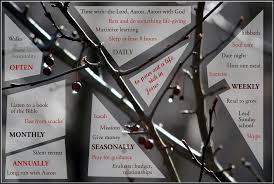
A rule of life is a monastic principle and it involves making a commitment to a number of spiritual disciplines – prayer, bible reading, giving and so on. It is “an intentional pattern of spiritual disciplines that provides structure and direction for growth in holiness.[1]” The reason for taking on such a rule is that it helps us to work on and to dRule of Lifeevelop our relationship with God, to create a rhythm to our days that enables us to focus on the presence of God in and around us, to be nourished by the grace of God and to be transformed more closely to the image of God.

A Rule of Life then, is intended to be a help not a hindrance, a pleasure not a burden. Just as physical exercise improves our physical health, so spiritual exercises are designed to improve our spiritual and emotional health. We take on spiritual disciplines to ensure that we grow and develop spiritually. A rule of life therefore has to be tailored to the individual. What works for one person may not work for another, what one person needs will not be the same as what someone else needs. What is life-giving for one person, might be stultifying and limiting for another so it is important for each person to discern what might and might not suit them, what will assist growth as compared to something that over time will become an empty practice.

It is clear that the fact of being baptised does not in and of itself infuse us with holiness. Few of us from birth truly embody all the characteristics of divinity that were displayed in Jesus and that are, ideally, are required of us. It is too easy for most of us to get caught up in the distractions of the everyday, to be absorbed by our own needs and bound by our own fears. Surrendering our lives entirely to God, allowing our lives to be completely directed by the Holy Spirit, freeing ourselves to be transformed into the image of God takes practice and discipline. This is why we use expressions such as “practice”, “exercise” and “discipline” when we are talking about something as indefinable as spirituality.

Prayer, bible study and spiritual reading all draw us closer to God, but the ways in which we can become aware of the presence of God in our lives and allow ourselves to be transformed are many and various. They include silence, attention, gratitude, forgiveness, generosity, being present, being compassionate and developing an attitude of openness to God’s abundant love and goodness. Such practices are not always part of our daily life or of our nature. For this reason it is important to identify those aspects of our lives that we need to work on and then adopt a practice or a habit that enables us to change. We may find that we need to learn for example how to stop and listen or to find out how to forgive or how to show compassion. There is no magic formula. If we want to truly reflect the image of Christ to the world, we must discipline ourselves to become like Christ. Just as we practice to become a better cook, a more competent cyclist or a more knowledgeable doctor, so we must practice those things that make us a better, more competent, more knowledgeable Christian, so that our lives are transformed and that Jesus can known through us.

It is not all hard work – we do not develop a rule of life or take on spiritual exercises to mortify the body or repress our God-given human nature. Spiritual exercises include play and rest, an appreciation of beauty and moments of pure joy, time to build relationships and time to dream. Our practices have to be onerous or time-consuming. I have heard of someone who places a coin on a lintel in her home. Every time she passes through that door, she remembers to be thankful. Another makes the sign of the cross before he gets up each day as a simple reminder that he belongs to God. Whatever we chose to do, it is important that it is achievable. Starting small and building up is much more likely to succeed than being too ambitious then failing and giving up.

In today’s gospel we hear the familiar words of peace. Jesus bestowing on the disciples that peace that the world cannot give.

The peace that Jesus offers is not a peace that ends world strife, or family discord. It is a peace deep within that transcends whatever is going on around us, a peace that enables us to be calm in the midst of the storms of life, a peace that fills and surrounds us no matter what else is going on. Sadly there is far too little evidence of this peace in a church that continues to argue and posture on issues such as theology, the ordination of women and the marriage of homosexuals.

It is easy to despair, to wonder what we can do in the face of what sometime seem to be insurmountable odds. True, we can’t change the world or the church, but we can change ourselves – by adopting spiritual practices, by working on spiritual exercises and by disciplining ourselves to be constantly aware that it is what we do and what we say that determines how non-believers make up their minds about God.

[1] The CSLewis Institute – http://www.cslewisinstitute.org. Other websites provide information about a rule of life: http://www.northumbriacommunity.org, http://www.westcott.cam.ac.uk are a few. A physical example can be found at https://ruleoflife.com/2015/03/10/paul-clarks-rule-of-life/. Images for Rule of Life provides an interesting example of how different Rules of Life can be.

No easy answers

March 26, 2016

Go back

Your message has been sent

Warning
Warning
Warning
Warning

Warning.

Today we meet, not only in the shadow of an act of terror over two thousand years ago, but also in the shadow of events in our own day. We draw comfort from the knowledge that God in Jesus shares our suffering. We know too that in Jesus God wrought victory from defeat, joy from sorrow and life from death and we believe that good will triumph over evil and that love will conquer hate.


Service of the Passion

and

Recognition of the Cross
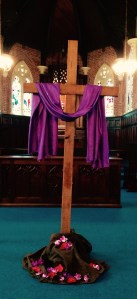
 

The contradiction of the cross

The contradiction of    the cross


(On this most solemn of days we would invite you to enter
and leave the church in silence.)


Procession with cross:

Hymn: 349 in the cross of Christ

Greeting:

The Lord be with you.

And also with you.


Let us pray:

God of contradiction,

give to us wisdom and understanding,

patience and humility,

and the courage to live with uncertainty,

so that we may hope for the right things

and arrive at what we do not know[1].

We ask this through your Son our Saviour Jesus Christ. Amen.


Poem: T. S. Eliot – from The Four Quartets


I said to my soul, be still, and wait without hope

For hope would be hope for the wrong thing; wait without love

For love would be love of the wrong thing; there is yet faith

But the faith and the love and the hope are all in the waiting.

Wait without thought, for you are not ready for thought:

So the darkness shall be the light, and the stillness the dancing.

Whisper of running streams, and winter lightning.

The wild thyme unseen and the wild strawberry,

The laughter in the garden, echoed ecstasy

Not lost, but requiring, pointing to the agony

Of death and birth.


You say I am repeating

Something I have said before. I shall say it again,

Shall I say it again? In order to arrive there,

To arrive where you are, to get from where you are not,

You must go by a way wherein there is no ecstasy.

In order to arrive at what you do not know

You must go by a way which is the way of ignorance.

In order to possess what you do not possess

You must go by the way of dispossession.

In order to arrive at what you are not

You must go through the way in which you are not.

And what you do not know is the only thing you know

And what you own is what you do not own

And where you are is where you are not.


In the name of God who suffers for us and with us, and who longs for us to turn and be made whole. Amen.

“And what you do not know is the only thing that you know.”

Shortly after five pm on Tuesday the world was shocked by the news of yet another act of terror – this time in Brussels. At least thirty people were dead and more than two hundred wounded many seriously. For those of us in Australia this news followed a grueling day in which, through the inquest into the police response, we revisited the final moments of the Lindt Café siege and the deaths of two hostages. At times like this, it is difficult not to ask: “Why?” “Why now?” “Why them?” As the story of the Brussels explosions unfolded, we learnt that a simple decision such as not buying a coffee made the difference between life and death, between being in the line of fire and being a safe distance away from the explosions.

Times like these remind us that there is a fine line between life and death, and that sometimes there is no rhyme or reason as to why one person lives and another dies, why some people live lives seemingly unfettered by grief or disaster and others live lives of quiet desperation, burdened by pain, sorrow or misfortune.

This side of the grave there are no easy answers. Life as we know it is vulnerable and fragile – susceptible to disease and constantly exposed to hazards and dangers – known and unknown. At the same time, humans are complex beings – capable of acts of great selflessness but also of unfathomable depravity, capable of great love, but also of immense hatred. We live in a world in which the good do die young, and the bad sometimes escape unpunished, in which only chance determines the country of our birth or the quality of our parenting, whether we stop for coffee or go straight to the departure gate. In this life, nothing is certain. We cannot predict what joys or heartache lie ahead.

There are two possible responses to this awful uncertainty – we can resist with all our might, refuse to take risks and try to force the world to conform to our expectations. This road will lead to frustration and disappointment, anger and bitterness. Our lives will be narrow and constrained and there will be no guarantee that we will be spared the pain of suffering and loss.

Alternately, we can willingly surrender. We can accept that life is filled with risk and uncertainty and choose to live boldly, courageously and confidently – no matter in what circumstances we find ourselves. This road will not be free of pain, but it will leave us open to joy and laughter, to adventure and hope. We will be able to ride out the bad times because we know that they will come to an end and that it is the good and the bad together that make life worth living.

Jesus chose the latter course. He willingly gave in to the future that was his. He surrendered himself completely to what life had in store. He submitted himself to the humiliation of a kangaroo court, the indignity of a flogging and the certainty of death of the cross. He did not ask: “Why?” or “Why me?” He simply walked the path that was his to walk, believing that somehow, in some way, God would give him both courage and strength in the present and that in the future, it would all begin to make sense. Jesus faced the cross not knowing what lay on the other side. As a consequence he learnt that through death comes life, that joy can be wrought from sorrow and victory from defeat.

Life is filled with uncertainty. The best that we can do is to place ourselves entirely in God’s hands and trust that in this life God will give us courage to face whatever it is that life throws at us and that in death, God will raise us to life eternal.

Reflection:

An abandoned God;

a dying God

confronts our sense of decency

and at the same time opens us to new possibilities –

to new ways of understanding God and ourselves.


Collect:


Holy God,

who teaches us that this day

which is so bad, is good.

Help us to live with incongruity

to know how much we do not know,

that understanding our limitations,

we may be open to the wisdom that comes from you alone. Amen.


Ministry of the Word

Isaiah 52:13 – 53:12

Hear the word of the Lord,

Thanks be to God.

Psalm 22

My God, my God, why have you forsaken me:

            why are you so far from helping me

            and from the words of my groaning?

My God, I cry to you by day, but you do not answer:

            and by night also I take no rest.

But you continue holy;

            you that are the praise of Israel.

In you our forebears trusted:

            they trusted and you delivered them.

To you they cried and they were saved:

            they put their trust in you and were not confounded.

But as for me, I am a worm and no man:

            the scorn of all and despised by the people.

Those that see me laugh me to scorn:

            they shoot out their lips at me

            and wag their heads, saying,

“He trusted in the Lord – let him deliver him:

            let him deliver him, if he delights in him.”

But you are he that took me out of the womb:

            that brought me to lie at peace on my mother’s breast.

On you have I been cast since my birth:

            you are my God, even from my mother’s womb.

O go not from me, for trouble is hard at hand:

            and there is none to help.

Many oxen surround me:

            fat bulls of Bashan close me in on every side.

They gape wide their mouths at me:

            like lions that roar and rend.

I am poured out like water,

and all my bones are out of joint:

            my heart within my breast is like melting wax.

My mouth is dried up like a potsherd:

            and my tongue clings to my gums.


My hands and my feet are withered:

            and you lay me in the dust of death.

For many dogs are come about me:

            and a band of evildoers hem me in.

I can count all my bones:

            they stand staring and gazing upon me.

They part my garments among them:

            and cast lots for my clothing.

O Lord, do not stand far off:

            you are my helper, hasten to my aid.

Deliver my body from the sword:

            my life from the power of the dogs;

O save me from the lion’s mouth:

            and my afflicted soul from the horns of the wild oxen.

I will tell of your name to my companions:

            in the midst of the congregation will I praise you.

O praise the Lord, all you that fear him:

            hold him in honour, O seed of Jacob,

            and let the seed of Israel stand in awe of him.

For he has not despised nor abhorred

the poor man in his misery:

            nor did he hide his face from him,

            but heard him when he cried.

The meek shall eat of the sacrifice and be satisfied:

            and those who seek the Lord shall praise him –

            may their hearts rejoice forever!

Let all the ends of the earth remember

and turn to the Lord:

            and let all the families of the nations worship before him.

For the kingdom is the Lord’s:

            and he shall be ruler over the nations.

How can those who sleep in the earth do him homage:

            or those that descend to the dust bow down before him?

But he has saved my life for himself:

            and my posterity shall serve him.

This shall be told of my Lord to a future generation:

         and his righteousness declared to a people yet unborn,

         that he has done it.

1 Corinthians 1:18-31

Hear the word of the Lord,

Thanks be to God.


Hymn: 339 O sacred head sore wounded


The Gospel of our Lord Jesus Christ according to John Chapter 18 beginning
at verse 1.

Glory to you Lord Jesus Christ.

For the Gospel of the Lord.

Praise to you Lord Jesus Christ.


Hymn: 341 My Song is love unknown.

(During the hymn a collection will be taken up for the Anglican Diocese of Jerusalem)


Intercessions:

Living, loving God, help us to relinquish our confidence in ourselves and our desire to go it alone;

to accept the vagaries of life and to let go of our need to be in control;

to recognise that we do not and cannot have all the answers and to understand that our knowledge is only partial and our insights limited by our humanity.

God when our hearts are aching,

Help us to find you in and among the suffering of the world.

Give us grace to acknowledge that life consists of the good and the bad and that our lives are enriched as a result;

to admit that hatred and fear only limit and bind and that love frees us to be fully alive

and to learn that it is only in your that true peace and joy are to be found.

God when our hearts are aching,

Help us to find you in and among the suffering of the world.


Be with all those whose lives are marred by violence, terror and war,

and with those who perpetrate acts of cruelty against others.

God when our hearts are aching,
Help us to find you in and among the suffering of the world

Support and encourage those whose lives are restricted by poverty, ill-health and disability,

and challenge those who have the means to help but do not.

God when our hearts are aching,
Help us to find you in and among the suffering of the world

Be a friend to those who are overlooked and discounted

and open our eyes to the suffering of those around us.

God when our hearts are aching,
Help us to find you in and among the suffering of the world.

Help us all to reevaluate our lives in the light of the cross and take our place among those who live life to the full and who make a difference in the lives of others.

God when our hearts are aching,
Help us to find you in and among the suffering of the world.


Lord’s Prayer: Accept our prayers through Jesus Christ our Lord,

who taught us to pray.

            Our Father in heaven,

                        hallowed be your name,

                        your kingdom come,

                        your will be done,

                        on earth as in heaven.

            Give us today our daily bread.

            Forgive us our sins

                        as we forgive those who sin against us.

            Save us from the time of trial

                        and deliver us from evil,

            for the kingdom, the power, and the glory are yours

                        now and forever. Amen.

Confession:

Our God whose love knows no bounds

comes to you – naked, weak and bleeding,

holding out holey hands, holy hands and asking only for your love in return.


Let us offer our hearts to God, confessing our sins – the barriers that separate us from each other and from God.

Suffering God,

who gave everything for us

forgive us our arrogance and presumption,

our greed and self absorption,

our neglect of the vulnerable,

our carelessness with the world’s resources,

our unwillingness to trust in you

and our failure to accept and to share your love and compassion. Amen


Absolution:

God whose love knows no bounds

forgives you and sets you free

to love God and to love one another.

Forgive others,

Forgive yourself. Amen.

Recognition of the cross:

730 Jesus remember me when you come into your kingdom.

(Recognition of the cross – you may like to place a flower at the foot of the cross, as a reminder that today is a day of contradiction, a reminder that God continually overturns our expectations so that we might rely on God and not ourselves. Alternately you are welcome to sit or stand in quiet reflection.)

Blessing: May the God who died for you, inspire you to live for God,

and the blessing of God almighty, Creator, Redeemer and Sanctifier be with you now and always. Amen.


Hymn: 262 When pain and terror


Please leave the church in silence


Copyright: Marian Free , 2014 (revised, 2016)


ANZAC DAY

There will be a service to commemorate Anzac Day

Monday 25th April – 8:00am


(If there is anyone for whom you would like us to pray,

Please add their name to the list at the back of the church.)


Rector:          The Rev’d Marian Free: m) 0402 985 593

  1. e) staugust@bigpond.com


Curate:                 The Rev’d Professor Rodney Wolff,

  1. e) staugust@gmail.com, 0426 287 283


Parish Office:       3268 3935 / Fax 3268 4245

Office Hours:       Monday, Thursday & Jumble Wednesdays

                               9.30am – 12.30pm


staugust@bigpond.com

www.staugustineshamilton.com.au


Sermons:            If you would like to read the weekly sermon,

                                 go to the home page and click on sermon.


            St Augustines Anglican Church


@StAugustines


Music Director:      Lesley de Voil: 0418 561 663 or

                                         lesleymdv@gmail.com


Service Times:      Sunday 7:30am & 9:30am

                               Tuesday & Thursday 7:00am

Wednesday 10:00am


Columbarium:      Robin Loan: 0417 799 400 or

                                 r.loan@optusnet.com.au

Columbarium Service: First Saturday of the month 7:30am


[1] “For hope would be hope for the wrong thing.” “In order to arrive at what you do not know you must go by a way which is the way of ignorance.” T.S. Elliot from “East Coker, The Four Quartets”
A matter of love

March 19, 2016

Palm Sunday – 2016

Luke 22: -23:

Marian Free


A matter of love

May God whose love for us knows no bounds, free us from all those things that prevent us from accepting that love. Amen.

Love is an extraordinary motivator. It can enable people to go to extraordinary lengths to make a difference for those whom they love. Parents of children with severe handicaps invest hours of their time and all their financial resources to not only ensure that their child has the best quality of life that is possible, but also to defy the medical staff who have advised them that the child has no future. Siblings of cancer sufferers cycle around Australia or complete other such feats to raise awareness of the disease and raise funds for research. Husbands or wives refuse to turn off life support machines, believing that the one whom they love has a future.

The love and determination of a spouse means not only the difference between life and death, but also the difference between simply being alive and having some quality of life.  Only last week I read the account of a young woman Danielle. At just 23[1] Danielle had married the love of her life. Only months later her husband, Matt he seriously injured in a cycling accident. As well as numerous fractures, he had sustained a serious traumatic brain injury. A team of doctors advised Danielle to turn off his life support.

Danielle trusted the doctors and thought she would agree to end Matt’s life. After a sleepless night she thought: “Matt is my husband. If he stays in a coma, of if he needs looking after for the rest of his life, I will be the one taking care of him.” Instead of conceding that the doctor’s were right, Danielle knew if a flash that she could do it. She felt that God was telling her to take a chance, that this was her path in life. Danielle was not going to let Matt die. That was 2011. What followed was a battle to bring Matt out of the coma, battles with the medical staff who wanted to put him into a nursing home and twenty four hour care, once she got him to her mother’s home. Caring for Matt meant changing nappies, checking feeding tubes, giving sponge baths, administering up to 20 different medications, turning Matt every two hours and single handedly doing all the physical therapy that was required.

Danielle’s journey is a long way from over and Matt may never be the same, but he sings to Danielle and writes her poems and tells her every day that he loves her.

As is the case with Danielle, the cost of love is often enormous – emotionally, financially and in terms of the time that is involved. Yet the lover (parent, sibling, friend) thinks nothing of that, only of ensuring that their beloved is loved and cared for, has the best life that is possible in the circumstances and that they know that they have not been abandoned.

This Lent, it has seemed to me that the readings have focused on love – God’s boundless, unconditional love for all of humanity. We have seen that God reaches out for us in love, refusing to give up on us no matter how much we disappoint, frustrate and even enrage God.  God does not/cannot stop loving even when we blindly go our own way, when we put up barriers between ourselves and God’s love or when we behave in ways that are damaging to ourselves or to others. God’s love for us is a love that never gives up, no matter how broken or beyond repair we might be and it is a love that never counts the cost.

Today and throughout this week, we will witness God’s love played out in Jesus’ journey to the cross. We cannot know what was going through Jesus’ head when he set out for Jerusalem or when he incurred the wrath of the Jewish leaders by entering the city as a King, by challenging their views and by being high-handed in the Temple. What we do know is that at any point Jesus could have turned back. At any point, Jesus could have decided that it was all too hard and simply given up. At any point, Jesus could have chosen to do what was right for him, rather than what might be right for others.

But as relentlessly as the forces of evil lined up against him, Jesus doggedly continued on the path that was before him, the path that would ensure death for him and life for the world.

This is the ultimate demonstration of God’s love for us – God, in Jesus entering our world and pouring out love and compassion on an ungrateful world. God demonstrates God’s love for us in Jesus’ giving himself completely to and for us – doing whatever it would take to enable us to live our lives as fully as we possibly can.

God cannot and will not stop loving us. It remains for us to accept that we are loved and to discover that it is only by surrendering to God’s love that we will find fulfillment, freedom and peace. It remains for us to abandon ourselves to God and to thereby see that it is only in God we have all that we want or need.

[1] Reported in the latest Marie Claire Australia magazine (April 16, 2016, p104-106).

Abundance not sacrifice – Lent is God’s gift to us, our gift to ourselves

March 12, 2016

Lent 5 – 2016

John 12:1-8

Marian Free

In the name of God whose outpouring of love is more than we can ever imagine.  Amen.

It is just possible that I am turning into a grumpy old woman or it may be that I am by nature someone who tends to take the world and faith seriously. Whatever it is, I have found myself being irritated or disappointed by the attitude that some people (particularly via social media) have taken towards Lent. There have been posts on Facebook by people bemoaning the fact that they are saying “goodbye” to beer or wine or some other treat for forty days as if Lent is a burden imposed upon them rather than something taken up freely. Other people have posted cartoons, which again make it seem that Lent is at worst some interminable punishment or at best a trial that has to be endured. To be fair, I am sure that most of the posts are from people who do take Lent seriously and who assume that their friends will understand that they are simply making light of it not expressing how they really feel.

It does concern me however that the negative messages about Lent, give the wrong idea – not only about the practice of Lent but about the Christian faith – to the non-Christians who hear or read them. Those who are not in on the secret could be forgiven for thinking that Lent is a period of misery expected by an exacting and demanding God instead of seeing it as a time of self-imposed abstinence that will liberate us to know more fully an indulgent and affirming deity.

The readings for the first four weeks of Lent have encouraged us to turn our lives around and to remove the barriers that separate us from the overwhelming abundance of God’s love. John the Baptist urged us to “repent” (literally – turn around), the parable of the fig tree reminded us that we share with all of humanity its frailty and imperfections, Jesus’ lament over Jerusalem gave us an insight into the sorrow experienced by God because of our refusal to accept God’s love and the parable of the two sons demonstrated God’s utter refusal to exclude us from that love and at the same time reminded us of the ways in which we place ourselves beyond the reach of God’s affection.

Today, as we approach the end of our forty days, we are confronted by a description of an act of intimacy, extravagance and tenderness – not of God towards us, but of Mary towards God. At first the gospel seems out of place an action of such beauty and lavishness seems to conflict with a time of fasting and self-denial.  But today’s gospel is a perfect fit – not only with the gospel readings that have preceded it, but also with the central purpose of Lent. In conjunction with the gospels of the past four weeks, today’s gospel sums up what Lent is about and what we can hope to achieve.

We discover, if we plumb the lectionary offerings, that Lent is primarily about ensuring that we are in the best condition possible to accept God’s love for us. We allow ourselves a period of prayer and self-examination to reflect on our lives and in particular to consider whether or not we are truly open to the love that God is constantly pouring out on us. Fasting and self-denial are not intended to be a way of  “mortifying” or denying the flesh” but a means of identifying and ridding ourselves of the obstacles that we place between ourselves and God – obstacles which are just as likely to be emotional and psychological as they are to be physical.

When we strip ourselves bare, when we purge ourselves of all the things that prevent us from experiencing the fullness of God’s love, we will be simply overwhelmed by the outpouring God’s grace and the generosity and the bounty of God’s affection. We will be astounded that God could love us so much and we will be acutely aware of our little we deserve that love.

Lent is a lesson of love, God’s extravagant, unconditional and boundless love, which is ours for the taking. The disciplines of Lent are not intended to weigh us down, but to prepare us to receive God’s love without question and without hesitation.

This is where Mary fits in. Mary, the sister of Lazarus, responds to God’s love with an extravagance that matches Jesus’ own. Mary is the perfect example of someone who has allowed herself to be stripped bare, who has opened herself completely and unreservedly to God’s scrutiny and in so doing has discovered not judgement but compassion, not condemnation but understanding, not rejection, but complete and total acceptance. Mary responds in the only way possible – with a demonstration of her deep and humble gratitude.

Even by today’s standards, Mary’s actions open her to disapproval – the loose hair, the public and intimate display of affection, the extravagance and waste. Yet for Mary there is no other response that will adequately express her reaction to God’s love for her. Mary throws caution, propriety and decorum to the wind. She has no thought of what others might think of her only that she must express her own love in a way that matches her experience of the love of God.

Lent then, is not so much about sacrifice as it is about abundance, not so much about self-denial as it is about self-acceptance, not so much about being unable to measure up, but about realizing that there is nothing against which to measure ourselves. Lent is less about sacrifice and more about abundance – about discovering the abundance that emanates from God and not from the world. Lent is less about will power and more about letting go – for it is only when we truly let go that we are able open ourselves to the wealth that is ours for the taking.

During Lent we identify and shed the obstacles that separate us from the love of God – a love so overwhelmingly abundant that it calls for a response that is extravagant, intimate and tender a response like that of Mary sister of Lazarus.

Forty days is not much to ask – in fact it almost seems far too little to give when we gain so much in return.

A quiet observance

February 10, 2016

Ash Wednesday

Matthew 6:1-8,14-18

Marian Free


In the name of God who created us and who, with our consent, continues to recreate us. Amen.

Jerusalem - Ramadan

Canon fire to mark end of fasting.

In 2015, we were in Jerusalem during Ramadan. Two things stood out, one was the fact that it was not until 8:00pm that the streets came alive. Food vendors who had been there for most of the day suddenly became busy as Palestinians came out to eat. The second was the canon (yes, canon) that helpfully fired at 4:00am to remind people that the time to fast had begun and again at 8:00pm to indicate that the fast had ended. Our Palestinian driver was observing Ramadan and while we Westerners ate lunch, he sat in the bus eating nothing.

One of the most challenging things about being in a largely Muslim country is the observance of faith. Five times a day the Muezzin gives the call to prayer – a haunting chant that floats overhead reminding the observant to stop what they are doing and offer worship to God. Five times a day faithful Muslims unroll their prayer mats and in full view of the world make their obeisance. For myself the call to prayer is a powerful reminder of the presence of God in every aspect of life, further, it always seems to me that such a public proclamation is an indictment of the Christian world whose faith is practiced behind closed door. (We might ring bells before services, but today few churches ring the Angelus.)

I think that it would be fair to say that in today’s secular world, more people know about Ramadan than they do about Lent. The reason for this can be placed directly at our door. If our observance is lack-lustre or non-existent, there is no reason for others to ask what we are doing and why. If we ourselves are not prepared to demonstrate that it is possible to go without for a short time or that it is necessary to hone our spiritual practices, how can we possibly confront the materialism and secularism of the world around us?

That does not mean that we should fast loudly and blatantly. It certainly doesn’t mean that we should go about with long faces so that everyone is able to notice how much we are suffering for our faith. Just the opposite – our practice of Lent should be quiet and unobtrusive. If our abstinence or our practice is noticed by others, we can say, without fanfare, something like: “Oh, this is just something that I am doing for Lent.” It is just possible that this will lead to further questions about why we do such things in Lent and give us opportunities to expand on the benefits of devoting a period of time to being less self-obsessed.

It is possible too that some will find our Lenten practice disquieting and confronting. Some people may feel uncomfortable around us if they are being extravagant and we are being economic, if they are feasting and we are fasting. Hopefully their disquiet may lead to further thought and questions (just as the Muezzin confronts my failure to display my faith more publicly).

Either way, without trumpeting our self-righteousness or proclaiming our self-discipline, an observance of Lent by more than just a few of us, may just enable the secular world to understand that we take our faith seriously, that our practice of the faith is more than just outward form and that God as known through Jesus Christ is indeed a very real presence in the world.

Let this be a year in which we take our practice seriously and in which our observance of Lent contributes to the knowledge of God in the world.

Beyond belief

February 6, 2016

Transfiguration

Luke 9:28-36

Marian Free

 In the name of God, whom we experience in the transcendent and in the everyday, the unbelievable and the believeable. Amen.

Captain Cook’s journey to Australia was not simply an expedition to discover and to claim new lands. It was also a very serious scientific enquiry. Cook himself was a navigator and a cartographer who had an interest in astronomy. During his first voyage among other things he recorded the transit of Venus. Nor was he alone in his scientific exploration. Other scientists joined him on his voyages including naturalists Joseph Banks and Daniel Solander and father and son scientist Johann and Georg Forster. The biologists recorded and preserved the new and interesting specimens of flora and fauna that they encountered on their travels. Some of these, including kangaroos and koalas were creatures that were previously completely unknown.

The most unusual animal to be discovered was the platypus. British scientists thought that the skin that was taken back to England was an elaborate joke. At first it was believed that someone (as a joke) had sewn a duck’s bill, a beaver’s tail and four webbed feet onto a rabbit’s body. It was apparently not until a third specimen arrived in England 1800 that Sir Joseph Banks, the naturalist on the voyage was able to declare that: “Suspicions about the existence of the platypus are now completely dissipated.” It is not just the appearance of the platypus that makes it unbelievable. The platypus is one of only two mammals in the world that lays eggs and even though they suckle their young, they have no nipples. No wonder the British scientists found it difficult to believe that they were not being duped.

It is not quite the same, but biblical scholars, especially those who are interested in uncovering the historical Jesus, try to ascertain whether some of the unbelievable things described in the Gospels really happened, or whether they are creations of the early church who, in trying to give flesh to their faith, embellished the “facts” or retold the story in such a way as to give it a particular emphasis. Such is the case with the account of the Transfiguration that records Jesus’ dazzling appearance and a conversation between Jesus and two people (Moses and Elijah) who at that time were long since dead.

According to Fitzmyer[1] there have been numerous attempts to come to grips with this extraordinary account. A number of scholars believe it to be an historical event, that after Peter confesses that Jesus is the Christ, he, James and John receive a physical affirmation of the fact. The problem is that this does not explain Peter’s later denial and the disciples’ abandonment of Jesus. Another explanation is that the Transfiguration is a vision that Peter, or all three experienced. Yet another explanation is that it describes a post-resurrection experience that was written back into the life of Jesus. This however does not explain what Moses and Elijah are doing and why Jesus’ glory is noted here and not in the resurrection accounts. Nor does it explain the differences between this story and the records of the resurrection. Lastly, there are some who believe that it is a description of Jesus at his coming again. No explanation is truly satisfactory.

The reality is that we will not (this side of eternity) be able to know with absolute certainty what lies behind this amazing story. We can however try to see what part it plays in the overall gospel account. In Luke’s gospel the Transfiguration acts as a kind of fulcrum between the Galilean ministry and the cross, it maintains the tension between Jesus’ suffering and his glory, between present realities and future vindication.

If we look at the account in context we will note that immediately prior to the scene on the mountain, Jesus has asked his disciples: “Who do people say that I am?” They respond – Elijah, John the Baptist, one of the prophets.” Finally, Peter proclaims: “You are the anointed one of God.” Then, as if to temper this outburst of enthusiasm, Jesus responds by predicting his death and resurrection and urging the disciples to: “take up your cross daily and follow me”. It is consistent with Luke’s telling of the story that Jesus makes clear that there are no short cuts to glory. Jesus’ victory will not come easily and now the disciples know that their reality will be the same as his. Vindication will be hard won, those things that are worth having are worth struggling for.

As if to reassure the disciples that it will all be worth it, Jesus then takes his inner circle with him up a mountain. There, they not only see Jesus completely transformed, but they also hear God’s voice affirming what Peter has earlier declared: that Jesus is the chosen one of God. The experience serves to assure the disciples that Jesus is the person whom they think he is and this despite what is to come – Jesus’ rejection, arrest, trial, crucifixion.

Faith in Jesus is not able to protect us from hardship, trouble, grief or pain – just the opposite, Jesus tells us that we will follow him to the cross. At the same time, Jesus gives us mountain-top experiences, moments of revelation and exhilaration that assure us that our faith is not misplaced, that Jesus is who we think he is and that just as he has come into this glory, so too will we finally be transformed from glory into glory.

[1] Fitzmyer, Joseph. A. The Gospel According to Luke I-IX. New York: Double Day and Company, 1979, 795-6.

God knows!

January 30, 2016

Presentation of Christ in the Temple – 2016

Luke 2:22-39

Marian Free

 In the name of God who gives Godself to us completely and utterly. Amen.

I happened to read a women’s magazine during the week. One of the stories was of a career woman who had had no intention of having a child, but at forty-five had given birth to her first child. Like so many other public figures she said that the experience had changed her life. “I have this fierce mother instinct – it’s quite fierce and protective.” For many of us, holding a newborn is one of the most amazing experiences. The child in your arms is so vulnerable and so dependent. Even if the child is not your own, you are often overcome with the urge to protect the child and there is a sense of foreboding in regard to all of all that could go wrong – in the present and in the future. What if someone drops the child? What if they don’t hold his/her head in just the right way? Will the child be settled or unsettled? Are the new methods of wrapping, feeding, bathing really better than they way that they used to be done? All of those thoughts can go through our minds in an instant – the wonder, the joy, the fear and the anxiety together.

After the initial excitement has passed, we might begin to consider what sort of future the child might have. If the child is our own, a grandchild, a niece or nephew, most of us would be secure in the knowledge that she/he would be well loved and parented well. If not, we might have fears for the safety and well-being of the child. And the distant future – well that is purely the subject of our imagination, fuelled by our own desires and concerns our fears and anxieties. Will the child be able to escape tragedy in his/her life? Will the education system/the health system be sufficiently well-funded to ensure that the needs of the child are met? Will the child have the resilience to resist peer pressure – avoid drugs and alcohol? Will the environment be able to sustain another generation on the planet? Will we, particularly in today’s violent and unstable climate be able to protect this child from acts of terror or from war?

So many unknowns lie ahead of every child and the best parenting in the best environment is not enough to prevent tragedy or disaster – whether of the child’s own making or from external causes.

Jesus is still an infant when his parents bring him into the Temple to present him to God as demanded in the Book of Exodus (13). The Temple is a bustling place, especially the outer courts which are open to men and women of every nation and where, as we learn later, the exchange of money occurs and the animals to be used in thank offerings are sold. Into this crowd come two very ordinary people bringing with them their infant son. Somehow Simeon (who has been drawn to the Temple precincts by the Spirit) identifies this couple and knows immediately that their child is the anointed one for whom he has waited his whole life.

Without so much as a: “by your leave”, Simeon scoops the child into his arms and before his surprised parents bursts into a song of praise in which he identifies this baby as the one who is to bring glory to Israel and to be a light to the Gentiles. Perhaps Mary and Joseph are not totally surprised by this. Luke’s introduction leads us to believe that they know full well who Jesus is and what he is to become. They might be surprised to hear that not only will he save his people, but that the Gentiles will also come to faith through him, but the angel has already told them that: “he will be great, and will be called the Son of the Most High, and the Lord God will give to him the throne of his ancestor David. He will reign over the house of Jacob forever, and of his kingdom there will be no end.” It may be that they have already begun to imagine their future and that of their son – the honour and respect that might ensue once he became known for who he really was!

Imagine their shock when Simeon concludes: “This child is destined for the falling and the rising of many in Israel, and to be a sign that will be opposed so that the inner thoughts of many will be revealed—and a sword will pierce your own soul too.” “The rising and falling”, “A sign to be opposed” –suddenly a sense of foreboding is introduced into what had been a situation of joy and hope and expectation. Simeon’s words suggest that Jesus’ future will not be all smooth sailing, not everyone will share their confidence that Jesus is the Son of God.

Simeon’s prediction includes an element of threat and a warning – Jesus’ life will not conform to expectations. It is possible that he will not be a triumphant king. that his teaching and actions will not always be positively received. Instead of glory, there is a possibility that he will experience suffering and defeat. For Mary and Joseph, the confidence of the angel’s words must have come into question. They must have wondered what they could expect of this child? What would the future really hold? We can only speculate, but I imagine that Mary and Joseph will have left the Temple with a very different and much less certain view of how Jesus’ future would play out.

In order to save humankind, to bring us to our senses, God was prepared to enter our world fully and completely, vulnerable and unprotected. In Jesus, God completely abandoned divinity becoming fully human, completely vulnerable, completely dependent and susceptible to the same dangers and difficulties as the rest of humankind. It is for this reason that Hebrews can record: “For we do not have a high priest who is unable to sympathize with our weaknesses”.

Life may not go the way that we expected for ourselves – or for our children. Not even God is able to protect us from the things that living in this world entails, but through good times and bad, disaster and triumph there is one thing of which we can be sure – that God in Jesus chose not to be shielded from the accidents of fate, the cruelties of human beings and the indifference of the planet. God, in Jesus knows that there is no certainty in this life except the certainty of God and of God’s overwhelming love for us that allowed God to immerse Godself so completely in our existence that it would be impossible for us to say: “God does not know what I am going through.”


(If you have taken up the challenge to explore Luke’s gospel. Note: Luke’s concern with the Temple, his determination to demonstrate continuity with Judaism – the family undergo the Jewish rites – the presence of the Spirit and the gospel for the Gentiles.)

To act or not to act

January 23, 2016

Epiphany 3 -2-16

Luke 4:14-21

Marian Free

In the name of God who challenges us to build a world without poverty, injustice or oppression. Amen.

The Clergy Summer School usually has two guest speakers. This year our guests were a Professor of Physics from the University of Queensland – Ross McKenzie and an American who is passionate about the pastoral uses of social media, Joshua Case. I’ll share more about social media another time, but this morning I wanted to tell you something about the Parish from which Joshua comes – The Church of the Holy Innocents in Atlanta, Georgia.  From what I can gather, the parish is not too different from our own. It is Anglican and is situated in a middle-to-high income suburb. There are at least two differences between ourselves and Holy Innocents. One is that on a Sunday five hundred people regularly attend services.  Another is the social justice focus of that Parish.

As I understand it, Joshua was employed to assist the congregation discover how they could live into their name – Holy Innocents. This exploration led to a realisation that if their church were to honour the children slaughtered by Herod, they would need to identify and to side with the vulnerable in their own time and place. A number of initiatives have emerged from this starting point. For example, every year the church seeks and obtains the names of all children in the state who have been violently killed over the course of the year. The names of the children are recorded and once a year the church holds a twenty-four hour vigil during which the names of all the children are read aloud.

Children are not the only vulnerable members of society.  In Atlanta, as elsewhere, homeless people have created a tent city on vacant land. The local fire department has made it their mission to support the homeless with food and other necessities. Last week (when the temperatures were still between -1 and 10 degrees C) the local authorities moved in and bulldozed a section of the camp.  That same week, the Federal authorities shipped a number of Latinos – some who had arrived through the appropriate channels and some who had not – to a detention centre in another state. Most of the children detained attended the school associated with the Parish.

The Parish’s relationship with the members of the Fire Department and with the children attending the school means that these actions directly affect them and their mission. They must work out how to respond, knowing that taking a stand may well make them unpopular with others in the city, the state and even the nation.

In today’s gospel, Luke depicts Jesus reading from the book of Isaiah. The language is uncompromising: “The Spirit of the Lord is upon me, because he has anointed me to bring good news to the poor. He has sent me to proclaim release to the captives and recovery of sight to the blind, to let the oppressed go free, to proclaim the year of the Lord’s favour.” From Exodus to Malachi, the Old Testament records God’s preference for the poor and the marginalised and details God’s anger: “against those who oppress the hired workers in their wages, the widow and the orphan, against those who thrust aside the alien, and do not fear the LORD of hosts” (Mal 3:5). “Cursed be anyone who deprives the alien, the orphan, and the widow of justice” (Deut 27:19).

Even though the Bible is very clear about God’s expectations, many of us find social activists to be uncomfortable people and we tend to want to distance ourselves from those who challenge the status quo. There are a number of possible reasons for our disquiet – the words and actions of social activists can and often do bring them into conflict with the government and the law and we don’t want to be seen as law-breakers. Activists are uncomfortable people because their willingness to act and take risks can lead to our feeling that we are lacking in courage or determination or, worse, that we have no compassion or understanding for the situations in which some people find themselves.

Those who challenge the status quo are often made to pay for daring to name things as they see them, for standing for and with the oppressed. Michael Lapsley a New Zealander and a Franciscan received a letter bomb that robbed him of both hands and an eye because he dared to speak out against apartheid. Oscar Romero, an El Salvadorian bishop was shot at the altar for taking a stand behalf of the poor. Peter Greste an Australian journalist and his colleagues were arrested and jailed in appalling conditions for reporting the truth as they observed it in Egypt.

We should not be surprised at the crowds’ reaction to Jesus. Jesus’ claim that the words of scripture had been fulfilled in himself was not the source of their anger. Rather it was his interpretation of the words of Isaiah (at least this is N.T. Wright’s suggestion).  With the passage of time, these words and other OT texts had lost some of their sting. As a people who had been in exile or under foreign domination for the better part of 500 years the Jews had come to believe that the words of Isaiah spoke to their situation – they saw themselves as the poor, the oppressed and the imprisoned.  They believed that when God’s anointed came, he would to set them free. They had lost sight of their responsibility for the vulnerable among them.

In his words and in his actions, Jesus demonstrated his compassion for the outsider – the poor and the dispossessed. By claiming that the words of Isaiah were fulfilled in himself, Jesus was calling the people to return to their biblical roots, to revive a concern for the widow and the fatherless, the hired worker, the alien and the poor.  This made him an uncomfortable figure, someone whom they didn’t want to have around. In the first century, Jesus is interpreting words that were written some five hundred years previously. In the twenty first century, it is our task to make sense of the words for our own time and place.

What do we make of Jesus’ words? Do they make us anxious, uncomfortable or uncertain?  Are we tempted to push the uncomfortable Jesus away from us (over a convenient cliff)? Or do these words challenge us to consider how we should respond. Do they encourage us to ask: Whose are the voices that are not heard in our day? Who are the people who are longing to be set free?  Where are the marginalised and the oppressed?

What is our role as Christians in the world today? Are we meant to keep our hands clean and our heads down or does God demand that we take an interest in and demonstrate a concern for what is going on around us? Do we leave issues like domestic violence, homelessness and refugees to the secular world, or do we take a stand and, with Jesus, initiate God’s kingdom here on earth?