Not our our watch?

February 16, 2019

Holy Innocents – 2019

Matthew 2:13-18

Marian Free

In the name of God who uses love, not force to ensure obedience and trust. Amen.

Some of you will have seen the recent movie, “Mary, Queen of Scots”. Mary was the legitimate daughter of James the V of Scotland, but more importantly, she was the great, granddaughter of England’s Henry VII, and, after the childless Elizabeth, she was the legitimate claimant to the English throne. Mary who at only 6 days old was declared Queen of Scotland as a consequence of the death of her father, was sent to France for her education. At eighteen Mary, a Roman Catholic, returned to a Scotland that in her absence had embraced Protestantism and did not welcome a papist Queen..

Her troubles in Scotland were one thing, but it was the fact that Mary was a threat to Elizabeth’s reign and and the fact that her presence might be the catalyst for civil war or war between the two nations, that led her to her imprisonment and finally to her execution. As long as Mary was alive, she could be a focal point for dissent in the realm and beyond, and Elizabeth’s grip on power was weakened as a result.

The history of the British monarchy is littered with stories of intrigue – of people seeking favour with the king (or queen) to increase their wealth or to bolster or secure their power; or of competing heirs to the throne who must be destroyed lest they pursue their claim by force or become figureheads for those who want to depose the crown. As a consequence, the queen (or king) learns that no one can be trusted, that power must be maintained by force and that any and all opposition must be eliminated so that they no longer pose a threat.

Given our own history, it should come as no surprise to us that Herod, whose position is entirely dependent on his relationship with Rome and his ability to maintain control over a people who despise and reject him, should be agitated when he learns from the magi that a king has been born and not only a king, but the legitimate king of the Jews. The child presents a double threat – he could become a focal point for the unrest that was always just below the surface or he could raise an army and make a claim for Herod’s throne. From Herod’s point of view there is only one way to avoid conflict and loss of face (not to mention loss of power). The child has to die. The problem, in this instance, is that Herod has no way of knowing when the child was born, so just to be safe, he kills all the boys who were born in Bethlehem in the two years before the magi’s visit.

There is no external historical proof that Herod did in fact slaughter the children of Bethlehem, but history has demonstrated time and time again that despots deal with threats to their power in only one way – by ruling tyrannically and by ruthlessly crushing any hint of opposition. Those who challenge, resist or protest oppressive and unjust regimes are usually arrested, tortured and killed – not only in the distant past but also in our present time.

News reports tell us in Venezuela today – a country in which inflation is out of control, medicines are impossible to source and food is scarce – the military is sent to into the slums to quell unrest, with violence if necessary. Protesters who are arrested simply disappear. In Turkey in 2016, an attempted coup against the government led to the imprisonment – not of students, and rabble rousers, but of lawyers and judges and military personnel. Anyone who was critical of the government or who was perceived to be a threat, was arrested and imprisoned. According to a CNN report, more than 110,000 people have been incarcerated since – a number that includes 200 top Turkish court officials. Many have been taken into custody despite the fact that there is no evidence that they had any involvement in the coup. The President was not and is not taking any risks.

In any time and place leaders who do not have the support of their people use repressive and violent means to suppress and eradicate opposition. Stalin’s Russia, Hitlers Germany, Apartheid South Africa, Pol Pot’s Cambodia, the list goes on and on. Brutal repression of revolt, the silencing of dissidents, and the scapegoating of those who are different is justified by the need to keep law and order and it gains support by the vilification and denigration of those who dare to expose injustice and oppression.

So, is Matthew’s account of the slaughter of the innocents simply a commentary on the abuse of power or – does it have something to say to those of us in twenty first century Australia who have the right to choose who governs us and the freedom to criticise our leaders and to protest decisions that we feel to be unreasonable or unfair?

I suspect that we have to recognise that there is a little bit of Herod in all of us, concern for our own welfare, fear of the unknown and a desire to maintain the status quo and in every age there will be those who abuse their power.

It is important that we do not become complacent. We have to be careful that our silence does not give legitimacy to acts of cruelty and torture, that our need for stability and security does not lead us to shore up unjust systems and oppression governments, that our own need for security and peace does not make us indifferent, or worse, deaf and blind to the legitimate complaints of others and that our desire to protect and preserve what we have does not make us fearful of the claims others might make on us.

In other words, let us be on our guard and let us do all that we can to ensure that the innocent are not slaughtered on our watch.
Try again

February 9, 2019

Epiphany 5 – 2019

Luke 5:1-11

Marian Free

In the name of God who challenges us to go our of our depths to see who, with the help of Jesus, we can be. Amen.

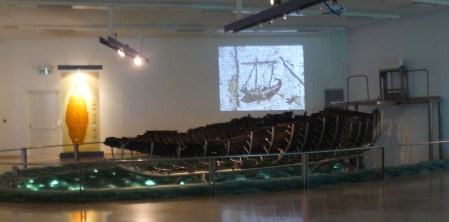
The most popular attraction in Israel is, perhaps surprisingly, a first century fishing boat. The boat in question was discovered by two brothers from Kibbutz Ginnosar who used to trawl the shore of the Sea of Galilee looking for artifacts. On one such occasion they discovered the outline of a boat. The story of raising and preserving the boat is fascinating and, thanks to the care taken with it’s restoration, we have an almost complete boat from the time of Jesus. It could hold up to fifteen men and their catch. The one located and preserved at Ginnosar had been repaired on many occasions during the course of its life and archeologists have identified a huge variety of timbers that, over time have been used to repair the boat. While the archeological significance of the discovery is immense and adds a great deal to our understanding of the craft of boat building in the first century, the discovery has the added weight of giving us a truer idea of the sort of vessel into which Jesus might have climbed in today’s gospel.

As with many of the accounts in our gospels, the story of the miraculous catch can be read in a variety of ways and on many different levels. We can notice the difference between this version of Peter’s call and that of the author of Mark, or we can compare the story with the post-resurrection catch of John’s gospel. Time could be spent comparing Peter’s reaction to Jesus with that of the prophets who, in the presence of the divine, recognize their limitations and frailties and protest their unworthiness. What did Jesus teach from the boat and what does it mean to ‘catch people alive’ we might wonder? Why does Peter address Jesus as ‘master’ before the catch and as ‘lord’ after the catch? And why does Luke use the language of ‘catching people alive’ (or enthralling them) when Matthew and Mark tell us that Jesus commissions the first disciples to ‘fish for people’.

These eleven verses, that on the surface recount the call of Peter, James and John, are filled with meanings and nuances that are both obvious and subtle. It could take hours for us to unpack the various complexities of the scene!

Today, I’d like to explore the possibility that the the story of the miraculous catch is a metaphor for our own time, that Jesus urges us to try again when we have lost hope and when feel that we have done all that we can.

We live in an age in which many of have grown weary of trying to win people for Christ and in which too often we fall into despair at the decline in church attendance and at our our inability to prevent the church’s slide into irrelevance. It is a time in which religion is often used to defend conservative values at the cost of compassion and to the detriment of the gospel message of love and in which the political and social landscape is undergoing great change. It is easy to be overwhelmed by the hopelessness of our situation and to simply give up.

Peter, James and John were, according to Luke, professional fishermen. They owned their boats and were in a business partnership. Almost certainly their fathers were fishermen before them and from an early age they would have understood the lake and the times at which the fish were most likely to be running. After an unfruitful night they would have been tired and frustrated and possibly anxious about the loss of revenue and in no mood to have another go. There would have been no reason for them to respond to a tradesman from Nazareth who knew nothing of the ways of fish or of the sea. Yet Jesus’ word is authoritative enough to persuade Peter to go back to the deep and to try one more time. He is rewarded with a catch so large that it begins to break the nets and Peter is forced to call for help.

The world of Peter was no more benign or settled than our own. Peter, James and John were not carefree fishermen, plying their trade and selling their catch. Rome overshadowed all their lives. The state would have demanded that they pay a tax or a levy for the right to fish and Rome’s representatives may have demanded a proportion of the catch. Life would have been difficult and the conditions oppressive and there would have been no reason to imagine that the situation was about to change. Tomorrow would be more of the same, but the certainty of their lives, hard as they were, would surely have more allure than the uncertainty of trusting in let alone following Jesus.

Jesus approached fishermen who were disillusioned and tired and he told them to try one more time. He ignored Peter’s protestations that he was a sinful man and without so much as a ‘by your leave’ he assured Peter that from now on he would hold people enthralled.

Many of us in the church are exhausted and disheartened. We feel that we have done all that we can to bring about growth in our congregations. We are conscious too, that collectively we are tainted by scandal, blemished by the compromises we have made and held in scorn because we have been unable to change and adapt.

When we feel that we have reached the limit of our reserves, Jesus comes to us, takes his place with us and says: ‘Try again. Take heart, go out once more into the midst of a world that is complex and hostile. Throw out your nets one more time. You will be amazed at what I can do with you – sinners that you are. Don’t be afraid, with me you will hold people enthralled.’

Spoiling for a fight?

February 2, 2019

Epiphany 4 -2019

Luke 4:21-30

Marian Free

In the name of God who challenges cultural norms and who asks us to see the world in a different way. Amen.

The movie Once Were Warriors depicts in very graphic terms a family caught in a cycle of violence, unemployment and neglect. It could be about any society but in this instance it is about a Maori family – hence the title. The husband loses his job, the wife is abused and, partly as a consequence of the dysfunction in the family, a son ends up in jail. There is worse, but I will spare you that. One particularly confronting scene is that in which the wife goads the husband until, unable to bear it, he lashes out at her.

What is it that causes some people to spoil for a fight? Why would one person try to so antagonize another that the other would respond with force? I can only guess that in this case the woman was trying to expose her husband’s weakness. That she seemed to think that if she could get him to hit her it would prove to them both that he was less than a man. In other words it was her way of putting him down and perhaps of building herself up. He beat her because his masculinity was threatened. Ironically, by using violence he proved her right.

There are all kinds of reasons why people deliberately antagonize another. One is to prove moral superiority. Another is just the opposite – if a person can get someone to attack them (verbally or otherwise) it reinforces their own low-esteem. They can think: “Of course they would attack me – I’m worth nothing more.” People who are very sensitive to criticism are always on the defensive. They are spoiling for a fight because that they feel that if they can get in first, they will have the upper hand in any argument that results. Someone who is angry might be looking for a fight just in order to release the tension that has built up inside them. If they have been put down or criticized by someone they might pick a fight with the next person they see in order to release the anger they feel or to restore their own sense of worth.

Others provoke fights in order to demonstrate their own strength in comparison to someone else. (I think for example of the shortest boy in my year at high school. He was forever egging on the taller boys so that he could engage them in battle and show that, even if he was small, he was at least as strong or as tough as they.) Similarly, someone with low self- confidence might try to prove themselves to their friends by seeming to take on someone else. Some of us may have been in the uncomfortable situation of having a complete stranger call out: “Hey, what are you looking at?” when we didn’t think we were looking at anything at all.

A rash response to a perceived threat or a desire to big-note oneself in front of one’s friends can have tragic results – especially if the person concerned is under the influence. So called ‘one punch’ attacks are usually brought on by someone consciously or unconsciously looking for a fight.

What, you might wonder, does any of this have to do with today’s readings?

If you look or listen carefully you will notice an apparent disconnect between what the people say of Jesus and his response to them. In verse 22 we are told that all “the people spoke well of Jesus and were amazed at the gracious words that came from his tongue.” Jesus’ response though is not one of quiet pleasure – just the opposite. He goes on the attack. He says: ““Doubtless you will quote to me this proverb, ‘Doctor, cure yourself!’ And you will say, ‘Do here also in your hometown the things that we have heard you did at Capernaum.’” “Truly I tell you, no prophet is accepted in the prophet’s hometown.”

What has caused this outburst from Jesus? Is he, as it appears, spoiling for a fight?

To solve the problem of Jesus’ harsh reaction we have to seek the help of social scientists .

The highest form of social currency in first century Mediterranean society was that of honour. Honour was something that was bestowed by birth and could only be increased by taking honour from another (by putting them to shame). One’s honour had to be protected at all costs.

This appears to be the issue here. Jesus is not spoiling for a fight – but he senses that his listeners just might be and he tries to cut them off at the pass. You see, Jesus hears what we do not. He understands that the words of praise are qualified by a subtle attack: “Is this not Joseph’s son?” they ask – simple words that contain an underlying anxiety,

Jesus’ honour, his place in his community, was determined by that of his father, and by extension the community to which he belonged. The cultural norms of the time dictated that Jesus should follow in his father’s footsteps and that he should not seek to change his place in the world. No wonder Jesus’ self identification as a prophet causes great consternation in his home town. Jesus’ claim to more honour than that which is his due inevitably diminishes the honour that is available to his fellow villagers – an increase in his status leads to a reduction in theirs. In a world in which honour is a limited and precious resource this is in fact a matter of life and death.

Jesus’ apparently unwarranted aggression may in fact be evidence that Jesus wishes to avoid the fight that his listeners want to bring on. This view is reinforced by Jesus’ refusal to fight back when they attempt to drive him over a cliff. Indeed the remainder of the gospel will demonstrate most vividly that, rather than seek status honour for himself, Jesus does those things which bring him into disrepute. He mixes with outcasts and sinners and submits to the most shameful of deaths.

Here, at the start of his ministry, he refuses to give his listeners satisfaction. He will not contend with them for honour. In life and in death Jesus will show that the kingdom of God operates according to different standards and measures a person’s place in the world by different norms.

Jesus will not be drawn into the narrow confines of their way of thinking, he will not be controlled by the restrictive cultural norms of his day. He slips through the crowd who threaten him and goes on his way proclaiming the good news of a kingdom that is not governed by human limitations.

Knowing our audience

January 26, 2019

Presentation of Christ in the Temple – 2019

Luke 2:22-40

Marian Free

In the name of God who has no beginning and no end. Amen.

Consciously or not, we all use rhetoric to ensure that our point of view is heard or that others are brought around to our way of thinking. The use of rhetoric in the modern world is perhaps most obvious in politicians and preachers whose futures may depend on their ability to sway their listeners. In ancient Greece rhetoric was highly prized and there were many schools of rhetoric and a vast number of books on the subject. Assessment in the subject was pass or fail. A student who had complete the course would be sent to their home town to give a speech. If they convinced their friends with their argument, they received a pass, if they did not, they failed. This was not as harsh as it sounds. The life of a philosopher was not an easy one.  They wandered around the countryside peddling their particular view of the world. Their success or failure depended entirely on their ability to command an audience and to persuade them that their arguments were valid. Success would ensure that they would have a bed for the night and food for the journey. It might even mean that they would secure a patron who would supply their every need.

Paul was a skilled rhetorician as were the gospel writers. In the first century the stakes were high. Those who followed Jesus were convinced that faith in him was the means to salvation, a source of liberation, peace and joy. They didn’t want to simply tell people about Jesus, they wanted their audiences to believein Jesus. It was not easy, they often came under attack and had to defend their faith. One way to do this was to demonstrate to their critics that the faith was rational, that it did not emerge in a vacuum but had a solid and respectable history. (In rhetoric terms this is known as an apology[1]– not in the sense of being sorry for something, but in the technical sense of mounting a defense.)

Luke uses this skill subtly, but to great advantage.

The third gospel is addressed to Theophilus who may be a high official in the Roman Empire, ora generic personage who represents Gentile (non-Jewish) readers. Either way, this and other clues suggest that Luke’s gospel was directed at a gentile audience. For example, in today’s gospel Simeon claims that Jesus is “a light for the revelation to the Gentiles and for glory to your people Israel” and the Lucan Jesus is the Saviour as the world, not of the Jews alone[2]. Only Luke’s gospel includes the parable of the Good Samaritan and only in Luke do we have the account of the Samaritan leper who returns to give thanks. Luke’s inclusion of these stories ensures a receptive hearing among Luke’s gentile audience.

The author of Luke must do more than prove that Gentiles have a place in the faith. If he wants to convince people to give up their ancestral religions and practices to embrace faith in Jesus, he must also establish the credentials of the Christian faith – to demonstrate that this is not a religion that has sprung up from nowhere, but which has a deep and respectable place among the religions of the world[3]. Luke manages to weave these two goals seamlessly into his story.

Luke defends the gospel’s Jewish heritage in a number of ways. Unlike the other gospel writers, Luke begins and ends the gospel in the Jerusalem – the centre of the Jewish faith and worship. At the start we find Zechariah in the Temple when the angel appears to him and at the conclusion instead of returning to Galilee (as they do in the other gospels), the disciples remain in Jerusalem which is where Jesus appears to them. Zechariah and Elizabeth both come from long established priestly families and Mary and Joseph are shown to be pious Jews – Jesus is circumcised on the eighth day, presented at the Temple “when the time came for their purification”, and taken to Jerusalem every yearfor the festival of the Passover (2:41). It is on one of these occasions that Jesus stays behind in the Temple and impresses the teachers with his answers. More than in other gospels, Jesus is found teaching in the synagogues.

In this way, Luke makes it clear that the faith he propounds is not new and superficial but is connected to one that has a long and noble heritage. In other words, Luke’s gentile readers can trust what he is saying.

Our world is both less complex and more complex than that of the first century. In the first century, those who preached the gospel, did so against a background of multiple competing gods and philosophies and had to claim a place, indeed a priority among the religions and ideas of the ancient world. In our day, the panoply of gods has shrunk but there has been an increase in indifference, agnosticism, atheism, scepticism and even antagonism towards faith in general and the Christian faith in particular.

From the writer of Luke’s gospel, we learn that if we believe that our faith is worth sharing it is vital that we understand the context in which we preach. It is essential that we know our audience and how to engage and persuade them, that we understand our history and that we are equipped to tell our story convincingly and well.

Ours is a great story, a transformative story. Our task is to understand those among whom we find ourselves so that we can tell that story in ways that are compelling and convincing and that show that we have taken the trouble to know those to whom we speak.


[1]It is not a recent publication, but Guerra’s book provides a comprehensive discussion of apologetic and its use in the New Testament. Guerra, Anthony J. Romans and the apologetic tradition: The purpose, genre and audience of Paul’s letter.Cambridge: Cambridge University Press, 1995, SNTS 81.

[2]This become even more obvious in Luke’s second volume: The Book of Acts in which the gospel spreads in concentric circles from Jerusalem to Rome (the end of the world).

[3]Matthew, who we believe is writing for a largely Jewish audience, establishes the faith’s credentials by demonstrating the ways in which the life of Jesus fulfils OT prophecies.

Love unearned

January 19, 2019

Epiphany 2 – 2019

John 2:1-11

Marian Free

In the name of God whose generosity is poured out freely and abundantly on the deserving and the undeserving. Amen.

Tony Campolo a psychologist, pastor, public speaker and author travelled a lot in the course of his work. Changes in time zones would mean that there were times when he was wide awake when the rest of the world was asleep. On one such occasion he was looking for somewhere to have breakfast at 3:30am. After wandering around he found a rather seedy diner and ordered a coffee and something to eat. While he was eating, the door opened and in came several noisy and provocative prostitutes who made Campolo feel very uncomfortable and out of place. When the women had sat down one announced to the others: “Tomorrow’s my birthday!” To which the response was something to the effect of: “ Bully for you. What do you expect us to do about it?” After a while the first woman responded: “I don’t expect anything but, you know, I have never had a birthday party.”

After they had left, Campolo asked the man behind the counter whether the women came there every night – particularly whether the one whose birthday it was came every night. “That’s Agnes,” the man responded. “Why do you want to know.” Campolo explained that he wanted to throw a party. The man was so impressed with the idea that he insisted that he, not Campolo, provide the cake and his wife offered to do the cooking for the party. Somehow word got around the streets and at 3:15am the next day the diner was crowded with prostitutes. When Agnes walked in everyone shouted: “Happy Birthday!” Agnes, whose life had never been celebrated, burst into tears .”

Compare that story with a true story from my own experience. “Sarah”, also a prostitute, came to faith at a Billy Graham crusade in 1994. The counselors at the crusade put Sarah in touch with her local church which is where I met her. Sarah was open both with the Rector and myself about her profession. She was also honest about the fact that she felt that she couldn’t give up the work until she had paid off a drug debt of $5,000. Interestingly, her conversion experience had enabled her to give up drinking, smoking and drug-taking, but $5,000 does not come from thin air. Such was Sarah’s integrity that she would not be baptized until she had given up the work.

One afternoon Sarah rang me in deep distress. Her psychologist – himself a Christian and a pastor – had accused Sarah of not being committed to Christ because she had not stopped working. I was completely floored. This beautiful, honest person whose personal background had been one of neglect and abuse, was being told that she hadn’t really turned her life around, that she was not sincere in her faith because she was still working. Her psychologist hadn’t offered to pay her drug debt or promised to protect her when the enforcers turned up for payment nor had he validated what she had already given up or affirmed her integrity in delaying baptism.

Sarah was in a state of utter despair and it took the best part of an hour for me to begin to undo the damage this man had done and for her to feel reassured that she was on the right path and that God had not rejected her.

Two Christian psychologists, who were also pastors, responded to the prostitutes in two completely different ways revealing two completely different understandings of the gospel. Campolo saw past Agnes’ profession and recognized her loneliness and alienation. He responded to her with generosity and love. The second man could not see beyond Sarah’s profession and so responded with meanness and condemnation.

These two men represent the different attitudes and responses of the church to those who do not fit the mould of a ‘good’ Christian. Both may feel that they have the love of God in their hearts but one doles out that love sparingly and only to people whom he considers deserving of that love. He believes that compassion and forgiveness must be earned and that a person must achieve a particular standard in order to be acceptable to God. His view of God’s kingdom is that it only includes the worthy and that he is in a position to determine who is and who is not worthy to belong. The other, who is from what is perhaps a more conservative Christian tradition obviously reads the Bible in such a way as to understand that God’s love is expansive and inclusive, that it cannot be earned but is poured out in equal measure on the deserving and the undeserving alike. The first demanded that Sarah change in order to earn God’s love, the latter showed God’s love to Agnes without condition.

Over and over again, in his teaching and in his actions, Jesus demonstrates that God’s love is poured out on those who do nothing to deserve it and that God delights in showing that love. The lost sheep is not reprimanded, the lost son is not castigated. When the lost are found they are not made to do penance. God doesn’t wait until they have redeemed themselves, instead from the moment they are found there is a celebration, a party – not only on earth, but also in heaven.

When Jesus calls Matthew the tax collector, he doesn’t say, “Go and make reparation, then come follow me.” He doesn’t demand that Zacchaeus stop collecting taxes. He simply says: “Come down. I’m going to have dinner with you.” The thief on the cross was not asked to repent but assured of his place in paradise.

God’s love is not doled out sparingly or meanly in response to what we (and others) do or do not do. God’s love is lavishly bestowed on those who have not done, or cannot do, anything to deserve it including ourselves. God does not wait till we are good enough and God holds nothing back – there is more than enough bread for those who need to be fed and more than enough wine to ensure that the wedding party does not come to an abrupt end.

Like the bread on the mountainside or the wine at the wedding, God’s love is not measured and limited but vast and abundant. It is withheld from no one, ourselves included.

Expect the unexpected

January 12, 2019

Jesus’ Baptism – 2019

Luke 3:15-22

Marian Free

In the name of God who is beyond our wildest imaginings. Amen.

Some of you will know the books “Animalia” and “The Eleventh Hour” by Graeme Base. The former consists of extravagant and alliterative illustrations of the alphabet including Diabolical Dragons Daintily Devouring Delicious Delicacies or Lazy Lions Lounging in the Local Library. The paintings are so filled with detail that the “reader” has to be given hints so that they know what to look for. The pages can be examined time and time again and still the “reader” will not see everything that there is to be seen.

As the author says in the introduction:

“Within the pages of this book
You may discover, if you look
Beyond the spell of written words,
A hidden land of beasts and birds.

For many things are ‘of a kind’,
And those with keenest eyes will find
A thousand things, or maybe more –
It’s up to you to keep the score…”

For a long time, I have thought of the Bible as an elaborate picture book. Even though it does not contain a single illustration it seems to me that its content is so complex that I will never see all that there is to be seen. Each time I read it or read a commentary on a passage or a book of the Bible I discover something new. Sometimes this happens even as I am reading the gospel as a part of the liturgy – a word or a piece of information will jump out at me and I will wonder why I never saw it before. (For example, it wasn’t until someone pointed it out, that I saw that there were children in the Temple when Jesus overturned the tables Mt 21:15.) As is the case with a picture book, once I’ve seen or been alerted to something new, I will see it every time.

I have known for some time (and preached to this effect) that Jesus’ baptism by John was controversial. Why did Jesus need to be baptised? Why indeed did he need to repent? The gospel writers deal with this difficulty in different ways. Only in Mark and Matthew are we explicity told that John baptises Jesus. Even then, in Matthew’s gospel John initially refuses to baptise Jesus only to be told that “it is proper for us in this way to fulfil all righteousness” (Mt 3:15). John’s gospel has John identify Jesus, but we are not that Jesus was himself baptised. It was only this week that the Lutheran scholar, Karoline Lewis[1], drew my attention to something I should have noticed before now. In Luke’s gospel too, John does not, indeed cannot baptise Jesus. I have been so used to the idea that Jesus is baptised by John that I had not noticed that when Jesus is baptised in Luke’s gospel, John is absent.

According to Luke Jesus was baptised after everyone else was baptised what we are not told is by whom he was baptised. Up until now the story has been about John so we (or at least I) simply assume that it was John who baptised Jesus. Lewis alerts us to the fact that that may not be the case. John in fact is nowhere to be seen – he is in prison. He has so offended Herod that Herod has locked John up! It is possible that the mention of John’s imprisonment is just a literary aside but, given Luke’s overall agenda, that seems unlikely.

Through the introductory stories of John’s and Jesus’ conception and birth Luke makes it very clear that, of the two men, John is the lesser. John is given credibility and status only because he points the way to Jesus. He has no other role in the story and so, when it is Jesus’ turn to shine, John can be dispensed with. His imprisonment beforeJesus’ baptism removes him from the picture all together. John is no longer a part of the story; his time has ended, and Jesus’ time has begun.

The fact that, more often than not, we overlook John’s absence at Jesus’ baptism reminds us how much we miss when we read our scriptures and how much we read into the story that is not actually there. For example, because the disciples are all men, we fail to see the role that women play in the story, because that is what we have been told. We think that because both Matthew and Luke tell the same parable that it means the same thing in each gospel. We do not notice that Jesus’ travel sometimes makes no sense and that our minds create order where there is none.

The Bible is not a picture book, but it isfull of hidden depths and unexpected surprises. There are gaps in the stories and silences that speak of deliberate or accidental omissions. Puzzles and contradictions abound; and the same story can be told in several different ways. When we read the Bible, we need to learn to read with fresh eyes – looking for things that we have never seen before and noticing the things not said as much as those things that are spoken.

Like God, the Bible really has no beginning and no end. There is much that we can learn from what we “see” and “hear” and “read” and “experience”, but there is so much more to be learnt from what is unseen, unheard, unreadable and beyond our experience. No matter how often and how deeply we immerse ourselves in our scriptures we will never see all that there is to see or know all that there is to know. What is important is that we do not settle, that we do not content ourselves with what is obvious or become comfortable with the “truths” that we hold, but that we always strive to see beyond the merely superficial, always expect to be surprised and even shocked and always remember that the subject of our scriptures – the creator of the universe – is forever beyond our grasp.

[1]Working Preacher

Loyalty to God alone

January 5, 2019

Epiphany – 2019

Matthew 2:1-12

Marian Free

In the name of God who holds all people in God’s embrace and longs only that they allow themselves to be held. Amen.

Last week there were shepherds and a stable. This week there are kings and a house . The differences between Luke’s account of Jesus’ birth and that of Matthew are striking and tell us something about the perspective of the authors. Luke, as we shall see throughout this year, emphasizes Jesus’ concern for and identification with the poor and the marginalised. No room can be found to house the pregnant Mary and the only visitors are shepherds (the lowest rung of the social ladder). Luke’s shepherds bring no gifts. The author of Matthew has different interests. He is more concerned with the fulfillment of prophesy and with Jesus’ place within Judaism. In Matthew Jesus’ visitors are respected Magi – of such significant rank that they receive an audience with King Herod and they present the child with rich gifts. Matthew makes it clear that this is no ordinary child but a king. The Magi go to the palace to ask Herod where they can find ‘the King of the Jews’ and Herod’s grip on power is so tenuous that the thought that there might be competition fills him with terror.

In the context of today’s gospel, it is interesting to note the contradiction between, but also within the two accounts of Jesus’ life – especially in relation to the inclusion of those who were not Jewish by birth. Luke’s gospel makes it clear that faith in Jesus is open to those outside the Jewish faith – the Gentiles. For example, in both the parable of the Good Samaritan and in the account of the ten lepers, it is a despised Samaritan whose behaviour shows up that of Jesus’ own people. In contrast, Matthew appears to believe that faith in Jesus is a logical – indeed foretold – continuation of Judaism. Matthew emphasises the Jewish law and the keeping of that law which, of course, is only relevant if you are Jewish. It is only in Matthew’s gospel that Jesus instructs the disciples to “go only to the lost sheep of Israel.”

At the same, even though Luke’s gospel is much more inclusive of non-Jews, the author is at pains to establish Jesus’ Jewish heritage and the devoutness of Jesus’ parents. Luke’s gospel both begins and ends in the Temple – the centre of Jewish religious practice. Matthew, whose gospel appears to exclude non-Jewish believers, both begins and ends in a way that implies the inclusion of Gentiles. Here at the very beginning of the story, it is the non-Jewish Magi who not only recognize Jesus but worship him – while the Jewish authorities (represented by Herod and the priests) and terrified of his existence. At the conclusion of Matthew’s gospel Jesus insists that the disciples “make disciples of all nations, baptizing them in the name of the Father, the Son and the Holy Spirit”. Matthew’s very Jewish Gospel is opened wide to all people

Both gospels, but that of Matthew in particular, reflect a contradiction that exists already in Judaism. From the time of Abraham onwards, the religion of the Hebrews was unique in that it promoted belief in one God who had a special and exclusive relationship with God’s chosen people – Israel. The children of Abraham were a people set apart for God and who had, in response, to set themselves apart from the nations around them – nations who believed in multiple gods and whose practices did not match the high standards that God expected of those whom God had set aside as God’s own. In order to ensure that the Israelites did not become contaminated by those who did not belong, God gave very clear instructions including ordering the genocide of the inhabitants of the Promised Land and a directive that the children of Abraham were not to marry men or women of different ethnic backgrounds.

Despite this, despite God’s obvious preference for Israel, there is a thread that runs through the Old Testament that makes it clear both that the relationship between God and God’s people is not entirely exclusive and that in the future all nations will worship the God of Israel. To give just two examples – the book of Ruth informs us that Ruth, a Gentile, is to become the forbear of David – Israel’s most beloved king and in turn the forbear of Jesus. The book of Jonah makes it quite clear that God has compassion on the Gentile Ninevites and will not destroy them if they acknowledge their fault. In more than one place we are informed that there will be a time when all nations will stream into Jerusalem to offer worship to God.

These contradictions, which continue in the New Testament, remind us that God, who is the creator of all, and the God above all Gods is a jealous God who demands absolute loyalty and insists that God’s people set themselves apart as God’s holy people yet at the same time is the God of every nation who cares for and longs to include all of humanity in God’s embrace.

The visit of the Magi to Jesus cautions us not to think too highly of ourselves in comparison with others. It was outsiders who saw the signs, those who did not belong who sought out Israel’s king and those who belonged to a very different faith who fell down and worshipped the infant Jesus. The people who should have been alert to the signs, the people whose king had come to birth and who should have been first to offer homage had stopped expecting a king. They took for granted their status as the people of God and had accommodated themselves to their situation as servants of Rome. Jesus was seen, not as a king to be welcomed, but as a threat who needed to be destroyed because he would expose the compromises they had made and return power to God and not the Empire.

May the visit of the Magi remind us that we should never be complacent and self-satisfied about our place in the kingdom, that we should always be alert to the signs of God’s presence and that we should not be in the all to the powers and values of this world but remember that our first and only loyalty is to God and to God alone.

Jesus – truly one with us

December 29, 2018

Christmas 1 – 2018

Luke 2: 41-51

Marian Free

In the name of God whose human existence was real and gritty, not superficial and sanitized. Amen.

Prior to the 1960’s there were no such things as shopping malls in Queensland. All the department stores were in the central city so, when it came to Christmas shopping, it was to the city that my mother took us so that we could spend our pocket money on gifts for each other. On one such occasion – I think I was about five years old – I became separated from my mother. I have no recollection of being anxious or frightened. What I do remember, is that when my mother found me, I was safely ensconced on a trestle table that was being used by a group of women to sell Christmas craft. Then, as now, society in general took it upon itself to take responsibility for children in such situations. The primary goal being to care for the child and to reunite the child with his or her parents as expeditiously as possible..

There are societies, those of the New Guinea highlands and our own indigenous culture for example, in which children are the responsibility of all the members of the community. Mothers can let their children roam free confident that everyone will see it as their responsibility to keep the children safe. The sort of ownership and personal responsibility that we feel for our children would be unknown. I’ve been told of an Australian family who, having come to Townsville from Darwin for a funeral, arrived home without one of their children. Instead of being mortified that a child had been left behind, or angry that the child had stayed behind, this family was utterly confident that the child was safe, would be well-looked after and would rejoin them at the next opportunity. (Thankfully, The Department of Children’s Services understood that this was a cultural practice and took no action against the family whose child was reunited with them as soon as it was feasible.)

It is against this sort of background that we have to read the account of Jesus in the Temple. Mary and Joseph were not careless parents who had failed to check on their child’s whereabouts when they left Jerusalem. No doubt they had travelled from Nazareth with a group of friends and relations to attend the feast. When it was time to return home, they would have simply trusted Jesus to have joined the group when everyone was ready to leave – after all he was nearly a man. They would have assumed that he was with cousins or friends whose parents would have treated him as one of their own. In this context there was no need for them to look for their son until the evening when, presumably, he would have joined his immediate family for dinner. Only then did they begin to worry.

Luke, at least in the beginning of the Jesus’ story, does not allow us to forget that this is an account of a real human situation. Jesus belongs to a real family that has the same hopes and dreams, the same flaws, the same irritations and the same anxieties. It is intriguing that across the four gospels we have only one story of Jesus’ childhood and it is the story of a rebellious teenager, or at the very least, of a young man testing his limits – letting his parents know that he is now an adult who can make his own decisions and that he has a vocation to fulfill in which they have no part. His stinging response to Mary’s anxious reproach is to wonder why his parents did not expect him to be in h

‘his Father’s house’. It is the sort of exchange that might occur in any modern household with teenage children.

Later accounts of Jesus’ birth like the Infancy Gospel of Thomas could not cope with such a messy, earthy, ordinary human start to Jesus’ life. For example, in some accounts, just prior to Jesus’ birth, time stands still, midwives appear apparently out of nowhere, the cave is unnaturally lit – by both the child and by Mary’s face. Mary experiences no birth pangs and the child is born completely clean. The birth does not affect Mary’s virginity and the hand of the skeptical midwife withers. In the History of Joseph the Carpenter, the family are taken into the home of a brigand. There, Jesus is bathed and his bath water bubbles up into a foam. The brigand’s wife keeps the foam and uses it to heal the sick and the dying. As a result the family become rich. In these later accounts not only is Jesus’ birth attended with miracles, the escape to Egypt is facilitated by the miracle of a spider’s web and the young Jesus performs miracles and even strikes dead a child who offends him! These later writers could not bear to think that the child Jesus was any less powerful, capable or wise than the adult Jesus.

The absence of somewhere to stay, the insalubrious surroundings of a stable, the visit of the shepherds and the teenager stretching his wings in the Temple are all reminders that we should not isolate Jesus from his very human beginnings or elevate him to the position of a superhuman being. Luke’s Gospel could not spell it out more clearly – Jesus is fully human, fully immersed in the messiness of human existence, susceptible to the same desires as any other human being and subject to some of the same fears. Luke brings Jesus down to earth, reminds us that in Jesus God fully immersed godself in the mundaneness of human existence and that despite being God, Jesus was not insulated from the reality of being one of us.

Jesus/God knows what it is to be one of us and shows us that it is possible for us, mere human beings, to become as he is. We just have to believe that this frail human body with all it’s complexities and this weak, indecisive mind is capable of great and extraordinary things. One of the messages of Christmas is that Jesus became one of us so that we could become one with him. Let us celebrate our human existence and try to live it to it’s full, divine potential.

Sleeping through Christmas

December 24, 2018

Christmas-2018

Luke 2:1-20

Marian Free

May the child in the manger open our eyes to see God’s presence in unexpected places and in unlikely people. Amen

Our Christmas cards and our imaginations give us a romanticized view of shepherds in first century Palestine. This view is enhanced by images of God as shepherd, and of David as the shepherd king. The reality was in fact quite different. In the time of Jesus shepherds were social outcasts, classed together with ass drivers, tanners, sailors, butchers and camel drivers. Theirs was an occupation for which there was no respect. They had no land of their own and their work kept them away from home at night which meant that they were unable to protect the honour of their wives and daughters (if indeed they could afford to have a family). What is more, because they grazed their flocks on land that did not belong to them they were considered to be thieves. In fact many of them were thieves. They were at the very bottom of the social hierarchy – dishonored and despised – certainly not the sort of people you would welcome into your home or seek to associate with. Yet it was to the shepherds that God revealed the birth of Jesus, it was the shepherds who were the first to respond and to see Jesus and it was the shepherds who were the first to spread the good news of Jesus’ birth.

Extraordinary as all that is, it is consistent with Luke’s view of the world that God would chose a woman of no social status or wealth to bear God’s son, that the son of God would be born in a stable and that God would reveal Godself to a disreputable group of shepherds with no social standing whatsoever. What is even more extraordinary and inexplicable is that, despite the cacophony of a multitude, an army of the heavenly host and the glory of the Lord that attended them, no one else saw or heard anything.

The townsfolk of Bethlehem might be excused for not noticing Jesus’ slipping into their midst, but how could they have been blind and deaf to a sky illuminated by the heavenly host singing praises to God? It almost defies belief. In this instance, God’s presence is not subtle or discrete, but bland at and obvious. Even so the presence of God goes unnoticed by all except a bunch of disreputable shepherds, who not only notice but who act on what they have seen and heard. What is more, having seen for themselves that the what the angel had told them was true, they spread the word and caused amazement to all who heard them.

Christmas is layered with sentimentality – the hay in the stable is clean, the shepherds are respectable, Jesus is worshipped. Beneath the sentiment however, we find rejection, apathy, blindness and even outright hostility (if we add Matthew’s version of events).

Only the angels greet Jesus with the appropriate fanfare and even then no one notices. The great irony of the gospel is that God is fully present among humankind and only a few people (and then not the ‘religious people’) even recognize that God is there.

It is easy for us to fall asleep, to allow ourselves to be complacent– satisfied with our relationship with God, confident that we know right from wrong and certain that we would know Jesus when he returns. The problem is this – if we fail to pay attention, if we stop noticing what is going on around us, if we begin to take God and God’s presence for granted we will find that we, like our first century brothers and sisters are blind and deaf to what is really happening around us. We will miss God’s presence in the unusual, the underestimated and even in the disreputable. We will fail to see God in the manger and God in the cross,

Let us not be like those who, not only through Jesus’ birth, but who failed to be stirred to wakefulness by a whole choir of angels.

Listen, process, change, share

December 22, 2018

Advent 4 – 2018

Luke 1:39-45

Marian Free

In the name of God who overwhelms us with goodness and love. Amen.

Do you remember tumbling in the door after school bursting with news of the day? Or bringing home a special purchase eager to share your pleasure with whoever might be there? Or waiting anxiously for a partner to return from work so that you can tell them the amazing news about your infant’s triumphs during the day? When we have good news we can’t keep it to ourselves. Somehow the joy is intensified by the sharing of it. We also have a need to share bad news, but then we are hoping that the pain will be lessened if someone else knows how we are feeling.

Mary has news. She may not really know if it is good news or bad news. It is certainly momentous news, news that she simply can’t keep to herself. If Luke is to be believed, on hearing the angel’s words, Mary sets out at once for the hill country to share the news with Elizabeth. We will never know exactly why she does this. It is possible that Mary wants to avoid the prying eyes, snide suggestions and pointed questions that will surely meet her if she remains at home. Mary might be worried by the censure of her extended family and the potential for violent attack if her story is not believed. Elizabeth lives far enough away that Mary could find refuge until things settle down at home. Furthermore, Mary can expect if not a warm welcome, at least some understanding from her cousin who, like her, has experienced what God can do, and whose news was, almost certainly, met with suspicion at worst and confusion at best.

Perhaps Mary needs time to process the news, to work out what it means to be pregnant. Her body will have begun to change – tender breasts, morning sickness, aversion to certain foods and a longing for others. In a small village Mary may know what the other women go through and not be surprised by the changes, but for her the pregnancy is unexpected and she may not be entirely ready. We have to imagine that Mary will also need to process what it means to be the mother of the Son of the Most High, who “will inherit the throne of David”. Unlike us Mary does not know the end of the story. Who knows what is going through her mind. Does she imagine that the child will be a mighty warrior who will wage war against the Romans or that in the same miraculous way that she became pregnant, her child will simply find himself crowned king? Is her mind filled with images of royal palaces, power and wealth or is she simply curious as to what this all might mean for her?

It is equally possible that Mary, filled with amazement and joy wants to share that feeling with someone who will really understand, someone who, like her, has had the most extraordinary experience of God. Their age difference melts away. God has blessed the one with a long-awaited child and the other with a totally unexpected child. Both children have a role to play in the coming of God’s kingdom.

All that is simply speculation we don’t know what Mary thought or why she raced off to see Elizabeth. Luke’s beginning is designed to set the scene for what is to come – John’s place in the story, Jesus’ Jewish credentials and the place of the Holy Spirit in the coming of the Kingdom. Luke wants us to know that the angel speaks to Mary and Mary responds – by saying ‘yes’ and by sharing the news.

If we pay attention we will know that God speaks to us in many and varied ways. Sometimes the news will be momentous and at others times a gentle nudge. We may be asked to move beyond our comfort zone, to take on a difficult task or simply to let go of a behaviour or attitude that is preventing our growth.

When God asks something of us we need time to think about how the change in our life might impact on or affect those around us. We might wonder what others will think of us and whether we have the courage to pursue the course. We will probably need time to process the impact a change of direction will have on our lives and to consider what changes we need to make in order for it happen and we will want to share the news with a trusted friend or a spiritual director – if not with the whole world.

Advent challenges us to be alert to God’s presence and to be ready to respond.

Listen, process, change, share.