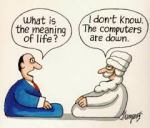
A win/win situation

September 17, 2016

Pentecost 18 – 2016

Luke 16:1-8

Marian Free

Dramatisation of the parable (Written by Juliet Quinlan)

The characters: Mr/Mrs Rich (R), owner of a chain of stores; (K) Kath/Kevin, supervisor of one of R’s stores.

 Part 1

R: Good morning K. Please sit down.

K: Good morning.

(Both sit down – two chairs facing each other at the front of the sanctuary.)

R: I’ll get straight to the point, K. This is the third time in three months I’ve had to call you in to my office to tell you that your performance isn’t what I’d expect from one of my store supervisors. There have been complaints from customers that you’re offhand with them, you’ve closed early on several occasions, the takings from your store are down…

K: (Shrugs) I’m sorry, I promise I’ll do better.

R: No, K, that’s not good enough. I’m very reluctant to do this, but I’m going to have to let you go. I’m losing money, and even worse, my reputation is being squandered. I’m willing to give you a month’s notice, but please try to leave the store in good shape. (Both stand up. R shakes K’s hand, looks sympathetic).

(K and R both exit.)

Part two

(K sits alone OR addresses the congregation.)

K: What am I going to do? I know I haven’t been efficient like I used to be. I’ve just got so bored with this place, that’s the problem. My heart hasn’t been in it. But how can I live now? I don’t want to be on the dole for the rest of my life. I need some inspiration…(Frowns, shakes head, looks anguished. Then straightens up, eyes wide open): OK, I’m beginning to get an idea…

Part three

(R beckons K into the office again. They remain standing. Would it be better if K presents herself to the office as it’s her last day?)

R: So this is your last day, K. I wonder why you’re looking so happy.

K: Oh well…

R: I know why you’re pleased with yourself. The accountant picked up an anomaly for this store. You know what I’m talking about, don’t you?

(K shrugs shoulders)

R: For the last month the cash you’ve banked has been around half the amount the cash register says it should be. Can you explain how this could have happened?

K: I took the money.

R: So you thought it’d be smart to give yourself a bonus, did you?

K: No, I gave it all to charity.

R: Why? What was the point of that?

K: I told the Coordinator of my favourite charity that you wanted to make a large donation, and made an appointment to hand it over. We got talking and I told her how I’d love to help, and some ideas I have, and now they’ve agreed for me to work for them as a volunteer. Perhaps I might get paid work there eventually. And it’s something I’ll really like doing, something fulfilling for the rest of my life…

R: But it was my money.

K: Well you’ve sometimes said money isn’t everything, that your main goal is to make your customers happy. I know how concerned you are about the company’s public image and I’ve heard you give quite a lot away yourself.

R (stops, thinks, then starts to laugh): Well, I must say I’m amazed. You’ve been really clever. You’ve made me look good in the eyes of your charity, and made a positive plan for your future. Good luck to you! (Smiles, claps K on the shoulder, shakes hands). Off you go. And I hope the future gives you all that you hope for.

(Both exit)


Reading of Gospel: Luke 16:1-8

Then Jesus said to the disciples, “There was a rich man who had a manager, and charges were brought to him that this man was squandering his property. 2 So he summoned him and said to him, ‘What is this that I hear about you? Give me an accounting of your management, because you cannot be my manager any longer.’ 3 Then the manager said to himself, ‘What will I do, now that my master is taking the position away from me? I am not strong enough to dig, and I am ashamed to beg. 4 I have decided what to do so that, when I am dismissed as manager, people may welcome me into their homes.’ 5 So, summoning his master’s debtors one by one, he asked the first, ‘How much do you owe my master?’ 6 He answered, ‘A hundred jugs of olive oil.’ He said to him, ‘Take your bill, sit down quickly, and make it fifty.’ 7 Then he asked another, ‘And how much do you owe?’ He replied, ‘A hundred containers of wheat.’ He said to him, ‘Take your bill and make it eighty.’ 8 And his master commended the dishonest manager because he had acted shrewdly;

 ***********************


God of love, give us an openness to your word and a willingness to understand those things that challenge and confront us. Amen.

Today’s parable is one of (if not the) hardest of Jesus’ parables to come to grips with. We are able to accept most of Jesus’ eccentricities and teaching that demands us to welcome the marginalised and love the unlovable and even to forgive the unforgiveable – but for Jesus to commend dishonesty or injustice – that goes beyond the pale of good, respectable Christians.

The problem is that it is almost impossible for us to make sense of today’s parable unless we take ourselves back to the first century and to the culture of the time. In particular, we have to understand that honour and shame determined how society functioned and how people related to each other. Having honour took precedence over the desire for wealth, or love of friend and family. Everyone knew their place and everyone was concerned to maintain their position within the community. One way to retain or to increase honour was through generosity.

In previous stories Jesus subverted these values of honour and shame– “take the lower seat”, “invite those who can’t pay you back”, “welcome home the son who has shamed and disgraced you”. Now he tells a story that plays right into the hands of those who hold those values he uses the concepts of honour and shame to his advantage.

Another characteristic of first century society was a failure to plan for the future. Most people lived day-by-day, not considering how they might fare either in the earthly future and certainly not thinking about their eternal future.

A steward had a great deal of authority. Very often the landowner lived elsewhere, so the steward had the responsibility for the day-to-day running of the property. Whether a slave or a free man, a steward could make decision about loans and interest rates, make sales, forgive or pay off debts. He earned his living by commission and had a relatively high status in the community.

As well as trying to understand the first century Mediterranean culture, we have to remember that this is a story, a parable. It did not happen in real life. It is a story pure and simple. That means that it doesn’t have to be entirely logical, or that it has to provide all the detail[1]. Jesus is using this parable to make a point or to shock his hearers into a new way of understand. It is more important to look for the meaning behind the story rather than try to force the story make absolute sense.

We also have to determine where the parable begins and ends. Unless we are clear about this we will not know whether it is Jesus who commends the steward for his shrewd behaviour or the master who praises him. Does Jesus commend dishonesty or is it the master in the story who commends the steward?

Lastly we have to ignore the heading that bible translators have added to the in order to let the parable speak for itself. Most bibles give this section a title like “the unjust or dishonest steward” which leads to the assumption that the character of the steward is dishonest, whereas that label is only applied to the steward at the conclusion of the story. There is no evidence to suggest that the steward is inherently dishonest or that he has behaved dishonestly in the past.

So with all that in mind, let’s look at the parable in detail, beginning with the problem as to where the story begins and ends. Most scholars agree that the actual parable concludes at the beginning of verse 8a that means that the person who commends the steward’s behaviour is the steward’s master – not Jesus[2]. The structure of the parable looks like this:

Introduction 1a Jesus’ introduction, 1b Introduction to parable

Scene 1 v 2

Scene 2 v 3,4

Scene 3 v 5, 6 (in symmetry with 4)

Scene 4 v 7

Conclusion v 8a (symmetry with the beginning 1b)

The first thing to note is that we are not told why the steward is being dismissed. All that we know is that rumours have reached his master (that the steward is squandering the master’s property – not that he is dishonest). Rumours alone are sufficient to have caused embarrassment or shame to the landowner, so in his mind there is no choice but to dismiss the steward. The steward has no recourse. If he takes action against his master he will cause the landowner even more shame and therefore possibly find himself in a worse position. Verses three and four tell us two things: one is that the steward is not a slave. If he were he might lose his position, but he would not lose his home. They also remind us that the cultural norms of honour and shame affected all levels of society.

In the next verses, Luke uses the technique to interior dialogue to let us know what the steward is thinking. Scene four lets us see where the steward’s thinking has taken him, and his solution to the problem – he will gain himself both honour and friends if he reduces the amounts due to his master. At the same time he will be increasing his master’s honour, because those on the receiving end will understand that the generosity has been extended by the landowner.

Finally the landowner commends the actions of the steward – he has not only secured his own future, but at the same time he has restored and enhanced the honour of his master. It is a win/win situation.

In summary:

  • A steward is mismanaging the estate
  • Rumours of this reach his master
  • He is told he can’t manage any more
  • He comes up with a solution
  • He is praised for his wise (shrewd) action
  • Action/vs no action

In short we will all be called to account, but rather than thinking that there is no solution we are challenged to think about our eternal future and to take action which might be risky, but which has the potential to result in a good outcome all around[3].


[1] We don’t know for example the nature of the loans or to whom they were made. Both the items loaned and the quantities are unusual and we only hear of two whereas there were probably several others.

[2] Verses 8b and 9 are a commentary on the parable that suggests that embarrassment at the commendation of dishonesty was early.


[3] I am heavily indebted to Jeffrey Durkin whose insightful article has given me an appreciation of the parable that I would otherwise not have had.

September 10, 2016

Pentecost 17 – 2016

Luke 15:1-10

Marian Free


In the name of God whose love and mercy confounds and astounds us all. Amen.

It all comes down to this – what sort of God you believe in. How do you envisage the nature of God? Do you believe in a fire-breathing, hell damning, judgemental, unforgiving God or is your image of God one of boundless, unconditional, all-encompassing, all forgiving love? The answer is important, because I believe that the answer lies at the heart of understanding the radical, shocking nature of the God depicted in today’s gospel.

Those who believe in an exacting, demanding rule-focussed God tend to have a view of the faith community as exclusive and limited, restricted to those who are willing and able to adhere to a set of stringent guidelines. They will be quite certain as to what behaviours determine who is in and who is out of the group and therefore who is in and out of God’s favour. A clear set of standards will enable them to measure their own goodness against that of others and at the same time will inform them of their (and others) status before God.

Those who believe in a compassionate, welcoming God will have a completely different view. They will understand that the community of believers is not exclusive or perfect but is made up of people who try but fail to achieve the godliness for which they aspire. As a consequence the boundaries of their community will be porous and ill-defined. They will welcome into their community the frail, the damaged and the imperfect. This community will also hold a clear set of standards, but they will accept that few, if any, will reach that ideal. Knowing their own imperfections and failures, they will think very carefully before measuring themselves against others and before standing in God’s place to judge.

Of course, these are broad-brush strokes and blatant stereotypes. Most Christian communities fall somewhere along the spectrum between these two extremes. Some will believe that God sets very high standards and, while imposing those standards on themselves will be open and compassionate towards those whom they consider to be “sinners”. Other communities that appear on the surface to be loving and compassionate may carry a weight of guilt at their failure to be more than they are.

I have described these two extremes to try to demonstrate just how shocking the parables of the lost would be to those who think of God as the arbiter of strict behaviours and who withhold love and approval from those who fail to live up to certain pre-defined standards. In fact as the opening verse reminds us, Jesus tells the parables in response to the accusation by the Pharisees and scribes that he eats with tax collectors and sinners. Jesus is answering the unspoken question: – who is worthy of God’s love – those who do what God requires or all God’s creatures, those who come up to standard or all people regardless of their failures?

Of the two parables, that of the lost sheep is the most shocking. Most of us find comfort in this parable. We see ourselves as those who were lost but are now found. It is interpreted as a parable that reminds us how much God loves us – that when we are lost God seeks us out and brings us home. That is certainly true – we can identify with the lost. However, what does the parable look like if we understand ourselves to be among the ninety-nine? Ninety-nine of the sheep are doing the right thing. Not one of them has wandered off. Not one has been absent-minded enough to lose track of the shepherd. Not one has been tempted to seek out better pastures. Not one thought that they knew better than the shepherd what was best for them.

No, only one sheep has been foolish enough or disobedient enough to wander from the safety of the group. Only one sheep has placed itself at risk by taking itself beyond the reach of the shepherd. Only one sheep has thought that it knew better than the shepherd. Yet – and here is the shock at the heart of the parable – despite the fact that one sheep hasn’t lived up to expectations, the shepherd abandons the ninety-nine compliant, obedient sheep and goes off in search of the one who did not conform. Instead of favouring those who behave according to expectation, the shepherd is making a big deal of the one that has gone its own way! The good sheep, those who are doing the right thing get no special treatment, no reward for their conformity – they might just as well not exist so concerned is the shepherd for the one that is lost.

If they could think like humans, the ninety-nine sheep would have every right to be indignant. What is the point, they might think, of doing the right thing, when the one who does the wrong thing receives special treatment. Why bother to behave in the right way when it is the one who behaves badly and creates so much trouble causes such joy to the shepherd when it is found? How can we feel smug about our own goodness when the shepherd (God) is obviously vitally concerned about those who are lost? If sheep could think I imagine that their reaction to the shepherd’s reckless behaviour would be much the same as the elder son’s response to the father’s extravagant welcome of the prodigal son.

In word and action, Jesus is revealing how much God loves ALL of God’s children. It is impossible for anyone to be beyond the reach of God’s love no matter what they do or how far they stray. When someone wanders from the fold, God is heartbroken and cannot rest until they are brought back in. God seeks the sheep that has drifted from the path, searches for the coin that has gone missing, and watches and waits for the prodigal to return.

Jesus’ parable is encouraging those who have responded to God’s love, who have remained within the fold, stayed with the other coins or remained at home with the Father to understand what a privilege it is to be so loved and to have the grace and generosity to allow – to desire even – that love to be shared with everybody – the good and the bad, the willing and the less willing, the conventional and the unconventional. .

In Jesus, God’s love for all people is made palpably visible. Do we, (like the scribes and Pharisees), resent the way that Jesus extends God’s love to those who do not deserve it? Are we (like the scribes and the Pharisees) so insecure of our place in God’s heart that we constantly compare ourselves with others to assure ourselves of our own worth? Or – are we so overwhelmed by God’s abundant, unconditional love and so confident that that love will never be withdrawn that we can join the rejoicing when the lost are found and God’s children come home?

To know God’s love and to begrudge that love to others demonstrates a meanness of spirit and a smallness of heart that makes us unworthy of the love that we have so freely received. God can love whomever God will. The wonder is that God has chosen to love us.


Can we say “yes”?

September 3, 2016

Pentecost 16 – 2016

Luke 14: 25-35

Marian Free


In the name of God who calls us out of our safety zone and takes us where we do not want to go. Amen.

Today at St Augustine’s six people will be baptised and four of those will then join six others in being confirmed. At the same time three young people will be admitted to Holy Communion. A confirmation is a great occasion in the life of a faith community. As adults and teens affirm the promises that were made for them in baptism, we are all challenged to reconsider our own baptism and confirmation and to think about how well those promises and commitments are lived out in our own lives. Do we “turn to Christ, repent of our sins, we reject false living and all that is unjust and renounce Satan and all that is evil?” On a daily basis do we make every effort to “love God with our whole heart and our neighbour as ourselves?”

In a Christian society these are not really such awesome commitments – believing in Jesus, recognising and being sorry for the times when we fall short, trying to ensure that those around us are treated fairly and renouncing evil come easily enough to most of us. We can even convince ourselves that we love God with our whole heart and our neighbors as ourselves. Being a Christian is a part of our self-identity, something that we accept as true without necessarily putting too much effort into it or spending too much time in reflection as to what it means. Most of us blend in with the world around us except that we probably attend church most Sundays and object to certain blatant misbehaviour. In a society that considers itself to be a Christian society, such commitments are not so far outside the norm that making them comes at any great cost.

I wonder if we would feel quite so self-assured if we were asked the questions implied in this morning’s gospel? Imagine, if you will, standing before your faith community and responding positively to ALL of the following questions:

Will you from this day forward commit yourselves to abandoning and hating your family?

Will you, if required, submit yourself to the horror of the cross?

Do you understand that if you want to follow Jesus that you must hate life itself?

Are you prepared to give up all your possessions?

If you start down this track are you prepared to see it through to the end?

I imagine that if these were the questions that were asked at our baptism and confirmation that not a few of us would reconsider our position. No wonder that most bibles entitle this section of the gospel “ the cost of discipleship.”

In the context of Luke’s gospel these statements are made at a time Jesus is on his way to Jerusalem and death. In making these demands, Jesus will have been ensuring that the disciples knew what lay ahead and assuring himself that they would be up to the task. Jesus wants to be confident that those who claim to be his disciples will be able to follow through – that they will not be found wanting when the time comes, that they will not expose themselves and therefore his message to ridicule.

Jesus is well aware that the journey on which Jesus and his disciples are embarking will have serious consequences. Those who follow him will need to be prepared to give up more and more as they approach their goal of walking in his footsteps. After Jesus’ death, when the disciples take on his mantle, they will face the same opposition and the same obstacles. They will have to be ready to sacrifice everything – family, possessions and even life itself.

In the twenty-first century we do not literally walk in the shadow of the cross, but Jesus’ demands are no less terrifying and overwhelming. They are a reminder that discipleship is costly. It can mean that we stand out from the world around us, that we are subject to greater scrutiny than those who profess no faith, that we might be called to put Jesus before our personal comfort, security and even safety. At the same time, we do not know when we will be put to the test, when we will be required to stand firm for what we believe or when we be asked to lay down our life for the sake of the gospel.

In every age, there have been believers who have known these demands to be true for their own lives, those who have refused to compromise even though it meant giving up family, possessions and ultimately life for the gospel[1].

It is perhaps our failure to give ourselves wholly and completely that leaves the church so open to scrutiny in today’s world. It is perhaps our half-hearted response to Jesus’ demands that means that we are not taken seriously, that ensures that the world is less than impressed by our commitment.

Should it be required of us, are we ready to follow Jesus to the bitter end, or are we among those who have begun to build but who have not considered whether or not we have the materials to finish it?

These are serious questions. The future of the gospel may depend on our response.

*********************

Afterword:

I thought this powerful quote was worth sharing. Check out the site for the rest of the article.

“So maybe, just maybe, these harsh words about “cross-bearing” are a call to do what Simon of Cyrene did. Once he picked up the cross, it wasn’t clear to anyone how the day would end. It was only clear that his future was bound up with the future of the poor, unfortunate person who could no longer carry the weight of the cross[2]”.


[1] I think of all the saints and martyrs – particularly those of our own time whom I name over and over again – Dietrich Bonheoffer, Oscar Romero, Martin Luther King not to mention the hundreds and thousands who have given their lives in the cause of justice and freedom.

[2] provokingthegospel.wordpress.com

Choose wisely, your future depends on it

August 27, 2016

Pentecost 15 – 2016

Luke 14:1, 7-14

Marian Free


In the name of God whose ways are not our ways. Amen.


One of the most contentious issues of our time relates to that of refugees, in particular, how the should the world respond to a crisis that threatens at times to overwhelm us? At the present moment around 60 million people are displaced. That is 60 million people have left their homes as a consequence of war, oppression, persecution, drought or poverty. Sixty million people are today seeking refuge from horrors that few of us can even begin to imagine.

Last year, the war in Syria saw an unprecedented number of people flocking to Europe by any means possible – by land and by sea, by foot, by boat and by train. Thousands lost their lives at sea as unscrupulous operators, used unsafe and overcrowded boats to ferry desperate people – not for humanitarian reasons but to line their own pockets. There were so many escaping horror that receiving countries were simply unable to cope. Not only could they not process the vast numbers seeking refuge, but fears about housing, feeding and providing work to the millions who were knocking at their doors led many European countries to close their borders. Terror attacks in France further raised the general anxiety about accepting people from countries that were also home to extremist groups such as ISIS.

Increasingly, compassion and welcome has turned to disquiet and distrust, generosity and openness have turned to protectionism and exclusion. The recent Brexit vote in the UK was as much about keeping Britain British and closing the borders as it was about the economic advantages or disadvantages of being a part of the EU. In Germany, the country which has been most determined to keep its borders open, recent attacks by traumatized refugees has highlighted the difficulties of providing adequate care for those whose mental health has been seriously affected by their experiences of war, displacement and the dangerous, uncertain escape to safety.

Issues surrounding migration and refugees are central to the Presidential campaign in the United States where there is talk of building walls, limiting the intake of refugees and so on. Here in Australia the issue is no less contentious. Discussions surrounding who to let in and who to exclude can be highly volatile. The debate has become so politicized and so divisive that it can be difficult to discuss the problem rationally. Fear of the other, defense of our standard of living and way of life and anxiety related to radical Islamism all mean that it can be hard to see the majority who are genuine behind the minority who may or not intend harm.

We are rightly appalled at the unscrupulous profiteering of people smugglers distressed by the deaths at sea as desperate people risk their lives to escape violence, oppression and discrimination at home but we cannot agree on how best to respond to those who take enormous risks hoping to find a safe haven.

It is not always easy to find the balance between caring for others and caring for our own. How do we determine at what point does generosity and compassion end and fiscal irresponsibility and prejudice begin?

It is a complex issue and I don’t claim to have all the answers, but it seems to me that today’s gospel gives us something to think about in relation to these questions. To recap: Jesus has been invited to a meal at the home of a Pharisee[1]. By now Jesus has gained a reputation and people are keen to see what he will get up to next. They are not disappointed – he challenges them to provide a reason as to why he may not cure a man who has dropsy and they are silent.

Then the situation is reversed. Jesus becomes the observer. In the first instance he observes the way in which people take their places at table and then he turns to his host and makes an observation about the guest list.

Jesus makes two speeches. The first provides practical advice to the guests on how to avoid humiliation while the second challenges the host to rethink his guest list. Interestingly the speeches take the same format – Jesus’ observation, a statement regarding what not to do, a comment on what to do and finally a theological rule. In the first speech Jesus observes the guests’ tendency to take the places of honour and he makes a pragmatic suggestion: “Take the lowest place so that the host might ask you to go up higher.” The practical nature of the speech changes with the conclusion that, though it is sensible advice, also points in a theological and an eschatological direction: “all who humble themselves will be exalted and all who exalt themselves will be humbled”. The future tense and the passive mood of the verbs tell us that this is not only a consequence that will occur in the present, but that humbling and exalting are actions that God will take in the future – at the judgement.

Having addressed the guests, Jesus turns his attention to his host. He suggests a radical reversal to the social norms of the day: “Don’t invite your friends or those who can return the favour, invite those who cannot repay you then you will be repaid at the resurrection of the righteous.” This time Jesus’ conclusion points very clearly to the resurrection – those who welcome the marginalised and the outcast are those who not only will be blessed in the present, but who will be welcomed at the resurrection.

The message of the two speeches is clear – God does not see as the world sees and, our behaviour in this life will affect what happens at the resurrection. The dinner party foreshadows the heavenly banquet and the place we take will reveal our self-assurance or our dependence on God. The invitation list for the wedding banquet reveals whether our concern for our reputation and our social position outweighs our compassion for others.

The place we assume will affect the place we are given, the welcome we give will determine the welcomes we are given. Choose wisely, Jesus suggests, your future depends on it.

[1] It is important to note that not all Jesus’ interactions with the Pharisees were antagonistic, but that Jesus was happy to social with Pharisees and they with him.

The cost of silence

August 20, 2016

Pentecost 14 – 2016

Luke 13:10-17

Marian Free

In the name of God who confronts evil and asks us to do likewise. Amen.

A couple of years ago I had two unpleasant experiences within a week. The first involved a cyclist who, having abused a driver who was waiting at the lights, tried to engage me in supporting him. So far as I could tell the driver had stopped exactly where he/she was required to stop and the cyclist was simply fueling a rage that somehow justified his existence. That is, if he was right and someone else was wrong he was somehow more – I don’t know – righteous or smarter than the other. There seemed to be no other point to the exercise other than the cyclist’s building himself up in his own eyes. Had I allowed myself to be involved I would have further justified his sense of self-righteousness. As it was I had the feeling that regardless of my lack of support he would spend the rest of the day feeling pleased with himself that he had got the better of someone. A little later that week I was walking the dog. As required, I had my plastic bag with me and made sure that I collected the dog faeces as we went. A car full of young men drove past and, as they did, they yelled out the window to the effect that I was causing offense. Again I didn’t engage but reflected that, like the cyclist, their outburst had less to do with me and more to do with their own need to make themselves feel as if they were in some way superior to myself.

Some use conflict to inflate their egos, others encourage conflict so as to bring a matter to a head, to enable them to deal with an issue and move on instead of pretending that nothing is the matter and allowing resentment or irritation to fester unchecked.

Then there are some who seek out conflict, not because they feel powerless or are lacking in confidence, but because they are seeking to bring about social change, to right wrongs, or to confront oppression and injustice. Such people have a conviction about what is right and are not afraid to challenge those who a perpetrating wrongs – even if their confrontational approach will lead to rejection, imprisonment or worse. Among such people we can count Mahatma Gandhi, Dietrich Bonhoeffer, Nelson Mandela and many, many others. They seek conflict, not for the sake of conflict, but because they believe that there is a need to expose the evils of their day and feel that they must name what is wrong even though they know that it will lead to division.

Some people thrive on conflict. They seem to seek it out because it makes them feel more important or as if they have more control in lives in which they feel they have little status or power. Such people not only seek out conflict but, like the cyclist and young men, create conflict – either by pushing others until they react or by seeing offense where none was intended. Others use conflict to bring unresolved issues into the open, and yet others feel they have no choice but act in ways that are bound to put them into conflict with the establishment.

I suspect that Jesus was a little bit of b and c. That is, Jesus was keen to bring unspoken tensions (for example around the law) into the open and at the same time he was so confident in his role as God’s messenger that, even though arrest and crucifixion appeared to be the likely outcome, he refused to compromise or to soften his message. So far as Jesus was concerned, restoring God’s intention for God’s people meant freeing them from the burdens that had been placed upon them and interpreting the law as a means of liberation rather than as something that was restrictive and overwhelming. No wonder that Jesus came into conflict with the religious leaders of his time. He was challenging a way of life that had come to be taken for granted and at the same time he was undermining their authority as those who interpreted the law for the people.

Almost from the beginning of his ministry Jesus has insisted that an interpretation of the Sabbath law that leads to harm rather than good is a misinterpretation of God’s meaning (Lk 6:6f). Like all practicing Jews, Jesus attends the synagogue regularly. However, instead of leaving well alone and maintaining the social norms, Jesus invites division. Early in his ministry, Jesus threw out a challenge: “I ask you, is it lawful to do good or to do harm on the Sabbath, to save life or to destroy it?” According to today’s gospel, Jesus is now beyond asking. It clearly makes no sense to him to allow a woman to suffer another moment when she could be set free today. Jesus points out the double standard of the religious when it comes to interpreting the law. It is permissible to save an animal from distress but not a human being!

Jesus cannot remain silent and nor can he hold back his healing power. He must do what he feels he is called to do even though it will cause offense and even though it will heighten the conflict between himself and the establishment.

In Luke’s gospel, Jesus’ conflict is not only with the religious leaders. Luke tells us that Jesus is engaged in a bigger and far more dangerous conflict – that between Jesus and Satan, or the conflict between the material and the spiritual worlds. Before Jesus even begins his ministry the forces of this world try to throw him off course in the desert. When Jesus proves too difficult a target, Satan departs until “an opportune time”. Now, mid-way through the gospel Jesus preempts Satan’s next strike, by freeing the woman whom “Satan has bound for eighteen long years.” Both on a human level and on a spiritual level, Jesus is inviting conflict, bringing discord into the open where it can be recognised and properly addressed, not allowed to deepen and grow. Jesus is not afraid to name what is wrong and to identify the true enemy. Despite the fact that this will deepen the opposition to him and his ministry, he will not be deflected from his goal or compromise his values.

Many of us avoid conflict. We do not want to cause trouble. As a consequence, we fail to see the unhappiness that can result when we fail to address those things that cause hurt to ourselves or to others. Jesus had no such problem.

Dare we remain silent if our silence means that the evils of the world are allowed to continue unabated?


Fire-breathing Jesus

August 13, 2016

Pentecost 13 – 2016

Luke 12:49-59

Marian Free


In the name of God who demands that we hold fast to the truth whatever the cost. Amen.

In Monday’s Sydney Morning Herald, two articles caught my attention. The first reported on the visit of Susan Sarandon to Melbourne. It may come as no surprise to you that Sarandon is one of the actors I most admire – along with other strong women (Kate Hepburn, Glenda Jackson, Meryl Streep) who refused to buy into the Hollywood hype and who maintain their commitment to their craft. Sarandon was in Melbourne at the invitation of the La Dolce Italia festival. Of course, the report only captured the material that would sell newspapers. What struck me in the short piece was Sarandon’s determination to say what she believes to be right and not to compromise.

“The thing that really gets me is when I haven’t said something honestly. When there is something that people who don’t have a voice … and someone tells me about it, and I have the opportunity to shine a light on it, when I don’t, I feel that I have betrayed my authenticity,” she told the compere, Crown’s Ann Peacock.

A second article contrasted strongly with the brief report on Sarandon. Headlined “Refugee singer’s uneasy air” it concerned a young refugee from Syria whom you might have seen in the news earlier in the year. As a means of dealing with the trauma and the hardship of his ‘pulverised, starving neighbourhood in war-torn Syria, Ayham al-Ahmad embarked on a career of playing concerts in the rubble’ to provide a sense of normality. Videos of his performances spread online, drew attention to him and finally enabled him to escape the siege of his hometown Yarmulke.. Ahmad has now been accepted as a refugee by Germany where he has “set himself the task of putting a human face on his fellow refugees”. In Syria Ahmad was a piano teacher and music salesperson. Here in Germany he has become a star. He is booked nearly every night, has appeared in numerous German news accounts and received a prestigious music prize.

Despite all this he is filled with a sense of unease. He wonders if he really makes a difference, if his audiences see him and his relative success and forget where he is from and do not see in him the thousands who are still in Syria – in prison, under siege or subject to constant bombing. Ahmad’s escape also gives him a sense of survivor’s guilt – why is he the lucky one? Did he make more of a difference when he was playing for and with those whom he has left behind?

On the one hand, Sarandon refuses to compromise, and on the other Ahmad is anxious that he perhaps he has been compromised. Of course, the two come from vastly different positions – Sarandon has, privilege, position and wealth where’s Ahmad has only talent, vulnerability and dependence. All the same, Sarandon’s outspokenness could potentially cost her roles and if Ahmad maintains his integrity he could win even more respect and notoriety – but these are issues on which we can only speculate.

Jesus has some challenging words in today’s gospel: “I came to bring fire to the earth, and how I wish it were already kindled! I have a baptism with which to be baptized, and what stress I am under until it is completed! Do you think that I have come to bring peace to the earth? No, I tell you, but rather division!”

Major social change rarely comes without a cost. Some things that we now take for granted were hard won and along the way created fury and split the community into those who were for and those who were against the issue. For example, the abolition of the slave trade – while ending centuries of inhumanity and liberating people from indenture – caused economic hardship, if not ruin for those who had built their wealth on free labour. No wonder abolition was so vehemently opposed and it’s supporters vilified.

Giving women the vote was equally contentious. It meant a complete overhaul of accepted social norms especially around the place of women and the capability of women. For some it was seen as a threat to family life and an overturning of the entire social fabric. No wonder the issue was so divisive and its proponents seen as disruptive and anti-social. Social change, even that pursued by followers of Jesus, can and does lead to harmony and division.

Many of us feel that being a Christian entails conforming to the world around us, keeping the law, not causing trouble and certainly not taking a radical stand. But Jesus gave us no such idea. Jesus utterly refused to fit in to the society around him. He refused to compromise his values, and he stood by his convictions even in the face of opposition and derision. Jesus was confident that he understood God’s purpose for him and he would not be dissuaded from this path no matter how many people he offended or put off side and no matter that the consequence would be his crucifixion for insurrection.

This is fire-breathing Jesus not the gentle Jesus meek and mild of the 19th century poem. This is a Jesus who knows what he believes and what he stands for and who will stick to his principles no matter what the cost. This is the “sign that would be opposed” that Simeon predicted when the infant Jesus was presented at the Temple. This is the division that Jesus predicts will result from his presence here on earth. When Jesus and his followers stand up for what is right, when they challenge governments and institutions, when they name injustices and shine a light on oppression they will cause disquiet, disharmony and even division, but that is not a reason to stay silent and it is a poor excuse for not becoming involved.

Listen again to what Jesus says in today’s gospel: “I came to bring fire to the earth, and how I wish it were already kindled! I have a baptism with which to be baptized, and what stress I am under until it is completed! Do you think that I have come to bring peace to the earth? No, I tell you, but rather division!”

Let us pray that the fire of Christ’s passion may fill our lives and inform our actions and that should it come to it, we would have the courage to take a stand no matter what the cost to ourselves.

August 6, 2016

Pentecost 12 – 2016

Luke 12:32-40

Marian Free

In the name of God our Creator, Redeemer and Sanctifier. Amen.

Four weeks ago when Pokemon Go was released in Australia, it seemed that you couldn’t go anywhere without running into people who were walking along with their eyes glued to their phones. Despite the fact that the game comes with sound effects it seemed that some players were afraid that if they weren’t paying attention to their device that a Pokemon or a Pokestop would pop up and they would miss it. The craze seems to have died down somewhat, but not before the occurrence of some minor injuries and accidents.

Even though the original version of the game asked people: “to be alert at all times, pay attention to your surroundings”, one person in the United States ran into the back of a police car because he was concentrating on the game rather than on his driving. More concerning is the news that teenagers in parts of war-torn Syria are risking their lives by entering buildings that have been rendered structurally unsound by the bombing in order to capture their Pokemon.  Others have been so obsessed with capturing Pokemon that they have entered private dwellings without asking for permission.[1] In Rhodes in Sydney, so many people flocked to the park that emergency vehicles were unable to enter the area and locals were concerned for their safety.

Presumably as a result of people’s obsessive use of the game, last weekend’s upgrade to Pokemon Go includes additional warnings: “Do not play game while driving.” “Do not trespass while playing Pokemon.” The need to watch where we are walking or driving, to look ahead for hazards that might be coming up, or to plan for an uncertain future seems to be self-evident, but apparently for a number of people caught up in the Pokemon craze, absorption with the game overrides concerns for their own safety and for the safety of others.

The point is not that everyone should give up Pokemon Go, but that there are times when we become so focused on something, that we forget to pay attention to the things that are happening around us. Sometimes, we are so absorbed in our work or our play that we do not even notice the hazards that lie ahead – whether or not the hazard is something physical like the truck that is hurtling towards us or the peril of a breakdown in a relationship. It is possible become so engrossed in our day-to-day activities that we forget to think about the future, or so caught up in anxiety about one thing or another that we become blind to the fact that tomorrow might bring something better. Living in a land of peace and freedom we can become blasé about potential for harm whether at the hands of a terrorist or a drunken driver.

Today’s gospel includes at least four discrete instructions: sell everything, store up treasures in heaven, be alert and ready for action and be prepared. The first follows on from last week’s parable of the barn builder and the others emphasise the need for preparedness, alertness, and readiness. As we read further, we will discover that these are dominant themes for Luke as Jesus makes his way to Jerusalem.  In these chapters we are aware that Jesus has a sense of urgency. He knows what lies ahead of him, he understands that “it is impossible for a prophet to be killed outside Jerusalem” and he knows that it is in Jerusalem that he will face his final showdown with the forces of evil[2]. He presses ahead despite the dangers because he knows that this is the future that is in store for him.

Because Jesus knows what lies ahead, he feels that it is important for the disciples to know and understand the dangers and difficulties that will confront them. He believes that it is essential that they do not become complacent – that they do not imagine that because they are Jesus’ disciples they will be unaffected by the events that are about to unfold. Jesus is concerned that if the disciples become too settled in their present role, if they are not paying attention, they will be caught out, unprepared and therefore unable to meet the challenge.

To ensure that the disciples really do understand and will not be found wanting, Jesus repeats the message over and over again – be prepared, be ready, be alert.

N.T. Wright believes that in their context, these passages refer not to Jesus’ coming again, but to a cataclysmic event that was to happen in the not too distant future. According to Wright, Jesus believed that the Jews’ resistance to Rome would inevitably lead to a collision with the Empire that could only have catastrophic results – the destruction of Jerusalem and the dispersal of Jews throughout the Empire[3]. For this reason, not only do the disciples need to grasp the fact that in Jerusalem Jesus will be facing a struggle between life and death, but that they too may well be caught up in events over which they have no control.

He warns them: you can’t take your eye off the ball, you have to pay attention to the times, be aware of what is happening around you – so that you will not be caught off guard and will not lose faith when the events that Jesus expects come to pass.

Our time and place is vastly different, but I don’t have to tell you that we too live in uncertain times. Jesus’ warning is as pertinent now as it was 2000 years ago: don’t be so absorbed in the present that you do not recognise the hazardous situations that you might be creating or walking into; do not be complacent, do not take for granted the precious gifts of freedom, justice and comparative wealth; do not be so absorbed in the present that you pay no attention to the future.

As best you can, keep your focus on God, constantly re-evaluate your priorities, notice what God is doing in and around you, be ready for God to surprise and challenge you and above all, deepen your relationship with God so that you might both be ready to face any challenge that life throws at you and prepared to welcome God should the Son of Man return tomorrow.

[1] Apparently the creators of the game face lawsuits for trespassing.
[2] In Luke 4:12 after the temptations, Satan departs from Jesus “until an opportune time”.
[3] N.T. Wright. Luke for Everyone. London: SPCK, 2002.

Having enough – not more than enough

July 30, 2016

Pentecost 11 – 2016

Luke 12:13-31

Marian Free

In the name of God who has blessed us with all things good. Amen.

To save or not to save? To store up or not? We live in a nation that has a reasonable system of social welfare, but which also places an emphasis on the importance of taking care of oneself. Those of us who can afford the luxury are encouraged to take out medical insurance rather than place a burden on the public health system and to put sufficient aside so that we can live comfortably in what may be an increasingly long period of retirement. Our desire to ensure a basic standard of living for the less fortunate is balanced by a strong streak of independence and unwillingness to rely on the state.

In the last few decades, Superannuation has become big business and retirement has become, not simply an end to our working life and a time to relax, but an opportunity to do all those things that we haven’t yet done, a time for travel and adventure. As a result, our expectations of what we can or should expect to do when we retire, has increased exponentially. Our super schemes fill our in-boxes with information about how much we need to have set aside to ensure a comfortable retirement and our government gives us tax incentives to encourage us to top up our super funds.

What all of this means is that it is difficult for us to read the parable of the rich fool without some sense of gloom or even guilt. We ask ourselves: “Are we doing the wrong thing by setting aside funds for our future?” “Is it wrong to store up “treasure” against a “rainy day?”” “Will we be judged as those who have been more concerned about this life than the next?”

I have said on previous occasions that one of the concerns of the author of Luke is wealth. Luke has more to say about money than any of the other gospel writers. It is only in Luke that we find today’s parable and the account of the rich man and Lazarus. Only Luke records the story of Zacchaeus – the tax collector who gave away half of his fortune to the poor. Only Luke records disputes about inheritance – today’s gospel and the parable of the Prodigal Son. In his second volume, Luke records the fact that the early Christians held all things in common (Acts 2:43, 4:32) and tells the startling story of Ananias and Sapphira whose deceit in such matters resulted in their immediate death.

However, before we give everything away and place ourselves at the mercy of the state, or of our families, it is important that we understand what is going on here. The parable of the rich fool is Jesus’ response to a request to mediate on a matter of inheritance. We cannot be sure what lies behind the request. of the person in the crowd. In Jewish law a distant family member or a third-party was engaged to sort out inheritance disputes. Here, however, the fact that the petitioner is a member of crowd and the language that he uses which is similar to that found in the prodigal son suggests that the he is seeking his portion of inheritance before time – in effect wishing his father already dead so that he can have now what is due him in the future.

Jesus’ response to the person is to caution against greed – hence the parable.

The rich man is a landowner who almost certainly did not grow the crops himself. No peasant farmer would have had sufficient land to produce enough for his family, let alone a surplus. Nor would a peasant farmer have had sufficient land on which to build a barn, let alone barns. The rich fool is already rich – he has barns and they are already full but apparently he cannot imagine sharing his good fortune with anyone else, he will keep on building and keep on hoarding even though he has no need. His inner dialogue tells us that he is thinking only of himself: ‘What should I do, for I have no place to store my crops?’ Then he said, ‘I will do this: I will pull down my barns and build larger ones, and there I will store all my grain and my goods.” “I, I, I, me, me, me.” He does not spare a thought for those whose back-breaking labour produced the surplus. He doesn’t think for a moment of his tenant farmers who struggle every day to earn enough to feed their families and who, being deprived of their land, have nothing to lay aside for themselves and no future to give their children.

The rich man is already in a position to eat, drink and be merry. He has no reason to store up his crops except to further enrich himself at the expense of others – that is by selling it at exorbitant prices when the crops fail. In thinking only of himself the rich man of our parable is blind to the fact that he is emotionally impoverished. And even though he is addressing his soul, he is giving no thought as to what might enhance his spiritual life, nor is he giving any real thought as to what might bring him contentment and peace both now and in the future. Instead, he seems to believe that shoring up and increasing his wealth is the key to true happiness.

Researchers tell us that while having enough to live on is important for a degree of contentment, once a person earns over a certain amount their happiness does not increase and is some cases it decreases. It should be self-evident to anyone that money alone does not bring happiness. In fact recently an economist reflected on the “shocking fact” that people in the West have become no happier in the last 50 years, despite being healthier, wealthier and better travelled.

True happiness, as most of us know, lies in our relationships with our families, our friends and ultimately with God. We cannot be truly at peace if we are always striving for something more, if we are competing with others or if we are living in an imaginary “better” future rather than being satisfied with the present.

If we are not content with what we have in the present, will we know when we actually do have enough or will our lives be a constant struggle to have more and more? Jesus does not buy into the question about inheritance. He knows that greed eats away at the soul, isolates us from the community around us, and reflects a belief that we are better than God at looking after ourselves. Instead of entering the dispute Jesus tells a parable and concludes by reminding us that the source of all things is God and that it is in our relationship with and our trust in God that true contentment is to be found.


No right way to pray

July 23, 2016

Pentecost 10 – 2016

Luke 11:1-13

Marian Free

In the name of God in whom we live and move and have our being. Amen.

There is a story, possibly mythical, about three monks who had chosen a solitary life on an isolated island. One day the local bishop decided that it was time he paid them a visit. On arrival he asked them how they prayed. Their response was to inform him that every day at regular intervals, they recited, “Jesus, Lamb of God have mercy on us”. The bishop thought that that was good, but he also felt that their prayer life could be enhanced. To that end he spent the whole day teaching them the Lord’s Prayer. In the evening, satisfied that he had made progress, the bishop got into his boat, ready to return to the mainland. The boat had barely pulled out from the shore when the bishop spotted one of the monks splashing clumsily towards him. “Bishop, bishop,” he called, “we can’t remember what comes after ‘your kingdom come’.” At that point the bishop realised that the monks had wisely chosen a prayer that suited them. He commended their discipline and recommended that they return to the prayer that had served them so well. Then he went on his way and the monks returned to their pattern of prayer.

In today’s gospel the disciples observe Jesus at prayer and ask him to teach them to pray as John taught his disciples. They probably know how to pray, but they know that it is usual for a teacher to pass on his particular knowledge to his disciples. Jesus prayed and he prayed often. Jesus’ response to the disciples was to teach them the “Lord’s Prayer” as it has become known. In these words, Jesus encapsulates all that prayer is and could be. The words acknowledge God’s extraordinary nature, our longing that the world as a whole would come under God’s governance, our utter dependence on God for all things, our need to be reconciled with our brothers and sisters, our request for courage to do what is right and our belief that God will support us through times of difficulty. In other words, the Lord’s Prayer encapsulates all that we need to say in prayer.

No wonder this prayer so quickly became part of the liturgical life of the church. The Didache recommended that it be said three times a day (8:3) and our formal liturgies – the Eucharist and Morning and Evening Prayer – gather up the prayers of the people with these words.

The importance of a regular pattern prayer was recognised long before Jesus taught the disciples. As early as the Psalms regular prayer is recommended. Psalm 119:64 suggests that we pray seven times a day including midnight (62) and the Book of Daniel recommends prayers three times daily (Dan 6:10).

Prayer is important (dare I say essential) – not because God demands it, but because our lives and our relationship with God are enhanced through prayer. Communicating with God on a regular basis is the only way of maintaining our relationship with God. Building a relationship with God not only enriches our understanding of God, but ensures that in times of trouble or distress we will be practiced at speaking with God, we will know what we can expect of God and we will be able to draw strength from our deep connection with God. Prayer strengthens our relationship with God and at the same time it reminds us of our utter dependence on God, that all that we have comes from God and that we are utterly dependent on God. It helps us to develop the humility that allows God to work in us and through us so that we might play our part in bringing peace and justice to the world.

A practice of regular prayer enables us to see ourselves as God sees us – to identify and recognise our weaknesses and our strengths, to become aware of any jealousy, bitterness or resentment in our lives (and with God’s help to deal with it.) In this way prayer not only deepens our relationship with God but also builds our understanding of ourselves and of our relationship with others.

Simply speaking, prayer is an acknowledgement of God’s constant presence in our lives and in the world. It is important to remember, as the story with which we began suggests, that our style of prayer must suit us and not be something that is imposed from outside. Prayer is not intended to be a burden but a gift and, as the story illustrates and it can be as complex or as simple, as lengthy or as short as we would like to make it. Short repeated prayers like the “Jesus prayer” of the monks are just as valid as lengthy intercessions. So we might find that repeating the “Jesus prayer” suits our temperament, or that making the sign of the cross when we wake or during the day is a sufficient reminder of God’s presence in our lives, or that a pattern of prayer just before we go to sleep might be more to our style. Our personality might suit the discipline of saying the Daily Office[1] or of setting aside time each day/each week for meditation. We might be someone who is good with words, or we might be more comfortable sitting in silence.

No one prayer or form of prayer is better than any other as long as we pray for there is no other way to keep open that channel of communication with God. Whatever and however we do it, the important thing, in the words of the Archbishop of Canterbury, is that we “just pray” – that we acknowledge God’s presence in our lives and allow our lives to be transformed as a result.[2]

[1] Most modern Prayer Books include prayers for each day of the week.

[2] The English Church has developed a website that encourages us to “just pray”: justpray.uk


Martha’s problem- too busy, or too unhappy?

July 16, 2016

Pentecost 9

Luke 10: 38-40

Marian Free


In the name of God who values and delights in each of us in our own way and desires that we are true to ourselves. Amen.

We all hate martyrs don’t we? By this I don’t mean that we hate those who are martyrs in the true sense of the word – those who have given their lives for their faith, the Dietrich Bonhoeffer, the Oscar Romeros and so on. People such as they rightfully command our attention and our admiration. No I mean the martyrs who are martyrs of their own making. Those who demand that we notice how busy, how put upon, in short how “good” they are. I mean those who take on things that they would rather not and then whine and moan that no one helps them or that no one recognises how much they are doing/how much they have to do. Such people have no joy in the task in which they are engaged and very often suck the life out of those around them. The reasons for their taking on more than they really want to could be the result of any number of things. They might think that they will receive recognition and thanks, a sense of importance in the eyes of other for doing something no one else seems to want to do. Sadly, because they take no delight in what they are doing, the effect of their overwork is the opposite of that they had hoped for. Instead of being commended, they are seen as kill-joys at worst and attentions seekers at best.

The interpretation of the Mary/Martha narrative with which I grew up and one that has haunted more than a generation of happily busy women, suggests that because Jesus commends Mary and censures Martha, that he values contemplation more than work. How often have you heard someone (usually a woman) say rather guiltily, ‘I’m only a Martha’ as they uncomplainingly pour yet another cup of tea at a Parish function. This view has been very damaging to many women in the church who are left feeling that their contribution is somehow lacking because it is not spiritual enough. At the same time their contribution has been undervalued, because making jams for the church fete and ensuring that churches and halls are kept clean has not been seen as the real work of the church[1].

A better way to view the story is to see it as an illustration of need for balance in our lives, to understand that it teaches that our times of busyness will be more fruitful and less stressful if they are sustained by prayer, and that a healthy spiritual life is one in which time is spent with God informs and guides what we do, so that what we do is not banal and empty, but infused with the presence of God. Martha and Mary are opposites who demonstrates that action and contemplation are both necessary for a life lived in the presence of God.

A feminist view of this account identifies the fact that Luke effectively silences both women. Martha is censured for feeling burdened and Mary’s silence is commended. Neither woman is given a voice, which is interesting given that in John’s gospel both women play prominent roles in the community.

Then there is, to me, the most compelling interpretation. It is not that Martha is too busy or that Martha is not holy enough. Jesus problem is that she is not happy enough.

Jesus has apparently dropped in on the pair unexpectedly. Hospitality was an important cultural norm. The women would be expected to provide Jesus with food and shelter. That didn’t mean providing a feast, it simply meant sharing what they had. Why then is Martha so upset, what are the “many tasks” that are driving her to distraction? We can only guess that Martha is not so much focused on making Jesus at home, but on impressing him with her culinary and housekeeping skills.

Martha appears to be doing more than is required. The problem is not what she is doing, but that she is getting no pleasure from her endeavours. She has taken on too much and no one seems to have noticed or if they have, they don’t care! it appears that what Martha wants, is not just to ensure that Jesus is fed and comfortable, but for Jesus to appreciate her efforts, to commend what she is doing and to confirm what she believes – that it is she, not Mary, who is doing what is necessary.

Martha does not have the insight to recognise that both she and Mary have a choice as to how they exercise hospitality. Mary has chosen to listen to Jesus first and to worry about other details later. Martha has given other things priority and now that those things have overwhelmed her, she looking for someone to blame for her distress and is wanting to draw Mary into the maelstrom of her distress.

It is important to recognise that there is nothing wrong with being busy If no one did anything the world would grind to a stop. So the issue here is not that Martha is working rather than listening, but that what she does is driven by a sense of self-importance or a desire for recognition.

Jesus’ interaction with the two sisters is a reminder that there is not a tension between prayer and work or that one is superior to the other. Both are necessary and it is our task to find the balance that works best for us. Underlying the narrative is the reminder that our faith is intended to be a source of freedom, peace and joy. Faith is not, and was never intended to be a burden, a struggle or an imposition.

Martha’s unhappiness stemmed from a belief that she needed to earn Jesus’ recognition and regard. Mary’s better part is not so much that she prays rather than works, but that in contrast to Martha she knows without needing to be told, just how much she is loved and just how little she had to do (has to do) to warrant that love.

[1] This despite the fact that many Australian churches have been built on the sales at church fetes and many continue to rely on cake stalls for their survival.