How great a forest is set ablaze by a small fire!

September 21, 2024

Pentecost 18 – 2024

James 3:1-12

Marian Free

In the name of God, Creator, Redeemer and Sanctifier. Amen.

I wonder if I or anyone else have told you that the books of the Bible are ordered according to length – not chronologically. By that I mean that the Books of the prophets are ordered, not according to when they were written, but according to how many words there are. Like wise, Matthew is the longest of the gospels (not the first to be written) and it appears first. Paul’s letter to the Romans was probably the last that he wrote, but it comes straight after Acts and Philemon )which was written earlier) is relegated to the last among the Pauline correspondence. The so-called catholic letters – the more general letters of Peter, James and Jude are similarly ordered – James, 1 Peter, 2 Peter and then Jude.

The catholic letters appear to have been written at a later time in the development of the Christian church. They are known as “catholic” because they address general rather than specific situations and the teaching is more direct, and behaviour based rather than general and theological. Indeed, the letter of James, which we are making our way through at the moment, reads as a list of unconnected instructions, a manual for church goers.  The only reference to Jesus (if ‘Lord’ refers to Jesus) is of his coming again. It would appear then, that the ‘church’ to whom the letter is written, doesn’t need to be told the story of Jesus, or to be taught theology, but rather, as the content of the letter suggests, they do need to be disciplined.

One of the difficulties faced by New Testament scholars is that what we know about a particular situation, or of an author can only be gleaned from the writing itself. There are no external, contemporary sources of any of our New Testament writings. All that we know about say the community in Rome for example, comes from the letter to the Romans. All that we know about the authors of our gospels is what the different emphases of the gospels can tell us. Letters, in particular the letters written by Paul were written to a particular group of people with their own needs and problems. Paul would have had no idea that letters, sometimes written in the heat of the moment (Galatians), would have been preserved, let alone that they would have been collected and treated as scripture! 

With regard to other New Testament literature, we can assume that the author and the communities who received the writings would have expected the collective memory to be passed on and therefore had no need to be recorded. Over time though, the reason that the letter was written and the community to whom it was written became less important than the content, which was now considered to be ‘holy’ and useful for the whole believing community and not just the church for whom it was written. 

At the moment we are making our way through the letter of James. There is very little we can say for certain about the sender – James. The letter reveals that he doesn’t appear to know of the apostle Paul, he is not interested in the story of Jesus and more interested in giving directions.  He is almost certainly not James the brother of Jesus, because Jerusalem, where that James was based, is not mentioned.  Further, Origin, writing in the beginning of the second century, knows the letter but does not refer to the author as Jesus’ brother.

It is possible to make more conjectures about the recipients. They are addressed as the Twelve Tribes of the Diaspora – an expression only used here, but whoever they are, the letter reveals that there was some tension within the community (‘conflicts and disputes’, 4:1) and that a mixture of rich and poor were members of the community.  It is possible that the author felt that there was too much emphasis on faith and not enough emphasis on “doing good works”. The author says: “show me your faith apart from works and I by my works will show you my faith” (2:18).

The catholic letters are less well known, but no less influential. Phrases and themes from these letters have become a part of Christian parlance – even if we don’t know their origin. You may have recognised the phrase from this morning’s reading – “not many of you should become teachers”, and you are almost certainly familiar with the phrase: “be quick to listen, slow to speak, slow to anger,” and “religion that is pure and undefiled.” Social justice advocates particularly like the sentiment expressed in the second chapter: “If a brother or sister is naked and lacks daily food, and one of you says to them, “Go in peace; keep warm and eat your fill,” and yet you do not supply their bodily needs, what is the good of that?” (2:14-16)

Our practice of healing prayer comes directly from the letter of James. “Are any among you suffering? They should pray. Are any cheerful? They should sing songs of praise.  Are any among you sick? They should call for the elders of the church and have them pray over them, anointing them with oil in the name of the Lord. The prayer of faith will save the sick, and the Lord will raise them up; and anyone who has committed sins will be forgiven.’ (5:13-15).

But perhaps the letter is best known for the passage we have read this morning about the dangers of the tongue. The author of James uses a great deal of imagery, and this chapter provides a good example. In just a few verses on the tongue there are six very different contrasts: 

“a large horse controlled by a small bit (verse 3) 

a large ship steered by a small rudder (verse 4) 

a small tongue with large boasts (verse 5) 

a small blaze versus a large forest fire (verse 5) 

blessing versus cursing (verse 9–10) 

fresh and brackish water (verses 11–12).”[1]

It is quite clear that that the author of this letter was well aware of the dangers of speaking without thinking, of the harm that words could cause, and that the real nature of a person was revealed by what came out of them rather than any superficial pretense.

The letter of James may not have much to tell us about the life of Jesus, or about faith in general, but it does reveal something of the emerging church and it filled with good advice – advice that can inform and influence our Christian living.


[1] Kelsie Rodenbiker.  https://www.workingpreacher.org/commentaries/revised-common-lectionary/ordinary-24-2/commentary-on-james-31-12-6

Who do people say that I am?

September 14, 2024

Pentecost 17 – 2024

Mark 8:27-38

Marian Free

In the name of God, Earth-maker, Pain-bearer, and Life Giver. Amen. 

In 1984, during Holy Week, a sculpture by Edwina Sandys was hung below the cross in the Episcopal Cathedral of St John the Divine, in Manhattan. The sculpture was of a woman, arms outstretched as if crucified. Needless to say, the image created a great deal of controversy, theological debate and emotive responses. For one woman though, it was a powerful and healing symbol of the God, who in Christ suffers with us, who suffered with her. Until that moment she had not understood that Christ shared her pain, that Christ was with her in her trauma.

She wrote a poem about her experience of sexual abuse which begins:

O God, 

through the image of a woman

crucified on the cross

I understand at last.

For over half my life

I have been ashamed 

of the scars I bear.

These scars tell an ugly story,

a common story,

about a girl who is the victim

when a man acts out his fantasies.

In the warmth, peace and sunlight of your presence

I was able to uncurl the tightly clenched fists.

For the first time

I felt your suffering presence with me

in that event.

I have known you as a vulnerable baby,

as a brother, and as a father.

Now I know you as a woman.

You were there with me 

as the violated girl

caught in helpless suffering[1].

“I have known you as a vulnerable baby, as a brother and as a father. Now I know you as a woman.” It was only when this woman saw Christ as a woman in agony that she saw herself in Christ. She was finally able to fully comprehend that on the cross. Jesus represented her, that his suffering was her suffering, that he truly understood what it was like to be in her skin and that on the cross he shared her pain and trauma. 

Images of Jesus have an interesting history. There were no portraits or even written descriptions of Jesus the man, but we can be sure that he almost certainly looked much like any other poor person of Middle Eastern origin with dark hair, dark eyes and dark skin tone. In the absence of a tradition of representing the divine the earliest artists turned to images of pagan gods for inspiration. Later a generic image of a bearded Christ with shoulder length dark hair predominated. It was during the Renaissance that artists in Europe began to depict Christ in their own image – a light skinned European. This was in part to represent the human, suffering Jesus and the artist’s identification with him. In the same period images of Jesus with Ethiopian and Indian features emerged. [2]

This image of a light-skinned, European Jesus spread throughout the world thanks to the ease of trade and colonisation and the attendant missionary activity. Unfortunately, this image, the image used to convert the colonised, had the negative effect of reinforcing the presumed superiority of the colonisers and the implied inferiority of the colonised – especially those of a darker skin-tone. During the last century as nations and races broke free of the chains of colonisation, people across the globe began to visualise and to represent Christ as someone with whom they could identify – someone who could identify with them. Today many such images exist, allowing believers to recognise themselves in Christ and to see Christ’s suffering as their suffering no matter what their race, culture, gender, sexuality, occupation or income. Artistic images which depict Christ as poor, or tortured, as a refugee, or a victim of natural disaster speak to those who find themselves in those situations and remind them that Christ shared their anxiety, their pain and their sense of powerlessness.

It is the image of a vulnerable, suffering, dying Christ, that Peter finds so scandalous in this morning’s gospel. Peter didn’t want a Christ to whom he could relate, a Christ who was weak, a Christ who was at the mercy of human powers – a Christ who would suffer and die. 

We don’t know just what Peter expected, but it certainly was not that. Indeed, Peter was so shocked by Jesus’ announcement that he dared to take Jesus aside and to rebuke him. He couldn’t allow that the person whom he had just identified as the Christ, would be so ineffectual, so disinterested in his own fate, and so apparently indifferent to the future of his mission and that of his disciples that he would willingly submit to suffering and death. 

Peter it seems, wanted a Christ who could impress, who could be put on a pedestal, who could stand against the power of Rome and against the leadership of the church. Peter wanted a Christ whom he could trust to protect him, who could exercise influence over the religious and political authorities and who could exert his divine power over his enemies.

Jesus could not meet Peter’s expectations. Having become fully human Jesus was susceptible to hunger, exhaustion and frustration, able to feel joy, compassion and grief. He identified completely with the human race – especially the marginalised, the vulnerable and the oppressed – and this meant that he identified with humanity even to the point of death.

It is because Jesus was born in human likeness and took on human form that we are able to relate to Jesus. In Jesus we recognise someone who knows what it is like to be one of us, to love and to be hurt, to trust and to be betrayed, to live and to die. 

Jesus the Christ is representative of all people, and he suffers with and for all people.  

We who are relatively privileged, free and at peace, need to take care not to colonise Jesus and insist that he is in our image alone. We need to recognise that Christ was sent into the world to save the world and that his face is the face of all people, and that. all people are found in him.


[1] In Prayers and Poems and Songs and Stories. Ecumenical Decade 1988-1998. Churches in Solidarity with Women. Crosswood, N.Y.:  St Vladimir’s Seminary Press. 1988.

[2] https://theconversation.com/the-long-history-of-how-jesus-came-to-resemble-a-white-european-142130

Calling people “dogs”. The Syrophoenician woman

September 7, 2024

Pentecost 16 – 2024

Mark 7:24-37

Marian Free

In the name of God in whose eyes nothing and no one is unclean in and of themself. Amen.

Some years ago, I watched a move titled simply Water. It was set in rural India in the 1940s. Set against the social movement of Gandhi’s non-violent resistance it tells a story of a number of widows (aged from about 12) who were forced to live out their lives in an ashram in order to expiate the bad karma which had led to their current situation of destitution. The widows were in effect an impoverished religious order. They rarely left the dilapidated building that was their home and when they did they were clearly identifiable in their plain white saris. A scene that has stayed with me is that of a young, beautiful widow who happened to be walking in the street when another woman brushed up against her. Even though the physical connection was brief and not caused by the widow, the other woman recoiled in horror and disgust and began to abuse widow for causing the contact. In that culture a widow was considered to be unclean and her impurity deemed to be contagious. The offended person was angry with the widow because it was the widow’s responsibility to keep well out of the way of the rest of society so that she didn’t risk sullying anyone else.

In our culture it is difficult to understand the purity laws of another culture – how contact with an otherwise moral and clean person might cause us to feel in some way polluted. We might shudder if we were touched by someone who had not bathed for several days, and we might want to wash ourselves after the encounter, but we would not consider ourselves seriously contaminated and unfit to mix in society until we had undergone some form of purification.

Purity laws abounded in first century Judaism. The Pharisees (and the Essenes) in particular were anxious to avoid impurity and there were rules about bathing to restore purity. The reason that the Jews didn’t enter Pilate’s quarters when they handed Jesus over was that they feared being made unclean before the Passover and therefore unable to celebrate the festival. In Jesus’ parable of the Good Samaritan, the Priest and Levite passed by the wounded man because, had he been dead, touching his body would have made them impure and unable to enter the Temple (which was their destination). 

Jesus’ encounter with the woman from Syrophoenicia Jesus takes place immediately after a discussion with the Pharisees and scribes on the subject of purity.[1] The Pharisees and scribes had challenged Jesus because he and his disciples did not observe the purity regulations – washing before eating, cleaning the outside of cooking and eating utensils and so on. Jesus’ response was to challenge the hypocrisy of his opponents who kept the letter of the law but not the Spirit of the law, whose inward nature was not at all impacted by their outward behaviour. Observing the purity laws had failed to purify them. (He on the other hand did not need to keep the laws governing purity as he was pure on the inside.)

After this encounter with the Pharisees, Jesus sought refuge in a house in the region of Tyre. Here, his own relationship with the purity laws was challenged by a desperate woman – a woman who was a source of impurity on three accounts. She was a woman; she was a Gentile, and she was the mother of a child who is possessed by a demon. For all these reasons, according to Jewish law, Jesus should have nothing to do with her. But the woman will do anything for her child. Even though Jesus insinuates that she is no more than a dog, undeserving of his attention, she will not take “no” for an answer. She refused to accept that she and her daughter were not worthy of Jesus’ attention due to their race, their gender and their state of health. She even accepted the description of “dog” and turned the argument around: “Even the dogs eat the crumbs under the table.”  

The woman confronted Jesus’ attitude towards outsiders and thereby his concept of clean and unclean, pure and impure. In so doing she forced Jesus to recognise that he was being that he was being inconsistent. If it was not the “outside” of a thing that makes it clean or unclean, then surely it was not the external identifiers of a person – race, gender, physical or mental health that could determine their state of purity. In his debate with the Pharisees, Jesus claimed that it was not what goes into a person that defiled but what comes out. Taken to its logical conclusion his argument implied that all people should be judged according to their inward nature not their outward characteristics.

This most extraordinary story of a woman, an outsider confronting Jesus and changing Jesus’ mind, makes more sense if we understand the context in which Mark was writing. Mark, and indeed all the gospel writers, were writing to an audience that was primarily Gentile in origin. The evangelists had to answer an unspoken question – How was it that those to whom Jesus was sent did not accept Jesus’ message, and those who were outsiders did?

Placed alongside each other, the debate with the Pharisees about purity laws and Jesus encounter with the Syrophoenician woman provide an answer to that question.  The Pharisees were too rigid to see in the rule-breaking Jesus the one whom God had sent. The Syrophoenician woman dared to claim God’s promise that the Gentiles would be included. 

All that of course is ancient history. We belong to a faith that has little connection with the faith from which it grew. That said, there are at least two lessons for us in today’s gospel. One is that it is not ours to judge others. The second is that God’s embrace can and does include all people regardless of sex, gender, race, religion or any other criteria that we might use to separate and divide.

Beware of calling other people: “dogs” or any other slur – they might just supplant us in the kingdom.


[1] I am grateful to Dr Margaret Wesley for this insight. 

Salvation of the Cosmos (Romans 1:18-23)

August 31, 2024

Pentecost 15 – 2024 Season of Creation – Planet Earth

Romans 1:18-23

Marian Free

In the name of God whose salvific act in Jesus embraces not only ourselves but the whole creation. Amen.

At the moment I am teaching a subject called New Testament Letters which of course includes the letters of Paul. Many people find Paul difficult to understand. This is in part because it is impossible for us to transport ourselves back into the culture of the first century and to the origins of what was to become the church. More than that we don’t always understand Paul because most of us are unaware of the many tools which Paul used to convince his readers of the truth of his arguments. Foremost among these are the tools of Rhetoric which were common usage for the philosophers, speakers and writers of Paul’s time. These included the rhetorical question – a question (to which the answer is obvious) and dialogues with an imaginary partner in which Paul poses questions that his readers might be asking. 

Another tool which is particularly evident in Paul is the use of ancient texts to demonstrate that he is arguing no new thing but is building on an established tradition. Paul’s dependence on the Old Testament is particularly evident in Romans which is peppered with direct quotes.  The translators have helpfully indented these in our Bibles which makes them easy to identify. Much more difficult to recognise are Paul’s allusions to scripture, especially when they are drawn from the Apocrypha, a number of books written between the Testaments which are often omitted from the Bibles that are used by Anglicans. 

I mention this, because Romans 1, a portion of which we have read this morning, draws heavily on the book of Wisdom especially chapter 13.  At some time, you might like to read the two texts so that you can see the similarities for yourselves. For the moment I will quote a couple of passages.

Wisdom 13:1 reads: “For all people who were ignorant of God were foolish by nature;

and they were unable from the good things that are seen to know the one who exists,

nor did they recognize the artisan while paying heed to his works.” 13:5 states: “For from the greatness and beauty of created things comes a corresponding perception of their Creator.”  Compare these lines with Romans 1:19,20: “For what can be known about God is plain to them, because God has shown it to them. Ever since the creation of the world his eternal power and divine nature, invisible though they are, have been understood and seen through the things he has made.”

Paul shares with the wisdom tradition a belief that God can be known through the revelation of the natural world and an understanding that the worship of idols (or a failure to worship God whose presence is all around), is the source of all vice and wrongdoing.

That is not to suggest that God is a fundamental entity of the same nature as the world but to recognise that God can be known through God’s creation and through history.

Paul is clear that the creator of the universe is not hidden but is accessible to and therefore able to be known by all of humanity whether or not they belong to the religious tradition that names the creator as God. Further, those who recognise God in God’s creation, will behave in ways consistent with knowing God, whether or not they subscribe to the law followed by those who call God their God.

On this first Sunday of creation, we celebrate God’s presence in the created world but Paul’s interest in creation doesn’t end there. If we read further in the letter to the Romans, we discover that not only can God be known in creation but that Paul’s view of salvation embraced the whole creation. The created world is of one piece, if one part of creation suffers, the whole of creation suffers. As long ago as the first century, Paul understood that all creation was weighed down by the powers of Sin and Death which had held sway since Adam. Now,  through Christ, creation itself has been set free.

In chapter 8 he writes: “For the creation waits with eager longing for the revealing of the children of God; for the creation was subjected to futility, not of its own will but by the will of the one who subjected it, in hope that the creation itself will be set free from its bondage to decay and will obtain the freedom of the glory of the children of God. We know that the whole creation has been groaning in labour pains until now; and not only the creation, but we ourselves, who have the first fruits of the Spirit, groan inwardly while we wait for adoption, the redemption of our bodies.”

It is powerful language especially as it was written at a time when no one could have perceived the life-destroying stresses that would be placed on our natural world, the weights under which it would begin to struggle and groan and the changes it would undergo as a result of human greed and indifference. 

Our individualistic, self-centred culture has tended to associate salvation with humankind.  As Gaventa points out: “we have reduced God’s salvific act into something small, a transaction between God and ourselves, or between God and a group of people”[1] whereas Paul’s view is collective and cosmic. Paul sees Jesus’ death as a turning point in a cosmic conflict (op cit, 42) in which God defeats the deadly powers that have held the whole cosmos in their thrall.

Paul recognises as we often fail to that all creation is God’s and that we are an integral part of, not separate from, that creation. As we celebrate this month of creation, may we understand our place in the universe and strive to live in harmony with the whole created world, and as one part of an intricate and interrelated cosmos.


[1] (not an exact quote). Gaventa, Beverly, Roberts. (2016) When in Romans: An invitation to linger with the Gospel According to Paul. Grand Rapids, Michigan:  Baker Academic, 32.

Does this offend you? Eating flesh and drinking blood

August 24, 2024

Pentecost 14 – 2024

John 6:56-69

Marian Free

In the name of God who shakes us out of our complacency so that we might always see the world afresh. Amen.

“Does this offend you?”  Jesus ask the disciples in today’s gospel.  

Unfortunately, the church/Christian faith in our time causes offense for all the wrong reasons. In the minds of many, religion is associated with warfare, often with good reason. The Crusades were a cynical attempt not so much to restore Jerusalem to the Christians, but to secure the trade route to Asia; and throughout the ages professed Christians have used their faith to defend aggression against others. An apparently closed mind towards science and innovation has meant that in some places and in. some minds the church has been left behind or has slipped into irrelevance. In recent decades the prevalence of child sex abuse and domestic violence within the church have caused many to react with revulsion and disgust towards the church – which, at best ignored perpetrators, and at worst protected them. Holier-than-thou attitudes towards and the exclusion of those who didn’t fit the narrow definition of “good” Christians – divorcees, single parents and members of the LGBTQI+ communities have led to great hurt and confusion among those who would be part of the church if only they were accepted. 

As a consequence of such behaviour and attitudes, many would-be believers have voted with their feet, have abandoned their faith and left the church.

As we come to the end of Jesus’ discourse on bread, we come face-to-face with the confronting imagery of eating Jesus’ flesh and drinking his blood. According to the Gospel this teaching is so difficult that “many of Jesus’ disciples turned back and no longer went about with him.” In the early church this teaching, expressed in the language of the Eucharist, continued to cause offense to the extent that early believers were accused of cannibalism. A second century document The Octavius of Minicius Felix[1] describes a debate between a Christian and a pagan. In it, “Caecilius The Pagan states: You Christians are the worst breed ever to affect the world. You deserve every punishment you can get! Nobody likes you. It would be better if you and your Jesus had never been born. We hear that you are all cannibals–you eat the flesh of your children in your sacred meetings.”

It is good that the church is no longer accused of cannibalism, superstition or any of the other false charges levelled against it in the first couple of centuries. What is sad is that in general the church has lost its capacity to shock and to offend, the ability to encourage people to think, to reevaluate their values and their ideas and to radically challenge injustice and oppression. In the minds of many (at least in the West) the church seems to have sunk into irrelevance.  It would appear that there is nothing about the church, its teachings or about our lives together that makes it stand out as different from almost any other not-for-profit organisation or that suggests that it has anything to offer a world that is suffering both from consumerism and from the current cost of living crisis. In many ways the church has become so bland that there is little that it says or does to draw the interest of the press or the attention of the public. Over the centuries Jesus’ radical teaching and behaviour has gradually been softened or has been modified so as not to draw attention. 

“Does this offend you?” Underlying Jesus’ shocking claim that; “unless you eat the flesh of the Son of Man and drink his blood” is the promise that faith in and an intimate relationship with him is the gateway to life – both in the present and for eternity. In contrast to the church and the state of his day, Jesus presented to a world that was hungry and thirsty, a gospel that was satisfying, life-giving and life-affirming. He was crucified in part because he dared to cause offense, because he refused to conform to the life-denying norms of his time or to the stultifying, out-dated, and restrictive teachings of the church in his time and place. Jesus drew people to him because he dared to critique the laws of church and state that oppressed, divided and excluded and that imposed unnecessary limitations and. which prevented people from being fully alive.

In the centuries that have followed Jesus’ death, the church at times has been guilty of colonising and appropriating Jesus’ teaching. Instead of celebrating Jesus’ radical inclusiveness of those on the margins and those already condemned by society, the church has from time to time weaponised Jesus’ teaching to exclude those who do not conform to a narrow definition of who is acceptable and who is not. Instead of rejoicing in Jesus’ loosening the strings of a restrictive and deadening law, the church has at times imposed limitations and created laws of its own making. Jesus’ relaxation of the Sabbath rest has (certainly in recent times) given reign to a culture in which rest can be seen as a weakness rather than a source of strength. Jesus’ liberation of the law surrounding divorce was used to keep abused women and unhappy men and women in marriages that were already dead. And so it goes.

“Does this offend you?” There is so much to takeout of today’s gospel, but let this be the year when we focus on the offence that Jesus caused and ask ourselves why we are no longer offensive. Are we content to blend in with the society in which we find ourselves or are we courageous enough to challenge those structures and institutions that are failing the poor, the refugee, the first nations people of this land and to preach a gospel of life abundant for ALL. Do we also “want to go away” or have we truly grasped the radical, uncompromising, life-giving potential of being Jesus’ disciples? 


[1] https://www.christianity.com/church/church-history/why-early-christians-were-despised-11629610.html#google_vignette

Mary – an ordinary girl

August 17, 2024

Pentecost 13 – 2024

Celebration of Mary (St Mary’s) Kangaroo Point

 Luke 2:1-7

Marian Free

Hail, Mary, full of grace,

Blessed art thou amongst women

the Lord is with thee.

and blessed is the fruit of thy womb, Jesus.

Holy Mary, Mother of God,

pray for us sinners,

now and at the hour of our death. 

Amen.

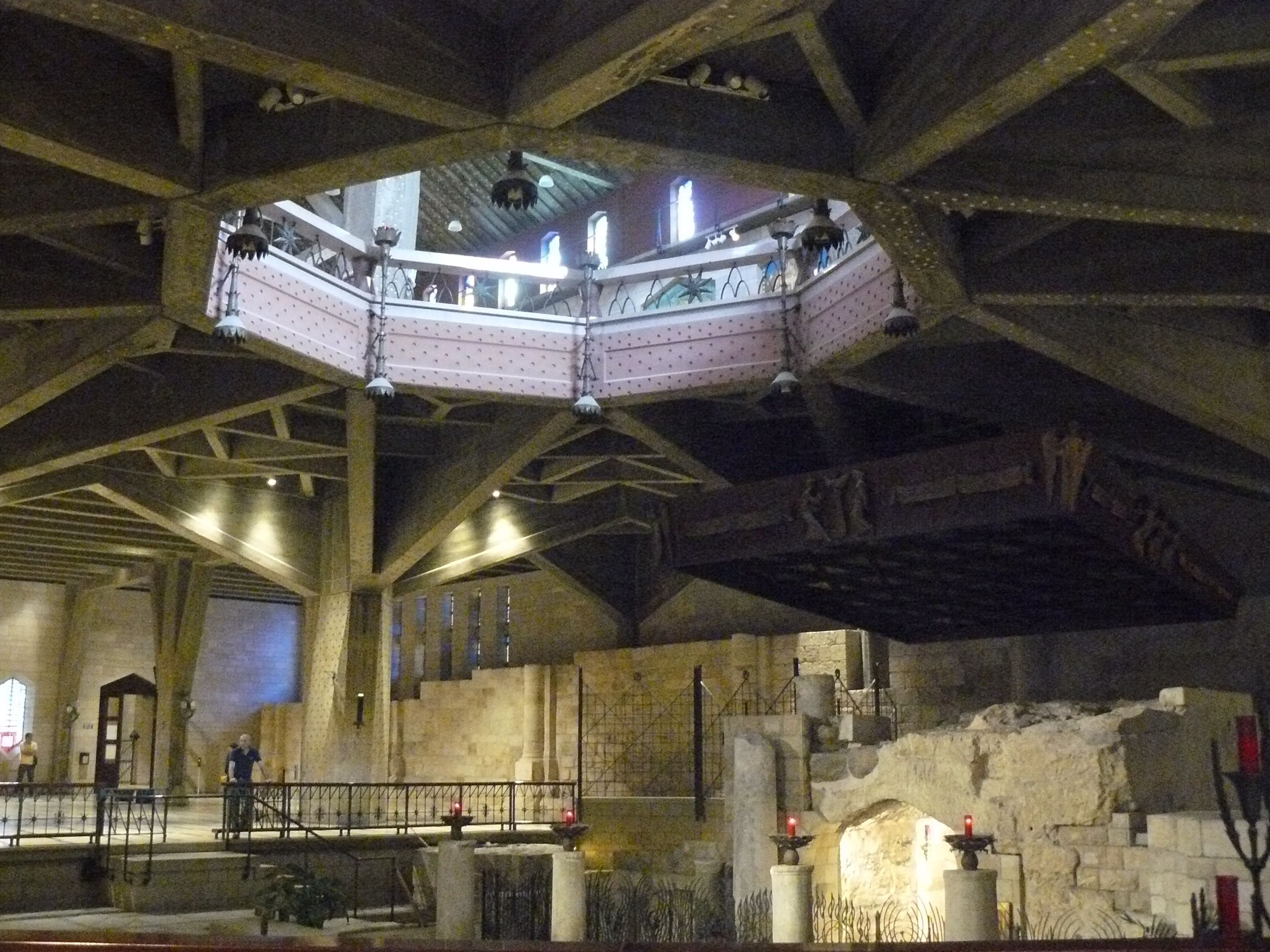
Grotto in the Basilica of the Annunciation (above). Mary’s well (below)

If you visit Nazareth, you will probably be taken to two Marian sites at both of which you will be told that this was where the angel appeared to Mary. One site is the Basilica of the Annunciation. Beneath the floor of this church a first century grotto was uncovered in which was found a foundation stone inscribed with the words: “Hail Mary”. A second site is known as Mary’s well – a covered well which used to be fed by a spring and from which water was drawn by Palestinian villagers for many years. Of course, we have no way of knowing at which site, if either, the angel appeared to Mary. The gospels do not accurately record where the events of Jesus’ life occurred and it was not until the fourth century when Helen, the mother of the then Emperor Constantine visited the Holy Land, that any such details were documented for posterity. 

In terms of developing a background for Mary, we are not served well by our scriptures. We have a backstory Elizabeth, who according to Luke, was a descendant of Aaron, was. married to Zechariah who belonged to the priestly order of Abijah, was righteous before God, and lived blamelessly according to all the commandments and regulations of the Lord. Luke further informs us that both Zechariah and Elizabeth were “getting on in years” and that Zechariah was performing his priestly duties when the angel appeared to him.

In contrast, we know nothing of Mary’ s life prior to the appearance of the angel. Though we are given quite a lot of detail about Elizabeth, Luke appears not to be interested in Mary’s heritage or her piety. The only information he gives us is that when the angel appeared to Mary, she was in a town in Galilee called Nazareth and she was engaged to a man whose name was Joseph of the house of David. Similarly, Luke is not particularly interested in where Mary is when the angel appears. What he tells us is that despite Mary’s initial confusion at the angel’s announcement, she readily submits to God’s will, and then she visits her cousin and sings a hymn exalting in the reversal of the fortunes of the rich and poor. 

Details of Mary’s parents and of her childhood belong to a later time and are almost certainly apocryphal.

That said, it is clear from the Gospels and Acts that Mary was held in regard by the early church, both as the mother of Jesus and as a prominent member of the community.

Perhaps as a consequence of her place in the emerging church, veneration of Mary began quite early. In the Roman catacombs there are paintings of Mary with the Christ child that date from the middle of the 2nd Century. Dedication to Mary grew and in 431CE. the Council of Ephesus gave Mary the title, Theotokos or Mother of God – thus sealing her place in the devotional life of the church. It was, and is, believed that Mary’s special relationship with Jesus enabled her to intercede with him on behalf of believers, a belief that became especially important in the Dark Ages.  When God was depicted as a remote and unforgiving figure and the church held the fear of hell fire over its members, Mary offered a vision of the divine that was conciliatory, relational and accessible. 

The trajectory  from Mary, the unknown young girl from Nazareth to Mary Queen of Heaven, is more complex than my simple picture, but what it is clear is that over time, Mary had been transformed from a person much like you and I, into an ideal figure to be appealed to and worshipped, and had been assigned an intercessory role between those who prayed and the God to whom they prayed.

The last thing I want to do is to disparage or diminish the practice of venerating Mary, but I can’t help wondering if elevating Mary to such an extent has had the effect of distancing Mary from us, of making her more into an idealised figure who is beyond our reach rather than someone with whom we can identify and whose example we can aspire to emulate.  

When the angel appeared to Mary, she did not stand out from the crowd in any way that the evangelists thought was worth recording. She could not trace her ancestry back to any person of significance, let alone to Aaron or to David. Her piety appears not to have set her apart from the crowd. As the scriptures tell it, Mary was an unknown, even ordinary, young girl from an insignificant place in an occupied country with no claim to notoriety or to religiosity. She was an ordinary person living an ordinary life when, out of the blue an angel appears with startling news. 

Mary is startled, but does not run away, she expresses surprise, but not anxiety and despite the fact that she is entering unchartered waters, despite the fact. That she has no idea how Joseph will respond, and despite potential cost to herself Mary says: “yes” to God. What is significant is not her background or even her faithfulness, but rather her openness to the presence of God and her willingness to say: “Yes” even when God suggested the impossible.  

In Mary, the Mary to whom the angel appeared, not the Mary who is the creation of the church, we find someone like ourselves – someone of little or no importance, someone without qualifications or impressive forbears, someone who is uncertain and tentative, someone whose faith and piety does not set them apart but someone who is curious and open to the presence of God in her life.

As the mother of Jesus, the one whose ‘yes’ to God changed the course of history, Mary deserves a special place in history and in our hearts, but perhaps the most significant role Mary has to play is that of reminding us that “ordinary” people – people like you and I – have the capacity to do extraordinary things. Mary is constant reminder that God does not seek extraordinary, talented, well- known people to make God’s presence known in the world. God uses people like you and like I, if only we are open to God’s presence in our lives and willing to add our “yes” to that of Mary.

Living Bread – are our expectations of God based on what we think God can do for us?

August 10, 2024

Pentecost 12 – 2024

John 6:35, 41-51

Marian Free

In the name of God, whose ways are not our ways and whose thoughts are not our thoughts. Amen.

I don’t know about you but every now and then I find that I am a little disappointed in God, or at least in the simplistic idea of a ‘fix-it’ God that has somehow remains in my brain – despite all attempts to remove that image.

 I am guilty, for example, of wondering why, if we had to have COVID, God didn’t allow some truly awful people to die from it? And there are times, I confess, when I ask myself how God can continue to remain aloof when for example, a powerful nation invades and overrules another weaker nation? Why doesn’t God jump in, boots and all, and end the conflicts and all the suffering in the world? Surely that would be a piece of cake for the ruler of the universe. A dictator could die of COVID, the tanks of an aggressor could become mired in mud, poverty and oppression could be alleviated. Any number of solutions come into my mind – especially when I am feeling powerless to make a difference in the world.

Of course, I can answer my own questions. I do know that God cannot be manipulated by me or be answerable to my concerns alone. I am also aware that I do not see the whole picture and that I cannot envision all the consequences of actions that I think will fix the problems of the world. In my heart if not in my head, I understand that if God did intervene in the course of history, by manipulating the death of a dictator or disabling the weapons of a perceived aggressor, the consequences might be far worse than the present reality. I am also aware that, sadly, many of the world’s ills are of our own making (a result of human greed and selfishness, and desire for power and wealth). I know too that issues like war, and poverty are not always black and white but are usually a complex shade of grey and that a mere mortal like myself doesn’t always have all the facts at my fingertips.

If I am disappointed in God then, it means that my expectations of God have, at least temporarily, been allowed to get out of hand, or that I have imprinted my image of God on to a God who is ultimately beyond comprehension and certainly beyond description.

Perhaps you too have expectations about God that God does not live up to. What is your image of God? How do you expect God to respond to what is going on in the world or in your own lives? Do you imagine that if only you pray hard enough or long enough that God will do what you want (maybe at the expense of what someone else wants)?

One of the issues today’s gospel addresses is that of expectations – the expectations of the people and the reality that is Jesus.

You might remember that last week we learned that the people followed Jesus across the lake because he had satisfied their physical hunger. They were not really interested in Jesus, or in who Jesus represented, but only in what he could do. So, when Jesus makes the outrageous claim that he is the bread that came down from heaven they are uncomprehending. Jesus simply doesn’t fit their expectations of a heavenly figure. Apart from anything else, they know his earthly reality. They know that he didn’t come down from heaven – his parents are known to them. He is no different from them – just the son of Joseph. Sure, he could feed a crowd with a small amount of food, but the living bread that came down from heaven? Impossible.

The crowds are not interested in who Jesus is, but in what he can do for them here and now. They want him to alleviate their hunger in the present. Jesus wants to satisfy a hunger for things that last. The crowds are focused solely on their earthly needs. Jesus wants to meet their spiritual needs. The crowds want to fit Jesus into some sort of stereotype with which they are familiar – Moses for example, who fed them in the wilderness. Jesus wants them to know who he really is, where he comes from and who he represents. 

Jesus and the people are at cross purposes, they want different things. The crowd want what can be seen and felt and, in this case, eaten.  Jesus wants to give them something intangible and permanent, something that will satisfy their deepest longings for eternity not just their superficial, present needs. Jesus can give them, something that will sustain them forever, in every circumstance, not something that will last for a moment and need to be replenished on a daily basis. 

The crowd want Jesus to give them what they want – in this case food. Jesus wants to give them what they need, spiritual sustenance that will enable them to face any difficulty, to endure any trials, to be at peace with themselves and with the world. The crowd wants something that they can see and feel and touch. Jesus offers living bread.  He wants them to rely totally on him, not just for their immediate physical needs but for their spiritual and eternal needs. 

Which brings me back to my starting point – expectations. How realistic our expectations of God? Do we expect a short-term miracle worker, a ‘fix-it’ God, or a God who can see into the distant future?  Do we expect God to work with us in a superficial way or do we understand that God can meet our deepest needs in the present and forever?  Have. our longings been satisfied by Jesus the living bread or are we still restless, searching out what we do not yet have?

Our expectations will of course determine the outcome. If we expect God to wave magic wand to solve all the problems of the world, we have failed to understand that our self-absorption and our desire to have God do what we want makes us part of the problem. If on the other hand, we have grasped that in Jesus God has come as close as God can to changing the world for the better then our expectations of what God can do will be tempered by an understanding of what we have failed to do. We have failed to trust God, to depend on God to satisfy all our needs, to accept from God the living bread which in turn will free us from the self-interest which makes demands of God, and will fill us with a deep sense of contentment, which will make us at peace with the world and in turn will ultimately make peace in the world.

Bread from heaven – satisfying our deepest needs

August 4, 2024

Pentecost 11 – 2024

John 6:24-35

Marian Free

In the name of God, who gives us more than we could ever need. Amen.

Last week I concluded that if nothing else, the account of Jesus’ feeding of the five thousand was a reminder that Jesus cared about the whole person. He didn’t try to address issues of faith and spirituality when he knew that people were starving – he simply satisfied their hunger.  He didn’t talk to the terrified disciples about having faith before he calmed the storm, he stilled the wind and waves and then asked why they were so worried. In other words, over and over again, we see that Jesus cared for people as and where they were. He didn’t demand that they sign up as card-carrying believers before he addressed what they require, he met them where they were and responded to their needs. 

That does not mean that Jesus let the crowds (or the disciples) off the hook, or that he didn’t challenge those who followed him to think about the ways in which their lives could be transformed through his presence in and with them. Caring about the whole person meant that Jesus did address their spiritual needs as well as their spiritual needs, he did confront deeper issues of meaning as well as the superficial needs of existence.  Afterhe calmed the storm he questioned the disciples’ lack of faith (their inability to ride the storms of life), after he fed them he accused them of seeking him out not because of the signs but because they ate their fill and were satisfied. Jesus showed that he cares for the body and the soul – the whole person.

So it is that when those who have been fed sought Jesus out, he tried to move them beyond their superficial understanding of the miracle of the loaves to its deeper meaning. In other words, he attempted to help them to see what it meant that he, Jesus, has fed them. He tried to lift their gaze from their earthly needs to the spiritual benefits that are available to those who were willing to see in the miracle a God reaching out to them with gifts that are beyond price. 

Jesus discerned that the crowds who had followed him from Tiberius to Capernaum were fixated on being fed, on having their physical needs met. They were hoping that if they found Jesus, that he would continue to perform miracles – like feeding crowds and that they would be able to (at worst) exploit and (at best) to take advantage of his ability to perform miracles.  Of course, it was within Jesus’ power to be a worker of miracles, but he knew that if the people were to be truly whole they would need to find a way to fill not just the emptiness of their stomachs but the emptiness of their lives. They would need to address the deeper issues that confronted them in ways that were not dependent on external factors, but which drew on a source of strength that was greater than them. They would need to rely on the spiritual (not physical substance) with which Jesus feeds them – bread which would last not just for a day, but which would endure for eternity. In the process they will need to adjust their expectations regarding Jesus and learn who he really is – the presence of the divine in their midst. 

Jesus makes his point by using a technique that he has used since his encounter with Nicodemus. He turns a question back on the one or ones who have asked and uses the misunderstanding to open their minds to the deeper spiritual truth. In this instance the crowds who have followed Jesus begin by asking: “How did you get here”?  Jesus ignores their question, choosing instead to confront their focus on their physical needs – they have followed him, not because of who he is but because they have had their fill of bread – but they understand bread in only one way as food for the stomach. Jesus wants them to recognise another hunger – a hunger for wholeness and life.  He points out that bread, such as that with which he fed them with the previous day, satisfies only for a short time, but the bread that is his presence among them can feed for eternity.

Of course, this doesn’t make sense to the he crowds who can’t shift their focus from the physical bread to the spiritual and they can’t comprehend that they could be given something for nothing. “What must we do?”  they ask. Jesus informs them that all they have to do is to believe in him as one sent by God and they will be satisfied for eternity. It is impossible for the crowd to believe that anything could be so simple. They demand another sign, proof that Jesus comes from God, does represent God. After all, they contend, Moses gave them food from heaven!

Their misunderstanding provides another opportunity for Jesus to try to open their minds to a new way of seeing. He corrects their misunderstanding. It was not Moses, but God who sent the bread – the true bread from heaven. Moses was the prophet who interceded, not the agent who sent the bread. The logical conclusion is that if he, Jesus, has fed the crowds with bread in the wilderness, then he, Jesus, is God (provider of the true bread). Jesus takes the claim even further – he is the bread from heaven, the food that sustains body and soul. He is “the bread of God”, the bread that will last, the bread that gives life to the world”.

Finally, at least for now, Jesus claims – “I am the bread of life. Whoever comes to me will never be hungry and whoever believes in me will never be thirsty.” Believing in him, Jesus asserts will satisfy the crowds deepest longings, will take away their trivial anxieties, will calm their troubled souls and will put everything into its proper perspective.

Over and over again in John’s gospel Jesus claims to be all that we need – the light of the world, living water, the true vine, the good shepherd, the bread of life. If we place our trust in Jesus, if we believe that Jesus will light our way and sustain us, we will not be spared those things that affect the rest of humankind, but we will be given the strength and courage to face them, the assurance that we are not alone and the confidence that whatever trials this life offers, we have the certainty of an eternity in the presence of God.

So much grass – feeding 5,000

July 29, 2024

Pentecost 10 – 2024

John 6:1-21

Marian Free

In the name of God who delights in the ordinary and who feeds us – body, mind and soul. Amen.

Sometimes I wonder if we take ourselves (and therefore our faith) too seriously. Jesus’ feeding of the 5,000 is one such example.  Much ink has been spilled in the attempt to explain just what happened. Was it a miracle in the sense that Jesus was able to turn five small loaves into enough bread to feed such an enormous crowd? OR was the miracle the small boy’s offering – which in turn exposed the selfishness of the crowd who then produced the food that they had brought with them?  If wondering about the miracle were not enough, others (like myself last week) focus on what the author’s intention was in re-telling the story. For example, as I said, Mark seems to be deliberately contrasting Jesus’ selflessness and humility with Herod’s self-centredness and pride. John, as we shall see, uses the miracle as a stepping off point for a long discourse on bread and possibly on Eucharistic theology.

Knowing the scholarship adds depth and breadth to our understanding, but it doesn’t hurt to have a more playful look at the text, to wonder at the detail and to try to put ourselves into the story. Instead of asking about meaning, we can take the story at face value and imagine it being related to a congregation of believers who might be trying to get a sense of what it was like to be in the presence of Jesus. Sometimes little details stand out and bring a smile to our face reminding us that Jesus was real, that he was human just like us, that the disciples didn’t completely understand or trust Jesus (a bit like us) that the people who followed Jesus were interested in him because of what he could do (at least a little bit like us).

So, Jesus – who if we read back – has just finished a long dispute with the Jewish authorities randomly decides to go to the other side of the Sea of Galilee. We are not told how he gets there! A large crowd continues to follow him either because they are interested in his showmanship or because they believe he has the power to heal. When Jesus gets to the other side of the Sea, he goes up the mountain and sits down with his disciples – only then does he appear to notice the crowd coming up behind. 

He doesn’t teach (as in Mark and Luke) or heal (as in Matthew and Luke) but turns to Philip and poses a “teaser[1]”: “Where are we to buy enough bread for these people to eat?” We can imagine Jesus’ lips curling slightly and his eyes twinkling as he tries to suppress a smile. He knows ahead of time that Philip will take him seriously and misunderstand him. Perhaps Jesus even imagines Philip doing the maths in his head. Indeed, Philip doesn’t even answer Jesus’ question which was “where” not “how” will we buy bread.

Then “miraculously’ the bread appears in the form of a small boy who has brought his lunch to Andrew and in Andrew who, even though he thinks the offering much too small, still brings the boy to Jesus. Jesus makes no comment about the bread but tells Andrew to make the peoples sit down and, as if it is an important detail, the gospel writer tells us that there was a “great deal of grass in the place”. (Mark and Matthew mention the grass, or the green grass, but not how much there is.) This comment about the grass, adds nothing to the miracle story, but it does situate the story and allows us to picture the scene and to put ourselves in it.

I draw out these details rather than the number fed, or the baskets left over, to demonstrate the ways in which the author has tried to make the text come alive for his listeners. Through this retelling, we are shown Jesus’ initial indifference (not that he doesn’t care, but that he is so focussed on what he is doing that he doesn’t at first notice the crowd). We can also see something of Jesus’ playfulness – life doesn’t have to be taken too seriously!  At the same time through Philip, we can see the consequences of taking things too seriously – we get the wrong end of the stick, we look for the wrong solution, we don’t listen carefully to the question! In Andrew, we observe the faith that is tentative, but not afraid of being disparaged or put down. Lastly, the plentiful grass is evidence that however we understand it, and however it actually happened, there was a time and a place when a great crowd gathered around Jesus, sat on the grass, and were fed.

If we pay attention to the detail, it is easier to see what is going on, and to put ourselves into the picture – are we part of the crowd, or do we relate to the pragmatic Philip or to the hesitant Andrew? How do we feel about Jesus’ gentle teasing of Philip? What do we make of the “great deal of grass”?

The Ignatians have a method of reading the bible which might be called imaginative contemplation. This method invites us to approach the bible with all our senses, to see, hear, feel and smell what is happening, to put ourselves into the story as one of the characters and to imagine what they are thinking[2]. To do this, you first open oneself to the presence of God, before reading the passage slowly once or twice so as to become familiar with it. Then you try to put yourself in the story as one of the people or simply as an observer (perhaps a maid from the inn peaking in on the Nativity). Finally, you turn to Jesus and speak to him. If you’d like to try. This method, John 6:1-21 would be a good place to start.

Who knows what really happened and what the miracle of the feeding really was, but from this story we learn that Jesus was real, that he had a sense of humour and that he cared, about the whole person – body, mind and soul, and that the people needed full stomachs as much as they needed to hear him or to be cured of their illnesses.


[1] A much better word than ‘test”.

[2] Christina Miller gives a simple explanation here https://blog.bible/bible-engagers-blog/entry/ignatian-contemplation-how-to-read-the-bible-with-your-imagination

Another way – Herod vs Jesus

July 20, 2024

Pentecost 9 – 2024

Mark 6:30-34, 53-56

Marian Free

In the name of God who shows us another way, a better away. Amen.

There have been times I admit when, exhausted from a day of minding children or simply bored with an inane children’s story, that I have skipped a page that I determined was not essential to the plot. I rarely got away with the omission – it was usually met with: “you missed a page!” For the child each page was integral to the plot and to the pleasure of having the story read to them. 

Most stories have a trajectory and are carefully constructed so as to take the reader along with them. This is why it can be frustrating when the lectionary writers leave out sections of the readings as is the case this morning. The missing verses in this instance are Mark’s account of the feeding of the 5000 and the rationale for omitting them is that for the next five weeks we will be focussing on John’s version of the same event. Wisely, the lectionary writers try to avoid too much repetition, but what that means is that we lose Mark’s voice, when it comes to this story and his voice is important.  

As might be expected, the author of John’s gospel takes a very different approach to the re-telling of this miracle. John uses the feeding of the 5,000 to introduce a very long discourse on the theme of bread. Here, Jesus compares himself to the manna in the wilderness, he claims to be the Bread of Life and he states that those who do not eat his flesh and drink his blood have no life in them. The Jesus of John’s gospel appears to be at least a little confrontational here – “if you don’t do this then this will happen”. Jesus’ language and assertiveness mean that some disciples find his teaching too difficult, and they turn away from him.

Mark’s account of the same event is very different. In Mark’ recounting, the emphasis is placed on Jesus’ compassion; on Jesus as shepherd of a people who are lost and who are looking for someone to lead them. Jesus does teach the crowd, but the content of that teaching is not considered worth reporting.  What is important to Mark is Jesus’ response to the crowds who have sought him out – the very crowds he was trying to escape. Though Jesus is desperately tired (and possibly wanting to grieve the death of John the Baptist and to process what that might mean for him) he doesn’t turn the people away. Jesus knows that he needs silence and solitude, and he has taken his disciples to a desolate place. But when he sees the crowd instead of being frustrated, he sees their need and puts aside his own. He teaches and heals the crowd and then, instead of sending them away as would make sense, he feeds them. Jesus draws on an inner strength which enables him to put his own needs last and the needs of the people first.  

Whereas in John’s gospel Jesus gives the crowds a metaphor – “I am the Bread of Life”, in Mark’s gospel, Jesus gives himself, all that he is.  

By leaving Mark’s version of the story out of our Sunday readings, we are prevented from comparing the two accounts, but the real damage caused by the omission of Mark. verses 35-52, is that it does not give us an opportunity to see the way in which Mark is constructing his gospel and the way in which the positioning of this story is significant for the gospel as a whole.

As we will see over the course of the next five weeks, John places the story of the feeding of the 5,000 in the context of the growing tension between Jesus and the authorities and the discourse which follows highlights the misunderstanding and the. tension. Mark uses the story very differently – to make clear the contradiction between the ways of the world and the way of God (as exemplified by Jesus).

In Mark’s gospel the feeding of the 5,000 follows the gruesome account of Herod’s banquet[1].

As you will remember, last week I concluded that there was no good news in the account of the beheading of John which reminds us that the world can be an ugly place in which brutal events occur, in which those who are innocent suffer and God has no magic wand to make everything right. But by juxtaposing John’s beheading with the feeding of the 5,000 Mark makes it clear that it doesn’t have to be this way. There is another way – a way that is not prideful, self-serving and destructive, but is humble, self-sacrificial and life-giving. 

As Donahue and Harrington point out, Herod’s banquet takes place in a palace. It is a birthday and only those who will enhance Herod’s honour will have been invited. The food is not mentioned but is surely fitting for such an occasion. Jesus’ banquet takes place somewhere desolate, it is not planned, the attendees (ordinary people, who have nothing to offer) have invited themselves, and the food is only that which is available – a paltry two fish and five loaves. Herod’s banquet is overshadowed by Herod’s immoral behaviour, Jesus’ banquet is characterised by his compassion. Jesus responds to the crowd by offering them food, Herod’s response (to the expectation of) his guests is to have John the Baptist beheaded. Herod’s concern was to hold on to his power and to his position at all costs. Jesus was willing to relinquish his own needs to serve the needs of others.

Herod’s hubris, self-centredness and his focus on what he can gain lead to division, brutality, violence. 

Jesus’ humility, his self-effacement and his willingness to put others first create unity, tenderness and peace. 

Herod and Jesus – two different ways. of living and being.

Whose example will we follow? What sort of world do we want to create?


[1] I am grateful to Donahue and Harrington for this insight. Donahue, S.J, John R, and Harrington, Daniel J, S.J. The Gospel of Mark. Collegeville, Minnesota: The Liturgical Press, 2002, 209.