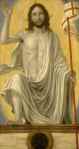
God so loved the world

March 21, 2009

Lent 4

John 3:13-22

Marian Free

In the name of God who offers life in him and with him for all eternity. Amen.

Sometimes, when I am driving, I catch the Book Reading on the ABC. It is just as frustrating to join the programme mid way as it is to reach the destination before the programme has finished. Not knowing the beginning leaves one wondering why the characters behave in a particular way, leaving before the conclusion creates lots of loose ends and unanswered questions. So it is with today’s gospel. While most of us know John 3:16 off by heart, the passage we have been given to read this morning seems to require a context. Where does this section belong in the story? How do the different components fit in to the gospel as a whole? Where is the author taking the discussion?

I am sure that most of you are well aware that the Gospel of John is quite distinct from the other three. Most notably John includes material that is found no where else – for example, the changing of water into wine, the discussion with the woman at the well and the raising of Lazarus. At the same time much that the Synoptic writers include is excluded – for example the parables, exorcisms, the institution of the last supper and more. John’s gospel is less concerned with historical fact and more concerned with theological interpretation. Written for contemporary readers, it only includes what it necessary to bring them to believe in Jesus. For the community from which the gospel emerged, it is the relationship with Jesus which is paramount. That means that for them, it is the encounter with Jesus in the present which is important NOT the words and actions of the historical Jesus limited as they are by time and place. The writer is concerned to present the gospel in such a way that those who have never met Jesus, might never-the-less be brought into a life changing relationship with Jesus – the Son of God.

Given this intention, it is not surprising that one of the techniques used to build this relationship is to present intense dialogues between Jesus and others – the woman at the well, Mary and Martha, Thomas and others. Often an initial misunderstanding of what Jesus has said provides an opportunity to elaborate on the topic, sometimes with the result that the conversation leads to understanding. The immediate context of this morning’s gospel is Nicodemus’ discussion with Jesus. Nicodemus affirms that Jesus has come from God to which Jesus replies that no one can have that understanding without having been born anew. This confounds Nicodemus as it is intended to. How can one be born again? He fails to see that Jesus means that he must be born of God, as Jesus is. At the same time, Jesus means to disconcert, to open Nicodemus to the revelation of the spirit. Jesus concludes that if Nicodemus cannot understand what is before his very eyes, that he will be unlikely to understand that Jesus, who has descended from heaven is the revealer of God and of heavenly things.

This revelation will take place when the Son of man is lifted up. Using a word which can be interpreted in two ways, the author indicates that it is on the cross that Jesus is lifted up, or exalted. He finds a precursor to this positive view of the cross, in the report of the bronze serpent of the exodus.

Jesus is lifted up (that is crucified) to demonstrate God’s love for the whole world God loves the world so much that he gave Jesus – in the Incarnation and he gave Jesus to die, in order that all who believed in this revelation could have eternal life. That is that they would understand that Jesus was the personification of God and having believed would share with Jesus in the divine life that he shares with God. By believing in Jesus, disciples are united to him and thereby become participants with him in the infinite life that he shares with God and the Holy Spirit. This is the life that Jesus had with God from the beginning and will have to the end. As God cannot die, so this life which Jesus gives is so powerful that it will triumph over death. The life that the believer shares with Jesus is eternal life. God’s gift of Jesus is the gift of God’s love which extends to the whole world.

God’s intention is not to condemn the world, but to save it. This intention does not mean that the world is saved, rather that the possibility exists for it to be saved. The choice to believe or not to believe is not imposed, but belongs to the individual. However, though the offer of eternal life seems too good to be true, there are those who refuse the gift as must be clear to the readers of the gospel. Those who do not believe are those who are unwilling to allow their true selves to be exposed to the scrutiny of God’s love and goodness. In John’s words, they choose darkness over light so that who they are will not be revealed. God does not judge them – they have already judged themselves. Because God has not judged them, the door remains open for them to enter into a relationship with Jesus.

It all depends on accepting God’s love, believing that that love extends to us in all our weakness, understanding that a relationship with Jesus is a relationship with God and that that relationship creates a union with God such that we share in the infinite, eternal life of God. For God so loved the world – the whole world not just part of it – that he gave his only Son – sent him into the world as a revelation of himself and allowed him to die – so that everyone who believes in him may not perish but may have eternal life – give up their old life so that they might share in the life of heaven that has no beginning and no end. In order to participate in that life, a person has to believe that Jesus is the revelation of God, to reorder one’s way of thinking (be born anew), to open one’s life to the brightness of God’s gaze and to enter into a lasting relationship with Jesus which leads to the indwelling of the Holy Spirit and life that never ends.

To resist God’s love is to put our lives in peril, now and for eternity.

Jesus in the temple

March 14, 2009

Lent 3 2009
John 2:13-22
Marian Free

In the name of God who, in Jesus, overturned all our expectations. Amen.

Jesus might just as well have said: “I have come to overturn all your expectations.” He was so different from what anyone expected, his teaching so radical and his death so undignified, so ungodly, that it is no surprise at all that people found him disturbing and unsettling. Here, at the start of John’s gospel he shows his true colours and demonstrates that he is not going to conform to the accepted norm. From the start, he demonstrates that he will be unable to tolerate the trivializing of faith, the desecration of the temple and the misuse of the law. All of this is made obvious in the incident in the temple. Incensed by what he sees as a blatant disregard for the holiness of the space, Jesus fashions a whip and uses it to drive the animals and the money-changers out of the temple thereby creating mayhem, inviting the disapproval of those in authority and causing confusion among the faithful.

This version of events is very different from the other gospel writers who place Jesus’ actions in the temple much later in their story. According to the Synoptic writers, the incident in the temple occurs towards the end of the story after Jesus’ triumphant entry into Jerusalem. (His only visit compared with the three he makes in John.) Their account is much less dramatic. Matthew, Mark and Luke do not mention the larger animals – the oxen and the sheep and Jesus does not go to the trouble of fashioning a whip. Jesus quotes Jeremiah: “You have made my Father’s house a den of thieves” whereas, John’s Jesus accuses them of making his Father’s house a market place” (merchants will not be found in temple on the day of the Lord according to Zechariah).

It is only in John that the reference to destroying and rebuilding the temple occurs in connection with the driving out of the money-changers and the salesmen.

Despite the difference, there is considerable consistency across all four gospel accounts. This includes Jesus’ indignation, the overthrowing of the tables of the money changers and driving the animals out of the temple. Jesus’ action must be seen against a background in which there is increasing dissatisfaction with temple worship and suspicion of the priests. Not that this is new. In the writings of the prophets and in the Psalms there are protests against the profaning of the temple and the abuses of Levitical worship which will lead to the destruction of the temple.

At the time of Jesus, the concern about the temple and temple has become so strong that groups such as the writers of the Dead Sea Scrolls have completely dissociated themselves from the Temple and Temple worship believing it to be too corrupt to be of any use to their relationship with God. For people such as those at Qumran their removal from Jerusalem was in part a protest against the abuses that they observed and also an attempt to create the purity of life and worship which they felt was missing in Jerusalem. They focused on a future heavenly temple created by God and it was for this temple that they were preparing themselves. For them the Temple in Jerusalem had become an anathema.

We can see then that Jesus’ anger was not formed in a vacuum, but against a background of discontent and a desire for a purity of worship, that represented faithful hearts turned towards God rather than cynical adherents hoping that sacrifices and other such practices would encourage God to look favourably towards them.

In some ways, Jesus was a man of his times, but his anger in the temple is also perfectly consistent with his charges of hypocrisy against the Pharisees, chief priests and scribes. Just as Jesus sees through the offering of beasts for sacrifice to the market forces beneath, so too Jesus sees through the Pharisees outward displays of piety to their shallow hearts below. Like the prophets, Jesus challenges the believers of his time, to rethink their relationship with God, to examine their self-deception, to reconsider the connection between their behaviour and their true attitude to God and to examine whether what they do reflects their desire for a relationship with God or a desire to be seen in a good light by their peers.

The gospels present a picture of a religious situation in which self-satisfaction has taken the place of self-examination, in which adherence to a system of laws has replaced a relationship with the living God, in which there is a certain smugness and complacency about one’s position before God, instead of an attitude of humility. Jesus wants to cut through this outward show to bring people back into a relationship with God which is based on a realistic view of sinfulness and a deep understanding of one’s dependence on God’s goodness and mercy. He is encouraging honesty and sincerity rather than self-deception and pretence.

In the light of today’s gospel, it is interesting to reflect on what Jesus might see were he to come to our churches today. Would he be critical that our concern for survival eclipses our concern for the gospel? Would he wonder that whether our focus is on our individual piety rather than on the needs of those around us? Would we feel the sting of the whip and feel the lash of his tongue because the state of our hearts belies our outward appearance?

The gospels record the life of Jesus, but they do so to inform and challenge us, to confront us with our own humanity and to force us to question whether we are really true to the gospel. How would Jesus respond to our practice of the faith he taught? How do we compare to the Pharisees and scribes of his time?

These are questions worth asking from time to time lest we find ourselves guilty of the same double-standards and complacency.

Let us not hide behind false piety, empty service or good works. Let it not be said that we show style not substance, but that, having a true sense of who we are and a true understanding of the gospel, we seek to build a relationship with God that is open and sincere with no false piety and no pretensions to be anything but who we really are.

Taking up our cross – Lent 2

March 7, 2009

Lent 2
Mark 1:31-38
Marian Free

In the name of God who, in Jesus, took all our burdens on himself. Amen.

Imagine the unlikely scene of a first century advertising agent speaking with a prospective client.

“Listen, I’m telling you,
it’ll never catch on!
I’m the guy with the advertising agency,
you’re the bloke with the boat, right?
You want a motif, a logo, a symbol for your set up,
and you came to me
with this crazy idea;
listen, you said your set up stands for
life, liberty, truth, love, joy, peace, hope,
all the big stuff;
well then, you’ll have to have a symbol which
a lady will wear at her wrist or her throat,
or a gent will attach to the lapel of his coat;
what d’you meant: ‘What’s a lapel?’
I mean, what set up standing for life
is going to expect its members to wear a badge
with something totally inappropriate on it,
like a, er, a guillotine,
or a gas chamber,
or an electric chair,
or a gallows?
You gotta have a symbol that’ll catch on,
a dove, an eagle,
spirit of life and freedom,
right?
Yeh, well, if that’s how you feel.

Here, George,
I just had this chap come in,
belongs to this set up,
you know, they stand for all the big ideals,
life, liberty, love, stuff like that,
and he had this idea for a logo:
a cross!
Yeh – a cross!
Your actual means of execution.
Yeh – right!
I thought what sorta lady is gonna wear a cross round
her neck!
That’s right, exactly what I said:
it’ll never catch on,
never in a thousand years!”

It is interesting that Christians have taken the sign of their greatest embarrassment and shame, the source of one of the most excruciating deaths humankind has perpetrated, and made it the most recognizable symbol of their faith – the cross. This is because the cross represents for us, not defeat, but victory. In the cross we find the source of our salvation – Jesus’ dying and rising for us. The cross for Christians is both the sign of Jesus’ total self-giving and the sign of his victory over death. The cross is empty. Jesus has risen. For us, then, the cross is a symbol of life not death, of what God gives to us, not what God demands of us.

So when Jesus says: “If any want to become my followers, let them deny themselves and take up their cross and follow me”, it is in the context that the cross is the way to life. Jesus is not insisting that his followers seek out suffering, nor is he asking them to resign themselves to the pain and loss which might come their way. He is simply encouraging them to follow his example – to actively engage in the life God has give and to willingly take on whatever God asks, confident that even the worst life has to offer will not be able to defeat them.

The popular use of this saying, “we all have our crosses to bear”, totally misrepresents Jesus’ intention here. An attitude of resignation in the face of suffering and loss implies that God imposes burdens upon us, burdens which we must accept as part of being a Christian. This completely misses the point. The cross is something that we are asked to willingly take up, not something which we are encouraged to grudgingly endure. Taking up our cross is something that Jesus asks us to do, not something which God inflicts upon us. So when Jesus asks us to take up our cross, it is not with the intention that we readily take on sickness, disability, disappointment or sorrow but rather that we follow his example and commit ourselves to living the gospel and focusing on God no matter where that road might lead us trusting that, not only will God see us through, but that God will bring something good out of the worst situation.

“Bearing one’s cross” not only contradicts Jesus’ request that we “take up the cross”, but it also risks becoming a form of self-absorption – leading to a focus on oneself and one’s forbearance. What presents as humble acceptance of one’s may really be an unconscious way of drawing attention to how long-suffering, how saintly one is. It is a long way from the self-denial which Jesus requires. The point of denying oneself and taking up one’s cross is to gain life, not to be smugly stuck in some sort of half-life. Focussing on one’s troubles, even if only to demonstrate that one accepts them, is to look inward to oneself rather than outward to God and to others and to make the cross a burden God imposes rather than a gift God offers. To create an identity of being a burden-bearer, is to miss the opportunity to be a bearer of the life which God promises.

Burden-bearing and attention seeking are two things which Jesus explicitly rejects. Elsewhere, Jesus accuses the lawyers of loading people with burdens that are hard to bear and condemns them for not lifting a finger to help them. In contrast, Jesus claims that his yoke is easy and his burden is light. Jesus is also extremely critical of the Pharisees who draw attention to their piety through their long prayers and other public displays. Taking up one’s cross he says, is not an act of public piety, but of self-denial. The verb aparneisthai (“aparneisqai”) which we translate as “to deny oneself” has the basic meaning of to act in a selfless way, to give up one’s place at the centre of things, to set one’s mind on divine things, not human things.

It would be totally out of character for Jesus to demand of his followers to do something that was difficult or burdensome, or to encourage them to make public displays of their devout behaviour.

The contradiction of the cross, which is demonstrated by Jesus’ resurrection, is that it leads not to death, not to resigned suffering but to life, fullness of life, life lived as God intends it to be lived in peace and hope and joy.

When we take up our cross we do so willingly, confidently and courageously, knowing that the road will not always be easy, but that it will lead to life in abundance and to life for eternity.

In the desert

February 28, 2009

Lent 1 2009 desert

Mark 1:9-15

Marian Free

In the name of God whose spirit calls us out of the world in order that we might more fully enter into it. Amen.

The desert can be a beautiful and terrifying place. In Australia, we know only too well the dangers that face the ill-prepared and unwary. Vast expanses emphasise isolation. Aridity and a lack of life highlight vulnerability. Absence of sound exaggerates the clamour of the voices within.

What then makes the desert or the wilderness so compelling for spiritual ascetics like John the Baptist and the Desert Fathers? What drew Jesus into the emptiness of the wilderness for 40 days? The solitude and emptiness of the desert attract those who want to withdraw from the noise and superficiality of the world to discover what is real. The barrenness of the wilderness provides a challenge for those who want to test their ability to survive without the supports offered by social structures. The loneliness of the desert offers an escape from the demands of social interaction. The lack of entertainment forces one to depend on one’s own resources. The absence of busyness allows space for reflection. The deep silence allows the voice of God to be clearly heard.

In the desert, without normal forms of identifiers, a person comes to know who they really are. In the desert with no one to affirm them, nothing external to give structure and meaning, a person is confronted with the bare facts of their existence. In the silence of the desert one is force to listen to the constant chatter of one’s own mind. In the isolation of the desert one is forced to come to terms with one’s own company. In the scarcity of the desert one identifies the demands one body makes for sustenance. In the inactivity of the desert one has to deal with boredom and lack of direction. In the absence of distraction one comes face to face with all of oneself – the dark, injured and furtive as well as the strong and respectable. In the vastness of the desert one recognises the how insignificant, how finite and how limited one is compared to the infinite majesty and power of God. Exposed to the dangers of the desert one has no choice but to be completely dependent on God.

In today’s world, in which time is at a premium, in which activity is valued over inactivity, in which social interaction takes precedence over solitude and in which even our leisure time is eaten up by demands to attain a certain level of fitness it takes a certain amount of discipline to allow oneself space to recharge and reflect. Few of us have the time, courage, resources or inclination to spend 40 days alone in the wilderness. Moreover, we tend to measure ourselves by what we do and not by what we don’t do. To do nothing is to risk being seen as lazy, or worse still as having nothing of value to offer.

As a result we continue to fill up our time to prove that our lives are worthwhile, to earn enough money to have the things we think we need, to demonstrate that we are getting the most out of life, and we pay the price in stress related diseases, broken relationships, drug dependence or depression. We become isolated from the person we really are, separated from the longing for God which is at the depth of our being.

It is important therefore, to fashion for ourselves an experience of the desert – to set aside space, to seek out the silence and solitude in which we can come to know ourselves and hear the voice of God. This takes not only discipline but courage because solitude is a place of conversion and transformation. In fact, the initial experience of silence and solitude can be truly terrifying. With nothing and no one to distract us from ourselves we come face-to-face with our deepest fears and anxieties, our longings and desires, our ambitions and strivings. Without external factors to affirm us, we may lose confidence in our own worth. With nothing to structure our time, the hours may drag on as if the day would never end. Stripped of everything that is familiar we may feel empty and alone. In the silence, the endless chatter of our inner mind may drive us crazy.

Sooner or later, we come to terms with the emptiness and even to appreciate the gifts it gives us. We become more attuned to ourselves, more aware of the world around us. We learn to be more compassionate towards ourselves and others. We learn to let go of those things we rely on to give us our identity and become more settled with the person we are. We give ourselves the freedom to re-think ourselves, to consider what is really important and to determine where and how we want to direct our energies. We give up our striving and allow ourselves to be at peace. When we have stopped trying to be who we think we should be we can become who we really are – accepting the bad with the good, the damaged with the whole. When the voices inside ourselves are finally silenced, when we are comfortable with who we are, we will finally be able to hear and respond to the voice of God.

This time of Lent is a gift, not a burden. It provides an opportunity for time out. The season of Lent gives us a pretext to reflect on our lives as they are and to ask ourselves if this is how we really want them to be. It presents us with an excuse to take stock, to test our mettle and to reflect on who we are and how that affects our relationship with God. We don’t have to take ourselves off to the desert, or go on a Retreat (though either would prove useful). Through prayer and reflection, through the discipline of fasting or simply by giving entering a desert of our own making we are asked to stop for a time to re-evaluate our lives and to rekindle our relationship with God.

Open to God’s next new thing

February 21, 2009

Seventh Sunday after Epiphany
Mark 2:1-2 Healing of the paralytic
Marian Free

In the name of God who longs for us to allow ourselves to be forgiven and healed. Amen.

The Old Testament provides a litany of the failures of the people of God. From creation onwards, they have gone their own way, sometimes with terrible consequences. Underlying the account of Israel’s waywardness is the deep grief of God that the relationship he desires with his people is fractured and broken. This grief can be heard in today’s reading from Isaiah as can the extraordinary generosity of God who is determined to blot out the transgressions of the people without their having to anything to deserve such an action.

The author of Mark understands that it is Jesus’ role to heal the breach between humankind and God, to restore the balance and harmony destroyed by humankind’s willfulness. In today’s gospel Mark develops this theme, but introduces a new idea – Jesus’ action bring him into conflict with the authorized teachers and leaders of the faith.

In typical Markan fashion, the relating of the healing of the paralytic is economical. There is frustratingly little information and it is very tempting to invent detail to fill in the gaps. However, we must be careful of elaboration and try to understand that the detail is much less important than the point which Mark is trying to make. Mark is demonstrating how it is that Jesus comes into conflict with the scribes, a conflict which escalates into conflict with the scribes and Pharisees and Herodians and which will lead to Jesus’ death.

As we have already seen Mark creates a pattern in his story-telling to reinforce the point he is making and to enable the listeners more easily remember what it is he is saying. The same is true in this section of Mark’s gospel. Chapter 2 and the first six verses of Chapter 3 include five conflict stories.

Joanna Dewey has argued that the section of Mark has a concentric structure . Stories of healing appear at the beginning and end – the healing of the paralytic and the healing of the man with the withered hand. The first two units share the theme of sin and sinners (forgiveness of the paralytic and the call of Levi the tax collector) and the last two relate to what is permitted on the Sabbath (plucking grain and healing). Units two, three and four share the theme of eating (or not eating, that is, fasting) (Jesus eats with the tax collector, is asked about fasting and the disciples pluck grain).

Mark brings in allusions to what has gone before to further develop and reinforce his point, albeit with a difference. In the first section, Jesus’ teaching and healing, the calling of the disciples and the crowds that are drawn to him are used as evidence that there is a positive response to Jesus. In this section however, similar stories are used to show that the reaction to Jesus is mixed – the crowds are still amazed, but the scribes see Jesus’ as a blasphemer.
The emphasis in today’s gospel is less on the healing, though it is dramatic and amazing, and more on Jesus’ right to forgive sins which is the source of conflict.

Even though Jesus implies it is God who forgives, “Your sins are forgiven”. The scribes are surprised. Jesus has subverted the established process. It is the priest makes atonement for the sins of the whole people of Israel (Lev 4:20). Even worse, by presuming to speak for God (announcing God’s forgiveness), Jesus is claiming the same authority as God.

Of course, the point Mark is trying to make is just that. Jesus does have the same authority as God. This is not clear to the scribes, who though, apparently attracted to Jesus’ teaching, are not able to grasp this new complexity and who are unable to see in Jesus the promised Christ – God’s representative on earth. All that they can see is someone who is making pronouncements which are as absurd as they are presumptuous.

Jesus, confident in his role, refuses to be cowed. He could simply tell the man to get up and walk as would any other miracle worker. However his role is to restore order and harmony to God’s creation – to heal the breach caused by human sin. He understands the connection between disease and sin in the Jewish tradition. Healing implies that a person is forgiven, restoration to health indicates a restoration in a person’s relationship with God. So the question Jesus asks is very real: “Which is easier, to say to the paralytic, “Your sins are forgiven”, or to say, “Stand up and take your mat and walk”? For Jesus the end result is the same – the person’s relationship with God is restored AND they are healed, a person is healed AND their relationship with God is restored. Jesus doesn’t just perform miracles, he gets to the root of the problem. He heals the breach between humankind and God.

The healing is evidence that Jesus does in fact have authority to forgive sins. It is not Jesus’ intention to draw attention to himself. The people get the message. They are not offended by Jesus’ presumption. They understand that while Jesus is behaving as God’s agent, Jesus is not placing himself in competition with God. Their praise is not directed at him but towards God: “They were all amazed and glorified God.”

The gospel speaks on many levels, but we do ourselves and our faith a disservice if we fail to look beyond the surface to what is really going on. The scribes have a reason to believe Jesus is blasphemous, but they have failed to grasp the larger picture. They are so used to the world as it is, that they have no vision of the world as it could be. They are so sure that they know right from wrong, that they cannot see that their rules are hurting rather than liberating people. They are so bound by the way they have always practiced their religion that they have lost sight of the forgiving God who lies behind it.

In a time of change, we need to remember that what was true for the church thirty years ago is not true for the church today. Over time we have responded to the urging of the Holy Spirit to become more compassionate and less rigid, more understanding of human frailty and less demanding of ourselves and others. An openness to God enables us to respond to changing times.
Every generation sees only a portion of all that God is. Our task is to remain open and receptive so that we do not fail to see how God is acting in our own time and place.

Marian Free

Che Guevera and Mother Teresa

February 14, 2009

che guevera

Sixth Sunday after the Epiphany
Mark 1:40-45

Marian FreeMother Teresa

In the name of God who longs that all people should be free and whole. Amen.

What do Che Guevara – Argentinian Marxist revolutionary, politician, author, physician, military theorist, and guerrilla leader and Mother Teresa – Albanian Roman Catholic nun with Indian citizenship who founded the Missionaries of Charity in Kolkata and ministered to the poor, sick, orphaned, and dying, and Jesus Christ – Saviour of the world – have in common?

Do you give up? I imagine that most of you found it easier to find connections between Mother Teresa and Jesus, but the answer is, that all of them were driven by their compassion for the poor and the dispossessed and that all dedicated their lives, albeit in very different ways, to alleviate the suffering of those who found themselves outcasts in their society. All of them were determined to make a difference in the world. Jesus, Che Guevera and Mother Teresa refused to allow fear to dominate compassion, social stigma to determine action or the opinion of others to dictate how they behaved.

Further, and this was the link which led me to the comparison – all of them took the very real risk of working closely with those who had leprosy – that most dreaded of diseases which led to separation and isolation from a world afraid of contagion.  In so doing, they gave dignity, hope and healing to people who were outcast, rejected and misunderstood by the societies in which they lived.

Che Guevara’s experience with the poverty in South America led him to believe that the solution to the problem was political, and if necessary military. So convinced was he that he was right that he believed that if people could not be changed by persuasion, they should be changes by force. Mother Teresa was so affected by the poverty in India and the abandonment of the poor to a lonely, ugly death that she set a goal of making the dying moments of the unloved more comfortable, more bearable. Che determined to change the shape of the society which led to the inequities he witness, Mother Teresa accepted the world as it was and tried to make a difference in the lives of those who suffered as a result of injustice and indifference.

Jesus’ programme was different from either and yet has elements of both. His mission is to restore and to transform the world – not through force, but through love. So he challenges the political and religious structures which impose burdens on the people, yet instead of taking up arms against them, he lays down his life. At the same time, he begins the process restoring order and wholeness to God’s creation by healing the damaged and  broken, welcoming the despised and the dispossessed and confronting the forces of evil which limit and constrain. Jesus understand that his task is to re-create the harmony which God intended before it all went wrong.

Jesus is as radical as Che Guevara and yet as compassionate as Mother Teresa. In a broken and unjust world he challenges the structures which limit and confine and he begins the process of healing and rebuilding those whose lives are restricted by illness, disability or possession. Unlike Che Guevara, Jesus does not intend to overthrow the unjust structures of his time. His goal is more ambitious still – his mission is to overcome the forces of evil which have humankind in their throw and to establish God’s kingdom on earth. Unlike Mother Teresa, Jesus’ compassion for those who suffer belongs to this wider programme of transforming the world.

As followers of Jesus, we are invited to join in the revolution – to work for justice and equity and to be agents of his healing and restoring presence in the world.

The leper says to Jesus: “If you choose, you can make me clean.” Jesus replies: “I do choose.”

In the burnt out ruins of homes destroyed by fire, in the homes of the jobless and on the streets of our cities our neighbours are saying: “If you choose, you can make a difference.” How will we choose?

Prayer

February 7, 2009

Fifth Sunday after Epiphany 2009

Mark 1:29-39

Marian Free

In the name of God who longs for us to draw near to him. Amen.

Little boy kneels at the foot of his bed,

droops on the little hands little gold head.

Hush! hush! whisper who dares!

Christopher Robin is saying his prayers.

God bless Mummy. I know that’s right,

wasn’t it fun in the bath tonight?

With the cold so cold and the hot’s so hot.

Oh, God bless daddy, I quite forgot.

If I open my fingers a little bit more,

I can see Nanny’s dressing gown on the door.

It’s a beautiful blue, but it hasn’t a hood.

Oh, God bless Nanny and make her good.

Mine has a hood and I lie in bed

and pull the hood right over my head,

and I shut my eyes and curl up small,

and nobody knows that I’m there at all.

Oh! Thank you God for a lovely day.

And what was the other I had to say?

I said “Bless Daddy”, so what can it be.

Oh! Now I remember it. God bless me.

Little boy kneels at the foot of his bed,

droops on the little hands little gold head.

Hush! hush! whisper who dares!

Christopher Robin is saying his prayers.

In my childhood, I was taught to say my prayers before I went to sleep each night. From memory, those prayers were as simple and limited as those of Christopher Robin – prayers for family and prayers for oneself. Like Christopher Robin I was not always entirely serious. M sister and I competed to think of different things for which to give thanks, striving to outdo each other with the most outrageous. Later, at school, my year 6 religious education teacher taught me how to pray using my hands as a reminder. The only thing that I can remember now is that my little finger represented me because it was the smallest and I was the least important person to pray for. In my late teens and early twenties I was privileged to hear the stories of older members of my congregation whom I respected. Two in particular inspired and challenged me by sharing that they would get up at four or five o’clock in the morning in order to pray. This meant that they would have no distractions and so that their prayers would not be forgotten.

“In the morning, while it was still very dark, Jesus got up and went to a deserted place, and there he prayed.”

Prayer is an important part of Jesus’ ministry. In fact Jesus’ ministry both begins and ends with prayer – from the 40 days in the desert to the cry from the cross, Jesus indicates a desire to develop a relationship with God, to seek God’s will and to ask for God’s help to live in accord with that will. On more than one occasion Jesus withdraws by himself to pray, after his first day of “work” and after the death of John the Baptist. Not that these attempts to pray alone are always successful. Despite the fact that Jesus gets up while it is “still very dark”, his friends are able to hunt him down and disturb him. On other occasion when he takes a boat to the other side of the lake, he arrives to discover that the crowds he was trying to escape had reached there before him. Only after he feeds the 5000 is Jesus able to send the disciples off in the boat and have some time to himself.

Prayer makes the difference in one instance of healing and Jesus teaches his disciples to pray. On the night before he dies he takes his friends with him to the Garden where he prays that he won’t have to endure the suffering ahead before he once again submits to God’s will.

Prayer seems to have a number of functions in Jesus’ life and ministry. It enables him to test his vocation and his strength of character. It restores his energy and his spirit. It frees him to share with God his deepest fears and supports his ministry of healing. Apart from the Lord’s prayer and Jesus’ anguish in the garden we don’t know the nature of Jesus’ prayer or its content. What we do know is that Jesus’ ministry was enhanced and supported by his relationship with God, a relationship which was sustained by prayer.

Unfortunately for me, the form of prayer which my RE teacher taught was particularly unhelpful and restrictive and while I aspire to early rising to pray, I have yet to achieve it. However, over the years, I have learned that not only are there a variety of ways in which to pray, but that each of us needs to find a way to pray that suits us. That does not mean that we will pray in one way throughout our life, or even at one time in our lives. Like Jesus, we may find that there are times when we simply want to stop and be with God, other times when we will want to pour out our hearts in anguish at our own situation or that of others. There will be times when we want to pay particular attention to how God wants to direct our lives, and other times when we will want to ask for God’s intervention in someone’s life or in a particular situation in the world. There will be times when we use words and times when we do not, times when we seek quiet and times when being engaged in the bustle around us becomes a form of prayer.

Prayer covers a variety of ways of communing with God and it is essential to find the ways which work for us, that we develop our own relationship with God rather than relying on tools that work for someone else. Some of us are very good at intercessory prayers – prayers for others. They will regularly pray for those whom they love and those who they know need God’s intervention in their lives. Some of us are better at meditative or reflective prayer – the kind of prayer that waits on God. Some of us make up our own prayers and some use the words which others have written. Some use the discipline of morning or evening prayer and a great many of us retain our childhood habit of saying our prayers last thing at night. For some art and music transport them to the presence of God and for others it is relationships with those whom they love that draws them closest to God.

There is simply no limit to the ways in which we communicate with and deepen our relationship with God and there is no one way that is right for all of us all the time. If however, we are to develop and grow in our faith, if we are going to share in God’s compassion for the world and be party with God to the healing of those in need, if we are going to come to a deeper understanding of ourselves and of the presence of God in our lives, then we need to nurture that relationship through prayer.

Our prayers are not a talisman against harm, nor a magical spell to get what we want. Prayer is not a means to manipulate God or bend God’s will to ours. Rather prayer is a way to share our lives with the one who loves us best, to align our lives with God’s will and to share with God in restoring and redeeming the world. Through prayer we are able to develop an authentic relationship with God, to unite ourselves to the source of our being and find strength for our journey. As we pray, we allow the fruits of the spirit to grow in us and so become signs of the presence of God in the world.

It is not an optional extra. Prayer is the source of the divine in us, the means to communicate with God and the tool which will help us to grown into the people we are called to be. It doesn’t matter how we pray, when we pray or where we pray. What matters is that we do pray.

Jesus casts out a demon

January 31, 2009

Fourth Sunday after Epiphany 2009

Mark 1:21-28

Marian Free

In the name of God who spoke and all things came into being. Amen.

We are only 21 verses into Mark’s gospel and already the writer has covered the Baptist’s role and announcement, Jesus’ baptism and temptation, the beginning of Jesus’ ministry and the call of the first disciples. By contrast, Matthew at the same point has just concluded Jesus’ genealogy and beginning the story of his birth. At this point in Luke’s gospel, we are still caught up in the story of the conception of John the Baptist.

Mark’s style is spare and his gospel has a sense of purpose and of urgency. He proceeds almost at once to Jesus’ identity and purpose. So John identifies Jesus as the stronger one, at his baptism Jesus is identified as the Son of God, in the desert he withstands Satan and Jesus begins his ministry by proclaiming the reign of God. His role becomes evident in the next few chapters. His proclamation of the reign of God confronts the forces which are in opposition to God and illustrates his intention to restore order and wholeness to God’s creation. He will challenge the forces of disorder, chaos, sin and disobedience which have made serious inroads into God’s rule. (There is no suggestion that these forces are in way a threat to God’s power, just that they have disrupted the harmony of creation.) Jesus’ role is to restore order and harmony and this is illustrated initially through the accounts of healing and the casting out of unclean spirits which show Jesus’ concern with wholeness and restoration and the authority which he has been given to bring this about.

The gospel of Mark was intended to be read (or rather heard) as a whole as were other documents of his time. Listeners would have been alert to patterns and repetitions which the writer used as an aid to their memory. They would have heard the themes were developed and seen where the author lay his emphasis. In Mark’s gospel, they would have followed the story as it built to a climax in the middle and grasped the tension as the second half moved towards the crucifixion.

Because we do not read or hear the gospel in one sitting, we miss out on the patterns which are developed and we are often unaware of the repetitions that help to make and reinforce the point which the author is trying to make. We are not used to listening for of looking for the same and we are so used to having the story told piecemeal that we find it very difficult to put it all together. Reading the stories in isolation means that we don’t see how they build on each other. For example, today’s gospel falls into a larger pattern which includes the healing of Peter’s mother-in-law which is sandwiched between two accounts of the casting out of demons. This pattern of sandwiching accounts between one or more similar stories is extended as far as the third chapter.

The pattern which extends from 1:16 to 3:21 includes two similar stories which are reversed and repeated sandwiching a third story in between. This section of the gospel is bracketed by 2 different accounts of the calling of disciples – the calling of 4 and the calling of the twelve. Inside these brackets we have two accounts of cures involving conflict the first includes a series of cures, the last of which involves conflict and the second a series of conflicts ending with a cure – a repetition but with a reversal of emphasis. Sandwiched in the middle is the calling of Levi (3:13-17). The effect of these patterns is to reinforce the point the author is trying to make – Jesus has authority to restore order to the world to bring wholeness to the sick and to cast out what has the power to destroy. This same authority draws people to leave everything and follow him, but it also leads to conflict with those who believe themselves to be in authority.

Though told in Mark’s typical style and without elaboration, the description of the casting out of an unclean spirit is full of detail – we learn that Jesus’ teaches with authority and is recognised by unclean spirits. The spirit is silenced by Jesus and Jesus’ reputation spreads. A number of themes introduced here are repeated in the remainder of this section – the Sabbath, healing (cleansing), recognition by demons, secrecy, astonishment or amazement on the part of the observers and the spreading of Jesus’ reputation.

The presence of the unclean spirit is evidence of the brokenness of the world. The disorder in God’s creation is represented by disease, possession or disability. To the Hebrew mind anything that was imperfect, out of order or incomplete was unfit for communion with God. The technical term for this was uncleanness. A person who was “unclean” was not able to enter the Temple, was out of relationship with God.

It is characteristic of demons that they recognise their opposition. The evil spirits know instinctively that Jesus role is to challenge their dominion and to show that God is stronger. Jesus’ rebuke is authoritative and will brook no denial. By a simple command he is able to exorcise the demon and free the man from possession and restoring his relationship with God and demonstrating Jesus’ authority. Strangely, Jesus demands silence of the unclean spirit. He will not allow the unclean spirit to identify and define him. Jesus wants to avoid any misunderstanding of his role. He wants to preserve his own sense of vocation, to be authenticated by what he says and does, not by what another says of him. He wants too to avoid a misunderstanding of his role – that he is mission is militaristic or political. It is God’s role to define who and what he is.

Mark is intent on establishing Jesus as the one who will restore God’s creative activity and challenge the power of forces which disrupt it. That the events occur on the Sabbath reinforces Mark’s point that Jesus’ role is that of returning order and unity to creation. At the same time, the narrative provides an opportunity to establish Jesus’ authority and the power of Jesus’ word.

At the very beginning of his gospel then, Mark has established that Jesus is the Son of God – his identity announced from heaven is now shouted by a spirit. He is also identified as the stronger one who not only withstands Satan’s attacks, but who by a word exhibits power over the unclean spirit. Jesus’ word, his teaching with authority, is clearly displayed – the power of Jesus’ word leads people to leave their occupation and follow him. Jesus’ word is shown to have more authority than that of the scribes. The spirits depart at his word and his word is spread throughout Galilee.

So we see, the story of the expulsion of the unclean spirit is not primarily the account of a miracle, but a demonstration of Jesus’ authority and of the power of his word. The restoration of the man with the evil spirit is a sign of the restoration of the whole of creation which has been marred by human weakness and disobedience, a restoration that will be brought about by this man Jesus who has been identified as the Son of God

The Apostle Paul

January 24, 2009

Conversion of Paul 2009
Luke 24:24-28 Marian Free

In the name of God, who calls us into a new relationship with him and with the world God loves. Amen.

“For freedom, Christ has set us free”. Today we celebrate that giant of the early church, the apostle and writer Paul. Paul’s passion for the gospel, his conviction that it was open to the Gentiles, his ability to interpret the life, death and resurrection of Jesus and his boundless energy for mission have shaped the church as we now know it. More than that, it is in Paul’s letters to the communities which he founded that we find are the earliest written accounts of the emerging faith. Through Paul’s letters we discover the earliest statements of faith, hymns and prayers used by the early community and the first written account of the Lord’s Supper. We learn too of the difficulties faced by the early church and the tensions which threatened to destroy the inclusive nature of Paul’s gospel and to lead to not one, but two expressions of the faith.

Paul wrote to chide, to correct and to encourage those who came to faith through his preaching. Though his letters reveal very little of his personal life they are provide the most direct information of any one person in the New Testament. So we know that Paul was and remained a good Jew (in fact a Pharisee). He was proud of his heritage and of his faithfulness to its traditions (Phil 3:4, cf 2 Cor 11:22). So strong was his sense of identity that, according to his own account, he persecuted those who believed Jesus to be the Christ (Gal 1:3, Phil 3:4). Paul did not come to believe in Jesus from intellectual conviction or through having met him during his earthly ministry. Paul had some sort of direct experience to which he refers obliquely in Galatians and 2nd Corinthians. He describes this elsewhere as a resurrection experience. His belief that his gospel came directly from God, gave him an imperative to preach it, even in the face of opposition from the apostle Peter, and the constant risk of beatings and imprisonment.

It is clear Paul was utterly confident of his message. He wrote not to inform, but to transform his addressees, so he pulled no punches, but used every technique at his disposal to convince his communities of the message as he saw it. His letters abound with examples of the type of rhetoric at use in that time.

Paul believed himself to be appointed as the apostle to the Gentiles (Gal 1:1, 16, Rom 1:5) that through him non-Jews would become followers of Jesus and fully integrated into the community of followers without the necessity of circumcision or of being bound by the Jewish law. It was this latter that caused the greatest amount of tension in the early communities and it is in relation to this that a great deal of Paul’s theology is worked out – in particular his notion of grace and justification by faith..

His passion for his message is reflected in his concern for the members of the communities he founds. Even when the tone of the letter is one of anger and frustration his care is obvious. He speaks both as a mother and a father, as a guardian and a nurse. He can say for example: “We were gentle among you like a nurse tenderly caring for her own children” (1 Thess 2:7). At the same time he believed that his own salvation was tied up to that of his communities (2 Cor 1:6; 1:14, Phil 2:17, 1 Thess 2:19) which made it all the more important that they hold to the faith.

His parental care for his communities did not prevent him from, at times, being bull headed and uncompromising. He was capable of biting sarcasm (1 Cor 4:8), deep disappointment (Gal 1:6), frustration and even anger (Gal 1:9). He was not afraid to pull his congregations into line or to take on those who preached a differing point of view – even when those preachers were Peter or other so-called “pillars of the church”.

Paul’s reputation as a misogynist is unfounded. In fact his style of leadership was surprisingly egalitarian and non-sexist. Those who worked with him included both men and women and the language he uses to refer to them is that of equals fellow-workers. In his communities women were co-workers for the gospel, they prayed and prophesied and exercised leadership in the churches. Paul’s letter to the Corinthians is a response to a report by Chloe and the letter to the Romans is delivered by Phoebe who Paul designates as a deacon. (It is only much later that those who claimed to be writing in his name began to put restrictions on the contributions of women in the churches.)

In terms of his person, Paul’s letters indicate that he has some sort of problem with his health which affects his work both positively and negatively –negatively in that he refers to a thorn in the flesh (2 Cor 12:7) and positively in that it forced an unexpected stay in Galatia (Gal 4:13). He himself says that he does not speak well (2 Cor 11:6) and his opponents accuse him of being weak (Cor 10:10; 1 Cor 2:4). We have only one description of his physical appearance and that not flattering. The Apocryphal Paul describes him as “small in stature, bald headed, bowlegged, of vigorous physique, with a slightly crooked nose and full of grace” (Buckel, 22). Whether or not he was a tent-maker as Luke records, Paul himself declares that he worked for his living rather than depending on the good will of the communities who he served (1 Cor 9:3; 2 Cor 11:7; 1 Thess 1:9).

Paul’s influence on the church is immeasurable. Not only did he forge a new way of belonging to the people of God, but his letters have been determinate for such influential figures as Augustine, Thomas Aquinas, Luther and Wesley all of whom came to a deeper understanding of faith on the basis of Paul’s letter to the Romans.

Without Paul, the Christian faith would have been not only remarkably different, but also remarkably poorer. Paul is not only a passionate evangelist, but also a proficient theologian and intellectual. Though he did not meet Jesus, he manages to distil the key aspects of Jesus’ teaching and leaves the church with a theological foundation on which to build the faith. Without Paul we would not have his understanding of the contradiction of the cross, his arguments about justification and the place of the law, his discussions on the nature of humanity and his belief that in weakness there is strength. Without Paul the resurrection might have been simply a proof text rather than a lived experience. Without Paul we would have no idea about the nature of the church and the relationships between Christians which are expressed as the Body of Christ and we may have misunderstood the freedom of the gospel or the role of the Holy Spirit.

Paul’s personal experience of Jesus drives him to explore and share that relationship, to defend the gospel which he believes came directly from God, to preach to those outside the Jewish faith and to include non-Jews in the people of God. His passion for the gospel is unmistakable and infectious. From him we have much to learn – not simply through his theology, but also his enthusiasm and commitment.

The church today is built on the faith and drive of those who came before us. The responsibility for the church of tomorrow rests with us. How will we respond to the call?

Confession of Peter

January 17, 2009

Confession of Peter 2009

Matthew 16:13-19

Marian Free

In the name of God, who calls us to know him and to share what it is that we know. Amen.

The keynote speaker at the recent Clergy Summer School, Clive Pearson, told us that he had the lyrics to between 70 and 80 rock songs that use the name Christ. This did not include, he said, songs that implied Christ, or songs that referred to a Biblical theme or story. This does not mean that the name is used in a way that we would appreciate or that we would even recognise in the words the Christ who is presented. The relationship between Christ and the lyrics may not be at all clear to us, but the fact that it is used at all tells us something of the way in which Christ is known to and part of today’s culture. The reason Pearson has listened to more rock music than “is good for someone of his age” is that he believes that in order to relate to the world in which we find ourselves, Christians need we need to hear the biblical language as it is used by different groups within our culture” and “having heard it we need to create space to listen to what is going on.” It is clear from this that Christ is not absent from today’s society, just present in a different way. Pearson argues that we should be attentive to the all the ways in Christ is present – even if we find the use of the name offensive or unpalatable. So, for example, he explores the use of expression: “for Christ’s sake” seeing its use as evidence of the presence of Christ in our culture. Paying attention to the presence of Christ means taking seriously art that challenges or affronts, listening for the name of Christ in the language of the people around us and looking for Christ in the experience and practice of those of other cultures and even those of other faiths. We need immerse ourselves in the world around us so that we hear what people are saying about the one in whom we place our faith. We may discover that Christ does not look or sound as we have been led to expect, but we may find him anyway. Pearson argues that a problem facing the church today is an increasing privatization of belief. This is reflected in the way that many of us have come to feel that our faith is a personal matter, that we don’t have a right to impose our faith on others, that our voice has no place in public affairs. As more and more people have chosen not to come to church we have drawn in on ourselves and lost our voice and our confidence in our place in the world. A loss of confidence can mean that instead of taking the opportunity to ask people why they have stopped coming to church, we simply let them go. As a consequence we don’t hear the pain of their stories and we miss out on learning of their criticism of the church. We haven’t asked where do they find Christ now. By listening for the ways in which Christ is present in the world, we can begin to have a conversation with those who are hurt, those who are lost and those whose views are different from our own. If we take the time to listen, we may be shocked, we may be disparaged, but we will hear their stories of Christ and we will learn where their ideas originate – whether from misconception or inspiration. Listening and hearing, we will find the places where we can connect and we will create a space for conversation. This model of mission is far from new. Today’s gospel balances the need to listen to the world with the need to be clear about what it is we believe. After warning the disciples to beware of the Pharisees, Jesus asks his disciples: “Who do people say that I am?” At this point in his ministry, Jesus is seeking to learn what people think of him, how they are relating to his presence, how they are responding to his message. The disciples respond – in the religious milieu of first century Palestine a teacher or holy person could be any one of a number of people – Jeremiah, Elijah, John the Baptist or one of the prophets. In other words, according to the disciples the people don’t quite know what to make of Jesus. He is not like their teachers, but neither is he like the miracle workers with whom they are familiar. He is something of an enigma. Then Jesus asks: “Who do you say that I am?” and elicits Peter’s confident response: “You are the Christ, the Son of the Living God”. Jesus questions represent two requisites of mission – understanding the world and how it sees Christ and at the same time being clear about what it is that Christ means to us. It is only when both are present that we are properly able to engage with others – to willingly and confidently listen to their stories and at the same time be competent to tell our own. Pearson’s research reminds that in a variety of ways Christ is present in the secular world today – in its language, in its songs, in its media, in its movies and its art. It is our responsibility to pay attention, to hear how and where Christ is present and how faith is perceived. Together we can discover Christ as if for the first time. The letters and the gospels demonstrate that the first disciples engaged with the society around them, that they tried to tell the story of Jesus in ways that it would be heard by those who had no lived experience of Judaism as well as to those who did. The differences between the four gospels remind us that the authors re-told the story for the world in which they found themselves – working out how they could connect in different culture milieus. During this year, as we celebrate the 150th anniversary of the Brisbane Diocese, we have a wonderful opportunity to share with others what Jesus means to us and to other Christians. We can begin by listening to the stories of those outside our community and hearing what Christ means to them and sharing our own story in response. The dialogue which will result has the potential to enrich us all.