Posts Tagged ‘abuse’

Scripture should never imprison, love should never hurt.

May 15, 2021

Easter 7 – 2021

John 17:6-19

Marian Free

In the name of God who calls us to love selflessly and unconditionally. Amen.

In the past two years, we have been rightly shocked and appalled by the horrific deaths of Hannah Clark and her children and more recently that of Kelly Wilkinson. Both women died at the hands of the men who had promised to “love and protect them”, both had endured years of abuse prior to making the decision that enough was enough and both were failed by a system that was unable to keep them safe. In recent times, a crisis that used to be hidden (or ignored) because it occurred behind closed doors has become front and centre. The very public acts of violence like the murders of Luke Batty and of Hannah Clark and her children have exposed the extent of the problem and the weakness of the response. 

In Australia one woman every week is murdered by an intimate partner. Many more are locked in abusive or coercive relationships that they find impossible to escape. It is estimated that one in 6 Australian women and 1 in 16 men have been subjected, since the age of 15, to physical and/or sexual violence by a current or previous cohabiting partner (ABS 2017b). Despite the statistics, despite public awareness and despite the attempts to strengthen the law and to police it, we seem unable to keep vulnerable women safe and unable to change the behaviour of men who abuse them. 

Historically, and to our shame, the church has often been complicit in the situation. A misunderstanding of the nature of forgiveness, a misinterpretation of scripture and a misplaced conviction regarding the sanctity of marriage has meant that the church has often turned a blind eye to domestic violence and worse, sent women back to their violent partners rather than confronting the partner’s abusive behaviour.

As we have seen with the issue of child sex abuse, too often a church that has focussed on outward appearance has fostered a culture of silence. Our embarrassment and confusion regarding the misbehaviour of our some of our members and our failure to confront what amounts to a misunderstanding of sacraments and the misuse of scripture has meant that not only have we not adequately addressed the issue of domestic violence, but we have created an environment in which women feel too ashamed to admit what is going on behind closed doors.  

For one reason or another in the past and continuing into the present the Bible has been used to coerce and control others. Individual verses have been used to ensure that women know and keep their place within an intimate relationship and to justify the use of controlling and abusive behaviour by men towards their partners. 

Three passages in particular are used to justify the control of or domination over a woman by a man.

The first of these is the creation story. It has been argued that because Eve was created from Adam, she was somehow inferior, and that it was her role to serve Adam rather than to be his partner. What is more, it was believed that because Eve persuaded Adam to eat the apple, women were by their nature both vulnerable andseductive -(as if that wasn’t a contradiction) – and therefore dangerous and in need of control by the more superior man. 

The other two texts come from Colossians and Ephesians. “Wives, be subject to your husbands, as is fitting in the Lord” (Col 3:18-19) and “Wives, submit to your own husbands, as to the Lord. For the husband is the head of the wife as Christ is the head of the church, his body, and is himself its Saviour” (Eph 5:22-33). Both these texts have been used to coerce a woman into compliance and to take responsibility for the violent behaviour of her partner. (After all, she must have behaved in such a way as to provoke such a response.) These verses are probably the source of the language of Holy Matrimony in the Book of Common Prayer in which the words “obey and serve” are added to the words of consent said by the woman alone.

All these texts are misrepresented by those who use them to justify violence against women. Yet what sort of God would not only condone, but actually incite violence against women I wonder? 

All our scripture readings have to be seen in context including these. For example, the creation of Eve occurs in the second of the two accounts of creation. In the first God creates humankind in God’s image, male andfemale (Gen 1:26-27). There is no hierarchy here. In the second account of creation woman is created to be Adam’s partner and equal because none of the animals could fulfill that role. (We note that Eve may have taken the apple, but as the story goes, Adam was weak enough to eat it. If blame is to be apportioned, both are culpable.)

The verses in Colossians and Ephesians are conveniently taken out of context – both historical and literal. If we were to read on, the next verse in Colossians says: “Husbands, love your wives and never treat them harshly” and Ephesians emphasises mutual subjection: “Be subject to one another out of reverence for Christ.” Misused these minute pieces of scripture have done considerable damage – not only to the lives of those impacted by domestic violence and but also to the gospel itself that has at its heart a message of love, respect and empowerment, regardless of gender, class or race.

As individuals and as church it is incumbent on us to break the code of silence and to free women (and men) to speak of their experiences without shame or fear of judgement. In order to truly show the love of Christ, we must equip ourselves to respond to occurrences of domestic violence, not only by understanding the issues surrounding it, but also by being able to offer alternative interpretations of the biblical texts that have had such a damaging impact on the lives of many.

After all, our scriptures should never imprison and love should never hurt.

Besides women and children

August 1, 2020

Pentecost 9 – 2020

Matthew 14:13-21

Marian Free

“And those who ate were about 5,000 men, besides women and children.” Matt 14:21

In the name of God who by becoming one of us affirms the dignity of all humanity. Amen.

Some time ago I watched a rather harrowing movie – The Whistle-blower – starring Rachel Weisz. The movie is based on the real story of Kathryn Bolkovac, a police officer in Nebraska, who was recruited by an American company, DynCorp International. DynCorp had a contract with the United Nations to hire and train police officers for duty in Bosnia and Herzegovina. Kathryn had not been in Bosnia long when she came across Raya, a young Ukrainian woman, who had managed to escape from a brothel where she was being sexually exploited and abused. Raya had been trafficked across the border by the uncle of a friend who had persuaded both girls that he had found them a job in a hotel. It was a sophisticated operation. He had brochures of the hotel and job descriptions but in reality, he was preying on their financial vulnerability and their trust in him. When the girls arrived in Bosnia, they discovered that they had been sold into prostitution. If the movie was accurate, the conditions in which the women were kept was appalling and the brutality they experienced at the hands of their “keepers” was horrendous. 

Bolkovac endeavoured to find a place of safety for Raya only to discover that her employer, DynCorp was facilitating the sex trafficking and worse, that the international peacekeepers knew of the operation but chose to turn a blind eye. As a consequence, Raya’s whereabouts was leaked, she was recaptured, violently punished. Within a few weeks was shot dead as an example to others. Kathryn tried to bring the situation to the attention of the United Nations and as a result she received death threats and was fired. She took her employers to court for unfair dismissal and won, but while she reported that the company was involved in prostitution, rape and sex-trafficking, only local employees were prosecuted as UN contractors had immunity from prosecution.

The deliberate, calculating trafficking of people for profit is endemic. Despite the efforts of William Wilberforce and others in the late 18th, early 19th century, slavery is far from dead. At any one time in 2016 there were an estimated 40.3 million people held in slavery. Over 40 million people – that is 5.4 people for every thousand person on the planet! The statistics are horrendous:  

  • 51% of identified victims of trafficking are women, 28% children and 21% men
  • 72% people exploited in the sex industry are women
  • 63% of identified traffickers were men and 37% women
  • 99%  percent of all women and girls who are trafficked are trafficked into the commercial sex industry.[1]

Australia is not immune to this trade in human beings. In 2018, Anti-Slavery Australia helped over 123 people who had been trafficked to or from Australia.[2]  A study by the Australian Institute of Criminology published in February last year estimated that in 2015-16, 2016-7 the number of people trafficked or forced into slavery in Australia was between 1,300 and 1,900 meaning that for every person who is identified as being trafficked or enslaved, there are another four who are not identified.[3]

Trafficking is only the beginning of a lifetime of exploitation, torture and abuse.

There are millions of stories of trafficking, exploitation and abuse – slavery in the 21st century.

The human capacity to denigrate, dehumanise or ignore others is almost beyond comprehension. The ability to be blind to the talents, hopes and dreams of those who are different from ourselves almost defies belief. And yet, as is evidenced by modern day slavery, both are very real human characteristics. 

Whenever we view another person or group of people as lesser than ourselves, we are in danger of dehumanising them – as if there were gradations of being human. When we consider that another person is of less value than ourselves, we free ourselves to disregard their needs, their feelings and their ambitions which in turn frees us to treat them in ways that are cruel, degrading and exploitative. When we take the view that a person or group of people exists primarily as a source of our own comfort or our own enrichment, we become blind to their needs for comfort and security. Whenever people are put to use to improve the lifestyles of others, they are vulnerable to financial exploitation or to physical or sexual abuse. 

Failing to take notice of the gifts, talents and capacities of people whose race, background or economic status are different from our own, impoverishes all of us. We not only lose the contribution they could make to our society; we also allow our own selfishness free rein. At the same time, we also excuse ourselves from taking responsibility for their well-being, and fail to advocate on their behalf. 

In today’s gospel it is the women and children who are unnoticed. Jesus fed 5,000 men we are told by Mark and Luke to which Matthew adds as something of an afterthought: “besides woman and children”. Only John includes everyone in the story.

Throughout history many people have been left out of our story – women and children, the poor, the disenfranchised, the disadvantaged, the prisoner, people of colour, people whose faith is different from our own, people whose sexual orientation or gender identification does not conform – on and on it goes. 

If slavery and exploitation are to end, it has to begin here, with us – with our own attitudes, beliefs and values. 

Who are the people whom we leave out of the story and whom are we abandoning to potential abuse and exploitation by our ignorance, our blindness, our selfishness and our desire to pay less than a product is truly worth?

In other words, who are the “besides” in our story and what will it take from us to ensure that they are included?


[1] https://www.antislavery.org/slavery-today/human-trafficking/

[2] https://theconversation.com/human-trafficking-and-slavery-still-happen-in-australia-this-comic-explains-how-112294

[3] https://www.aic.gov.au/publications/sb/sb16

“Blind unbelief is sure to err”

April 18, 2020

Easter 1 – 2020
John 20:19-31
Marian Free

In the name of God whom Abraham confronted, with whom Jacob wrestled and with whom Job argued. Amen.

“Have you believed because you have seen me? Blessed are those who have not seen and yet have come to believe.”
I would like to say that I don’t want to contradict the gospel, but those who know me would know immediately that that was not true. So I will be honest and say that, however pious they sound, these words – purported to be the words of Jesus – are at best coercive and at worst abusive – especially when they are used to bully people into believing or to dismiss as unbelief questions or doubts in relation to faith.

I could give many examples of the way in which this text is misused and abused. This is clearly illustrated in a story that I hope I haven’t already shared with you. Some years ago, I attended a conference on Spirituality, Leadership and Management. The keynote speaker devoted a large portion of his talk denigrating Christianity, while at the same time using the images of the Christian faith to expound his own theories of wholeness and life! Later that evening as I was wandering around the conference venue, I met another attendee, Jack, who asked me what I had thought of the speaker. I responded by saying something to the effect that I felt that it was unnecessary for him to be so disparaging of the Christian faith. Jack’s response took me completely by surprise. He explained that he had attended an Anglican Boy’s School and that as a teenager he had taken his faith very seriously. He was however confused by a number of things, in particular belief in a virgin birth. He finally plucked up courage to ask a teacher to explain. Instead of taking the question seriously or entering into discussion, the teacher simply responded that Jack had to accept the virgin birth as a matter of faith.

As he recounted this experience, Jack’s eyes filled with tears. He had been made to feel that his faith was inadequate. His question had simply been dismissed. The failure of his teacher to honour his question and to engage with his doubt had hurt him so badly that some 35 years later the hurt was still evident. Having been made to feel that his faith was not sufficient, Jack had simply stopped trying to believe. His tears were evidence that this loss continued to be a source of grief and that his exploration of other forms of spirituality had not (at that point) been able to fully mend the hurt or to fill the void.

I cannot recount this story without feeling angry on behalf of Jack and on behalf of all who, having found some aspects of the Christian faith challenging, confronting or simply improbable, were denigrated or silenced – usually as a result of ignorance, insecurity or, dare I say, a lack of faith on the part of the responder.

You will note from today’s gospel that Jesus’ response to Thomas’s incredulity is quite different from that of the teacher in Jack’s story. In Thomas’ absence, Jesus had not only appeared to the disciples, he had also shown them his hands and his side. In other words, he had offered them the very proof that Thomas sought, he had made it easy for them to believe. I’m sure that many of us can relate to Thomas’s disbelief. Someone who has been dead for three days doesn’t simply appear in a locked room! Thomas’ imagination simply could not encompass something so incredible – perhaps his friends had seen a ghost. He, like them had to see and touch in order for him to comprehend that Jesus was not dead but alive.

Jesus does not denigrate or dismiss Thomas’ questioning. He honours it. Not only does Jesus appear a second time, but he invites Thomas to see and to touch. Then Thomas does what the others have not – he acknowledges Jesus as his Lord and God – becoming the first of the disciples to do so.

To believe that God expects unquestioning faith and obedience is to misread both the Old and the New Testaments. When God threatens to destroy Sodom and all its inhabitants, Abraham dares to challenge that decision and when God appears to Jacob at night, Jacob wrestles with God till dawn. Moses has the impudence to tell God that destroying the Israelites will ruin God’s credibility in the eyes of the surrounding nations and Job questions why God would take away his family, his possessions and his dignity. Even the prophets have the nerve to challenge the wisdom of God’s decisions and Jonah in effect says to God: “I told you so.” In fact, as Sister Eileen Lyddon points out: “the Jews in the Old Testament questioned God frequently and vigorously.” Even Jesus has a moment (albeit brief) of wondering if God’s way was the only way.

God does not respond to these questions, challenges and doubts with anger or even with disappointment. God does not dismiss or disparage those who do not conform or those who refuse to accept God’s way blindly and without thought. God’s response to each (with the exception of the sulky Jonah) is one of acceptance and indeed of respect. God does not demand blind obedience and God does not scorn, denigrate or coerce. The opposite is true. Biblical evidence confirms that God honours the doubters, the questioners and the challengers. God is worn down by Abraham and finds a worthy match in Jacob. God heeds the challenge of Moses and God does not think any the less of the prophets for all their doubts, criticisms and questions.

God meets us where we are; encourages and affirms us and, as a result, draws from us not blind faith, but a relationship built on trust, respect and love. God comes to us and reaches out with scarred hands, hands that have fully identified with the human condition and in response we can only declare (without threat or coercion) that Jesus is indeed: “Our Lord and our God.”

Are we drifting apart?

November 30, 2019

Advent 1 – 2019

Matthew 24:36-44

Marian Free

In the name of God, Earth-maker, Pain-bearer, Life-giver. Amen.

I heard a tragic story the week. It concerned a young man, Brandon Richard Webster who is in Australia as a Fullbright Scholar researching how to use drones to assist farmers. Given his traumatic childhood, Brandon may never had made it this far. He only lived with his mother for the first eleven years of his life and as he tells it, the relationship was particularly toxic. For reasons that he does not understand, his mother did not want him to be happy and found the cruelest ways to make his life miserable. His only respite was a weekly visit to his grandparents and even then, they had to say that the visit was to give his mother (not him) a break. He was still quite young when his mother’s drug habit saw him spending hours alone in the houses where she bought and used the drugs. He often missed school and was frequently starving. At age eleven he took his mother to court. She lost custody and he has not seen her since (1).

Physical and mental abuse are just two reasons why relationships break-down. Tragic though the circumstances are, ending such relationships is usually the only way that the abused person is able to move forward and have any chance of happiness. Other reasons that relationships fall apart are nowhere near as dramatic and include such mundane things as ‘drifting apart’, ‘not communicating’, ‘the pursuit of different goals’, ‘having different values’ or simply ‘losing touch’.

Relationships, whether they are a marriage, a family or a friendship require an effort from both parties – taking an interest in what the other is up to, listening to their concerns, being there when times are tough, keeping in touch and ensuring the channels of communication remain open – especially when there has been a difference of opinion. Each relationship has its own peculiar properties. Marriage has to move from the heady days of first love to the building of a solid working partnership. Parenting has to shift from being in control to allowing increasing independence. Friendships must weather changes in occupation, marital status and address and must face the intrusion of partners and children. All relationships need to navigate carefully changes in circumstance especially when those circumstances involve loss or disappointment.

The break-down of a relationship – particularly of a marriage or between parent and child can be devastating. For some there is a sense of failure, for others a concern that they are being judged and for most the grief that something that once was so strong and so full of potential and hope has come to an end.

Today’s Gospel consists of a number of sayings relating to the coming of the Son of Man and two exhortations to be watchful and to be ready. The passage itself is just one small part of Matthew’s discourse on the last things which begins with Jesus’ prediction of the destruction of the Temple and concludes with three parables which reinforce the need to be prepared for Jesus’ return – the parable of the wise and foolish virgins, the parable of the talents and the parable of the sheep and the goats. Without the wider context of the gospel, these sayings and parables would be enough to put one constantly on the alert, living in terror of Jesus’ coming and of being found wanting.

That may well have been Matthew’s intention. He is writing some fifty years after the death and resurrection of Jesus. The first disciples have died, and it would not be surprising if the initial enthusiasm for the gospel had waned. Most of those in the community would be a second generation of believers who had not known the intensity of a conversion experience. Their opponents and the sceptics among their friends may well have been challenging them to explain why it was that Jesus has not yet returned. Matthew’s apocalyptic discourse may be just the shot in the arm that this community needed. However if, in our day and age, these chapters lead to a belief that God is a distant and demanding God who is just waiting for us to put a foot wrong in order come down on us like a ton of bricks then we have completely missed the point of the Incarnation – God’s presence among us in Jesus. God is nothing like the fickle, unkind mother in Brandon’s story. God, as the life, death and resurrection of Jesus demonstrates is always reaching out to us with love. God is longing to be in relationship with us.

The key is relationship.  Our relationship with God requires as much nurture and labour as any other relationship if it is going to weather the passage of time and if it is to develop and grow. Our relationship with God is at much at risk of drifting apart if we do not put the time and effort into maintaining it.

On this the first Sunday of Advent, the beginning of the church year, we might take time to stop and ask ourselves how our relationship with God is going. Are we in danger of losing touch? Have we stopped communicating or at least stopped communicating in a meaningful way? Is our relationship with God stuck in a rut, unable to move forward because of some barrier or another that we have put in the way? Or is our relationship with God limited because we are failing to grow and mature in our faith?

I can’t answer for you, but I would not want to come to the end of time or the end of my life only to discover that I no longer had anything in common with God, that I had neglected our relationship to the point of estrangement, or that I had become stuck at a certain point in my faith development so that I had only a stunted and partial relationship rather than one that was rich and meaningful.

In the end it is all about relationship – God’s with us and ours with God. It is about God’s constantly reaching out in love to us, our willingness to be embraced by that love and our desire to enter into a relationship that grows and matures such that nothing, not our death and certainly not the end of time will be able to separate us from the God who has given us everything, even God’s very self.


  1. Brandon says that if he were to see his mother again, he would tell her that he forgives her.

Will the real king stand up?

November 23, 2019

The Reign of Christ – 2019

Luke 23:33-43

Marian Free

In the name of God, Earth-maker, Pain-bearer, Life-giver. Amen.

 I imagine that even the royalists among you have been disturbed by the recent BBC interview with Prince Andrew who, in the process, revealed himself as self-centered, thoughtless and completely out of touch with the values of today’s world. This is not the first time that members of the Royal family have demonstrated that at times they are completely removed from the real world. Remember when Princess Diana died. The Queen it seems believed that as an ex-mother-in-law that it was inappropriate for her to have a part in the public outpouring of grief, but in fact, she (or her advisors) had completely misjudged public expectation and by keeping her distance, appeared as unfeeling and aloof. News media and social media as well as a growing distrust in our institutions, mean that in our times members of the Royal family can be scrutinized by all and sundry. Whereas there may have been a time when they could be protected by their position, the palace walls and by their minders, today their behavior – good and bad – is on display and open to critique.

We live in a time in which the public awareness of the damage caused by abusive sexual and other relationships has risen. The public are less inclined to turn a blind eye to the inappropriate behaviour of the rich and famous – particularly when that behaviour is exploitative or abusive. Our attitudes have changed dramatically in the last few decades and our expectations of public figures has risen. In today’s world even sporting stars are not only held to account for their behaviour off the field, but also to be a model of behaviour that their fans can emulate. Likewise the once powerful figures in the film industry have been called to account and those who once turned a blind eye to exploitative behaviour and the misuse of power are now more likely to call them to account.

Whether it is a consequence of his wealth, his position or his privilege, the BBC interview exposed Prince Andrew as having at best a lack of awareness and at worst a lack of regard for the well-being of those who do not share his social status. He may “regret his friendship with Epstein”, but his continued association with that man after he had been convicted of sex-trafficking shows a blatant disregard and a failure to grasp the suffering of people who are exploited and abused.

How different from Jesus who, as Son of God, could have made many demands on his contemporaries – rich and poor alike – but who took no advantage of the power that was his, but instead put himself at the service of others. This, despite the fact that Herod was keen to know him and I am sure that many others among the rich and powerful would have been delighted to count him among their friends. Jesus, however, chose to relinquish any privilege or influence that he could have exercised. Jesus did not live in isolation from the harsh realities of the world, but immersed himself fully in the lives of the poor and the vulnerable, the exploited and the abused. What is more rather than associate himself with the rich and powerful, of with those who took advantage of or turned a blind eye to the suffering of the weak and friendless, he confronted their heartlessness and alienated himself from those who had the power to protect him.

Jesus’ first century followers did not attach themselves to Jesus because he had power and privilege and they did not follow him because he could in some way advantage them or improve their status. He had none of the external indications of authority. He did not live in a palace. He did not have command of servants or soldiers and nor did he have wealth with which to buy allegiance from those less powerful than himself. Jesus had no obvious external authority. All that he had was himself and his confidence that he was doing God’s will. Despite this people were drawn to him – not through any use (or abuse) or power but through his wisdom, his compassion and his understanding. It was his own personal characteristics that made him a leader of people, that led them to recognize him as king.

It was not Jesus’ given authority that disturbed the Jewish and Roman leaders but his innate authority that drew the crowds to him and that therefore threatened their own hold on power and their ability to control and manipulate the crowds. This man – by all accounts a peasant from Galilee – presented a real and immediate danger to the powers and authorities. When the religious leaders failed to unseat his influence or to expose his ignorance through argument they were reduced to the use of force. If they could not discredit him in debate, they would make a public spectacle of him in the religious and civic courts and ultimately, through the degrading and painful death by crucifixion. By debasing and disarming Jesus, they would, they thought demonstrate their own power and reclaim their influence over the people.

The taunts and mockery by the soldiers, by the religious leaders and even by one of the criminals were intended to humiliate Jesus and to expose his presumption before the people: “If you are the King of the Jews, save yourself” “let him save himself if he is the anointed one”! The sign over the cross completed the picture – The King of the Jews would not be hanging on the cross dying like a common criminal. By all accounts Jesus’ power has been neutralized.

Rome, assisted by Jerusalem, had done all that they could to strip Jesus of his own power and influence. Yet their attempts to shame and embarrass Jesus backfired. Their taunts, rather than diminish Jesus unwittingly revealed the truth and reinforced the power and authority that came from no external force – King – but not of this world. One of the criminals crucified with him articulates this when he says: “Remember me when you come into your kingdom.”

Jesus, whose kingdom is not of this world, demonstrated that true leadership is that which aligns itself with those whom one is called to lead, that lifts up and does not crush the vulnerable and which wins the loyalty and allegiance of the people, through wisdom, compassion and understanding.


One with God or with each other?

May 27, 2017

Easter 7 – 2017

John 17:1-11

Marian Free


In the name of God who calls us into union with God, with Jesus our Saviour and with each other. Amen.

In the wrong hands the Bible – indeed any religious texts – can be dangerous. This is blatantly obvious at present as we live with the consequences of Islamic extremism. No faith is exempt from the misinterpretation or misuse of its holy texts. We have to acknowledge that over the centuries even Christian texts have been used in ways that are punitive and even abusive. Passages from the bible have at times been used to limit and oppress rather than to liberate and make whole. Witness for example, the centuries during which it was believed that the inequitable distribution of wealth was God’s design. The poor were poor because that was how God ordered the world – not because kings and nobles taxed them beyond their means. For centuries it was taught and believed (at least by some) that the bible sanctioned violence against women and that women who were beaten by their husbands should not only endure such violence, but that they should also forgive the perpetrator thereby being forced to collude in their abuse.

In the case of today’s gospel, the final half sentence: “That they may be one as we are one” was used as a weapon in the debate about the ordination of women. Those who supported such a move were accused of being divisive and of wanting to destroy the church. Indeed the insinuation was that in seeking change they were going against the express will of Jesus in John 17:11. It was both a powerful and a manipulative strategy, designed to unsettle those who supported the ordination of women, to appealing to their core beliefs and making them feel guilty for daring to suggest change. (Interestingly, the opponents of the ordination of women did not believe that by refusing to accept change it might have been they not the others who were causing division.)

John 17:11 has been used to support unity within the church and between the churches and a quick look at the website textthisweek suggests that this is the most common interpretation of this verse and the most common theme of sermons on this passage. However, if we examine the verse in its immediate context and in the context of the gospel as a whole, we will recognise that the prayer is slanted somewhat differently.

As we saw a number of weeks ago, a key theme of the Johannine gospel is that of the unity of the Father and the Son. Over and over again, the Johannine Jesus states that he is in the Father and the Father is in him. The union between Jesus and God is such that to know one is to know the other. Now we learn that Jesus is sharing with the disciples the union that exists between himself and God. Jesus prays that the lives of the disciples will be indistinguishable from that of the Father and the Son.

Chapter 17 is a part of Jesus’ farewell speech in which he prepares the disciples for his departure and for life without him. After announcing that he is going away, Jesus encourages the disciples to live in him (as branches attached to a vine) and he promises to send them the Advocate – the Spirit of Truth. Now he prays – for himself and for them – beginning with an appeal to God that his role may be brought to completion. In John’s gospel the cross is not something to be avoided but to be embraced. It is on the cross that Jesus will be glorified, because it is here that his complete submission to God will be demonstrated, it here that he will be lifted up and from here that he will be able to hand over his spirit to his followers.

Death is merely the fulfillment of his mission: “Glorify me,” Jesus prays “with the glory that I had before the world existed”. As we learn in the very first verse of this gospel, Jesus and the Father have been united since before time began. Jesus continues by praying for the disciples. He prays that they union that he shares with God will not be shared with those who believe in him.

That Jesus is praying that the disciples will be one with himself (and therefore with God) is confirmed if we read to the end of the prayer. In verses 21-23 Jesus prays again: “that they may all be one. As you, Father, are in me and I am in you, may they also be in us, so that the world may believe that you have sent me. The glory that you have given me I have given them, so that they may be one, as we are one, I in them and you in me, that they may become completely one, so that the world may know that you have sent me and have loved them even as you have loved me.” The prayer concludes: “so that the love with which you have loved me may be in them, and I in them.” If the disciples are united to God in the same way that Jesus is united to God then, God will be known through them as God was made known through Jesus.

At the end of the Farewell Speech, Jesus commissions the disciples to continue his work in the world. As God sent Jesus into the world, so now Jesus sends the disciples. As Jesus revealed the Father, so now the disciples have the responsibility of revealing both the Father and the Son. They cannot do this if they insist on asserting their individuality and on going their own way. The only way that the disciples can achieve union with God is if, like Jesus, they hand themselves over entirely to God and submit themselves completely to God’s will. By subsuming their own needs and individuality into the Godhead, they will allow God to be made known through them. Their union with God will in turn lead to unity with one another.

It’s all a matter of what we take as our starting place. If we begin by believing that God is insisting that we live in complete unity, we can end up chasing the wrong goal – focusing on ending our internal divisions rather than focusing on our union with God. If however we make it our primary goal to seek union with God, the end result will union with one another – in our Parishes, in our Dioceses and with the members of other churches.


Victory of the cross

March 14, 2015

Cruciform woman - Emmanuel United College Toronto

Cruciform woman – Emmanuel United College Toronto

A more sentimental image

A more sentimental image

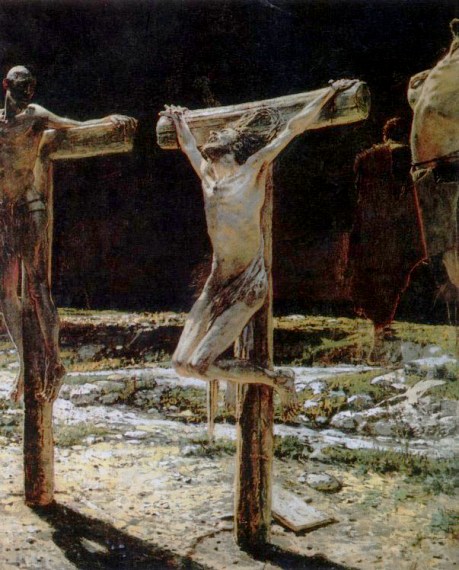
Nikolai Ge Crucifixion

Nikolai Ge Crucifixion

Lent 4 – 2015

John 3:14-21

Marian Free

 God of contradiction, open our hearts and minds to understand that your ways are not our ways and your thoughts are not our thoughts. Amen.

The crucifixion of Jesus has been portrayed in a wide variety of ways from the pious and sentimental to the violent and grotesque. Many are confronting (if for different reasons). For example I feel some disquiet when I see an image of Jesus fully dressed (in Bishop’s regalia) and exhibiting no signs of pain. Equally confronting is one from South America that depicts what looks like a charred body arched in pain and screaming in agony. For centuries the crucified Jesus was depicted as white (often blond). During the twentieth century new and original images emerged that more accurately reflected Jesus as a representative of all humanity – or example a Jesus with Chinese, Maori or African features. Sidney Nolan portrayed Jesus as a woman as did the artist whose sculpture was placed in a United Church in Toronto. Such imagery enables women and those whose skin colour is not white to fully grasp the notion that Jesus died for all people – including them – and not just for white (middle class) males.

New and confronting images of the crucifixion can help to make real the horror of the crucifixion. They can enable us to peel back the layers of piety that have, over the centuries, stripped the cross of its meaning. Our churches have crosses in all kinds of shapes and designs. There are wooden crosses, brass crosses, crosses made of silver or gold and crosses that are encrusted with jewels. Crosses in a number of different designs are worn as jewellery – even by those who do not profess the Christian faith. In many cases, the image of cross even when it is adorned with a crucified Christ has become so familiar that it has lost its power to confront and to challenge.

That said, I’m not at all sure that we would wish to be confronted with the horror of the crucifixion on a daily basis. We are told that crucifixion was an awful way in which to die. Whether a person was nailed or tied to a cross, they died slowly and of suffocation – pushing down on their nailed (or bound) feet so that they could take a breath[1]. It could take as long as three days to die. Crucifixion was also a very public death. Those who were condemned to die were generally put to death by the side of a well-travelled road so that their deaths could serve as an example to as many people as possible. It was a cruel, inhumane and humiliating way in which to die and, one would think, the most unlikely image to become an object of veneration.

This contradiction – that an image of torture and death could become a symbol representative of life and hope – is captured by the author of John’s gospel. In 3:14-15 Jesus says: “the Son of Man must be lifted up so that whomever believes in him will have eternal life.” In this passage and other places in which Jesus uses the expression “lifted up”, he is referring to his crucifixion. (“And I, when I am lifted up from the earth will draw all people to myself.” (12:32)) For the author of John’s gospel the cross, the crucifixion is the high point of Jesus’ ministry, the moment towards which the whole gospel is moving and the point at which it Jesus’ mission reaches not only its climax, but its fulfillment. The cross is a victory, not a defeat.

Lindars points out that Jesus’ victory on the cross is at least two-fold[2]. By laying dow his life for others, Jesus is demonstrating not only his deep love, but what is really God’s love for the world. In freely offering this gift, Jesus shows his readiness to do as the Father wills and demonstrates that he and the Father are one. Lindars refers to this as his “moral union with God”.

By overcoming the natural human resistance to pain and death and by conquering the human will to live, Jesus shows that human nature’s propensity to resist God and goodness can in fact be overcome and that humanity does not have to submit to selfish desires or to the propensity to gratify one’s own needs and desires before all else. Through his submission to the cross Jesus, Lindars suggests, wins the “supreme moral victory” (which is also a cosmic victory for “in his own person the devil’s grip on humanity is broken” (12:31)).

“Lifting up” in John’s gospel several layers of meaning. It can refer to the cross as the place of victory but it also suggestive of Jesus’ exaltation to the right hand of the Father. At the same time, because as we have seen, crucifixion was a very public event and because the cross lifted the victim above the level of the crowds the condemned men were very visible to those who gathered and to those who passed by. On the cross, Jesus is visibly and publicly displayed for all to see. Thank goodness we do not have to witness the physical event, but through the images that are available and those in our mind’s eye, we see Jesus’ lifted up and through John’s gospel comprehend that in this instance defeat is in fact victory, that death is a door to life and that even the worst of human excesses can be overcome.

We come to understand that on the cross, Jesus bore all the suffering of the world, experienced the baseness and cruelty of humankind at its worst and identified with the victims of cruelty and torture, the victims of domestic violence and bullying, the victims of oppression and injustice and all who have suffered at the hands of others. Those who have experienced unbearable pain and suffering can look at the cross and know that God shared/shares their pain. This understanding is best captured by a poem written by a woman who had experienced abuse at the hands of a man. The poem is written in response to a cruciform image of a woman that was hung below a cross in a United Church Chapel in Toronto.

May we all see in Jesus “lifted up” the victory of the cross, Jesus union with the Father, the triumph over evil and the possibility of resurrection.

By his wounds you have been healed

1 Peter 2:24


O God,

through the image of a woman

crucified on the cross

I understand at last.


For over hold my life

I have been ashamed

of the scars I bear.

These scars tell an ugly story,

a common story,

about a girl who is the victim

when a man acts out his fantasies.


In the warmth, peace and sunlight of your presence

I was able to uncurl my tightly clenched fists.

for the first time

I felt your suffering presence with me

in that event.

I have known you as a vulnerable baby,

as a brother and as a father.

Now I know you as a woman.

You we’re there with me as the violated girl

caught in helpless suffering.


The chains of shame and fear

no longer bind my heart and body.

A slow fire of compassion and forgiveness

is kindled.

my tears fall now

for man as well as woman.


You, God,

can make our violated bodies

vessels of love and comfort

to such a desperate man.

I am honored

to carry this womanly power

within my body and soul.


You were not ashamed of your wounds.

You showed them to Thomas

as marks of your ordeal and death.

I will no longer hide these wounds of mine.

I will bear them gracefully.

They tell a resurrection story.


Anonymous. Written after seeing a figure of a woman, arms outstretched as if crucified, hung below the cross in the Chapel of the Bloor St United Church in Toronto. The statue is now in a courtyard of Emmanuel United College in Toronto.[3]


[1] A Google search of images of the crucifixion provides some sketches which demonstrate what crucifixion was like.

[2] Lindars, Barnabas, SSF in The Johannine Literature. Ed Lindars, Barnabas, Edwards, Ruth B. and Court, John. Sheffield: Sheffield Academic Press, 2000, 91-93.

[3] The poem is anonymous. I read it in a Newsletter published by The World Council of Churches in 1988 as a part of the Ecumenical Decade of Churches in Solidarity with Women (1988-1998).