Posts Tagged ‘Advent’

The God-child, the child-God

December 22, 2012
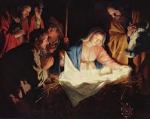
Baby Jesus

Baby Jesus

Advent 4

Hebrews 10:5-10

Marian Free


In the name of God, who as Jesus, became fully human in order to fully redeem human beings. Amen.

There is a television programme which I do not watch, but which I have caught glimpses of in advertisements. It is called something like: Our embarrassing bodies. From what I can glean from the promotions it is about ghastly and disfiguring afflictions and, I presume, it is about ways to deal with them. It is a reminder that the human body is a fascinating and complex organism and it has many parts, functions and characteristics that we tend to consider unspeakable, embarrassing and even disgusting.

Somehow, it is much easier to believe that baby Jesus is a real baby than it is to accept that the adult Jesus was flesh and blood like us.  It is difficult to accept that God could really inhabit a human body, to believe that Jess really did experience all the bodily functions. It would be more palatable to imagine that Jesus, even as a human being somehow occupied a different plane form the rest of us, that somehow his humanity was tempered by a body that didn’t behave in the same way as ours – that Jesus had no primal urges, that he didn’t sweat or burp or do anything that might be considered improper or unbecoming.

The problem of Jesus’ humanity is not a new one. The early church was torn apart by controversy regarding the nature of Jesus. There were some who thought Jesus was just a supremely virtuous person whom God adopted as the “Son of God”. Others believed that Jesus remained God even though he appeared to be human. Still others thought that it was only when he was resurrected from the dead that the human Jesus became God.

In the fourth century matters were brought to a head by a popular preacher from Libya called Arius who denied the divinity of Christ. His ideas were so compelling that they convinced many of the bishops of the time. The Emperor, Constantine was so dismayed by the disunity in the church that he called the Council of Nicea and demanded that the bishops come to some agreement as to what Christians believed. The result was the declaration expressed in the Nicean Creed that:“ We believe in one Lord, Jesus Christ, eternally begotten of the Father, God from God, light from light, true God from true God, begotten, not made, of one being with the Father through him all things were made … he was incarnate of the Holy Spirit and the Virgin Mary and became truly human”.

Jesus’ fleshly nature was already an essential component of New Testament theology – it was not an invention of the Council of Nicea. Writers as different as the apostle Paul, the writer of the gospel of John and the author of the book of Hebrews all attest to an early belief that Jesus truly inhabited human flesh, just as he was truly God on earth.

That Jesus was fully human, that he did really take on human flesh is important for a number of reasons which are different but complementary.

It was only as a human being that Jesus could work salvation for humankind. The obedience of the human Jesus’ was the only way to undo Adam’s disobedience. In the flesh, Jesus was able to redeem the flesh. By taking on human form, Jesus demonstrated that it is possible for human beings to be all that God created us to be. If Jesus as fully human can submit to God, we know it is not our flesh that prevents us from being obedient, but what we choose to do with it. Jesus’ humanity reminds us that, despite all the evidence to the contrary, human beings, inhabiting human flesh can be truly godly.

The fact that Jesus became fully human means that Jesus redeemed human flesh with all its weaknesses, its urges and its passions. Jesus’ humanity is evidence that our whole person is redeemed not just that part of us which might consider untainted and sinless. Our whole person is redeemed not just a part of it. Jesus’ being fully human demonstrates that God values our physicality as well as our divinity.

Jesus’ becoming human confirms that we cannot pay God off or placate God with sacrifices. God wants us – heart, soul and body not our deeds or our gifts. Jesus as a human being gave his whole self and showed that we should give nothing less.

As we come to the end of Advent and enter into the season of Christmas, we come face to face with the child in the manger. It is not difficult to identify the baby Jesus as a real baby.  The challenge that faces us year after year is to accept that the real child in the cradle grows into a real human being – a human being with longings and desires, weaknesses and strengths, just like us.

As Jesus became one with us, so we should strive to become one with him, and through him become agents of redemption in the world.


Being aware – looking inwards

December 15, 2012

Advent 3

Luke 3:7-18

Marian Free

In the name of God whose unconditional love challenges us to accept ourselves for who we are so that we may seek to be made whole. Amen.

 You will have gathered by now that I am a great fan of the writings of C.S. Lewis. Unfortunately, while his ideas are sometimes quite simple, his writing is complex and it is not always easy to re-frame his thoughts in a way that accurately captures what he is trying to say. Lewis was a late comer to Christianity and he used his great intellect to write not only books on theology, but also children’s books, as in the Narnia series, science fiction and imaginative theology. One of my favourites in the latter category is a light-hearted but deadly serious look at sin. The book is called The Screwtape Letters[1] and it takes the form of a number of letters written by a senior devil to a much younger devil who is just starting out. The ultimate goal of these devils is to weaken a believer’s connection to God while at the same time convincing them that their faith and their practice of that faith is just as strong as it ever was.

Among other things, one of the achievements of the book is to illustrate how difficult it can be for human beings to adequately identify sin. In particular it demonstrates how often and how easy it is for us to convince ourselves that what we are doing is selfless, humble and abstemious when in fact we are being selfish, proud and greedy. Screwtape (the senior devil) urges his nephew Wormwood to exploit these weaknesses – to encourage the believer to pursue those things that make him or her feel virtuous but which in fact increase the distance between themselves and God. He uses an example of a person who thinks that his or her modest diet is evidence of their economy and self-control when in reality their apparent virtue lapses easily into an obsession with food and into attention seeking behaviour. “No, no, I couldn’t eat all that, just bring me a dry biscuit.”

Screwtape also encourages Wormwood to make use of those supposed virtues which, if engaged in simply for the sake of being virtuous, tend to lead to bitterness and resentment – the exact opposite of their intention. For example, he suggests that Wormwood take advantage of what he calls the petty altruisms – the affected unselfishness which hides a person’s true needs and feelings and which creates, instead of satisfaction, feelings of resentment and a sense of being unappreciated.

In today’s gospel, those who come out to John the Baptist ask the direct question in response to his challenge that they repent. “What then shall we do?” they ask. His answer is very specific. True to the Lukan communitarian values John’s answer to the crowds is that they should share what they have with those who have nothing. Tax collectors and soldiers are singled out for even more specific advice which relates to their professions. That is well and good, but for twenty-first century listeners these suggestions are not entirely helpful and the very specific nature of the advice does not allow us to generalize it to our own situation. The advice only allows us to deal with a very narrow band of sinful actions and provides only a limited number of ideas as to how to behave well.

Jesus’ attacks on the Pharisees later in the gospel make it clear that simple, rule-bound behaviour is not sufficient for entry into the Kingdom of God. He is adamant that the state of a person’s heart is just as important – if not more so – than external behaviour. The behaviours and attitudes of the Pharisees as described by the Gospels demonstrate that it is relatively easy to deal with the surface sins, to paper over deeper issues such as insincerity and a need for recognition with an outward appearance of virtue, selflessness and goodness. An example of a conflict between external behaviour and internal insufficiency can be seen in the apparent selflessness of a parent or spouse which is in fact a way of feeding their own need to be needed. Instead of helping their partner or child, such a person may be fostering the other’s dependence on themselves and, as a result, making themselves feel useful and virtuous at the expense of the other. Their own low self-esteem and deeper need for affirmation is hidden beneath a veneer of self-sacrifice which in turn becomes a burden not a relief for the person whom they claim to be assisting. To quote C.S. Lewis: “She’s the sort of woman who lives for others – you can tell the others by their hunted expression.”

Again the Gospel description of the Pharisees is evidence that religion and its practice may be another way of hiding one’s inner faults and failings with a veneer of religiosity. Asceticism, fasting, and other spiritual practices may serve not to build holiness but to disguise a spiritual emptiness. Instead of modelling a deep and meaningful relationship with God, such people can seriously damage the vulnerable seekers who come to them for guidance.

Sometimes the obvious sin is not the real problem. The real sin is not what can be seen but an underlying condition which needs to be healed and addressed before the surface behaviour can properly go away. For example the outward sin of bullying may be driven by an inward urge to be recognized and valued by others. The outward sin of greed may cover up a feeling of emptiness and reveal a belief that possessions will fill the void. The outward sin of arrogance may compensate for a deep sense of unworthiness. A person who feels that they are of little value may go to a great deal of trouble to convince others and therefore themselves that they are of some importance. If only the outward expression of such sins is managed, then the inward issues may fester and grow and be expressed in some other equally damaging or unhealthy way.

All of this should go to show that sinning is a much more complex issue than simply breaking one of the Ten Commandments, or practicing any one of the seven deadly sins. The problem with simply following rules, is that it allows us to feel OK and doesn’t force us to examine our ulterior motives, to question whether or not our behaviour assists or damages others or to face our own inner demons, insecurities and needs.

During Advent we are challenged to be awake and alert, to prepare ourselves for the coming of Jesus. In this time of reflection and preparation let us have the courage to be awake and alert to our inner selves, to have the nerve to examine not only our outward appearance but to look deep inside to see what drives us and our behaviour, to ask if our selflessness is really selfishness, if our abstemiousness covers up our greed and if our attempts to serve others lead to resentment rather than to satisfaction. To ask, in other words, what specific advice would John the Baptist offer us, were we to find ourselves in his presence.


[1] Lewis, C.S. The Screwtape Letters.

(There are a number of internet sites which offer a free PDF version of the book.)

Shepherding God’s people

April 28, 2012

Easter 4 2012 (Good Shepherd Sunday)

Benjamin Glennie
Marian Free

In the name of God who calls us to serve and to shepherd God’s people and the world beyond the church. Amen.

The history of the church in the colonies must be full of stories of heroism, vision, steadfastness and good humour. Clergy from a vastly different climate and landscape faced isolation and indifference, they had to travel vast distances in a largely unpopulated and sometimes unforgiving country and minister in situations that were quite different from the English Parish Church. A pioneering priest in this Diocese, Benjamin Glennie faced all these challenges with courage, determination and humour. I imagine that many of you are familiar with the Glennie School in Toowoomba, but I wonder how many of you know much of this tenacious man whose anniversary of death falls on April 30 and whose 200th anniversary of birth falls this year.

Benjamin Glennie was born in 1812, in Dulwich in Surrey, England, the twelfth son of William Glennie a school principal. On leaving school, Glennie spent time as a tutor in Europe before, at thirty, entering Christ’s College Cambridge. By this time three of his brothers had migrated to New South Wales – one a landowner, another a doctor and the third a farmer who was later ordained. Glennie himself came to Australia in 1848 with the first bishop of Newcastle, Dr William Tyrrell. Bishop Tyrrell brought with him several young men who were to be ordained and he took advantage of the long voyage to prepare them for ordination.

After their arrival in Newcastle, the only priest in the settlement of Moreton Bay drowned. As a result, Glennie was urgently ordained and sent to replace him. This was only three months after he had arrived in Australia and before he had had any experience in the ordained ministry. When he arrived in Brisbane he was taken to Newstead House to stay with the Governor. The very next day he conducted morning and evening services. Almost immediately, at the Governor’s insistence, he bought a black horse “Jim Crow” which was to be his companion for the next 20 years.

Glennie must have been shocked by his new home. Moreton Bay only opened to free settlers in 1842. It was isolated from the rest of the colony and sparsely populated. There was no church building so services were held in a converted carpenter’s shop on North Quay. This prompted Glennie to begin a fund for the building of what became St John’s.

Like his predecessor, Glennie was the only priest to minister the whole of Moreton Bay which included Ipswich and the Downs. He held services at St John’s church and also established day and Sunday schools in Brisbane. He visited Ipswich once a month and toured the Downs. Glennie was ordained a priest in 1849 and from 1850-1860 (another priest being available) he was made responsible for all of the Downs meaning that he had the oversight of all Anglicans west of Toowoomba! It must have been a daunting task. Each year Glennie (who did not have a strong constitution) covered a distance of nearly 5,000 kilometres and as he did so he established congregations and bought property suitable for the building of churches or schools.

Glennie disliked riding, but in that era, it was the only means of transport available to enable him get around his vast Archdeaconry. At the same time, there were few roads and those that existed often reduced to tracks through the scrub. This meant that, even if the church could afford one, a gig would have been of little use. It is reported that on many occasions, Glennie could be seen walking from place to place with the laden horse walking along beside him. Riding was not his only trial. In the days before telephones – let alone the internet – communication was slow or non existent. On one occasion Glennie wrote in his diary – “Drayton very wet, no one came to church: The Swamp very wet and no one came to church.” Another time he wrote: “Wet day, no person came to church and I did not go to Toowoomba.”

Among the other hardships were locusts, flies, intolerable heat, fleas and the vast distances with no homestead in which to seek shelter for the night. At times he was forced to sleep in a shepherd’s hut which he records was: “a place miserable in the extreme. The natural earth formed the floor and was quite wet.” Loneliness was another problem and he writes that he was “sadly isolated from my brethren of the clergy”.

A testimony to his drive and hard work are the four churches which he built in the four major centres: Drayton, Warwick ,Toowoomba and Dalby – named for the evangelists – Matthew, Mark, Luke and John respectively . A considerable amount of the funds for these projects came from Glennie himself. That he used money from his own pocket is revealed in a letter written to the Bishop after St Luke’s was built. “ St Luke’s building paid for, but in debt to me of 20 pounds.”

That said, he did not release the congregations of their obligation to support him. At one time, when the Parish of Warwick were behind in paying his stipend, his curate wrote: ” he had an extraordinary suit of clothes – blue frock coat, high collar and sleeves rubbed at the elbows, a pair of short grey trousers which displayed a good deal of white sock and an old cabbage tree hat. Whenever his stipend was in arrears he donned this suit and continued to wear it until the reason for doing so no longer existed.”

One of Glennie’s passions was education – not only for boys but also for girls and to this end whenever he built a church it was expected that during the week it would be used as a school. Glennie also established the “Schools Endowment Fund” to which again he contributed from his own funds, some of which came from the sale of fruit and vegetables grown in Rectory gardens. In 1882 Glennie transferred to the Diocese the sum of £1627 and in 1900 the Synod voted that schools for girls and boys be established in his memory. (By that time the Toowoomba Preparatory School had been founded, so only a school for girls was needed.)

In 1863 Glennie was appointed as the Archdeacon of the Downs. Glennie’s last appointment was to the Parish of Toowong where he built his fifth and final church. He is buried in the Toowong Cemetery and his grave can be visited there.

In 1919, a writer in the Toowoomba Chronicle said of him “The little children ran to welcome with outstretched hands and eager joy in their faces, for to them he truly was the Good Shepherd. ” On this Good Shepherd Sunday, it is fitting that we remember Benjamin Glennie and give thanks to God for his passion for the Gospel, his dedication to the Church and his love for the people. May we, remembering the stature of those whose shoulders we stand on, continue to support and build the church, preach the Gospel and show God’s love to all.