Posts Tagged ‘Anna’

Seeing what is in front of us

February 1, 2020

Feast of the Presentation – 2020

Luke 2:22-40

Marian Free

May I speak in the name of God, Earth-maker, Pain-bearer, Life-giver. Amen.

Sacramental worship in first century Palestine was a very different proposition from that in Brisbane today. Whereas we are used to celebrating Holy Communion every week in our Parish Churches, the Hebrews might, if they were able, attend the Temple for major feast days or to observe specific rituals that could only be carried out in the Temple. Passover seems to have been a must for most Israelites, but it is possible that not everyone was able to make these pilgrimages on a yearly basis.

It is difficult to know how many towns or villages had synagogues, but from the biblical evidence that Jesus taught in their synagogues and that the early believers came together every week, we can assume that it was the practice (of the men at least) to gather weekly to read from scripture, say or sing the Psalms and to expound on the biblical text. But as there was only one Temple, anything that required the services of a priest took place there, in Jerusalem.

In setting the scene for his gospel, the author of Luke is careful to establish Jesus’ Jewish credentials. This seems strange for a person who was writing for a Gentile audience, but the Roman Empire was suspicious of anything novel, in particular of different belief systems which they regarded as superstitions and as a threat to the Empire. Judaism was accepted and even respected by the Romans because of its long, established history. By making it clear that Jesus was a member of this ancient faith Luke establishes the credibility (and the heritage) of what, to many, appeared to be a new religion.

Luke builds up the picture of Jesus’ Jewish credentials in a number of ways. The parents of John the Baptist (Jesus’ cousin) are described as coming from ancient priestly families and Zechariah is in the Temple offering the sacrifice when an angel announces John’s conception. Mary and Joseph fulfil the obligation under the law to circumcise Jesus on the eighth day. Forty days after Jesus’ birth they make the long journey to Jerusalem to offer a sacrifice to redeem their first-born son and to undergo the rite of purification. Later, when Jesus is twelve years old, the family will return to Jerusalem for the Passover Festival. Five times in today’s the author refers to the law, the basis of the relationship between God and God’s people and Luke’s gospel both begins and ends in the Temple – the centre of the Jewish faith. In other words, the Gentile readers of this account of Jesus’ life (in particular Theophilus) are left in no doubt that this emerging faith has its roots firmly based in Judaism and is in fact nothing new but a continuation of that ancient religion.

In describing the presentation of Jesus in the Temple Luke moves the story forward. He suggests that the time of the prophets has ended. What God has promised to Israel has come to pass. Led by the Spirit, Simeon recognises the child as the Lord’s anointed – the one who will be the instrument of God’s salvation – a light to the Gentiles and the glory of God’s people Israel. Without labouring the point, Luke establishes that God has acted in the world and that going forward, Gentiles as well as Jews will be included in God’s acts of salvation.

Luke has established that this apparently ‘new’ faith has an age-old history. Now he makes it clear that, with the birth of Jesus, the faith is moving from one era into another. It is a continuation of the old while at the same time it is leaving the past behind and forging a new path. John the Baptist provided the bridge between the past and the present. From now on the focus will be on Jesus and God’s actions in the world through him. All this, the reader is led to believe, is completely in accord with God’s plan.

Luke moves the story forward in another way as well. Simeon’s words to Mary give us a foretaste of what it to come. Jesus’ presence will not be welcomed by all. His teachings and actions will be a source of division. People’s reaction to him will reveal where they stand in relation to what God is doing in the world and a once unified faith will be divided to the point of separation.

When I read this account, what strikes me is the wisdom, openness and spirituality of Simeon and Anna and their very different responses to Jesus. Both are near the end of their lives and seem to have led lives of prayer such that their connection to God is strong and their awareness of God’s presence in their lives is real and powerful. Mary and Joseph would have been little different from other parents visiting the Temple that day, that week or that year. They were poor (as is indicated by the sacrifice of a dove not a lamb) and had travelled from an insignificant village in the Gentile region of Galilee.  Yet Simeon, guided by the Spirit, comes into the Temple at the very moment that they do and recognises in Jesus the child whom God had promised he would see. Simeon’s reaction is to take the child and give thanks. Anna appears to be already in the Temple and has presumably seen or heard something. She wastes no time with the child and his parents but exuberantly praises God and announces the presence of the child to everyone who is ‘looking for the redemption of Jerusalem’.

As their lives come to a close, Anna and Simeon demonstrate a depth of faith that enables them to sense what God is up to and to recognise God’s presence in the world. They display an openness to the possibility that God might do the unexpected and they reveal their confidence that God will do what God has promised. May we too live such lives of faith and faithfulness that our relationship with God will make us aware of God’s presence in our lives and in the lives of others and may we live in expectation that God will act in the world.
Standing with our feet in two worlds

February 4, 2017

Candlemas – 2017

Luke 2:22-40

Marian Free

Candlemas

         Candlemas

Loving God, light in our darkness; give us the courage to allow your light to reveal the darkness in our lives. Amen.

Today we celebrate the feast of the Presentation of Jesus in the Temple – an event in Jesus’ life that is recorded only by Luke. As early as the fourth century, the Church Fathers considered that this was an event of such significance that it needed its own feast day. At that time, the Presentation was marked on the fourteenth of February – 40 days after the feast of the Nativity on the 6th of January. Four hundred years later, sometime after the celebration of Christmas had been moved back to December 25, the feast of the Presentation was moved to February 2 where it remains to this day.

It appears that around that time, in the 700s, influences from the pagan festival of Imbolc began to creep in to the Christian celebration. Imbolc is the word for ewe’s milk in old Irish. In Northern Europe Imbolc marked the midpoint between the winter solstice and the spring equinox. In a world in which winters were dark and bleak, the lengthening of days and the first signs of spring growth were a cause for celebration. They were proof yet again that the darkness had not triumphed over light and that the earth would once again bring forth life and growth. It was a time of promise and possibility. White candles were lit as a symbol of purifying fire and of the rays of the sun.

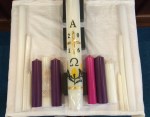
Imbolc took place at the same time as the feast of the Presentation – on February 1st or 2nd. It appears that the church absorbed the practice of lighting candles into its own practice. The liturgy incorporated a procession of candles followed by a blessing of the candles for use that year hence the alternate name for the feast – Candlemas.

Just as Imbolc marked a mid-point in the astronomic calendar, in the Christian practice, Candlemas signified a movement away from the wonder and joy of Christmas and Epiphany and a movement closer to the sobriety of Lent and thus to the shadow of the cross. The changing seasons and longer days encouraged spring cleaning and the preparation of the ground for sowing and in the church Candlemass signified a movement away from festivity and feasting towards self-reflection and fasting.

Today’s gospel clearly depicts the tensions of being caught between celebration and solemnity, joy and apprehension, between Christmas and Good Friday. When Mary and Joseph brought Jesus to the Temple, Simeon’s gratitude and relief was matched by Anna’s exuberance and excitement as they both responded in their own ways to the encounter with their long-awaited Saviour. The joy of the meeting was tempered by Simeon’s warning and sense of foreboding as he says to Mary: “This child is destined for the falling and the rising of many in Israel, and to be a sign that will be opposed so that the inner thoughts of many will be revealed—and a sword will pierce your own soul too.”

Simeon might have identified Jesus as the one who was promised as “light to the gentiles and the glory of God’s people Israel” but at the same time he cautioned that God’s promised salvation is not without cost.

Light, you see, is a mixed blessing. Light is threatening and benign, welcome and unwelcome. Light lifts the burden of darkness and enables us to see clearly. It allows us to walk without stumbling, but it has the potential to expose the dark corners and secret places of our lives – the cobwebs and dust that have built up over a long winter of neglect, the self-deception and arrogance that have been allowed to hide in the shadows, the inner thoughts that we would prefer to keep to ourselves.

When Simeon announced that Jesus was “the light to the Gentiles” he was fully aware that not everyone would welcome his presence among them. There would be many who would prefer to remain in the shadows rather than have their shallowness exposed and their self-deception revealed. He predicted that they would resent, resist and even oppose Jesus whose very presence would show them up for the charlatans that they were. The light of Jesus’ goodness and love would be greeted with delight by those who, like Simeon have looked forward to a time when God’s presence will be more fully known and who would feel the warmth and glow of that presence in Jesus. That same love and goodness, would serve to reveal the complacency, self-satisfaction and blindness of those who thought that neither the world nor themselves needed changing and who experienced the light as a scorching flame and a glaring beam that must be extinguished so that their lives could remain the same and their falsehoods unchallenged.

For those who recognise that the world lies in darkness, light is a welcome relief, but that same light is perceived dangerous and threatening by those who recognise that the light will shake and shatter their place in the world.

Today, as we celebrate Candlemas and the Presentation of Jesus in the Temple, we stand as it were with our feet in both worlds – between Jesus’ birth and the cross, between joy and sorrow, between the darkness and the light. As we follow the church calendar from Epiphany to Lent, we have time to consider whether we will allow our darkness to be exposed to the light or whether, content with the way things are and unwilling to accept that different could be better, we will turn our backs on the promise of change and renewal and consign ourselves to the shadows.

Open to God’s future

December 27, 2014

Christmas 1 – 2014

Luke 1:21-40

Marian Free

In the name of God who is beyond all we can conceive or imagine. Amen.

It is not unusual for parents to keep records of their children’s birth, growth and development. At the very least, many will keep the band that identified their child in the hospital, the records of immunisations and the growth chart from routine visits to child health centres. Others go further and record in a book designed for the purpose, the date of the baby’s first smile, first tooth, first step, first word. If the child is the first born, there will be ample photos to accompany the time-line. Over time stories will be told and re-told about events in the child’s life or signs that foretold the sort of person the child would grow to be.

No such records exist for Jesus. If his parents had stories to tell, they are lost to us and if the gospel writers knew any such stories they considered them irrelevant to the account of Jesus’ life and ministry. Mark and John are singularly uninterested in any aspect of Jesus’ life before his public ministry. Matthew and Luke do record Jesus’ birth, but they do so in ways that serve their particular purpose and that make it difficult to tell truth from fiction.

Of all the gospel writers, it is only the author of Luke’s gospel who shows any interest at all in the events of Jesus’ childhood and even then, his interest serves to make a theological point rather than to create an accurate record. In the gospel of Luke, accounts of Jesus’ childhood firmly embed and ground him in the traditions of his faith – circumcised on the eighth day and redeemed by an offering of two turtledoves in the Temple. In this way, Luke establishes Jesus’ credibility and makes it clear that he indeed is the one expected by Israel – despite the fact that he will turn out to be very different from what had been expected.

Jesus’ status both as the one who fulfils the promise to Israel and the one who confounds all expectation is established by two unlikely figures – Simeon and Anna. Both are old and wise and, by all accounts, model Jews. Simeon we are told is righteous and devout and Anna has spent the better part of her life in prayer and fasting. Their presence in the Temple links them to the past, to the traditions of their people and to what God has done. Their recognition of the child Jesus points to the future and to what God is about to do.

Past and future are juxtaposed throughout this narrative – life and death, youth and age, old and new, law and Spirit. We, the readers, get the sense that the world is on the brink of something new. The past and all the traditions represented by the Temple are about to give way to something radically different and unexpected. The exclusivity of Israel is about to be shattered by the inclusion of the Gentiles and the law and all that it represented is about to give way to the precedence of the Holy Spirit.

Simeon can see that the much-anticipated salvation of Israel will cause disquiet among the people and that not all will welcome the child with as much joy and excitement as does Anna. His hymn and the prophecy that follow exemplify just how divisive this child of Mary and Joseph will be. “he is destined for the falling and the rising of many in Israel, and to be a sign that will be opposed so that the inner thoughts of many will be revealed.” Jesus’ life and ministry will shatter all preconceptions about a Saviour for Israel and his very presence will demand a response and expose the nature of a person’s relationship to and understanding of God.

Those who accept Jesus will demonstrate their openness to God and those who do not will reveal their self-absorption, their narrowness of heart and mind. There will be many who think that they know the law yet their very adherence to the law will result in their inability to recognise the one sent to fulfil the law. Jesus’ failure to conform to their expectations and their subsequent rejection of him, will disclose their narrow and limited understanding of the law and of God’s promises. Conversely there will be many – especially those on the fringes of the faith – who will recognise Jesus’ divinity and embrace his presence despite or perhaps because he challenges the established view and refuses to be bound by a limited view of what the Christ should be.

Simeon understands that nothing is at it seems and that everything will be turned upside down and thrown into apparent disarray. Only those who are truly open to God and to the presence of God’s Spirit within them, will, with Simeon and Anna welcome the Christ among them.

We are all creatures of habit. We become comfortable with what we know and suspicious of what we do not. Change can be unsettling and disquieting and it is tempting to resist it believing that the ways things are is the way that they should always be. This is as true for our relationship with God as it is with other aspects of our lives. We are sometimes guilty of making God conform to our own image of God, of assuming that because we worship God in one particular way that that is the only way to worship because, that because our faith is expressed in certain words and forms, that that is the only way that it can be expressed. It is easy to make the mistake of believing that the past was right and the future must be wrong. In our desire to retain our comfort levels we struggle to maintain the status quo and we become closed and cautious, unwilling to accept that things could be any different or better.

What makes Anna and Simeon distinct from those around them is that they are actively waiting for God’s intervention in the world, and they have not predetermined how that intervention will occur. Because their eyes and minds are open, they see Israel’s Saviour where others see an ordinary child of an equally ordinary family. They are not at all perturbed that God has entered the world in such an extraordinary fashion – just the opposite – they are joyful and filled with praise for God.

God cannot and will not be bound by the limits of our imagination. It remains for us to develop an attitude of anticipation and expectation such that will we recognise God’s presence in the world in the ordinary and extraordinary, the expected and the unexpected and that our thoughts – when they are exposed for all to see – will not be found wanting.

Eyes wide open

February 1, 2014

The Presentation of Christ in the Temple

Luke 2:22-40

Marian Free

In the name of God who opens our eyes to the wonders around us. Amen.

It sometimes seems that we live in a world of Botox, facelifts, diets and exercise programmes designed to delay aging. No one wants to grow old or to face the consequences of growing old. Youth and beauty are ideals that people want to hold onto forever. This is understandable of course. We would all like to retain our strength and vitality as long as possible and to avoid the gradual descent into dependence on others. Youth has more than good health to recommend it. Where would we be without the confidence, enthusiasm, vision and impetuousness of youth – the idealism that has yet to be dampened by the realities of the world.

This adoration of and hanging onto youth does however have a number of drawbacks the most significant of which is a failure to come face-to-face with mortality. Accepting that death is inevitable, however unpalatable that may be, has the effect of encouraging us to make the most of life. Knowing that our time is finite enables us to live more fully in the present, to accept life for what it is rather than living in constant denial and fear, focussed on putting off the inevitable rather than relaxing into the reality of our existence.

A desire to hold onto our youth may mean a failure to take on the responsibility of adulthood. We may find ourselves locked forever into a kind of teenage limbo-land, never moving forward, refusing to allow life to mould and shape us into wiser and stronger people.

In his book, Falling Upwards, Richard Rohr suggests that, spiritually speaking there are two stages of life. He makes the claim that in the first half of life we are egocentric focussed on ourselves and our own needs. At this stage of our spiritual life we are bound by external rules and regulations – only able to think in terms of black and white, right and wrong. In the second stage of our spiritual life we are able to see beyond ourselves and better able to understand that between black and white there are vast stretches of grey. Rohr argues that many people never grow beyond the first stage no matter what age they are in worldly terms. Many, he suggests, continue to put their own needs first and their ideas of right and wrong, good and evil continue to be determined by outside forces. They never manage to internalise the principles behind the rules that they learnt as a child. They are never so secure in themselves that they can let go of the need to be reassured.

Simeon and Anna are wonderful characters, and I think, examples of people in the second stage of their spiritual life. Both, in different ways, exhibit the wisdom of age, the confidence of knowing who they are, the freedom to trust in God and the willingness to see things in ways that differed from their expectations. Luke’s account is quite extraordinary. Mary and Joseph are doing something that is quite routine  – taking Jesus to the Temple in order to present him to God and make the appropriate offerings. Externally, there would have been nothing to distinguish them from the hundreds of other parents who came on a daily basis to do the very same thing. From the point of view of the average onlooker, Jesus is just another baby. Yet both Simeon and Anna recognise the infant Jesus as God’s anointed, the one who was to redeem Israel.

Unlike many others of their era, Anna and Simeon, being outward (God) focussed are not limited to one way of seeing. They expect God to send a Saviour, but they are open to God’s doing something unexpected. Neither of them is locked into one or other particular idea. They are not committed to a belief that God will send someone out of the ordinary – a king or a soldier – to lead the people to freedom. They are not taken aback by the fact that God has chosen to send a Redeemer in the form of a tiny infant – just the opposite. Their years of prayer have ensured that they are no longer self-absorbed, and they have no need for absolutes. With the wisdom of age, they know that things are not always what they seem. This is why they are able to see Jesus for who he is, even though he looks like an ordinary child of ordinary parents.

Simeon and Anna have the wisdom and patience of age. Anna has lived in the Temple for at least sixty years, Simeon seems to be aware that his end might be near.  They expect God to act, but know that God will act in God’s way and in God’s time.  Year after year, they have continued to wait and to pray, confident that God will act, content even though they do not know when.

That said, when they do see the child – God’s anointed – they demonstrate that age and wisdom have not dampened their youthful passions. They respond to the infant Jesus with all the impetuousness and enthusiasm of youth. Simeon sweeps the child away from his mother and Anna throws caution to the wind as she tells all and sundry about the child.

Anna and Simeon are among my favourite New Testament characters. They remind us that age is not something to be feared and denied but in the case of a life lived well age is liberating and ennobling – they no longer have to worry about what others might think of them and they have the wisdom and experience that can only be gained by being open to all that life has to offer. As Luke describes them, they are two people who have grown and matured in their faith to a point that their own egos and needs are unimportant, they have abandoned any need for certainty and security and have placed their trust completely in God. Lives of prayer have enabled them to allow the Holy Spirit to work through them, to make them, at the end of their lives prophets and messengers of God who announce the Saviour to the world and in so-doing have earned themselves a place in history.

Life is a progression from birth to death, certainty to uncertainty. If we hold on too tightly to youth, to security, if we try to avoid suffering and pain, we may never grow in faith and may never allow ourselves to be in-dwelt by the Holy Spirit. God will be more of an idea than a reality and we will miss the  wonders and revelations that God has in store for us.