Posts Tagged ‘being transformed’

Standing in solidarity

December 24, 2020

Christmas 

Children 

I wonder what you would do if you were God?

Some people would like to punish all the bad people in the world.

Some would like to stop the wars and cure all the disease.

We wonder why God doesn’t do these things.

God is full of surprises. God comes to earth as a tiny baby and lives alongside us.

God shares all our good times and all our bad times. God shows that God care for us and understands us.

God knows that this is how the world will change – not by waving a big stick and threatening to punish us, and not simply by making the bad things go away. God knows that if we change the world will change.

We will change the world if we learn from Jesus. If we learn to try to understand other people, if we are sad with them and happy with them. If we show other people that we care they will change and the world will change!

We need to let the baby Jesus be a part of our lives. Jesus will change us and we will then be able to change the world.

Christmas – 2020 Midnight

In the name of God who does not force us to conform to God’s will, but who enters our world in solidarity with us. Amen.

It might surprise you to know that I’m one of those people who thinks that they know how to solve the problems of the world – well now that I’m older I settle for slightly less ambitious goals. But I do still think I know better than some people. For example, there is a part of my brain that believes that Trump would not have won the election four years ago if only I had been able to share my brilliant insights with Clinton and her team. They would have stopped trying to confront irrational ideas and instead focused on the fears and anxieties that Trump was latching on to. Needless to say, I have no credentials to back up my ideas and no contacts in the US who could have passed them on! On a smaller and more local level, I feel that I have the solution for the new businesses in the street.  So, when I observe a new business owner sitting expectantly in an empty store or barber shop, I think to myself: if only they had had a grand opening and given everyone a free drink or if only they had offered the first ten customers a free haircut or shave. Of course, I’ve never run a business let alone started one from scratch, but believe you me, I think I know what would work. In fact, you wouldn’t believe how many amazing ideas I have to share with an unsuspecting world! 

I suspect that there are times for all of us when we imagine that we could do a better job – than government departments, than schoolteachers, than employers and corporations – maybe we even think we can do a better job than God.

We’ve all heard people say: “Why does God let that happen?” “Why does God allow corrupt governments to flourish?” “Why is there evil in the world?” A part of us expects an omnipotent God to break into the world brandishing a big stick and putting all to rights. When the world seems to be going awry, we long for an interventionist God who will impose God’s will and will bring an end to poverty, war and disease. 

But God does not conform to our expectations or behave as we might want. Instead of forcing God’s will on us, instead of dramatically and violently entering our world to punish the wicked and to put everything to rights, God surprises us by joining us in our struggles, by taking on human form and by showing us how it is really done, how change and transformation really happen – not by force, but through love, not by being over- bearing, or even by being right, but by being present with us and in us and living in solidarity with us through all our triumphs and all our failures.

We will not change others or the world through force, but we might just bring about change them by standing alongside others, coming to understand their struggles and their fears and by demonstrating compassion and understanding. 

It is only when we open ourselves, to the God who enters the world silently and unobtrusively, to the God who arrives among us in a cradle and who stands in solidarity with us, that our lives will be transformed and through us the whole world.
We can’t change the world, but we can change ourselves

April 30, 2016

Easter 6 – 2016

John 14:23-29

Marian Free


In the name of God who gives us that peace that the world cannot give, so that we might give peace to the world. Amen.

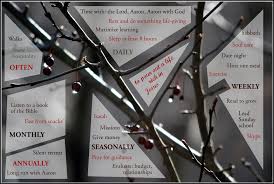
When I was confirmed my priest suggested that I, along with the other candidates, create a rule of life. It was his hope that, having been confirmed, we might all become people who took our spiritual growth seriously. The problem with this approach was that we were twelve years old. Many of the children in the group were being confirmed because it was the thing to do, rather than because they were making a commitment to the Christian faith. His idea was destined to fail, either through lack of interest or because it was an ambitious task to impose on children about to enter high school and their teenage years. I did take the idea seriously. I remember trying to accomplish what I set out to do and giving up early because I failed spectacularly. That said, it obviously made an impact on me, because I still remember writing the rule for myself.

A rule of life is a monastic principle and it involves making a commitment to a number of spiritual disciplines – prayer, bible reading, giving and so on. It is “an intentional pattern of spiritual disciplines that provides structure and direction for growth in holiness.[1]” The reason for taking on such a rule is that it helps us to work on and to dRule of Lifeevelop our relationship with God, to create a rhythm to our days that enables us to focus on the presence of God in and around us, to be nourished by the grace of God and to be transformed more closely to the image of God.

A Rule of Life then, is intended to be a help not a hindrance, a pleasure not a burden. Just as physical exercise improves our physical health, so spiritual exercises are designed to improve our spiritual and emotional health. We take on spiritual disciplines to ensure that we grow and develop spiritually. A rule of life therefore has to be tailored to the individual. What works for one person may not work for another, what one person needs will not be the same as what someone else needs. What is life-giving for one person, might be stultifying and limiting for another so it is important for each person to discern what might and might not suit them, what will assist growth as compared to something that over time will become an empty practice.

It is clear that the fact of being baptised does not in and of itself infuse us with holiness. Few of us from birth truly embody all the characteristics of divinity that were displayed in Jesus and that are, ideally, are required of us. It is too easy for most of us to get caught up in the distractions of the everyday, to be absorbed by our own needs and bound by our own fears. Surrendering our lives entirely to God, allowing our lives to be completely directed by the Holy Spirit, freeing ourselves to be transformed into the image of God takes practice and discipline. This is why we use expressions such as “practice”, “exercise” and “discipline” when we are talking about something as indefinable as spirituality.

Prayer, bible study and spiritual reading all draw us closer to God, but the ways in which we can become aware of the presence of God in our lives and allow ourselves to be transformed are many and various. They include silence, attention, gratitude, forgiveness, generosity, being present, being compassionate and developing an attitude of openness to God’s abundant love and goodness. Such practices are not always part of our daily life or of our nature. For this reason it is important to identify those aspects of our lives that we need to work on and then adopt a practice or a habit that enables us to change. We may find that we need to learn for example how to stop and listen or to find out how to forgive or how to show compassion. There is no magic formula. If we want to truly reflect the image of Christ to the world, we must discipline ourselves to become like Christ. Just as we practice to become a better cook, a more competent cyclist or a more knowledgeable doctor, so we must practice those things that make us a better, more competent, more knowledgeable Christian, so that our lives are transformed and that Jesus can known through us.

It is not all hard work – we do not develop a rule of life or take on spiritual exercises to mortify the body or repress our God-given human nature. Spiritual exercises include play and rest, an appreciation of beauty and moments of pure joy, time to build relationships and time to dream. Our practices have to be onerous or time-consuming. I have heard of someone who places a coin on a lintel in her home. Every time she passes through that door, she remembers to be thankful. Another makes the sign of the cross before he gets up each day as a simple reminder that he belongs to God. Whatever we chose to do, it is important that it is achievable. Starting small and building up is much more likely to succeed than being too ambitious then failing and giving up.

In today’s gospel we hear the familiar words of peace. Jesus bestowing on the disciples that peace that the world cannot give.

The peace that Jesus offers is not a peace that ends world strife, or family discord. It is a peace deep within that transcends whatever is going on around us, a peace that enables us to be calm in the midst of the storms of life, a peace that fills and surrounds us no matter what else is going on. Sadly there is far too little evidence of this peace in a church that continues to argue and posture on issues such as theology, the ordination of women and the marriage of homosexuals.

It is easy to despair, to wonder what we can do in the face of what sometime seem to be insurmountable odds. True, we can’t change the world or the church, but we can change ourselves – by adopting spiritual practices, by working on spiritual exercises and by disciplining ourselves to be constantly aware that it is what we do and what we say that determines how non-believers make up their minds about God.

[1] The CSLewis Institute – http://www.cslewisinstitute.org. Other websites provide information about a rule of life: http://www.northumbriacommunity.org, http://www.westcott.cam.ac.uk are a few. A physical example can be found at https://ruleoflife.com/2015/03/10/paul-clarks-rule-of-life/. Images for Rule of Life provides an interesting example of how different Rules of Life can be.