Posts Tagged ‘boats’

Try again

February 9, 2019

Epiphany 5 – 2019

Luke 5:1-11

Marian Free

In the name of God who challenges us to go our of our depths to see who, with the help of Jesus, we can be. Amen.
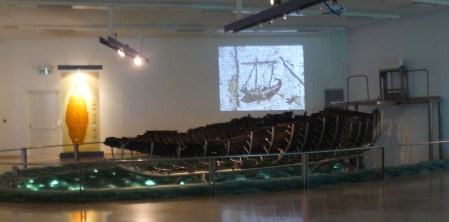
The most popular attraction in Israel is, perhaps surprisingly, a first century fishing boat. The boat in question was discovered by two brothers from Kibbutz Ginnosar who used to trawl the shore of the Sea of Galilee looking for artifacts. On one such occasion they discovered the outline of a boat. The story of raising and preserving the boat is fascinating and, thanks to the care taken with it’s restoration, we have an almost complete boat from the time of Jesus. It could hold up to fifteen men and their catch. The one located and preserved at Ginnosar had been repaired on many occasions during the course of its life and archeologists have identified a huge variety of timbers that, over time have been used to repair the boat. While the archeological significance of the discovery is immense and adds a great deal to our understanding of the craft of boat building in the first century, the discovery has the added weight of giving us a truer idea of the sort of vessel into which Jesus might have climbed in today’s gospel.

As with many of the accounts in our gospels, the story of the miraculous catch can be read in a variety of ways and on many different levels. We can notice the difference between this version of Peter’s call and that of the author of Mark, or we can compare the story with the post-resurrection catch of John’s gospel. Time could be spent comparing Peter’s reaction to Jesus with that of the prophets who, in the presence of the divine, recognize their limitations and frailties and protest their unworthiness. What did Jesus teach from the boat and what does it mean to ‘catch people alive’ we might wonder? Why does Peter address Jesus as ‘master’ before the catch and as ‘lord’ after the catch? And why does Luke use the language of ‘catching people alive’ (or enthralling them) when Matthew and Mark tell us that Jesus commissions the first disciples to ‘fish for people’.

These eleven verses, that on the surface recount the call of Peter, James and John, are filled with meanings and nuances that are both obvious and subtle. It could take hours for us to unpack the various complexities of the scene!

Today, I’d like to explore the possibility that the the story of the miraculous catch is a metaphor for our own time, that Jesus urges us to try again when we have lost hope and when feel that we have done all that we can.

We live in an age in which many of have grown weary of trying to win people for Christ and in which too often we fall into despair at the decline in church attendance and at our our inability to prevent the church’s slide into irrelevance. It is a time in which religion is often used to defend conservative values at the cost of compassion and to the detriment of the gospel message of love and in which the political and social landscape is undergoing great change. It is easy to be overwhelmed by the hopelessness of our situation and to simply give up.

Peter, James and John were, according to Luke, professional fishermen. They owned their boats and were in a business partnership. Almost certainly their fathers were fishermen before them and from an early age they would have understood the lake and the times at which the fish were most likely to be running. After an unfruitful night they would have been tired and frustrated and possibly anxious about the loss of revenue and in no mood to have another go. There would have been no reason for them to respond to a tradesman from Nazareth who knew nothing of the ways of fish or of the sea. Yet Jesus’ word is authoritative enough to persuade Peter to go back to the deep and to try one more time. He is rewarded with a catch so large that it begins to break the nets and Peter is forced to call for help.

The world of Peter was no more benign or settled than our own. Peter, James and John were not carefree fishermen, plying their trade and selling their catch. Rome overshadowed all their lives. The state would have demanded that they pay a tax or a levy for the right to fish and Rome’s representatives may have demanded a proportion of the catch. Life would have been difficult and the conditions oppressive and there would have been no reason to imagine that the situation was about to change. Tomorrow would be more of the same, but the certainty of their lives, hard as they were, would surely have more allure than the uncertainty of trusting in let alone following Jesus.

Jesus approached fishermen who were disillusioned and tired and he told them to try one more time. He ignored Peter’s protestations that he was a sinful man and without so much as a ‘by your leave’ he assured Peter that from now on he would hold people enthralled.

Many of us in the church are exhausted and disheartened. We feel that we have done all that we can to bring about growth in our congregations. We are conscious too, that collectively we are tainted by scandal, blemished by the compromises we have made and held in scorn because we have been unable to change and adapt.

When we feel that we have reached the limit of our reserves, Jesus comes to us, takes his place with us and says: ‘Try again. Take heart, go out once more into the midst of a world that is complex and hostile. Throw out your nets one more time. You will be amazed at what I can do with you – sinners that you are. Don’t be afraid, with me you will hold people enthralled.’

An Extraordinary story

February 9, 2013

Epiphany 5

Luke 5:1-10

Marian Free


In the name of God who calls us, imperfect though we are, to follow Jesus and to share the gospel with others. Amen.

Those among you whose enjoy puzzles will know the “Find the Difference” puzzles. Even those who do not enjoy puzzles may have had to find the difference between two pictures as part of their early schooling. If you don’t know what I’m talking about, the puzzle involves two almost identical pictures which are placed side by side. The observer is asked to find the differences. Usually, if there are say, ten differences, the first seven or so are relatively easy – the dog is black in picture (a) and white in picture (b), a cloud in picture (a) is missing in picture (b) and so on. However, the last couple of differences tend to be more subtle and are often overlooked. For example, the curtain in picture (a) has four pleats and in picture (b) it only has four.

It is a different exercise, but we can play “find the difference” using the gospels. Placing one or more gospel passages side by side allows us to note the different ways in which Jesus’ life and teaching is recorded by the different authors. For example, last week we noticed how differently Luke presents the account of Jesus in the synagogue and we made some educated guesses as to the reason for the differences. In his re-telling of the story, Luke is influenced by his social justice programme and his desire to demonstrate that the inclusion of the Gentiles was always part of God’s plan.

Having noted that Luke has a different agenda, it will therefore come as no surprise to note that Luke’s report of the call of Peter, Andrew, James and John is also quite different from that of Mark. This week we will have a look at the actual texts. (You might like to see how many differences you can spot.)

Mark 1:16-20 As Jesus passed along the Sea of Galilee, he saw Simon and his brother Andrew casting a net into the sea—for they were fishermen. And Jesus said to them, “Follow me and I will make you fish for people.” And immediately they left their nets and followed him. As he went a little farther, he saw James son of Zebedee and his brother John, who were in their boat mending the nets. Immediately he called them; and they left their father Zebedee in the boat with the hired men, and followed him.

Luke 5:1-10 Once while Jesus was standing beside the lake of Gennesaret, and the crowd was pressing in on him to hear the word of God, he saw two boats there at the shore of the lake; the fishermen had gone out of them and were washing their nets. He got into one of the boats, the one belonging to Simon, and asked him to put out a little way from the shore. Then he sat down and taught the crowds from the boat. When he had finished speaking, he said to Simon, “Put out into the deep water and let down your nets for a catch.” Simon answered, “Master, we have worked all night long but have caught nothing. Yet if you say so, I will let down the nets.” When they had done this, they caught so many fish that their nets were beginning to break. So they signalled their partners in the other boat to come and help them. And they came and filled both boats, so that they began to sink. But when Simon Peter saw it, he fell down at Jesus’ knees, saying, “Go away from me, Lord, for I am a sinful man!” For he and all who were with him were amazed at the catch of fish that they had taken; and so also were James and John, sons of Zebedee, who were partners with Simon. Then Jesus said to Simon, “Do not be afraid; from now on you will be catching people.”

In comparing the readings we note, as we might expect, that Luke has expanded and elaborated Mark’s account. Another obvious difference is that the sea is given a different name. In Mark, Jesus walks by the Sea of Galilee, in Luke, the crowds press in on Jesus at the lake of Gennesaret. In Mark Peter and Andrew are fishing from the shore, James and John are mending their nets. In Luke all four have left their boats and are washing their nets. Luke includes a miraculous haul of fish which is not in Mark and while Mark leaps straight into the call of the disciples, Luke precedes the account with a vast amount of material not considered necessary to Mark – the birth narrative and the genealogy.

Those are the obvious differences. A more subtle difference, but one which is important for our understanding of the Gospel of Luke is this: Peter now has a boat, he and Andrew are not standing on the shore casting their nets but are boat-owners. The comparison between the two families has been softened or obliterated. James and John are no longer set apart by the fact that their family owns a boat and has servants – both sets of brothers now have a boat. Finally, in Luke Peter’s response to the miracle of the fish is a significant addition, as is his designation for Jesus – “Lord”.

To understand the changes made by Luke it is important to understand something about him and why he is writing. For the purpose of today’s gospel, we need to note again to whom the gospel is addressed: “most excellent Theophilus”.  Luke’s re-telling is influenced in no small part by the person to whom he is telling the story. From his name and Luke’s form of address we suspect that Theophilus is a wealthy person of some status who lives a long way distant from the villages of Galilee. This means that Luke has to tell the story in such a way that it will not only make sense to Theophilus, but also in such a way that it will not offend him.

In order to do this, Luke makes some basic changes in the way he tells Mark’s account. He moves the gospel to the city, removes the poor, uneducated people and makes it clear from the very beginning not only that Peter is a leader in the church but that Jesus is “Lord” – a title used for a prominent person in the Empire. Luke changes Peter’s socio-economic status and his role in the early church is established. Peter recognises and names Jesus and Jesus is named in a way that would indicate Jesus’ significance to Theophilus. (A poor fisherman and an itinerant preacher may not have grabbed the attention of Theophilus, but he is able to recognise a boat owner and a “lord” as people worthy of his attention.)

Luke would have had no thought that by changing the way he told the story, he was changing the story. He would have thought that he was faithfully recounting the story of Jesus and the church, but that he was doing it in such a way as to ensure its reception not only by Theophilus, but also to the whole of the Roman Empire.

It is extraordinary to think that a man from a tiny village in a remote part of the Empire, who was executed as a trouble-maker, should have made such an impact that his story was told at all. It is even more extraordinary that four people thought it so important that the story be told that they told it in such a way that others would grasp its significance. And perhaps, most extraordinary of all, is that two thousand years later, we are still telling the story and are moved to faith by it.