Posts Tagged ‘call’

Try again

February 9, 2019

Epiphany 5 – 2019

Luke 5:1-11

Marian Free

In the name of God who challenges us to go our of our depths to see who, with the help of Jesus, we can be. Amen.
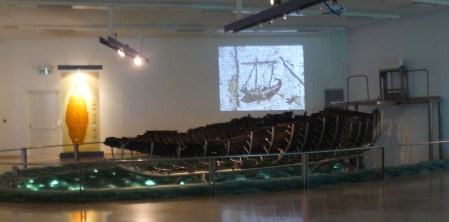
The most popular attraction in Israel is, perhaps surprisingly, a first century fishing boat. The boat in question was discovered by two brothers from Kibbutz Ginnosar who used to trawl the shore of the Sea of Galilee looking for artifacts. On one such occasion they discovered the outline of a boat. The story of raising and preserving the boat is fascinating and, thanks to the care taken with it’s restoration, we have an almost complete boat from the time of Jesus. It could hold up to fifteen men and their catch. The one located and preserved at Ginnosar had been repaired on many occasions during the course of its life and archeologists have identified a huge variety of timbers that, over time have been used to repair the boat. While the archeological significance of the discovery is immense and adds a great deal to our understanding of the craft of boat building in the first century, the discovery has the added weight of giving us a truer idea of the sort of vessel into which Jesus might have climbed in today’s gospel.

As with many of the accounts in our gospels, the story of the miraculous catch can be read in a variety of ways and on many different levels. We can notice the difference between this version of Peter’s call and that of the author of Mark, or we can compare the story with the post-resurrection catch of John’s gospel. Time could be spent comparing Peter’s reaction to Jesus with that of the prophets who, in the presence of the divine, recognize their limitations and frailties and protest their unworthiness. What did Jesus teach from the boat and what does it mean to ‘catch people alive’ we might wonder? Why does Peter address Jesus as ‘master’ before the catch and as ‘lord’ after the catch? And why does Luke use the language of ‘catching people alive’ (or enthralling them) when Matthew and Mark tell us that Jesus commissions the first disciples to ‘fish for people’.

These eleven verses, that on the surface recount the call of Peter, James and John, are filled with meanings and nuances that are both obvious and subtle. It could take hours for us to unpack the various complexities of the scene!

Today, I’d like to explore the possibility that the the story of the miraculous catch is a metaphor for our own time, that Jesus urges us to try again when we have lost hope and when feel that we have done all that we can.

We live in an age in which many of have grown weary of trying to win people for Christ and in which too often we fall into despair at the decline in church attendance and at our our inability to prevent the church’s slide into irrelevance. It is a time in which religion is often used to defend conservative values at the cost of compassion and to the detriment of the gospel message of love and in which the political and social landscape is undergoing great change. It is easy to be overwhelmed by the hopelessness of our situation and to simply give up.

Peter, James and John were, according to Luke, professional fishermen. They owned their boats and were in a business partnership. Almost certainly their fathers were fishermen before them and from an early age they would have understood the lake and the times at which the fish were most likely to be running. After an unfruitful night they would have been tired and frustrated and possibly anxious about the loss of revenue and in no mood to have another go. There would have been no reason for them to respond to a tradesman from Nazareth who knew nothing of the ways of fish or of the sea. Yet Jesus’ word is authoritative enough to persuade Peter to go back to the deep and to try one more time. He is rewarded with a catch so large that it begins to break the nets and Peter is forced to call for help.

The world of Peter was no more benign or settled than our own. Peter, James and John were not carefree fishermen, plying their trade and selling their catch. Rome overshadowed all their lives. The state would have demanded that they pay a tax or a levy for the right to fish and Rome’s representatives may have demanded a proportion of the catch. Life would have been difficult and the conditions oppressive and there would have been no reason to imagine that the situation was about to change. Tomorrow would be more of the same, but the certainty of their lives, hard as they were, would surely have more allure than the uncertainty of trusting in let alone following Jesus.

Jesus approached fishermen who were disillusioned and tired and he told them to try one more time. He ignored Peter’s protestations that he was a sinful man and without so much as a ‘by your leave’ he assured Peter that from now on he would hold people enthralled.

Many of us in the church are exhausted and disheartened. We feel that we have done all that we can to bring about growth in our congregations. We are conscious too, that collectively we are tainted by scandal, blemished by the compromises we have made and held in scorn because we have been unable to change and adapt.

When we feel that we have reached the limit of our reserves, Jesus comes to us, takes his place with us and says: ‘Try again. Take heart, go out once more into the midst of a world that is complex and hostile. Throw out your nets one more time. You will be amazed at what I can do with you – sinners that you are. Don’t be afraid, with me you will hold people enthralled.’

Don’t send me!

May 19, 2018

St Augustine – Pentecost, 2018

John 15:26-27

 When the Advocate comes, whom I will send to you from the Father, the Spirit of truth who comes from the Father, he will testify on my behalf.  You also are to testify because you have been with me from the beginning.

Marian Free

In the name of God who will empower and direct us and who has already gone before us into the world. Amen.

The English Historian the Venerable Bede has provided us with a history of the English church from about 100 BCE to 731 CE. Even though he himself did not travel he was able to get others to bring him relevant information and documents. Among these were the letters from Pope Gregory to Augustine that give us a reasonably comprehensive idea of Augustine’s mission and of the concerns that Augustine raised. Those of us who regularly worship at St Augustine’s are familiar with the story. Pope Gregory (the Great) was intrigued by some blonde slaves whom he saw in the market. On learning that they were Angles (he heard the words as angels) he determined to send someone to the British Isles to convert them.

To that end Augustine and several other Benedictine monks were commissioned with the task. On reaching England they received a welcome from the King of Kent Ethelbert whose wife was already a Christian. Ethelbert gave the monks land on which to build their church and allowed them liberty to preach the gospel in his kingdom. The site on which the church was built became Canterbury Cathedral, the center of the Anglican Communion to this day.

There are a number of interesting facets to the story but my favorite is this – after the team set out they got cold feet, to quote Bede: “Having undertaken this task in obedience to the Pope’s command and progressed a short distance on their journey, they became afraid, and began to consider returning home. For they were appalled at the idea of going to a barbarous, fierce, and pagan nation of whose very language they were ignorant. They unanimously agreed that this was the safest course, and sent back Augustine … that he might humbly request the holy Gregory to recall them from so dangerous, arduous and uncertain a journey.”[1]Gregory refused this request and so they continued.

Their anxiety is not uncommon among those called to serve God. Moses at first refused God’s call (even though God appears in a burning bush!). The reasons – he was certain that Pharaoh would not listen to him and that the Israelites would not believe that God had sent him. When these excuses did not dissuade God, Moses argued that he could not do the task because he was not eloquent enough[2]. Jeremiah likewise argued that he could not speak well and he added to that that he was only a boy.[3]Gideon made the point that his tribe was the weakest in Israel and when God insisted that Gideon wasthe one whom he had chosen, Gideon asked for a sign. When God gave him a sign, Gideon, still refusing to believe that God could use him, asked God to repeat the sign![4]Jonah’s reaction to God’s call was the most dramatic and the most selfish of all. Jonah was so reluctant to respond to God’s call that he ran away, presumably believing that he could escape God.  Worse, when he finally did what God had asked and God spared Nineveh, Jonah sat under a tree and sulked.

If we are anxious or lacking in confidence when it comes to sharing the gospel, we are in good company. However, that does not let us off the hook. In today’s gospel Jesus commissions us to testify on his behalf. Through our baptism we are all called and commissioned as disciples to be God’s presence in the world. And still we hesitate. The reasons for our hesitation may be as many and varied as those of us who are present. Like Jeremiah we might think that we are too young (or even too old). Like Moses and Jeremiah we might be afraid that we will be unable to find the right words to say or that people won’t believe what we do say. Like Gideon we might need to be convinced that God really canuse us. Like Jonah we might simply think that God can do it all on his own and that God doesn’t need us or, like Augustine and his fellow monks, we might be terrified of the reception that we imagine awaits us.

The worst fears of Augustine’s monks were not realised. The reality was quite different from that which they had expected. Instead of a hostile reception, they received a warm welcome and were given freedom to pursue their mission and the resources to establish themselves and their community. Their obedience to the call of God resulted in blessings far more than they could have imagined because God had not asked them to do the impossible. God had gone before them to prepare the way, remained with them as their help and support and empowered them with the Holy Spirit so that they could do what needed to be done.

Almost certainly, wewill not be called to lead a company of people out of slavery to the Promised Land. Wewill not be asked to lead an army in battle or to call an entire city to repentance. We won’t be asked to go to an unknown land to people whose language we do not know. All that we are asked to do is to testify to the risen Christ and to Christ’s presence in the world, to share with others the comfort, strength and assurance that we experience because Christ is present in our lives. We are to trust that the Holy Spirit will equip us for that task and to remember that God will not ask us to do more than we can do, nor will God send us out on a mission that has no chance of success.

The examples of Moses, Gideon, Jeremiah, Jonah and Augustine assure us that it doesn’t matter how old (or how young we are), how articulate we are, how wise and clever or how strong or brave we are. God can and will use us to make known God’s presence in the world.

[1]The Venerable Bede, Chapter 23.

[2]Exodus 3,4

[3]Jeremiah 1:4

[4]Read the story for yourself (Judges 6)

Ask not what God can do for you

June 25, 2016

Pentecost 6 – 2016

Luke 9:51-62

Marian Free


In the name of God who calls us out of our comfort zone and calls us to follow wherever we are led. Amen.

It is probably true to say that we all respond differently to different invitations. For example we might not feel as well disposed to attend our partner’s work function as we are to participate in the wedding of our best friend. We might jump at the opportunity to meet someone whom we admire, but hesitate to respond to an invitation to a function hosted by someone who is less well-known or less interesting to us. If our diaries are fully booked up we might move heaven and earth to be at the death-bed of someone we love, or to babysit a treasured grandchild, but if the invitation does not have a sense of urgency or a pull on our heart-strings we will politely point out that we simply do not have the time to attend.

Invitation seems to be at the heart of this morning’s gospel – God’s invitation to us to follow wherever God might lead.

Luke’s gospel, like that of Mark and Matthew, is broadly speaking divided into three parts – Galilee, the journey to Jerusalem and Jesus’ time in Jerusalem. Of course the divisions are not hard and fast but they do enable us to recognise that the majority of Jesus’ life and ministry were spent in and around Galilee in the northern part of Palestine. It is also useful to be able to locate Jesus’ teaching in relation to the different phases in his ministry – when he is on home turf, when he is travelling to Jerusalem and of course when he is facing danger in Jerusalem[1].

As we have seen, the gospel writers arrange their material differently. Matthew includes a vast number of Jesus’ sayings in what is known as the Sermon on the Mount. Some of these sayings can be found in Luke’s Sermon on the Plain, but the author of Luke has used much of the same material in the account of Jesus’ journey to Jerusalem. From Luke’s text we can deduce that the Lucan Jesus uses the journey to prepare the disciples for their own ministry. So while Jesus’ teaching is rarely exclusive, there are times in this section of the narrative where Luke specifically addresses the disciples. .

Although we begin today’s gospel reading at verse 51 of chapter 9, it is clear that we are entering the second phase in Jesus’ ministry – that of the journey to Jerusalem. This means that from now until Jesus reaches Jerusalem, the primary theme will be that of discipleship and underlying that will be the tension and the threat associated with what awaits Jesus in that city.

Even in translation it is clear from the language that for Jesus going to Jerusalem is an act of will – that the journey is something that he has to do rather than something that he wants to do. When the time came Jesus set his face to Jerusalem. The Greek word στηριζω (staritzo) means to set fast, or in this context  “to render mentally steadfast”.  Jesus knows that he must go to Jerusalem and so he points himself in that direction despite his fear and trepidation. In other words, putting aside his own needs and desires, he responds to the call of God.

Jesus’ response to God’s invitation stands in stark contrast with the examples that follow. The Samaritans for example, demonstrate their complete indifference or even hostility by refusing Jesus hospitality. A would-be follower is warned that discipleship will be difficult and challenging (we do not know how he responds). Two others – those whom Jesus invites to follow – are willing to be disciples, but they want to put their affairs in order first. Jesus’ response is harsh: “let the dead bury the dead” and “no one who looks back is fit for the kingdom of God”. Those who are left behind are already dead, Jesus suggests, they can take responsibility for themselves. A person who is ploughing cannot possibly plough a straight line unless their focus is on what lies ahead.

Discipleship entails courage and commitment, a willingness to leave the past behind and to give oneself completely to the task at hand. Cowardice and delay simply will not do. Jesus’ own experience tells him that the only way to follow God is to do so wholeheartedly and without delay, not weighing up the costs or being held back by indecision or personal considerations. Following where God will lead does not necessarily mean an easy existence, it may mean leaving behind what one loves and going where one does not wish to go. It might entail discomfort and risk-taking or facing hardship and even hostility, but Jesus’ example demonstrates that the rewards by far outweigh the costs.

We make a mistake if we think that faith is only about what God can do for us. It is clear from the example of Jesus and the disciples that just as often faith is about what we can do for God.

God is always leading us on, drawing us out, inviting us to take risks and suggesting new directions for our lives. Today’s gospel asks us to consider how we respond to God’s invitation. Do we pay so little attention that we do not even notice that God is calling? Do we play it safe and stay in our own little comfort zone rather than allow God to stretch and challenge us? Is our response to God’s call lukewarm and half-hearted or does it depend on what else we have going on in our lives? Do we answer “yes” but keep half an eye on what else might be on offer?

Jesus “set his face” to go to Jerusalem. Following Jesus is not just a matter of doing the right thing. It entails responding to God’s call, stepping out of our comfort zones, taking up the challenge and facing every difficulty and hardship knowing that whatever the cost, it will all work out in the end.


[1] The chapter and verse numbering is helpful in enabling us to quickly find a verse or parable, however they do not necessarily reflect the natural breaks in the narrative. For example, in Luke the journey to Jerusalem begins at the end of chapter 9 rather than at the beginning of chapter 10.

God’s insistent call

January 25, 2014

Epiphany 3

Paul’s Conversion – Galatians 1:11-24

Marian Free

In the name of God whose insistent call draws us out of ourselves and into God’s service. Amen.

Throughout history there have been numerous accounts of people coming to faith, or coming to what they believe is a deeper and truer understanding of their faith. Many such accounts are dramatic and powerful of the sort that turn a person’s life around and lead them to serve God in ways that are risky and demanding, or that have a profound effect on the world around them and on the church in particular.

One such person was Augustine of Hippo whose spiritual quest had so far failed to satisfy him when his heart was touched by God. His own account goes like this: “As I was weeping in the bitter agony of my heart, suddenly I heard a voice from the nearby house chanting and repeating over and over again. “Pick it up and read, pick it up and read.” I began to think intently whether there might be some sort of children’s game in which such a chant is used. But I could not remember having heard of one. I checked the flood of tears and stood up. I interpreted it solely as a divine command to open the book and read the first chapter I might find. So I hurried back to the place where I had put down the book of the apostle when I got up. I seized it, opened it and in silence read the first passage on which my eyes lit. “Not in riots and drunken parties, not in eroticism and indecencies, not in strife and rivalry, but put on the Lord Jesus Christ and make no provision for the flesh in its lusts.” (Rom 13:13-14) I neither wished nor needed to read further. At once, with the last words of the sentence, it was as if a light relief from all anxiety flooded into my heart. All shadows of doubt were dispelled” (Chadwick, St Augustines Confessions, 152).

Much later in Germany, Martin Luther, a monk of the Augustinian Order had been going through “hell” obsessed with his own sinfulness and the impossibility of remembering all his sins in order to confess them. He tried all kinds of self-abasement to atone for his perceived sinfulness – sleeping in the snow, lying almost naked in the belfry tower at night – nothing seemed to work.

Part of his struggle was: “ to understand Paul’s expression, ‘the justice of God’ because I took it to mean that God is just and deals justly in punishing the unjust. My situation was that, although an impeccable monk I had no confidence that my merit would assuage God. Therefore I did not love a just and angry God, but rather hated and murmured against him. Night and day I pondered this until I grasped that the justice of God is that the righteousness by which through grace and sheer mercy God justifies us by faith. Thereupon I felt myself to be reborn and to have gone through open doors into Paradise. The whole of scripture took on a new meaning and whereas before the phrase ‘the righteousness of God’ had filled me with hate, now it became to me inexpressibly sweet in great love. This passage of Paul became to me a gate to heaven ….” (Bainton, R. Here I Stand – The Classic Biography of Martin Luther. Sutherland, NSW: Albatross Books, 1978, 65.)

An encounter with God not only gives relief from anxiety or opens a gate to heaven, it gives new insights, a different perspective of God and the world. An encounter with God can draw people out of their comfort zone and compel them to respond to a call on their lives that they would not have thought possible and of which they would not have believed themselves capable. The Bible is full of such figures. Abraham and Sarah who responded to a God whom they did not know and set off to a place they had never heard of. Moses who protested that he could not speak, liberated God’s people from slavery and led them to the promised land. Isaiah and Jeremiah who likewise did not believe that they were capable of the task God was asking them to fulfill challenged Kings to change their ways. Jonah who ran away, before he did what God required. Mary and Joseph who said “yes” and enabled Jesus to enter the world. Then there was the rag-tag bunch of unlikely people who left all they had to follow Jesus. People from all walks of life drawn out of their comfort zone to serve a God or a Christ whom they did or did not know who might take them who know where.

Among this great crowd of people we find Paul – that passionate, self-assured servant of God whose life radically changed direction after a “revelation of Jesus Christ”. Unlike Augustine and Luther Paul was not troubled by a search for faith or a fear that he could not please God. By all accounts Paul was a proud and confident Jew, absolutely convinced of his righteousness, his place in the world and before God. He was so sure of himself and his beliefs that he set out to persecute the misguided Jews who believed that Jesus was the Christ. He says of himself: “I advanced in Judaism beyond many among my people of the same age, for I was far more zealous for the traditions of my ancestors. If anyone else has reason to be confident in the flesh, I have more: circumcised on the eighth day, a member of the people of Israel, of the tribe of Benjamin, a Hebrew born of Hebrews; as to the law, a Pharisee; as to zeal, a persecutor of the church; as to righteousness under the law, blameless” (Phil 3:4-6). Nothing, so far as Paul could tell, was lacking in his life or faith – his credentials were impeccable, his behaviour exemplary and his actions a clear demonstration of his commitment to the faith of his fathers.

Then all this changed: “Yet whatever gains I had, these I have come to regard as loss because of Christ” (Phil 3:7). Those things of which he was so proud now count for nothing, the beliefs that led him to persecute Jesus-followers have been overturned. Now he proclaims the faith that “he once tried to destroy.” What happened? The truth is that we do not really know. Paul provides no more details than those in today’s reading from Galatians. He says only that he received a “revelation of Jesus Christ”, that “God called him through his grace and was pleased  to reveal his Son to him, so that he might proclaim him among the Gentiles,.”

We may not know what form the revelation took but we can see that the results are astounding – the one who persecuted believers is now preaching the faith he once tried to destroy. More than that, he is so convinced that there is no other way to understand God’s action in Christ that he will brook no other interpretation or accept any other view. “As we have said before, so now I repeat, if anyone proclaims to you a gospel contrary to what you received, let that one be accursed!” (Gal 1:9). Paul preaches as though his life depends on it, and in fact, he does believe that his eternal salvation is intimately bound to that of the communities who have come to faith through him.

Paul’s encounter with God sharpens and refines the faith that he has held from birth. His new, God-revealed perspective allows him to see that God always intended that Gentiles can be included in the Abrahamic faith, that believers be led by the Spirit (not determined by the law) and that God’s grace is not something to be earned, but something that is freely given. Empowered by his experience of God, driven by the conviction that he was called to share what he hd received and enabled by his passion and his great intellect, Paul became a potent force for change in the world. Some twenty years before the Gospels were written, Paul was making sense of Jesus’ life death and resurrection and finding ways in which emerging communities, made of of people who had come from different faiths and different social groupings could worship together.

Paul’s impact on the church is demonstrated by his place in the New Testament – one-fourth of which consists of letters written by or attributed to Paul. Half of the Book of Acts deals with the life and ministry of Paul which means that he accounts for one-third of the New Testament. Paul’s letters are the earliest written documents of the church and provide us with valuable information about the struggles to build community and to come to some consensus as to what faith in Jesus meant for Jew and Gentile alike.

God has ways of getting ours attention, often when we least expect it.  Whether it is a thunder-clap or a whisper, a blinding light or a moment of insight, a call to change the world or a call to change ourselves, a demand to protest against injustice or an insistence to maintain our integrity, empowerment to do something heroic for others or strength to face a personal battle. God’s insistent call will not be denied. We can run, but we cannot hide. God will find us and take us where we do not want or did to expect to go. But whatever it is, whatever God asks of us, we can be sure that God will equip us, support and sustain us and that God will never abandon us until our task is done.