Posts Tagged ‘calming of storm’

Is your God asleep on a cushion?

June 19, 2021

Pentecost 4 – 2021
Mark 4:35-41 (notes)
Marian Free

In the name of God who is with us even through the storms of life. Amen.

There is just so much contained in these seven verses that it is impossible to know where to start. What for example, are the disciples – not to mention the flotilla of boats – doing on the lake at all? Mark has already introduced us to four of the disciples. Peter and Andrew, James and John are fishermen and as such they would have been well-schooled in reading the weather and the lake. If a storm was brewing, why were they setting sail in the first place? Because Jesus told them to?

Then there is Jesus, asleep on a cushion in the boat – a lovely domestic detail. Jesus is not at all perturbed. Or perhaps after the last few days he is simply so exhausted that he could sleep through almost anything.

There is delicious irony here too. Earlier in the gospel, Jesus has explained the parable of the sower and claimed: “To you has been given the secret of the kingdom of God, but for those outside, everything comes in parables” (3:11). This suggests that understanding belongs only to his inner circle. Yet, here are the disciples, disciples to whom Jesus has revealed himself, disciples who have witnessed Jesus casting out demons and healing the sick who quite clearly do not understand who Jesus is. Worse, having witnessed his compassion towards the sick and the possessed the disciples dare to express their anxiety in language that makes it quite clear that they don’t get it. “Do you not care?” they shout above the waves. Their ignorance is exemplified by their last question: “who is this that even the wind and sea obey him?” All this time they have been with Jesus and still they need to ask.

No wonder Jesus accuses them of having no faith!

It would be easy to see this short account as a demonstration of Jesus’ power over the natural elements (and an expose of the disciples’ lack of understanding) but it is so much more. The language that Jesus uses to calm the storm is the same as that which he uses to cast out demons (1:25 for eg). Jesus “rebukes” the wind and demands that the sea “be silent” (translated as ‘peace’ in many versions). More is at stake here than a dramatic miracle. This is apocalyptic a realignment of a world that is perishing. It is evidence of the breaking-in of God’s kingdom (the subject of the preceding parables). The kingdom is bursting though as a seed breaks the ground. Jesus is setting the world to rights. When Jesus rebukes the wind and silences the sea, he is demonstrating that his mission has little to do with miracles and more to do with a cosmic battle. More, Jesus is making it clear that he has the power to prevent the world (the cosmos) from perishing. (Perhaps a play on words: “Do you not care that we are perishing?”)

No wonder that the disciples are terrified – filled with a great fear . This is a side of Jesus they have not seen before. Compared to the terror of the wind and waves the revelation (apocalypse) that Jesus is much more than a teacher (the word they use when they waken him) is utterly unexpected and overwhelming. Here is a man who possesses power that is far beyond their ability to comprehend. Here is man who exercises power that is associated with God not with human beings. To whom have they attached themselves? They were looking for a safe harbor, not a dynamic, world altering experience. (It is like thinking that you have laid for a ride on the merry-go-round only to discover that you are on the octopus.)

As the Old Testament attests, being in the presence of God is more often terrifying than comforting, more challenging than reassuring. The awesome presence of God can make a person feel exposed, sinful, or insignificant. Being in the presence of God can make a person want to sink into the ground or hide behind a post – after all the living God can see us through and through.

Seen in this light, the story of the calming of the seas challenges us to ask ourselves whether we have domesticated and tethered God. Is “our” God gently asleep on a cushion waiting to be woken to get us out of trouble or is God a force beyond our imagining whose concern is less with the petty and every day and more with the cosmic battle between good and evil?

Who or what is God to you?
Stormy waters

August 8, 2020
The Jesus boat

Pentecost 10 – 2020

Matthew 14:13-21

Marian Free

In the name of God who understands our deepest fears and who overlooks our multiple weaknesses. Amen.

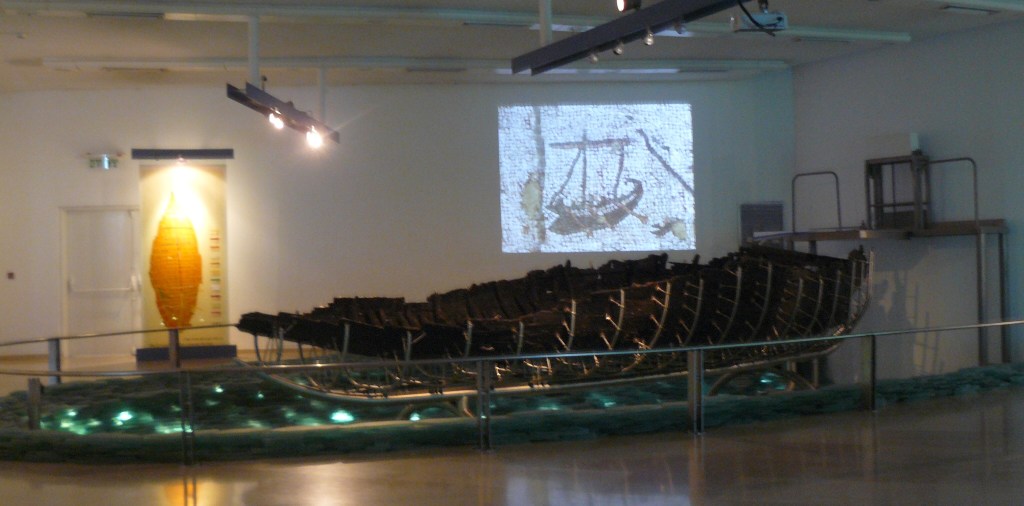
The most visited tourist destination in Israel is Kibbutz Ginosar on the shores of Galilee. It was here, in 1986 that two brothers, Moshe and Yuval Lufan, found the remains of a first century boat. That year the water levels were particularly low and the brothers – who spent a great deal of time looking for artifacts – came across a rusty nail which, on inspection belonged to a boat, buried in the mud beside the water. Recovering the boat was a mammoth task. Archaeologists had to work out how to excavate the boat without damaging or destroying it. This meant keeping the timbers wet, moving the fragile structure in one piece, cleaning off the mud without touching the boat, and finding the right fish to keep the bacteria away. Thankfully the hard work was rewarded with success and the boat can now be seen in a museum close to where it was found.

Boats are a feature of the gospels. Jesus calls four fishermen to follow him, he teaches from a boat, is responsible for an extraordinary catch of fish from a boat and he himself seems to criss-cross the Galilee in a boat. The discovery of the “Jesus boat” puts flesh on the gospel stories and enables us to visualise Jesus and his disciples as they sail from one side of the lake to another. The popularity of the “Jesus boat” lies in the fact that it is probably the most intact structure that can be related directly to Jesus’ life and ministry. 

Fishing, in the time of Jesus was regulated by the Roman government – delegated to local officials. Anyone who wanted to fish needed to purchase fishing rights and a proportion of the catch was subject to tax. Fishermen were at the mercy of the brokers and tax-collectors. They were also vulnerable to the vagaries of the sea – a good catch was never guaranteed and the sea could whip up into a storm at any moment. Most fishermen could not swim, and, as the sea was considered to be the home of demons, falling overboard was doubly dangerous. No wonder the disciples were terrified when they found themselves on the lake, at night, in the middle of a storm.

An account of Jesus calming the sea is one of the few stories that occurs in all four gospels – sometimes twice. In Matthew, Mark and John it follows Jesus’ feeding of the 5,000.  Matthew and Mark have included an account of Jesus’ walking on the water. In every instance, the event illustrates Jesus’ power over nature and over the demonic forces, but the authors use the story in very different ways. (Only Matthew chooses to include Peter’s attempt to walk on water – his initial confidence and his ensuing doubt.) 

In Mark, Matthew and John, Jesus is not in the boat when the storm blows up. He has stayed behind. Later, during the storm, he walks across the water towards the boat. A comparison of Mark and Matthew is interesting and illustrates the different purposes of the gospel writers and the different ways in which they depict the disciples and the disciples’ reaction to the stilling of the waters[1]. In Mark, the incident is directly related to Jesus’ feeding of the 5,000, specifically the bread. When Jesus enters the boat and the wind ceases the disciples are utterly astounded, but there is no expression of faith because: “they did not understand about the loaves, but their hearts were hardened.”[2] Matthew reports an entirely different reaction. When Jesus and Peter get into the boat (after Peter’s failed attempt to walk on water) and the wind ceases, the disciples worship Jesus as the Son of God. 

In Mark’s gospel, the disciples never identify Jesus as God’s son. Indeed, other aspects of Mark’s telling of the story, suggest that the question of Jesus’ identity remained a secret until the resurrection. Throughout that gospel the disciples are consistently depicted as foolish and lacking in understanding. In contrast, Matthew suggests that despite the fact that the disciples do recognise Jesus as the Son of God, they constantly waver between doubt and faith (even after the resurrection – Mt 28:17). 

We will never know for certain the purpose of the authors. (We have nothing except the gospels on which to base our conjectures). Is Mark, the first of the gospel writers, describing the disciples as they really were and did Matthew, dismayed that the founders of the church were presented as such poor role models, remodel their failings from misunderstanding to doubt? Or did the community for whom Mark was writing need models that shared their misunderstanding, and did Matthew’s community need to feel that even the disciples had moments of doubt? 

Whatever the truth of the matter, the writers of the gospels have given us disciples with whom we can relate, real people with real fears and failings. This means that if we are confused, we can be reassured that the first disciples were confused. When we are afraid, we can identify with disciples, who despite being in the presence of Jesus still experienced fear.  At those times when our faith wavers or when we are overwhelmed by the circumstances in which find ourselves, we can be comforted in the knowledge that the disciples too had moments of doubt. 

Our gospel writers did not gloss over the failings of the disciples, nor did they present them as exemplary models. In our gospels we find disciples with whom we can identify. Through them we are assured that God does not expect perfection but will find ways to use us – however weak our faith, however wavering our courage and however poor our understanding. 

There is one thing of which we can be sure that, whether we falter or not, whether we are uncomprehending or not, whether we are brave or not God’s love for and confidence in us is steadfast and unwavering.


[1] Read Matthew 14:22-33, Mark 6 45-52 (John 6:16-21 Jesus doesn’t calm the storm, but he does walk on the water.)

[2] Hard to know just what this means!