Posts Tagged ‘communication’

Lambs among wolves – do you dare?

July 1, 2022

Pentecost 4 – 2022
Luke 10:1-12, 17-24
Marian Free

In the name of God who asks us to leave everything and follow. Amen.

I wonder, do you travel light, or do you need to be prepared for any eventuality? Do you like to plan your accommodation in advance, try out new places to eat or are you just as happy to take things as they come? Either way I wonder how you respond to Jesus’ instructions to his disciples in this morning’s gospel? “Carry no purse, no bag, no sandals”, “Remain in the house you first enter, eating and drinking what they provide”? Could you set out on a journey with nothing but the clothes that you are wearing? And how do you feel about accepting hospitality from strangers, eating whatever is put in front of you? How comfortable would you feel as a “lamb among wolves”?

In the first century, the most common form of communication was by word of mouth. People were illiterate and letters were an expense that few could afford. A majority of people lived on the breadline – paying for accommodation was not an option. To get a message to someone in the next village or further afield meant that someone had to travel by foot and be dependent on the kindness of strangers. This had its dangers and risks but, by and large, travellers could rely on the culture of hospitality that existed among many of the cultures in the Middle East. Even the poorest of people would share what they had, even if it was just some bread or maybe some fish.

If the gospel was to be shared the disciples had to go out, to travel through the towns and villages of Galilee: “to cure the sick who are there, and say to them, ‘The kingdom of God has come near to you.’” In a world without internet, telephone or even the printing press, there was only one way that people were going to hear the good news of the kingdom and that was if was taken to them.

Today’s world is very different. In the first instance, since Constantine made Christianity the religion of the Empire in the fourth century, it has been possible to assume that, in the West at least, the Christian faith was known (if not always held). Then during the years of expansion and colonisation, the Christian faith was exported to all corners of the world. Either way, until the last hundred years or so, there has been no apparent need to take the gospel to the world. Add to that the fact that in the 22nd century, communication is easy, cheap and, often, immediate. Modern day followers of Jesus can share the message of the gospel simply by sitting at their computer or by tapping out messages on their phone. Blogs, tweets, Facebook posts can all be employed in the service of spreading the gospel. There is not even a necessity for any face-to-face contact – no need to go out, no need to accept hospitality from strangers, no need to take risks, and certainly no danger of being “lambs among wolves”.

Safe behind our texts and our screens we can congratulate ourselves on spreading the word. We may take a certain pride in the number of “followers” that we have, imagine that our creative meme helps to make the gospel “relevant” to a new generation or that our erudite words will convince a sceptic or unbeliever that the gospel does indeed have something to say to today’s world.

Therein, I suspect lies a serious problem. In our offices and our homes, we have no idea what the world needs to know, even worse, we do not know what the world needs us to hear. Safe in our own little worlds, we do not need to engage with the pain and suffering experienced by millions – in distant places, but also on our doorsteps. We do not have to get our hands dirty with the grit and toil of what for many is daily life. If we do not take ourselves into the streets of our cities and towns, we will not have to contend with the anger that many people feel towards the church or face their disappointment with a church that has failed them. Confined in our churches, we do not have to personally take responsibility for the ways in which Jesus’ teachings have been distorted and used for purposes for which they were never intended.

How can we possibly follow Jesus’ instruction to “heal the sick”, unless we allow ourselves to come face-to-face with those whose lives are limited by poverty, injustice or trauma? How will we learn the stories or those beyond our walls, unless we allow ourselves to become vulnerable (unprotected by our equivalents of purse, bag, and sandals)? How will we begin to have any understanding of their lives and their struggles unless we graciously accept their hospitality and not only listen to, but share their stories? How can we tell others that the “kingdom of God has come near” when for so many it is palpably absent and when we demonstrate by remaining in our comfort zones that we are loath to place our trust and hope completely in Jesus?

At first glance, the gospel appears to be bound in time and place, but like most of our gospel stories, Jesus’ sending out of the seventy can and does speak to us. Jesus warns that if we take seriously the commission to share the gospel, there will be times when we are overwhelmed by the impossibility of saving the world, when we feel defeated by the cynicism and scepticism of those who have rejected the church’s teaching and occasions when we are struck with anguish when we hear of the pain inflicted directly and indirectly by the church in which we have found a home. If we truly allow ourselves to be defenceless against the onslaughts of those whom we seek to serve, we may indeed feel as though we are “lambs among wolves”.

The good news is that the seventy did go out and when they returned, they exclaimed: “Lord, in your name even the demons submit to us!” “Even the demons submit to us!”

In a different time and place, we would not use the language of demons, but it is fair to say that there are many evils in the world today. The evil of greed which leads to the impoverishment of millions. The evil of a desire for power and control that leads to war and terror. The evil of climate injustice, which leads to the most vulnerable paying the cost for the careless of others. The evil of domestic violence and child-abuse. The evil of dispossessing people of their land, removing their children and incarcerating them at disproportionate rates. (I am sure that you could add more.)

Our blogs, tweets, Facebook posts, our Live-streaming and Zoom meetings will not do. We must find the courage to go out – even if we do not know what to say and even if we are afraid of our welcome – because only then can we confront the evils of the world and only then will Jesus be able to empower us to overcome them.
No words needed

May 22, 2021

Pentecost – 2021

John 15.26-27; 16.4b-15 (Acts 2:1-21)

Marian Free

In the name of God in whom we live and breathe and have our being. Amen.

On Wednesday I listened to an interview with the Rev’d Bill Crews (whom you might know in connection to the Wayside Chapel in Kings Cross). Bill has just released a memoir entitled: ‘Twelve ways to a better life”. As you might expect the interview covered a vast array of topics, but what captured me was the transformational experience that he described at the very beginning of the interview. Bill was in Calais where he was seeing first-hand the crowded camp full of refugees who had been hoping to reach England. One day he saw an advertisement for an NA meeting (which I took to be what we would know as an AA meeting). On a freezing cold night, he made his way to a square of carpet that was covered in plastic and other rubbish. Needless to say, he was the only English speaker there and the only Christian. Everyone else was of the Muslim faith and had come from a variety of countries – there was no common language. As is the case for AA meetings, each person told their story in their own language which was then translated into French. Bill understood nothing of what was said, but as person after person told their stories he realised that all he needed to know was written in the suffering on their faces.

When his turn came, Bill spoke in English and the translator turned it into French. For him it was if a dam had been unstopped, the account of his whole life came flooding out. When he had finished, tears streaming down his face, everyone in the group came and held him in their embrace. No words were needed – he was in pain as they were in pain, and they understood.

That was Wednesday. On Friday, I saw a short video of a young Spanish woman hugging a Senegalese refugee who had made it from Morocco to Ceuta. “She hadn’t caught the man’s name but had seen he was battling exhaustion and had given him water. “He was crying, I held out my hand and he hugged me,” she said. “He clung to me. That embrace was his lifeline.” The video is very moving, the woman held the man as he released emotions of fatigue, relief and fear. 

What struck me in both stories was that language is so much more than words, that sometimes we don’t even need words and that so often our non-verbal communication is more important than what we actually say. Suffering and loss, love and compassion are universal languages. Bill did not need to know what the refugees were saying about their experiences, because their anguish was clearly written on their faces. They didn’t need to understand what he was saying because his tears told a story that they could identify with.  The young Red Cross worker in Ceuta did not need language to understand that the refugee was thirsty, exhausted and overwhelmed and the Senegalese man did not need to understand Spanish to feel the empathy and concern of the young woman.

Both stories spoke to me of the experience of the first Christian Pentecost when the Holy Spirit enabled the disciples to speak in other languages such that they were understood by “devout Jews from every nation under heaven living in Jerusalem.” It occurs to me that whatever language was spoken by the first disciples, their wonder and excitement about the coming of the Holy Spirit would have been obvious to all. 

In saying this, I am not trying to minimise, to explain away or to rationalise the miracle of Pentecost but rather to see it from another point of view – one that need not be bound by time or place and one that doesn’t lead us all to expect that when we are filled with the Holy Spirit people of other nations will literally be able to understand the words that we say. 

The rushing wind and tongues of fire are important because they liberated a frightened group of people to leave their hiding place and to share the gospel with the world, but so too are the non-verbals of conviction, passion and joy. When we reflect on spreading the gospel in our time, it is important to realise that our non-verbal language is as important if not more so than what we actually say. People know when we are forcing a smile or giving and insincere compliment. They are sensitive to body language that belies the words that are coming out of our mouths. They will be suspicious if they think we don’t truly believe what we say. On a personal level people can be hurt and confused by an apparent lack of sincerity. On an institutional level, the church as a whole is hurt when its members non-verbally express disapproval, judgmentalism, racism, or any other “ism” that implies that another human being is somehow of less value than ourselves. Hypocrisy on the part of any of us, reflects on all of us.

On the other hand, if we, empowered by the Holy Spirit, consistently demonstrate love and compassion for our fellow human beings the world might find Christ in us. If we were energised and enthused by what we believe, if our faces showed the joy and peace that we find in Christ, if we allowed the Holy Spirit to work in and through us what power might be released? If our passion for the gospel and our love for all humankind was written on our faces and demonstrated in our lives, the world would want to know what it was that set us apart and they would want it too. The church, instead of dwindling, might be filled to overflowing and the world, instead of being torn apart by suspicion and hatred, might be as one.

We might never experience the rushing wind or the tongues of fire, but each of us by virtue of our baptism have been given the Holy Spirit. I wonder what would happen if we really had the courage to release it?

Context is important

August 22, 2020
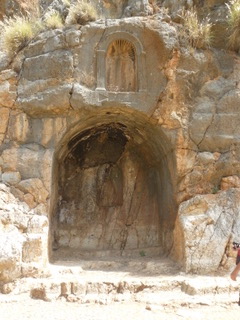
Pan’s Cave Caesarea Philippi

Pentecost 12 – 2020

Matthew 16:13-20

Marian Free

In the name of God who knows what we need to hear and speaks to us where we are. Amen.

Context is everything. Some years ago, the well-known broadcaster and journalist, Philip Adams was invited to address the VFL[1] Grand Final breakfast, this, despite his well-known aversion for the game. Attendees at the breakfast included die-hard fans, high-ranking officials and very often even the Prime Minister of the day. Strangely, for such an experienced writer/speaker, Adams chose that venue and that audience to mock the sport that they all held dear. Adams reports that he “explained to the crowd that Aussie Rules was, in fact, an ancient fertility rite. Like Easter”, he said, “it is all about eggs. The footy is an egg. The game is played on an egg-shaped oval. The goal posts are there to be impregnated” and so on[2]. Needless to say, no one thought that he was remotely funny. Adam’s address was met with horrified silence.  He had completely misjudged his audience. There might have been a place to mock Australian Rules Football, but this was not it. 

If we want to get our message across, if we want people to laugh at our jokes, or to be shocked into changing their ideas or to be comforted by our platitudes we have to be sensitive to our audience. We have to ask ourselves – what is their starting point? what can I say that will speak to their situation? what language will help them to understand what I want to say? Will my words be helpful, or will they add to someone’s pain? 

The gospel writers were masters of context. Each author tailored their retelling of Jesus’ story in a way that they felt would speak directly to their listeners, that would meet them where they were in their faith journey and would draw them into a deeper understanding of that faith.  Their goal, as the gospel of John specifically says: “These are written so so that you may come to believe that Jesus is the Christ, the Son of God, and that through believing you may have life in his name” (Jn 20:31). 

In other words, the gospel writers knew the importance of setting out their accounts in such a way as to give the listeners the best chance of grasping the message of Jesus the Christ. At the same time, they could confront, through their re-telling of Jesus’ stories and miracles, the anxieties and the shortcomings of the communities. Matthew, Mark and Luke were writing to completely different communities – to people with different backgrounds, different experiences of the world and people whose contexts differed greatly. Being sensitive to the needs and experiences of their listeners, each author ordered his account and adapted his story-telling to ensure that the communities for whom they wrote heard what they needed to hear in their current situation – a situation that was vastly different from the time of Jesus and which had its own challenges for the emerging believers. 

Mark’s version of today’s gospel with that of Matthew for this reason. Both authors place Peter’s confession in the vicinity of the city of Caesarea Philippi but there are subtle and not so subtle differences in the telling. Mark emphasises movement not place, journey not destination. His language implies movement. “Jesus was asking (the question is repeated) his disciples while they were on the way (Jesus and the disciples are moving from one place to another).” Movement is an important of Mark’s setting, but so too is his language. “On the way,” is a phrase that Mark uses repeatedly as shorthand for discipleship. Mark presents Peter’s recognition of Jesus as a stage in the journey of discipleship. As we shall see, despite Peter’s declaration that Jesus is the Christ, he has no idea what this means. His declaration is a stage in the journey, not the end of the story.

Matthew’s emphasis is primarily on place or at least the significance of place. Jesus has come into the district of Caesarea Philippi. He is stationary not moving. Caesarea Philippi was close to a cave and a spring that were dedicated to the Greek god Pan and was believed to be the entrance to the underworld. Herod the Great had built a Temple to Caesar Augustus here to curry favour with the Emperor. The region was inherited by Herod’s son Philip who made it his administrative headquarters and dedicated it to the then Caesar. Caesarea Philippi was important for other reasons. It was near a major trade route and it was the place to which the commander of the Roman army had returned to celebrate with his troops after they had crushed Jerusalem. In other words, it was a place that was redolent with symbolism – of power, religion and economic viability. 

Whereas in Mark, Jesus’ question: “Who do you say that I am?” is primarily a question about Jesus’ identity, in Matthew the question has more to do with allegiance. Matthew’s readers are being challenged to ask themselves in what and in whom do they trust. Are they over-reliant on their economic security? Are they tempted by their culture’s latest fancies? Do they place their trust in the power of secular rulers? Where – in the midst of all the worldly distractions – does their loyalty lie – with earthly powers or with the power revealed by Jesus, “the Christ, the Son of the living God”? 

The gospel writers knew their communities and understood their needs. They knew when to challenge and when to comfort their audience. Mark wants to move the community along the road to belief, Matthew wants them to consider where their true loyalty lies.   

Context is important. If we want to share the gospel with our contemporaries we need to understand where they are coming from. We need to recognise and understand their longings and their fears, their strengths and their weaknesses so that we can speak in a way that will touch their hearts, utter a message that responds to their deepest needs and offer a word that will bring them into the presence of the living God.


[1] For overseas readers, VFL in those days highly parochial. Most Melbourne suburbs had their teams and followers were fiercely loyal even fanatical in the way of many soccer fans.

[2] Reported by Phillip Adams The Australian Magazine, August 15-16, 2020.

No right way to pray

July 23, 2016

Pentecost 10 – 2016

Luke 11:1-13

Marian Free

In the name of God in whom we live and move and have our being. Amen.

There is a story, possibly mythical, about three monks who had chosen a solitary life on an isolated island. One day the local bishop decided that it was time he paid them a visit. On arrival he asked them how they prayed. Their response was to inform him that every day at regular intervals, they recited, “Jesus, Lamb of God have mercy on us”. The bishop thought that that was good, but he also felt that their prayer life could be enhanced. To that end he spent the whole day teaching them the Lord’s Prayer. In the evening, satisfied that he had made progress, the bishop got into his boat, ready to return to the mainland. The boat had barely pulled out from the shore when the bishop spotted one of the monks splashing clumsily towards him. “Bishop, bishop,” he called, “we can’t remember what comes after ‘your kingdom come’.” At that point the bishop realised that the monks had wisely chosen a prayer that suited them. He commended their discipline and recommended that they return to the prayer that had served them so well. Then he went on his way and the monks returned to their pattern of prayer.

In today’s gospel the disciples observe Jesus at prayer and ask him to teach them to pray as John taught his disciples. They probably know how to pray, but they know that it is usual for a teacher to pass on his particular knowledge to his disciples. Jesus prayed and he prayed often. Jesus’ response to the disciples was to teach them the “Lord’s Prayer” as it has become known. In these words, Jesus encapsulates all that prayer is and could be. The words acknowledge God’s extraordinary nature, our longing that the world as a whole would come under God’s governance, our utter dependence on God for all things, our need to be reconciled with our brothers and sisters, our request for courage to do what is right and our belief that God will support us through times of difficulty. In other words, the Lord’s Prayer encapsulates all that we need to say in prayer.

No wonder this prayer so quickly became part of the liturgical life of the church. The Didache recommended that it be said three times a day (8:3) and our formal liturgies – the Eucharist and Morning and Evening Prayer – gather up the prayers of the people with these words.

The importance of a regular pattern prayer was recognised long before Jesus taught the disciples. As early as the Psalms regular prayer is recommended. Psalm 119:64 suggests that we pray seven times a day including midnight (62) and the Book of Daniel recommends prayers three times daily (Dan 6:10).

Prayer is important (dare I say essential) – not because God demands it, but because our lives and our relationship with God are enhanced through prayer. Communicating with God on a regular basis is the only way of maintaining our relationship with God. Building a relationship with God not only enriches our understanding of God, but ensures that in times of trouble or distress we will be practiced at speaking with God, we will know what we can expect of God and we will be able to draw strength from our deep connection with God. Prayer strengthens our relationship with God and at the same time it reminds us of our utter dependence on God, that all that we have comes from God and that we are utterly dependent on God. It helps us to develop the humility that allows God to work in us and through us so that we might play our part in bringing peace and justice to the world.

A practice of regular prayer enables us to see ourselves as God sees us – to identify and recognise our weaknesses and our strengths, to become aware of any jealousy, bitterness or resentment in our lives (and with God’s help to deal with it.) In this way prayer not only deepens our relationship with God but also builds our understanding of ourselves and of our relationship with others.

Simply speaking, prayer is an acknowledgement of God’s constant presence in our lives and in the world. It is important to remember, as the story with which we began suggests, that our style of prayer must suit us and not be something that is imposed from outside. Prayer is not intended to be a burden but a gift and, as the story illustrates and it can be as complex or as simple, as lengthy or as short as we would like to make it. Short repeated prayers like the “Jesus prayer” of the monks are just as valid as lengthy intercessions. So we might find that repeating the “Jesus prayer” suits our temperament, or that making the sign of the cross when we wake or during the day is a sufficient reminder of God’s presence in our lives, or that a pattern of prayer just before we go to sleep might be more to our style. Our personality might suit the discipline of saying the Daily Office[1] or of setting aside time each day/each week for meditation. We might be someone who is good with words, or we might be more comfortable sitting in silence.

No one prayer or form of prayer is better than any other as long as we pray for there is no other way to keep open that channel of communication with God. Whatever and however we do it, the important thing, in the words of the Archbishop of Canterbury, is that we “just pray” – that we acknowledge God’s presence in our lives and allow our lives to be transformed as a result.[2]

[1] Most modern Prayer Books include prayers for each day of the week.

[2] The English Church has developed a website that encourages us to “just pray”: justpray.uk


The heavens torn asunder

January 10, 2015

Baptism of Jesus – 2015

Mark 1:4-11 (Genesis 1:1-8)

Marian Free

May my spoken word, lead us through the written Word, to encounter the Living Word, even Jesus Christ our Saviour. Amen.

It is difficult to let go of the idea that heaven is above us and that hell – if such a place exists – is below. Even though modern science has revealed the vastness of the universe, and even though we know that the nearest star is light years away, most of us still think of heaven as somewhere above the sky. One reason for such a view is that our image of heaven is formed by our biblical texts that in turn are dependent on a view of the world that dominated in ancient times. In this period of time, it was believed that the earth sat on pillars above the waters below and that the sky was a vast dome that held back the waters above. The sun, moon and stars hung from this dome and the rain fell through holes in the dome.

In Hebrew the word for this dome is raqia. This is the same word that is used for God’s chariot or for the platform for God’s throne. It seems that in Hebrew thought the sky – what was for them the roof of the earth – was for God the floor of heaven. That is not to say that they understood God to be confined to heaven or that they thought that the dome was impermeable, preventing movement in either direction. After all, God had conversations with Abraham and Moses spoke to God face-to-face. It does seem however, that communication between God and humankind generally occurred through individuals such as the patriarchs or the prophets or through intermediaries such as angels. In any event, over time the communication between heaven and earth became ritualized and instead of communication being a two-way conversation, it was limited to an action that took place once a year – first of all in the tent of meeting and then in the Temple.

The design of these places of worship is important, in particular the separation of the sanctuary, which is the place of meeting. In Exodus God says to Moses: “And have them make me a sanctuary. There I will meet you and I will give you all my commands for the Israelites.” Moses used to meet God in the sanctuary on a regular basis but, according to the Book of Leviticus this place, which was separated by a curtain from the remainder of the tent of meeting, was considered so holy that it was only entered once and year and then only by the current High Priest. On the Day of Atonement, the High Priest would enter the Holy of Holies surrounded by a cloud of incense that would prevent him from seeing God. Inside the sanctuary he would sprinkle blood on and before the mercy seat. This was to cleanse the tent of the sins of the people and to make it possible for God to continue to dwell in their midst. It was not a conversation between the priest and God as it had been in Moses’ day. The Temple, when it was built, was built on the same design as the Tent of meeting. Again the sanctuary was separated from the inner court by a curtain and entered only once a year by the High Priest. The relationship between God and the people at this time was not personal but formal and dictated by ritual.

All of this background information is essential if we are to understand Mark’s account of Jesus’ baptism.

Mark tells us that as Jesus was coming out of the water, he saw the heavens torn asunder and hears the voice of God saying: “You are my beloved Son in whom I am well pleased.” It is true that in this account only Jesus sees the heavens torn and hears the voice of God, but Mark’s audience hear the words as if they too see and hear, and the implication of what is happening is not lost on them. The violent tearing of the heavens suggests to them that the barrier that existed between them and heaven has been broken irreparably. The dome is no longer intact. God has broken through into the world and nothing will ever be the same. From now on the way in which God communicates with the world will be radically different. God will be accessible to all people, not to just a few.

That this is Mark’s intended meaning is made clear at the conclusion of the gospel when another violent tearing destroys the curtain in the Temple – that which had separated the people from the sanctuary. Mark records that when Jesus took his last breath, the veil (curtain) in the Temple was torn from top to bottom making clear that no longer is communication with God limited to just one person just once a year. All people now have access to and can communicate directly with God.

Even though Mark does not record Jesus’ birth, in only a few verses he makes it obvious that in Jesus, God has radically entered the world. God’s heaven has been opened in a way that could not previously have been imagined and the violence of the opening suggests that it will not easily be closed again. The barriers (real or perceived) between earth and heaven have been destroyed. All of humanity is now able to speak directly to God without the need of an intermediary.

God has done everything possible to open channels of communication with us. It is up to us to make good use of them.