Posts Tagged ‘Creation’

Salvation of the Cosmos (Romans 1:18-23)

August 31, 2024

Pentecost 15 – 2024 Season of Creation – Planet Earth

Romans 1:18-23

Marian Free

In the name of God whose salvific act in Jesus embraces not only ourselves but the whole creation. Amen.

At the moment I am teaching a subject called New Testament Letters which of course includes the letters of Paul. Many people find Paul difficult to understand. This is in part because it is impossible for us to transport ourselves back into the culture of the first century and to the origins of what was to become the church. More than that we don’t always understand Paul because most of us are unaware of the many tools which Paul used to convince his readers of the truth of his arguments. Foremost among these are the tools of Rhetoric which were common usage for the philosophers, speakers and writers of Paul’s time. These included the rhetorical question – a question (to which the answer is obvious) and dialogues with an imaginary partner in which Paul poses questions that his readers might be asking. 

Another tool which is particularly evident in Paul is the use of ancient texts to demonstrate that he is arguing no new thing but is building on an established tradition. Paul’s dependence on the Old Testament is particularly evident in Romans which is peppered with direct quotes.  The translators have helpfully indented these in our Bibles which makes them easy to identify. Much more difficult to recognise are Paul’s allusions to scripture, especially when they are drawn from the Apocrypha, a number of books written between the Testaments which are often omitted from the Bibles that are used by Anglicans. 

I mention this, because Romans 1, a portion of which we have read this morning, draws heavily on the book of Wisdom especially chapter 13.  At some time, you might like to read the two texts so that you can see the similarities for yourselves. For the moment I will quote a couple of passages.

Wisdom 13:1 reads: “For all people who were ignorant of God were foolish by nature;

and they were unable from the good things that are seen to know the one who exists,

nor did they recognize the artisan while paying heed to his works.” 13:5 states: “For from the greatness and beauty of created things comes a corresponding perception of their Creator.”  Compare these lines with Romans 1:19,20: “For what can be known about God is plain to them, because God has shown it to them. Ever since the creation of the world his eternal power and divine nature, invisible though they are, have been understood and seen through the things he has made.”

Paul shares with the wisdom tradition a belief that God can be known through the revelation of the natural world and an understanding that the worship of idols (or a failure to worship God whose presence is all around), is the source of all vice and wrongdoing.

That is not to suggest that God is a fundamental entity of the same nature as the world but to recognise that God can be known through God’s creation and through history.

Paul is clear that the creator of the universe is not hidden but is accessible to and therefore able to be known by all of humanity whether or not they belong to the religious tradition that names the creator as God. Further, those who recognise God in God’s creation, will behave in ways consistent with knowing God, whether or not they subscribe to the law followed by those who call God their God.

On this first Sunday of creation, we celebrate God’s presence in the created world but Paul’s interest in creation doesn’t end there. If we read further in the letter to the Romans, we discover that not only can God be known in creation but that Paul’s view of salvation embraced the whole creation. The created world is of one piece, if one part of creation suffers, the whole of creation suffers. As long ago as the first century, Paul understood that all creation was weighed down by the powers of Sin and Death which had held sway since Adam. Now,  through Christ, creation itself has been set free.

In chapter 8 he writes: “For the creation waits with eager longing for the revealing of the children of God; for the creation was subjected to futility, not of its own will but by the will of the one who subjected it, in hope that the creation itself will be set free from its bondage to decay and will obtain the freedom of the glory of the children of God. We know that the whole creation has been groaning in labour pains until now; and not only the creation, but we ourselves, who have the first fruits of the Spirit, groan inwardly while we wait for adoption, the redemption of our bodies.”

It is powerful language especially as it was written at a time when no one could have perceived the life-destroying stresses that would be placed on our natural world, the weights under which it would begin to struggle and groan and the changes it would undergo as a result of human greed and indifference. 

Our individualistic, self-centred culture has tended to associate salvation with humankind.  As Gaventa points out: “we have reduced God’s salvific act into something small, a transaction between God and ourselves, or between God and a group of people”[1] whereas Paul’s view is collective and cosmic. Paul sees Jesus’ death as a turning point in a cosmic conflict (op cit, 42) in which God defeats the deadly powers that have held the whole cosmos in their thrall.

Paul recognises as we often fail to that all creation is God’s and that we are an integral part of, not separate from, that creation. As we celebrate this month of creation, may we understand our place in the universe and strive to live in harmony with the whole created world, and as one part of an intricate and interrelated cosmos.


[1] (not an exact quote). Gaventa, Beverly, Roberts. (2016) When in Romans: An invitation to linger with the Gospel According to Paul. Grand Rapids, Michigan:  Baker Academic, 32.
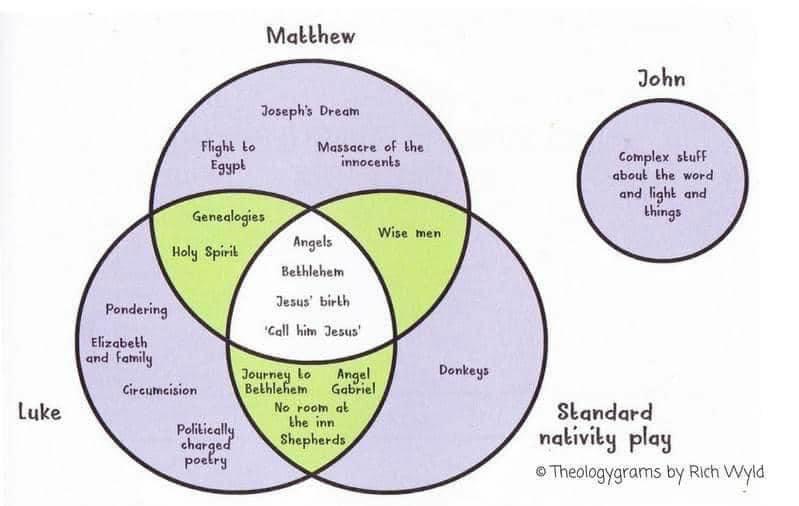
God Incarnate

December 23, 2022

Christmas – 2022
Marian Free

In the name of God who comes among us silently, unobtrusively and unremarkably. Amen.

A73B3131-3B24-4954-8E33-6588DF7BB8A0

In the beginning was the Word, and the Word was with God, and the Word was God. . . . All things came to be through him, and without him nothing came to be. —John 1:1, 3

During the week our Bishop posted the above photo in Facebook. It is a light-hearted attempt to compare the accounts of Jesus’ birth in the four gospels. At the same time, it reminds us that when it comes to Christmas, we conflate two versions of the story – our nativity scenes. have the shepherds and the magi even though the shepherds are found only in Luke and the magi only in Matthew. (Mark is missing, because in Mark’s gospel, Jesus bursts on to the scene fully grown.) When the post appeared, discerning viewers noticed at once that Mary was not included in the diagramme. You might like to compare the first few chapters of Luke and Matthew and see if anything else needs to be added. The four gospels begin quite differently and as might be expected, the beginnings reflect the interests of the authors. Matthew is concerned to stress the Jewishness of Jesus and the way in which his early years demonstrate the fulfillment of Old Testament promises. (“This was to fulfill what was spoken by the prophets” occurs 5 times in the birth narrative.) What is more Matthew’s genealogy goes back to Abraham – the founder of the Jewish faith. Luke, on the other hand is more concerned with the universal implications of Jesus’ birth and with the historical context in which the story takes place. Luke includes the census and mentions Herod. His genealogy goes all the way back to Adam – indicating that Jesus is for everyone, not just for a few. Mark, as I said is not concerned with Jesus’ origins and John’s poetic start gives us – not a birth, but a cosmic beginning. From John’s point of view Jesus always was.

Does it matter that we do not have a consistent account to explain Jesus’ presence among us? Do we need to explain the differences? Of course not. Each story tells us something different, helps to satisfy our curiosity about Jesus’ beginnings and enriches our understanding of something that is essentially beyond our understanding. Indeed, Richard Rohr would argue that Jesus’ birth is only one expression of God’s incarnation among us – the account/s of Jesus’ birth are only one expression of God’s presence among us. That is to say, prior to Jesus’ birth, God was not absent in creation, invisible to God’s people or inactive in relation to the world. From the moment God said: “Let there be light” God has been dynamically engaged with creation and constantly in relationship with God’s people.

As Rohr says, we will never know the how, why or when of creation, but most traditions suggest that everything that it is the creation of some “Primal Source, which originally existed only as Spirit.” He goes on to say that “This Infinite Primal Source somehow poured itself into finite, visible forms, creating everything from rocks to water, plants, organisms, animals, and human beings. This self-disclosure of whomever you call God into physical creation was the first Incarnation (the general term for any enfleshment of spirit), long before the personal, second Incarnation that Christians believe happened with Jesus.”

What this means is that from the beginning of creation God has existed/been incarnate within all creation – animate and inanimate. When God ‘became flesh’ in the person of Jesus, God became incarnate in a very particular way – uniting Godself to us. At that point in time, God the creator, with the Logos/Word, fully identified with humankind, proving once and for all, that humanity is created in the image of God and that God is incarnate in and with us – not simply in creation or in some indistinct, immaterial form out of sight and out of reach. God, through God’s incarnation in Jesus that God chooses not only to be incarnate in the beauty of a sunset, the perfection of a flower, the majesty of a mountain, but in the frailty of human flesh, the imperfection of human behaviour, and the weakness of human will. Thanks to God’s coming in flesh – in Jesus – we can see God in one another and in ourselves and, in Jesus, we can see too what it is that we can be.

So, this year, let us not look back with longing to the infant in the stable or forward with anticipation to the coming of the Son of Man, but let us simply look – around and within – so that we might perceive God’s incarnation in its many and myriad forms – in the world and in ourselves. Let us celebrate God, with us throughout all time.

Scripture in service of abuse

August 24, 2019

Pentecost 11 – 2019
Luke 13:10-17
Marian Free

In the name of God, Earth-Maker, Pain-Bearer, Life-Giver. Amen.

Here’s a question: “Did you know that there are two versions of the Ten Commandments and, if you did, did you realise that they differ in regard to keeping the sabbath?”

As you know, the Ten Commandments are given to Moses when the Israelites are wandering in the wilderness. When at last they are about to enter the promised land, Moses reminds the people of all that has happened since God led them out of Egypt. In this second version, Moses changes the fourth commandment and provides a different reason for “observing the sabbath and keeping it holy”. Unless it is pointed out to us, we might not notice the difference because, apart from a slight rearrangement of words the two versions are the same apart from the justification. So, when Moses receives the commandments the creation story is given as the basis for sabbath keeping. “For in six days the LORD made heaven and earth, the sea, and all that is in them, but rested the seventh day; therefore the LORD blessed the sabbath day and consecrated it.” (Exodus 20:8) Moses’ farewell speech as recorded in Deuteronomy emphasises the liberation of Israel from Egypt: “Remember that you were a slave in the land of Egypt, and the LORD your God brought you out from there with a mighty hand and an outstretched arm; therefore the LORD your God commanded you to keep the sabbath day.” (Deut 5:15)

The two explanations complement rather than contradict each other. Genesis tells us that on the seventh day of creation God blessed and hallowed the day. We are not to understand that God was exhausted, but rather that God was taking the time to revel in all that God had made. The sabbath was intended to be a day of delight, a time to appreciate God’s gifts and to allow oneself to be held in and by the presence of God.

Deuteronomy recounts the tale of liberation– from Egypt, through the wilderness to the present – and God’s role in bringing the people from slavery to freedom in the promised land. Not surprisingly, the sabbath is associated with redemption. It is set aside as a constant reminder that God has set the people from free from slavery – from everything that limits or prevents human flourishing.

The sabbath is God’s gift to God’s people – a day in which to delight in God’s blessings or to remember with gratitude the freedom God has won for them. “Remember the sabbath day and keep it holy”.

So far so good, but around 613 BCE it seems that people began to worry about what it meant to keep the sabbath holy, in particular what did it mean to “do no work”. The attempt to define “work” produced rules and regulations that were so detailed and unwieldy with the result that, rather than being a day of rest (of delight or redemption), the sabbath became a day of anxious concern that one or other rule might inadvertently be broken.

It is in this context that we have to read this morning’s gospel. What appears at first glance as a healing story is in reality a story that primarily serves to illustrate the disagreement between Jesus and the leader of the synagogue with regard to the observation of the sabbath. (A debate that is very much in the public domain as we can see through the reaction of the observers). It appears that the synagogue leader views the sabbath commandment through a very narrow and literal lens. He believes (as Jesus points out) that an ox or a donkey can be unloosed and led to water on the sabbath, but because the law has nothing to say on the matter, he refuses to accept that a woman who is bound can similarly be set free on the sabbath in order to be able to make the most of her life.

Jesus has no such difficulty. Informed by both versions of the fourth commandment and by using the refinements that have been added to it, Jesus looses the woman from that which binds her. He liberates her from her ailment, from the ungodly power that has her in its thrall and he sets her free to stand tall and to live life to the full. Surely on this day of redemption, this is the way in which to understand the commandment. The woman is freed to delight in creation – which she does by immediately standing and praising God. The sabbath is the perfect day on which to set someone free!

It is no longer the sabbath law that is misinterpreted and misused. During the course of my own lifetime the church has been forced to acknowledge that our inherited laws had become laws that had power to oppress and even to destroy the lives of many. Battered women were sent home to abusive husbands because of Jesus’ injunction against divorce. Children have been subject to abuse because they were taught not “to talk back” to adults or worse that they had to “honour their father and their mother”. Gay men and women continue to be denigrated and excluded and denied the comfort and joy of being in relationship with one another because the bible says one thing or another.

We must always be on our guard against rigid interpretations of our faith that limit rather than encourage others. It is my belief that scripture should be read through the lens of God’s love and compassion, God’s inclusion of the marginalised and God’s desire for all people to be made whole. The lesson to be learned from today’s and other controversy stories in the New Testament is that scripture can be used as much to bind as to liberate and that the bible can be used as a tool of abuse as readily as it can be used as an instrument of compassion and respect.

Scripture is a tool for liberation and not for oppression. Let us pray that we will never find ourselves guilty of using scripture to limit, to bind or to repress, but only to encourage, to set free and to enliven.

The heavens torn asunder

January 10, 2015

Baptism of Jesus – 2015

Mark 1:4-11 (Genesis 1:1-8)

Marian Free

May my spoken word, lead us through the written Word, to encounter the Living Word, even Jesus Christ our Saviour. Amen.

It is difficult to let go of the idea that heaven is above us and that hell – if such a place exists – is below. Even though modern science has revealed the vastness of the universe, and even though we know that the nearest star is light years away, most of us still think of heaven as somewhere above the sky. One reason for such a view is that our image of heaven is formed by our biblical texts that in turn are dependent on a view of the world that dominated in ancient times. In this period of time, it was believed that the earth sat on pillars above the waters below and that the sky was a vast dome that held back the waters above. The sun, moon and stars hung from this dome and the rain fell through holes in the dome.

In Hebrew the word for this dome is raqia. This is the same word that is used for God’s chariot or for the platform for God’s throne. It seems that in Hebrew thought the sky – what was for them the roof of the earth – was for God the floor of heaven. That is not to say that they understood God to be confined to heaven or that they thought that the dome was impermeable, preventing movement in either direction. After all, God had conversations with Abraham and Moses spoke to God face-to-face. It does seem however, that communication between God and humankind generally occurred through individuals such as the patriarchs or the prophets or through intermediaries such as angels. In any event, over time the communication between heaven and earth became ritualized and instead of communication being a two-way conversation, it was limited to an action that took place once a year – first of all in the tent of meeting and then in the Temple.

The design of these places of worship is important, in particular the separation of the sanctuary, which is the place of meeting. In Exodus God says to Moses: “And have them make me a sanctuary. There I will meet you and I will give you all my commands for the Israelites.” Moses used to meet God in the sanctuary on a regular basis but, according to the Book of Leviticus this place, which was separated by a curtain from the remainder of the tent of meeting, was considered so holy that it was only entered once and year and then only by the current High Priest. On the Day of Atonement, the High Priest would enter the Holy of Holies surrounded by a cloud of incense that would prevent him from seeing God. Inside the sanctuary he would sprinkle blood on and before the mercy seat. This was to cleanse the tent of the sins of the people and to make it possible for God to continue to dwell in their midst. It was not a conversation between the priest and God as it had been in Moses’ day. The Temple, when it was built, was built on the same design as the Tent of meeting. Again the sanctuary was separated from the inner court by a curtain and entered only once a year by the High Priest. The relationship between God and the people at this time was not personal but formal and dictated by ritual.

All of this background information is essential if we are to understand Mark’s account of Jesus’ baptism.

Mark tells us that as Jesus was coming out of the water, he saw the heavens torn asunder and hears the voice of God saying: “You are my beloved Son in whom I am well pleased.” It is true that in this account only Jesus sees the heavens torn and hears the voice of God, but Mark’s audience hear the words as if they too see and hear, and the implication of what is happening is not lost on them. The violent tearing of the heavens suggests to them that the barrier that existed between them and heaven has been broken irreparably. The dome is no longer intact. God has broken through into the world and nothing will ever be the same. From now on the way in which God communicates with the world will be radically different. God will be accessible to all people, not to just a few.

That this is Mark’s intended meaning is made clear at the conclusion of the gospel when another violent tearing destroys the curtain in the Temple – that which had separated the people from the sanctuary. Mark records that when Jesus took his last breath, the veil (curtain) in the Temple was torn from top to bottom making clear that no longer is communication with God limited to just one person just once a year. All people now have access to and can communicate directly with God.

Even though Mark does not record Jesus’ birth, in only a few verses he makes it obvious that in Jesus, God has radically entered the world. God’s heaven has been opened in a way that could not previously have been imagined and the violence of the opening suggests that it will not easily be closed again. The barriers (real or perceived) between earth and heaven have been destroyed. All of humanity is now able to speak directly to God without the need of an intermediary.

God has done everything possible to open channels of communication with us. It is up to us to make good use of them.