Posts Tagged ‘cross’

Why is this Friday “Good”?

March 30, 2024

Good Friday

John 18:1-19:42

Marian Free

In the name of God who exposes the values of this world for what they are. Amen.

I am often asked why today is called Good Friday, when it is a day filled with horror and death. 

It is good, not because of what happened OR because of what will happen. It is good because of what it tells us. 

By going willingly to the cross, by refusing to engage with a process that was blatantly unjust, and by resisting the temptation to save himself, Jesus exposed all that is wrong with this world – the grasping for and holding on to power, the desire to increase one’s wealth (albeit at the expense of others), the marginalisation and stereotyping of those who are different, the limits placed on freedom of expression, freedom of movement, and the attempts to control the narrative.  By submitting to and not fighting the powers of this world, Jesus exposes their powerlessness – to control, to limit, to label or to frighten. Jesus reveals that it is possible to play by a different set of rules – that one does not have to be bound by fear, hatred, greed or by a hunger for power or seduced by the desire for self-preservation or. control. By refusing to give evil power over him, by refusing to compromise to secure his own comfort and safety, Jesus takes power into his own hands, stripping evil of its power to intimidate, coerce or subjugate. 

Jesus overpowered evil and death by refusing to let them control his story. By facing the forces of this world head on, Jesus deprived them of their power over him.

Today is called “Good” because on this day Jesus showed that by standing apart from the world and refusing to be bound by worldly desires and conventions, and by resisting the. temptation to engage in the grasping for power, recognition and possessions Jesus stripped them of their power over him, and ultimately over us.   

It is Good Friday because the victory has been won and with our cooperation can become the reality for all people. 

We see God through the cross or not at all

May 13, 2022

Easter 5 – 2022
John 13:31-35
Marian Free

In the name of God who confronts and overturns the values and expectations of the world and opens our eyes to new possibilities, new ways of being. Amen.

A couple of weeks ago I shared the reflections of Scott Hoetze that there are really very few accounts of the resurrection – hardly enough to account for the forty days between Easter Day and Ascension Day. That may be why our Lectionary only spends three of the seven Sundays of Easter focussed on the gospel accounts of the resurrection – there are simply not very many! Last week, Easter 4, used the gospel reading from John chapter 10 which took us back to the middle of Jesus’ earthly ministry. The next two weeks will begin to focus on the Holy Spirit which leads us to Pentecost. This morning we are looking at a small section of chapter 13 which, in turn, is a very small part of Jesus’ discourse during the Last Supper.

I’m not entirely sure if it is still the case but when I began to study the gospel of John scholars were in general agreement that Jesus’ farewell speech – the five chapters from John 13-17 represented Jesus’ post-resurrection teaching. That is, these chapters refer to what Jesus revealed to the disciples after he was raised from the dead which would mean that today’s gospel, and that of the next two weeks do fit neatly into the post-Easter resurrection experiences. Certainly, this view would appear to make sense of Jesus’ use of the past tense in today’s gospel in which he declares: “Now the Son of Man has been glorified, and God has been glorified in him”. A post-resurrection Jesus would indeed have been glorified.

However, seen in context, Jesus makes that statement after Judas has “gone out” to betray him. Associating Jesus’ glorification with Judas’ betrayal does not immediately make sense unless we understand John’s use of the word “glory” and the way in which it subverts both the honour/shame culture of the 1st century Mediterranean and the power structures of the Roman Empire. Like Paul in the first letter to the Corinthians, John makes it clear that the cross is central to redemption – not so much as sacrifice, but as a deliberate act – challenging conventional wisdom and forcing believers to re-evaluate their ideas about God. According to Paul, the cross undermines smugness and self-satisfaction. It is a reminder of the unfathomable nature of God and of our limited ability to understand God. Both John and Paul face head on the apparent absurdity of worshipping a crucified man, demonstrating how something – apparently shameful and senseless – is in fact God’s way of redeeming the world.

John doesn’t focus on the contradiction of the cross as does Paul. Instead, he shows how the cross is the pivotal event in the story, the moment at which Jesus is glorified and at which his purpose is accomplished (19:30). The significance of the cross in this gospel is evident almost from the beginning when, in conversation with Nicodemus, Jesus makes the claim that: “the Son of Man must be lifted up” (code in John for the crucifixion), “(so) that whoever believes in him may have eternal life” (3:14). (This is in contrast to Moses’ lifting up the snake in the desert which gave life to those who looked at it, but which did not give eternal life.) Jesus further asserts that the Jews will “realise that I am he” when they have lifted up the Son of Man (8:28) and that when he (Jesus) is lifted up he will “draw all people to himself” (12:32). Finally, when Jesus is praying in the garden before his arrest, he prays that the Father may glorify him that he in turn may glorify God (17:1-5). Glory and cross are inextricably linked in this gospel.

From the outset, the author of John makes it clear that Jesus’ glorification – the point at which people will recognise him for who he is, and the point at which all people will be drawn to him – occurs on the cross and not at the resurrection. The act of self-sacrifice and shame is given more weight here than is the triumphalism of the resurrection. It is the unexpected that is important. God does not behave in the way that we expect God to behave. God’s anointed (Jesus) did not enter the world to the sound of trumpets and his early life was so insignificant that it was not considered worth recording. Jesus did not impose his will on others or lord it over them, but acted as a servant to them, he didn’t lead nations or armies but unobtrusively shared the message of God’s love.

In John’s gospel, Jesus’ glorification occurs on the cross not in the resurrection because it is here that Jesus shows most clearly what God’s love for the world looks like and it is through the cross that the blinkers will be removed from our eyes so that we may be freed to see God – unfettered by our preconceptions.

Over the centuries we have sanitised the scandal of the cross – to the point where it has almost lost its meaning. We have become so used to it as a symbol that adorns our churches and hangs around our necks that we can overlook the horror and shame, the ugliness and the brutality, and the violence and bloodiness that it represents. In so doing we deny its power to undermine our preconceived notions of who and what God is and how it is that God acts in the world. We refuse to allow the cross to defy our cosy and comfortable relationship with God and we reject its purpose which is to confound and startle us.

Jesus can announce his glorification in connection with Judas’ betrayal precisely because he is clear sighted about his role, about his relationship with God and about God’s action in the world.

Jesus, through John, wants us to know that we see God through the cross or not at all.

The true victory is the cross

April 11, 2020

Easter Day – 2020 (Locked down due to Covid 19)

Matthew 28:1-11

Marian Free

In the name of God, Earth-Maker, Pain-Bearer, Life-Giver. Amen.

“Those who want only God’s will want nothing for themselves, except to carry out God’s will for themselves and for others. But those who operate through their own wills leave no space for God”.[1]

In The Christian Century this week Richard Lischer wrote: “What Jesus offers this Holy Week is not an escape from loss but a better way of losing.” “Not an escape from loss, but a better way of losing.”[2] In other years and in other settings, we have approached Easter with a sense of joy and triumph. We have made it through Lent, spent time in solemn reflection on Maundy Thursday and especially on Good Friday. On Easter Day then we feel free to reflect not on the lessons of Lent or on the sufferings of Jesus but on the wonderful act of God in raising Jesus from the death.

It is difficult in times of relative comfort to really grasp the significance of loss and suffering that lie at the heart of the Christian faith, to forget that the Saviour of the World gave up absolutely everything in order to faithfully answer the call of God, that the resurrected Christ was only possible because of the crucified Christ.

This Easter, when we are facing the loss of social contact, the loss of being present at our Easter services, the loss of freedom and, for many, the loss of jobs, income and businesses, it is timely to reflect that at the heart of the Christian faith is not victory but surrender, not triumphalism but deep humility, not even of resurrection but of the dying that enables resurrection.

All of this is evident in Jesus’ life, who from the moment of his baptism began to let go of his own ambitions and desires and to place himself wholly at God’s disposal. Instead of relying on himself and his own resources, Jesus emptied himself thereby allowing God to work in and through him. In fact, as John’s gospel makes clear, Jesus’ true divinity is revealed on the cross, the place of Jesus’ greatest suffering is the place of his triumph. It is on the cross that Jesus fully realises his destiny, his complete submission to God. The resurrection is a confirmation of Jesus’ victory, it is not the victory itself.

This time of isolation and deprivation is not of our choosing, but it does provide an opportunity to explore our own willingness (or lack thereof), to follow Jesus’ example, to let go of our need to be in control, our desire to achieve something or to be someone. Instead of seeing the closure of our churches as a deprivation, we can see this moment as an occasion to let go of the props on which we rely and to allow ourselves to trust completely in the presence of God.

It is precisely circumstances such as these that – at their best – throw us on the mercy of God and force us to learn that it is when we give up everything that we gain more than we could ever imagine and that when we surrender our lives to God that God can truly work in and through us.

Have a Happy and Holy Easter and instead of being sad about what we do not have let us rejoice in the lessons that this Easter has to teach us.

Every Sunday is a celebration of the resurrection. We will gather once more and how much will we have to celebrate!


[1] Marguerite Porete, in The Flowering of the Soul: A Book of Prayers by Women, Ed Lucinda Vardey, Australia: Random House, 1999, 300.

[2] https://www.christiancentury.org/article/2012-03/stripped-bare

A matter of love

March 19, 2016

Palm Sunday – 2016

Luke 22: -23:

Marian Free


A matter of love

May God whose love for us knows no bounds, free us from all those things that prevent us from accepting that love. Amen.

Love is an extraordinary motivator. It can enable people to go to extraordinary lengths to make a difference for those whom they love. Parents of children with severe handicaps invest hours of their time and all their financial resources to not only ensure that their child has the best quality of life that is possible, but also to defy the medical staff who have advised them that the child has no future. Siblings of cancer sufferers cycle around Australia or complete other such feats to raise awareness of the disease and raise funds for research. Husbands or wives refuse to turn off life support machines, believing that the one whom they love has a future.

The love and determination of a spouse means not only the difference between life and death, but also the difference between simply being alive and having some quality of life.  Only last week I read the account of a young woman Danielle. At just 23[1] Danielle had married the love of her life. Only months later her husband, Matt he seriously injured in a cycling accident. As well as numerous fractures, he had sustained a serious traumatic brain injury. A team of doctors advised Danielle to turn off his life support.

Danielle trusted the doctors and thought she would agree to end Matt’s life. After a sleepless night she thought: “Matt is my husband. If he stays in a coma, of if he needs looking after for the rest of his life, I will be the one taking care of him.” Instead of conceding that the doctor’s were right, Danielle knew if a flash that she could do it. She felt that God was telling her to take a chance, that this was her path in life. Danielle was not going to let Matt die. That was 2011. What followed was a battle to bring Matt out of the coma, battles with the medical staff who wanted to put him into a nursing home and twenty four hour care, once she got him to her mother’s home. Caring for Matt meant changing nappies, checking feeding tubes, giving sponge baths, administering up to 20 different medications, turning Matt every two hours and single handedly doing all the physical therapy that was required.

Danielle’s journey is a long way from over and Matt may never be the same, but he sings to Danielle and writes her poems and tells her every day that he loves her.

As is the case with Danielle, the cost of love is often enormous – emotionally, financially and in terms of the time that is involved. Yet the lover (parent, sibling, friend) thinks nothing of that, only of ensuring that their beloved is loved and cared for, has the best life that is possible in the circumstances and that they know that they have not been abandoned.

This Lent, it has seemed to me that the readings have focused on love – God’s boundless, unconditional love for all of humanity. We have seen that God reaches out for us in love, refusing to give up on us no matter how much we disappoint, frustrate and even enrage God.  God does not/cannot stop loving even when we blindly go our own way, when we put up barriers between ourselves and God’s love or when we behave in ways that are damaging to ourselves or to others. God’s love for us is a love that never gives up, no matter how broken or beyond repair we might be and it is a love that never counts the cost.

Today and throughout this week, we will witness God’s love played out in Jesus’ journey to the cross. We cannot know what was going through Jesus’ head when he set out for Jerusalem or when he incurred the wrath of the Jewish leaders by entering the city as a King, by challenging their views and by being high-handed in the Temple. What we do know is that at any point Jesus could have turned back. At any point, Jesus could have decided that it was all too hard and simply given up. At any point, Jesus could have chosen to do what was right for him, rather than what might be right for others.

But as relentlessly as the forces of evil lined up against him, Jesus doggedly continued on the path that was before him, the path that would ensure death for him and life for the world.

This is the ultimate demonstration of God’s love for us – God, in Jesus entering our world and pouring out love and compassion on an ungrateful world. God demonstrates God’s love for us in Jesus’ giving himself completely to and for us – doing whatever it would take to enable us to live our lives as fully as we possibly can.

God cannot and will not stop loving us. It remains for us to accept that we are loved and to discover that it is only by surrendering to God’s love that we will find fulfillment, freedom and peace. It remains for us to abandon ourselves to God and to thereby see that it is only in God we have all that we want or need.

[1] Reported in the latest Marie Claire Australia magazine (April 16, 2016, p104-106).

Victory of the cross

March 14, 2015

Cruciform woman - Emmanuel United College Toronto

Cruciform woman – Emmanuel United College Toronto

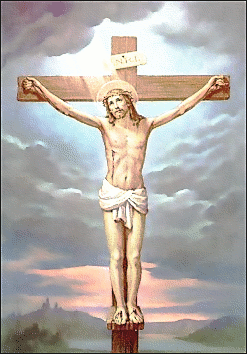
A more sentimental image

A more sentimental image

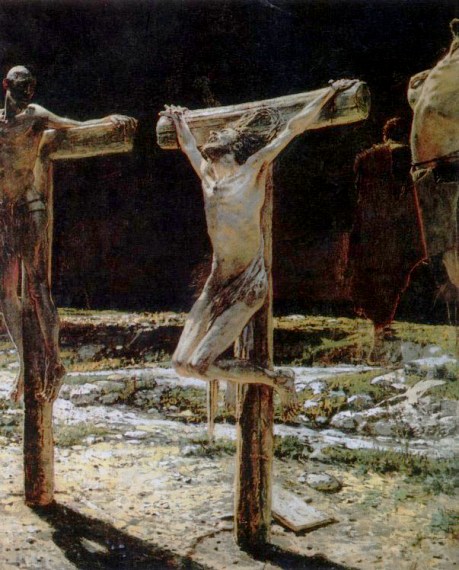
Nikolai Ge Crucifixion

Nikolai Ge Crucifixion

Lent 4 – 2015

John 3:14-21

Marian Free

 God of contradiction, open our hearts and minds to understand that your ways are not our ways and your thoughts are not our thoughts. Amen.

The crucifixion of Jesus has been portrayed in a wide variety of ways from the pious and sentimental to the violent and grotesque. Many are confronting (if for different reasons). For example I feel some disquiet when I see an image of Jesus fully dressed (in Bishop’s regalia) and exhibiting no signs of pain. Equally confronting is one from South America that depicts what looks like a charred body arched in pain and screaming in agony. For centuries the crucified Jesus was depicted as white (often blond). During the twentieth century new and original images emerged that more accurately reflected Jesus as a representative of all humanity – or example a Jesus with Chinese, Maori or African features. Sidney Nolan portrayed Jesus as a woman as did the artist whose sculpture was placed in a United Church in Toronto. Such imagery enables women and those whose skin colour is not white to fully grasp the notion that Jesus died for all people – including them – and not just for white (middle class) males.

New and confronting images of the crucifixion can help to make real the horror of the crucifixion. They can enable us to peel back the layers of piety that have, over the centuries, stripped the cross of its meaning. Our churches have crosses in all kinds of shapes and designs. There are wooden crosses, brass crosses, crosses made of silver or gold and crosses that are encrusted with jewels. Crosses in a number of different designs are worn as jewellery – even by those who do not profess the Christian faith. In many cases, the image of cross even when it is adorned with a crucified Christ has become so familiar that it has lost its power to confront and to challenge.

That said, I’m not at all sure that we would wish to be confronted with the horror of the crucifixion on a daily basis. We are told that crucifixion was an awful way in which to die. Whether a person was nailed or tied to a cross, they died slowly and of suffocation – pushing down on their nailed (or bound) feet so that they could take a breath[1]. It could take as long as three days to die. Crucifixion was also a very public death. Those who were condemned to die were generally put to death by the side of a well-travelled road so that their deaths could serve as an example to as many people as possible. It was a cruel, inhumane and humiliating way in which to die and, one would think, the most unlikely image to become an object of veneration.

This contradiction – that an image of torture and death could become a symbol representative of life and hope – is captured by the author of John’s gospel. In 3:14-15 Jesus says: “the Son of Man must be lifted up so that whomever believes in him will have eternal life.” In this passage and other places in which Jesus uses the expression “lifted up”, he is referring to his crucifixion. (“And I, when I am lifted up from the earth will draw all people to myself.” (12:32)) For the author of John’s gospel the cross, the crucifixion is the high point of Jesus’ ministry, the moment towards which the whole gospel is moving and the point at which it Jesus’ mission reaches not only its climax, but its fulfillment. The cross is a victory, not a defeat.

Lindars points out that Jesus’ victory on the cross is at least two-fold[2]. By laying dow his life for others, Jesus is demonstrating not only his deep love, but what is really God’s love for the world. In freely offering this gift, Jesus shows his readiness to do as the Father wills and demonstrates that he and the Father are one. Lindars refers to this as his “moral union with God”.

By overcoming the natural human resistance to pain and death and by conquering the human will to live, Jesus shows that human nature’s propensity to resist God and goodness can in fact be overcome and that humanity does not have to submit to selfish desires or to the propensity to gratify one’s own needs and desires before all else. Through his submission to the cross Jesus, Lindars suggests, wins the “supreme moral victory” (which is also a cosmic victory for “in his own person the devil’s grip on humanity is broken” (12:31)).

“Lifting up” in John’s gospel several layers of meaning. It can refer to the cross as the place of victory but it also suggestive of Jesus’ exaltation to the right hand of the Father. At the same time, because as we have seen, crucifixion was a very public event and because the cross lifted the victim above the level of the crowds the condemned men were very visible to those who gathered and to those who passed by. On the cross, Jesus is visibly and publicly displayed for all to see. Thank goodness we do not have to witness the physical event, but through the images that are available and those in our mind’s eye, we see Jesus’ lifted up and through John’s gospel comprehend that in this instance defeat is in fact victory, that death is a door to life and that even the worst of human excesses can be overcome.

We come to understand that on the cross, Jesus bore all the suffering of the world, experienced the baseness and cruelty of humankind at its worst and identified with the victims of cruelty and torture, the victims of domestic violence and bullying, the victims of oppression and injustice and all who have suffered at the hands of others. Those who have experienced unbearable pain and suffering can look at the cross and know that God shared/shares their pain. This understanding is best captured by a poem written by a woman who had experienced abuse at the hands of a man. The poem is written in response to a cruciform image of a woman that was hung below a cross in a United Church Chapel in Toronto.

May we all see in Jesus “lifted up” the victory of the cross, Jesus union with the Father, the triumph over evil and the possibility of resurrection.

By his wounds you have been healed

1 Peter 2:24


O God,

through the image of a woman

crucified on the cross

I understand at last.


For over hold my life

I have been ashamed

of the scars I bear.

These scars tell an ugly story,

a common story,

about a girl who is the victim

when a man acts out his fantasies.


In the warmth, peace and sunlight of your presence

I was able to uncurl my tightly clenched fists.

for the first time

I felt your suffering presence with me

in that event.

I have known you as a vulnerable baby,

as a brother and as a father.

Now I know you as a woman.

You we’re there with me as the violated girl

caught in helpless suffering.


The chains of shame and fear

no longer bind my heart and body.

A slow fire of compassion and forgiveness

is kindled.

my tears fall now

for man as well as woman.


You, God,

can make our violated bodies

vessels of love and comfort

to such a desperate man.

I am honored

to carry this womanly power

within my body and soul.


You were not ashamed of your wounds.

You showed them to Thomas

as marks of your ordeal and death.

I will no longer hide these wounds of mine.

I will bear them gracefully.

They tell a resurrection story.


Anonymous. Written after seeing a figure of a woman, arms outstretched as if crucified, hung below the cross in the Chapel of the Bloor St United Church in Toronto. The statue is now in a courtyard of Emmanuel United College in Toronto.[3]


[1] A Google search of images of the crucifixion provides some sketches which demonstrate what crucifixion was like.

[2] Lindars, Barnabas, SSF in The Johannine Literature. Ed Lindars, Barnabas, Edwards, Ruth B. and Court, John. Sheffield: Sheffield Academic Press, 2000, 91-93.

[3] The poem is anonymous. I read it in a Newsletter published by The World Council of Churches in 1988 as a part of the Ecumenical Decade of Churches in Solidarity with Women (1988-1998).

Living Dangerously

February 28, 2015

Lent 2 – 2015

Mark 8:31-38

Marian Free


In the name of God who invites us to take risks, to live dangerously and to have fun. Amen.

Over the past week or so I have been reading an interesting book entitled: “Why Men Hate Church” by David Murrow. The book addresses the obvious – the fact that in most Christian denominations women outnumber men, often by a considerable number (something which is not entirely accounted for by the reality that, on the whole, men die at a younger age than women). Admittedly I have only had a cursory look at the book[1], but from what I have gleaned it is something of a “Men are from Mars, and Women are from Venus” sort of thesis. Murrow argues that men and women think differently, act differently and want different things. He suggests that even though until recently men dominated the leadership of the church; for the last 1300 – 1400 years, the church has been increasing feminised. Murrow contends that around the year 700 the church lost its edge. At that time, he claims, the church gave up the emphasis on struggle and sacrifice and replaced it with a call to passivity and weakness. The image of Jesus changed from someone who was strong and courageous to someone who was meek and submissive. This in turn, he suggests, has led vast numbers of men and some women to feel at best uncomfortable and at worst unwelcome in many churches.

Assuming Murrow’s thesis to be true, we can of course document exceptions to the rule. As ill-conceived as they were, the crusades provided an opportunity for displays of courage and self-sacrifice, as no doubt did the two world wars. Throughout the ages, Saints such as Joan of Arc, missionaries such as Graham Staines and his sons Phillip and Timothy, clergy such as Dietrich Bonhoeffer and Bishops such as Oscar Romero have been willing to take greats risks and lay down their lives for the faith.

By and large though, the institutional church has settled down, become a part of the surrounding landscape and played it safe. It could not be argued that we at St Augustine’s live dangerously or that we take risks that might cost us our place in the community, let alone cost us our lives. Murrow suggests that this is one of the reasons why some people do not come to church – they don’t want to be safe. They want to be dangerous. Risk-takers, fun-lovers and builders he claims, do not find enough in our liturgy or our community life that is challenging or that takes them to the edge and so they stay away.

I am not at all sure that I agree with Murrow’s overall argument (among other things he is writing from a North American perspective) but his book does provide some food for thought and leads to a number of questions. Have we created a kind of mono-culture which leaves some people feeling as though there is no place for them in the church? More importantly it forces us to ask – what are we really about? Have we forgotten that the gospel is all about living dangerously, not about building a secure and comfortable place in which we can now (and forever) feel at home? Worshipping in our beautiful churches, using a liturgy with roots that are ancient, gathering with our friends week by week, have we lost sight of the fact that the Son of Man had nowhere to lay his head and that the early disciples were called away from all that was familiar and secure to a life in which almost nothing was certain except for uncertainty and risk. In our efforts to be part of the world around us, do we allow injustices to go unchallenged? In other words, are we really living gospel lives?

I suspect that we all suffer from a form of collective amnesia and that for the most part we put our efforts into keeping the institution of the church alive, rather than worrying about the survival of the gospel. That said, that model has served us well for centuries. As long as the community around us was predominantly Christian, the church has served the purpose of building up the community of faith. Through worship and prayer we have supported one another through difficult times and been challenged to grow in faith and faithfulness. Our faith has enabled many of us to take risks of sorts, to trust God when we have had to make difficult decisions or to step out in faith when we had no idea what the future held for us.

Times have changed. We can no longer assume that members of our local community hold the faith or that those who do will join our worshipping community. This being the case, how can we ensure the continuity of the gospel? How, in this changing world can we share with others this amazing gift of faith?

One answer is this – if people don’t come to us, we must go to them. We must ask those who do believe in Jesus Christ why they don’t join us. Is it because our culture and practice make them feel unwelcome? For those who do not believe we must explore new ways of making conversation, new ways of letting them into our secret. If the Christian church is to survive, we must be bold and courageous. We must seek out builders, risk-takers and those who are prepared to live dangerously and we must allow them to make us feel uncomfortable for a change. We must step out of our comfort zones and do things differently for a change.

Whether we like it or not, we must change or die. Or, perhaps as today’s gospel puts it, we must die to all that we are and all that we have known so that God’s purpose can be worked out through us. Jesus didn’t call us to be safe – anything but. His call to follow is an invitation to live on the edge, to let go of the past and to begin each day as if it were our first. We are not invited to be comfortable or complacent, but to be adventurous and daring, open to change and to challenge. We are only here because twenty centuries ago there were those who were brave enough to step out of their comfort zones and leave everything behind in order to answer Jesus’ call. Their courage and willingness to take risks ensured that the gospel message, not only survived but spread throughout the world?

In the twenty-first century, do we have the courage to answer the call? What are we prepared to leave behind to enter the future God is preparing for us?

[1] If you are interested, I suggest you read it for yourselves. Murrow, David. Why Men Hate Going to Church.

Suffering is not failure

August 30, 2014

Pentecost 12 – 2014
Matthew 16:21-28
Marian Free

In the name of God who gives us strength and courage to weather the storms of this existence and to come through the other side. Amen.

It is not unusual for someone who is confronted with bad news to deny or ignore it or to change it into a challenge – something that can be defeated or overcome. For example, a typical response these days to a diagnosis of terminal illness is: “I am going to fight it.” Older people (weary with living) who are encouraged by their families to hold on: “You are not going to die, we won’t let you.” When someone has an untimely death at sea, in the mountains or in the air or at sea, it is not uncommon to hear friends and family say: “At least he (or she died) doing what they loved,” as if that somehow makes it all right. At the same time, it is possible to treat the suffering of others in the same way. After the flood and during the cyclone our then Premier assured the state: “We are Queenslanders – we will recover.”

In today’s world it seems that many people are so determined to be positive or to be survivors that they are both unwilling and unable to confront the fact that life consists of both the good and the bad and that together they make up the fullness of living. Death is not some disaster that should be evaded – either by fighting it to the bitter end or by making out that a tragic death is somehow wonderful. Neither is it, for Christians at least, something to be feared. Death will come to all of us and while we may want to embrace life we cannot, in the end, cheat death. In the context of this strong, positive culture a simple acceptance of one’s circumstances has come to be seen as a weakness. Giving up or refusing treatment and accepting the inevitable has come to be viewed as a lack of determination to survive. A failure to be upbeat in the face of loss is considered to be giving in to rather than challenging fate.

Of course, I am over-generalising, but it does seem to me that, in this country at least, there has been a movement from a culture that lives with the tension of life and death, trauma and triumph, to a culture that seems to believe that with the right attitudes anything can be achieved.

When viewed through the lens of this culture Peter’s outburst in today’s gospel makes absolute sense – he doesn’t want Jesus to die.

To re-cap the story – in last week’s gospel Jesus asked the disciples: “Who do people say that I am?” After a couple of responses: “Elijah, one of the prophets”, Jesus asked: “But who do you say that I am?” Peter responds: “You are the Christ, the son of the living God.” His statement earns Peter not only Jesus’ commendation, but also the assurance that Peter is the rock on whom Jesus will build the church. In today’s gospel Peter the rock, is being accused of being Satan, a scandal, a stumbling block. The problem is that Peter doesn’t really understand. While he has come to the conclusion that Jesus is the Christ, he has not grasped what that really means. When Jesus explains that he must suffer and die, Peter reacts in a very human way and demonstrates that he has no idea of Jesus’ real nature and purpose.

At the time of Jesus there were a variety of expectations about the type of Saviour that God would send to redeem Israel. Some Jews thought that the redemption of Israel would be a military victory over Rome and that the Christ would lead them in battle. Others looked for a priestly figure who would reinvigorate the faith and cleanse the Temple and its officials of corruption. No one, it seems, expected the sort of Saviour that Jesus would turn out to be, a Christ who would suffer at the hands of the elders, the chief priests and the scribes and be put to death. They expected a leader, not a victim.

No wonder Peter bursts out: “God forbid! This will not happen to you.” He has not grasped that Jesus will win the hearts and minds of the people, not by force, but by love and that evil will not be defeated by power, but by powerlessness. He is thinking in human terms, showing that despite his acknowledgement of Jesus as the Christ he has not fully grasped what this means.

Peter’s natural instinct is to reject the notion of a suffering Christ and to protect his friend and teacher from harm. He does not realise that his good intention would in fact defeat God’s purpose. His misunderstanding makes him no better than Satan. For like Satan, Peter is trying to turn Jesus from the path set before him, like Satan, Peter fails to understand that weakness, not power will achieve God’s purpose, like Satan Peter has not grasped that it is only by submitting to God’s will that humanity will be saved.

No wonder Jesus reacts so strongly. He must be as firm in his purpose now, as he was when he was tempted in the desert. What is more, it is essential that Peter and the disciples understand what lies ahead. It is vital that they, his followers, understand the way of salvation, not only because he, Jesus will need their support and encouragement, but more importantly because if they are to carry on after he is gone, they will have to teach others about Jesus and they too will have to walk the way of the cross. The disciples must learn not only that Jesus is the Christ, but they must learn and understand what it is to be the Christ to follow in his footsteps.

Accepting the way of Christ is no passive submission to fate, but an active decision to follow the path that God has laid down for us wherever it may lead and whatever it may cost. It is a decision to allow our lives to be governed, not by human needs and desires, but by the presence of God within us. It is grasping the contradiction that the one sent by God to save, must also suffer and die and teaching others that suffering is not always failure, but is sometimes the very thing that leads to salvation and life.

Wisdom and the cross

February 8, 2014

Epiphany 5

1 Corinthians 2:1-13

Marian Free 

In the name of God, whose foolishness is wiser than human wisdom. Amen.

 If someone were to ask me which of Paul’s letters was my favourite, I think I would say the first letter to the Corinthians for no other reason than it reveals Paul’s profound insight into and interpretation of the cross. The community almost certainly Gentiles so it is not surprising that, as the letter indicates, they were a little confused as to the details of this new faith. It has to be remembered that at that time, there were no Christian scriptures. New converts were entirely dependent on the teaching of itinerant preachers who did not stay long enough in the community to ensure that all possible problems had been dealt with and all questions answered. Even though Paul had spent quite some time among the Corinthians, it seems that confusion reigned once he had left the city.

Paul writes this (possibly his second)[1] letter to Corinth in response to some concerns which had been reported by Chloe’s people[2] and also in response to a letter that the community had written to him[3]. Chloe’s concerns relate to divisions and competition in the community and immoral and un-Christian behaviour. Paul’s deals with issues such as members striving to outdo each other with regard to spiritual gifts, sub-groups following different leaders, a man living with his father’s wife and believers taking one-another to court. The letter also deals with more specific issues, many of which relate to relationships and sex: how to behave towards one’s spouse (whether to have sex or not, whether one should divorce a non-believing partner) and to marry or not to marry.

Even though Paul is addressing these very specific issues, he does so in a way that is theologically insightful and which interprets the cross of Christ is such a way that he can apply it to the community life of the believers in Corinth and to his own ministry.

The Corinthians, as I have said, were a divided community who had not fully grasped Paul’s message of the gospel. Perhaps based on the religions from which they had come, they placed wisdom as the high point of their faith and competed for the distinction of being the wisest or most knowledgeable in the community. It is clear that knowledge or wisdom is at issue. More than once Paul challenges their supposed wisdom with the question: “Do you not know?” (Obviously they do not!)

In order to demonstrate that the Corinthians wisdom is only narrow and partial, Paul points out the absurd contradiction of a crucified man proving to be God’s chosen one. As he says, any self-respecting Jew would have nothing to do with such a person – let alone elevate him to the status of God’s anointed.  On the other hand Greeks would think that to have faith in such a man would be utter foolishness.  To be fair, if we were to strip away sentimentality, dogma and creed, we too would think that a crucified Saviour was both gruesome and ridiculous (and impossible to sell). God, in Christ, has done something absolutely ludicrous. This, Paul claims, this is exactly the point. Christians believe that a man who was condemned to death as a criminal was the one sent by God. God’s action begs the question: Why on earth or in heaven would God chose such a person, or allow such an awful fate to befall the one whom he sent? He provides the answer using the words of Isaiah “I will destroy the wisdom of the wise, and the discernment of the discerning I will thwart.” (29:14)

According to Paul, God’s purpose in presenting us with a crucified Saviour was precisely to confound and unsettle us, to create some sort of cognitive dissonance that would force us to rely, not on ourselves, but on God, to shake us out of our complacency and to open our eyes to a completely different way of seeing, so that instead of being limited and bound by our own intelligence and by the constraints of the human imagination, we might be freed to see and hear what God is actually doing and saying. This, the cross demonstrates, is often the exact reverse of what we expect God to say and do.

In today’s text, Paul extends his argument about the cross to his proclamation of the gospel.  Paul made no attempt to claim power or knowledge for himself as did other preachers. He did not pretend to be anything he was not but allowed the Corinthians to see his weaknesses and imperfections. Paul has no need to compete, to demonstrate that he is wiser, stronger or more knowledgeable than anyone else. He is content to be weak and inarticulate because he knows that this enables him to be used by God and to be receptive to the Spirit. What is more those who come to faith know that they have not been swayed by the power of Paul’s presence and the force of his argument, but by the power of God working through him. Their faith lies where it belongs, in God and not in Paul.

The contradiction of the cross turns everything upside down. In so doing the cross exposes the flaws in what we might have thought we knew and the limitations of human knowledge and understanding – about worldly values, wisdom and strength. Through the cross God makes us aware that our knowledge, however good, is always incomplete and imperfect. The only true wisdom is that of God and the only way to achieve that wisdom is through recognizing the vast gulf between ourselves and the creator of all – who saw fit not to stun us with a triumphant king or a military victory, but a vulnerable, friendless man who died one of the most shocking deaths of all.

The purpose of the cross is to challenge the arrogance and self-conceit that allows us to believe that we know all there is to know about God. A crucified Saviour confronts our need for certainty and our dependence on doctrine, ritual and yes, even scripture and to open us to the power of God working in us and through us.


[1] 1 Corinthians 5:9

[2] 1 Corinthians 1:11

[3] “Now concerning the matters about which you wrote” (7:1, cf 7:25, 8:1).