Posts Tagged ‘Crucifixion’

In vulnerably lies our salvation

November 19, 2016

The Reign of Christ – 2016

Luke 23:33-43

Marian Free


In the name of God whose contradictions keep us always guessing. Amen.

Periander had sent a herald to Thrasybulus and inquired in what way he would best and most safely govern his city. Thrasybulus led the man who had come from Periander outside the town, and entered into a sown field. As he walked through the wheat, continually asking why the messenger had come to him from Cypselus, he kept cutting off all the tallest ears of wheat which he could see, and throwing them away, until he had destroyed the best and richest part of the crop. Then, after passing through the place and speaking no word of counsel, he sent the herald away. When the herald returned to Cypselus, Periander desired to hear what counsel he brought, but the man said that Thrasybulus had given him none. The herald added that it was a strange man to whom he had been sent, a madman and a destroyer of his own possessions, telling Periander what he had seen Thrasybulus do. Periander, however, understood what had been done, and perceived that Thrasybulus had counselled him to slay those of his townsmen who were outstanding in influence or ability; with that he began to deal with his citizens in an evil manner[1].

According to Wikipedia this tale, which dates from at least the 4th century BCE is the origin of what we know as the Tall Poppy Syndrome – the desire to cut down anyone whom we believe to have “risen above their station”. That same site quotes Peter Harcher from the Sydney Morning Herald who defines the Australian version of the syndrome in the following way, “(Australian) citizens know that some among them will have more power and money than others… But according to the unspoken national ethos, no Australian is permitted to assume that he or she is better than any other Australian. How is this enforced? By the prompt corrective of levelling derision. It has a name—The “Tall Poppy Syndrome”. The tallest flowers in the field will be cut down to the same size as all the others. This is sometimes misunderstood…It isn’t success that offends Australians. It’s the affront committed by anyone who starts to put on superior airs[2].”

Sociologists like Max Weber believe that believe that in some groups, especially those that are disadvantaged socially or economically, there is only a “limited amount of prestige to go around”. As a result those who gain a degree of power or influence are resented for absorbing more than their fair share, which in turn restricts the ability of others to gain attention and authority[3]. In Australia, it seems that another person’s success offends our sense of egalitarianism. If someone is more successful than his or her peers, it is (in the minds of their peers) a sign that they think more highly of themselves than they should. They have broken the bonds of solidarity that provide strength and dignity to those on the lower rungs of the social scale and have set themselves apart to the chagrin of their peers.

Those left behind seek to humiliate if not destroy those who by good fortune or hard work have improved their place in the world. They try to bring that person down to their own level, to prove that they are just as human and flawed as the next person.

Should that person experience a reversal in fortune or a fall from grace, his or her peers will crow with delight, gather like vultures to pick over the bones, boast with delight that they knew that no good could come from someone overreaching themselves. They think to themselves how wise they were to have predicted the inevitable outcome of another’s ambition and pride. They express no sympathy for the plight of the fallen, just gleeful spite and self-congratulation.

If we understand this characteristic of human nature (the desire to cut others down to size), we will not surprised that this is how a majority of people react to Jesus’ arrest, condemnation and crucifixion. After all Jesus, in the minds of many, is just some peasant upstart from the far-flung region of Galilee who despite being a nobody has been causing mayhem in Jerusalem and in the Temple. Egged on by the leaders (whose apparent power derives from Rome), those present at the cross deride and mock Jesus, pointing out his powerlessness and the contrast between his present situations and that to which he might have aspired. What right does he have to set himself above others? What makes him different from the rest of the poor peasants who make up 99% of the population? Why should he receive the adulation and support of the crowds? What gives him the right to challenge the leaders and to critique Temple worship? Those who have no power – the soldiers, the crowd and even one of Jesus’ co-condemned – ridicule Jesus and demand that he demonstrate the power that he claimed to have. They want him to prove himself. If he is better than them, if he is able to perform miracles, if he is closer to God than they are then now is the time to prove it.

Three times the challenge rings out: “If he is the Christ let him save himself.” “If you are the King of the Jews save yourself.” “Are you not the Christ? Save yourself and us.” Three times Jesus is challenged to “save”. Save! Save! Save! they cry in mockery, knowing that the cross holds Jesus tight.

What we can see and the crowds cannot, is that the cross is unable to hold Jesus. The leaders, the soldiers, the man condemned to death have completely misunderstood the way in which Jesus will save (will bring about salvation). He will not “save himself from the cross, but his submission to the cross will bring about the salvation of the whole world. What the leaders and the soldiers and the condemned man have failed to understand is that it is precisely Jesus’ willingness to be powerless and vulnerable, his readiness to submit himself completely to God and his total obedience to and reliance on God that will lead not only to his own “rescue” from death, but also to the salvation of the whole of humankind.

As is often the case in the gospels, it is the most unlikely figure who can see the truth. A condemned man, who within two days will have died the most horrific of deaths, recognises Jesus’ paradoxical kingship. “Jesus, remember me when you come into your kingdom.” Jesus, knowing the authority that he does have, promises “today you will be with me in Paradise”.

Crucifixion does not look like salvation, death does not look like life, vulnerability does not look like control but Jesus’ knew and the thief discerned, that it is only when we give up our independence and sense of control, only when we place ourselves completely and utterly in God’s hands that we can and will be saved.


[1] The concept originates from accounts in HerodotusThe Histories (Book 5, 92f), Aristotle‘s Politics (1284a), and Livy‘s History of Rome, Book I. https://en.m.wikipedia.org/wiki/Tall_poppy_syndrome

[2] op cit

[3] op cit

Victory of the cross

March 14, 2015
Cruciform woman - Emmanuel United College Toronto

Cruciform woman – Emmanuel United College Toronto

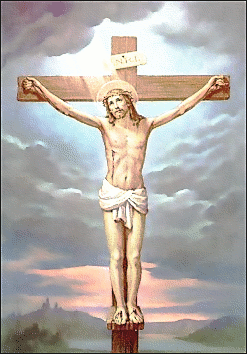
A more sentimental image

A more sentimental image

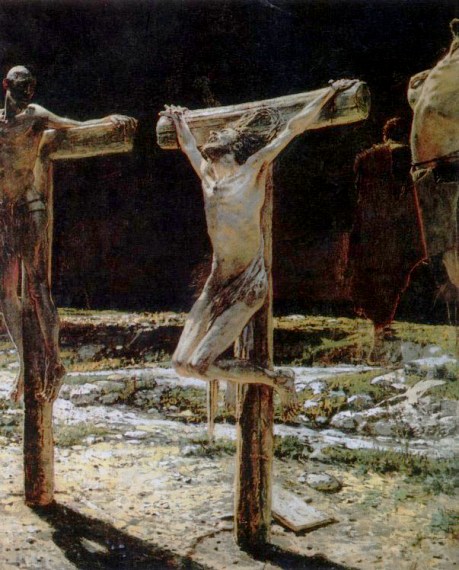
Nikolai Ge Crucifixion

Nikolai Ge Crucifixion

Lent 4 – 2015

John 3:14-21

Marian Free

 God of contradiction, open our hearts and minds to understand that your ways are not our ways and your thoughts are not our thoughts. Amen.

The crucifixion of Jesus has been portrayed in a wide variety of ways from the pious and sentimental to the violent and grotesque. Many are confronting (if for different reasons). For example I feel some disquiet when I see an image of Jesus fully dressed (in Bishop’s regalia) and exhibiting no signs of pain. Equally confronting is one from South America that depicts what looks like a charred body arched in pain and screaming in agony. For centuries the crucified Jesus was depicted as white (often blond). During the twentieth century new and original images emerged that more accurately reflected Jesus as a representative of all humanity – or example a Jesus with Chinese, Maori or African features. Sidney Nolan portrayed Jesus as a woman as did the artist whose sculpture was placed in a United Church in Toronto. Such imagery enables women and those whose skin colour is not white to fully grasp the notion that Jesus died for all people – including them – and not just for white (middle class) males.

New and confronting images of the crucifixion can help to make real the horror of the crucifixion. They can enable us to peel back the layers of piety that have, over the centuries, stripped the cross of its meaning. Our churches have crosses in all kinds of shapes and designs. There are wooden crosses, brass crosses, crosses made of silver or gold and crosses that are encrusted with jewels. Crosses in a number of different designs are worn as jewellery – even by those who do not profess the Christian faith. In many cases, the image of cross even when it is adorned with a crucified Christ has become so familiar that it has lost its power to confront and to challenge.

That said, I’m not at all sure that we would wish to be confronted with the horror of the crucifixion on a daily basis. We are told that crucifixion was an awful way in which to die. Whether a person was nailed or tied to a cross, they died slowly and of suffocation – pushing down on their nailed (or bound) feet so that they could take a breath[1]. It could take as long as three days to die. Crucifixion was also a very public death. Those who were condemned to die were generally put to death by the side of a well-travelled road so that their deaths could serve as an example to as many people as possible. It was a cruel, inhumane and humiliating way in which to die and, one would think, the most unlikely image to become an object of veneration.

This contradiction – that an image of torture and death could become a symbol representative of life and hope – is captured by the author of John’s gospel. In 3:14-15 Jesus says: “the Son of Man must be lifted up so that whomever believes in him will have eternal life.” In this passage and other places in which Jesus uses the expression “lifted up”, he is referring to his crucifixion. (“And I, when I am lifted up from the earth will draw all people to myself.” (12:32)) For the author of John’s gospel the cross, the crucifixion is the high point of Jesus’ ministry, the moment towards which the whole gospel is moving and the point at which it Jesus’ mission reaches not only its climax, but its fulfillment. The cross is a victory, not a defeat.

Lindars points out that Jesus’ victory on the cross is at least two-fold[2]. By laying dow his life for others, Jesus is demonstrating not only his deep love, but what is really God’s love for the world. In freely offering this gift, Jesus shows his readiness to do as the Father wills and demonstrates that he and the Father are one. Lindars refers to this as his “moral union with God”.

By overcoming the natural human resistance to pain and death and by conquering the human will to live, Jesus shows that human nature’s propensity to resist God and goodness can in fact be overcome and that humanity does not have to submit to selfish desires or to the propensity to gratify one’s own needs and desires before all else. Through his submission to the cross Jesus, Lindars suggests, wins the “supreme moral victory” (which is also a cosmic victory for “in his own person the devil’s grip on humanity is broken” (12:31)).

“Lifting up” in John’s gospel several layers of meaning. It can refer to the cross as the place of victory but it also suggestive of Jesus’ exaltation to the right hand of the Father. At the same time, because as we have seen, crucifixion was a very public event and because the cross lifted the victim above the level of the crowds the condemned men were very visible to those who gathered and to those who passed by. On the cross, Jesus is visibly and publicly displayed for all to see. Thank goodness we do not have to witness the physical event, but through the images that are available and those in our mind’s eye, we see Jesus’ lifted up and through John’s gospel comprehend that in this instance defeat is in fact victory, that death is a door to life and that even the worst of human excesses can be overcome.

We come to understand that on the cross, Jesus bore all the suffering of the world, experienced the baseness and cruelty of humankind at its worst and identified with the victims of cruelty and torture, the victims of domestic violence and bullying, the victims of oppression and injustice and all who have suffered at the hands of others. Those who have experienced unbearable pain and suffering can look at the cross and know that God shared/shares their pain. This understanding is best captured by a poem written by a woman who had experienced abuse at the hands of a man. The poem is written in response to a cruciform image of a woman that was hung below a cross in a United Church Chapel in Toronto.

May we all see in Jesus “lifted up” the victory of the cross, Jesus union with the Father, the triumph over evil and the possibility of resurrection.

By his wounds you have been healed

1 Peter 2:24


O God,

through the image of a woman

crucified on the cross

I understand at last.


For over hold my life

I have been ashamed

of the scars I bear.

These scars tell an ugly story,

a common story,

about a girl who is the victim

when a man acts out his fantasies.


In the warmth, peace and sunlight of your presence

I was able to uncurl my tightly clenched fists.

for the first time

I felt your suffering presence with me

in that event.

I have known you as a vulnerable baby,

as a brother and as a father.

Now I know you as a woman.

You we’re there with me as the violated girl

caught in helpless suffering.


The chains of shame and fear

no longer bind my heart and body.

A slow fire of compassion and forgiveness

is kindled.

my tears fall now

for man as well as woman.


You, God,

can make our violated bodies

vessels of love and comfort

to such a desperate man.

I am honored

to carry this womanly power

within my body and soul.


You were not ashamed of your wounds.

You showed them to Thomas

as marks of your ordeal and death.

I will no longer hide these wounds of mine.

I will bear them gracefully.

They tell a resurrection story.


Anonymous. Written after seeing a figure of a woman, arms outstretched as if crucified, hung below the cross in the Chapel of the Bloor St United Church in Toronto. The statue is now in a courtyard of Emmanuel United College in Toronto.[3]


[1] A Google search of images of the crucifixion provides some sketches which demonstrate what crucifixion was like.

[2] Lindars, Barnabas, SSF in The Johannine Literature. Ed Lindars, Barnabas, Edwards, Ruth B. and Court, John. Sheffield: Sheffield Academic Press, 2000, 91-93.

[3] The poem is anonymous. I read it in a Newsletter published by The World Council of Churches in 1988 as a part of the Ecumenical Decade of Churches in Solidarity with Women (1988-1998).

The absence of God- what makes this Friday “Good”?

April 18, 2014

Good Friday 2014Good Friday – 2014

(Read in conjunction with the Good Friday liturgy on this site

https://swallowsrest.wordpress.com/good-friday-liturgies/)

“My God, my God, why have you forsaken me?”

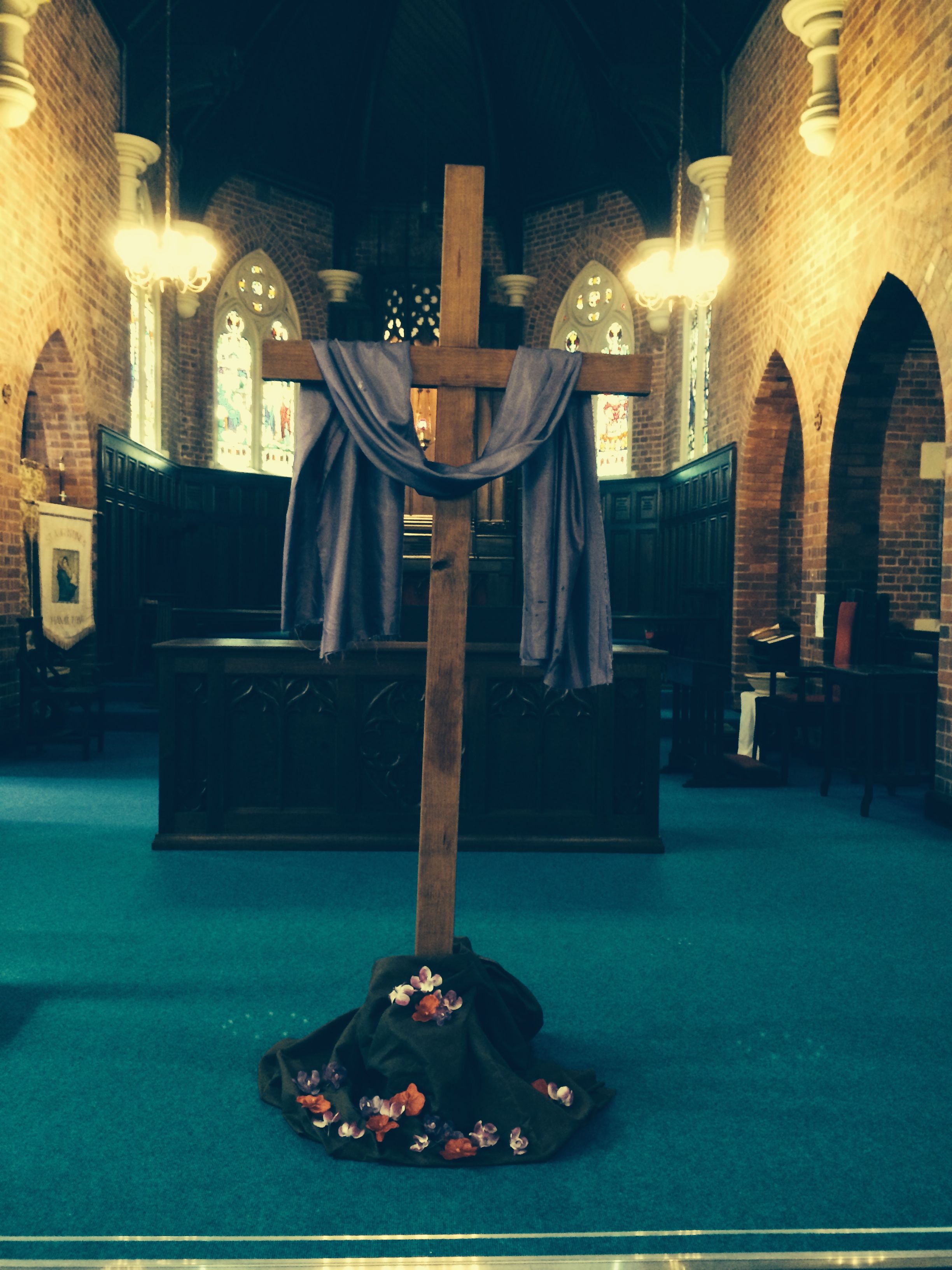
A bare church, an empty altar speaks to me of absence – God’s absence.

The Bible is full of God’s absence, times when people have called to God and have been met with silence. Of all the biblical images of absence, Jesus’ cry from the cross and his ultimate death are the most poignant.

If Jesus is God, where is God when Jesus hangs dying on the cross? Is there a moment when there is no God?

If Jesus is God – and we believe that he is – then God is Jesus and Jesus is dying/dead.

How can it possibly be Good Friday? The shocking failure of Jesus’ potential, Jesus’ promise, the destruction of the hopes of all who followed him, the brutality of the crucifixion are anything but “good”.

“My God, my God, why?

The paradox is this – God’s apparent absence is also God’s ultimate presence.

The cross confronts us with the uncomfortable truth that God is so intimate, so completely identified, with the human condition, that God would go so far as to share a human death. You can’t get any closer to human experience, to us than that.

This is perhaps the ultimate contradiction. Not only that Jesus’ death is God’s death, but that God’s death is a confirmation of God’s deep, unswerving, unreserved love for us – a love shown by God in Jesus who not only goes through the motions of dying, but who actually dies – dies a we will all one day die.

It is a contraction – God’s absence serves to demonstrate God’s intense, immediate, never-ending presence with us and in us.


And that is what makes this Friday “Good.”

There is no river

March 28, 2013

Good Friday


In the name of God, Creator, Redeemer and Sanctifier. Amen.

(Eli, Eli, by Judith Wright,

http://reflectionsonlandusetranslationsmorebycew.com/Judith_Wright/Wright_Poems.html)

And all the while he knew there was no river.

One of the things people most struggle with in regard to faith is the fact that God does not intervene. “Why does God let that happen?” people ask in the face of untimely death, natural disaster, war, disease or terror. Where is God when the drunken driver swerves on to the footpath, when the megalomaniac leader tortures and kills any opposition, or when unprincipled greed leads to the sale of addictive drugs and to the violence and murder of drug wars?

Where is God, silent and inactive while the world tears itself apart? Where is God?

The silent, suffering God is nailed to the cross, enduring the agony of watching those whom He created with such confidence destroying themselves and each other.

On the sixth day, God created humankind in God’s own image. God saw everything that he had made, and indeed, it was very good. If the world is less than perfect, it is by and large because we have made it so. Humanity, the “very good” of God’s creation, has chosen a path other than that which was intended by the creator. Given the choice, humankind chose competition with rather than cooperation with God – with disastrous results.

And though God in Christ holds out love and faith, humanity will not take it God’s hand. We would rather be in control of our own destiny and despite the evidence that we are making a very poor job of it, we continue to hold ourselves apart, to believe that the solution lies in our own hands. We continue to turn our back on God, and on all that is good, and in so doing we reduce God’s power to intervene to nothing.

There is no river but the morass we create for ourselves. There is no river but that of our own making. There is no river, but our own self-absorption, our need for power and control and our desire to make decisions for ourselves.  These are the nails that hold Christ to the cross. These are the causes of God’s apparent inaction. These are the wounds which we continue to inflict and which God in Christ continues to bear.

There is no need to drown in the river. If only we would let go of our pride and take the hand that is offered, the love that is proffered and the faith that is ours to claim we would learn that there is no river except that which we ourselves have created.

There is no river, but Christ will hold our pain and sorrow on the cross until at last we let go of ourselves and turn to him.


Intercessions


Suffering God,

open our eyes to the suffering in the world

and to the part we play in causing harm to others.

Give to us the gift of discernment

so that we might be wise in our decision-making

and alert to the broader consequences of our actions.

God who allows us to make our own mistakes.

Guide us into the way of your wisdom.

Holy God,

empower your church to proclaim your gospel and

to confront evil and injustice.

Help her to resist the temptation to conform and

to name greed and selfishness

especially when it destroys the lives of others.

Be especially with your church in the Middle East

and Palestine, that it might give wise counsel on

ways to bring about peace.

God who allows us to make our own mistakes.

Guide us into the way of your wisdom.

God of love,

be with those whose wounds are self-inflicted

because they cannot or will not accept your love

or the love and care of those around them.

Show us how to share your love with those whom we do not understand

and those whom we find to be unloveable.

God who allows us to make our own mistakes.

Guide us into the way of your wisdom.

Wounded God,

heal the bodies, minds and souls of all who turn to you for help and give them confidence and peace.

Endow with compassion and resilience those

whose task it is to heal broken bodies and minds

and be especially with those who work at the cutting edge of accident or disaster.

God who allows us to make our own mistakes.

Guide us into the way of your wisdom.

Dying Christ,

as you gave yourself completely to God,

so may we give ourselves completely to you

that in this life we may know peace and wholeness

and in the life to come may share your kingdom with all who have gone before us.

God who allows us to make our own mistakes.

Guide us into the way of your wisdom.