Epiphany 5 – 2019
Luke 5:1-11
Marian Free
In the name of God who challenges us to go our of our depths to see who, with the help of Jesus, we can be. Amen.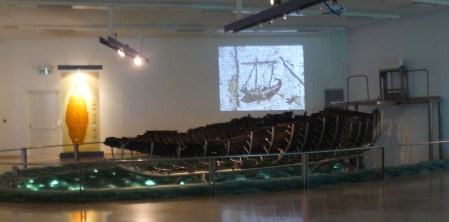
The most popular attraction in Israel is, perhaps surprisingly, a first century fishing boat. The boat in question was discovered by two brothers from Kibbutz Ginnosar who used to trawl the shore of the Sea of Galilee looking for artifacts. On one such occasion they discovered the outline of a boat. The story of raising and preserving the boat is fascinating and, thanks to the care taken with it’s restoration, we have an almost complete boat from the time of Jesus. It could hold up to fifteen men and their catch. The one located and preserved at Ginnosar had been repaired on many occasions during the course of its life and archeologists have identified a huge variety of timbers that, over time have been used to repair the boat. While the archeological significance of the discovery is immense and adds a great deal to our understanding of the craft of boat building in the first century, the discovery has the added weight of giving us a truer idea of the sort of vessel into which Jesus might have climbed in today’s gospel.
As with many of the accounts in our gospels, the story of the miraculous catch can be read in a variety of ways and on many different levels. We can notice the difference between this version of Peter’s call and that of the author of Mark, or we can compare the story with the post-resurrection catch of John’s gospel. Time could be spent comparing Peter’s reaction to Jesus with that of the prophets who, in the presence of the divine, recognize their limitations and frailties and protest their unworthiness. What did Jesus teach from the boat and what does it mean to ‘catch people alive’ we might wonder? Why does Peter address Jesus as ‘master’ before the catch and as ‘lord’ after the catch? And why does Luke use the language of ‘catching people alive’ (or enthralling them) when Matthew and Mark tell us that Jesus commissions the first disciples to ‘fish for people’.
These eleven verses, that on the surface recount the call of Peter, James and John, are filled with meanings and nuances that are both obvious and subtle. It could take hours for us to unpack the various complexities of the scene!
Today, I’d like to explore the possibility that the the story of the miraculous catch is a metaphor for our own time, that Jesus urges us to try again when we have lost hope and when feel that we have done all that we can.
We live in an age in which many of have grown weary of trying to win people for Christ and in which too often we fall into despair at the decline in church attendance and at our our inability to prevent the church’s slide into irrelevance. It is a time in which religion is often used to defend conservative values at the cost of compassion and to the detriment of the gospel message of love and in which the political and social landscape is undergoing great change. It is easy to be overwhelmed by the hopelessness of our situation and to simply give up.
Peter, James and John were, according to Luke, professional fishermen. They owned their boats and were in a business partnership. Almost certainly their fathers were fishermen before them and from an early age they would have understood the lake and the times at which the fish were most likely to be running. After an unfruitful night they would have been tired and frustrated and possibly anxious about the loss of revenue and in no mood to have another go. There would have been no reason for them to respond to a tradesman from Nazareth who knew nothing of the ways of fish or of the sea. Yet Jesus’ word is authoritative enough to persuade Peter to go back to the deep and to try one more time. He is rewarded with a catch so large that it begins to break the nets and Peter is forced to call for help.
The world of Peter was no more benign or settled than our own. Peter, James and John were not carefree fishermen, plying their trade and selling their catch. Rome overshadowed all their lives. The state would have demanded that they pay a tax or a levy for the right to fish and Rome’s representatives may have demanded a proportion of the catch. Life would have been difficult and the conditions oppressive and there would have been no reason to imagine that the situation was about to change. Tomorrow would be more of the same, but the certainty of their lives, hard as they were, would surely have more allure than the uncertainty of trusting in let alone following Jesus.
Jesus approached fishermen who were disillusioned and tired and he told them to try one more time. He ignored Peter’s protestations that he was a sinful man and without so much as a ‘by your leave’ he assured Peter that from now on he would hold people enthralled.
Many of us in the church are exhausted and disheartened. We feel that we have done all that we can to bring about growth in our congregations. We are conscious too, that collectively we are tainted by scandal, blemished by the compromises we have made and held in scorn because we have been unable to change and adapt.
When we feel that we have reached the limit of our reserves, Jesus comes to us, takes his place with us and says: ‘Try again. Take heart, go out once more into the midst of a world that is complex and hostile. Throw out your nets one more time. You will be amazed at what I can do with you – sinners that you are. Don’t be afraid, with me you will hold people enthralled.’


 Swallowsrest