Posts Tagged ‘doubt’

Is seeing believing? Thomas

April 6, 2024

Easter 2 – 2024

John 20:19-31

Marian Free

Christ is risen! He is risen indeed!

In the name of God, who reveals Godself to us, as and when we need to know God’s presence. Amen.

Today’s gospel is rich in detail, detail that we fail to notice because our focus too often has been on Thomas. The idea of a doubting Thomas has become part of our lingua franca as if the primary purpose of Jesus’ resurrection. appearances was to expose Thomas’ need for proof, to congratulate those who do not need proof and to chide those who need to see to believe.  

A number of problems arise when we approach Jesus’ resurrection appearances to the disciples with this blinkered, one-eyed approach. A primary problem, as I have pointed out previously is that among the disciples in John’s gospel, Thomas is one of the few who has a speaking part. It is Thomas, who in an earlier chapter avers that he will die with Jesus and Thomas who, when Jesus says that they know the way to where he is going (14:4) has the courage to ask the question that is on the lips of every disciple: “We do not know where you are going. How can we know the way?”

Far from being the example of a questioning, doubting disciple, Thomas demonstrates what it is to be a leader among the disciples and a confident follower of the earthly Jesus. One might even argue that Thomas’s absence from the locked room (in which the other disciples had hunkered down “for fear of the Jews”) was that, of all the disciples he was not to be afraid to go out – even if that meant being put to death with or for Jesus!

If the focus of today’s gospel is not Thomas’ failure to believe, we need to look at the text anew. 

Looking at the two resurrection appearances together, we notice that the disciples (with the exception of Thomas) are afraid, so afraid that they have locked the doors of the house. They are afraid – despite the fact that Peter and John at least have seen the empty tomb. They are afraid –   even though Mary Magdalene has reported that she has seen (and touched) the risen Christ.  Thomas is not alone, until the other disciples see Jesus for themselves they are all unbelievers. It is only when Jesus appears among them and shows them his hands and side that the disciples let go of their fear and rejoice. 

What happens next suggests that Thomas feels that he has been hard done by. For some reason, Jesus chooses to appear at a time when only Thomas is not present. In the absence of Thomas, Jesus has commissioned the other disciples to carry on his ministry and has equipped them with the Holy Spirit. Further, Jesus has given those disciples authority to forgive. Up until now Thomas has shown leadership qualities, his absence now is evidence of his courage. It would be surprising if he didn’t feel disappointed and overlooked. His petulant cry might reflect his disappointment that he was not present and his refusal to believe his fellow disciples as much as it reflects his scepticism that Jesus had risen. 

Not surprisingly, Thomas’ demand is no problem for Jesus.  A week later, (possibly the next time they were all together) Jesus appears again. On this occasion the doors are shut, but not locked. Jesus again offers “Peace”. He invites Thomas to touch his scars and, to not be unbelieving[1], but to believe. Thomas’ response reminds us of his leadership qualities. Unlike the other disciples who, when they see Jesus, simply accept that he has risen, Thomas declares Jesus to be both Lord and God. Far from being the Doubter, Thomas is in fact the first, and only disciple in John’s gospel to identify Jesus as both Lord and God.

That leaves us with perhaps the most confusing aspect of today’s gospel – Jesus’ response to Thomas’s declaration. According to John, instead of commending Thomas for his declaration of faith (as he does Peter in the Synoptics), Jesus appears to chide him. “Have you believed because you have seen me? Blessed are those who have not seen and yet have come to believe.” The question is, are those words addressed to the disciples as a whole, to Thomas alone, or does the gospel writer have his eyes firmly fixed on his readers, and on those of us who will read the words centuries later?

John concludes the resurrection account (and what some believe to be the original gospel) with the following explanation: “But these are written so that you may come to believe that Jesus is the Messiah, the Son of God, and that through believing you may have life in his name”. Given that the gospel is written at a time when there are no eye witnesses to Jesus, let alone to the resurrection it is possible to argue that the beatitude has quite a different intent. Jesus (or the gospel writer) seems to be making it clear that the readers of John’s gospel and those like ourselves who have come to faith generations later, are at least as blessed if not more blessed than those knew him in the flesh and who as a consequence, struggled to accept his resurrection.

We who have never known the earthly Jesus, but who have his life, death and resurrection reported and interpreted in scripture, do not have to struggle with the fact that our friend, Jesus was God after all. We, who did not have to ponder how someone so obviously dead could now be alive, have the advantage of knowing the resurrected Jesus in our own lives. We are indeed blessed, because seeing and knowing may in fact have been impediment to believing.


[1] This is more accurate translation and avoids giving Thomas the misnomer of “Doubting”.
Jumping out of the boat – earning salvation or being ourselves

August 12, 2023

Pentecost 11 – 2023
Matthew 14:22-33
Marian Free

In the name of God who comes to us on stormy waters and gives us reassurance and peace. Amen.

[“Drop thy still dews of quietness till all our strivings cease, take from our soul the strain and stress. and let our ordered lives confess, the beauty of thy peace, the beauty of thy peace.”]

How we read the bible is fascinating. For example, generations of Christians have used today’s gospel as a guide (albeit negative) to discipleship. The disciples are terrified (not by the storm, but by the appearance of Jesus and Peter, even though Jesus has identified himself, put him to the test: “If it is you command me to come to you on the water,” he says. Then, when Jesus commands Peter to “come”, Peter demonstrates how little he trusts him. Having begun well, Peter notices the waves and begins to sink. The lesson, we suppose, is that we are not to be like Peter – Peter the impetuous, Peter the foolish, Peter the doubter. In order to prove that we are good disciples, we will demonstrate that we trust God sufficiently to leave the boat to walk on stormy waters – to take risks confident that God will come to our rescue. Good Christians do not falter like Peter when storms rage all around us, we hold fast to our faith, confident that God is with us.

Too often we fall into the trap of making the scriptures a rule book for Christian behaviour – a guide as to how we should behave, what our response to God should be, what will happen if we do the wrong thing and how we measure up against the standard required to achieve salvation. In other words, our tendency is to read scriptures as if they are all about us, rather than understanding that scripture is a revelation about God. Such an attitude makes us inward looking, focused on what we do for God rather than what God does for us.

If today’s gospel is about discipleship, the implication is that discipleship requires unquestioning faith, courage and fortitude – not fear, doubt and indecision. In the face of the disciple’s terror and Peter’s mistrust, we are left feeling that we have to prove ourselves, that we have to behave in a certain way if we want to earn Jesus’ approval. After all no one wants to earn Jesus’ approbation: “You of little faith.” Yet the disciples are anything but models for Christian living and they certainly don’t provide an example for us to emulate. Rather than being exemplars of faith, they reveal their uncertainty, and their fear. They do not recognise Jesus, they are terrified, and Peter puts Jesus to the test. What they are however is real – their humanity and their imperfections are obvious.

So, perhaps this is not a story about how to be disciples and is not urging us to trust Jesus and leave the safety of the boat. In which case, what is Matthew’s intention and what Matthew’s listeners hear that we do not?

It is important to remember that the first century was an oral culture. Most people could not read, and scrolls were rare and beyond the income of most people. Community stories and stories from the Bible would have been repeated so often that they were committed to memory. Matthew’s community might not have known chapter and verse, but they will have known their scriptures well enough to have recognised allusions to the Old Testament even if they could not tell you exactly where it came from. Such would have been the case with regard to today’s gospel. Hearing that Jesus went to them, walking on the sea, Matthew’s listeners will have heard references to the role of God in creation as depicted in the Book of Job where God “tramples the waves of the sea” (9:8) and challenges Job asking if he ever “went upon the springs of the sea or walked on the recesses of the deep” (Job 38:16). They will have drawn the conclusion that Matthew was making the claim that Jesus and God were one.
That conclusion would have been reinforced when Jesus addresses the terrified disciples saying: “Do not be afraid. I AM.” Matthew’s community will have recognised, “Do not be afraid”, as the first thing a divine messenger says when interacting with a human (Gen 15:1, 26:24 eg). Jesus is more than a messenger he is I AM. The Greek – εγω ειμι – is clumsy, so our English translations read: “It is I”, but the Greek is simply I AM. Jesus is using for himself the name by which God identifies himself to Moses: “I AM.” The disciples affirm that this scene is about the nature of Jesus when they state: “Truly you are Son of God.”

At the heart of today’s gospel is a revelation about the nature Jesus. It is not a guidebook on Christian living, but it does after all have something positive to say about discipleship.

Discipleship, as this account reminds us, is about being ourselves – with all our flaws, our fears, and our doubts. Discipleship is not about striving to do good works, trying to be better people, or struggling to earn God’s approval. Discipleship has nothing to do with earning our salvation and everything to do with accepting that God in Jesus has already wrought our salvation. Discipleship means being in relationship with the living God who, though we did nothing to deserve it, lived with and died for us.

When we understand this, we can see that Peter and the other disciples in the boat were in fact model disciples, not because they were perfect, but because they were perfectly themselves, perfectly willing to have their humanity exposed and perfectly open to the revelation that Jesus was/is God.

We don’t have to jump out of the boat, we don’t have to take risks of faith, we simply have to be ourselves and allow God to do the rest.

The danger of certainty

April 10, 2021

Easter 3 – 2021

John 20:19-31

Marian Free

In the name of God “whose ways are not our ways and whose thoughts are not our thoughts.” Amen.

Hymn 453 in Together in Song begins:

We limit not the truth of God
  to our poor reach of mind,
by notions of our day and sect,
  crude, partial and confined.
No, let a new and better hope
  within our hearts be stirred:
the Lord hath yet more light and truth
  to break forth from His Word.

“The Lord hath yet more light and truth to break forth from His Word”. As the hymn suggests, if we believe that we know all that there is to know about God or think that God’s self-revelation ended with Jesus we are limiting the truth of God to our imperfect capacity to see and to understand. If we approach our scriptures in a glib and superficial way, we are almost certain to draw the wrong conclusions. And if we see scripture only as a collection of proof texts, we will be guilty of using the bible to reinforce our own preconceptions and we will miss the depth and complexity that lies within scripture as a whole. 

An example of the latter can be found in a common interpretation of today’s gospel. There are 13 verses in our reading which are themselves part of a wider context – including Jesus’ resurrection appearances, the entire gospel of John and scripture as a whole. Despite this the focus has almost invariably been on two short phrases: “Do not doubt but believe,” and “blessed are those that not having seen me believe.” Read together, and separated from their context, these two quotes imply that doubt is incompatible with faith and that Jesus is indirectly censuring Thomas for doubting that he had risen.

Isolating these phrases from their setting leads us to ignore the fact that Jesus does not condemn Thomas but makes an appearance especially for him. It overlooks the fact that having seen Jesus, it is only Thomas among the disciples who proclaims Jesus as: “my Lord and my God.” Detaching these phrases from the gospel as a whole means that we forget that Thomas alone promises to follow Jesus even unto death. It also means that we pay no heed to the faithlessness of all the disciples who abandoned Jesus at the first hint of trouble and who now, two weeks after the resurrection are still hiding in terror. Without the benefit of the other gospels, we fail to realise that Thomas is not the only disciple who finds it hard to believe that Jesus is risen. 

Doubt is not limited to Thomas but is a consistent theme throughout the bible. Many of the people whom we consider to be heroes of the faith had moments (even years) when their faith in God wavered or failed. Abraham and Sarah are remembered for their courageous faith, but together they doubted that God would keep God’s promise to give them a son. Moses did not have confidence that God would enable him to lead God’s people out of Egypt. Jeremiah wondered at times if God had abandoned him and the Israelites as a whole constantly doubted that God had their best interests at heart. Job doubted God’s fairness and the Psalmist doubted when God appeared to be silent. Doubt it seems is a constant companion of faith. 

It is certainty, not doubt, that is the opposite of faith. Certainty has all the appearance of faith and yet it leaves no room for God. Instead, it assumes that it is possible to know everything that there is to know about God. Rather than being evidence of a strong faith, certainty is an indication of arrogance and independence. It is a sign of belief in what one knows rather than a conviction in what one does not know. A sense of certainty creates a feeling of security which blinds a person to the unexpected actions and revelations of God. Those who choose certainty over uncertainty have overlooked the fact that God is full of surprises. 

God simply does not behave the way we want (or hope) that God will act. No one expected that God would enter human history. No one believed that God’s anointed would be born in humble circumstances rather than in a palace. No one thought that the salvation of Israel would be brought about by the crucifixion of an itinerant preacher from Nazareth. God is simply not predictable, because we do not have the mind of God. 

Certainty may be comforting and reassuring, but it can also be deceptive, sending us down blind alleys and providing us with a false sense of security. It can also be a deterrent for those who are coming to faith but who have questions of their own. Certainty implies that we have all the answers when, unless we are God we do not. I don’t know about you, but I don’t have an answer as to why an infant is still born, or why the good die young and the evil sometimes prosper. I don’t know why we live on a planet that is so unstable that hundreds of thousands can die in a tsunami or why humans are so volatile that hundreds of thousands more are forced to abandon their homes for refugee camps.  But I do believe that my uncertainty in the face of unanswerable questions frees others to ask questions of their own.

So, you see, I believe that doubt or uncertainty is an integral part of faith. Uncertainty provides a space in which we can learn and grow, forever deepening our relationship with a God who is ultimately unknowable. Doubt opens us to the possibility that God might reveal Godself in a new and unexpected ways. Without a certain amount of incredulity there is no faith, only a self-centred assurance of one’s own truth. I prefer to live with ambiguity, filled with a sense of wonder and awe in a God whom I can never fully know and who will continue to surprise and delight me. 

Stormy waters

August 8, 2020
The Jesus boat

Pentecost 10 – 2020

Matthew 14:13-21

Marian Free

In the name of God who understands our deepest fears and who overlooks our multiple weaknesses. Amen.

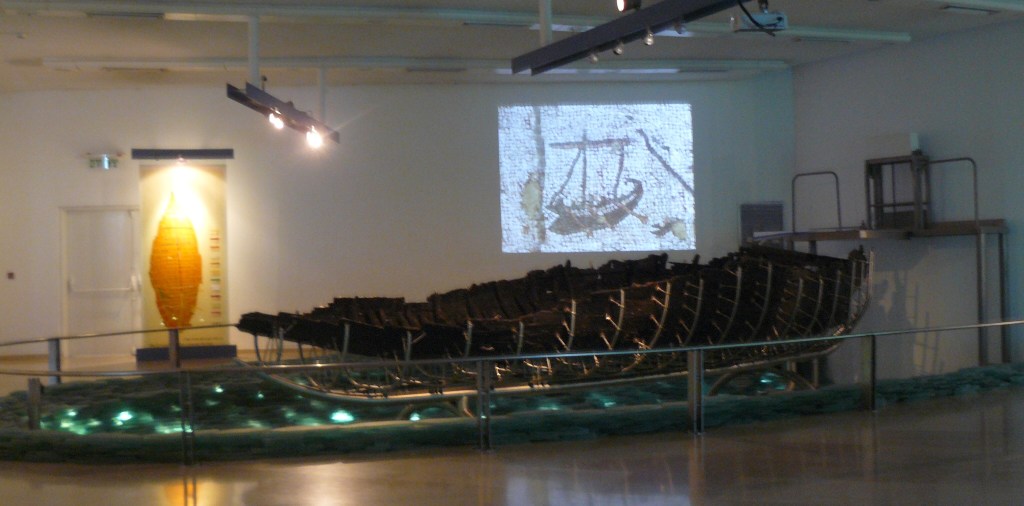
The most visited tourist destination in Israel is Kibbutz Ginosar on the shores of Galilee. It was here, in 1986 that two brothers, Moshe and Yuval Lufan, found the remains of a first century boat. That year the water levels were particularly low and the brothers – who spent a great deal of time looking for artifacts – came across a rusty nail which, on inspection belonged to a boat, buried in the mud beside the water. Recovering the boat was a mammoth task. Archaeologists had to work out how to excavate the boat without damaging or destroying it. This meant keeping the timbers wet, moving the fragile structure in one piece, cleaning off the mud without touching the boat, and finding the right fish to keep the bacteria away. Thankfully the hard work was rewarded with success and the boat can now be seen in a museum close to where it was found.

Boats are a feature of the gospels. Jesus calls four fishermen to follow him, he teaches from a boat, is responsible for an extraordinary catch of fish from a boat and he himself seems to criss-cross the Galilee in a boat. The discovery of the “Jesus boat” puts flesh on the gospel stories and enables us to visualise Jesus and his disciples as they sail from one side of the lake to another. The popularity of the “Jesus boat” lies in the fact that it is probably the most intact structure that can be related directly to Jesus’ life and ministry. 

Fishing, in the time of Jesus was regulated by the Roman government – delegated to local officials. Anyone who wanted to fish needed to purchase fishing rights and a proportion of the catch was subject to tax. Fishermen were at the mercy of the brokers and tax-collectors. They were also vulnerable to the vagaries of the sea – a good catch was never guaranteed and the sea could whip up into a storm at any moment. Most fishermen could not swim, and, as the sea was considered to be the home of demons, falling overboard was doubly dangerous. No wonder the disciples were terrified when they found themselves on the lake, at night, in the middle of a storm.

An account of Jesus calming the sea is one of the few stories that occurs in all four gospels – sometimes twice. In Matthew, Mark and John it follows Jesus’ feeding of the 5,000.  Matthew and Mark have included an account of Jesus’ walking on the water. In every instance, the event illustrates Jesus’ power over nature and over the demonic forces, but the authors use the story in very different ways. (Only Matthew chooses to include Peter’s attempt to walk on water – his initial confidence and his ensuing doubt.) 

In Mark, Matthew and John, Jesus is not in the boat when the storm blows up. He has stayed behind. Later, during the storm, he walks across the water towards the boat. A comparison of Mark and Matthew is interesting and illustrates the different purposes of the gospel writers and the different ways in which they depict the disciples and the disciples’ reaction to the stilling of the waters[1]. In Mark, the incident is directly related to Jesus’ feeding of the 5,000, specifically the bread. When Jesus enters the boat and the wind ceases the disciples are utterly astounded, but there is no expression of faith because: “they did not understand about the loaves, but their hearts were hardened.”[2] Matthew reports an entirely different reaction. When Jesus and Peter get into the boat (after Peter’s failed attempt to walk on water) and the wind ceases, the disciples worship Jesus as the Son of God. 

In Mark’s gospel, the disciples never identify Jesus as God’s son. Indeed, other aspects of Mark’s telling of the story, suggest that the question of Jesus’ identity remained a secret until the resurrection. Throughout that gospel the disciples are consistently depicted as foolish and lacking in understanding. In contrast, Matthew suggests that despite the fact that the disciples do recognise Jesus as the Son of God, they constantly waver between doubt and faith (even after the resurrection – Mt 28:17). 

We will never know for certain the purpose of the authors. (We have nothing except the gospels on which to base our conjectures). Is Mark, the first of the gospel writers, describing the disciples as they really were and did Matthew, dismayed that the founders of the church were presented as such poor role models, remodel their failings from misunderstanding to doubt? Or did the community for whom Mark was writing need models that shared their misunderstanding, and did Matthew’s community need to feel that even the disciples had moments of doubt? 

Whatever the truth of the matter, the writers of the gospels have given us disciples with whom we can relate, real people with real fears and failings. This means that if we are confused, we can be reassured that the first disciples were confused. When we are afraid, we can identify with disciples, who despite being in the presence of Jesus still experienced fear.  At those times when our faith wavers or when we are overwhelmed by the circumstances in which find ourselves, we can be comforted in the knowledge that the disciples too had moments of doubt. 

Our gospel writers did not gloss over the failings of the disciples, nor did they present them as exemplary models. In our gospels we find disciples with whom we can identify. Through them we are assured that God does not expect perfection but will find ways to use us – however weak our faith, however wavering our courage and however poor our understanding. 

There is one thing of which we can be sure that, whether we falter or not, whether we are uncomprehending or not, whether we are brave or not God’s love for and confidence in us is steadfast and unwavering.


[1] Read Matthew 14:22-33, Mark 6 45-52 (John 6:16-21 Jesus doesn’t calm the storm, but he does walk on the water.)

[2] Hard to know just what this means!

“Blind unbelief is sure to err”

April 18, 2020

Easter 1 – 2020
John 20:19-31
Marian Free

In the name of God whom Abraham confronted, with whom Jacob wrestled and with whom Job argued. Amen.

“Have you believed because you have seen me? Blessed are those who have not seen and yet have come to believe.”
I would like to say that I don’t want to contradict the gospel, but those who know me would know immediately that that was not true. So I will be honest and say that, however pious they sound, these words – purported to be the words of Jesus – are at best coercive and at worst abusive – especially when they are used to bully people into believing or to dismiss as unbelief questions or doubts in relation to faith.

I could give many examples of the way in which this text is misused and abused. This is clearly illustrated in a story that I hope I haven’t already shared with you. Some years ago, I attended a conference on Spirituality, Leadership and Management. The keynote speaker devoted a large portion of his talk denigrating Christianity, while at the same time using the images of the Christian faith to expound his own theories of wholeness and life! Later that evening as I was wandering around the conference venue, I met another attendee, Jack, who asked me what I had thought of the speaker. I responded by saying something to the effect that I felt that it was unnecessary for him to be so disparaging of the Christian faith. Jack’s response took me completely by surprise. He explained that he had attended an Anglican Boy’s School and that as a teenager he had taken his faith very seriously. He was however confused by a number of things, in particular belief in a virgin birth. He finally plucked up courage to ask a teacher to explain. Instead of taking the question seriously or entering into discussion, the teacher simply responded that Jack had to accept the virgin birth as a matter of faith.

As he recounted this experience, Jack’s eyes filled with tears. He had been made to feel that his faith was inadequate. His question had simply been dismissed. The failure of his teacher to honour his question and to engage with his doubt had hurt him so badly that some 35 years later the hurt was still evident. Having been made to feel that his faith was not sufficient, Jack had simply stopped trying to believe. His tears were evidence that this loss continued to be a source of grief and that his exploration of other forms of spirituality had not (at that point) been able to fully mend the hurt or to fill the void.

I cannot recount this story without feeling angry on behalf of Jack and on behalf of all who, having found some aspects of the Christian faith challenging, confronting or simply improbable, were denigrated or silenced – usually as a result of ignorance, insecurity or, dare I say, a lack of faith on the part of the responder.

You will note from today’s gospel that Jesus’ response to Thomas’s incredulity is quite different from that of the teacher in Jack’s story. In Thomas’ absence, Jesus had not only appeared to the disciples, he had also shown them his hands and his side. In other words, he had offered them the very proof that Thomas sought, he had made it easy for them to believe. I’m sure that many of us can relate to Thomas’s disbelief. Someone who has been dead for three days doesn’t simply appear in a locked room! Thomas’ imagination simply could not encompass something so incredible – perhaps his friends had seen a ghost. He, like them had to see and touch in order for him to comprehend that Jesus was not dead but alive.

Jesus does not denigrate or dismiss Thomas’ questioning. He honours it. Not only does Jesus appear a second time, but he invites Thomas to see and to touch. Then Thomas does what the others have not – he acknowledges Jesus as his Lord and God – becoming the first of the disciples to do so.

To believe that God expects unquestioning faith and obedience is to misread both the Old and the New Testaments. When God threatens to destroy Sodom and all its inhabitants, Abraham dares to challenge that decision and when God appears to Jacob at night, Jacob wrestles with God till dawn. Moses has the impudence to tell God that destroying the Israelites will ruin God’s credibility in the eyes of the surrounding nations and Job questions why God would take away his family, his possessions and his dignity. Even the prophets have the nerve to challenge the wisdom of God’s decisions and Jonah in effect says to God: “I told you so.” In fact, as Sister Eileen Lyddon points out: “the Jews in the Old Testament questioned God frequently and vigorously.” Even Jesus has a moment (albeit brief) of wondering if God’s way was the only way.

God does not respond to these questions, challenges and doubts with anger or even with disappointment. God does not dismiss or disparage those who do not conform or those who refuse to accept God’s way blindly and without thought. God’s response to each (with the exception of the sulky Jonah) is one of acceptance and indeed of respect. God does not demand blind obedience and God does not scorn, denigrate or coerce. The opposite is true. Biblical evidence confirms that God honours the doubters, the questioners and the challengers. God is worn down by Abraham and finds a worthy match in Jacob. God heeds the challenge of Moses and God does not think any the less of the prophets for all their doubts, criticisms and questions.

God meets us where we are; encourages and affirms us and, as a result, draws from us not blind faith, but a relationship built on trust, respect and love. God comes to us and reaches out with scarred hands, hands that have fully identified with the human condition and in response we can only declare (without threat or coercion) that Jesus is indeed: “Our Lord and our God.”

Doubt and authenticity

August 27, 2017

Pentecost 12 – 2017

Matthew 16:13-24

Marian Free

 In the name of God who respects our doubts and welcomes our questions. Amen.

Some time ago I met a man who was, I think, in his fifties. We were at a conference on spirituality in the workplace and after dinner we were discussing the opening paper. I mentioned that I was disappointed that the speaker used the platform to sideline the Christian faith (while at the same time using some of Christianity’s key concepts to make his point). My conversation partner (Jack) defended the speaker and in doing so shared something of his own story. He had, he said, attended an Anglican boarding school in country Queensland. At age fifteen Jack had asked a teacher to explain the virgin birth. The teacher’s reply was that the boy had to accept the virgin birth by faith. As Jack recounted the story, his eyes welled with tears. He had been a young person who was keen to understand and desperate to believe. The response of his teacher left him feeling that he been fobbed off, not taken seriously. Worse, Jack felt that questions were out-of-place and this led him to query the depth of his own faith – which, the teacher had implied, was in some way lacking.

Obviously this man had been a serious and thoughtful young man seeking for answers. A consequence of the teacher’s dismissive and unsatisfactory response was that my new friend abandoned his search for truth within the Christian faith and over, the course of his life had explored alternative ways to meet what was obviously a deep spiritual need. Some thirty years later, his tears clearly indicated his feeling of betrayal and the pain that he had experienced as a result of the dismissive reaction to his questioning and exploration.

I still can’t think of Jack’s story without a sense of grief – for Jack and for the church that has lost so many people because they have been made to feel that they do not belong. A common mistake from both within and outside religious traditions is to confuse faith with certainty. It is sometimes assumed that people who confess a particular faith adhere to if not rigid, certainly to reasonably fixed ideas. From this point of view doubt and or questioning can be interpreted as a lack of faith. Confusing faith with certainty and questioning with a lack of faith has served to exclude and alienate many who, with a little encouragement might have come to see that while there are sometimes no easy answers that asking questions can be the beginning of a deep and satisfying experience of the relationship with God.

The idea that faith and doubt are incompatible is incompatible with a great deal of scripture, the Old Testament is very clear that God doe not reject those who question God. In Genesis Abraham challenges God about God’s plan to destroy Sodom () and as we heard a couple of weeks ago, Jacob struggles with God all night. Moses is constantly questioning God’s response to Israel’s unfaithfulness and more than one of the prophets questions God’s wisdom. In the New Testament, in the gospels in particular, doubt and faith seem to go hand in hand (Matthew 28:17).

What is clear is that neither in the Old Testament or the New does God revile or reject those who dare to question, those who are not satisfied with simple or simplistic answers.

Two weeks ago when we looked at the story of Jesus (and Peter) walking on the water (August 13) we saw that, rather than demonstrating Peter’s faith, the story revealed Peter’s doubt, his unwillingness to believe unless he had absolute proof. We saw too that Peter’s language: “If it is you”, put him in the same category as Satan and Jesus’ opponents. According to today’s gospel, it is Peter who claims that Jesus is the Christ. Jesus calls Peter “the rock on which he will build his church” and gives to Peter the keys of the kingdom. However, within moments Jesus is accusing Peter of being Satan because, once again, Peter demonstrates that he simply does not understand the sort of Christ Jesus is to be.

Jesus calls Peter out, but he does not reject him nor does he hold him to account. Jesus accepts Peter as he is with his doubts, his questions and his need for absolute proof. If that is not an indication that doubt and questions are an acceptable part of the faith journey, I don’t know what is.

Faith and doubt are not so easily separated. Peter’s struggle to believe demonstrates that the two can be held in tension. Our questions and our struggles are often necessary to bring us to a deeper understanding of and a closer relationship with God. When we refuse to take things at face value we are led beyond the obvious and the superficial to find meaning in the things and issues that puzzle us. We are free to engage in the sort of exploration that is content with the journey itself and that understands that ultimately God will always elude us. As T.S. Eliot expresses the mystery: “We shall not cease from exploration, and the end of all our exploring will be to arrive where we started and know the place for the first time.”

Peter’s doubt does not exclude him from a relationship with Jesus, but rather demonstrates the sort of authenticity that reveals an openness and a trust that allows the relationship to grow and develop. Rather than isolate him from God, Peter’s freedom to be himself, to question and to challenge, eventually leads Peter to believe with such conviction that he will willingly give his life for what he believes.


We are not meant to walk on water

August 12, 2017

Pentecost 11 – 2017

Matthew 14:22-33

Marian Free


In the name of God who dares us to believe and refuses to perform tricks to prove that God exists. Amen.

Recently Michael and I watched the movie “War Machine”. It features Brad Pitt as a gung-ho Four Star American General who is a veteran of the war in Iraq. He is sent to Afghanistan to bring an end the war or at least to find a way to bring the troops home. In order for him to do this the General, Glen McMahon, has been given wide-ranging powers. He is convinced that he, not those with years of experience in the country, knows just how to bring the Taliban to heel. He decides (against his explicit brief) that with more troops he can take Helmand Province, an area which in fact has little strategic or political value and which is a notoriously difficult area in which to carry out any sort of military operation. McMahon uses some underhand methods to gain public support for his plea for more troops and launches his offensive with disastrous consequences – for civilians, for his troops and for the war effort as a whole.

The movie is a good depiction of the sort of self-absorbed person who believes that they and only they are the solution to a problem and who will do anything to prove their invincibility. McMahon is so self-obsessed and so determined that he can do what is required that all objections and rational discussions are swept aside. The accepted wisdom is meaningless to him because he is sure that he knows better.

It is important to have people who challenge the accepted wisdom of their time. Without such people we would not have landed on the moon, explored the depths of the sea, discovered electricity and developed life-saving and life-changing surgery. We need people who see the world differently to provide leadership, to push-boundaries and to ensure that we do not stagnate. At the same time questioning the existing situation simply for the sake of seeking glory, in order to prove someone wrong or simply for the sake of it can expose the character of the contender, lead to harm to some if not many and may put a movement or discovery back years or decades.

Peter was many things – he was impetuous, thoughtless, he didn’t always think through the consequences of his actions and it took him a long time to accept that Jesus’ ministry was not about dramatic miracles and interventions, he wasn’t going to be particularly extraordinary and nor was he going to present as some sort of heavenly being. Today’s gospel is a good example of this aspect of Peter’s character. It demonstrates his overwhelming desire that Jesus be something special or that prove himself to be who he says he is. He couldn’t accept things as they were. He needed to push the boundaries to provide himself with some sort of evidence that Jesus really was who Peter hoped him to be.

Because Peter cannot simply accept things as they are, he puts God (in this case Jesus) to the test. In so doing, Peter reveals his lack of faith, need for absolute proof, and worst of all, his propensity to share the view of Jesus’ opponents that if Jesus is really the Christ, he should demonstrate it in such a way that it would be clear and easy for him to accept.

It is early morning – somewhere between 3:00am and 6:00am. The disciples have been on the lake all night. No wonder their tired, unsuspecting eyes believe that the figure walking towards is a phantom. When they cry out in fear Jesus tries to reassure them. He says: “Take courage, I AM, do not be afraid.” The expression: “Take courage” is one that Jesus has used twice before (9:2, 22) and “Do not be afraid” is an expression that is often on Jesus’ lips in Matthew’s gospel. “I AM” may simply mean “It is I”, but it is also the language used for God in the Old Testament. Eleven of the disciples appear to be satisfied with this response – the familiar language and the “I AM” statement assure them that this is no phantom, but Jesus coming towards them. Peter is not so easily satisfied. He cannot accept things at face value. He challenges Jesus to provide proof of his identity. “If it is you,” he says. “If it is you.” These are the words that Satan uses when he challenges Jesus in the wilderness (4:3,6). They are the words used by the High Priest at Jesus’ trial (26:63) and the words of those who mock Jesus at the crucifixion (27:40). “If it is you[1].” Even before Peter has even left the boat, he has put himself in the same league as Satan and Jesus’ earthly opponents all of whom demand: “Prove yourself, show us what you can do, demonstrate that you are not like the rest of us, and then maybe we’ll believe”.

Peter leaps out of the boat into the waves, not because he trusts Jesus but because he doesn’t trust Jesus. Peter sinks, not because he loses focus but because he didn’t believe it was Jesus in the first place. He puts himself at risk in the hope that Jesus will rescue him and that his doubts about Jesus will be put to rest.

The problem for Peter is that Jesus is not a conjuror. He doesn’t perform miracles to prove himself or to gain status and power. Satan couldn’t persuade Jesus to win over the world by doing astounding feats; Jesus will not perform miracles to win over the High Priest and he will not free himself from the cross just to attain temporary glory. Jesus will not put God to the test by doing something stupid like jumping from the top of the Temple and hoping that God will send angels to catch him.

We are not meant to walk on water, nor are we to take heedless, pointless risks in order to prove to ourselves, or to others, that God exists, or to test whether or not God will get us out of difficult and dangerous situations. God is beyond our ability to comprehend or to manipulate. We have simply to accept that God is, and no matter what happens around us, to hold fast believing that God will come to us over the waves and the winds that buffet us will cease.


[1] I am grateful to Mark G. Vitalis Hoffman for these insights. workingpreacher.org

Taking our eyes off Jesus

August 9, 2014

Pentecost 9 – 2014

Matthew 14:22-36

Marian Free


In the name of God who stretches out his hand and holds us when we falter. Amen.


One night I dreamed I was walking along the beach with the Lord.

Many scenes from my life flashed across the sky.

In each scene I noticed footprints in the sand.

Sometimes there were two sets of footprints,

other times there were one set of footprints.

This bothered me because I noticed

that during the low periods of my life,

when I was suffering from

anguish, sorrow or defeat,

I could see only one set of footprints.

So I said to the Lord,
 ‘You promised me Lord,

that if I followed you, 
you would walk with me always.

But I have noticed that during the most trying periods of my life

there have only been one set of footprints in the sand.

Why, when I needed you most, you have not been there for me?’

The Lord replied,

‘The times when you have seen only one set of footprints in the sand,

is when I carried you.’

-Mary Stevenson


This poem adorns cards bookmarks, placemats, wall hangings, plates and a vast number of other things. It is a reminder that while we might take our eyes off Jesus, Jesus never takes his eyes off us.

Like most gospel stories this morning’s gospel reading is packed with detail.

You may remember from last week, that Jesus sought solitude after the death of John the Baptist and that he and his disciples got in a boat to go to a deserted place. His plan was foiled by the crowds who followed him seeking healing. Jesus’ compassion was such that instead of sending them away, he not only healed them, but he also fed them. It is now evening. Jesus commands the disciples to get into the boat. Then he dismisses the crowd. He himself remains behind to pray (his reason for being in the mountains in the first place).

When the disciples are a significant distance from land, the wind and waves build up and (according to the Greek) “torture” the boat[1]. This is not unusual. The Sea of Galilee is surrounded by mountains. When a wind causes the cool air from the mountains down to meet the warm air of the lake, the change in air pressure means that storms spring up suddenly and without warning. The lake is relatively shallow which means that waves build up more rapidly than they would in deeper water. We know that at least some of the disciples are fishermen and used to weathering stormy seas. This would explain why they do not appear to be afraid of the storm or the wind – even though they appear to have been battling the waves for several hours.

They are not afraid until – sometime between 3 am and dawn – they see a figure that they presume to be a ghost, walking on the water towards them. Terrified, they call out in fear, but Jesus – for of course, that is who it is – responds: “It is I, do not be afraid.” Both phrases are significant. The words: “It is I” are reminiscent of God’s words to Moses from the burning bush. I AM being the self- designation of God. Jesus is identifying himself to the disciples. At the same time he is identifying himself as divine. “Do not be afraid,” is also a familiar phrase. These are the words of the angel to Mary and to Joseph and to the shepherds in the fields. A natural response to the presence of God is fear or awe and from Genesis onwards, God’s representatives are careful always to allay that fear with the words, “Do not be afraid”.

Jesus is present but the storm continues to rage. The storm is not the source of the disciples’ fear, nor is the purpose of this story to demonstrate Jesus’ power over the storm.

Peter, who from now on, becomes the spokesperson for or the representative of the disciples wants to be sure that it is Jesus. Perhaps too he is testing Jesus’ divinity – if Jesus is “I am” then surely he will be able to empower Peter to come to him on the water. Jesus’ command: “Come!” makes the impossible possible. Peter gets out of the boat and walks on the water towards Jesus. At first all is well. Then Peter sees the wind (or more likely the effects of the wind). He loses confidence and begins to sink. Terrified, he calls out to be saved. Jesus reaches out to catch him, at the same time chiding him for having little faith and asking why he wavered or doubted. Together they get into the boat. Only then does the wind stop.

Astounded by what has happened, those in the boat realise that Jesus is the Son of God and the fall down and worship him.

The chapter ends as it began with large crowds seeking out Jesus in order that he might heal their sick.

For the ancients the sea was the place of chaos and evil. It was volatile and uncontrollable. That Peter left the boat at all is evidence of his faith and confidence in Jesus. That he faltered when he realised the danger in which he had placed himself is perfectly understandable. Jesus might chide Peter, but blind faith is not a pre-condition for Jesus’ saving grace.

Faith enables us to do extraordinary things and to face terrifying and demoralising situations. Responding to the call of God empowers us to do things we could not otherwise do – to step out of the safety of our figurative boats and to walk across the stormy seas of life. There will be times when we walk with assurance with our eyes firmly fixed on Jesus, but there may also be times when we falter. When we are overcome with confusion or grief, when we are weighed down with despair or guilt or when misfortune hits us out of the blue we can forget that Jesus is present with us or waiting ahead of us. At those times we can be sure that even if we forget, Jesus will not forsake us and that, when we call out in terror, Jesus will stretch out his hand and pull us to safety. The storm that had threatened to overwhelm us has been stilled.

We will discover that Jesus does not put limits on his compassion or his love nor does he place conditions on his help. Just as he did not abandon Peter to the sea, he will not abandon us in those times when our faith is tested or when our confidence in him has grown weak. Our faltering faith may mean that there are times in our lives when we take our eyes off Jesus, but no matter how much we waver, Jesus will never take his eyes off us.


[1] (The Sea of Galilee is not a sea at all but a large inland lake. It is formed between the steep cliffs of a wadi where the Jordan spreads out across the Rift Valley. The sea itself is 680 feet below sea level and the surrounding mountains reach up to 2000 feet in height. This means that while the valley enjoys a temperate climate the mountaintops get quite cold. When a wind rises in the east it brings the cold air down to the lake and when the cool air meets the warm the resultant change in air pressure mean that storms can spring up suddenly and without warning. The lake is quite shallow – 141 metres – and this means that it takes no time for waves to build up.)

Faith and doubt – two sides of one coin

April 26, 2014

Easter 2

John 20:19-31

Marian Free

In the name of God who, far from demanding blind faith, challenges us to think for ourselves. Amen.

I can clearly remember July 20, 1969 – the day Neil Armstrong stepped on to the moon. The space landing was considered such a significant historical event that we were given a half day off school to go home and watch it on TV. As my family did not have a television, I went home with a friend and saw it as it happened. America really did manage to land someone on the moon. Amazingly, though the event was broadcast live and watched by people all over the world, there were still those who didn’t believe that it was real. At one extreme, the grandmother of one of my friends who steadfastly clung to her naive belief that the moon was made of green cheese and at the other end were those who held all kinds of conspiracy theories – including one that the whole thing was filmed somewhere in the Australian outback.

New discoveries or new ideas are not always readily accepted. Most of us take time to absorb new information or to adjust to new ideas. All of us, before we accept something new or different, have to make decisions about who and what we trust. Confronted by new information, we have to weigh up the evidence before us and come to our own conclusion before we change our mind-set. This is true not just for advances in science, but also for revisions in the way in which historical data is interpreted over time. So for example, one of the questions which requires a response at the moment is whether climate change is real or whether its proponents are hysterical nature lovers who want to impose their ideals (and their limitations) on us. Another challenge is to come to a conclusion about the way in which historians are revising the story of the Gallipoli landing. Could it really be true that the calamitous campaign was as much the responsibility of the Australians as it was of the British or are the historians just trying to create controversy and draw attention to themselves? Faced with new data, we also have to decide whether our failure to accept it is based on a rational examination of the new facts, or whether we are held back by sentiment, conservatism or a dislike of change.

This need to question, to test ideas, is no less true in regard to issues of faith. It is reasonably easy to demonstrate that Jesus was an historic person who lived and was crucified in the Palestine of the first century and it does not require a great intellectual leap to acknowledge that Jesus’ teaching contains wisdom and guidance for life that crosses the barrier between secular and divine.

The resurrection however is a different matter that creates a number of difficulties. There is no rational, reasonable explanation for the resurrection. There were no witnesses to the actual event and there are at least four differing accounts of the risen Christ – more if John 21 is considered original to the gospel. There are consistent elements – the women at the tomb and Jesus’ appearing in locked rooms – but they are reported slightly differently by each evangelist. Both John and Mark record a meeting with Mary Magdalene and Mark and Luke suggest that the risen Jesus met travelers on the road. Some stories are unique to the individual gospels. Jesus’ appearance to Thomas is recorded only in John and Luke alone suggests that the risen Jesus is able to eat. If we had only the original Markan gospel we would have only the account of the empty tomb and the fear of the disciples to convince us that Jesus had risen.

And yet we believe. We believe despite the lack of eyewitnesses; the apparent absurdity of the claims and the paucity of the evidence. We believe despite the centuries that separate us from the events themselves. Does that mean that we suspend our reason, that we allow ourselves to pretend that belief or faith requires that we do not need to question or to think, that we can just ignore the difficulties presented by a dead man returning to life?

I don’t think so. We don’t believe without a basis for our belief. Like Thomas we ask questions and we test what we believe and like Thomas, we believe because, we have had an experience of the risen Christ and because we know Jesus’ living presence in our lives.

Over the centuries, for a number of reasons, Thomas has had a lot bad press:.he questioned the experience of the other disciples, Jesus’ asked him to have faith and his lack of confidence in the other disciples led to the expression ‘doubting Thomas’. This has caused many to come to the conclusion that faith requires unquestioning belief in what others tell us. The reality is that for many, doubt and questioning are essential ingredients of faith. Jesus himself was not free from doubt – before he died he wondered if God could do things differently and on the cross he doubted that God was with him.

Doubt need not be an indication that faith is wavering. It can be a sign of faith that is growing into maturity. Questioning, searching often indicates a movement from a faith that is dependent on the word of others to a faith that is based on personal research and experience – a faith that is truly one’s own. Questioning is not only healthy, but as the example of Thomas indicates, it can lead to a deeper understanding – a richer experience than is possible if faith is based on second-hand knowledge or experience.

It is important to note that Jesus does not censure Thomas for his failure to accept the word of the other disciples, nor does he deny Thomas the opportunity to have the same experience that they had. Instead Jesus allows Thomas not only to see, but also to touch and feel – to discover conclusively for himself that what the others said was indeed true. The result is powerful. Thomas falls to his knees declaring: My Lord and my God.”

Thomas should be remembered, not for his lack of faith but for his recognition of Jesus – as Lord, but more importantly as God. In this Thomas is a ground-breaker, a leader – anything but a doubter or a failure.

We do not believe because someone else has told us to. We believe because like Thomas we know Jesus Christ as our Saviour, as our Lord and our God.


Christ is risen.

He is risen indeed! Alleluia!