Posts Tagged ‘fear’

Who infects who? Woman with a haemorrhage.

July 2, 2024

Pentecost 6 – 2024

Mark 5:21-43

Marian Free

In the name of God who sees our deepest needs and sets us free. Amen.

Thanks to Reginald and Catherine Hamlin, the prevalence of obstetric fistula in Ethiopia became known and, more importantly, addressed. Their story is well known. The medical couple responded to an advertisement for a medico to establish a midwifery school in the hospital in Addis Adiba. Once there, it was not long before they observed the huge number of untreated injuries caused by childbirth. Instead of returning to New Zealand when their contract was completed, the couple founded the Addis Adiba Fistula Hospital. It is the only hospital of its kind and has treated over 60,000 women.

The tearing of the fistula during childbirth can have devastating consequences. It is especially prevalent in places where there is inadequate access to pre-and peri-natal care and where there are no midwives to assist with birth. In countries where child marriage is allowed and in which female circumcision is practiced the situation is even more dire. Girls whose bodies are not ready for childbirth become pregnant and genital mutilation can make the birthing process even more difficult. In Ethiopia something like 100,000 women and girls live with a fistula and around 9,000 new cases occur every year (this in 2022).

An obstetric fistula is a hole or tear that is created during a long or obstructed labour.  The tear creates a hole between the bladder and/or rectum which leads to leakage of urine or faeces over which the woman has no control. This in turn results not only in physical discomfort, psychological distress and infertility but also in rejection by the spouses and families of these women and social isolation. Rejected by their communities, young women who suffer from this condition become homeless and impoverished.

The medical situation of the woman with a haemorrhage in today’s gospel is different but the resulting situation is similar – rejection, isolation and penury. In the ancient world, blood, especially menstrual blood, rendered a woman unclean, a source of contamination and therefore as someone to be avoided. The woman with a haemorrhage would not only have been unclean, but also infertile. She would have been socially isolated and her value as a woman (able to bear children) would have been seriously compromised. The woman would have been an object of fear, isolated, destitute and desperate.

No wonder she takes her chance with Jesus. No wonder that she is driven to break the law, to cause offence and to risk the wrath of the crowds.  Jesus is her last and only hope of restoration – to health and to the community.

We know nothing of the woman, but we can imagine that she had been a person of some means, because she has, over the course of twelve years, been able to seek the help of doctors. Now she has spent all that she has on doctors – to no avail. 

Jesus’ reputation has reached the woman, and while the woman dare not appeal to him openly for fear of the crowd’s reaction, she presumably knows that that Jesus has not demonstrated an unwillingness to engage with those deemed unclean. After all, he has healed lepers who, like her are considered impure and forced to separate themselves from family and community. 

So when she learns that Jesus is near the woman somehow slips into the crowd, makes her way to Jesus and touches, not him, but his cloak.  Two things happen simultaneously – the woman knows that she is healed, and Jesus feels power flow from him to another. 

In Jesus, the process of contamination is reversed. His purity is not polluted by her impurity, her uncleanness does not taint him but rather her impurity is sanitised by his purity. His ‘power’, his pureness, moves from him to her, cleansing and restoring her. In healing the woman, Jesus not only sets her free from her suffering, but restores her to her family: “Daughter” he says.

It is easy to fool ourselves into believing that notions of purity and impurity belong to another time and age, but I challenge you  to think of the ways  in which we limit and exclude those who do not fit the norms of our own time, the ways in which we judge those with health issues that we do not understand, the barriers we place between ourselves and those who are different, the ways in which we exclude people from participation in things we take for granted. 

The examples are manifold so I shall only list a few – women with endometriosis who spend years and fortunes convincing doctors that they are unwell and are made to feel that the problem lies with them, the rough sleepers who endure our discomfort rather than our compassion and who feel our discomfort, fear and revulsion, our physical environments that make it impossible for the differently abled to fully participate in the lives we take for granted and which tell them of our indifference. Consciously or unconsciously, we isolate and protect ourselves from the suffering of others. 

Consciously or unconsciously, we send the message that we are repulsed or affronted by those whose situations we do not fully understand.

Time and again, Jesus demonstrates that compassion for and engagement with the despised and rejected takes nothing from himself and gives everything to them – restoring them physically, psychologically and socially. If we are willing to learn from his example, we will create a society in which everyone is valued, included and made whole, a world infected and transformed by kingdom of God.
A storm tossed boat – relinquishing control

June 22, 2024

Pentecost 5 -2024

Mark 4:35-41 (thoughts while on leave)

Marian Free

In the name of God who knows our deepest fears, who holds us in the palm of God’s hands and who knows the number of hairs on on head. Amen.

One of my favourite hymns is ‘Abide with me.’ I have always loved it but knowing the role the hymn played in the life (or rather death) of Edith Cavell has given it new power and meaning.

 Abide with me, fast falls the eventide
The darkness deepens Lord, with me abide
When other helpers fail and comforts flee
Help of the helpless, oh, abide with me

Swift to its close ebbs out life’s little day
Earth’s joys grow dim, its glories pass away
Change and decay in all around I see
O Thou who changest not, abide with me

I fear no foe, with Thee at hand to bless
Ills have no weight, and tears no bitterness
Where is death’s sting?
Where, grave, thy victory?
I triumph still, if Thou abide with me

Hold Thou Thy cross before my closing eyes
Shine through the gloom and point me to the skies
Heaven’s morning breaks, and earth’s vain shadows flee
In life, in death, o Lord, abide with me
Abide with me, abide with me. (Henry Francis Lyte and Will Henry Monk)

Edith Cavell was a nurse, and an extremely competent and brave woman. During the First World War, Cavell was based in Brussels. Her hospital was taken over by the Red Cross. Working for the Red Cross, Cavell treated all injured soldiers without distinction – friend and foe – and she assisted some 200 hundred Allied soldiers escape German occupied Belgium. For this, she was captured, accused of aiding a hostile power and sentenced to be executed for treason. The daughter of a priest, Cavell had a strong faith. The night before she was to face the firing squad, she was visited by an Anglican priest who was based in Brussels. After she received the Eucharist, she and the Rev’d Gahan sang together ‘Abide with me.’

I don’t know the history of this hymn, but the lyrics express a complete and utter faith in God, especially at the time of death. That Cavell could sing this when the firing squad awaited her fills me with awe as does the fact that she was able to ask the priest to tell her loved ones later on “that my soul, as I believe, is safe, and that I am glad to die for my country”.

To face such a gruesome death with such calm and confidence is surely something all Christians are capable of, but how many of us along the way allow ourselves to be bothered and weighed down by trivial and unimportant anxieties. When it comes down to it, how many of us trust God with every aspect of our existence.

This, I think is what today’s gospel is getting at – the ability (or not) to place our lives, with all their minor irritations and major setbacks, completely in the hands of God.

Mark’s account of the stormy sea crossing has a number of interesting features. In the first instance, according to Mark (and only Mark), the disciples venture on to the sea in the evening – a time when, as anyone knew, the waters could be rough and difficult to manoeuvre. We are not told why they took the risk, but it is clear that Mark places the responsibility for the dangerous journey on them. Secondly, we are told that they took Jesus ‘just as he was’ which supports the notion that not a lot of thought or preparation was put into the journey. Again, the blame for the situation seems to be being laid at the feet of the disciples.

 Despite the lack of preparation and the failure of the disciples to take the conditions into account, Jesus is completely relaxed. Indeed, he is so relaxed that he falls asleep on a cushion.

 As might be expected, a storm blew up in the evening. The boat was tossed about and swamped. Unable to control the boat, and in fear of their lives, the disciples wake Jesus, accusing him of not caring about them: ‘Teacher, do you not care that we are perishing?’ they shout.

 Jesus wakes, rebukes the wind and chides the disciples. It is important to note that Jesus doesn’t berate the disciples for not believing in his ability to control the elements. He doesn’t ask them: ‘didn’t you believe that I could do this?’  His question to the disciples is: ‘why are you afraid?‘ why are you afraid?

 It is fear not faith in Jesus’ power that is at issue here.

 Jesus, who probably knows the lake as well as any other Galilean, got into the boat and promptly fell asleep. He will have known that the wind was likely to come up. He will have known too, that if he so chose, he could command the wind to stop but he chooses to sleep instead of take control. Unlike the disciples, Jesus trusts in God so completely that he has no fear. Having placed himself in God’s hands Jesus trusts that whatever the outcome of the storm, he is with God and God with him. Sleep is possible because he has chosen not to worry – living or dying he knows that his life is God’s.

 When we read this story, we are often so focussed on the storm and Jesus’ power over the natural elements that we lose sight of what may be the central point of the story – the sleeping Jesus’ utter trust in God, his lack of fear in the face of possible death and his knowledge that God is with him in every circumstance of his life – be it good or evil.

 Like the disciples- who are foolish and uncomprehending in Mark’s gospel we don’t always get it. The disciple’s response says it all. ‘Who then is this that the wind and the sea obey him?’ It has nothing to do with faith and everything to with the miracle – which, when you think about it, completely negates the need for the sort faith that Jesus is modelling and which he will continue to model until the end. Faith that is dependent on miracles, faith that relies on God to get us out of tight corners, faith that believes God will always intervene to protect us from harm, is not the faith that Jesus lives and proclaims.

 The faith that allows Jesus to sleep through the storm, is a faith that trusts the God of the universe to get us through (not avoid) life’s difficulties. The faith that Jesus lives is a faith that gives God control over our destiny (rather than trying to control every aspect of our lives by ourselves.) The faith that allowed Jesus to face the cross is a faith that understands that in life, in death, God abides with us.

 This is a story not about Jesus’ taking control, but about Jesus’ willingness to relinquish control.

 When we are tossed and turned about, do we seek to control our circumstances and rage that God doesn’t care? Or, can we like Jesus, remain asleep in a storm tossed boat?


November 25, 2022

Advent 1 – 2022

Matthew 24:36-44

Marian Free

In the name of God who is always near, and always coming. Amen

Unless the danger is real, it is impossible to live constantly on the edge, or in a heightened state of awareness. After the September 11 attacks for example, we were urged to be constantly alert to any unusual or unattended package or luggage and, for a while, we were “alert, but not alarmed”. Thankfully, there have been no bombs and in Australia, terror attacks were largely averted or limited in their impact. Over time, the messaging stopped and the fear of a terrorist attack no longer felt real.[1] People began to let down their guard, to stop living as if an attack were imminent. More recently of course, we have lived with a constant fear of COVID. Even though that was threat was very real and impacted on every person, few have remained are as cautious as they once were. Even though, in Australia, a fourth wave has hit, the number of people wearing masks is considerably lower than it was six months ago. The danger is real, but the energy to deal with it is missing because, by and large, the community is exhausted by the stress of the last few years. It is  simply impossible to constantly live on a knife’s edge. When the immediate danger has passed, most of us breathe a sigh of relief and go back to the way we were before.


This, I imagine, was the situation for which Matthew (indeed all the Synoptics were written). Jesus had suggested that he would return and gather believers to himself and, if further evidence were needed, he had not established any formal structures that would have implied that he expected a community to form, to establish ways of being together and to develop leadership structures. Fifty years after Jesus’ ascension into heaven it was no longer possible to live with the same sense of urgency that might have been expected immediately after


No doubt the first generation of believers had lived with an air of anticipation, aware that Jesus might appear at any time and that they must be ready for his return. At the time Matthew was writing, the faith community consisted of third generation believers. Those who knew the earthly Jesus had died and those who now believed had apparently become complacent (as is attested by Matthew’s parables of the bridesmaids and the sheep and the goats.) No one can constantly live on tenterhooks and maintaining a sense of trepidation is increasingly difficult especially in a time when the threat of Jesus’ coming appears  increasingly unreal.


One of the tasks of the gospel writers was to find ways to revive the sense of expectation, to confront the apparent complacency of believers and to recall them to their call. This is not, I suspect an attempt to force believers to live in fear, but to encourage them to  live ‘as if’ – as if Jesus were to return, as if Jesus might catch them unawares. It is not so much that the gospel writers desire that believers should live in terror – always wondering if they could meet the standard expected – but more that they are encouraging those who follow Christ to strive to live in such a ways that they would not be ashamed were Jesus to appear in the next minute, the next hour, the next day.


The gospel for this morning provides both reminders and incentive.  “Keep awake! For you do not know on what day your Lord is coming.” Life may appear to be going on as it always has – eating and drinking, working in the field, grinding grain, but the simple and mundane things of everyday life should not be allowed to make us complacent. It is not so much that daily life does not continue – of course it does. Nor is it a matter of being always on the edge – worried that Jesus will come and find us wanting. It is a reminder that no matter when Jesus might come it is important that we are not caught sleeping.


That does not  mean that we have live in fear, constantly worried about being caught out. Fear is a poor motivation. It sees only judgement and punishment; not welcome and joy. Fear does not lead to growth, it leads us to play it safe, to behave in ways that we believe will please, to become rule bound and rigid – believing that there are ways to be and ways not to be. Fear tempts us to hide our flaws instead of accepting and facing them honestly. Worse, living in fear does not provide the basis for a healthy, and real relationship with God. Fear leaves us anxious and self-conscious, unable to trust in ourselves and in God’s abundant love and forgiveness, and failing to engage with the deep and difficult work of allowing Jesus  to transform our lives, so that we are being formed in the image of Christ.


In practical terms then, ‘being ready’ living in a state of expectation means that at all times we are to strive to live our best life, to detach ourselves from the passions and desires of this world,  and to draw ever closer to the God who gave everything for us that in turn we might give our all for God.


This Advent, and every Advent is an opportunity to re-examine our lives and to ask ourselves: “Were Christ to come tomorrow, would we want to cling to the things of this world or would we be ready to let go and excited to experience something new? Would we be happy to go out in joy to greet him, or would we want to hide ourselves in shame? Would we have learnt to be comfortable in God’s love or would we still feel we needed to put on a front?”


Are you ready and if not, what would it take?


[1] I have been surprised therefore, to be hearing the message again now that I am in the UK.

Terrified of Jesus?

June 18, 2022

Pentecost 2 – 2022
Luke 8: (22-25) 26-29
Marian Free

In the name of God who is both comforting and challenging, benign and threatening. Amen.

According to a report by ABC news, at least 10, 000 cattle were washed away during the recent floods in Northern NSW. A vast majority of these will have drowned. One resident – trapped in her home and waiting for help – described a cow that was floating past her in the water. The animal looked at her, its eyes pleading for help, but of course, there was nothing she could do. It is a haunting image and one that came to mind as I wondered about the unsuspecting pigs in today’s gospel. Like the cattle they will have been caught completely of guard. Unlike the cattle the pigs will not have had the warning signs of heavy rain and rising water, and, rather than being propelled by an external force, they will have been driven by an internal urge. Either way cattle and pigs are caught up in the water and drowned.

I can’t help but think about the pigs in today’s gospel – the surprise and then the terror as they found themselves involuntarily propelled towards the water. I see them struggling to keep afloat before taking their last (fatal) breath and drowning. Why the pigs? What had they done to deserve such a fate?

The pigs are not the only conundrum in this story. There are so many unanswered questions. Why does Jesus bother to cross the lake into Gentile territory only to cause havoc come straight back again? Why did the demons have a choice as to where they were sent? How were the owners of the pigs to recoup their losses? Would the swineherders be out of work as a consequence of there being no pigs to herd?

It is impossible to come up with satisfactory answers to all those questions and it is conceivable that, in order to make a point, the narrator allowed himself the luxury of a little exaggeration. As it is, this is one of the more memorable and colourful gospel stories.

One component of this story, (and the one that precedes it) is that of fear. It is not just the pigs who are afraid. When Jesus rebukes the wind and the raging waves, the disciples are afraid. In today’s gospel the demons are afraid, the people who came out to see what had happened are afraid and the people of the surrounding countryside are greatly afraid. The demons are afraid, because Jesus sees them for who they are. The people are afraid – not because Jesus has been the reason that they have lost all their livestock – but because he healed the demoniac! The disciples and the people of Gerasene are afraid of Jesus – of his power over the natural elements and of his power over demons.

Why, you might ask, would anyone be afraid of Jesus? Why in particular would they be afraid of Jesus when he has saved the lives of the disciples and restored the demoniac to life thus freeing them from the burden of restraining him? Surely, those who witnessed Jesus’ power in these events would be amazed and grateful, but afraid? It doesn’t make sense – or does it? You and I are so familiar with the stories of Jesus that they have lost their power to confront, let alone terrify. When we are faced with the destructive powers of the natural world, we long for Jesus to intervene – to stop the fires, halt the floods, suppress the earthquake. When we watch someone suffer unbearably from mental illness or a deteriorative disease we yearn for Jesus to step in and bring about healing. What could be terrifying about either of those things we wonder?

I suspect that what is terrifying is Jesus’ display of power – the way in which he upsets the natural order – of creation, of society. When the disciples called out in terror as the waves threatened to sink the boat, I suspect that they wanted Jesus to share their fear, to help with the boat. They did not imagine that this wonder worker could or would exert the power of the creator. In their day there were many healers and exorcists – but no one who had control over the natural elements. Jesus’ demonstration of such extraordinary power would have been overwhelming. If the wind and sea obeyed Jesus, what other powers might he unleash? Was anything/anyone safe in his presence?

The source of the Gerasenes’ fear is similar. Here too, Jesus has upset the natural order of things. For, while he was possessed, the demoniac had a place (albeit it distressing) within the society. People knew how to respond to him, and his demonic state told them something about their place in the world. While he was under the influence of demons, those around him were able to define themselves in relation to him, to reassure themselves that they were not possessed, to feel superior to him, to feel a certain amount of self-righteousness concerning their acceptance of him and his condition and to have the role of carers – even if that care was limited to chaining him when he got too wild and providing him with the occasional scrap of food. In other words, when the demoniac was possessed, they knew where he fit and where they fit in relation to him.

When the demonic was possessed they knew what to do with him, but now that he is healed they find themselves in a completely new situation – one which they did not ask for and one over which they have no control. The delicate balance of their community has been disturbed. They are afraid because they do not know what to do now and they are afraid because they do not know what Jesus will do next.

These two stories reveal that both the disciples and those who met Jesus for the first time; that both those of a Jewish background and those from Gentile lands experienced fear in his presence. They recognised Jesus awesome presence and power and were terrified.

When Jesus unleashes the power of God creation itself obeys and our lives are changed forever. Perhaps the question we need to ask ourselves is not: “Why were they afraid?” but “Why are we not afraid.”

Stormy waters

August 8, 2020
The Jesus boat

Pentecost 10 – 2020

Matthew 14:13-21

Marian Free

In the name of God who understands our deepest fears and who overlooks our multiple weaknesses. Amen.

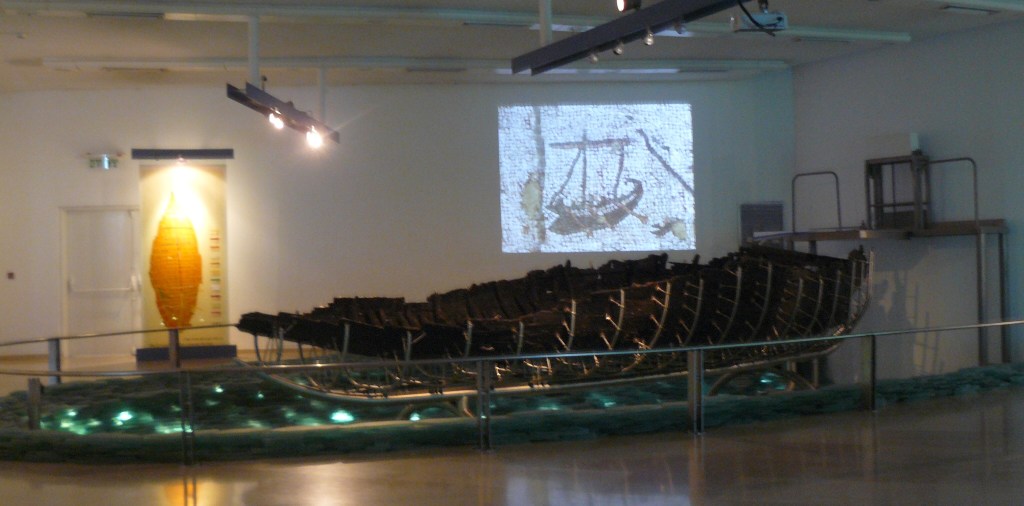
The most visited tourist destination in Israel is Kibbutz Ginosar on the shores of Galilee. It was here, in 1986 that two brothers, Moshe and Yuval Lufan, found the remains of a first century boat. That year the water levels were particularly low and the brothers – who spent a great deal of time looking for artifacts – came across a rusty nail which, on inspection belonged to a boat, buried in the mud beside the water. Recovering the boat was a mammoth task. Archaeologists had to work out how to excavate the boat without damaging or destroying it. This meant keeping the timbers wet, moving the fragile structure in one piece, cleaning off the mud without touching the boat, and finding the right fish to keep the bacteria away. Thankfully the hard work was rewarded with success and the boat can now be seen in a museum close to where it was found.

Boats are a feature of the gospels. Jesus calls four fishermen to follow him, he teaches from a boat, is responsible for an extraordinary catch of fish from a boat and he himself seems to criss-cross the Galilee in a boat. The discovery of the “Jesus boat” puts flesh on the gospel stories and enables us to visualise Jesus and his disciples as they sail from one side of the lake to another. The popularity of the “Jesus boat” lies in the fact that it is probably the most intact structure that can be related directly to Jesus’ life and ministry. 

Fishing, in the time of Jesus was regulated by the Roman government – delegated to local officials. Anyone who wanted to fish needed to purchase fishing rights and a proportion of the catch was subject to tax. Fishermen were at the mercy of the brokers and tax-collectors. They were also vulnerable to the vagaries of the sea – a good catch was never guaranteed and the sea could whip up into a storm at any moment. Most fishermen could not swim, and, as the sea was considered to be the home of demons, falling overboard was doubly dangerous. No wonder the disciples were terrified when they found themselves on the lake, at night, in the middle of a storm.

An account of Jesus calming the sea is one of the few stories that occurs in all four gospels – sometimes twice. In Matthew, Mark and John it follows Jesus’ feeding of the 5,000.  Matthew and Mark have included an account of Jesus’ walking on the water. In every instance, the event illustrates Jesus’ power over nature and over the demonic forces, but the authors use the story in very different ways. (Only Matthew chooses to include Peter’s attempt to walk on water – his initial confidence and his ensuing doubt.) 

In Mark, Matthew and John, Jesus is not in the boat when the storm blows up. He has stayed behind. Later, during the storm, he walks across the water towards the boat. A comparison of Mark and Matthew is interesting and illustrates the different purposes of the gospel writers and the different ways in which they depict the disciples and the disciples’ reaction to the stilling of the waters[1]. In Mark, the incident is directly related to Jesus’ feeding of the 5,000, specifically the bread. When Jesus enters the boat and the wind ceases the disciples are utterly astounded, but there is no expression of faith because: “they did not understand about the loaves, but their hearts were hardened.”[2] Matthew reports an entirely different reaction. When Jesus and Peter get into the boat (after Peter’s failed attempt to walk on water) and the wind ceases, the disciples worship Jesus as the Son of God. 

In Mark’s gospel, the disciples never identify Jesus as God’s son. Indeed, other aspects of Mark’s telling of the story, suggest that the question of Jesus’ identity remained a secret until the resurrection. Throughout that gospel the disciples are consistently depicted as foolish and lacking in understanding. In contrast, Matthew suggests that despite the fact that the disciples do recognise Jesus as the Son of God, they constantly waver between doubt and faith (even after the resurrection – Mt 28:17). 

We will never know for certain the purpose of the authors. (We have nothing except the gospels on which to base our conjectures). Is Mark, the first of the gospel writers, describing the disciples as they really were and did Matthew, dismayed that the founders of the church were presented as such poor role models, remodel their failings from misunderstanding to doubt? Or did the community for whom Mark was writing need models that shared their misunderstanding, and did Matthew’s community need to feel that even the disciples had moments of doubt? 

Whatever the truth of the matter, the writers of the gospels have given us disciples with whom we can relate, real people with real fears and failings. This means that if we are confused, we can be reassured that the first disciples were confused. When we are afraid, we can identify with disciples, who despite being in the presence of Jesus still experienced fear.  At those times when our faith wavers or when we are overwhelmed by the circumstances in which find ourselves, we can be comforted in the knowledge that the disciples too had moments of doubt. 

Our gospel writers did not gloss over the failings of the disciples, nor did they present them as exemplary models. In our gospels we find disciples with whom we can identify. Through them we are assured that God does not expect perfection but will find ways to use us – however weak our faith, however wavering our courage and however poor our understanding. 

There is one thing of which we can be sure that, whether we falter or not, whether we are uncomprehending or not, whether we are brave or not God’s love for and confidence in us is steadfast and unwavering.


[1] Read Matthew 14:22-33, Mark 6 45-52 (John 6:16-21 Jesus doesn’t calm the storm, but he does walk on the water.)

[2] Hard to know just what this means!

Graduation speech?

June 20, 2020

Pentecost 3 – 2020

Matthew 10:24-39

Marian Free

In the name of God Earth-maker, Pain-bearer, Life-Giver. Amen.

In 2015, the actor Robert de Niro addressed the graduands at the New York University Tisch School of the Arts Commencement ceremony. He began by saying: “Tisch graduates you made it and you’ve had it.[1]

The speech in full is available on Youtube. This is an excerpt.

“You’ve had it. The graduates from the College of Nursing, they all have jobs. The graduates from the College of Dentistry – fully employed. The Leonard Stern graduates of Business Studies, they’re covered. The School of Medicine graduates, each one will get a job.

Where does that leave you? Jealous? I doubt it. Those accountants they all had a choice. I suspect they used reason, logic and common sense to give them a career that would give them stability. Reason, logic and common sense at the Tisch School of Arts? – are you kidding me? But you didn’t have a choice did you. When it comes to the Arts common sense doesn’t come into it. You have a talent; a passion and you chose to pursue it.

“That’s not a bad place to start. Your place is clear – not easy, but clear. A new door is opening for you, a door to a lifetime of rejection. How do you cope? I hear that Valium and Vicodin block the pain, but you don’t want to block the pain too much – without the pain what would we talk about?” 

“Rejection may sting but my feeling is that very often it has nothing to do with you. You have to be true to yourself. I presume you didn’t pick this life because you thought it would be easy. Don’t be afraid to fail. Take chances, you have to be bold and go out there. You are not responsible for the whole project, only your part in it. You learn to trust each other and depend on each other, because you are all in this together.”

It would only take a little adaptation to turn de Niro’s words into Jesus’ graduation speech to his disciples. There are two major differences. One is that I am not entirely sure that the disciples chose their path. Sure, they have followed Jesus willingly – but he asked them, not the other way around. The second is that the Tisch graduates (judged by their wholehearted laughter) have some idea that the way ahead will not be easy – and may in fact be extraordinarily difficult.

Today’s gospel continues that begun last week – Jesus’ sending out of the disciples. Last week Jesus provided a list of instructions to the twelve – what not to take and where not to go. If these instructions weren’t daunting enough, Jesus continues by informing the disciples what they might expect. Up until now, I imagine, the disciples will have been caught up in the excitement and novelty of being followers of Jesus, with little to no thought that it might be dangerous or costly. Jesus teaching may have in parts been difficult, even harsh, but there has, up until now, been little hint that the path that they have chosen will lead to persecution or to the cross. 

And now – just before Jesus sends them out on their own – he spells out the consequences of following him. Graduates of the Tisch School of Arts might face unemployment and rejection. Disciples of Jesus can expect to be handed over to the authorities, betrayed by their own families and hated by all. They must even be prepared to lose their lives for Jesus’ sake. 

I can’t help wondering if the disciples realised that this was what they had signed up for. In fact, did they think that they had signed up for anything at all? And, even if the twelve had made a choice, if they had signed up for discipleship, did they really know what it entailed? Did they understand that one day Jesus would simply send them out (on their own) into a hostile world – a world of hatred and rejection, a world filled with violence and persecution, a world that would turn its back on them and which might even put them to death? I suspect that this was all news to them. 

At that point, I would not be surprised to discover that the disciples were frozen in fear, unable to go forwards or backwards. Our Arts graduates have their talent and their passion to fall back on. The disciples had no such resources. Only Matthew could be considered to have been a “man of the world”, someone who knew how cruel and unforgiving it could be. Thankfully, Jesus’ warnings are interspersed with assurances. Despite promising the disciples that he has come to set “a man against his father and a daughter against her mother” Jesus insists that they need not be afraid because their very association with him is the protection and strength that they will need. He may not be able to keep the disciples from harm, but he can assure them that when they are at a loss for something to say, the Spirit of the Father will speak through them. Their lives may be at risk, but Jesus can give them the affirmation that their lives are of such value that even the hairs of their head are all counted.  Jesus doesn’t promise that it will be easy, but he does promise that even if they lose their lives they will find them.

In the light of this passage, Jesus’ “graduation speech” we may all have to reconsider our understanding of discipleship. If we had thought that following Jesus comprised conformity to a code of behaviour and a peaceful coexistence with our fellow human beings, then – this passage tells us – we are very much mistaken. Jesus has come not to bring peace but a sword. His very presence was divisive and confrontational, and he expects that our presence will extract the same reaction. Where there is injustice, we are called to confront it. Where there is oppression, we are called to challenge it. When people are excluded, marginalised or stereotyped because of their race, religion, colour, gender or sexuality; we are called to stand for and with them whatever it may cost.

Disciples of Christ – you are done for! Wherever you go from here may be dangerous and frightening. It may cost you your family, your friends and your life! In the end, though, it does not depend entirely on you. You are not alone, and you are not “responsible for the whole project.” With other disciples of Christ, you are in this together and you are supported and upheld and given voice by the Spirit of the Father. 

The way ahead may not be easy, but in the end, would you have made any other choice?


[1] Not his word. He used a word that got attention, but which I didn’t feel I should repeat.

A frightened, angry Jesus

April 9, 2020

Maundy Thursday – 2020
John 13:1-17,31b-35 (1 Cor 11:23-26)
Marian Free

In the name of God, Earth Maker, Pain Bearer, Life Giver. Amen.

Several years ago, I came across an extraordinary video titled Coach Trip to Calvary. The video followed a mixed group of travellers in the Holy Land and their Palestinian driver. As the small tour group visited the sites of some of the biblical stories, they became a part of the story. In other words, there were two parallel narratives – that of the tourists and that of the events of Jesus’ life – but the characters remained the same. The biblical story was transported into the present and the tourists entered into it as themselves which made the story incredibly real, if a little confusing.

The scene that remains with me is that of the last supper. In this scene the Palestinian bus driver takes on the role of Jesus and the tourists the role of Jesus’ disciples. The group are in a cheap café, seated on benches at a trestle table. The lighting is low, and the meal consists of shared plates, pita bread and wine. Without warning, the driver (who has morphed into Jesus), takes the bread and violently tears it. “This is my body which will be given for you”, he says angrily, handing the bread to the surprised disciples. It is a confronting scene – a far cry from the peaceful domesticity depicted by such artists as Leonardo da Vinci. As I watched, I cringed, whether from embarrassment, discomfort or fear I’m not sure, but this was not the Jesus I knew, the Jesus with whom I was comfortable, the Jesus whom the gospels describe as going quietly to his death. The Jesus presented here was an angry, hurting Jesus, an all too human Jesus, Jesus who knew what lay ahead and who was expressing his fear and anguish that it had come to this.

I suspect that my discomfort lay here. I had allowed myself to think that while Jesus did have some qualms he was relatively accepting about his fate, willing to do what was required (or willing to accept the consequences of his actions). The very domestic setting of the last supper in the gospels lulled me into the belief that Jesus’ final meal with his friends was relatively calm. My reading of the text and my experience of the Eucharist had conveniently ignored the sense of foreboding at that meal and the hint of the violent and the gruesome death that would follow. Witnessing Jesus’ angry, violent tearing of the bread shocked me into a recognition of my complacency and of my comfortable, armchair view of Jesus’ trial and persecution.

I was brought up short and I cannot help but wonder why the disciples were not so moved by Jesus’ distress that they were able to stay awake, to stand by him, to be identified as a disciple and if need be to share his death.

Tonight, we remember that night. We are challenged to hear Jesus’ pain, to stay awake, to watch while he prays and, if need be, to walk with him to the cross.


Which kingdom?

January 25, 2020

Epiphany 3 – 2020

Matthew 4:12-23

Marian Free

In the name of God who calls us not only to follow but to serve God and serve others. Amen.

 There are a number of benefits to social media, but equally there are a number of downsides. These include bullying, spreading ‘false news’ and creating narratives that do not necessarily reflect the whole picture. This is illustrated to some extent by the content on some of the local sites. There have been a number of break-ins in the area recently and a couple of other nasty situations. Despite information from the police that suggest that the situation is not much worse than previously and that Clayfield and the surrounding suburbs are a safe place to life and/or work; repeated posts on Facebook seem to be creating an atmosphere of fear, which can lead to withdrawal, self-preservation and in turn a lack of compassion.

 It is possible that this was played out in another story that was posted on the same site. It reads: “This morning I witnessed the saddest situation on Seymour road. A young man was laying face down-still on the ground. As I approached in my car I witnessed a couple step over him and continue on their walk…another woman with a dog walk around him, quickening her pace…another gent crossed the road. No one appeared to care.”

Our gospel reading today continues the theme of light that continues through Epiphany. “The people who sat in darkness have seen a great light, and for those who sat in the region and shadow of death light has dawned.” Matthew is quoting Isaiah chapter 9. Isaiah is writing in the context of the Assyrian occupation of Israel. He is encouraging the people to maintain their faith in God, reminding them that God will send a king who will defeat the invaders and who will introduce a time of endless peace. Centuries later, Matthew’s audience would have understood that when Isaiah names Zebulun and Naphtali he is referring to the lands promised by God to Abraham, Isaac and Jacob, the lands that Moses saw and into which Joshua led the people of Israel.

In Jesus’ time the promised dawn must have appeared to be a distant hope. Galilee (Zebulun and Napthali) were once again under the oppressive yoke of a Gentile nation. This time it was the Romans. Occupation by the Romans had had more than a demoralizing effect. Under Caesar’s rule farming land had been usurped and given to others, depriving families of a means of earning an income and dependent on others for work. Exorbitant and crippling taxes resulted in poverty which led to poor diets, poor hygiene and therefore to poor health. Into this situation of despair Jesus came – announcing a very different situation – the kingdom of God – the reign of God that would bring restoration and peace, rather than oppression and devastation.

Jesus has barely appeared on the scene when he insisted that the fishermen, Peter and Andrew, James and John, follow him. These four are to be the first of many – women and men – who will be caught up in in vision of God’s rule and whose lives will be given meaning and purpose where before there was only drudgery and hopeless. It was a radical move, but it may not have been as hard as we think for Peter and Andrew, James and John to drop everything and follow Jesus. Fishing was demanding, exhausting and often unrewarding work. As fishermen they might have had a semblance of independence, but their boats were almost certainly owned by a Roman invader to whom they would have owed a percentage of their catch, more of the catch would have gone to pay taxes for using the roads and for selling the fish. At the end of the day there would have been little left for themselves.

Jesus’ confidence obviously attracted the men and what is more, he has offered them a future, a new role – fishing for people – whatever that might mean. Instead of being caught up in an endless, soul-destroying occupation that brought little to no financial reward, instead of a daily grind that barely sustained their families, the brothers are called to a role in the kingdom that Jesus has come to proclaim. He must have symbolized the hope of a future that, until now, seemed out of reach. He has given the men a purpose, a reason to hope and to dream. They have no hesitation in joining Jesus in announcing the advent of God’s reign.

No sooner has Jesus begun to gather followers than he begins his mission in earnest – not only teaching in their synagogues and proclaiming the good news of the kingdom but curing every disease and every sickness among the people.

The Roman Empire brought destruction poverty and despair. Jesus brought healing and wholeness. The Roman Empire imposed its rule by force. Jesus drew people to him through empathy and concern. The Roman Empire subjugated conquered peoples to its will. Jesus encouraged loyalty through the power of his presence and his word. The Roman Empire quashed opposition through fear. Jesus did not fear competition but encouraged others to join him in his enterprise. The Roman Empire disempowered it subjects. Jesus gave to his followers meaning and purpose.

The Roman Empire was dominated by fear. Jesus modelled a kingdom governed by compassion. The Roman Empire built walls of self-interest, self-preservation and disdain to isolate themselves from the suffering of the conquered, the poor and the disenfranchised. Jesus opened himself to the misery and pain of the outcast, the marginalised and the oppressed.

The Roman Empire is a distant memory, but we who are followers of Jesus continue to exist in two dimensions – the kingdom of God and the kingdom of the world. How we respond to threats and how we react to those who are do not fit the norm are a reflection of the kingdom in which we feel most at home. Perhaps we need to ask ourselves whether we are beginning to pull up the drawbridge to keep ourselves safe or whether Jesus’ love and compassion continues to determine our reaction to others and to the world around us.

Do not be afraid

September 22, 2018

Pentecost 18 – 2018

Mark 9:30-37

Marian Free

In the name of God who sees us as we are and loves us still. Amen.

Imagine this – in a small country church there are two women. Each woman has a daughter and each daughter has a daughter. The woman in the middle is both a daughter and a mother and she is addicted to illegal drugs. Our church-going women tell no one of their situation, not even their church community. They are worried that other members of the congregation will think less of them if they know of the family’s situation. For some reason, are ashamed of their situation, too embarrassed to share their grief and powerlessness with members of the church family. And, because they do not feel comfortable sharing their pain, they remain unaware that someone else is in exactly the same situation. They do not know that within their very own church community there is another grandmother standing by helplessly, unable to intervene fearful of losing contact with her granddaughter altogether.

Because they hide their pain and their shame inside, they deprive themselves not only of the mutual support they could give each other, but also of the help and encouragement of other members the congregation. They deny the community the community the opportunity to provide support and prayer. Almost certainly nothing except divine intervention will change the situation but imagine how different their day-to-day lives would be if they knew that members of the community were holding them, their daughters and granddaughters in prayer. Imagine what a difference it would make if they shared with each other their anxieties and their griefs. How much stronger the congregation could be if together they took on one another’s burdens?

Now imagine the same small community in which a woman has a daughter who has a granddaughter who has the more socially acceptable diagnosis of a brain tumour. This grandmother has no fear of sharing her grief and anxiety with the congregation who prayer week after week, day after day for the grandchild. When that grandmother comes to church she is assured of sympathy and concern. Everyone knows what is happening and shares the devastation the grandmother feels whenever the child has setbacks and her joy when things are going well.  This grandmother has the assurance that the whole community is holding her family in their hearts and in their prayers. Eventually the child recovers. The community that grieved together can rejoice together.

I am sometimes saddened by the fact that many of us who are members of a church community feel unable or unwilling to be vulnerable, to have our weaknesses exposed to one another. It seems that we are afraid that if our fellow worshippers know that we struggle with depression, that we get angry more easily than we should, that we resent the impositions made upon us, that our income barely stretches to cover our expenses or any number of real or perceived failings, that they will think less of us for it. Instead of believing that the Christian community is the one place in which we can be truly ourselves, the one place where we might hope to receive unconditional love and the best forum from which to seek advice, support and help, we imagine that we have to present an image that best represents what we think that they think a “good” Christian would be like.

None of us like our weaknesses to be laid bare – a situation that is all too evident in today’s gospel. Jesus tells the disciples – for the second time – that he is going to suffer and die. Clearly the disciples do not understand this anymore now than they did the first time Jesus told them. This is understandable – nowhere in the gospels does Jesus expand on his announcement or explain why this might happen. According to the context he simply states: “The Son of Man is to be betrayed into human hands, and they will kill him, and three days after being killed, he will rise again.” Nothing in scripture, or in their tradition, has prepared the disciples for a suffering, dying Christ. They must have been perplexed that their leader had no vision for the future beyond his death, no plan for the community that had built up around him. They must have wondered what they were expected to do when he had left them. If they were confused, they didn’t show or express it. They didn’t ask: “What do you meant? What will happen to us?”  They kept quiet because, as we are told: “they were afraid to ask him.”

Why were they afraid to ask? Surely the future of their movement depended on their understanding what sort of Saviour they were following.  Were they afraid of appearing foolish to the other disciples or to Jesus? Were they worried that Jesus might think less of them if they revealed their ignorance? Were they afraid of what the answer might be? Were they worried that their fear might make them appear childish? Whatever the reason for their fear they do what anyone else would have done – they cover up their fear, their vulnerability and their ignorance with bravado. They compete with each other as to who is the greatest. They are not vulnerable but strong, not foolish but knowledgeable. As if anyone is fooled by their talk! Jesus certainly is not duped. He knows exactly what is going on and he confronts it head on.

Not only does Jesus know that they were arguing, he points out that it is what they are arguing about – not their failure to understand that has revealed just how foolish they are.  The way to greatness in the kingdom is not gained by competing with one another, not by being stronger, smarter or richer. Greatness in Jesus’ eyes is measured by vulnerability, trust and dependence, a by a willingness to admit to not knowing everything above by being like the child Jesus places in their midst.

The disciples have it so wrong – as do we!

If only we had had the courage to acknowledge our vulnerability and to confront our weaknesses, we as church may not have covered up child sex abuse out of a sense of shame and embarrassment. If we had been more willing to ask questions of God and of the scriptures, we may have avoided the centuries of condoning domestic violence and condemning divorce. If we were more open about our imperfections, more willing to trust others with our real selves more people might have been drawn into our number rather than being put off by our apparent goodness or disgusted by our obvious hypocrisy.

Over and over again in the gospels we hear the refrain: “Do not be afraid.” Do not be afraid to show your real self to others. Do not be afraid to ask for help. Do not be afraid to question God and question the scriptures. Do not be afraid to trust God and others with your weaknesses, your imperfections, your fears and your doubt.

Do not be afraid – and who knows – you and the whole church might just be stronger for it.


What does it take to be number among the disciples?

June 24, 2017


Pentecost 3 – 2017

Matthew 10

Marian Free


In the name of God who notices a sparrow fall and who has numbered the hairs on our head. Amen.

You no doubt know that there are tricks to public speaking that are used to gain and to keep the attention of the audience. In the first century only about 1% of the population was able to read, so the gospels were not written to be read, but to be heard – (often in just one sitting). The gospel writers did not simply pull together a life of Jesus. The gospels and their component parts are very carefully structured in such a way as to ensure that their listeners would be gripped by the story and continue to focus on what they were hearing. Because few people could write, it was equally important that the stories about Jesus’ life and teaching were told in such a way that they would be remembered.

We heard last week that the author of Matthew’s gospel carefully structured Jesus’ teaching into five sermons or discourses each of which contained material that had a similar theme. Within at least two of these discourses is an internal structure that aims to unify and emphasise a central theme.

The technical term for this structure is a chiasm. In simple terms a chiasm is the repetition of ideas in reverse around a central theme. A chiasm is used for emphasis and for clarification. It serves to draw attention to the central point that is the focus of the passage and which gives meaning to the whole. One way to think of it is an arched bridge. The footings on either side are the same and the spans on either side mirror each other and hold up the central arch. A simple example of a chiasm is found in Luke chapter 4 – Jesus’ sermon at Nazareth. Jesus stands up, receives the scroll, unrolls the scroll, reads the scroll, rolls up the scroll, hands back the scroll and sits down[1]. The reading of the scroll and its content is the central point surrounded by actions in reverse order.

Matthew 10 is an example of a much longer chiasm. The chapter is complex and repetitive, but it begins to make sense when we see that Matthew draws his material together around a central point. The use of a chiasm bolsters and supports this key point in the same way as the footings and spans support the arch of a bridge.

The best way to understand what I am saying is to see what it looks like in practice.

After Jesus calls and names the disciples, the following structure unfolds

A. vv 5-15: The sending out of the disciples: how they should travel and find hospitality; how to respond to acceptance/non-acceptance

B. vv 16-23: Prediction of persecution; being brought before the courts, inner-family betrayal and encouragement in the face of these.

C. vv 24-25: This is because they can expect to be treated in the same way as Jesus.

 D. vv 26-31: Exhortation: “Have no fear.” They are worth so much to God that they can depend on God. (In this        section the disciples are told 4 times that they need not be afraid.)

         C’. vv 32-33: If they confess Jesus on earth, he will confess them.

     B’. vv 34-39 Division in families is to be expected; family loyalties must take  second place to the following of Jesus.

A’. vv 40-42 Those who welcome them will be richly rewarded because they are actually welcoming the risen Lord who is sending them, and ultimately the one – God – who send him[2].

Seen in this light, it is relatively easy to see that the central point around which the remainder circles is the exhortation not to be afraid. At the extremes we have comments about the disciples being accepted or not. The second and second last point warn of divisions (even within families) and the third and third last point stress a believers relationship with God to whom, the centre assures them they are of such value that God knows even the hairs on their head.

It is important to remember that this gospel is, as I mentioned last week, being written after the destruction of Jerusalem and of the Temple. It is a time of change and trauma, a time in which both Jew and Christ-believing Jews are trying to work out and to establish their identity in a new and vastly different environment. For those who believe in Jesus there is the added confusion and pain associated with the increasing intolerance of difference and exclusion that is directed towards them from their fellow Jews. This may well have extended to their expulsion from the synagogue. What this means is that those who consider themselves to be the disciples of Jesus are being increasingly isolated from their ancestral faith, from their fellow Jews and ultimately from their families and their friends. Ideas of acceptance and rejection and division even among families would have been extremely pertinent.

These words, addressed to the Twelve in the gospel, must have brought great reassurance and comfort to those who were experiencing the very things that Jesus predicted. To understand that they were just as likely to be rejected as to be accepted, to know that they their experiences united them to the one whom they followed, that their loyalty to him would be repaid by his to them and above all to be reassured that they had no need to fear because they were so valuable to God would have helped them not only make sense of their experiences, but would have given them the courage to stand firm in their faith and to continue to proclaim the gospel in the face of any and all difficulties.

The sort of fear that must have gripped these first Christians, may be matched by those in places such as Egypt and Nigeria today in which simply holding the faith is enough to place one in mortal danger. To know that their persecution is part and parcel of being a disciple must surely give them strength. To know how precious they are to God must help them to understand that there are worse things than death.

We who have no knowledge of such terror and who practice our faith in security and comfort must ask ourselves why it is that we do not draw attention to ourselves, why it is that we do not illicit a negative reaction from those around us. Is it because we have accommodated ourselves so well to our surrounding culture that we no longer stand out as being different? Have we watered down our faith to the point where it is no longer offensive to non-believers? Or is it just that we avoid conversations in which awkward questions might be asked or in which we might be asked to defend our point of view?

Whatever the reason, it is important to consider (20th century disciples of Christ) whether we are so far removed from the situation of the first disciples that Jesus’ instructions and words of encouragement mean nothing to us, or whether we have removed ourselves so far from the risks and dangers of discipleship that we can no longer really call ourselves disciples.

What does discipleship really mean and what will it take for us to be numbered as one?


[1] The longest and most complex chiasm is the entire book of Revelation.

[2] Adapted from Byrne, Brendan, Lifting the Burden – Reading Matthew’s Gospel in the Church today. NSW, Australia: St Paul’s Press, 2004, 87.