Posts Tagged ‘following Jesus’

Try again

February 9, 2019

Epiphany 5 – 2019

Luke 5:1-11

Marian Free

In the name of God who challenges us to go our of our depths to see who, with the help of Jesus, we can be. Amen.
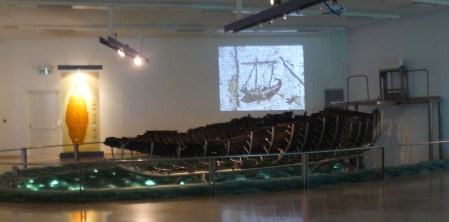
The most popular attraction in Israel is, perhaps surprisingly, a first century fishing boat. The boat in question was discovered by two brothers from Kibbutz Ginnosar who used to trawl the shore of the Sea of Galilee looking for artifacts. On one such occasion they discovered the outline of a boat. The story of raising and preserving the boat is fascinating and, thanks to the care taken with it’s restoration, we have an almost complete boat from the time of Jesus. It could hold up to fifteen men and their catch. The one located and preserved at Ginnosar had been repaired on many occasions during the course of its life and archeologists have identified a huge variety of timbers that, over time have been used to repair the boat. While the archeological significance of the discovery is immense and adds a great deal to our understanding of the craft of boat building in the first century, the discovery has the added weight of giving us a truer idea of the sort of vessel into which Jesus might have climbed in today’s gospel.

As with many of the accounts in our gospels, the story of the miraculous catch can be read in a variety of ways and on many different levels. We can notice the difference between this version of Peter’s call and that of the author of Mark, or we can compare the story with the post-resurrection catch of John’s gospel. Time could be spent comparing Peter’s reaction to Jesus with that of the prophets who, in the presence of the divine, recognize their limitations and frailties and protest their unworthiness. What did Jesus teach from the boat and what does it mean to ‘catch people alive’ we might wonder? Why does Peter address Jesus as ‘master’ before the catch and as ‘lord’ after the catch? And why does Luke use the language of ‘catching people alive’ (or enthralling them) when Matthew and Mark tell us that Jesus commissions the first disciples to ‘fish for people’.

These eleven verses, that on the surface recount the call of Peter, James and John, are filled with meanings and nuances that are both obvious and subtle. It could take hours for us to unpack the various complexities of the scene!

Today, I’d like to explore the possibility that the the story of the miraculous catch is a metaphor for our own time, that Jesus urges us to try again when we have lost hope and when feel that we have done all that we can.

We live in an age in which many of have grown weary of trying to win people for Christ and in which too often we fall into despair at the decline in church attendance and at our our inability to prevent the church’s slide into irrelevance. It is a time in which religion is often used to defend conservative values at the cost of compassion and to the detriment of the gospel message of love and in which the political and social landscape is undergoing great change. It is easy to be overwhelmed by the hopelessness of our situation and to simply give up.

Peter, James and John were, according to Luke, professional fishermen. They owned their boats and were in a business partnership. Almost certainly their fathers were fishermen before them and from an early age they would have understood the lake and the times at which the fish were most likely to be running. After an unfruitful night they would have been tired and frustrated and possibly anxious about the loss of revenue and in no mood to have another go. There would have been no reason for them to respond to a tradesman from Nazareth who knew nothing of the ways of fish or of the sea. Yet Jesus’ word is authoritative enough to persuade Peter to go back to the deep and to try one more time. He is rewarded with a catch so large that it begins to break the nets and Peter is forced to call for help.

The world of Peter was no more benign or settled than our own. Peter, James and John were not carefree fishermen, plying their trade and selling their catch. Rome overshadowed all their lives. The state would have demanded that they pay a tax or a levy for the right to fish and Rome’s representatives may have demanded a proportion of the catch. Life would have been difficult and the conditions oppressive and there would have been no reason to imagine that the situation was about to change. Tomorrow would be more of the same, but the certainty of their lives, hard as they were, would surely have more allure than the uncertainty of trusting in let alone following Jesus.

Jesus approached fishermen who were disillusioned and tired and he told them to try one more time. He ignored Peter’s protestations that he was a sinful man and without so much as a ‘by your leave’ he assured Peter that from now on he would hold people enthralled.

Many of us in the church are exhausted and disheartened. We feel that we have done all that we can to bring about growth in our congregations. We are conscious too, that collectively we are tainted by scandal, blemished by the compromises we have made and held in scorn because we have been unable to change and adapt.

When we feel that we have reached the limit of our reserves, Jesus comes to us, takes his place with us and says: ‘Try again. Take heart, go out once more into the midst of a world that is complex and hostile. Throw out your nets one more time. You will be amazed at what I can do with you – sinners that you are. Don’t be afraid, with me you will hold people enthralled.’

Staying the course

June 29, 2013

Pentecost 6 – 2013

Luke 9:51-62

Marian Free 

In the name of God who asks nothing less than all that we are and all that we have. Amen.

When reading the gospels it is often important to see the pattern that is developing. Luke, like the other gospel writers, carefully crafts his account of Jesus’ life. Some stories are clustered together for maximum impact, the whole gospel is framed by Jerusalem and Jesus’ travels are recorded in such a way as to point the reader or listeners to certain conclusions.

Today’s gospel sets the scene for Jesus’ final journey to Jerusalem. Jesus undertakes this journey with a certain amount of foreboding, he is well aware that entering that city is filled with risk, that his very life is at stake. Luke builds the tension through the way he organises his story and by his use of language. The narrative leading up to this point includes Peter’s recognition of Jesus and Jesus’ prediction of his death and resurrection. “The Son of Man must undergo great suffering, and be rejected by the elders, chief priests and scribes, and be killed, and on the third day he will rise” (9:22, 44).

The readers know then that the words “taken up” refer to the crucifixion and understand that Jesus is turning towards Jerusalem even though he knows the likely consequence. They will recognise that Jesus does not take this journey lightly. The language: “He set his face” makes this clear that for Jesus the decision to go to Jerusalem is an act of will, not a whim. Against his inclination to turn back, Jesus none the less resolves to complete his mission, to go to Jerusalem whatever the outcome might be.

Jesus’ courage and determination to finish what he started may well determine his responses to the three would-be disciples – not one of whom seems to recognise or share Jesus’ utmost commitment to the task ahead. The situation now is different from that when Jesus began his mission – when people like Peter and Andrew, left everything without a thought for the future. As Jesus nears the end of his journey and his time on earth, he realises that those who wish to follow him must understand the costs involved before they join him otherwise they will not last the distance.

At first glance, Jesus’ response to the three would-be disciples is harsh and uncompromising – not to mention ungrateful. However, he knows that what lies ahead for him (and for those who follow) will take great courage and fortitude – it is not for the faint-hearted or for those who will waver in the face of difficulty. Those who would be his disciples must “take up their cross, lose their life in order to follow.” (9:23ff). Discipleship is more than a grand adventure, more than healing and miracles and it will not lead to earthly glory or recognition. Following Jesus will require fortitude and commitment, a willingness to cope with difficult circumstances and an acceptance that discipleship might cause a re-alignment of loyalties. Discipleship is something that should only be undertaken if the would-be follower is determined to see it through to the end.

On the way to Jerusalem three different people engage with Jesus. Two say that they will follow him and the third is asked by Jesus to follow. Jesus’ response provides an idea of what he believes discipleship to entail. In the first instance someone offers to follow him wherever he may go. Instead of welcoming the offer Jesus responds that in fact he has nowhere to go. Following him means leaving behind all security, no longer belonging anywhere.

A second person when asked by Jesus to follow him, responds that first he would like to bury his father. Jesus’ reaction is not one of compassion as we might expect, but the rather cold: “Let the dead bury their own dead.” There can be no prevarication, no half-hearted measures. What lies ahead will demand the full attention and commitment of those who follow. They must be prepared to leave behind those things that would hold them back.

Finally, a third person says that he will follow Jesus – after he has said “good-bye” to those at home. Again we are surprised by Jesus’ response. Instead of commending the man, he implies that he implies that he does not have the steadfastness to complete what he begins. The journey of discipleship requires persistence. There is no point starting if one does not intend to finish, if one is always going to be looking back to what one left behind.

While it is true that these definitions of discipleship are contextual, it would not be true to draw the conclusion that they do not apply to us. Being a disciple of Jesus is not something that we can do with only part of us, not something to which we can commit only a portion of ourselves. We are followers of Jesus or we are not. It is not possible to be a partial follower. That being said, it is important to recognise that discipleship has consequences – it means accepting that there may be times when we feel that we do not fit in, that we cannot tie ourselves to the past and that those to whom we belong will be re-defined.

Jesus’ willingness to see the task through to the end led to the cross. Without the cross, there would have been no resurrection. He asks only that as followers we demonstrate the same commitment to the task at hand and the same willingness to follow it through to the end. If at times the cost seems more than we can bear, we need only to look to Jesus to be reminded that if  we stay the course, we will come out the other side richer, stronger and transformed into the likeness of Christ.