Posts Tagged ‘frustration’

I have come to bring fire

August 13, 2022

Pentecost 10 – 2022
Luke 12:49-56
Marian Free

In the name of God, Earth-maker, Pain-bearer, Life-giver. Amen.

The Australian tennis player Bernard Tomic is a controversial player whose matches have featured “epic displays of ranting, racquet-wrecking and trash-talking”. He has thrown tantrums over not having been provided with a white towel, tossed a tennis racquet at a ball boy, and even spat at spectator during a match. At Wimbledon recently he accused a judge of being “a snitch with no fans”. It is hard to know what leads to such outbursts. Is it that he feels under pressure to succeed having been a child prodigy. Could it be that he is frustrated that he is not playing as well as he knows that he can? Are his expectations of himself too high? Is is irritated by comments from the crowd or other distractions that he believes have put him off his game? Or is it as fellow-tennis player and four times Grand Slam winner Kim Cliijsters was reported as saying that: “He feels like he’s being disrespected”. Whatever the cause of his behaviour, it appears that in the moment his annoyance cannot be contained, and it spills out in what is sometimes a vicious attack. His anxiety or frustration builds to a point where he can take it no longer and the sense of injustice, inadequacy or whatever it is spills out into an attack.

One does not expect such outbursts from Jesus. Jesus (at least as we perceive him) is more measured, more in control of his emotions. Certainly, his teachings can be confrontational and challenging but, in general we hear him as encouraging and reassuring. After all, hasn’t he just told us that if God feeds the birds and clothes the grass of the field that God will surely feed and clothe us? When he does have outbursts they are not directly at us but at Pharisees and lawyers (“Woe to you Pharisees”). In our minds, those attacks are justified – after all aren’t the Pharisees hypocrites; aren’t they driven by the letter of the law rather than the intent of the law? They are the opposition. They represent the establishment which holds Jesus in suspicion, and which seeks to discredit him – not the disciples and the crowds who follow Jesus.

The only other instance in which Jesus loses his cool is when he discovers that the Temple is being used as a marketplace. He simply cannot countenance such disrespect for Judaism’s most holy place. Again, that makes perfect sense to us. Of course, he would be incensed by the traders and money changers plying their trade in what should be a place of worship!

It is all very well for Jesus to be angry with and frustrated by the teaching and behaviour of the Pharisees, the lawyers, the scribes, and the priests, but today his outburst is personal and, while not directly aimed at us, is certainly intended for us. Apparently without warning, Jesus launches into an expression of such frustration and exasperation that we cannot ignore it: “I came to bring fire to the earth, and how I wish it were already kindled!” “Do you think I came to bring peace to the earth? No!” This is explosive language, language that has us looking for shelter, a rock under which to hide. It is difficult, confronting and unexpected. This is not the Jesus we are used to.

Jesus, the Prince of Peace, the one whom the angels announced with promises of peace is now declaring that peace is the last thing on his mind! It is true that he has come to “bring good news to the poor, to proclaim release to the captives, the recovery of sight to the blind and to let the oppressed go free.” But that is not all that he has come to do. He sees only too clearly the complacency and self-satisfaction of the pious, the uneasy accommodation that the Jewish leaders have with the Roman colonisers, the neglect of the poor and the abandonment of the marginalised.

Jesus did not come into the world because everything was going well – just the reverse. He has come to put the world to rights – to wake people up to themselves, to expose an institution that had lost its way and to reveal the self-righteousness of the religious leaders. It was not his purpose to commend or to reassure the believers of his day. His task was to shake them to their core, to give them a wakeup call and to urge them to see how far they had strayed from the faith of their forbears.

The religious leaders are so entrenched in their ways, so complacent and self-serving that it will take nothing less than a cataclysmic event – a blazing fire – to bring them to their senses. The place of the church, its practices and observances, is so firmly established, so deeply entrenched in the community, so clearly associated with the God of Israel, that it and its community cannot help but be divided when some respond to Jesus and others hold fast to what they have always known.

We can imagine Jesus’ irritation, his impatience when his teaching falls on deaf ears, when no one but himself seems to be able to read the signs of the times and when those with the authority to effect change are so concerned to hold on to their own power that they seek to destroy anyone who threatens their position. It is little wonder that his frustration should come to a head and that he should let fly and tell it how it really is.

“I came to bring fire to the earth, and how I wish it were already kindled!” “Do you think I came to bring peace to the earth? No!” Jesus’ words are jarring, harsh and confronting but they are apposite. If Jesus were to come today, nothing would have changed. There would be little to show for his life, death, and resurrection. By and large, the church and its members are indistinguishable from the communities in which it finds itself. It is concerned as much with its survival as it is with matters of equity and justice. There are divisions in the church that are apparently insurmountable. In Australia, fewer people than ever identify as Christians. We live in a world in which a few have much, and the majority have less than enough. It is enough to raise Jesus’ ire, to call forth his disappointment, his despair, and his frustration.

We need to take these words to heart, not to brush them off. We need to ask ourselves again – what sort of world do we want/does God want? And we need to allow ourselves to be tempered by fire so that all that is rotten in can be purged and so that we can be part of the solution – not the problem.
Try again

February 9, 2019

Epiphany 5 – 2019

Luke 5:1-11

Marian Free

In the name of God who challenges us to go our of our depths to see who, with the help of Jesus, we can be. Amen.

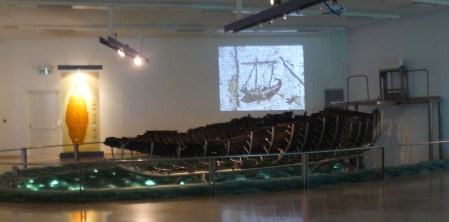
The most popular attraction in Israel is, perhaps surprisingly, a first century fishing boat. The boat in question was discovered by two brothers from Kibbutz Ginnosar who used to trawl the shore of the Sea of Galilee looking for artifacts. On one such occasion they discovered the outline of a boat. The story of raising and preserving the boat is fascinating and, thanks to the care taken with it’s restoration, we have an almost complete boat from the time of Jesus. It could hold up to fifteen men and their catch. The one located and preserved at Ginnosar had been repaired on many occasions during the course of its life and archeologists have identified a huge variety of timbers that, over time have been used to repair the boat. While the archeological significance of the discovery is immense and adds a great deal to our understanding of the craft of boat building in the first century, the discovery has the added weight of giving us a truer idea of the sort of vessel into which Jesus might have climbed in today’s gospel.

As with many of the accounts in our gospels, the story of the miraculous catch can be read in a variety of ways and on many different levels. We can notice the difference between this version of Peter’s call and that of the author of Mark, or we can compare the story with the post-resurrection catch of John’s gospel. Time could be spent comparing Peter’s reaction to Jesus with that of the prophets who, in the presence of the divine, recognize their limitations and frailties and protest their unworthiness. What did Jesus teach from the boat and what does it mean to ‘catch people alive’ we might wonder? Why does Peter address Jesus as ‘master’ before the catch and as ‘lord’ after the catch? And why does Luke use the language of ‘catching people alive’ (or enthralling them) when Matthew and Mark tell us that Jesus commissions the first disciples to ‘fish for people’.

These eleven verses, that on the surface recount the call of Peter, James and John, are filled with meanings and nuances that are both obvious and subtle. It could take hours for us to unpack the various complexities of the scene!

Today, I’d like to explore the possibility that the the story of the miraculous catch is a metaphor for our own time, that Jesus urges us to try again when we have lost hope and when feel that we have done all that we can.

We live in an age in which many of have grown weary of trying to win people for Christ and in which too often we fall into despair at the decline in church attendance and at our our inability to prevent the church’s slide into irrelevance. It is a time in which religion is often used to defend conservative values at the cost of compassion and to the detriment of the gospel message of love and in which the political and social landscape is undergoing great change. It is easy to be overwhelmed by the hopelessness of our situation and to simply give up.

Peter, James and John were, according to Luke, professional fishermen. They owned their boats and were in a business partnership. Almost certainly their fathers were fishermen before them and from an early age they would have understood the lake and the times at which the fish were most likely to be running. After an unfruitful night they would have been tired and frustrated and possibly anxious about the loss of revenue and in no mood to have another go. There would have been no reason for them to respond to a tradesman from Nazareth who knew nothing of the ways of fish or of the sea. Yet Jesus’ word is authoritative enough to persuade Peter to go back to the deep and to try one more time. He is rewarded with a catch so large that it begins to break the nets and Peter is forced to call for help.

The world of Peter was no more benign or settled than our own. Peter, James and John were not carefree fishermen, plying their trade and selling their catch. Rome overshadowed all their lives. The state would have demanded that they pay a tax or a levy for the right to fish and Rome’s representatives may have demanded a proportion of the catch. Life would have been difficult and the conditions oppressive and there would have been no reason to imagine that the situation was about to change. Tomorrow would be more of the same, but the certainty of their lives, hard as they were, would surely have more allure than the uncertainty of trusting in let alone following Jesus.

Jesus approached fishermen who were disillusioned and tired and he told them to try one more time. He ignored Peter’s protestations that he was a sinful man and without so much as a ‘by your leave’ he assured Peter that from now on he would hold people enthralled.

Many of us in the church are exhausted and disheartened. We feel that we have done all that we can to bring about growth in our congregations. We are conscious too, that collectively we are tainted by scandal, blemished by the compromises we have made and held in scorn because we have been unable to change and adapt.

When we feel that we have reached the limit of our reserves, Jesus comes to us, takes his place with us and says: ‘Try again. Take heart, go out once more into the midst of a world that is complex and hostile. Throw out your nets one more time. You will be amazed at what I can do with you – sinners that you are. Don’t be afraid, with me you will hold people enthralled.’

At peace with ourselves – with the world.

April 11, 2015

Easter 2 – 2015
John 20:19-31
Marian Free

In the name of God who gives us all that we need, if only we were ready to accept what God has to give. Amen.

Of course, I don’t need to tell you that the news is full of bad news stories. This morning for example , I woke to the news that in my own city, less than twenty miles from my home, a man of fifty-five had been killed – his neighbour was upset by the amount of noise that he was making. Later in the day, I heard that a young woman had been arrested for the murder of her father-in-law (her husband having already been arrested for the same offense). The newspaper provided an update on the man who had nearly killed his brother, by knocking him to the ground after they had visited a nightclub together and there was also a report on the guilty verdict for the “Boston bomber”. I could go on – the litany of crimes committed in anger, frustration, greed or need for power is just appalling.

Despite Jesus’ resurrection gift to the disciples, peace and harmony seem to be illusive even on the domestic front. The problem of course, lies with us – with the very human needs to be in control, to feel important and to put ourselves first.

What that means is that as long as there are people who are filled with anger and insecurity; as long as people feel entitled to do what they want and to behave how they want to behave; as long as there are some who are so concerned with their own comforts and own desires that they are able to disregard the concerns and interests of their neighbours: as long as some are filled with self-doubt: as long as there are some who feel that the world owes them something; there will be people who will resent any attempt to limit or curtain their activity, those who vent their fury in violent actions; those who seek to build their own prosperity with little or no regard for the cost to those who labour makes them rich or to consequences for the environment or the wider society and there will be those who will seek to diminish others in order to prove themselves smarter, better, stronger.

It is all too easy to imagine that such people are very different from ourselves – that we are above such petty, nasty, aggressive behaviour. But I wonder, are we really so different? Are we, those who profess the faith, perfect examples of the peace that Jesus gives? When others look at us, do they see our deep contentment with life our satisfaction with who we are and what we have? Are we so secure in our (God created) selves that we have no need to fill our emptiness with possessions, achievements or comparisons with others? Do others looks at us and see in us anything that separates ourselves/our lives from their own? Do we really stand out from the world around us?

Let me be clear that I have enormous respect for members of the Parishes in which I have served. Their life and their faith has often challenged my own. In general though, I suspect that too few of us find our meaning entirely in Jesus, that not enough of us seek above all that peace which only Jesus can give and that not all of us really believe that we can trust God with every aspect of our lives.

For the world to be a better place we would all need to find our meaning, our hope, our security and our peace in the Trinity – in God our Creator, Jesus our Redeemer and the Spirit our enlivener. As long as we look elsewhere we will not be at peace and our striving, our frustration, our fears and our anxieties will be taken out on others (intentionally or otherwise).

As I write this, the words of a well-known hymn are repeating themselves in my head:

Drop thy still dews of quietness,
till all our strivings cease;
take from our souls the strain and stress,
and let our ordered lives confess
the beauty of thy peace,
the beauty of thy peace.

Breathe through the heats of our desire
thy coolness and thy balm;
let sense be dumb, let flesh retire;
speak through the earthquake, wind, and fire,
O still small voice of calm,
O still small voice of calm. John Greenleaf Whittier

May we together seek the beauty of that peace which Jesus alone can offer, and in relinquishing our striving to be other than who we are, find our true selves and know the presence of God there.