Posts Tagged ‘grief’

Loving and letting go – Mary Magdalene

July 24, 2021

Mary Magdalene – 2021
John 20:1-18
Marian Free

In the name of God who frees us from the grief and pain of the past and who sends us to proclaim hope to the world. Amen.

I was so lucky! Imagine being able to spend seven weeks overseas with not a care in the world. You will remember that in 2018 I was fortunate enough to spend seven weeks in Europe for my long service leave. As part of that holiday, I had two weeks in Florence. Before travelling I met with David Henderson who has lived in Italy. He told me what would be his top five places to go, things to do. I was so grateful, it meant that instead of trying to fit everything in, I could focus on just a few special experiences and do the remainder if I had time. One of his suggestions was that if I did nothing else that I should see Donatello’s Mary Magdalene in the Museo dell’Opera del Duomo.

I am so grateful. The Penitent Mary Magdalene has a room to herself and is so extraordinary and so moving, that, had there been a chair, I could have spent half a day contemplating the figure. As it was I was so moved that finally I had to tear myself away. I have included a photograph in the Pew Sheet, but it is hard to do her justice. Donatello has carved a figure that is utterly bereft, completely desolate. His image is of a woman who is so stricken with grief, that she has lost all sense of pride. She looks haggard, her hair has grown to her ankles, teeth are missing, and she looks as though she has been wandering around the countryside, living in the open .

The idea of a penitent Mary stems from end of the 6th century when Pope Gregory 1 made the association between Magdalene and the sinful woman from the street who anointed Jesus’ feet (in Luke 8). There are many reasons why these cannot be the same woman. It is true that we are told that Mary Magdalene was the one from whom 7 demons were cast out but that suggests that she was suffering from a physical ailment or a mental illness, not that she was making her living from prostitution. Mary was among the women who supported Jesus from their own incomes, she was at the foot of the cross when all the disciples had fled and, as every gospel records, she was at the tomb early in the morning of the third day. That Mary’s role in the ministry of Jesus was remembered (at a time when women were being written out of the story) is indicative of the role that Mary went on to play in the early church. This is further supported by the fact that Mary is mentioned in the Gospel of Philip in which Jesus is said to have shared secrets with her and to have kissed her on the lips.

The Biblical Mary is someone who has been empowered by Jesus, not someone who was overwhelmed by guilt. Indeed, Mary is often called the “apostle among apostles” as it was Magdalene who was commissioned by Jesus to tell the disciples that he had risen from the dead . For this reason, it is impossible for me to marry the Mary that I know, with the Penitent Mary popular with artists in the 15th and 16th centuries.

When I saw Donatello’s sculpture, I knew only that it was his Mary Magdalene, and it is only in preparing for today that I discovered the ascription “Penitent” given to the sculpture by the artist . It was because I knew the Mary of the New Testament that Donatello’s Mary spoke to me of grief and not of penitence, of despair and not of guilt. In fact, for me Donatello’s Mary comes straight from this morning’s gospel. Mary has come to the tomb alone. Having discovered that Jesus was not there she has run and told Peter and the disciple whom Jesus loved. They ran to see for themselves and, having seen, returned to their homes.

Mary stayed, weeping – utterly alone, utterly disconsolate. It is this desperate grief that I see in Donatellos’ sculpture – a woman who has lost, apparently forever – someone who had loved her and affirmed her and whom she had loved in return. This Mary knew that nothing would ever fill the void that filled her heart at that moment. Her life, which for a time had had meaning and purpose at this moment stretched out, empty, before her. Now, even his body had gone. Now there was no grave, no place where she could go to mourn him.

Lost in her thoughts and overwhelmed by sorrow, Mary could not recognise the risen Jesus until he called her name. Then, apparently fearing that she would lose him for a second time, Mary – physically or metaphorically – clung to him. But the future that she imagined cannot be. Jesus tells her to let go. He must leave and she, Mary must take on a new role – that of apostle, one sent by Jesus to spread the gospel.

Our story is very different from that of Mary, but over the last twenty months we have said good-bye to many of our hopes and dreams, we have endured separations from those whom we loved, some of us have experienced financial hardships and all of us find ourselves facing a future that is very different from that which we had expected. Our lives will never be the same but, like Mary, we cannot cling to the past, we cannot put our lives on hold, hoping that they will return to what they were. We must move forward, impelled by our faith and confident that Jesus, our risen Saviour goes before us, having faced his own demons, experienced the worst that life can throw at him and come out triumphant on the other side.

Grief is a natural response to loss, but we cannot allow it to hold us forever in its grip for none of us know what the future may hold.
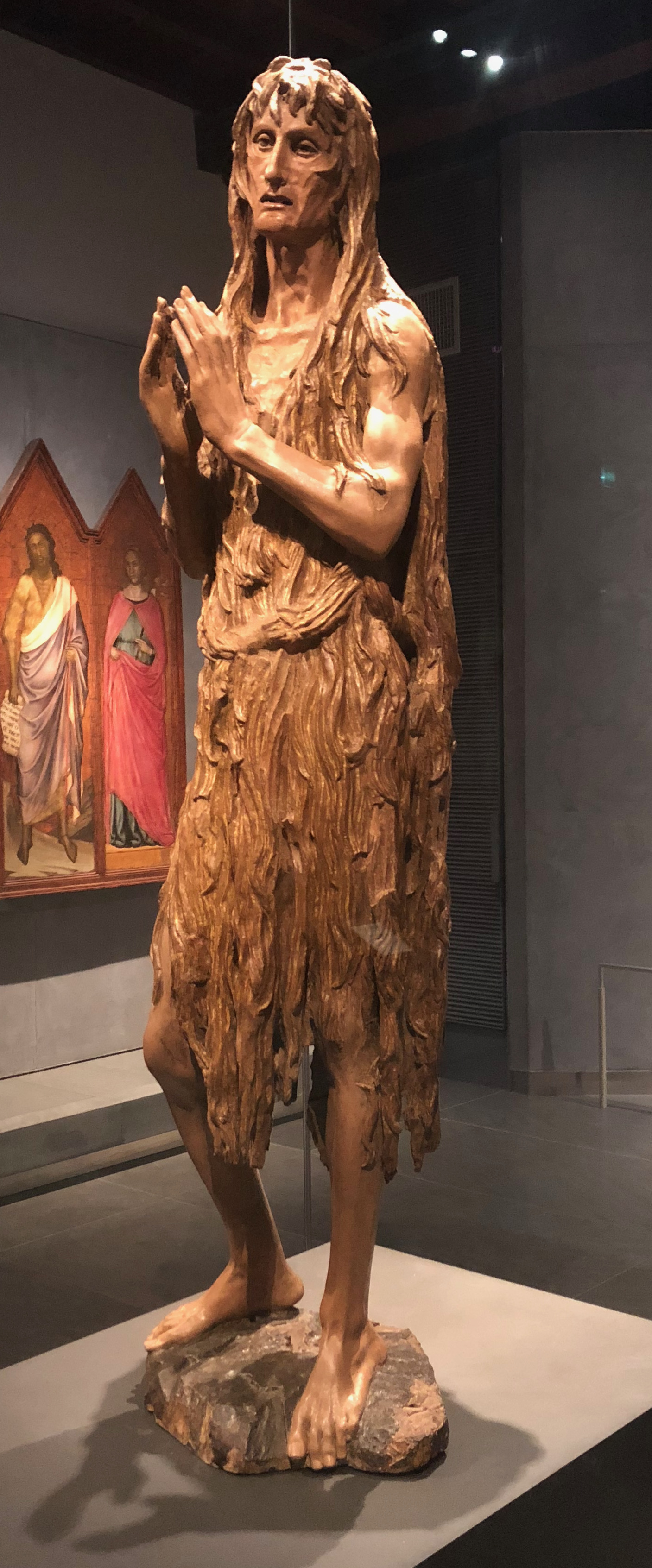
Penitent Mary Magdalene, Donatello, Museo dell’Opera del Duomo

In the company of saints

October 31, 2020

ALL SAINTS AND ALL SOULS – 2020

MATTHEW 5:1-12A

MARIAN FREE

In the name of God in whose loving care are the living and the dead. Amen.

‘Blessed are those who mourn for they shall be comforted.”

 The Beatitudes, one of the best-known New Testament passages, are a reminder of the upside-down world that Jesus preaches and which he encourages us to embrace. In a world that values success and happiness, Jesus promotes humility and sobriety and assures his followers that, contrary to popular opinion, grief and poverty are blessings[1]. Over and over again, Jesus contradicts commonly held values and aspirations. Through his choices and his actions, Jesus demonstrates that it is not necessarily those whom society values – the rich, the powerful and the healthy – who have precedence in the kingdom of God. It is the poor and the marginalised who are the focus of Jesus’ ministry – those who have nothing and who have no opportunity, those who by virtue of their disability, their poverty or their powerlessness demonstrate to the rest of us that it is possible to exist in this world and to have faith without the trappings that many of us find indispensable.

Luke’s version of the Beatitudes is even more stark than Matthew’s: 

“Blessed are you who are poor,

                        for yours is the kingdom of God. 

            “Blessed are you who are hungry now,

                        for you will be filled.

            “Blessed are you who weep now,

                        for you will laugh.”

Jesus knows, as we often do not, that absence makes presence even more special and that the acceptance of one’s current situation frees us from striving and stops us from thinking about what we do not have but rather of what we do have allowing us to live in the present and not in some imagined the future. He reminds too us that this life is only a part of the story. 

For many hundreds of thousands of people this has been a year of unbearable grief and loss, often compounded by the inability to visit a dying parent, or even to attend their funeral. Rituals that have existed since the beginning of human existence are forbidden or limited and those things that provide comfort and allow us to properly farewell those whom we love are being denied us. I cannot imagine the agony and anxiety which countless families have endured, and nor can I conceive the ways in which their grief might have been amplified by COVID restrictions.

The Feasts of All Saints and All Souls which fall on November 1st and 2nd respectively provide an opportunity, as best we can, to express our loss for the souls of the departed but also to affirm our confidence in the commonwealth of heaven and the belief that not even death can separate us from those whom we love. 

On All Saints day we honour the lives of all the faithful and on All Souls’ Day we give thanks for and pray for the departed. We do both in the company of other Christians throughout the world. This year, whether we are confined to our homes or able to worship with our faith communities, we can be both comforted and supported in our common prayer and in the knowledge that we are surrounded by “a cloud of witnesses”. As we remember before God those whom we grieve, we can be confident that we do so with countless others who have known loss and in fellowship with all the saints, both living and departed. We can take advantage of these two days to begin to make peace with our grief and lay to rest those whom we love despite the opportunities that we have been denied.

This year and next and for however long it takes, the feasts of All Saints and All Souls can be an occasion to fill the vacuum created by the COVID restrictions on caring for the dying and farewelling the dead. If we have not been able to say “farewell” in the way that we would have liked – with full churches, families and friends – let us say our farewells in a different but vastly greater community of saints – living and dead.

Remember too that the Beatitudes remind us that however difficult our current situation, stiving for that which is not possible will only lead to discontent and misery. The truly blessed are those who can acknowledge and sit with the present, accept things as they are and to place their trust in the God of time and history.


[1] I like to think that he doesn’t mean grinding poverty but rather the absence of excess, of the things that we don’t need.

100th Anniversary – Armistice Day

November 10, 2018

Armistice Day – 2018

Mark 12:38-44

Marian Free

In the name of God who sustains us in our darkest hours. Amen.

On the 24thof April 2015, Tony Abbot told the following story that was reported by The Herald Sun.

“It was on a still spring night a century ago that the ships carrying the Australian and New Zealand Army Corps stole in towards the high coastline of the Gallipoli peninsula.

The first boat landed at a small cove surrounded by steep slopes of thick scrub shortly after four in the morning. Two of the ANZACs who came ashore on April 25, 1915, were Privates Lance and Daryl Blannin-Ferguson. Hailing from Mt Martha, they were two of the first to enlist after the war broke out. They were assigned to the 7th Infantry Battalion, and left Melbourne on the transport ship Hororata on October 19, 1914. Lance was one of more than 750 Australians who were killed on the day of the landing. He was just 21 years old.

His younger brother, Daryl, was killed on May 8, 1915, during the Second Battle of Krithia, aged only 19.

By the time of the evacuation — the only successful part of the campaign — in December 1915, Lance and Daryl were just two of more than 8700 Australians who had died. Their older brother, Lieutenant Acland Blannin-Ferguson, also served on Gallipoli. He survived the campaign and transferred to the British Army in January 1916 before returning to Australia after the war. The Blannin-Ferguson family, like so many families across Australia during the Great War, paid a great price.”

I belong to a generation that has had a rather charmed existence. Both my grandfathers were too young to enlist in the first World War, my father too young for the second and my brother too young for Vietnam. During my lifetime our shores have not been threatened and civilians have not had to endure rationing or the other ordeals associated with a nation at war. I have not had to flee my home with only what I could carry because the enemy were advancing or the bombs raining down.

I have no idea what it is like to farewell a beloved father, brother or husband knowing that I might never see them again. I cannot imagine what it is like to open the door to the person delivering the feared telegram and to know that you will not see your husband, father or brother and that you will not even know where their bodies lie have no grave at which to grieve.

That said, the First World War did cast a shadow over our family life. Lance and Daryl were the older brothers of my paternal grandmother – great uncles whom I never knew, and whose stories were cut short.

The First World War, the Great War, the War to end all Wars was the costliest conflict the world has known. In total, the losses on both sides amounted to nearly 10 million soldiers and 7.7 million civilians  – a total of over 17 million dead (some estimates make the number 19 million). Over 21 million soldiers on both sides were wounded. It was a huge price to pay for a conflict that was driven by nationalism rather than ideals, by greed rather than a deeply held cause. It is much easier to defend our engagement in the second World War than our participation in the first. Yet it is possible to argue that “out of the war came a lesson which transcended the horror and tragedy and the inexcusable folly. It was a lesson about ordinary people – and the lesson was that they were not ordinary. On all sides they were the heroes of that war; not the generals and the politicians but the soldiers and sailors and nurses – those who taught us to endure hardship, to show courage, to be bold as well as resilient, to believe in ourselves, to stick together”[1]. It was, as many have claimed, the time when we identified the characteristics that made/make us uniquely Australian – mateship, youthful confidence, a certain “devil may care” attitude to life (especially in the face of danger or difficulty).

It is common to speak of the sacrifice these young people made for us, but we must be careful not to use the word sacrifice too liberally. The idea of sacrifice is idealised and it allows us to dignify what became a shocking, even wasteful loss of life. The young men (and some young women) who boarded our troop ships had no idea what lay ahead, many were signing up for the adventure of a lifetime. Few, I imagine, enlisted with the goal or ideal of dying for king and country.

Sacrifice can be a dangerous notion as today’s gospel suggests. Too often it involves asking those who are the most vulnerable to give the most – the widow to give her last coins to the Temple treasury, the youth of this land to face a hail of bullets, mustard gas and muddy trenches for what, at times, were futile gains.

There were 61,000 Australian soldiers who never returned home, 152,000 who were wounded and another 119,000 who served overseas. Whether the cause was noble or not, whether they were asked to do the realistic or the impossible, whether the leadership was wise and strategic or unwise and haphazard, all those who served, served willingly and did what was required of them. They faced the horrors and the losses with fortitude, resilience and courage, not to mention a dose of good humour and a determination to stand by one’s mates.

It is true that this day 100 years ago did not provide the world with lasting peace. WWI was not the war to end all wars, but it does remain the most devastating and wide-reaching war with the worst loss of life. We remember today those who did not come home, those who came home maimed and scarred, and those at home whose lives were changed forever by loss or by the changes in those they loved. We do not remember war to glorify it. We remember to remind ourselves how great is the cost of conflict. We remind ourselves of the cost, so that we will think carefully before we enter any future engagements and so that we will do all that is humanly possible to promote reconciliation and to work for peace.

We remember all those who bear the cost on our behalf – soldiers, medics and nurses.

We will remember them.

[1]Paul Keating http://www.awm.gov.au/commemoration/speeches/keating-remembrance-day-1993Ar