Posts Tagged ‘History’

40 days in the wilderness with Mark

February 17, 2024

Lent 1 – 2024

Mark 1:9-15

Marian Free

In the name of God whose love is our beginning and our end. Amen.

I wonder, if we only had Mark’s account of Jesus’ forty days in the wilderness would our practice of Lent any different? Mark simply tells us: “The Spirit immediately drove him out (literally cast him out) into the wilderness. He was in the wilderness forty days, tempted by Satan; and he was with the wild beasts; and the angels waited on him.”  There is no mention here of fasting, no reference to Jesus being famished and no elaboration of the temptations. It is Matthew and Luke who fill out the story with details of three specific temptations and of Jesus being hungry.  Interestingly – in their accounts there is no record of wild animals and no reference to the angels ministering to Jesus.

We know from the gospels that fasting was a spiritual practice among the Pharisees in the time of Jesus, but in Mark’s gospel there is no evidence that Jesus himself fasts. In fact, Jesus is asked why his disciples do notfast when the disciples of John the Baptist and the Pharisees fast (Mark 2:18). Jesus may or may not have fasted.

The earliest Christians did fast. Possibly following the tradition of the Pharisees, the first believers fasted on a weekly basis though – as the first century document the Didache makes clear – they were to distinguish themselves from the hypocrites – presumably the Pharisees. In that document, we read that the community should not fast on the days that the hypocrites fast (the second and fifth days of the week,) but on the fourth day and on the day of preparation (Friday). That fasting was an accepted spiritual discipline among Christians by the second century is recorded in a letter written by Irenaeus bemoaning the fact that there was no common practice and that the discipline varied from one day of fasting to as many as 40 days.

Fasting for the forty days before Easter can be traced to the Council of Nicea in 325 CE which formalised the custom – possibly as a way to prepare for baptism. It took much longer for there to be a common practice throughout Christendom. Some places allowed the Lenten fast to be broken on Sundays, others not. Some only fasted from Monday to Friday, meaning that the 40 day fast took place over 8 weeks. In general, meat, fish and dairy were forbidden, as was consuming food before 3pm. During the reign of Pope Gregory the Great, the season of Lent was regularised. It was to begin 46 days before Lent, with a ceremony of ash. Sundays were excluded. During the 9th century the strictures were relaxed somewhat and by the 1800’s the emphasis on one meal a day was relaxed. Traditions and practices continue to evolve, but we maintain the practice established in the seventh century – Ash Wednesday to Easter Day, excluding Sundays.

To return to where I began, if we only had Mark’s gospel I wonder if it would make a difference to our Lenten observance?

It seems to me that there are four parts to Jesus’ experience as reported by Mark. First, we are told that Jesus was cast out, or thrown out into the wilderness. In other words, Jesus allowed himself to be tossed about by the Spirit. He didn’t fight the Spirit’s leading, no matter how uncomfortable it made him, or how unpleasant it seemed. Second, in the wilderness Jesus was tempted by Satan. Mark doesn’t elaborate on this point, but his gospel depicts a power play between Satan and God. Jesus now (and throughout his ministry) resists the temptation to rely on anything and anyone but God. 

Third, and this is perhaps the most difficult to make sense of – Jesus was with the wild animals. There is no suggestion that Jesus is in any kind of danger here so perhaps Mark means us to understand that in the wilderness Jesus identified himself wholly with all of God’s creation – the creation with whom God has made a covenant (as the reading from Genesis tells us (Gen 9:8-10)).[1]

Finally, Mark tells us that Jesus was ministered to by the angels. Out there in wilderness Jesus allowed God’s representatives to care for him. He didn’t need to assert his independence and he didn’t need to prove how strong-willed he was because he knew that God would take care of everything. 

What might this reading of Mark mean for us and for our observance of the 40 days before Easter?

In the first instance, we might allow Mark’s account re-frame the way that we see the season. Instead of seeing Lent as a time of penance and self-sacrifice, we might grasp opportunity to allow ourselves to be led by (tossed about by) the Spirit – as terrifying as that might be. 

In a world which places a premium on independence and self-reliance, we could learn to serve not ourselves (Satan), but God.  

In a world in which we have used the earth for our benefit and for which we are now paying the price, we might take a page out of Jesus’ experience in the wilderness and understand that we are part of, not apart from all creation, that working with and not against creation will be better for us and lead to the healing of the world.  

And finally, and for some of us the most difficult, we might use these 40 days to truly allow ourselves to trust in God’s unbounding love for us, accept that we are worthy of that love and in so doing permit the angels themselves to care for us. 

Mark’s account of Jesus’ 40 days in the wilderness frees us to let go of any striving to be good, encourages us to abandon our attempts to punish ourselves for our shortcomings and allows us to stop using self-denial to prove how strong or how disciplined we are. It enables us to understand that Lent is less about what we do for God, and more about what we let God do to and with us. 

Our Lenten observances are based on the scriptures and moulded by centuries of tradition – that doesn’t prevent us from looking at it anew and seeing what Mark has to teach us. 

This Lent – Are we willing for the Spirit to toss us about? Can we let go our need to rely on ourselves? Do we understand that we are integrally related with all creation? And, can we accept that we are entirely worthy of God’s love?


[1] This is the suggestion of Dr Margaret Wesley who draws on today’s reading from Genesis to the effect that God has made a covenant with all creation.

Let the past inform the present and future

July 12, 2021

NAIDOC WEEK – 2021 (Pentecost 7)
Mark 6:14-29
Marian Free
In the name of God who created humankind in God’s own image and who cherishes each one of us as children of God. Amen.

The history of St Augustine’s church Restless Hearts which is in the process of being published, begins: “Sometimes it is so hard to believe how close we are, even today, to penal stations and missionary priests, Aboriginal skirmishes and interminable journeys on horseback through unchartered eucalypt forest.” It was as recently as 1823 that Thomas Pamphlett, along with three other ticket-of-leave men set out to cut cedar in Illawarra. They were caught in a storm which blew them north where they were wrecked on Moreton Island. As the book continues: “After various hardships, mitigated by help from Aboriginals, the emancipists crossed to the mainland, and, believing themselves to be south of Sydney they sought a northward route homewards. Aboriginals again helped them with food and directions, and they soon chanced upon a large river (the Brisbane). Too wide to cross, they followed its banks upwards almost to the present site of Goodna, and finding a canoe, they crossed the stream and returned along the opposite bank, again living with Aboriginals for some weeks”.

Soon after, a settlement began at Eagle Farm and in 1829 and a Patrick Logan established a farm with maize, potatoes and some cattle (on what is now the Royal Queensland Golf Club). Eagle Farm was also the site of a Women’s Prison which, as it was built on swamp land and therefore and ideal breeding spot for malaria bearing mosquitoes’. Despite this the site remained until the penal colony was closed in 1842.

Charles Fraser, the Colonial Botanist from 1821 to 1831, visited the Moreton Bay settlement in 1828. He ‘found a native cemetery represented by hollow logs filled with the bones of blacks (sic) of all sizes at the mouth of Breakfast Creek.’ Initially the new settlers and the indigenous Australians, lived together – if somewhat uncomfortably. A penal surgeon noted in 1836 that: “in the first years of the penal settlement there was a substantial population of local Aborigines in the area, their numbers depending on the season.” He also wrote of the long road between Brisbane and Eagle Farm passing through ‘the fishing ground of a tribe of aboriginal natives; at seasons of the year they are very dangerous and troublesome.’

It was when the Women’s Prison closed and the land was opened up to white settlers who used it for mixed farming – citrus fruit, dairying, cattle-grazing and small crops – that it became harder for the original inhabitants to live side-by-side with the newcomers. Tensions arose over the use of land. The destruction of crops was followed by attacks on the local indigenous by the colonists. Yet, as late as 1848, a Charles Phillips arrived in Hamilton as a small boy. He recalls that he was friendly with the Aborigines, ‘especially the Bribie Island tribe which frequented the Hamilton and Eagle Farm areas and had their camps there.’

Despite Phillip’s positive memories, tensions continued as Hendricksen notes: “between 1856 and 1867, there was continual harassment and counter-harassment, raids and robberies by Aboriginal groups, and punitive attacks by settlers including the burning of camping grounds. Such was the sense of injustice felt by the original inhabitants that Dalinkua – an Aboriginal leader and delegate – published his ‘indictments’, in the Moreton Bay Courier in 1858/9. He wrote:
“That indictment, which we are forced to bring against our white brothers … we charge them with having disregarded the command of the Great Father, and being unfaithful to the trust reposed in them; insomuch as they leave us and our people, whom they find stripped of land where our fathers hunted on, and driven off naked and wounded, diseased and destitute, to pine away and perish; while their government, like the priest in the parable, passes us by on one side, and their church, Levite-like, passes us on the other, neither of them taking any notice of our utter helplessness! Leaving us, perhaps, until some good Samaritan, of another creed and another nation, pass this way, and supply us with what is needful, both for this life and that which is to come …. But, surely, our white brothers, in their wisdom, could devise means whereby our wants could be met …. …. Christians, you are here in this land by the inscrutable Providence of God! Have you brought your religion with you? Is not its precept ‘Thou shalt love thy neighbour as thyself?’ If so, ‘Love worketh no ill to his neighbour, therefore love is the fulfilling of the law.’ Governed by this law you can no longer disregard the well-being of your fellow creatures. Your brotherhood must develop itself more, if ye belong to Him who does not wish that any of His ‘little ones’ perish.’”

Evidently, the church was present in the colony almost from its inception. As early as 1838 Anglican services were held in the area by The Rev’d Handt (a Lutheran!) and in May 1896 the first St Augustine’s Church in Hamilton was dedicated – only 73 years after Pamphlett found himself here and only 38 years after Dalinkua published his indictments. Though to us, it might feel like the distance past, in historical terms, colonisation of this area is recent history. The change in the landscape, its population and its use has been extraordinary in that time. Our indigenous brothers and sisters carry inter-generational trauma of all that has happened in the past two hundred years of white settlement of Moreton Bay – dispossession, massacres, stolen wages and decimation as a result of smallpox and other diseases introduced by white settlers; not to mention alcoholism, child removal.

As the note in the Pew Bulletin says, NAIDOC week invites us to embrace First Nations’ cultural knowledge and understanding of Country as part of Australia’s national heritage and equally respect the culture and values of Aboriginal peoples and Torres Strait Islanders as they do the cultures and values of all Australians. We can begin by trying to learn the rich history of the first peoples of the land on which we stand and endeavouring to reconnect with our brothers and sisters whose forbears walked this country for countless generations before us. May the indictments of Dalinkua not be applied to us.

The Holy Land

June 21, 2015

At this moment I am sitting in the Bethharram Convent in Nazareth. I had thought to post some reflections on the Sunday readings while I was away only to discover that technology has let me down and the texts I had so carefully begun are lost somewhere between my laptop (in Brisbane) and my iPad in Israel. I had thought also that maybe by now I might have seen the Sea of Galillee and could therefore have spoken authoritatively about storms on the lake. Galillee is for another day. It is both exciting and frustrating to be here. There are of course many devotional sites – some of which we have visited – but there is almost nothing that might give a hint of what Nazareth might have been like in Jesus’ time.

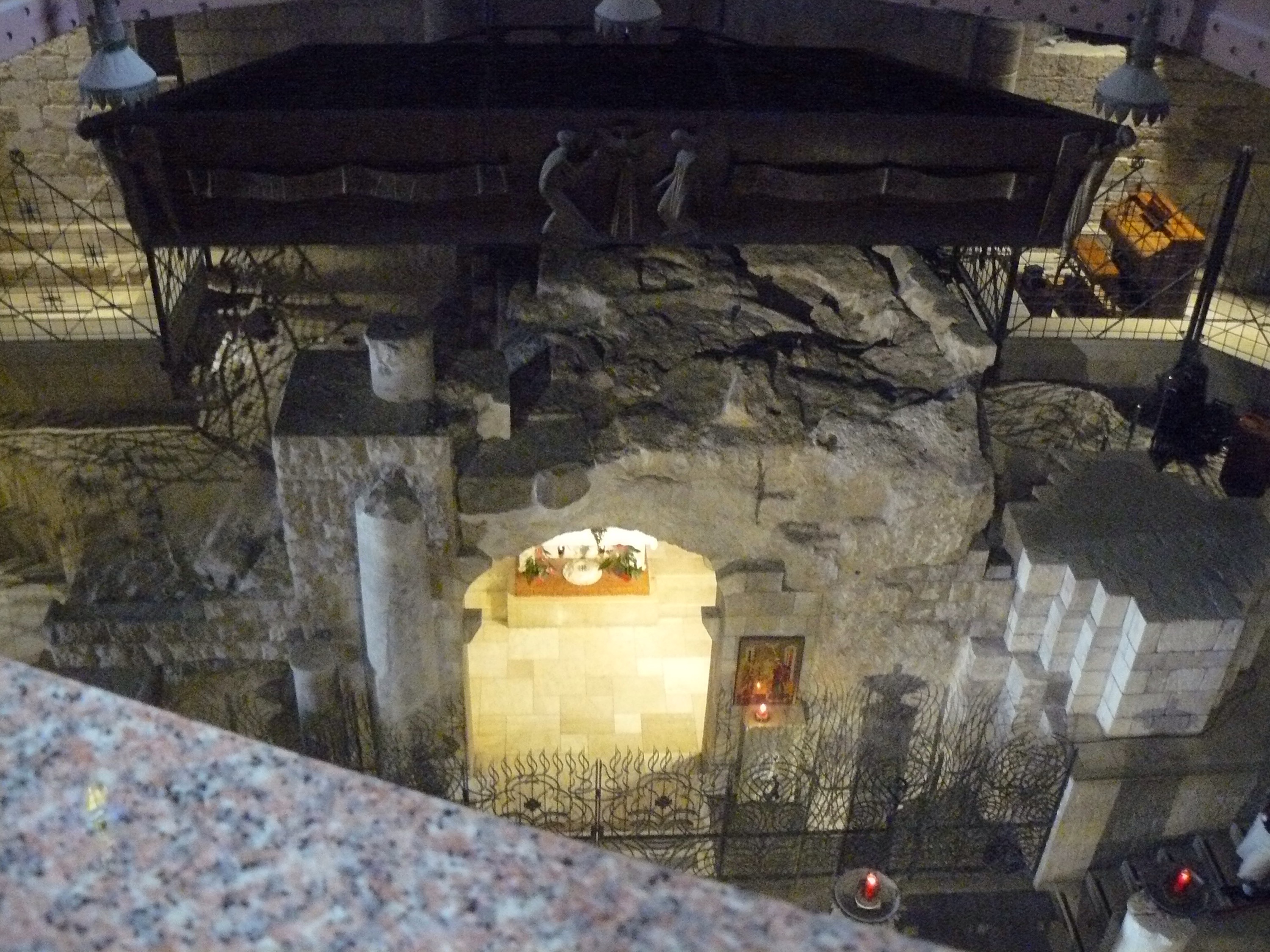
The city has been destroyed on many occasions since the first century and what we see now is a modern, Palestinian city. Many scholars believe that in the time of Jesus, Nazareth would have been a small Jewish settlement (possibly with strong ties to Jerusalem). All the evidence seems to suggest that at this time there might have been only fifteen families resident here – somewhere between 300-500 people. It is probable that they lived in one of the many limestone caves that now lie beneath the city. Some, like that beneath the Church of the Annunciation have been significantly altered as a result of devotional practices, others are more original. The caves are cool and make a great deal of sense for life during hot dry summers.


Limestone cave in Church of the Annunciation

 Understanding the geography and nature of first century Nazareth gives some cause for thought with regard to the way the Jesus’ story is presented in the gospels. For example, while there might have been sufficient men in Nazareth to form a gathering (synagogue), it is extreme unlikely that a structure that could be called a synagogue existed as LUke suggests. Likewise it is equally difficult to imagine the villagers trying to push Jesus off a cliff when the nearest “cliff” is some distance away.

Knowing the geography and learning about the history is wonderful, but we have to be careful, as our guide says that we do not “mortgage truth to history”. By this he means that we should not be so concerned with absolutely provable concrete facts that we lose the truth of two thousand years of faith. 

Will continue to be fascinated with the geography and history of this land, I will be keen to discover as much as I can of the historicity of our faith, but I will never lose sight of the deep insights that are to be found in our scriptures and of the eternal truths which they and our traditions contain.

No greater love

April 24, 2013

ANZAC DAY 2013

John 15:9-17

Marian Free

No one has greater love than this, to lay down one’s life for one’s friends. John 15:13

While most of us know the story of ANZAC Day, I’m not sure how many of us know the history of its commemoration and the part played by an Anglican and a Queenslander. A day in the midst of war is perhaps an unusual date for remembrance, especially a day on which so many lives were lost and which in military terms was anything but a success.

Interestingly, the history of the commemoration begins in Queensland and it begins as long ago as January 1916 when the then Premier met with the Recruiting Committee –whose primary goal was to encourage young men to enlist. However, the loss of so many men on April 25 – Queenslanders were the first ashore – suggested the importance of setting aside the day for a solemn commemoration. Canon Garland an Anglican priest who spoke strongly in support of this idea, was elected to lead the committee to plan the commemoration.

From the beginning the service was a multi-faith event which was in many ways a requiem for the fallen and Garland enthusiastically supported the day as Australia’s “All Soul’s Day”. Once the day was established in Brisbane, Garland urged all the mayors in other Australian (and New Zealand) cities to follow suit. He also lobbied hard that ANZAC Day become a public holiday in the same way as Good Friday and in 1930 this was enacted throughout the nation.

Garland, an Orangeman, clearly drew on the custom of an annual march, but despite his sectarian background, he was well aware of the divergent Christian, not to mention religious traditions in Australia. Originally, all churches were encouraged to hold their own commemorations before their members joined a public service at the War Memorial. At the public service hymns that were non-Trinitarian were sung and sensitivity towards the multitude of faiths and no faith led Garland to introduce the minute’s silence in which each person could pray, or reflect in their own way.

From the beginning the committee were clear that ANZAC Day was not intended to glorify war. All the chaplains agreed it was to be a day of remembrance and a day to recognise the sin that gave rise to national conflict and the nation’s need to atone for that sin. This is expressed in a sermon given by Rudolf Otto in St John’s Cathedral in 1924 referring to the Cross of Sacrifice in Toowong cemetery:

“The memorial in its noble dignity proclaims, as befits a Christian people, the great sacrifice of Calvary; and unites therefore the sacrifice of those who also laid down their lives for their friends. Its inscription is no less dignified than the memorial itself: Their Name Liveth for Evermore.” On Anzac Day we gather collectively, and plead for them the Sacrifice of Calvary, to which they united themselves by offering their souls and bodies as a reasonable, holy and lively sacrifice, after the example of Him who by word and from the pulpit of the Cross taught that “Greater love hath no man than this, that a man lay down his life for his friends.” Thus in the House of God, pleading at the Altar of God, we find the most comfort, not the sorrow of those without hope for them that sleep in Him, nor the swamping of our grief in noisy demonstrations; but by emphasizing in mind and thought the reality of that life beyond the veil where they live for evermore, and where some day we, too, shall meet them. Thus again there is no room for anything but a solemn observance of Anzac Day – the All Souls’ Day of Australia – and so we come before God not in the bright vestments of festival and the joyous music of triumph; but with the tokens of Christian penitence and sorrow for the sin of the world which caused the sacrifice of those bright young lives, our dearest and our best.”[1]


[1] I am indebted to and heavily dependent on an article by Dr John Moses. “Anzac Day as Australia’s All Souls’ Day: Canon David John Garland’s Vision for Commemoration of the Fallen”

[A paper given at “Christian Mission in the Public Square”, a conference of the Australian Association for Mission Studies (AAMS) and the Public and Contextual Theology Research Centre of Charles Sturt University, held at the Australian Centre for Christianity and Culture (ACC&C) in Canberra from 2 to 5 October 2008.]

Click to access Moses.pdf

Maintaining a sense of awe

January 5, 2013

Maintaining a sense of awe and wonder

Maintaining a sense of awe and wonder

Epiphany 2013

Matthew 2:1-12


Marian Free


Holy God, open our hearts to the wonder that surrounds us – especially that which reveals your presence. Amen.

I don’t know what your experience was, but I clearly remember the day on which I became aware that science had destroyed my innocence – the day I knew things which changed forever the way in which I looked at the world.  I guess that I was about nine years old. I was lying on my back under a frangipani tree. As I looked up at the clouds I saw – not fluffy, cotton wool creations on which angels might sit, but instead floating masses of water which would not hold even the smallest of celestial beings. In that moment I knew, all the magic of clouds had gone. My new-found knowledge meant that my view of the world had changed forever. It was no longer possible to see the world as I had once seen it.

While I obviously remember that moment with absolute clarity, I can assure you that it did not destroy my joy and wonder in creation, nor did it produce an antipathy for science which, as often as not, points me in the direction of awe and wonder not only in God’s creation, but in those good things made by our hands.

That said, I do feel a sense of regret that the church, which at first protected its members from the Enlightenment, eventually allowed itself to be caught up in a need to be both rational and scientific. Over the years much astronomical work has gone into trying to find an explanation for the star that the Magi followed. Could it the triple conjunction of planets, a combination of just two planets, a Nova or even a comet? Unlike other miracles, astronomical events can be traced with some accuracy. If we knew the exact date of Jesus’ birth or could read back into Matthew’s story the precise time at which the Magi saw the star, we could scientifically work out whether there was an actual astronomical event which caught the attention of our Magi.

Determining the nature of the “star”, finding scientific evidence for the biblical miracles, is to miss the point of the story-telling. It is clear if we read all four gospels, that none of the writers were intent on writing an historically accurate account of Jesus’ birth. If they were all four accounts would be exactly the same. By the time the evangelists were writing, there were no eyewitnesses to Jesus’ life and besides, they had a more important goal in mind. As they saw it, their task was to bring people to faith in Jesus not to write history and certainly not to write history as you and I think of history.

In the setting of the first Christian communities, the stories of Jesus played a number of roles, one of which was that of forming the identity of the emerging community, of reinforcing the idea of who they were. The stories that were repeated were the stories of faith. They recalled Jesus as people had known him, they developed an understanding of Jesus’ place in history and provided tales that were vital for the ongoing life of the church. The writers and their communities were not cross-checking references to make sure they got it right. What they were doing was trying to make sense of, not to record history. (It is only in relatively recent times that there has been a concern with the historicity and reliability of biblical stories. Prior generations accepted them as sacred stories of faith and were not overly concerned with whether or not they corresponded with actual fact.[1])

Which brings us back to the Magi, those mysterious figures who come from who knows where to offer gifts to a child whom they believe – despite his unpromising beginnings – will one day become a king. Their place in Matthew’s gospel and in the future direction of the church is vital for they represent the Gentiles – all the nations other than that of Israel, who by virtue of this birth, will through faith rather than physical descent be able to gain a place in the people of God.

In this way scripture was fulfilled. Throughout the OT there are signs that the God of the Jews could and did use others to fulfill God’s purpose, just as there are indications and even promises that no one would be excluded from God’s embrace. Abraham was promised that he would be the forebear of many nations, significant characters of the OT testament did not belong to the nation of Israel – Ruth was a Moabite, Rahab a Canaanite and Cyrus a Persian. Jonah saved the Gentile people of Nineveh. A queen from Sheba came to visit Solomon and so on. Add to this the references in the Psalms and elsewhere that the Gentiles will stream to Jerusalem. In other words it is easy to defend the notion that the OT expectation was that Judaism would not remain an exclusive group.

The reality of the early Christian community was that the Gentiles were flocking to Jesus while the Jewish people were, by and large holding back. All the gospel writers struggle to come to terms with this situation. Matthew solves the puzzle at the start by having rank outsiders become the first to identify and to worship Jesus.

It would be wonderful if both the shepherds and the magi were historically true, but what is more important is what the stories have to tell us. The shepherds place Jesus among the poor and the outcast. The account of the Magis expands Jesus’ sphere of influence beyond the confines of Israel. In that sense both accounts are true because they both reveal an essential truth about Jesus.

In our search for truth let us not abandon our sense of wonder and expectation. There are times when we may suspend out intellect and allow ourselves to be drawn into a story which in the final analysis is beyond our grasp and certainly beyond our comprehension.


[1] Johnston, Engaging the Word, 7.