Posts Tagged ‘Incarnation’

God Incarnate

December 23, 2022

Christmas – 2022
Marian Free

In the name of God who comes among us silently, unobtrusively and unremarkably. Amen.
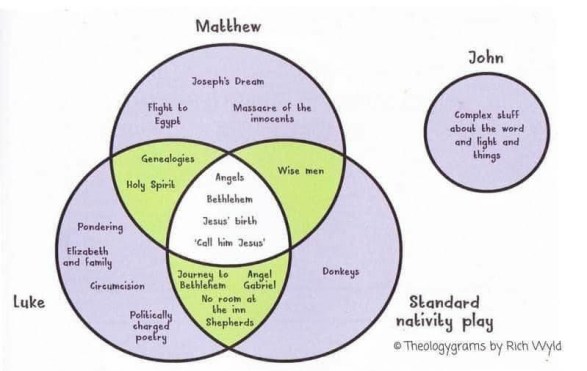
A73B3131-3B24-4954-8E33-6588DF7BB8A0

In the beginning was the Word, and the Word was with God, and the Word was God. . . . All things came to be through him, and without him nothing came to be. —John 1:1, 3

During the week our Bishop posted the above photo in Facebook. It is a light-hearted attempt to compare the accounts of Jesus’ birth in the four gospels. At the same time, it reminds us that when it comes to Christmas, we conflate two versions of the story – our nativity scenes. have the shepherds and the magi even though the shepherds are found only in Luke and the magi only in Matthew. (Mark is missing, because in Mark’s gospel, Jesus bursts on to the scene fully grown.) When the post appeared, discerning viewers noticed at once that Mary was not included in the diagramme. You might like to compare the first few chapters of Luke and Matthew and see if anything else needs to be added. The four gospels begin quite differently and as might be expected, the beginnings reflect the interests of the authors. Matthew is concerned to stress the Jewishness of Jesus and the way in which his early years demonstrate the fulfillment of Old Testament promises. (“This was to fulfill what was spoken by the prophets” occurs 5 times in the birth narrative.) What is more Matthew’s genealogy goes back to Abraham – the founder of the Jewish faith. Luke, on the other hand is more concerned with the universal implications of Jesus’ birth and with the historical context in which the story takes place. Luke includes the census and mentions Herod. His genealogy goes all the way back to Adam – indicating that Jesus is for everyone, not just for a few. Mark, as I said is not concerned with Jesus’ origins and John’s poetic start gives us – not a birth, but a cosmic beginning. From John’s point of view Jesus always was.

Does it matter that we do not have a consistent account to explain Jesus’ presence among us? Do we need to explain the differences? Of course not. Each story tells us something different, helps to satisfy our curiosity about Jesus’ beginnings and enriches our understanding of something that is essentially beyond our understanding. Indeed, Richard Rohr would argue that Jesus’ birth is only one expression of God’s incarnation among us – the account/s of Jesus’ birth are only one expression of God’s presence among us. That is to say, prior to Jesus’ birth, God was not absent in creation, invisible to God’s people or inactive in relation to the world. From the moment God said: “Let there be light” God has been dynamically engaged with creation and constantly in relationship with God’s people.

As Rohr says, we will never know the how, why or when of creation, but most traditions suggest that everything that it is the creation of some “Primal Source, which originally existed only as Spirit.” He goes on to say that “This Infinite Primal Source somehow poured itself into finite, visible forms, creating everything from rocks to water, plants, organisms, animals, and human beings. This self-disclosure of whomever you call God into physical creation was the first Incarnation (the general term for any enfleshment of spirit), long before the personal, second Incarnation that Christians believe happened with Jesus.”

What this means is that from the beginning of creation God has existed/been incarnate within all creation – animate and inanimate. When God ‘became flesh’ in the person of Jesus, God became incarnate in a very particular way – uniting Godself to us. At that point in time, God the creator, with the Logos/Word, fully identified with humankind, proving once and for all, that humanity is created in the image of God and that God is incarnate in and with us – not simply in creation or in some indistinct, immaterial form out of sight and out of reach. God, through God’s incarnation in Jesus that God chooses not only to be incarnate in the beauty of a sunset, the perfection of a flower, the majesty of a mountain, but in the frailty of human flesh, the imperfection of human behaviour, and the weakness of human will. Thanks to God’s coming in flesh – in Jesus – we can see God in one another and in ourselves and, in Jesus, we can see too what it is that we can be.

So, this year, let us not look back with longing to the infant in the stable or forward with anticipation to the coming of the Son of Man, but let us simply look – around and within – so that we might perceive God’s incarnation in its many and myriad forms – in the world and in ourselves. Let us celebrate God, with us throughout all time.

Wholly whole, holy whole

March 5, 2022

Lent 1 – 2022a
Luke 4:1-13
Marian Free

In the name of God in whose image we are made and in whose eyes we are beloved. Amen.

Just when you think that a section of scripture has nothing more to reveal, the Holy Spirit opens your eyes to new insights. So it was as I prepared once again to find some words to say about Jesus’ time in the wilderness and about his battle with the devil.

In the course of my reading around the subject, it occurred to me that the heart of the account of Jesus’s temptations is less an example of the strength and more an exploration of the Incarnation – what it means for Jesus to be both fully divine and fully human. That Jesus is both human and divine is hinted at in the verse immediately prior to this account. Unlike Matthew, who begins his gospel with Jesus’ genealogy, Luke places it after his baptism and before his temptation. Further, whereas Matthew goes back to Abraham – the father of the Israelites, Luke takes Jesus’ origins all the way back to God. In 3:38 we read: “son of Enos, son of Seth, son of Adam, son of God”. In other words, Luke is making it quite clear that Jesus is the offspring of the first human and of God.

As such, the account of Jesus in the wilderness is as much a lesson on the nature of Jesus as it is about temptation. If we avoid the temptation to see that Jesus’ encounter with the devil is only about temptation, we can allow ourselves to consider what it is about Jesus’ nature that informs our understanding of human nature. That is if, as we believe, Jesus was fully human, filled with the Holy Spirit what can we do in the power of the Holy Spirit – with which we have all been gifted at our baptism? Instead of talking about will power, about resisting temptation what if we,Iike Jesus were willing and able to dig deeply into the divine power that dwells within us. If, rather than trying to ‘be strong’ in the face of temptation we were to rely on a deep knowledge of scripture that was informed by a deep trust in and an intimate relationship with God? What if, instead of trying to face the world alone, we faced the world and all its attendant difficulties in the power of our godly nature.

As Athanasius tells us: “Jesus became human that we might become gods.” Jesus’ Incarnation is intended to reveal to us our true selves – bearers of the divine in human flesh. What distinguishes Jesus from us is that in Jesus the divine and the human are fully integrated. His human nature did not make him less divine and his divine nature did not make him less human. One aspect of his nature does not negate or overshadow the other and neither does one despise and distrust the other, but both – human and divine -are integral to Jesus’ wholeness/holiness. Jesus the human was really hungry and after 40 days without food or company was probably weak and vulnerable, if not a tad grumpy. Jesus did not abandon or suppress his humanity in the desert. He accepted the frailty associated with being human but he didn’t allow that frailty to overwhelm him or to disappoint him. He holds his dual nature together in a way that many of us do not.

Jesus’ response to the devil is one of confidence and strength. He has not rejected and nor does he despise his physical needs or his earthly desires. He feels no shame at being hungry enough to want to make bread from stones. He is not weighed down by guilt at the thought that he has considered taking a short cut to glory. He is does not want to hide the fact that for a moment he wanted to test God’s love for him. And because he has not created a division between the two aspects of his being he can draw on the spiritual at the same time as he is recognising and accepting the human.

Jesus’ victory, if we can call it that, in the desert is not the final word. It is not as if having overcome these temptations he has subdued his human nature once and for all allowing his divine nature to be the face that the world sees. Luke makes it clear that Jesus’ humanity has not been “overcome” or “abandoned”. Not only does he not have the last word but the devil has only : “left him till an opportune time.” It is not over. Jesus is still human and there will be times when that is more obvious than at others (when he overturns the tables in the temple, when he gets tired or exasperated, when he weeps at the tomb of Lazarus, when he relaxes and allows Mary to wipe his feet with her hair). Jesus will agonize in the garden and cry out in despair from the cross. His humanity is evident until the very end.

Our problem is that we have difficulty acknowledging the divinity that is our birth right and, if we do, we waste a. great deal of time trying to separate the two parts of ourselves – suppressing and rejecting the human while not really believing in the divine. We tend to idealise the spiritual and demonize the physical to the extent that we simply cannot accept that both are equally a part of us, that both reveal something about our God-given nature. Temptation, we believe, is something that happens to our unholy human selves and therefore it is our unholy selves that we enlist to resist and fight temptation. We try to subdue what comes naturally and when we fail we further demonise our human nature thereby driving an even bigger wedge between our two natures. In rejecting one part of who we are, we unwittingly reject both.

What Jesus demonstrates both in his encounter with the devil and in his life as a whole is that our divine nature does not have to be split off from our human nature. We don’t have to reject our fleshly, messy humanness in order to be spiritual, holy or divine. We don’t have to change ourselves or mold ourselves the sort of ideal person we have convinced ourselves that God wants or expects us to be. There is no need to sever or, at the very least bury those parts of ourselves that we are afraid that God will find unacceptable for when we do we demonstrate that we despise and reject what God has created, we reveal our lack of faith in God’s boundless love for us and we make it impossible for us to be fully integrated human beings created in the image of God.

In Jesus, God became one of us, demonstrating once and for all, that God does not despise human nature, reject its frailties or feel the need to suppress its physical, emotional and psychological desires and that being human does not make one any less godly. In Jesus, God shows us how the holy and “unholy” can be one as indeed they were intended to be. Through Jesus God challenges us to connect with the ground of our being, the source of life and love and to become wholly whole, holy whole.

This Lent, can we do this – free ourselves from fear, accept who we are and allow the divine within us to make us whole and holy?

A trivial miracle?

January 15, 2022

Epiphany- 2022
John 2:1-11
Marian Free

In the name of God who can be found in the ordinary as well as the extraordinary. Amen.

A hymn that I had not heard or sung for over twenty years has been doing the rounds of Facebook this year. Jim Strathdee adapted a poem by Howard Thurman. The first verse reads:

‘When the song of the angels is stilled,
When the star in the sky is gone,
When the kings and the shepherds have found their way home
The work of Christmas is begun.’

‘When the kings and the shepherds have found their way home, the work of Christmas is begun.’

The miracle of Jesus’ birth and the wonders that attended it are only a small part of the story of the Incarnation. It is important to realise that if we remain fixated on the extraordinariness of the event, if our attention is focussed only on signs and wonders then we miss the unexceptional presence of God in the everyday. The very ordinariness of the Incarnation – a child born to an unexceptional couple in an obscure part of the world, a boy like any other boy and an adult with needs and fears common to every human being – can get lost if we are more interested in the dramatic and the showy – in the stars, the angels, the wise ones and the gifts. Indeed, the Incarnation is robbed of its meaning unless we understand that Jesus’ life was filled with the mundane, everyday business of living that is common to all human beings.

Our gospels are written ‘in order that we might believe’ but even so they cannot entirely obscure the fact that God in Jesus became fully human. There was no pretense. Jesus/God ate and drank, slept and worked like the rest of us. He had the same bodily needs and functions as all of humankind. Perhaps the greatest miracle of all is not Jesus’ birth, or dare I say it, Jesus’ resurrection, not Jesus’ teaching or his healing power, but the very fact of God’s becoming human – God’s extraordingary decision to enter into the earthy, fleshy, ordinariness of being part of the created world.

Perhaps this is why John begins his account of Jesus’ life with a wedding – a festive gathering of friends – rather than the more dramatic, showy and more obviously divine action of healing or exorcism with which Mark begins. John doesn’t surround Jesus with crowds of people whom he can impress – just the opposite. The action of this miracle not only takes place behind closed doors as it were, but in the presence of a few (servants who may not have been believed had they told their story). Having begun the gospel with the Christ hymn in which John proclaims an exalted Jesus who is pre-existent with God, the author of the fourth gospel brings us right back down to earth, setting Jesus’ first miracle in a private domestic scene – a family wedding.

The Word made flesh begins his ministry with a very fleshy deed – turning water into wine – meeting a very basic human need. One might go so far as to say that this first miracle is a superficial extravagance. How can turning water into wine – albeit to save the pride of the host family – compare with giving sight to the blind, freeing an enslaved person from their demons, healing the lame or raising the dead? What does such an action achieve in the wider scheme of bringing the community to faith? Indeed, what is the point if no one knows about the miracle except the servants who fill the water jars. (No one but Mary appears to know that the wine has run out. Even the steward is unaware that there is a problem and Jesus does not know until his mother tells him.) From the point of view of making Jesus’ presence and ministry known to the world at large, the changing of water into wine is something of a non-event. It will not draw the crowds or make his powers known and it seems too trivial a miracle to be repeated over and over again as some sort of party trick when there is no end to the more serious needs for healing and exorcism.

John, it appears, wishes to begin by demonstrating that Jesus is firmly embedded within the community in which he finds himself and that the Incarnation – God’s dwelling among us – is absolutely authentic not simply a matter of God’s lauding it over us, or of God’s trying to make us feel insignificant. Rather the Incarnation, the Word made flesh is God’s fully engaging with our experience, and this includes enjoying a good party.

That this might be the case becomes even more evident when we consider that the Gospel of John consists of what is known as a book of signs or miracle stories to which the Passion narrative has been added . These ‘signs’ are designed to convince people to believe that Jesus is the Christ. As the gospel is written the signs become more and more astounding until we come to the last – the raising of Lazarus – which presages Jesus’ own resurrection, but which also heralds his crucifixion. In this context, turning water into wine seems out of place especially when it it not accompanied with a discourse or a dialogue to explain it as are the others.

In juxtaposition with the Christ hymn, the wedding at Cana brings us back down to earth. Before we can become too wound up in the divine Logos we are confronted with the Word made flesh engaging in a very fleshy activity and performing a very fleshy miracle.

The wedding at Cana, serves as a reminder to us not to exalt Jesus to the point at which we can no longer see his humanity and so deprive the Incarnation of its true power and meaning.

Just how much does God love us?

December 24, 2021

Christmas – 2021
Marian Free

In the name of God who became human so that we might become divine. Amen.

Sometimes a person will say or do something that changes the way you think or act.

Such was the case for me when I was at Theological College. The scenario was a community meeting at which we were discussing our differences and how we could manage to make the student community a place in which everyone could feel comfortable no matter what their background or church tradition. On this occasion a primary issue was the matter of the daily Eucharist and whether attendance was absolutely necessary for those among us whose tradition made this more of a burden than a joy. Sadly, I no longer remember the name of the student who raised the issue. He explained that for him the Incarnation, not the crucifixion/resurrection was central to his faith and that the Eucharist’s emphasis on the latter did not hold as much meaning for him as did the daily office. God’s becoming one of us was, he felt, more significant than God dying for us.

The event is so long ago that I would not be able to say why an emphasis on the Incarnation was such a revelation. I imagine that until that time I simply had not paid much attention to the significance of Jesus’ birth. If I were to hazard a guess I think that I might have thought that Jesus’ birth was simply a means for Jesus to enter the world – so that he could die and rise again.

Since then I have pondered long and hard on the Incarnation and am filled with wonder and awe that God should enter our human existence. Yes, Jesus was crucified and yes he was raised, but the Incarnation – God with us – is a powerful statement of God’s love for us and of God’s identification with our hopes and joys, our disappointments and our sorrows. If we stress the crucifixion to the detriment of the Incarnation, we lose sight of the fact that in the Incarnation, God is demonstrating the depth of God’s love for us. In becoming one of us, God becomes one with us. In entering our existence God shows that so far from being unworthy, we – with our physical and other limitations -were considered a suitable vessel for God to inhabit.

If, as we believe, Jesus is God then we can be certain that God knows what it is to be human. God, in Jesus, has experienced the full gamut of human emotions. God in Jesus has been idolized and abandoned, has been surrounded by friends and deserted by the same, has known joy and sorrow.

God’s entering the world completely changes the dynamic of our relationship with God (and, with ourselves). For if God did not despise the human form or reject the constraints of being human, then we can be kinder to and gentler with ourselves. If God knows what it is to face the difficulties that we face, then we need never feel alone knowing that God has felt the same.

The conversation at our community meeting came back to me this week when I learned that for the first thirteen centuries of church history the focus was on Easter. It was only when Francis of Assisi entered the scene that Christmas began to hold the significance for the church that it does today. Francis felt that God’s love for us was not limited to the crucifixion but was made clear when God entered the world in the form of the infant Jesus. It was love that propelled God to come to us. It was God’s love that insinuated itself among us. It was love that wanted us to know just how precious we are in God’s sight.

Enjoy Christmas and all the traditions that you observe as a family, but when you look at the tiny vulnerable child in the manger, be sure that you see God and be filled with wonder that God could love you – love me so much – that God would risk everything to share our lives.

Is God masquerading as a human being or is Jesus fully human?

February 20, 2021

Lent 1 – 2021

Mark 1:9-15

Marian Free

In the name of God Earth-Maker, Pain-Bearer, Life-Giver. Amen.

I am aware that a number of people struggle with the idea that Jesus is fully human. That is not really surprising. It is an extraordinarily difficult concept to get one’s head around and yet the belief that Jesus is fully human and fully divine is at the centre of our faith – as we confess each week in the Nicene Creed. 

The significance of Jesus full humanity is clearly illustrated in two lines from this morning’s gospel. “And the Spirit immediately drove him out into the wilderness. He was in the wilderness forty days, tempted by Satan; and he was with the wild beasts; and the angels waited on him.” Something external – the Spirit of God – drove Jesus the human into the wilderness. There his true mettle was tested. Without food, water, shelter or even human contact would he succumb to the temptation to take short cuts or would he trust in God to see him through? Would he complain and wish himself at home (as did the Israelites did in the desert) or would he have faith that God would sustain him? Would he try to take control of the situation or would he allow himself to be completely vulnerable?

It is precisely because Jesus is human that the wilderness experience has any value. In the absence of any physical comfort Jesus learns that he is able to rely on God for nourishment. Without human companionship, Jesus discovers that God’s presence has followed him into the barrenness of the desert. It is as a human being that Jesus faces the privations of the desert. It is as a human being that he deals with hunger and loneliness and the voices that taunt him. It is as a human being that Jesus confronts Satan.  

If Jesus is simply God – all of this becomes meaningless. The wilderness would not be a test because God would not be impacted by hunger, fear or loneliness. Forty days would be as nothing to God who created time and space and Satan would be no match because God is strongly than Satan and it is impossible for God to be tempted. 

The whole point of the Incarnation, of God’s coming to earth among us, is that God chooses to fully share our human existence, to become one of us. It is only by fully inhabiting the human condition that Jesus is able to redeem the human condition. Jesus can save humanity from itself precisely by being human, by demonstrating in his own (human) life that our human nature is not an impediment to our divinity. Through the human Jesus, we are reminded that are we created in the image of God and we can be restored to our original place in creation. 

It is only because he is human that Jesus is able to reverse the damage done to our relationship with God inflicted by that first human – Adam. Adam was disobedient, Jesus was obedient. Adam desired to be as God. Jesus resisted the temptation to compete with God. Adam sought control; Jesus chose submission. Jesus demonstrated that we, as human beings, do not have to be determined by Adam’s misstep, but that we can choose a different way of being, a different way of relating to God. He demonstrated in his own life that it is possible to transcend the limitations of being human. 

Examples of Jesus’ humanity abound in Mark’s gospel. Jesus eats and drinks and sleeps. He is compassionate (1:41) angry and sad (3:5, 11:14,15). He expresses amazement (6:6). He becomes tired (4:38) and needs to find time and space for himself (6:30f). He sighs and groans (7:34, 8:12) and becomes annoyed (10:14). He gets frustrated and impatient with his disciples (4:40, 8:21, 8:31) to the extent of calling Peter ‘Satan’. He becomes indignant when the disciples send the children away (10:14). His miracles do not always work the first time (8:22-26) and he does not display foreknowledge (he doesn’t know who touches him). He allows the Syrophoenician woman to challenge him and to change his mind. He is disappointed in, critical of (7:9f, 8:15) and rude to the Pharisees (7). 

In the garden of Gethsemane, Jesus was distressed and agitated, he confessed to being deeply grieved and prayed that God might spare him (14:33f). He experienced betrayal at the hands of two of his inner circle and finally, he was arrested, beaten and crucified. Jesus died, really died – if he did not then the resurrection means nothing.

I put it to you that if Jesus is simply God masquerading as a human being then our faith becomes a nonsense. I don’t know about you, but I don’t want to believe in a God who just pretends to be one of us, who is play-acting sharing our experience and who does not really know what it is to be one of us. Because if God is just pretending, Jesus’ torment in the garden becomes a farce, as does his agony and confusion on the cross, not to mention his frustration, his exhaustion and his grief. If Jesus is God impersonating us his death means nothing. 

The reality is that God does not and did not need to go through the drama of coming to earth if God did not believe that by sharing our experience God could somehow enrich that experience, remind us of our true nature and awaken the divinity that resides within each one of us. God, being God could simply have waved his hands and reversed everything that had gone wrong since creation. God, being God, could simply have bent us to God’s will. From the beginning of time, God has not enforced God’s will, but has allowed us to choose our own way. 

The whole point of the salvation event is God’s identification with God’s creation. God in Jesus became one of us to show us creation at its very best and to remind us of what we were intended to be. As the orthodox would say: “Jesus became fully human so that we might become fully divine.” Can we honour that intention this Lent?

Loving our bodies – Maundy Thursday

March 29, 2018

Maundy Thursday – 2018

Some thoughts and prayers

Marian Free

In the name of God who loved us enough to take on human form. Amen.

Bodies are interesting things – they come in a myriad of shapes and sizes. They can be strong and straight or twisted and misshapen. They can function as we hope and expect or they can rebel and resist. They can be well and whole or they can be eaten away by age, cancer or degenerative disease. They can attract or repel. They are extraordinarily resilient and yet easily broken.

By and large our bodies serve us well, yet many of us have an ambivalent attitude towards them – they are not thin enough, muscular enough, pretty enough. We wish that one bit or another were smaller or larger, smoother or prettier.

Our ambivalence towards our bodies is demonstrated in the way we respond to those whose bodies are damaged, disfigured or aged. We turn our heads away. We are reluctant to touch or to hold those whose skin is not smooth and unblemished, whose limbs are not straight and strong.

God has no such problem with the human form or its functioning. None of the considerations that cause us anxiety or dismay, held any fear for God when God in Jesus chose to inhabit our human form. The one who created us, showed absolute confidence in God’s creation – risking everything to be born and to live as and with us.

Nor did Jesus show any dismay or distaste for the bodies of others. He was not afraid to touch and be touched– touching the blind, the lame and the leper, allowing himself to be touched by the woman with a hemorrhage, the women who anointed him, and ultimately those who flogged him and nailed him to the cross.

At the Last Supper, Jesus did what no self-respecting person would do – he took on a role reserved for a slave. Kneeling before his friends, he took in his hands their dirty, calloused and cracked feet, tenderly touching, washing and wiping them.

The Incarnation is all about bodies – our bodies and God’s body.

Imagine God in human form. Imagine your body as God’s body. Imagine God stooping to wash your feet, touching you caressing you, loving you in all your physicality.


Maundy Thursday Intercessions

Loving God, who in Jesus was not afraid to take for Godself human form, open our eyes to see you in the wounded and dispossessed, in the despised and ill-treated, the refugee and the prisoner. Seeing you in others may we reach out in love and strive to build with you a world of justice and peace.

Word made flesh.

Hear our prayer.

 Servant God, may we as your church reach out to the marginalised and distressed in our own communities. May we never seek to meet our own needs, but only the needs of others.

Word made flesh.

Hear our prayer.

Jesus our friend and companion, help us to reach out to those who never experience the gentle, loving touch of another – children abandoned by parents, children, the disabled and the aged cared for in institutions in which there is often not enough love to go around, those whose damaged or deformed bodies cause us to turn our gaze away, and all whose age, frailty or disability confine them to a life of loneliness.

Word made flesh.

Hear our prayer.

Wounded God, bind up the broken hearted, support those who struggle, comfort those who mourn, heal those who are stricken in body, mind or spirit and hold in your loving arms, those who are dying.

Word made flesh.

Hear our prayer.

Jesus, who faced death with fortitude if not courage, give us the grace to accept our own frailty and mortality and to understand that death is the gateway to something so much more.


Looking backwards and forwards on Advent 1

November 26, 2016

Advent 1 – 2016

Matthew 24:36-44

Marian Free

 In the name of God who was and is and is to come, who has loved, does love and will love. Amen.

If you have ever had a medical procedure you will know that you will usually receive a list of instructions telling you what you must do to prepare. Some blood tests require you to fast before hand and others do not. A visit to an obstetrician will often require you to produce a urine sample. An appointment for a breast screen will come with instructions as to what to wear and the insistence that on that day you do not use talcum powder. A booking for surgery will come with pages of instructions – don’t drink alcohol, do not eat or drink for a specified period, do not bring valuables to the hospital with you but do bring your method of payment. And as for having a colonoscopy – let’s not even go there! (Those of us who have had the experience know what is involved and those of you yet to have the pleasure, will find out soon enough.)

The point is that there are many things in our life that require careful and thoughtful preparation – travel, meals, study, buying a house, getting married and so on. While some of these need more attention than others, they are all relatively easy in the sense that the guidelines are clear, others have done it before us and by and large we know what is expected or where to go for information or advice.

Preparing for eternity is a very different proposition from preparing for surgery, travel or a job interview. For a start, no one has ever come back from the dead to tell us what it is like or to give us specific instructions as to exactly how to get in. No one, that is, except Jesus and he did not give a straight forward, easy to follow list of directions or instructions. Instead he left his followers to make sense of his teachings and to put them together in ways that made sense to them.

Preparing for eternity or for the return of Jesus, is the most important thing that we will ever do with our lives, but it is easy to put it off because it seems so remote, so far into the future that we imagine that we have plenty of time to put our lives in order. Alternatively, it is possible to become complacent, to believe that we have already done all that is necessary to enter into eternal life.

I wonder how many of us put the same amount of effort into our preparation for eternity as we do for other aspects of our lives. Do we have a check list that we refer back to see how ready we are? Are we really clear as to what is required? Have we put some effort and research into the subject or do we think we already know all that there is to know?

Many of us were brought up with a Christian faith that taught us to be good, that entrance into heaven required sticking within some prescribed guidelines – most notably the Ten Commandments. Along the way, we have learned that Jesus does not want simple obedience to a set of rules. In life, he consistently chose those who did not conform to the societal view of what does or does not constitute “goodness”, he criticized those who placed weight on outward appearances, and he constantly revised the commandments in such a way as to make it clear that it was a person’s attitude to and relationship with God that was the key to eternal life. In other words, Jesus shifted the goal posts and cast us adrift from the safety of clear rules and codes of behavior and left us to find our own direction.

Jesus knew that it was possible to do the “right thing” but to do it for the wrong reasons. He exposed the hypocrisy and shallowness of those whose outward show of goodness hid a lack of love and compassion, a self-centredness and self-congratulatory attitude that blinded them to their own weakness and frailty. Jesus sought out those who knew their own sinfulness and who relied on God’s love rather than their own efforts.

If Jesus were to offer advice for living or guidelines for attaining eternity, he would probably encourage us to seek self-awareness rather than self-righteousness, to recognise our imperfection rather than aim for perfection and to understand that we are no better than the next person rather than striving to outdo them with our “goodness”.

In the final analysis, Jesus’ incarnation demonstrated that our salvation does not depend on anything that we do for ourselves, but on what God does for us. Salvation is entirely related to God’s love for us – love that entered into our existence, challenged our concepts of right and wrong, of power and weakness, of judgment and acceptance, love that endured the worst that we can throw at it, and which loves us still. Love, that on the cross overcame evil and death so that nothing might stand between ourselves and life eternal.

On this, the first Sunday of Advent, we are urged to both look backward to Jesus’ coming in love and forward to Jesus’ coming in judgement, to place our lives in the balance and to see how we measure up.

Are we living in such a way that demonstrates our awareness of God’s love and our inability to deserve that love? Have we thrown ourselves completely on God’s mercy or are we still holding something back – in other words do we completely and utterly trust in God’s unconditional love or does some part of us still believe that we have to do something to deserve it?

Christmas is a celebration of God’s incomprehensible yet unmistakable love for us. Advent is an opportunity to ask ourselves whether or not we trust that love and whether that love has translated into love for ourselves and love for others.

Perhaps, after all, we are better not to prepare, but instead to ensure that we fully accept all that God in Jesus has done for us, such that Jesus’ return will be time of rejoicing and not a time of fearfulness and that we will be truly ready to rest in God’s love for eternity.


The Trinity and Paul – some thoughts

May 30, 2015

Trinity Sunday – 2015

Romans 8

Marian Free

In the name of God who created us, died for us and enlivens us. Amen.

The Apostle Paul gets a lot of bad press. From the time the author of 2 Peter wrote: “There are some things in them (Paul’s letters) hard to understand”, there have been those who accuse Paul of being difficult, culture bound and chauvinistic. As a Pauline scholar I would of course, contest all such negative comments and claim them to be misrepresentations at worst and misinterpretations at best by those who have not taken the time to study and understand the genius that is Paul[1].

I am not saying that the letters of Paul are immediately transparent, or that there are not some parts that require a certain amount of effort to understand, but I would claim that what Paul has to say is absolutely essential for our understanding of the gospel and that he says it in a way that is quite masterful and compelling.

One of the difficulties that we face when we read either Paul’s letters or the gospels is that they were written in the first century for a first century Mediterranean audience. The letters are even more specific. Paul was not writing for our edification. In fact I think that he had no more idea of his letters being turning into Holy Scripture than we would imagine that our assignments in theology would one day be accepted into the canon.

Paul was writing to specific situations that had arisen in communities that had come to faith as a result of his teaching or, as is the case with Romans, a community that he wished to visit. His intention was not to write theology but to set the recipients straight on matters of faith or behaviour. The communities to whom he wrote consisted by and large of people who had had no grounding in the Jewish faith and who therefore had considerable catching up to do in order to begin to understand the gospel.

What I find remarkable is, that in this context and within twenty years of Jesus’ death, Paul – who never met the earthly Jesus – was able to distil the significance of Jesus’ life and teaching and to give them a meaning that continues to inform us today. The gospels give us the story of Jesus (albeit with interpretation). Paul, writing considerably earlier, tells us what it all means. In so doing he foreshadows ideas which later scholars turned into theology and into doctrine.

Take the notion of the Trinity for example. Over the centuries much ink has been spilt in trying to elucidate the nature of God and what it means for God to be both one and three. Paul simply assumes a Trinitarian God – Creator, Son and Spirit. This is particularly evident in Romans 8:9-11. “But you are not in the flesh; you are in the Spirit, since the Spirit of God dwells in you. Anyone who does not have the Spirit of Christ does not belong to him. But if Christ is in you, though the body is dead because of sin, the Spirit is life because of righteousness. If the Spirit of him who raised Jesus from the dead dwells in you, he who raised Christ from the dead will give life to your mortal bodies also through his Spirit that dwells in you.” Paul is making an argument about life in the Spirit, but in order to do so he also speaks of God and Christ as if they were all one God.

In verse 9 Paul speaks of “being in the Spirit” because the “Spirit of God dwells in you” and adds “Anyone who does not have the Spirit of Christ does not belong to him. He goes on to say “the Spirit of him who raised Jesus from the dead dwells in you”, “the Spirit dwells in you.” The Spirit incorporates believers into the life of Christ that in turn incorporates them into the union between Christ and God. It seems that it is perfectly natural for Paul to think of God as the one who raised Jesus from the dead, as Jesus and as Spirit and that as a result he is able to use the expressions interchangeably.

The notion of God being known as God, as Spirit and as Word is not new to Paul. Genesis 1 introduces the Spirit in the form of ruah or breath and in Ezekiel (37:5) it is God’s ruah (breath) that brings life to the dry bones. The same Spirit animates Ezekiel, transports him to the valley of bones and will give life to the people of Israel. (This is not dissimilar to Paul’s idea that it is the Spirit that gives life to the believer (Rom 8:11)). Proverbs introduces Wisdom (sophia or logos) as co-creator with God. So in the Judeo-Christian from the beginning of creation there has been an implicit notion of the complex nature of the One God.

It would be the Incarnation that would give this idea flesh both literally and figuratively. God in human form proved much more challenging than the less concrete ideas of God as breath and wisdom. How could Jesus be both human and God? How could Jesus be pre-existent? Where did the Spirit fit in all this? It would take the church close to four hundred years to express the idea of the Trinity in theological and doctrinal terms that were universally accepted[2] and many more centuries for scholars to continue to explore and name what it means for God to be both one and three and how to express this without diminishing one of the persons of the Trinity.

For Paul and the early church the nature of God was not something to be intellectualized or argued. It seems to have been taken for granted that God could be known as Father, Son and Spirit, the one who sent Jesus, the one sent (Jesus) and the one whom Jesus sent (Spirit), the one who raised Jesus from the dead, Jesus who was raised from the dead and the Spirit.

Instead of worrying about how the Trinity works and which analogies are heretical or not, let us take a page out of Paul’s book and assert that God simply is – Creator, Redeemer and Sanctifier, Father, Son and Holy Spirit.

[1] When I speak of Paul’s letters I refer to the seven letters that are considered genuinely Pauline – Romans, 1 and 2 Corinthians, Galatians, Philippians, 1 Thessalonians and Philemon.

[2] Some would claim imposed was a better word.