Posts Tagged ‘Israel’

One more time

May 4, 2019

Easter 3 – 2019

John 21:1-19 (some thoughts)

Marian Free

In the name of God who reveals godself to us when we least expect it and when we most need it. Amen.

A trip to Israel is amazing. It is a beautiful country steeped in history. There you will come across a Canaanite altar that goes back 3,000 years before Jesus and a horned altar that makes sense of the horned altars of the Old Testament. You will encounter archeological sites that go back at least 1000 years before Jesus’ time and which have been built on over the centuries by different nations and cultures up until the present. The site of Capernaum with its ruins of homes that date from the time of Jesus helps us to put the gospel story into context and the Sea of Galilee is so vast that one can understand why the disciples might have been afraid when tempests arose.

That said, there is much that, for me at least, is a source of irritation or disappointment. I found it impossible to imagine the Israel of Jesus’ day in the towns and tourist sites that capitalize on their place in the gospel story and compete with each other for the tourist dollar. Christian denominations that vied with each other for attention were, for me, a source of deep shame and embarrassment. If visitors to the nation had been less keen to immerse themselves in the story they might ask themselves why both the Anglicans and the Catholics need such large churches in Bethlehem, why they have divided Capernaum into two parts, and why the Church of the Holy Sepulchre is divided between a number of Christian traditions.

On a lighter note, seeing a place at first hand had the tendency to burst the bubble of my imagination. Sites that loomed large in the gospel story did not have quite the same impact in reality. The Mount of the Transfiguration turned out to be a geological feature that I would have would called a hill; and the cliff that Jesus was ‘pushed’ to in Luke’s gospel was so far from Nazareth that it was hard to believe that even a huge crowd would have persisted in pushing Jesus over such a large distance.

What really surprised me and shattered my image of the story, were the fish. At the kibbutz by the Sea of Galilee we were served ‘St Peter’s fish’, which I took to be the fish of the miraculous haul recorded in both Luke and John. These fish (at least those cooked for lunch) were small – about fifteen cm long with very little flesh. It was hard to imagine even 153 of these fish being sufficient to make a net impossible to haul in as today’s gospel suggests and hard to imagine how many would be required to stretch to the nets to breaking point (Luke 5:6). But, as my grandmother used to say: “Why spoil the story for the sake of a little exaggeration?”

Why indeed? Whether here in John (after the resurrection) or in Luke (in connection with the calling of the disciples) the story is not so much about the fish as it is about recognition. In Luke’s telling of the story, the disciples have been fishing all night without success. When Jesus comes down to the shore they have left their boats and are cleaning their nets. Seeing the empty boat, Jesus asks Simon to put out from the shore so that he can more easily teach the crowds who have been pressing in on him. It is only when he has finished teaching that he tells the fishermen to try one more time which they do. This time the nets are so full they threaten to sink the boats. At this point Peter falls to his knees before Jesus and says: “Go away from me, Lord, for I am a sinful man.”

As a result of the miraculous catch, Simon recognizes Jesus as Lord and, in the presence of Jesus’ goodness, becomes only too aware of his own sinfulness. The story of the fish is not just a miracle but it is an entry point to the story of Simon’s identification of Jesus’ true nature.

John places the account of the miraculous haul at the very end of his gospel, but here too recognition is the central point. A group of despondent disciples tire of sitting around and decide to go fishing. All night they fish with no success. In the morning a ‘stranger’ on the beach urges them to put down their nets one more time. This time there are so many fish that they cannot haul in the net. Then John identifies the stranger as the risen Jesus and Peter, (despite the fact that he had denied and abandoned Jesus), is sufficiently excited to see Jesus and sufficiently confident that Jesus will not reject him that he leaps out of the boat in order to be the first to reach him.

Whether it is recognition of the divinity of the earthly Jesus or the reality of the risen Jesus, it is success after a night of struggle, a surprise catch after fruitless effort, that opens the disciples’ eyes to the divine presence that has urged them to give it one more try.

When we are tempted to give up, when the night is too long or the task seemingly impossible, we can remember the catch of fish, believe in the risen Christ, give it one more try, and discover that Jesus was there all the time.

One more time

May 4, 2019

Easter 3 – 2019

John 21:1-19 (some thoughts)

Marian Free

In the name of God who reveals godself to us when we least expect it and when we most need it. Amen.

A trip to Israel is amazing. It is a beautiful country steeped in history. There you will come across a Canaanite altar that goes back 3,000 years before Jesus and a horned altar that makes sense of the horned altars of the Old Testament. You will encounter archeological sites that go back at least 1000 years before Jesus’ time and which have been built on over the centuries by different nations and cultures up until the present. The site of Capernaum with its ruins of homes that date from the time of Jesus helps us to put the gospel story into context and the Sea of Galilee is so vast that one can understand why the disciples might have been afraid when tempests arose.

That said, there is much that, for me at least, is a source of irritation or disappointment. I found it impossible to imagine the Israel of Jesus’ day in the towns and tourist sites that capitalize on their place in the gospel story and compete with each other for the tourist dollar. Christian denominations that vied with each other for attention were, for me, a source of deep shame and embarrassment. If visitors to the nation had been less keen to immerse themselves in the story they might ask themselves why both the Anglicans and the Catholics need such large churches in Bethlehem, why they have divided Capernaum into two parts, and why the Church of the Holy Sepulchre is divided between a number of Christian traditions.

On a lighter note, seeing a place at first hand had the tendency to burst the bubble of my imagination. Sites that loomed large in the gospel story did not have quite the same impact in reality. The Mount of the Transfiguration turned out to be a geological feature that I would have would called a hill; and the cliff that Jesus was ‘pushed’ to in Luke’s gospel was so far from Nazareth that it was hard to believe that even a huge crowd would have persisted in pushing Jesus over such a large distance.

What really surprised me and shattered my image of the story, were the fish. At the kibbutz by the Sea of Galilee we were served ‘St Peter’s fish’, which I took to be the fish of the miraculous haul recorded in both Luke and John. These fish (at least those cooked for lunch) were small – about fifteen cm long with very little flesh. It was hard to imagine even 153 of these fish being sufficient to make a net impossible to haul in as today’s gospel suggests and hard to imagine how many would be required to stretch to the nets to breaking point (Luke 5:6). But, as my grandmother used to say: “Why spoil the story for the sake of a little exaggeration?”

Why indeed? Whether here in John (after the resurrection) or in Luke (in connection with the calling of the disciples) the story is not so much about the fish as it is about recognition. In Luke’s telling of the story, the disciples have been fishing all night without success. When Jesus comes down to the shore they have left their boats and are cleaning their nets. Seeing the empty boat, Jesus asks Simon to put out from the shore so that he can more easily teach the crowds who have been pressing in on him. It is only when he has finished teaching that he tells the fishermen to try one more time which they do. This time the nets are so full they threaten to sink the boats. At this point Peter falls to his knees before Jesus and says: “Go away from me, Lord, for I am a sinful man.”

As a result of the miraculous catch, Simon recognizes Jesus as Lord and, in the presence of Jesus’ goodness, becomes only too aware of his own sinfulness. The story of the fish is not just a miracle but it is an entry point to the story of Simon’s identification of Jesus’ true nature.

John places the account of the miraculous haul at the very end of his gospel, but here too recognition is the central point. A group of despondent disciples tire of sitting around and decide to go fishing. All night they fish with no success. In the morning a ‘stranger’ on the beach urges them to put down their nets one more time. This time there are so many fish that they cannot haul in the net. Then John identifies the stranger as the risen Jesus and Peter, (despite the fact that he had denied and abandoned Jesus), is sufficiently excited to see Jesus and sufficiently confident that Jesus will not reject him that he leaps out of the boat in order to be the first to reach him.

Whether it is recognition of the divinity of the earthly Jesus or the reality of the risen Jesus, it is success after a night of struggle, a surprise catch after fruitless effort, that opens the disciples’ eyes to the divine presence that has urged them to give it one more try.

When we are tempted to give up, when the night is too long or the task seemingly impossible, we can remember the catch of fish, believe in the risen Christ, give it one more try, and discover that Jesus was there all the time.

Wadi Qelt – a certain man (Luke 10:30)

July 4, 2015

I confess that this week Saturday has crept up on me so that with or without Internet, I have not thought of this reflective piece. The dig at Bethsaida was so all-consuming and tiring that time has simply sped past. It has been amazing to be by the Sea of Galilee for two weeks and to try to get some sense of the history, to wonder about what it was all like some two thousand years ago. The Lake has many moods changing with the light and the breeze. A particular treat was to see a boat from the first century which had been hidden in the mud and which has now been restored.

Today we have driven to Jerusalem through the Negev – a barren, uninviting desert. Along the way we stopped at Wadi Qelt, the ancient route from Jerusalem to Jericho. You can see from the photo how inhospitable it is and you can imagine that Jesus got the attention of his listeners as soon as he mentioned that a man was taking that route and doing so alone. Not only was the area full of brigands, but the very nature of the land is forbidding. To take the journey without the protection of a caravan would have been to be taking his life into his hands.

Jesus is a consummate story-teller. First he grabs the attention of his audience, in this case by choosing a character who is doing something outrageous, then he uses the classic technique of using three characters. (This is well known to many of us in the way that jokes are told – there were three priests, a Catholic, an Anglican and a Lutheran and so on.) Once he has established the scene Jesus doesn’t need to explain why the other travelers are on the road. The audience know that it is a story.

Of course we know the story so well that we are no longer surprised that the man takes the route alone, nor are we surprised that the Samaritan stops to help. In fact the expression “the Good Samaritan” has passed inot common usage and many people today would not know the origin of the expression. What is lost on many of today’s readers is how shocking it would have been for a Samariton to stop and offer assistance to a Jew and that the Jew may not have been particularly grateful for that help. Such was the enmity between the two groups that Jews would walk the long way to Jerusalem so as to avoid going through the region of Samaria. Both groups claimed to be the true faith and Jews considered Samaritans to be ritualy unclean, presumably because they did not observe the same purity laws.

As I said, Jesus crafts a great story. By using the same language for both the priest and the Levite, he creates a certain expectation in the minds of the listeners. The priest/Levite is “going down”, “he saw him”, “he passed by on the other side”. Jesus’ audience are expecting the pattern to continue, but they have gone ahead believing that they know how the story will end. They imagine that Jesus will continue: “a Jew (ie someone like themselves), was going down, he saw him and he stopped to help.” In their imagination, it is they who will be the hero of the story. After all the priest and Levite have simply behaved in a way that could have been expected of them, but they, the people would surely show compassion.

Jesus takes the ground from under their feet. The hero is not one of their own, but a despised Samaritan. Now they are really listening. There is, in their mind, no such thing as a “good” Samaritan. But this of course, is exactly Jesus’ point. By categorizing and judging others, by expecting them to behave in a particular way we are limiting ourselves and determining who is and who is not our neighbour.

The question of the lawyer is not really answered. What Jesus does though is to expose the prejudices that most of us hold. So long as we fail to see and recognise the good in those whom we fear or distrust, we are unable to love our neighbour as ourself. It is not a problem to care for those in need, but that is not the meaning of the parable. The shocking reality that Jesus exposes here is that a Samaritan can be good and that our values no preconceptions mean that we fail to see the goodness in others.

Whom do we despise or fear. Can we allow this parable to challenge our preconceptions and open us to the challenging idea that those who cause us anxiety may in fact be those who are most willing to show us love and compassion?

The Holy Land

June 21, 2015

At this moment I am sitting in the Bethharram Convent in Nazareth. I had thought to post some reflections on the Sunday readings while I was away only to discover that technology has let me down and the texts I had so carefully begun are lost somewhere between my laptop (in Brisbane) and my iPad in Israel. I had thought also that maybe by now I might have seen the Sea of Galillee and could therefore have spoken authoritatively about storms on the lake. Galillee is for another day. It is both exciting and frustrating to be here. There are of course many devotional sites – some of which we have visited – but there is almost nothing that might give a hint of what Nazareth might have been like in Jesus’ time.

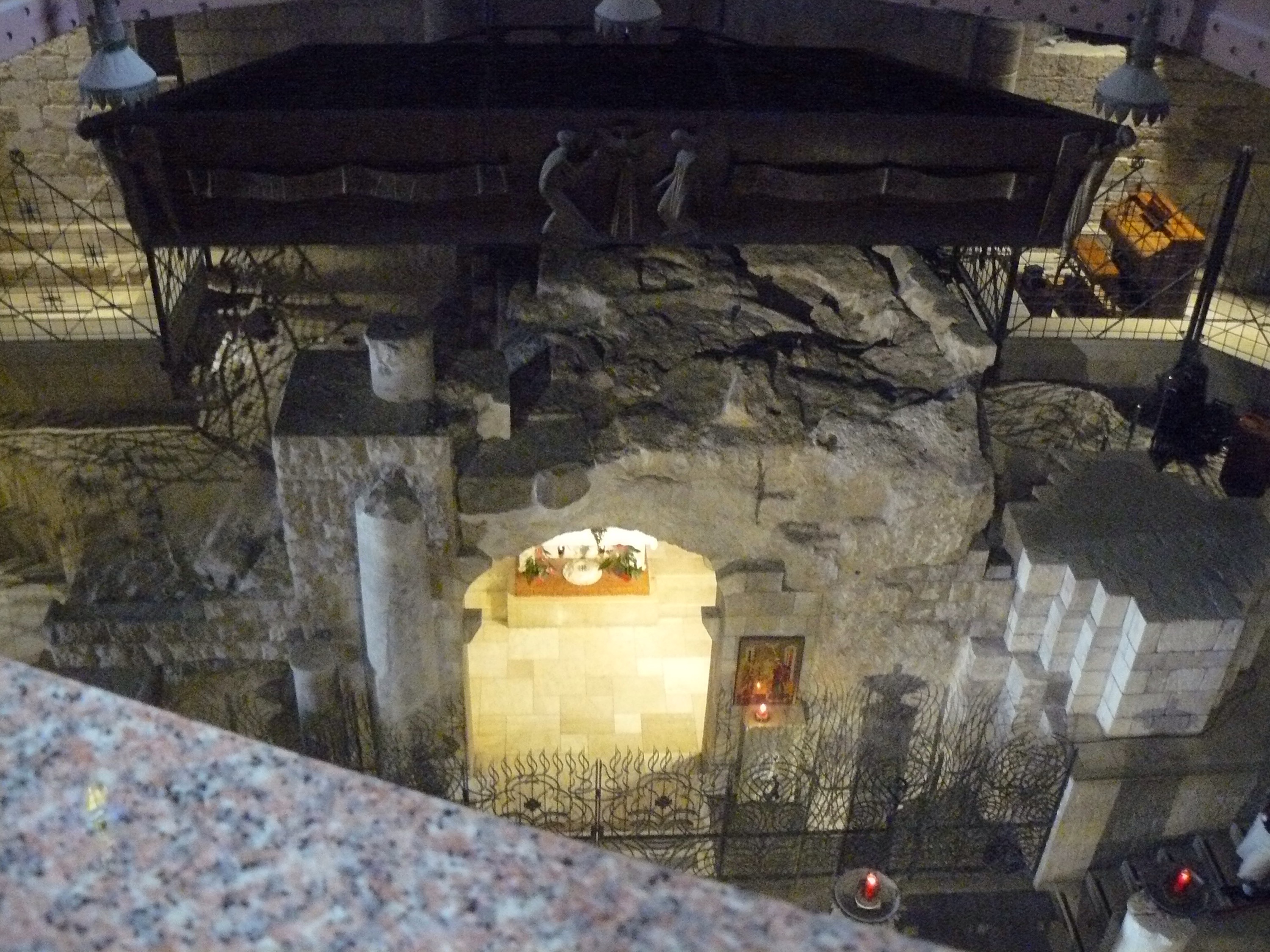
The city has been destroyed on many occasions since the first century and what we see now is a modern, Palestinian city. Many scholars believe that in the time of Jesus, Nazareth would have been a small Jewish settlement (possibly with strong ties to Jerusalem). All the evidence seems to suggest that at this time there might have been only fifteen families resident here – somewhere between 300-500 people. It is probable that they lived in one of the many limestone caves that now lie beneath the city. Some, like that beneath the Church of the Annunciation have been significantly altered as a result of devotional practices, others are more original. The caves are cool and make a great deal of sense for life during hot dry summers.


Limestone cave in Church of the Annunciation

 Understanding the geography and nature of first century Nazareth gives some cause for thought with regard to the way the Jesus’ story is presented in the gospels. For example, while there might have been sufficient men in Nazareth to form a gathering (synagogue), it is extreme unlikely that a structure that could be called a synagogue existed as LUke suggests. Likewise it is equally difficult to imagine the villagers trying to push Jesus off a cliff when the nearest “cliff” is some distance away.

Knowing the geography and learning about the history is wonderful, but we have to be careful, as our guide says that we do not “mortgage truth to history”. By this he means that we should not be so concerned with absolutely provable concrete facts that we lose the truth of two thousand years of faith. 

Will continue to be fascinated with the geography and history of this land, I will be keen to discover as much as I can of the historicity of our faith, but I will never lose sight of the deep insights that are to be found in our scriptures and of the eternal truths which they and our traditions contain.