Posts Tagged ‘John the Baptist’

Held by God for eternity

December 5, 2020

Advent 2 – 2020

Mark 1:1-8

Marian Free

In the name of God “who is casting down the barriers” and coming in love to claim us. Amen.

There is an event from my childhood that comes back to haunt me from time to time. It is only a small thing, but it taught me a big lesson. Like many families, ours had a nightly ritual of ‘goodnight’ kisses. If we had taken ourselves to bed and our parents had not come in to say ‘goodnight’, my sister and I would call out in a sing song voice; “Mummy and Daddy, come and kiss us!” It was a comforting routine and one that assured us that parents would come, that we were important to them. One night, I think it was when I was about eleven, mum came in as usual. Whether it was because we had guests I don’t know, but I do remember that my eleven-year-old self insisted that I was too big for goodnight kisses. I can’t quite recall my mother’s face, but I think there was an element of surprise and maybe disappointment. To her credit, in this as in other matters, she didn’t press me, and the kisses ceased from that point. 

I often wonder if mum was sad that I had ended that routine but of course, the person who suffered most was myself. Through my own actions I had cut myself off, not only from the nightly routine, but from expressions of parental affection. I had created a barrier that was hard to break through. I had put an end to one way in which my mother could show her love for me. 

There are all kinds of reasons why we lock people out. Mine was apparently a belief that nightly kisses were for babies. There are some people have been so badly hurt that they build up barriers between themselves and others. If they don’t let anyone in, they think they can’t be hurt. Others put up barriers because they don’t think they are good enough or clever enough to warrant attention or affection. Still others refuse help because they want to assert their independence or because they fear that their independence will be compromised if they display any weakness. 

I’m sure that we all know or have known people who push us aside, who refuse to be helped or who will not let anyone show affection to them. The problem is, that such people, like my younger self hurt themselves more than they hurt others and they become even more isolated and alone, less able to acknowledge – to themselves and to others – that they might need help or that they would in fact benefit from care and affection.

I suspect that the same can be said of some people’s relationship with God. That is, there are those who think that they won’t ever be good enough for God so they push God away, refusing to believe that God could love someone like them. Some have been so hurt by the church (or its officials) or taught that God is punitive and cruel that they are quite unable to open themselves to love of any kind, let alone the love of God. Still others simply don’t want God to cramp their style. They refuse to let God in because they are afraid that if they do, they will have to give up behaviours that are incompatible with a relationship with God. And there are those who feel they need to keep God at a safe distance because they do not want to admit that they need the love and support that God can give. To them a relationship with God would be a sign of weakness, an indication that they could manage on their own. 

Pushing God away damages us more than it damages God. God, like my mother, will not force anyone to accept affection and support against their will, and those who know God and who deliberately lock God out of their lives will inevitably miss out on the warmth, encouragement and confidence that comes from knowing oneself loved by God. 

In today’s gospel John the Baptist quotes Isaiah: “In the wilderness prepare the way of the Lord.” Isaiah continues: “make straight in the desert a highway for our God. Every valley shall be lifted up, and every mountain and hill be made low; the uneven ground shall become level and the rough places a plain” (Is 40:3). Isaiah is assuring the people that their time of desolation has come to an end and is urging them to ensure that they remove any barriers that would prevent God’s return. John the Baptist makes the same plea: “Prepare the way of the Lord, make his paths straight”. One difference between the two is that John’s call for repentance (literally turning around) suggests that the barriers he is thinking of are the barriers of our own making and rather than the physical barriers envisaged by Isaiah. 

Advent is a time of preparation, a time to ensure that we are ready for God’s return – whenever and however that will be. We can make ourselves ready by polishing up the outside, by doing good works and practicing ‘holiness’. We can fret about whether we are good enough or whether we have done enough. Or we can look at ourselves and our lives. Are there parts of our lives from which we have locked God out? Have we built up protective barriers – so that we won’t be disappointed In God or so that we won’t be exposed as inadequate? Is there anything at all that prevents us from resting in God’s love?

Are we fearfully preparing to be judged, or confidently waiting for God to take us in God’s arms for all eternity?  

You will be judged

December 7, 2019

Advent 2 – 2019

Matthew 3:1-12

Marian Free

In the name of God who will come in judgement. Amen.

It is difficult for us to comprehend that John the Baptist’s followers did not automatically defect to Jesus. The fourth gospel that tells us that Andrew left John to become a disciple, otherwise the gospels are silent on this matter. This seems strange. According to Matthew John recognized Jesus when he came to be baptised and, we have to presume, shared that knowledge with others. Yet, as next week’s reading will make clear, John still had disciples when he was in prison and those disciples took his body and buried it. It appears that there were still followers of John at the gospels were being written and that John’s role had to be clearly delineated and limited such that it was clear that Jesus was the more significant of the two.

The New Testament was only interested in John so far as his life intersected with that of Jesus and the New Testament writers were certainly not interested in what did or did not happen to John’s followers. Notwithstanding this we know that John the Baptist’s ideas and ministry continued to influence people. This is evidenced by the Mandaean faith that originated in Mesopotamia some 2,000 years ago[1]. The Mandaeans worship John the Baptist whom they call Yehyea Yahana. Worldwide there are 60-70,000 Mandaeans and of these 10,000 can be found in Sydney’s western suburbs. Mandaeans are gnostic, that is they believe that they have access to secret knowledge and that their soul is in exile, seeking to return to its true home.

Not surprisingly, baptism is central to the worship and practice of the Mandaeans. Unlike Christians they can be baptised hundreds or even thousands of times during their lives. Baptism for them is not a sign of entry into the faith or the means by which they receive the Holy Spirit. It is a symbol of purification, an opportunity to cleanse and refresh one’s life and soul. Members are usually baptised in a river where the water is flowing and fresh. Baptism is practiced at significant times in the church calendar and on other occasions including funerals. We know little of their teachings or whether they have records of what the original Baptist taught.

We do know that John seems to have captured the mood of his generation. He established himself on the Jordan River, preached a baptism of repentance, and announced the coming of one who was more powerful than himself. Baptism as a means of entering the Jewish faith was not common if it existed at all. First century Hebrews were familiar with washing as a means of ritually purifying themselves, but it was not related to repentance. Purification related to fitness to worship in the Temple.

The biblical John is somewhat enigmatic and elusive. His role in the New Testament is primarily as a foil for Jesus. Yet, despite their embarrassment about the significance of John – after all Jesus was baptized by him – the Gospel writers are unable to disguise the fact that John had an important ministry and a following of his own.

Like the prophets before him, John named the situation for what it was – a time in which some had lost hope that God would act, and in which others appear to have assumed that their behaviour did matter because God would not act. John’s preaching appears to have exposed the sinfulness and lacklustre faith of his contemporaries. He seems to have struck a chord with both the people and with the religious establishment. John’s call to repentance must have spoken to their hearts and exposed the poverty, selfishness and faithlessness of their lives. Something in his preaching revealed the need for them to turn their lives around. After all, we are told that all Jerusalem, all Judea and all the region of the Jordan were going out to him.

John’s message was not one of comfort and reassurance, but of judgement and condemnation, even his message about Jesus was not designed to encourage, but rather to convince the people of the need to bear good fruit, to turn to God and to be ready for the wrath that was to come. No one was spared John’s tongue. He accused even the penitent Pharisees and Sadducees of being vipers and challenged the complacency that led them to believe that their ancestry assured them of a good outcome at the judgment.

Jesus’ message was quite different. It was aimed more at the people than at the religious hierarchy and was much more conciliatory and compassionate. That said, we forget John’s warning at our peril. Jesus’ death and resurrection may have assured us of God’s love and given us confidence that our sins have been forgiven, but that does not mean that we can afford to be complacent or that we need do nothing in return. Through our baptism we have been made children of God. It is incumbent on us to behave as such. Jesus proclaimed that the Kingdom had come near. We, his followers, are called to live as Kingdom people– recognizable as members of that kingdom through all that we do and say.

Advent is a reminder that Jesus will come again and that we will have to answer to him for all that we have done and not done in this life. We will be called to be accountable for the way in which we have used or misused the gifts that God has given us. We will be challenged to consider whether we have taken God’s love and forgiveness for granted or whether the knowledge of God’s love has encouraged us to grow into the people God believes that we can be.

Even though John’s primary role in our faith was to prepare the ground for Jesus’ coming, his words echo down through the generations. We cannot afford to be complacent – repent, be cleansed of your sins – get ready for God to break into the world in judgement!


[1] Whether or not this was a direct continuation of John’s ministry is not clear.

Expect the unexpected

January 12, 2019

Jesus’ Baptism – 2019

Luke 3:15-22

Marian Free

In the name of God who is beyond our wildest imaginings. Amen.

Some of you will know the books “Animalia” and “The Eleventh Hour” by Graeme Base. The former consists of extravagant and alliterative illustrations of the alphabet including Diabolical Dragons Daintily Devouring Delicious Delicacies or Lazy Lions Lounging in the Local Library. The paintings are so filled with detail that the “reader” has to be given hints so that they know what to look for. The pages can be examined time and time again and still the “reader” will not see everything that there is to be seen.

As the author says in the introduction:

“Within the pages of this book
You may discover, if you look
Beyond the spell of written words,
A hidden land of beasts and birds.

For many things are ‘of a kind’,
And those with keenest eyes will find
A thousand things, or maybe more –
It’s up to you to keep the score…”

For a long time, I have thought of the Bible as an elaborate picture book. Even though it does not contain a single illustration it seems to me that its content is so complex that I will never see all that there is to be seen. Each time I read it or read a commentary on a passage or a book of the Bible I discover something new. Sometimes this happens even as I am reading the gospel as a part of the liturgy – a word or a piece of information will jump out at me and I will wonder why I never saw it before. (For example, it wasn’t until someone pointed it out, that I saw that there were children in the Temple when Jesus overturned the tables Mt 21:15.) As is the case with a picture book, once I’ve seen or been alerted to something new, I will see it every time.

I have known for some time (and preached to this effect) that Jesus’ baptism by John was controversial. Why did Jesus need to be baptised? Why indeed did he need to repent? The gospel writers deal with this difficulty in different ways. Only in Mark and Matthew are we explicity told that John baptises Jesus. Even then, in Matthew’s gospel John initially refuses to baptise Jesus only to be told that “it is proper for us in this way to fulfil all righteousness” (Mt 3:15). John’s gospel has John identify Jesus, but we are not that Jesus was himself baptised. It was only this week that the Lutheran scholar, Karoline Lewis[1], drew my attention to something I should have noticed before now. In Luke’s gospel too, John does not, indeed cannot baptise Jesus. I have been so used to the idea that Jesus is baptised by John that I had not noticed that when Jesus is baptised in Luke’s gospel, John is absent.

According to Luke Jesus was baptised after everyone else was baptised what we are not told is by whom he was baptised. Up until now the story has been about John so we (or at least I) simply assume that it was John who baptised Jesus. Lewis alerts us to the fact that that may not be the case. John in fact is nowhere to be seen – he is in prison. He has so offended Herod that Herod has locked John up! It is possible that the mention of John’s imprisonment is just a literary aside but, given Luke’s overall agenda, that seems unlikely.

Through the introductory stories of John’s and Jesus’ conception and birth Luke makes it very clear that, of the two men, John is the lesser. John is given credibility and status only because he points the way to Jesus. He has no other role in the story and so, when it is Jesus’ turn to shine, John can be dispensed with. His imprisonment beforeJesus’ baptism removes him from the picture all together. John is no longer a part of the story; his time has ended, and Jesus’ time has begun.

The fact that, more often than not, we overlook John’s absence at Jesus’ baptism reminds us how much we miss when we read our scriptures and how much we read into the story that is not actually there. For example, because the disciples are all men, we fail to see the role that women play in the story, because that is what we have been told. We think that because both Matthew and Luke tell the same parable that it means the same thing in each gospel. We do not notice that Jesus’ travel sometimes makes no sense and that our minds create order where there is none.

The Bible is not a picture book, but it isfull of hidden depths and unexpected surprises. There are gaps in the stories and silences that speak of deliberate or accidental omissions. Puzzles and contradictions abound; and the same story can be told in several different ways. When we read the Bible, we need to learn to read with fresh eyes – looking for things that we have never seen before and noticing the things not said as much as those things that are spoken.

Like God, the Bible really has no beginning and no end. There is much that we can learn from what we “see” and “hear” and “read” and “experience”, but there is so much more to be learnt from what is unseen, unheard, unreadable and beyond our experience. No matter how often and how deeply we immerse ourselves in our scriptures we will never see all that there is to see or know all that there is to know. What is important is that we do not settle, that we do not content ourselves with what is obvious or become comfortable with the “truths” that we hold, but that we always strive to see beyond the merely superficial, always expect to be surprised and even shocked and always remember that the subject of our scriptures – the creator of the universe – is forever beyond our grasp.

[1]Working Preacher

Wake up – before it is too late

December 15, 2018

Advent 3 – 2018

John 3:7-18

Marian Free

You snakes, you brood of vipers! What are you doing here? Is this your insurance policy against death? Do you presume that coming to church will save you from the wrath that is to come, that your baptism alone makes you right with God? Not so! Faith does not consist of outward observance, sticking to the rules or belonging to the church. Your whole lives need to be turned around. You must turn your back on the world and worldly things and give yourselves entirely to God. God is not taken in by externals. God knows the state of your hearts. God can discern the godly from the ungodly.  You must do all that you can to be counted among the godly for God is surely coming and God will know whether you are sincere or whether your faith is purely superficial. Repent and believe in the gospel!

I imagine that you are pleased that I don’t begin every Eucharist by attacking your sincerity, your faith or your behaviour. You will be equally pleased to know that I believe that you are here because you want to acknowledge your dependence on God, express your gratitude for all that God has given you and, in the company of those who share your faith, worship God and deepen your understanding of and your relationship with God. In truth I do not question your authenticity, nor would I dare to cast aspersions on your behaviour.

John the Baptiser had no such qualms. He was very happy to attack the crowds who came to him seeking to be baptised. It didn’t concern him that those who came to him were not the religious leaders but ordinary people, including soldiers and tax-collectors most of whom would have travelled a considerable distance, across sometimes difficult terrain, to seek baptism from this wild man on the banks of the Jordan. How could he question their intentions? The only reason that anyone would have come all this way into the wilderness would be to repent and to seek John’s baptism for forgiveness.

Yet, instead of welcoming the crowds, John attacks them. He challenges their sincerity and suggests that they have come to him out of a sense of self-preservation rather than from a genuine sense of remorse and a desire to change.

But the crowds are sincere. They do not stamp away in high dudgeon, offended by John’s insinuations. Instead they hold their ground and engage John in conversation: “What should we do?” ask the crowds. “What should we do?” ask the tax-collectors. “What should we do?” ask the soldiers. Their desire to turn their lives around is real, John’s rudeness and insolence will not deter them. Because they stay, because they seek to know more, John is forced to accept that their desire to repent is authentic. Their questions demonstrate that the crowds (including the tax-collectors and soldiers) understand that intention must be accompanied by action and that repentance is meaningless unless it is lived out in changed behaviour. “What should we do?” they ask.

And how does John respond? He tells the crowds: “Don’t do just enough – do more than enough.” To the soldiers and the tax-collectors he says: “Don’t use your position to take advantage of others or to treat them badly. Don’t behave in the ways that others expect you to behave – surprise them by refusing to act according to the norm.” To everyone he says: “Don’t conform to the world around you, conform instead to the values and demands of the kingdom. Demonstrate in your lives that you belong to another world, that you belong first and foremost to God.”

It is easy to relegate the story of John the Baptist to history, to believe that his words, his attack on insincerity and hypocrisy belongs to his time and place – to the ingenuous, to the hypocrites and to the unbelievers of the first century. But to make that assumption would be a mistake. John speaks to the crowds, to those who have sought him out. John is addressing people who, like you and I, are trying to do the right thing and to live out their lives faithfully and true. John’s assault on the crowds is like a test. It is intended to shock them into thinking about their lives and to examine their motives. Do they mean what they are doing or is their presence at the river only for outward show? Are they there because they really intend to change or are they there for the circus that is John’s strange appearance and behaviour?

In our age his words challenge us to ask ourselves similar questions. Does our outward behaviour truly represent the state of our hearts? Do we do things for show or because we really mean them? Do we do just enough or do we go over and above to serve God and serve our neighbour?

“You brood of vipers!” the voice of John the Baptist is a wakeup call for us all. In the time before Jesus comes again, John insists: “Don’t take God for granted. Don’t imagine that just because you keep the Ten Commandments and go to church that your place in the kingdom is guaranteed. Don’t allow yourself to think that just because God has set you apart that God can’t and won’t choose others. Examine yourselves and ask whether or not you need to turn your life around.”

Advent is a wakeup call. It is reminder that we cannot afford to be complacent and that we cannot make assumptions about what God will and will not do. It is an invitation to rethink our relationship with God and to ask ourselves whether or not it is in the best shape possible.

Wake up! Repent! Advent is here! Jesus is coming! Are you ready??

Speaking truth to power

December 8, 2018

Advent 1 – 2018

Luke 3:1-6

Marian Free

In the name of God who is not separate from, but fully engaged with world. Amen.

During the apartheid era in South Africa, ardent sports fans argued that politics and sport had nothing to do with each other – a point of view that failed to see that politics ensured that the majority population of that nation were excluded from representing their country. Similarly, we are often told that the church should not be involved with politics – that is the church should refrain from commenting on or critiquing government policies even when they disadvantage the poor and the vulnerable. The argument is usually raised when the the church speaks uncomfortable truths to power. I’m not a sociologist or a social historian but my superficial, uneducated observation suggests that, in recent times, the waters have become very muddied and confused on this score . If I were to put a finger on the reasons I would suggest that the wider public are disappointed with and disaffected by politics as it is currently playing out. I offer two examples. With regard to the question of refugees we have, on liberal side of the equation, those who feel strongly about off-shore detention and who, when the church takes action, as for example with the Sanctuary movement, are all too willing to support the church’s stand and challenge government policy in this area. With regard to gay marriage the government seems anxious to try to appease the more conservative members of the community and branches of the church by trying to enshrine in law the freedom to not employ gay teachers. In other words on some issues the community supports the church’s interference in politics and on the others the government appears to accept the interference of the church.

In reality it is impossible to separate church and politics. For one thing we live in a society which, while increasingly secular (and even anti-religion), has been formed and shaped by the Judea-Christian tradition. For another, the church has a clear imperative to speak out against injustice and corruption. It is equally foolish to believe that the church itself has not been shaped and influenced by the community – social and political – in which it finds itself. For example, it was Christian women who led the struggle for the vote and later it was a changing attitude to the role of women that led to the church admitting women to the ordained ministry. Rubbing shoulders as we do, living side-by-side means that (at least for the present) the state influences the church and the church influences the state.

The impact of the political situation on the emerging faith was not lost on the author of Luke’s gospel. From the very beginning of the gospel Luke provides us with the the political and religious context in which the Christian faith emerged. He tells us that the story is set in the time of King Herod and he makes sure that we are aware of the Jewish pedigree of Elizabeth and Zechariah – both members of priestly families going back even to Aaron. The reader, (in particular Theophilis), is to infer that this is a story set in the heart of Judaism and in the shadow of the empire. As we begin the story proper the situation is spelled out even more clearly. Luke tells us that it is the “fifteenth year of the Emperor Tiberius, when Pontius Pilate was governor of Judaea, and Herod was the ruler of Galilee, and his brother Philip ruler of the region of Ituraea and Trachonitis, and Lysanias ruler of Abilene, during the high priesthood of Annas and Caiaphas” (Lk 3:1).

Apparently Luke does not believe that the story of Jesus cannot be told in isolation. It has to be understood against the political and religious currents of the time. Luke’s lengthy introduction to the story of John not only alerts the reader to the fact John and Jesus are “players on the world stage” but also creates an air of foreboding. The Emperor was known to be cruel and unpredictable – a person so insecure in his position that he destroyed anyone me whom he deemed to be a threat. Tiberius was also the Emperor who had exiled the Jews from Rome in 19CE. Pilate, Tiberius’ representative in Judea, also had a reputation for cruelty and oppression. Herod, as we know, was the ruler who would order John’s beheading. While Philip and Antipas were more benign figures, the effect of the long list of rulers is to show how thoroughly Judea is under the power of Rome. Finally, the high priest, though a representative of the faith, was himself was a Roman appointment – answerable to the Empire.

It is in this hostile political environment that the lives of John and Jesus will be played out. Vulnerable leaders with a tenuous grasp of power will do all within their means to stifle and destroy any hint of opposition and John and Jesus will forfeit their lives by refusing to conform. Speaking the truth to power will cost them both their lives.

We who follow in Jesus’ footsteps must not abrogate our responsibility to promote the values of the kingdom, to take the side of the poor and the oppressed and to question laws that are unjust and we must acknowledge that our freedom to worship and to live lives consistent with our faith may be challenged and even curtailed by unsympathetic powers.

Centuries ago Luke recognized that it was impossible for people of faith to exist in isolation. We are affected by and must recognize and work within the constraints and protections of our political, social and religious context.

True honour

July 14, 2018

Pentecost 8 – 2018

Mark 6:14-29

(Notes while on leave)

Marian Free

In the name of God, who sees who we are and not who we pretend to be. Amen.

If you watch enough gangster or James Bond movies, you will know how precarious life can be for the members of a gang or terrorist group. In order to join the group a person must prove themselves by committing a crime or an act of violence. Once admitted, a member cannot afford to show any sign of weakness lest they be despised, humiliated or even abused by the other members of the gang. The position of leader is even more tenuous than that of members and can only be maintained by a continual show of strength and even violence. Any sign of insurrection or lack of discipline within the group must be dealt with immediately – the perpetrator put back into their place or in the worst-case scenario disposed of in order to establish the fact that the leader is the ultimate power within the group.

This is not a modern problem. Any examination of the ruling class in Great Britain will reveal that many of the Kings (or Queens) obtained their power through subterfuge, brutality, war or murder. If they achieved their goal, they were vulnerable to attack by those whom they had deposed or disenfranchised. The only way to maintain their hold on power was by violence and oppression. Because they had achieved their position by force, they had to hold on to it by force. They could never be sure who their friends were and had to always be on high alert because just as he/she had sought power, so he/she could be sure that someone else was waiting to take the power from them at the first opportunity. (The current documentary about Lady Jane Grey illustrates this most clearly.)

The situation was much the same in the first century. Herod Antipater had a reputation for ruthlessness. He was not a legitimate ruler, but had obtained his power by backing the winner in the battle between Pompey and Julius Caesar. The people resented him because he wasn’t a Jew and just as Rome had appointed him, so Rome could depose him if he didn’t keep the peace and if he didn’t ensure that the nation paid its dues to the Emperor. When Herod died, his son, Herod the Great inherited the kingdom and on his death the kingdom was divided among his three sons one of whom, also named Herod, is the Herod of today’s gospel. Like his father and grandfather before him, Herod was not secure in his position but was dependent on Rome and on his ability to subdue any opposition. He ruled by force – crushing any opposition to ensure that Rome saw him as a person of strength and that the people perceived him as a person not to be crossed.

It is against this background and against the background of a culture of honour and shame that the death of John the Baptist must be understood. (For a brief description of the honour/shame culture see last week’s offering.)

In the context of the time, hosting a feast was a means to reveal one’s wealth and to test the loyalty of one’s constituents. It was also a way to ensure that the guests were in one’s debt. Herod will have observed all the proper protocols in order to ensure that a) his guests would attend, b) that their honour was appropriately recognized and c) so that they would recognize their dependence on him. Seating arrangements would also have been organized to give to each person the respect due to their position relative to everyone else. The food will have been of an appropriate standard and entertainment will have been provided.

It is very unlikely in such a context that the daughter of his Herod’s wife would have danced for the guests. We have to see this as artistic license on the part of the author (or the tradition). (In fact for a member of Herod’s family to have danced before the guests would have been shameful – it would imply that Herod had no self respect and was not able to manage his family.) Even had the daughter danced, the kingdom clearly was not Herod’s to give away.

Taking the account at face value (as Mark would have us do) we have to understand that Herod cannot afford to lose face or to show weakness in front of his guests. To do so would jeopardize not only his status but his grip on power. He must fulfill his promise however reluctant he is.

We live in a world that is vastly different from that of the first century Mediterranean but most of us are still concerned with how others might see us and some of us compromise our values and ideals so as not to be derided or excluded.

Jesus had no such scruples. Jesus was absolutely confident in his own self-identity. He did not hesitate to cause offense or to be considered disreputable. Jesus, though strong enough to take on the authorities in verbal jousts, was not afraid to appear to be weak and vulnerable -both in public and in private. At the last he faced with courage and confidence the humiliation of arrest and crucifixion rather than compromise his values.

Jesus demonstrated that authority and honour did not lie in externals and that it was not dependent on the good opinion of others. He showed us that true honour lies in self assurance, integrity, loyalty and faithfulness and that the only opinion that ultimately matters is that of God.

May we have the courage to do and be likewise.

Promise and threat

December 9, 2017

Advent 2 – 2017

Mark 1:1-8

Marian Free


In the name of God who comforts the disturbed and disturbs the comfortable. Amen.

Isaiah calls out to those in exile:

“In the wilderness prepare the way of the Lord,

make straight in the desert a highway for our God.

Every valley shall be lifted up,

and every mountain and hill be made low;

the uneven ground shall become level,

and the rough places a plain.

Then the glory of the Lord shall be revealed,

and all people shall see it together,

for the mouth of the Lord has spoken.”

God has charged Isaiah with a message of assurance for the Israelites. The time of their banishment has ended. Soon they will be able to return to their homes. What is more, a road will be prepared for them so that they do not encounter too many obstacles on their way. Isaiah declared that despite all that their forebears have done, despite their present anxieties and fears, God has not forgotten them. During their exile the Israelites have recognised their dependence on God and God, who observed their remorse had sent the prophet with words of comfort and hope.

Centuries later, the author of Mark’s gospel used these same words more as a threat than a promise. John the Baptist did not offer words of assurance but rather insisted that the people: ‘Prepare the way of the Lord, make his paths straight.” Instead of offering comfort to a suffering people, John demanded that the people admit and repent of their sins, that they turn their lives around in order to make the path clear for the coming of God.

Isaiah reassured the people that God had forgiven their transgressions and would come to them and will comfort them. In contrast John the Baptist warned the people to seek forgiveness for their transgressions because God was coming among them.

In Mark the words of Isaiah are applied to a different time and place. Whereas the Israelites in exile needed to hear words of comfort and reassurance, the people of the first century needed to be confronted and challenged. The exile had given the Israelites plenty of time to think about the past and to long for their relationship with God to be restored, whereas the situation of the 1st century had allowed them to once again become complacent. It was true that the Romans had occupied the land, but the Temple still stood and the people were free to worship and offer sacrifices without too much interference. Such freedoms however had come at a cost. The priests and leaders of the Israelites had accommodated themselves to the Roman occupation. They had made themselves comfortable with the present situation and they had made compromises that meant that they had lost the trust of the people and led others to believe that the Temple and its worship had become corrupted. They had lost sight of their need to trust in and depend on God to take care of all their needs. They felt that they were comfortable enough. They did not need a prophet to speak words of comfort. They needed to be challenged and confronted. They needed to be forced to consider what was really important – their own comfort or their relationship with God.

Isaiah offered comfort. John demanded repentance. Our scriptures are full of these kinds of contradictions: comfort and judgement, reassurance and challenge, compassion and rage. The different voices of our scriptures reflect the different situations into which they speak. There are times when the prophets need to censure the people of Israel, to remind them of their true calling and to bring them back to God. At other times, often when the people of Israel have been humbled and humiliated – the prophets need to speak words of reassurance and comfort, to reassure the people that God has seen their suffering and has not abandoned them.

The different voices of scripture speak to our own situations. There are times in our lives when we need to know God’s loving presence: when a loved one is dying, when we have lost our job or when our child comes up against an obstacle. At such times it is easy to recognise our dependence on God and to seek the comfort of God’s presence. There are times in our lives when everything seems to be going along smoothly, when we are at peace with the world around us. At such times it is easy to take God for granted, to lose sight of our dependence on God and to go our own way.

The contradictions that we find in scripture help us to seek the right balance between anxiety and complacency. Threats of judgement remind us that we cannot take our relationship with God for granted. Like any other relationship, our relationship with God can be damaged by neglect, by carelessness and disregard and when it is damaged we will experience the pain and heartache of being separated from God as if we really were in exile. Words of comfort provide us with hope in our moments of darkness and despair. They remind us that no matter how far we have strayed, God is constant and will never abandon us.

The tensions and contradictions in our scriptures serve to heighten our awareness of our relationship with God and encourage us to take stock of our lives. Words of judgement and calls to repentance remind us that there are consequences to pay for going our own way. Words of comfort provide strength and encouragement in those times when we are tempted to feel lost and alone.

This Advent, may the contradictions and tensions of our scriptures keep us on our toes, help us to focus on what is really important and prevent us from falling into the sort of complacency that allows us to neglect God and to forget how much God has done for us. May words of comfort not blind us to the need to be on the alert so that we are ready when Christ should come again.

Pecking order

September 29, 2017

Pentecost 17 – 2017

Matthew 21:23-32 (some thoughts)

Marian Free

In the name of God who is ultimately beyond our understanding. Amen.

 It wasn’t until I became the proud owner of chickens that I really understood the concept of “pecking order”. Of course I knew what it meant, but to see it in practice among my fowls was an eye opener. I inherited my chickens and it was clear at the time to see that Tracey was the dominant one and that poor foolish Lacey was at the bottom. When new chickens were introduced they took the lowest place in the order. Over time as the original chickens were replaced I have observed that the pecking order can change even when the chicken population remains stable. So for example, when one chicken goes off the lay, another steps into her place and one that appears to be on the outer can, for reasons unknown to me, suddenly become one of the crowd again. I’m sure that a little bit of research would enlighten me as to the behavioural codes that determine the way in which the pecking order is arranged, but today I just want to make the point that there are certain codes that determine a chicken’s place in the world.

Humans are very different from chickens of course, but we are still very interested in our place in the world. This was particularly true in the culture of the first century Mediterranean. Concepts of honour and shame were at the centre of social life and Maintaining one’s place in society depended on observing a complex code of interaction. There is not the space here to go into detail. A person (man) had to behave in such a way as to avoid coming into dishonour and to some extent to prevent causing dishonour to another by, for example, putting them in his debt. A person’s honour could be enhanced if they were able to put down or dishonour another. Honour was in limited supply and if one gained honour, he did so at the expense of someone else

This is the social context in which we have to view today’s gospel. The literary context of the exchange between Jesus and the chief priests and elders is that of an extended series of controversy stories that start at the beginning of chapter 21 and go all the way through to the end of chapter 22.

Jesus’ entry into Jerusalem and his “cleansing” of the Temple have caused great consternation among the leaders of the Jews. The reaction of the crowd and Jesus’ own behaviour threaten to undermine the authority of the leaders. Having spent the night at Bethany, Jesus has returned and now he appears to be establishing himself in their Temple – their place of authority and power. In order to reestablish their own position the chief priests and elders need to bring Jesus into disrepute, to expose him as a fraud and to undermine his authority. They issue five challenges in total (Matthew 21:23-32, 22:15-22, 22:23-33, 22:34-40, and 22:41-46) but they unable to discredit Jesus and the section concludes: “No one was able to give him an answer, nor from that day did anyone dare to ask him any more questions.” Jesus has not only held his ground, but as a consequence has further undermined the authority of the leaders and as a consequence their status and their honour has been diminished. It is no wonder that they seek to put Jesus to death – they have been utterly humiliated and, being unable to best Jesus in argument, there appears to be no other way in which they can regain lost ground

In today’s gospel first of the challenges, is about authority – the priests are sure that their authority comes from God, but from where does Jesus’ authority come? Jesus doesn’t answer, but instead turns the tables on them by asking a question of his own. It is evident that John has drawn many people to him, to repent and to be baptised, including members of the establishment. How do the chief priests explain his authority? The question, as we see, places the chief priests and the elders in a double-bind, whatever answer they give will have negative consequences. They will either be accused of failing to believe someone sent from God, or they will risk the displeasure of the crowds by claiming John to be merely human – either way they lose. They are forced to admit that they don’t know, thereby losing face in the presence of the crowds.

Many of us, at some point in our lives, make the mistake of thinking that we know better than God that if we ran the universe things would be different. The controversy stories remind us that while we can challenge and argue with God, in the end, God cannot be bested.

Foolish questions are better than no questions

January 14, 2017

2nd Sunday after Epiphany – 2017

John 1:29-42

Marian Free


In the name of God to whom we can speak as an intimate friend. Amen.

The meaning of life

The meaning of life

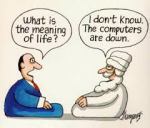
We’ve all seen the cartoons about the seeker who climbs up a steep mountain to receive guidance from a guru or wise person only to be met by a smart retort. “What is the meaning of life?” might be answered by “Google it.” or “If I knew do you think I’d be wasting mine by sitting up here alone?” or “The meaning of life is don’t ask don’t tell – and now we’ve both blown it.” or “I don’t know. The computers are down.”

A cartoonist could have a field day with this morning’s gospel. Two disciples follow Jesus on the road and when he asks what they seek, all they can come up with is: “Where are you staying?”

Our gospel reading covers two days. On the first day, John the Baptist sees Jesus and identifies him as “the Lamb of God”, the one about whom he spoke, the one who is both before him and greater than him, the one who will baptise with the Holy Spirit – in fact the Son of God. On the following day John is standing with two of his disciples when Jesus passes by again. Presumably these two were not with him on the previous day because John again says: “Look, here he is the Lamb of God.” Without hesitation, John’s disciples abandon him and set off after Jesus.

Jesus appears to realise that he is being followed because he turns and asks the pair: “What are you seeking?” “What are you seeking?” This is exactly the sort of question that a wise person, a guru or the incarnate divine might ask someone who was chasing after him. What are the disciples looking for, why have they come after him, is there something missing in their lives, an emptiness that they need to fill? Why indeed have they left John the Baptist? “What are you seeking? It is a reasonable question. After all, these two have been until now been followers of John the Baptist. They know what John has been saying, so they are not approaching Jesus in complete ignorance. Of all John’s disciples only these two, Andrew and one other, see fit to find out more about Jesus. They must know what it is that they are seeking.

This story is so familiar to us that we may have never really noticed the disciples’ strange reply to Jesus’ question. The disciples seem to be dumb struck. They don’t respond to Jesus’ question by asking something meaningful or profound. They certainly don’t give the impression that they are seeking a word of wisdom or the answer to life’s problems from someone whom their own teacher has identified as being greater. They don’t even ask the question that the priests and the Levites have asked of John: “Are you the Messiah?” Instead they seem to blurt out what must be the first thing that comes into their mind: “Rabbi, where are you staying?” Something that might explain why they have been following him.

“Where are you staying?” I wonder, “If you had the opportunity to ask anything at all of the Saviour of the world would this be the first question that came to mind?”

“Where are you staying?” Did John’s disciples have no game plan when they left John so abruptly? Was it a spur of the moment thing or had John’s teaching prepared them to follow someone else? Were they simply curious – wanting to observe for themselves this ‘Lamb of God’? That they are surprised or inarticulate when confronted by Jesus suggests that they had hoped simply to be observers – to see what Jesus might do and to hear what he might say so that they could decide for themselves whether he really was greater than John. In all probability they didn’t expect to be caught. They were just checking Jesus out, gathering all the information that they could before making the radical decision to leave John and follow Jesus.

An alternative view is that the disciples accepted what John had said, believed that Jesus was the one that John had been announcing and were in fact hoping to become disciples of Jesus but were overcome with awe or terror when Jesus turned to address them. After all, what does one say to the Lamb of God who takes away the sin of the world?

You and I don’t have any of these dilemmas. Thanks to the boldness of Andrew and the other disciple we know that an intimate relationship with Jesus is not only possible but is freely available. Thanks to the gospel records we know that even though the disciples themselves asked foolish questions they were not excluded from Jesus’ company. We know that there is no need for us to be coy or careful because we are assured that our relationship with Jesus is direct and personal. We do not need to be in awe of Jesus, nor do we need to self-conscious about our burning questions. In reality, we have the opposite problem from Andrew and his companion. Our problem is that it is easy to become over-familiar to be so confident and so comfortable in our relationship with Jesus that we begin to take it for granted. We can fall into the trap of treating Jesus as a comfortable friend, forgetting that he is, after all, the Saviour of the world, the Son of God. After all, we are already followers of Jesus, what more is there to do or to know?

How is your relationship with Jesus? Where are you with Jesus right now? When did you last think about following after him? What would you say if he turned right now and asked you: “What are you seeking?” Does your relationship with Jesus have the right balance between awe and familiarity?

Andrew and the other disciple took a risk. They knew that Jesus was something special and they weren’t sure what to say but they didn’t flinch when Jesus turned and they didn’t run away. When the journey got hard they stood by Jesus and when Jesus was no longer there, they carried on alone.

Foolish questions are better than no questions. Any relationship is better than no relationship. The right relationship with Jesus will see us through the hard times and if we work on that relationship the world will see Jesus through our lives and come to seek him for themselves.


Does Jesus need to be baptised??

January 7, 2017

The Baptism of Jesus – 2017

Matthew 3:13-17

Marian Free


In the name of God whose plan is, was and always will be to save the world.

Why does Jesus need to be baptised? Surely Jesus doesn’t need to be cleansed from sin. He doesn’t need to profess his faith. John certainly doesn’t think that Jesus needs to be baptised. It is important that we, with John ask the question? Why does Jesus need to be baptised? The problem is that it is easy for us to make assumptions based on the  idea that John’s baptism was like that which we received when in fact the two things are very different.

John’s baptism – that received by Jesus – was very different from the baptism that has grown up in the practice of the church. John was calling the people of Israel to repentance.  Baptism (the greek word simply means “wash”) was a sign that they were turning their backs on the way that had been living and were returning to God. John’s baptism was a baptism of repentance. It was not intended for individuals but for all of Israel. John was calling for the renewal of the Jewish people nation. He was NOT calling for people to repent of their own individual sins. John the Baptist was preparing the people as a whole for the coming of a Redeemer.

Baptism in the name of Jesus is, at the very least a post-resurrection event. It is form of initiation and a statement of faith. John’s baptism is not and cannot have been a baptism into the Christian faith.  Jesus had not even begun his public ministry and Jesus was, and remained a Jew.

What all this means is that when we consider Jesus’ baptism we have to see it as a stand-alone event and not as something that foreshadows the practice and doctrine of the Christian church. The baptism of Jesus is not baptism in the way that we think of baptism, but something entirely different.

All the gospel writers record this event, so we can state with some confidence that it has a basis in historical fact. Jesus was baptised and the Holy Spirit in the form of a dove descended on him. Matthew, Mark and Luke all report a voice coming from heaven (or from a cloud) that affirmed Jesus as God’s Son and indicated God’s pleasure in God’s son.

Of the accounts of Jesus’ baptism, Matthew’s is the longest. This is because he alone records John’s reluctance to baptise Jesus. “I need to be baptised by you and do you come to me?” he asks. John recognised that Jesus is the more powerful than he.  John thinks that Jesus should baptise him, not vice versa. Matthew apparently agrees with John that Jesus does not need to be baptised, so in order to understand what is happening, we have to examine how Matthew explains Jesus’ baptism.

According to Warren Carter we need to pay attention to four things in order to understand Matthew’s understood if we pay attention to four things: the context, John’s baptism, the conversation between John and Jesus and the voice from heaven[1].

The account of Jesus’ baptism occurs part way through chapter three in Matthew’s gospel. Jesus’ ministry is yet to begin. In fact it will not begin until mid-way through chapter four (after the temptations). Matthew has been setting the scene. Jesus’ baptism is one of the way in which Matthew establishes Jesus’ identity and demonstrates the way in which Jesus is a fulfilment of God’s promises. Matthew begins by establishing Jesus’ identity and the ways in which his early life is a fulfilment of scripture. Jesus is of the line of David, conceived by the Spirit to save the people from their sins. He is Emmanuel, “God with us”. His life is in danger because he is a threat to Herod. The leaders in Jerusalem ignore his birth and yet he is recognised and worshipped by foreigners. Through Joseph, God ensures that he is kept safe from harm and finally John the Baptist prepares the people for his coming.

Matthew has made is clear that Jesus has been sent by God. His baptism by John demonstrates that Jesus both understands and accepts his role and that he intends to be obedient to God’s plan for his life.

Only Matthew records the conversation between Jesus and John – John’s initial reluctance and Jesus’ insistence. Remember that John ‘s baptism is not about individuals, but about the nation of Israel. Jesus’ sinlessness is not in question, it is Jesus’ role as the “one who is more powerful” that causes John some anxiety.  Jesus’ response is mysterious. All it really tells us is that Jesus’ submission to John’s baptism is part of God’s plan for putting everything right – the plan that John has been announcing to the world. Just as other events in Jesus’ life so far have been to “fulfil” God’s plan, so too will Jesus’ baptism. It does not make immediate sense, just as Jesus’ death will not make sense. What is important for Matthew’s story is that God has a plan and that Jesus is determined to submit to that plan, to accept his commission from God.

After Jesus has convinced John that his baptism is not only right, but also divinely sanctioned John baptises Jesus. Then, as Jesus emerges from the water, God affirms both Jesus’ identity and his mission by opening the heavens, descending as a dove and declaring Jesus to be his son, the Beloved, with whom God is well pleased.

Through genealogy and story, affirmation and fear, Matthew has established Jesus as the one of David’s line who will fulfil God’s promise to bring salvation to Israel. Now that he has made it absolutely clear who and what Jesus is, Matthew can begin his record of Jesus’ teaching, teaching that he has proven can be heard and received with absolute confidence. Those who hear and those who read Matthew’s gospel know exactly who Jesus is, by whom he has been commissioned, and what role he is to play in the history of Israel.

As we travel together through the gospel according to Matthew this, we can be sure of this that Matthew believes that: Jesus has been sent by God, to fulfil God’s promises and to carry out God’s plan. What we read and hear can be trusted because it comes from God..


[1] For the original see http://workingpreacher.org