Posts Tagged ‘King’

What sort of king?

November 26, 2024

Christ the King – 2024

John 18:33-37

Marian Free

In the name of God who continues to surprise, confound and amaze us.  Amen.

Many years ago, I read an article in an occupational therapy journal about children in foster care. It reported that no matter how much abuse or neglect a child had suffered at the hands of a natural parent they still wanted to go home. It seemed that the idea of family, mother, father created a deep longing to belong, even if the child’s reality did not live up to expectation. Apparently, an abusive mother was better than no mother, a disparaging, derisive father was better than no father. 

Terms like mother, father, mum, dad, family come laden with meaning – often idealistic and vastly different from many people’s reality. Few parents are perfect and even if they were, their styles of parenting would differ according to their own experience, their personalities and the relationship that they have with each other – no one family is the same. Even though the definition of “family” has vastly changed over the last 50 years, still many of us have an idea of what a mother/father/family should be like[1].  

The same is true of the expression “God”. In the eighties and nineties many feminists and others chose to use the term “Godde” to make it clear that the divinity in whom they believed was not a bearded, white-haired man sitting on a throne, condemning people to the fire of hell and that “Godde’ was much bigger and broader than the narrow image that was circulating. Many of us still confront the problem that the God which many of our friends have rejected is unrecognisable to us – a human invention not a revelation of scripture ad certainly not related to our experience.

Over and again, scripture confronts a narrow, unimaginative concept of God, an image of God that is easier to manage, understand and, dare I say, control. In a phrase that I often repeat, Isaiah says: “God’s thoughts are not our thoughts and God’s ways are not our ways.” (Is 55:8).  Paul’s first letter to the Corinthians makes the same point when he  argues that the cross exposes our false understanding and overturns all our preconceptions. “God’s foolishness is wiser than human wisdom, and God’s weakness is stronger than human strength.” (1 Cor 1: 28).

Though there might be some assumptions that we can make about God, God consistently overturns and challenges our simple-minded ideas.  Nowhere is this more obvious than with the person Jesus. On every level, Jesus failed to meet expectations and at every turn Jesus refused to be bound by the limits of the human mind. Jesus came to serve not to be served, he argued that the first would be last, and announced – not that he would lead the Israelites to victory – but that he would suffer and die.

That Jesus confounds every attempt to label him and to box him in, is particularly clear in Jesus’ interaction with Pilate. Despite the fact that Pilate is in a position to put Jesus to death, Jesus refuses to give Pilate a clear answer to Pilate’s question as to who he is. In response to Pilate’s questioning Jesus is evasive, elusive and enigmatic. 

Until the moment of Jesus’ trial, Jesus was probably unknown to Pilate and now he is brought before him by the Jews (whose traditions and laws Pilate does not understand, and over whom he has no jurisdiction). Pilate makes an attempt to discover who and what Jesus is, yet Jesus speaks in riddles and throws Pilates’ questions back to him. “What makes you think I’m a king?”

Jesus does not deny that he is a king, but he is clear that like “God” and “family” the title “king” is impregnated with meaning and expectation and that if he admits to being “king” Pilate (and the crowd) will impose their own understanding on the word – Pilate will see Jesus as a threat to Caesar and the crowd will expect him to seek power.

By prevaricating, by being evasive, by not directly answering Pilate’s question, Jesus is trying to redefine “kingship”. Yes, he is a king, but not the sort of king that people are used to – not a king who enriches himself at the expense of others, not a king who expects everyone to be subservient to him, not a king that seeks to dominate and oppress all the nations of the world. Jesus is king of an unworldly kingdom, a king whose primary purpose is to testify to the truth – the content of which is contained in John’s gospel, the purpose of which is that those who hear Jesus’ voice will attain eternal life.

In just five verses the author of the gospel has de-stabliised and undermined the traditional understanding of what it means to be king. Jesus is king, but he is king on his own terms, he will not be defined and confined by the expectations of others – whether they be his fellow Jews or the representatives of Rome.

The passage is left hanging with Pilate’s question: “What is truth?” 

There is an interesting twist to John’s account of Jesus’ trial and crucifixion. Traditionally a name is attached to the cross to identify the one being crucified. Pilate orders that the sign on Jesus’ cross read (in Hebrew, Latin and Greek): “Jesus of Nazareth, King of the Jews.” Despite the objections of the Jews, Pilate leaves the wording as it is. Has Pilate come to see the truth? Has he grasped that Jesus is a king (albeit a very different one) or is this is Pilate’s way of justifying an execution which at heart he believes is not justified.

Either way, Jesus’ crucifixion is the ultimate act de-stablises, unsettles and even undermines all our expectations of what it means to be King of the Jews, the one sent by God, the anointed.  

Jesus’ dialogue with Pilate, is a reminder that the narrative is not within our control, that God the Trinity will always act in ways that we do not expect and will always defy our attempts to categorise and define.  In the face of Pilate’s efforts to label him Jesus infuses the expression with new meaning.  He is a king, but he is a king like no other (before or since).

May all our longings for the kingdom be tempered by the knowledge that the kingdom is not of our making and that our human intellects are inadequate to the task of truly comprehending who and what God is, what it is that God plans, and what the kingdom will finally be revealed to be.


[1] Of course, the nature of families has completely changed and with that comes a change in expectations.
In vulnerably lies our salvation

November 19, 2016

The Reign of Christ – 2016

Luke 23:33-43

Marian Free


In the name of God whose contradictions keep us always guessing. Amen.

Periander had sent a herald to Thrasybulus and inquired in what way he would best and most safely govern his city. Thrasybulus led the man who had come from Periander outside the town, and entered into a sown field. As he walked through the wheat, continually asking why the messenger had come to him from Cypselus, he kept cutting off all the tallest ears of wheat which he could see, and throwing them away, until he had destroyed the best and richest part of the crop. Then, after passing through the place and speaking no word of counsel, he sent the herald away. When the herald returned to Cypselus, Periander desired to hear what counsel he brought, but the man said that Thrasybulus had given him none. The herald added that it was a strange man to whom he had been sent, a madman and a destroyer of his own possessions, telling Periander what he had seen Thrasybulus do. Periander, however, understood what had been done, and perceived that Thrasybulus had counselled him to slay those of his townsmen who were outstanding in influence or ability; with that he began to deal with his citizens in an evil manner[1].

According to Wikipedia this tale, which dates from at least the 4th century BCE is the origin of what we know as the Tall Poppy Syndrome – the desire to cut down anyone whom we believe to have “risen above their station”. That same site quotes Peter Harcher from the Sydney Morning Herald who defines the Australian version of the syndrome in the following way, “(Australian) citizens know that some among them will have more power and money than others… But according to the unspoken national ethos, no Australian is permitted to assume that he or she is better than any other Australian. How is this enforced? By the prompt corrective of levelling derision. It has a name—The “Tall Poppy Syndrome”. The tallest flowers in the field will be cut down to the same size as all the others. This is sometimes misunderstood…It isn’t success that offends Australians. It’s the affront committed by anyone who starts to put on superior airs[2].”

Sociologists like Max Weber believe that believe that in some groups, especially those that are disadvantaged socially or economically, there is only a “limited amount of prestige to go around”. As a result those who gain a degree of power or influence are resented for absorbing more than their fair share, which in turn restricts the ability of others to gain attention and authority[3]. In Australia, it seems that another person’s success offends our sense of egalitarianism. If someone is more successful than his or her peers, it is (in the minds of their peers) a sign that they think more highly of themselves than they should. They have broken the bonds of solidarity that provide strength and dignity to those on the lower rungs of the social scale and have set themselves apart to the chagrin of their peers.

Those left behind seek to humiliate if not destroy those who by good fortune or hard work have improved their place in the world. They try to bring that person down to their own level, to prove that they are just as human and flawed as the next person.

Should that person experience a reversal in fortune or a fall from grace, his or her peers will crow with delight, gather like vultures to pick over the bones, boast with delight that they knew that no good could come from someone overreaching themselves. They think to themselves how wise they were to have predicted the inevitable outcome of another’s ambition and pride. They express no sympathy for the plight of the fallen, just gleeful spite and self-congratulation.

If we understand this characteristic of human nature (the desire to cut others down to size), we will not surprised that this is how a majority of people react to Jesus’ arrest, condemnation and crucifixion. After all Jesus, in the minds of many, is just some peasant upstart from the far-flung region of Galilee who despite being a nobody has been causing mayhem in Jerusalem and in the Temple. Egged on by the leaders (whose apparent power derives from Rome), those present at the cross deride and mock Jesus, pointing out his powerlessness and the contrast between his present situations and that to which he might have aspired. What right does he have to set himself above others? What makes him different from the rest of the poor peasants who make up 99% of the population? Why should he receive the adulation and support of the crowds? What gives him the right to challenge the leaders and to critique Temple worship? Those who have no power – the soldiers, the crowd and even one of Jesus’ co-condemned – ridicule Jesus and demand that he demonstrate the power that he claimed to have. They want him to prove himself. If he is better than them, if he is able to perform miracles, if he is closer to God than they are then now is the time to prove it.

Three times the challenge rings out: “If he is the Christ let him save himself.” “If you are the King of the Jews save yourself.” “Are you not the Christ? Save yourself and us.” Three times Jesus is challenged to “save”. Save! Save! Save! they cry in mockery, knowing that the cross holds Jesus tight.

What we can see and the crowds cannot, is that the cross is unable to hold Jesus. The leaders, the soldiers, the man condemned to death have completely misunderstood the way in which Jesus will save (will bring about salvation). He will not “save himself from the cross, but his submission to the cross will bring about the salvation of the whole world. What the leaders and the soldiers and the condemned man have failed to understand is that it is precisely Jesus’ willingness to be powerless and vulnerable, his readiness to submit himself completely to God and his total obedience to and reliance on God that will lead not only to his own “rescue” from death, but also to the salvation of the whole of humankind.

As is often the case in the gospels, it is the most unlikely figure who can see the truth. A condemned man, who within two days will have died the most horrific of deaths, recognises Jesus’ paradoxical kingship. “Jesus, remember me when you come into your kingdom.” Jesus, knowing the authority that he does have, promises “today you will be with me in Paradise”.

Crucifixion does not look like salvation, death does not look like life, vulnerability does not look like control but Jesus’ knew and the thief discerned, that it is only when we give up our independence and sense of control, only when we place ourselves completely and utterly in God’s hands that we can and will be saved.


[1] The concept originates from accounts in HerodotusThe Histories (Book 5, 92f), Aristotle‘s Politics (1284a), and Livy‘s History of Rome, Book I. https://en.m.wikipedia.org/wiki/Tall_poppy_syndrome

[2] op cit

[3] op cit

Standing out from the crowd

April 12, 2014

Palm Sunday – 2014

Matthew 26:14-27:66

Marian Free

In the name of God who challenges us to discern right from wrong and to have the courage to stand out from the crowd. Amen.

Anyone who has ever been to a concert or a sporting match knows that it does not take long to snap into sync with the crowd. Being part of a group can be extraordinarily compelling and energising. The sense of sharing a common interest holds together people who are very different from each other and causes them behave as one.

Crowds are notoriously difficult to control – in part because of this sense of unity and in part because as a result, they take on a life of their own. In many instances – especially in the case of spontaneously formed crowds – the group morphs into a self-organizing system. There is no need for central control – the common purpose holds them together. In the case of a sporting event or concert, there is no one with a megaphone saying “now!” Everyone simply cheers (or boos) together. They know instinctively how to behave. They are absorbed into the behaviour of the crowd and act as one. Even when a crowd has a leader, a crowd mentality can take over making the leader powerless – for example, surging forward despite being urged to stop or rioting when the intention was a peaceful protest.

Crowds can be sinister or positive. It is easier to be brave (or foolish) when you know that you are acting in a manner that is consistent with those around you. Being part of a group creates a feeling of solidarity, a feeling of empowerment, a belief that the many can make a greater difference than one. Being part of a crowd can be also liberating and disinhibiting. The sense of anonymity, the adrenaline rush provided by being in a crowd can provide just the excuse for someone to behave in a lawless manner, when at other times public opinion (or their own conscience) would prevent them from doing the same thing.

A crowd can work together for good – changing an unjust government or law or cleaning up after a natural disaster. But a crowd can just as easily work for bad. Crowds can turn ugly in a moment. The same mentality that had a group protesting peacefully can be turned into the opposite by the action of a few. Crowds can determine the fate of a nation, but they can just as easily decide the fate of an individual.

It can be difficult to hold one’s position, to be the person standing out from the crowd, the one shouting: “stop!”, when everyone else is shouting: “go!” Only truly courageous people have the courage to act unilaterally – to go against the flow, to stand up for a principle or ideal when no one else can yet see the need.

It is not surprising that crowds were drawn to Jesus’ arrival in Jerusalem. That he was on a donkey was calculated to attract attention. According to Zechariah, this was how the promised King would arrive. No doubt some people noticed and, thinking the prophecy fulfilled began to gather and cheer. Soon others would have joined. As the excitement built, more and more people would have wanted to be part of the excitement (perhaps so they could tell their grandchildren that they had been there). It is not surprising that the Romans and the leaders of the Jews were anxious – they knew from bitter experience how little it took for a crowd to become a riot.

It is not surprising that after Jesus’ arrest, the crowds gathered to see what would happen next. Many would have been wondering who Jesus really was and whether – if he were the King – he would find a way out of the predicament in which he found himself. Moreover, for those who have little to look forward to, a trial breaks the monotony of everyday life. It has the potential to create drama and intrigue and the outcome is never certain. Once a crowd had gathered, it could be easily manipulated. The chief priest (or others) would not have found it too difficult to incite the crowd to shout: “Barabbas” or “crucify him!” Those who did not want to join in would have found it hard to remain silent.

Because we know the story, it is easy to believe that we would have behaved differently, that we would have resisted the pressure of the crowd, and that – heedless of the consequences – we would have taken a stand to prevent an innocent person condemned to death. However, there is no reason to believe that we would have behaved any differently, that, in the circumstances we would have found the courage to stand-alone against a crowd.

Let us hope that we will not be put to the test and that if we are, we will not be found wanting.

March 23, 2013

Palm Sunday 2013

The Passion According to Luke

Marian Free

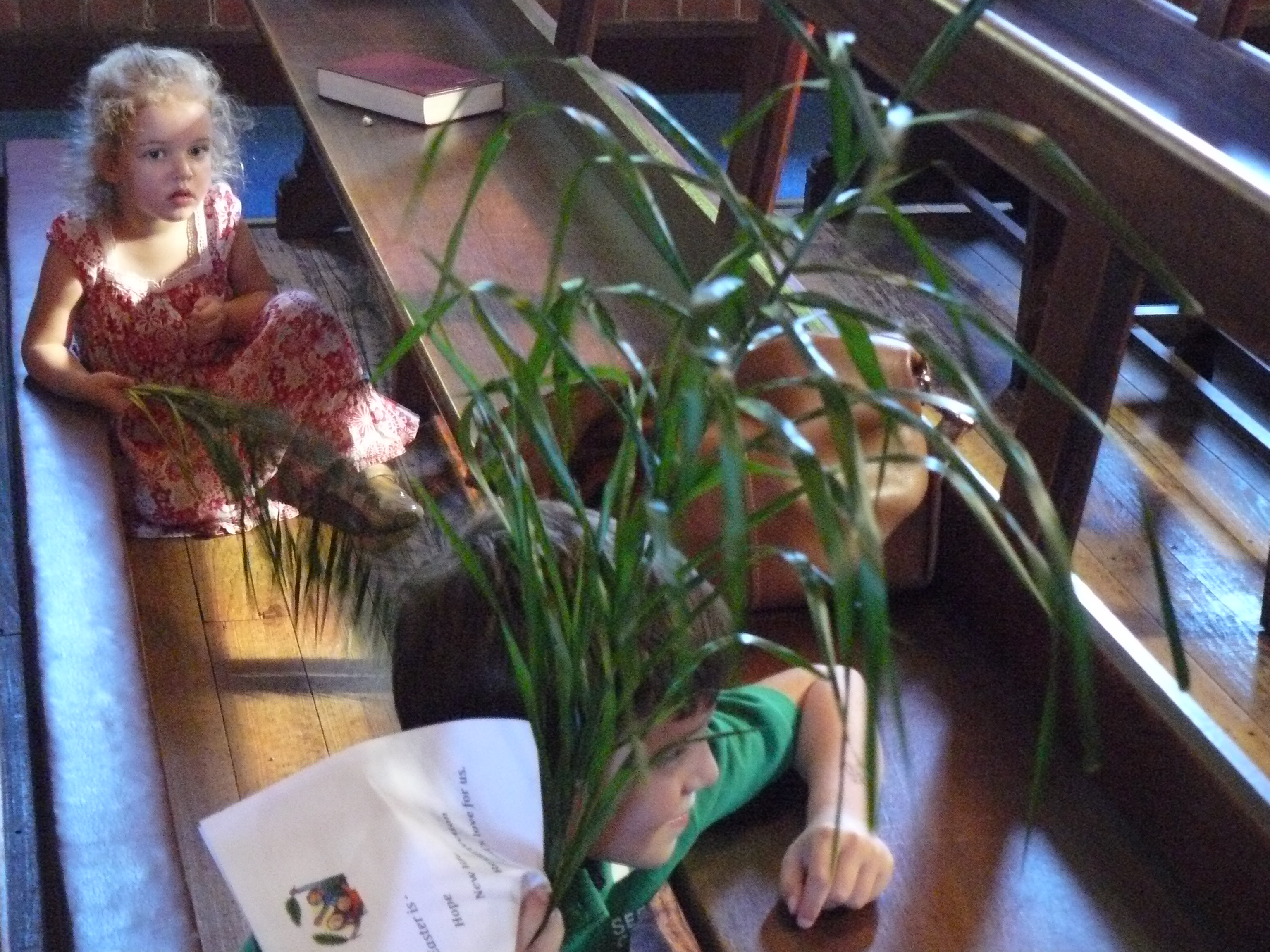
Palm Sunday, Children's Easter Service 2013

Palm Sunday, Children’s Easter Service 2013


In the name of God who asks us to be true to ourselves and faithful to God. Amen.

Imagine Australia, defeated and occupied by an oppressive and exploitative foreign power. A puppet Government has been installed under the supervision of a foreign governor. Former political and business leaders have of course maintained their wealth and status by collaborating with the foreign overlords and the onetime patriotic media has become their mouthpiece. The old Australian flag has been suppressed and replaced and the old national anthem banned. Resistance has been largely crushed apart from a few underground terrorist groups and some freedom fighters in isolated rural areas. The churches have become quiescent and fallen into line, in exchange for some measure of freedom to engage in purely spiritual activities. Occasionally a firebrand would-be nationalist leader appears and gathers some support but the police and army easily put such movements down and their followers are rounded up and disappear.

The old Australia Day weekend is coming up. It is now of course carefully orchestrated by the new regime as a means of both gaining support and diffusing nostalgia for the past and everybody hopes there will be no terrorist incidents to destabilize the situation. 

Suddenly, out of nowhere, one of these popular leaders appears, riding in an old government limo, flying the old flag and accompanied by a few rag-tag supporters. Suddenly the crowds begin to swell on the foot paths and as more and more flags begin to appear, the crowds burst spontaneously into the old national anthem. The security troops are caught totally unprepared and before they can intervene, the car swings into the square and draws up before City Hall and the young leader gets out and marches insidehe must be stopped.[1]

It’s hard to imagine what it was like to be in Palestine in the first century. We have to remember that since the exile Israel had never recovered its former glory. The nation has, with a brief respite in the time of the Maccabees, been under foreign control and the current situation has seen the leaders of the nation and of the church sell out to Rome. High priests are political appointments – no longer members of the ancient tribe of Levi. Herod is a puppet King and Pilate has been sent to this outpost of the Empire to keep the peace. Jerusalem is ripe for rebellion, the countryside is filled with people who, with their followers, incite rebellion and who are claimed to be the Messiah. Everyone, it seems, is looking for a Saviour who will free them from the yoke of oppression.

Into this mix rides Jesus, a man who has made a reputation for himself as a healer and teacher, who is reputed to have drawn large crowds to him and whom some believe to be the awaited Redeemer. He has unsettled the political and religious leaders to the extent that, from the time he enters the city, he is in their sights and they are looking for a way to kill him (19:47).

The problem, for the people and for the leaders of the people, is that contrary to their hopes or, the case of the leaders – their fears – Jesus is not the person they expected. The Israelites are looking for someone who will free them from the yoke of the Romans, someone who, like his ancestor David will lead them in battle, someone who will restore Israel to nation it once was. What they discover is that Jesus is not a fighter. For all that his entry into Jerusalem is staged to look like a fulfillment of the words of Zechariah, Jesus is a disappointment. He does not intend to raise an army and he is more critical of the leaders of his own people than he is of Rome. His mission is not so much to restore independence to Israel, but to restore the nation’s relationship with God.

A number of scholars argue that rather than supporting an uprising, Jesus actually cautions against it. When Jesus “predicts” the destruction of Jerusalem, it is because he can see the likely outcome of a revolution. Rising up against the Romans will, he believes, lead to defeat. Worse, a rebellion will lead to the destruction of all that the Jews hold precious – the Temple, the centre of their faith, the place in which their festivals are marked and celebrated, the site where all their rituals are carried out will be destroyed. If they challenge Rome, all that will be gone – never to be replaced.

Rome may be a problem, but the greater problem is the hypocrisy of the religious leaders who have made compromises of faith to keep the peace. It is this that Jesus confronts and condemns.

So Jesus enters Jerusalem, but from the start, his purpose is misinterpreted and misunderstood. The religious leaders fear that he will incite the crowds to riot which will mean that their freedoms will be curtailed. They are also frightened that his influence on the crowds will affect their influence in religious matters. The governing powers are also anxious. These people (the Jews) are notoriously difficult to contain, Jerusalem is at its most populous and this is the festival most associated with national identity. If the people are allowed to get out of control there is not telling what will happen. The role of the occupying forces is to maintain the peace at any cost.

From the moment he enters the city, Jesus’ life is at risk.

And so it plays out. Judas, for whatever reason, sides with Jesus’ opponents. Jesus (who does not intend to lead the resistance) goes quietly. What is more, given the opportunity to defend himself, Jesus remains mute, thus allowing himself to be subject to one of the most horrifying forms of punishment and death.

Through it all though, Jesus’ faith remains steadfast. In the face of corruption and compromise Jesus maintains his integrity and his independence. Despite the adulation of the crowd, he refuses to be seduced into changing his purpose. Given the opportunity to make an easy exit, Jesus refuses to sell out. Whatever the consequences for himself, he will not be turned from his certainty that the only way forward is for the nation and for himself to put themselves completely in the hands of God.

And so it is that he will not turn from his call, he will maintain his commitment to his cause. Nothing will persuade him from his course which is to reestablish Israel’s relation with God. For he knows that nothing less than complete trust in and dependence on God will do. It may not keep him safe from harm, but it will and does lead to a life such that cannot be known by any other means.


[1] From a sermon preached by The Rev’d Alan Dale at St Thomas’s Toowong on Palm Sunday 2007.