Posts Tagged ‘Love’

God and slugs

December 24, 2015

Christmas 2015

Some thoughts

Marian Free

 In the name of God who could chose to be anything and yet chose to become one of, one with us. Amen.

 From time to time, I dip into a collection of daily readings that uses the writings of C.S. Lewis[1]. Recently, in the readings for December, I came across this statement: “The Eternal being, who knows everything and who created the whole universe, became not only a man but (before that) a baby, and before that a foetus inside a woman’s body. If you want to get the hang of it, think how you would like to become a slug or a crab[2].” I have to admit, that as much as I have pondered the nature of the Incarnation, I had never grasped the enormity of God’s decision as clearly. Lewis’s comparison really puts the concept of the Incarnation into perspective. In fact, as I absorbed the new point of view, it occurred to me that the difference between divinity and humanity is so vast that even Lewis’s distinction may not be sufficient to capture the chasm that exists. In fact it is almost certainly impossible to come up with an image that does the notion justice, but it might be more useful to consider our becoming an amoeba, a mould or some other microscopic life form.

It is beyond imagining that a human being would voluntarily trade their human form for something so base and so insignificant as a single-celled organism. Is there any circumstance under which a human being would make that choice? Is it conceivable that there would be a situation that would draw out the sort of love and compassion that would compel a person to make such a radical sacrifice?

I suspect that there is no way that any one of us would willingly choose to give up our independence, our rational thought, our self-determination. There is no imaginable state of affairs that would cause us to make a choice that would leave us completely at the mercy of the elements, adrift in the world with no power to change our position or to influence the direction that our lives might take. Human beings can and do make enormous sacrifices for others, but it is hard to imagine any human being giving up their humanness for any cause whatsoever.

Yet, God, the source of life and love, God who could and can do anything, who could choose to be anything at all and who could determine any number of ways to save the world, made the choice to fully and completely enter our existence. There were no half measures. God did not appear to become human. Jesus was not merely similar to us. God took on human flesh with all its frailty. God abandoned power and glory, imperishability and immortality to fully enter the human race. In so doing, God exposed Godself to all the indignities associated with being human. God sentenced Godself to all the restrictions, all the limitations of the human form – the spewing, mewling, incontinent state of infancy and old age, the vulnerability to disease and accident, the risk of being emotionally abused or abandoned.

We cannot come close to envisaging the cost of God’s abandoning the glories of Paradise for the uncomfortable realities of life on this planet. We cannot take lightly God’s love, commitment and compassion for the human race.

This is what the Incarnation, what Christmas is all about. God’s desire that we should be saved that is so powerful and so overwhelming, that what to us is an unimaginable decision becomes a realistic solution. God could see no other way to demonstrate God’s love and to bring us to our senses than to share our existence and to show us our real potential. I have no desire to become an amoeba or even a slug, but I will for this life and the next be overawed and filled with gratitude that God should love so much that God would become one of us.


Christmas 2015

Family service

If you could be anything at all when you grow up, what would it be?

(Take responses and comment – something like there are some pretty ambitious and amazing goals there. I hope that you work hard enough to make them a reality. If there are no outrageous comments, mention some that came up at our grandson’s Kindy graduation – princess, batman, Prime Minister)

God can do or be anything that God wants, and what did God decide to be? (Wait for answers or simply provide the answer.) Yes, God decided to be a baby. God could be anything at all, and yet God became a baby – a baby that cries, that needs its nappy changed, that throws up after it is fed. Yuk! Why would God want to become a baby? Why? Because God loves us so much, that God will do anything to get our attention. Why? Because God knew that we wouldn’t really trust God unless God became like us and that if God was to become like us, then God had to be just like us – starting as a baby. Why? Because God knows that everyone loves a baby and God hoped that if we loved the baby, we might learn to love God.

So Christmas is all about the baby, and the baby is all about love – God’s love for us that is bigger than anything we can begin to imagine.

God loves us, and hopes that we will learn to love God.


[1] In C.S. Lewis. The Business of Heaven. Ed Walter Hooper. Great Britain: Fount Paperbacks, 1984.

[2] op cit 300.

It still doesn’t depend on us

May 9, 2015

Easter 6 – 2015

John 15:9-17

Marian Free

In the name of God – Lover, Friend, Enlivener. Amen.

Today will be the third time in three weeks that I have had cause to preach on John 15:9-17 – at the service to dedicate the windows, on ANZAC Day and now today. That tells you at least three things. One is that our scriptures are often put to uses for which they were not originally intended, a second is that they are to some degree pliable (that is they can withstand more than one interpretation) and a third is that our biblical texts contain so much depth and complexity that they can be viewed from a wide variety of angles and through an array of different lenses and so continue to reveal new and rich insights. This is certainly the case with John’s Gospel. Apparently simple, transparent texts contain layers of detail that only become obvious when we make the effort to really familiarize ourselves with them.

Take John 15:1-17 for example. Jesus declares himself to be the true vine – an image that he expands on in two ways. In the first few verses (those we heard last week) he elaborates on the image by comparing himself with the vine – the source of life for the branches. That seems straightforward enough until the reader begins to explore questions such as: to whom is Jesus referring when he speaks of the branches and whom does he mean by the branches that have withered? What does sort of fruit are the branches to bear? Does he mean doing good works or does he, as the reading suggests mean discipleship? If bearing fruit is discipleship what does that look like? [1]

Jesus expands on the question of discipleship in his second explanation of the vine. Discipleship according to this image is evidenced by self-sacrificial love for one another – love that like fruit flows from a believer’s abiding in him. This discussion is no less complex than the first. Here, Jesus turns his attention to the theme of love but he confuses the issue by adding instructions about keeping his commandment, about servanthood (slavery) versus friendship, about being sent and about answered requests.

In a ten minute sound bite, such as a sermon, it impossible to follow and elaborate on all of these different threads much as I would like to! I alert you to them so that you are aware that I am skimming the surface of and not plumbing the depths of Jesus’ analogy.

When John 15:9-17 is read on ANZAC Day, it is usual for the preacher to focus on just one of the verses: “Greater love has no one than this, that they lay down their life for their friends” (John 15:13). In that context of ANZAC Day, it is appropriate think of all those who, in times of conflict, have risked or given their lives so that others might live and it is comforting to understand that their lives were given not only for a good cause, but in response to the highest Christian ideal.

Jesus setting was not that of wartime, nor do I imagine that he spoke these words with that particular context in mind. In trying to come to grips with the text today it is important to ask: “What is the context that Jesus is addressing? To whom was he speaking? and What did he mean by that line?

A number of factors make it clear that Jesus is talking to believers,those who are already disciples. In the first instance, the setting in the gospel is Jesus’ last meal with the disciples – presumably the twelve minus Judas who has already gone out, but certainly an inner circle of followers. Secondly, Jesus is addressing those who abide in him – those who have not already withered and died. Thirdly, he calls the listeners “servants” a term that implies they are his disciples or followers. Jesus is speaking to his followers in the context of saying farewell to them and preparing them to be the church in his absence.

This is an essential detail in terms of working out the meaning for us today. Jesus is NOT encouraging us to do good works. The fruit we are called to bear is that of discipleship and discipleship is to be demonstrated in self-sacrificial love – not for the nation, not for those in need, but for our fellow church members, those with whom we meet week by week, those whom we take for granted and those whom we let get under our skin, those who agree with us on issues such as music and furnishing and those who want to turn everything upside down, those who encourage us and those who let us down, those whom we have known for years and those whom we have only known for hours. In one sense it is a much more homely love (less noble) than dying for another in battle and yet in another sense it is a much more difficult love because it means that issues that arise need to be properly addressed, differences recognised and dealt with and rifts mended. It entails recognising when to hold one’s ground and when to give way, when to be firm and when to be gentle. In one sense this sort of love is incredibly difficult, in another it is the easiest love in the world, because above all it not our love – it is God’s love, God’s love expressed through Jesus to us.

In the end then, love has little to do with us and everything to do with God. Our primary responsibility is to abide in the vine, to abide in Jesus and in Jesus’ love for us such that Jesus’ self-sacrificial, life-giving love flows through us, filling us, fulfilling our every need and freeing us such that we cannot help but to give that love freely and abundantly to others. We are called, each and every one of us to be in a relationship with God, a relationship with Jesus that is so all-embracing, so intimate that it is as if we are branches that are fed and nurtured and empowered by the life-giving love of the vine that produces the fruit of discipleship which is our love for each other.

Imagine a church community that truly and completely bound itself to God as branches in a vine, a church in which God’s love was abundantly and transparently clear. Who would not want to belong to such a church? Who would not want the love that its members showed to one another?

If we live in God’s love, God’s love will live in us and that love will be manifest to the world. It is my belief that in this community we know and live God’s love. Can know and live it better? Are we willing to know and live it better? If not why not?

[1] That is not taking into account the questions as to whether chapters 15-17 are original to the gospel and/or original to Jesus. Nor does it refer to the issue of Old Testament precedents.

God does not discriminate

September 20, 2014

Pentecost 15 – 2014
Matthew 20:1-16
Marian Free

In the name of God who values each one of us equally and desires only that we allow ourselves to be loved. Amen.

One of my favorite movies (and books) is The Joy Luck Club by Amy Tan. It tells the story of five Chinese women and their daughters. The mothers have all fled traumatic experiences in their homeland and have made a new home in America where, like many Chinese women, they want their children to excel. This desire puts a great deal of pressure on the daughters who, not surprisingly, find that while they are like cousins to each other they are also each other’s competitors.

One of the daughters Jing-Mei doesn’t fit the competitive mold. She is quiet and unassuming, always blending into the background rather than drawing attention to herself. At social functions, it is Jing-Mei (June) who hovers around the older women ensuring that they have what they need – drinks, snacks and so on. It is June who takes the worst piece of crab at a dinner party and who can be found in the kitchen washing the dishes when the meal is finished.

Though June has happily and willingly taken on the role of nurturer, there are times when she cannot help but feel that she is unappreciated and unseen.

On one occasion, when June is clearing up yet again after a dinner party, all her pent up frustration bursts out. She says to her mother:

Jing-Mei: I’m just sorry that you got stuck with such a loser, that I’ve always been so disappointing.
Suyuan: What you mean disappoint? Piano?
Jing-Mei: Everything: my grades, my job, not getting married, everything you expected of me.
Suyuan: Not expect anything! Never expect! Only hope! Only hoping best for you. That’s not wrong, to hope.
Jing-Mei: No? Well, it hurts, because every time you hoped for something I couldn’t deliver, it hurt. It hurt me, Mommy. And no matter what you hope for, I’ll never be more than what I am. And you never see that, what I really am.

But her mother has seen, her mother knows her and loves her. She does not want June to be like her friend’s daughters but to be herself. She responds (referring to that night’s meal):

Suyuan: That bad crab, only you tried to take it. Everybody else want best quality. You, you’re thinking different. Waverley took best quality crab. You took worst because you have best quality heart. You have style no one can teach. Must be born this way. I see you.

All this time, June had thought that she had to work hard to be noticed and that if she only did enough she would stand out from the others and her mother would see and value her. All that time, she hadn’t realised that who she was was enough. Her mother did not compare her with her friends, but valued her for herself. June did not have to earn her mother’ love, it was already hers.

It has been said that the parable of the labourers in the vineyard is “the gospel in a nutshell” and while June’s story is not an exact parallel it does illustrate the point that we do not have compete for love and certainly not for God’s love. God’s love is not something that we have to earn – it is already ours. If it is ours, it is others also. It doesn’t matter if a person recognises God’s love at the eleventh hour – like the thief who is crucified with Jesus – or whether – like many of us – one has known God’s love since birth. It is not a competition. God’s love is given in equal measure to each one of us no matter who we are or what we do.

In first century Galilee, many of the small land holdings had been consolidated. This meant that there were many men who had no means of support and who had to hire themselves out on a daily basis. These men would gather in the market place every day in the hope that they would be offered work. Landowners would come to the market place to hire day-labourers. (Even if they could afford slaves it was cheaper to pay a daily rate, than to expend money on slaves who had to be fed and kept even if they were sick and unable to work.)

What is unusual in the parable is that the landowner comes out at dawn and at the third hour, the sixth hour, the ninth hour and even the eleventh hour. He agrees with those hired at dawn to pay them a denarius for the day. Those hired at the third, sixth and ninth hour are simply told that they will be paid what is just – no amount is specified. Those told to work at the eleventh hour are not made any offer of pay.

Our attention is caught by two details: first that the landowner should take on anyone so late in the day and second that the landowner has not specified any recompense for the latecomers. The tension is heightened when we discover that those who arrived last are paid a denarius – the same amount that was offered to those hired first. We, the audience expect that those who have worked all day will receive more – despite their initial agreement with the landowner. We join the gasp of surprise and resentment when they receive only what was promised. After all, those who were hired first have worked so much longer and have born the burden of the day. In human terms the landowner’s action is simply unjust.

That is the point of course. The landowner is God, as the parable makes clear by calling him the “lord” of the vineyard. God is not just in human terms. God does not discriminate according to how long or how hard a person works. Everyone who responds to the call of God – whether early or late – is treated in the same way, because there is only one thing that God has to offer and that is salvation or eternal life. It would be nonsense for someone to be one third or one half saved or for God to give the late-comers only a representative proportion of eternal life depending on when they came to faith. Eternal life is eternal or it is not.

This is why the repentant thief is told: “today you will be with me in Paradise” and why those who come last receive the same as those who came first. There is no such thing as partial salvation or limited eternal life. One is saved or one is not, one belongs to the kingdom or one does not, one has eternal life or one does not. Those who work all day are no more saved than those who come in late.

At the heart of the gospel is God’s inclusive love. No one who accepts that love is excluded from the kingdom – not tax-collectors, not prostitutes, not even sinners. In God’s eyes we are all equal and all equally loved. If God chooses to love, who are we to begrudge that love to others? If God makes no distinction, who are we to compare ourselves favourably with others?

The seeds of evil

July 19, 2014

Pentecost 6b. 2014

Matthew 13:24-30 (31-33) 34-43 (see below)

Marian Free

(It is always difficult for a blog to represent just what is actually said, and the tone with which it is said. I was unhappy with what I wrote last night and so spoke from the heart. The update – what is immediately below – represents as best I can remember, the verbal edition.)

In the name of God who sends rain on the just and the unjust. Amen.


(Sung before the reading of the Gospel:

God is love, and gently enfolding

all the world in one embrace,

with unfailing grasp is holding

every child of every race.

And when human hearts are breaking

under sorrow’s iron rod,

then they find that selfsame aching

deep within the heart of God.

Timothy Rees 1874-1939)

 No doubt you, like me and countless others, woke up on Friday to the news that flight MH 17 had been shot out of the sky over Ukraine – presumably by pro-Russian separatists. No doubt you too have spent the time since in a state of bewilderment and incomprehension. How could such a thing happen? How could anyone wantonly take the lives of nearly three hundred civilians who have nothing to do with your cause? How could a civil war so far away and in which we have no stake come all the way to our shores? The impact of the loss of life is more powerfully felt because twenty-eight of those on the flight are our fellow citizens, friends of our friends, people whom we might have known. We are not at war and yet we, and many others who are equally removed from the situation, have been affected by an act of war.

The how and why of these questions belong with a broader group of questions – how could the Rwandans, the Serbs and others slaughter vast numbers of their fellow citizens – former neighbours and friends? How can would-be lovers throw acid in the faces of the women who reject them? How can men gang rape a woman to the point of death or rape teenagers to settle a score with their family or tribe? How can men and women commit acts of torture, degrade other human beings? How can anyone force children to become soldiers? How can a person traffic others into slavery or into the sex trade? How can people stroll through a shopping mall indiscriminately shooting anyone they see? How can such evil and ugliness persist in a “civilized” world?

How? How? How?

On a day like today when there are so many questions, we have to ask ourselves what does the gospel have to say in such a situation. In particular what does today’s gospel have to say?

At first glance today’s gospel makes it easy – the devil did it. This response is problematic for two reasons. The first is this, that Matthew or someone telling the story before Matthew has radically changed the original parable as told by Jesus. In Mark, chapter 4, we find the same parables that Matthew has grouped together in chapter 13. Mark’s version however, is that of a sower who sows seed and goes to sleep and wakes and goes to sleep while the seed grows. (The sower does not know how it grows.) The writer of Matthew has added an enemy, weeds and reapers. Not only do these appear to be additions to an original, but they don’t really make sense. What enemy would go to the trouble of sowing? It would be much easier to wait until the wheat was ripe (and dry) and set fire to it. Furthermore, who would make a large collection of weed seeds (which might affect their own crop)? Finally, darnel (the weed) carries a fungus that is hazardous to the wheat. Leaving the weed to grow until the harvest is not really an option.

It appears that the original parable was adapted to answer the same question that we might well be asking at this time: What has happened to the kingdom of God that Jesus promised? Why does the world look so different from that which we might have expected as a result of Jesus’ preaching? By the time Matthew is putting pen to paper, Jerusalem has been destroyed, the Temple razed to the ground and the community for whom Matthew is writing has been forced to leave their homes. This is not what they expected. The parable is recast to enable them to make sense of the current situation.

That said, there is another reason that taking the parable at face value is problematic – for to do so would absolve us of our complicity in the affairs of the world. It would be to make the assumption that some among us were good, in contrast to the others who are not.

I can’t answer for you, but I know for sure that I am a long way from perfect and while I do not wish to share my flaws with you, I can assure you that they are many and that I am as yet only a poor reflection of the child of God I was created to be. Until I, until you, are perfect and perfectly fitted for the kingdom, the world will remain violent, unjust and cruel.

And this is where the parable as told by Matthew shines a light on our current situation. Good and evil exist side by side in the world and in each one of us and, failing a miracle, will co-exist until the end of time. It is this our brokenness that excludes us from passing judgement. Only God, who is without flaw, can truly distinguish good from evil, and as a result, only God is in a position to judge.

In the meantime, it is essential that we who are concerned with the kingdom do all that we can to ensure its presence in the world – by allowing God’s love to expose the presence of evil in our own lives, by making Jesus’ life the model for our own and by giving the Spirit free reign to produce in us the fruits of love, joy, peace, patience, kindness, generosity, faithfulness, gentleness, and self-control.

It is only when we are not part of the problem that we can be part of the solution. It is only when we allow God full reign in our lives that we can begin to alleviate the sorrow that is “deep within the heart of God”.


Matt. 13:24   He put before them another parable: “The kingdom of heaven may be compared to someone who sowed good seed in his field; 25 but while everybody was asleep, an enemy came and sowed weeds among the wheat, and then went away. 26 So when the plants came up and bore grain, then the weeds appeared as well. 27 And the slaves of the householder came and said to him, ‘Master, did you not sow good seed in your field? Where, then, did these weeds come from?’ 28 He answered, ‘An enemy has done this.’ The slaves said to him, ‘Then do you want us to go and gather them?’ 29 But he replied, ‘No; for in gathering the weeds you would uproot the wheat along with them. 30 Let both of them grow together until the harvest; and at harvest time I will tell the reapers, Collect the weeds first and bind them in bundles to be burned, but gather the wheat into my barn.’”

Pentecost 6. 2014

Matthew 13:24-30 (31-33) 34-43

Marian Free

In the name of God who sends rain on the just and the unjust. Amen.

No doubt you, like me and countless others, woke up on Friday to the news that flight MH 17 had been shot out of the sky over Ukraine – presumably by pro-Russian separatists. No doubt you too have spent the time since in a state of bewilderment and incomprehension. How could such a thing happen? How could anyone wantonly take the lives of nearly three hundred civilians who have nothing to do with your cause? How could a civil war so far away and in which we have no stake come all the way to our shores? The impact of the loss of life is more powerfully felt because twenty-eight of those on the flight are our fellow citizens, friends of our friends, people whom we might have known. We are not at war and yet we, and many others who are equally removed from the situation, have been affected by an act of war.

The how and why of these questions belong with a broader group of questions – how could the Rwandans, the Serbs and others slaughter vast numbers of their fellow citizens – former neighbours and friends? How can would-be lovers throw acid in the faces of the women who reject them? How can men gang rape a woman to the point of death or rape teenagers to settle a score with their family or tribe? How can men and women commit acts of torture, degrade other human beings? How can anyone force children to become soldiers? How can a person traffic others into slavery or into the sex trade? How can people stroll through a shopping mall indiscriminately shooting anyone they see? How can such evil and ugliness persist in a “civilized” world?

How? How? How?

Evil permeates the world in which we live. This, it seems, is the problem that confronts the community for whom Matthew writes. They know that Jesus announced the coming of the kingdom of God and yet the world of Matthew’s community does not resemble the kingdom any more now than it did before Jesus’ came. In fact the situation could be said to be worse. Jerusalem and the Temple have been destroyed and the Matthean community has been forced from their homes. Why, they might be asking, have things not turned out as they expected? Why has the kingdom not come to fruition?

At the time that Matthew is writing, some fifty years have passed since the death of Jesus. In that time Jesus’ teaching has been passed on and sometimes adapted to meet changing circumstances. This process may be reflected in the parable included in today’s gospel, that of the wheat and the tares. We can make this assumption because a similar parable occurs in Mark. The Markan version makes more sense in the context of the parable of the sower and the parable of the mustard seed with which it is told. Mark’s parable is simple, while the farmer sleeps, the seed grows though he does not know how, the farmer wakes and sleeps and the seed grows until it is ready for harvest (Mark 4:26-29).

Matthew or someone else has retold the parable in the light of their experience of the world and added new elements so that it makes sense of their situation. That this has happened, becomes clear when we realise that many of the aspects of the story do not really make sense. What enemy would think to sow weeds and at night? Even if he did think that this was a good idea, it is very unlikely that anyone would have sufficient seeds of the weed to hand? In any case, apart from the obvious inconvenience at harvest time, the weeds in the story have made little or no difference to the final crop. (In reality, darnel contains a fungus that in turn damages the wheat. It would be worse to leave the weed than to pull it out.)

We cannot know for sure in what form Jesus told the parable or whether both versions come from him. It does seem clear though that the author of Matthew uses the parable in a way that reflects the experience of his community – that, even though the Kingdom of God has been sown, evil continues to be real and effective in the world.

Nothing has changed. There is still little evidence that the Kingdom of God has come. Terror and violence persist to a greater or lesser extent in all parts of the world, and this despite the best efforts of local and international law-makers. Increased communication and better understanding of different cultures and faiths has made little difference to peace, harmony and goodwill. People continue to commit atrocities and inflict cruelty on others. Innocent men, women and children continue to be caught up in disputes that don’t directly concern them. Locally and internationally violence against individuals continues.

It would be easy, like the author of Matthew, to place the blame elsewhere, but one thing that the parable tells us is that the good and bad exist side by side and will do until God’s kingdom is firmly established. Humankind is capable of the greatest good and the basest evil. We have no need of an external power to sow the seeds of discontent, anger, hatred, greed, envy or fear. To a greater or lesser extent, all of those characteristics exist side by side with love, compassion and contentment in each one of us. In the final analysis, only God can distinguish evil from good, and only God can root out evil from the world.

Our task in this lifetime is to do our best to be part of the kingdom now – by allowing God’s love to expose the presence of evil in our own lives, by making Jesus’ life the model for our own and by giving the Spirit free reign to produce in us the fruits of love, joy, peace, patience, kindness, generosity, faithfulness, gentleness, and self-control. When, in our own lives God is all in all, we will have played our part in the coming of the kingdom.

God loves the world?

March 15, 2014
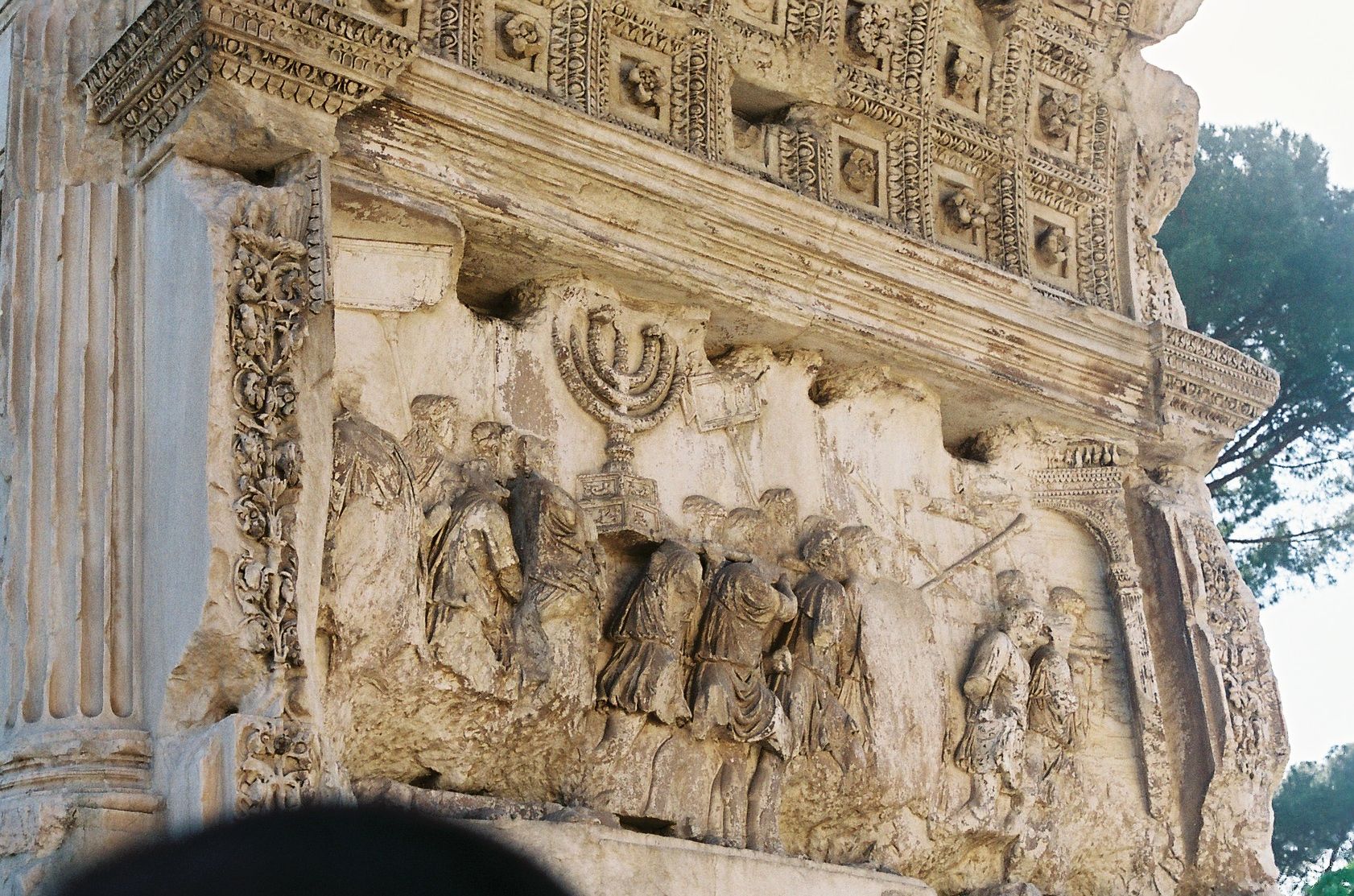
Titus' arch

Titus’ arch

Lent 2. 2014

John 3:1-17 (Genesis 12:1-4a; Romans 4:1-17)

Marian Free

In the name of God whose love embraces a world torn apart by violence, hatred, fear and greed. Amen.

During the week I came across a graphic description of the siege of Jerusalem in 70 CE. The author, Reza Aslan imaginatively recreates the turmoil and unrest of first century Palestine, the various revolts by “bandits” against the Roman rulers and how finally this ferment boiled over in the centre of the Hebrew faith – Jerusalem[1]. Aslan records the failure of successive Roman governors, the discontent of the people, the uprisings, the factions and the focus on Jerusalem and the Temple. Then he goes on to describe the callous ruthlessness of the Roman reaction.

When the Israelites expelled the Romans from Jerusalem, Vespasian was sent to quell the rebellion and restore order. Approaching Jerusalem from north and south, Vespasian and his son Titus retook control of all but Judea. In 68 CE Vespasian was distracted by the death of Nero and his ambition to fill that role. He abandoned the battle and returned to Rome where he was declared Emperor. The people of Rome were restless and Vespasian realized that he needed a decisive victory (or Triumph) to consolidate his hold on the office and to demonstrate his authority over the whole of the Roman Empire.

The revolt in Palestine provided the perfect scenario to show of what he was made. Vespasian decided not only restore order and reclaim authority in the nation, but to utterly destroy it – its people and, more particularly its God. To this end Vespasian dispatched his son Titus to bring the Hebrews to their knees. Titus set siege to Jerusalem, cut off the water supply and ensured that no one could go in or out. Those who did escape, he crucified in full view of the city. Slowly the people starved to death. They ate grass and cow dung and chewed the leather from their belts and shoes. Soon the dead were piled high in the streets, as there was nowhere to bury them. Titus needed nothing more for victory, but his task was to annihilate the people completely. His troops stormed the city, slaying men, women and children and burning the city to the ground so nothing remained[2].

The world doesn’t change. The situation of those imprisoned in Jerusalem in 70 CE is not too different from that of those in many parts of Syria in 2014. The city of Homs has been under siege for two years now. Its inhabitants – men, women and children – have lived on grass boiled in water and killed cats for food. Schools are shut, only one hospital remains open and there is no electricity or running water. Those who emerged during the recent cease-fire were gaunt and hollow-cheeked, often caked with dirt. No one has been excluded from the horror, not the elderly, the disabled or the very young.

Syria is perhaps the most graphic example of a world gone wrong, of the way in which human beings can inflict the most horrific suffering on their brothers and sisters and of the way in which our primal fears can boil over into violence and destruction. As the world waits with bated breath to see what will be the outcome of the strife in the Ukraine, we cannot overlook the fact that Syria and the Ukraine are not isolated situations but are the face of a world in crisis – a world which reveals the very worst that humankind can be. Even to begin to list the nations at war or in the grip of civil strife would take too long. What is more, our minds simply cannot encompass the scale of suffering on a global scale. War and civil strife are just one example of a world that bears no hint of a good creator God. When we add to that human trafficking, extreme poverty, corrupt or ineffectual government, we could be tempted to ask: “Is this the world that God loves so much that he sent his Son?”

The answer is of course a resounding “yes”!

Today’s readings remind us that God’s love is not restricted to a privileged few or to those parts of the world that are free from strife and turmoil. God’s love reaches out to include the whole world.

The biblical story of God’s inclusive love begins in Genesis with Abraham and Sarah (12:1-4a). When God calls Abraham, God’s intention is clear – it is to make Abraham the Father of many nations – “in you all the families of the world will be blessed”. Initially it appears that through Abraham, God has chosen a select group of people for Godself. Certainly that is how the story plays out for centuries. All the while though there are constant hints that God’s love extends farther and embraces those who do not belong to the family of Abraham. Consider the following for example. Rahab was an outsider, yet it was she who enabled the victory at Jericho and facilitated entry into the Promised Land. Ruth, the forebear of Jesus was not a member of the Hebrew nation. God relented and saved the Gentiles city of Nineveh (despite Jonah’s objection) and the Psalmist tells us that all nations will flock to Jerusalem. Even Cyrus the King of Babylon is called God’s “anointed”. It is clear that God’s love and attention was not focused on the children of Abraham alone.

Paul picks up on this theme in both the letter to the Romans (4:1-17) and the letter to the Galatians (3:3-9). It was, he informs his readers, always God’s intention to include all people within the ambit of God’s love. No one is privileged in God’s eyes, all are equally worthy of God’s loving attention. “God is the father of all of us (Rom 4:16).”

It comes as no surprise then to read the familiar words of John 3:16 “God so loved the world that he sent his only Son”.

God’s love in not (and never was) restricted to a limited few, to those who belong to a particular group or to those who behave in a certain prescribed way. God’s love doesn’t pick and choose and it certainly does not wait until the world is ready or worthy of that love. The Palestine to whom God sent his Son was far from an ideal microcosm of human existence – far from it. In the first century, the Hebrew people were compromised, conflicted and divided, their priests were, at best, servants of Rome and, at worst, men seeking wealth and aggrandizement. Despite all this, it was to such a broken and imperfect people that God chose to send his Son.

Nothing much has changed – the world that God loves continues to be a long way from perfect but that doesn’t stop God from loving. However unlikely it seems, however undeserving the world continues to be, God reaches out in love giving us the opportunity for salvation. What it takes is for us to respond, for us to choose light over darkness, salvation not destruction.

God so loves the world – how then should the world respond?


[1] Aslan, Reza, Zealot – the life and times of Jesus of Nazareth. New York: Random House, 2013, 60ff.

[2] Vespasian’s Triumph, the procession of slaves and spoils of war were immortalized in the arch which can still be seen in Rome today.

The world God loves.

Devastation in South Sudan

Devastation in South Sudan

Riots in Egypt in 2013

Riots in Egypt in 2013

Syrian refugees lining up for food Syrian refugees lining up for food

Destruction of HomsDestruction of Homs

Perfect has no part measures

February 15, 2014

Epiphany 6 – 2014

Matthew 5:21-32

Marian Free

In the name of God who loves us and expects us to share that love with others. Amen.

There used to be a playground chant used as a response to teasing or insult. I’m sure that most of you know it: “Sticks and stones may break my bones, but words will never hurt me!” I imagine it was a jingle that was taught to children by people who wanted to build their resilience and I suspect that it worked at least to some extent. That is, it taught children not to let negative comments get under their skin, but to treat them as something superficial, to have such a solid understanding of their worth as a person that the taunts could run off their back. If the child in question felt that they had been heard, the advice would have assured them that someone was on their team, recognising that the attacks were not warranted and giving them a strategy for coping[1].

The problem with the statement, “words will never hurt me” is, that in a great many cases, it is not true. Words can do as much, if not more, damage than physical attack and they leave wounds that are not immediately obvious to others – and sometimes not even to the victim.

Children who are constantly demeaned by the adults in their lives or taunted by their friends, can develop a sense of self-loathing that is difficult to turn around. Women and men who are constantly put down by their partners begin to believe that they are in fact worthless. In many cases, broken bodies heal with the proper attention, but broken minds and hearts can go unattended, often with disastrous consequences.  Thanks to social media we cannot ignore the devastating effects of on-line harassment which tragically has led young people to take their own lives. I can’t even imagine what the consequences of the current practice of “shaming” young people will have on their future lives and development.

Jesus, without the benefit of modern psychology seems to know intuitively the power of words to hurt. You have heard it said: “You shall not kill, but I say to you whoever calls their brother or sister “fool” will be liable to the Gehenna of fire.”

In this rather long selection from the Sermon on the Mount, Jesus is addressing the radical love that being his follower demands. In a series of anti-theses, “It was said – but I say,” Jesus takes the teaching of his day one step further. It is not sufficient, he suggests, to do the bare minimum. True love does not demean another person, real love is not limited to those who love us back, love that is real seeks reconciliation not conflict. Love is based on an authenticity that does not need to swear on anything, because it is always truthful.

When we think of the Sermon on the Mount, we tend to think only in terms of the beatitudes. However, the way in which Matthew has arranged his material extends the sermon from what we know as the beginning of chapter 5 to chapter 7:28. Within this section, verses 5:21-48 consist of a series of six anti-theses of which three are included in today’s gospel reading. These six anti-theses are divided into two groups of three 21-32 and 33-48. What links these six together – apart from their common structure – is the commandment to love which is implied throughout and stated explicitly in verse 43. In verse 48, Jesus’ hearers are exhorted to “be perfect as their Heavenly Father is perfect.” This conclusion makes clear that Jesus is demanding his followers to go above and beyond duty and law and to try to emulate the perfect love of God.

Throughout this section of the sermon, Jesus uses the formula: “you have heard that it was said to those of ancient times” – or an abbreviated form of the formula. It is difficult to say with certainty to which authority Jesus is referring. As there few are exact quotes Jesus could be referring to the Old Testament, to the oral tradition of the Jewish people or to the teaching of the Pharisees. One commentator, Luz, argues that on the basis of the content and the language of the sayings that the content refers to the Jewish scriptures. This, Luz argues, is consistent with Matthew’s overall view that Jesus fulfills or completes the scriptures. That does not mean that Jesus contradicts or rejects the Old Testament scriptures but rather that he expands and breathes new life into precepts that were always true. In other words Jesus rewrites what he has inherited in such a way as to bring to fulfillment or completion their true purpose.

Jesus begins with what is the only explicit quote from the Old Testament: “You have heard that it was said to those of ancient times, ‘You shall not murder’; and ‘whoever murders shall be liable to judgment.’” He then goes on to list five antitheses to this statement. In other words, Jesus takes one of the commandments (slightly expanded) and demonstrates how different it looks with love at the centre – or when a lack of love is replaced with love.

Jesus follows the commandment with three negative examples of unloving behaviour, examples of not keeping the commandment. He points out that anger and name-calling are not expressions of love. They can be just as damaging and hurtful as physical violence. He continues with two positive examples of being loving (keeping the commandment) – making peace with a fellow believer who is angry at you and coming to an agreement with someone who is taking you to court. Jesus is insinuating that while not loving is as bad as murder, loving leads to reconciliation. In other words, nothing less than unconditional love and respect fulfills the sixth commandment.

In these anti-theses, Jesus takes the law to its ultimate goal. By making clear the intention of the commandment, he introduces a radical law that is free of compromise. One is either loving or one is not.

It is relatively easy to keep the letter of the law: do not kill. It is much harder to live in such a way that no one is ever hurt by a thoughtless word or a deliberate barb. Until we are perfect, as our Heavenly Father is perfect (5:48), we must accept that our behaviour falls far short of the law, that the standard set by Jesus is one that we may never reach and that we must never judge another or consider ourselves better than another.

Perfect has no part measures.


[1] A quick look at my Facebook account tonight had two posts that I was tempted to use as examples – one on the top twenty things to say and another about breastfeeding. The latter posted on upworthy reminded me of a great response to bullying by a American broadcaster who received a nasty emai about her weight.

Shepherds and sheep

September 7, 2013

Pentecost 16

Luke 15:1-15

Marian Free

 In the name of God who will not be bound by human convention or constrained by human wisdom, and whose love extends to all. Amen.   

When we were in Tanzania, we observed the local Masai herdsmen (often children) herding their sheep to pasture in what seemed to be a harsh and unforgiving land. Each person had somewhere between ten and twenty sheep and they were kept together with a switch. I don’t know, but I assume the loss of one sheep due to carelessness would have been a serious matter when the total number was so low.

How different from the Australian experience! When I was young I visited a sheep station that was 100 square miles in size. The boundaries were fenced as were the interior paddocks – no opportunity for sheep to wander off. Shepherding was required only when it was time to move the sheep from one pasture to another and then it was done from the back of a motorbike – no switch and no personal relationship between shepherd and sheep. I can no longer remember how many sheep the landowner stocked on the property, but I clearly remember a delivery of sheep. A double, two-layer sheep trailer disgorged its contents in front of us – probably in the vicinity of two hundred sheep. In the crush of the transport one had died. The farmer immediately took out his knife and skinned it in front of us. Before our holiday had ended, that sheep had contributed to at least one evening meal. When such large numbers of livestock are involved, there is no room for sentimentality. Pragmatism rules the day.

But back to our Tanzanian experience which is a much better illustration of today’s parable. Small herds are not only more precious, they are better able to be cared for in a more intimate way. There is no need for them to be herded on to freight trains or abandoned to their own devices far from the homestead. Small herds can be protected from wild animals which Australian fences do not deter and it is easy to recognise when one is missing. Every evening the animals are returned to the village where they are contained behind a fence in the centre of the huts so that they will be safe until morning. Every morning they are taken from the pen to once again find pasture.

From what we can gather, herding in Jesus’ day was similar to that of the East African experience. There were some notable differences. The Palestinian herdsmen didn’t necessarily return to a village in the evening (think of the shepherds to whom the angels relayed the news of Jesus’ birth). Instead, crude walls out of stones were made in the pastures to protect the livestock from predators. These sheepfolds seem to have been ad hoc structures – in any case, they were constructed without a gate. In the evening, the shepherd would herd the animals into the enclosure and then lie in front of the opening so as to be able to prevent wild enemies from entering. The shepherds may have built fires for warmth and added protection, but all that kept the animals safe from harm was their shepherd’s ability to aim a sling or to otherwise deter or frighten off an attacker.

Seen from the perspective of shepherding in Israel, Jesus’ parable about the lost sheep is far from a benign, feel good story. Jesus’ audience would have justifiably been shocked and outraged. What sort of shepherd abandons ninety-nine sheep to the wolves in order to go off and search for one that is missing? Wolves or hyenas could cause far greater loss to the shepherd among ninety-nine unprotected sheep, than to one isolated sheep. In other words, for the sake of the one, the shepherd is risking several, if not all, of the others.

You can almost hear the gasps of Jesus’ listeners – the Pharisees, the tax collectors and the sinners. They are not herdsmen, but they have some idea of animal husbandry – even the biggest cities of Palestine are not far from the countryside. Is this shepherd crazy they must be wondering? What is one sheep when you have ninety-nine safe and sound? It gets even worse.  Not only does the shepherd abandon those sheep which have kept close to him, but when the shepherd recovers the sheep which has strayed, he calls all his neighbours over to rejoice with him. Surely that is an over reaction. A party for a lost sheep?

Jesus has almost certainly caught the attention of his listeners. They are probably beginning to wonder what sort of meaning he can draw from the story. How can he use a story about a lost sheep to defend eating with tax collectors and sinners which, in the eyes of the Pharisees breaks the codes of purity and implies that he overlooks their obvious sinfulness. What they have not realised is that the story is a not so subtle attack on their own arrogance and self-satisfaction and a challenge for them to re-assess their understanding of God. Jesus piques their interest and then he goes in for the kill. This is what heaven is like he says. God (we are to suppose) seeks out not the upright, not the law-abiding, but those who have strayed. The people whom the Pharisees despise, exclude and denigrate are the very people whom heaven will seek out and rejoice to welcome home.

What a slap in the face that must have seemed to the Pharisees.  From what we can tell these righteousness and law-abiding people, believed that behaviour set them apart from those around them and assured them of a place in heaven before all others. Jesus’ story about the lost sheep is an affront to everything they had been led to believe and it was a direct attack on their attitude towards those who didn’t achieve their high standards of behaviour. They think that entrance into heaven is something that has to be earned by keeping the law, by prayer and by fasting, that God has particular standards that people have to reach before God will grant them salvation. At the same time they are so sure of that they are right that they have made themselves both judge and jury of the behaviour of others. Anyone who doesn’t conform to their standards is, they believe, automatically excluded from the heavenly realm.

Jesus puts the lie to that belief. Contrary to God’s abandoning and turning his back on sinners, God does what for the Pharisees is unthinkable – God seeks out those who are lost and takes more pleasure in the return of a sinner than in those whose very goodness leads them to forget how much they need God and who believe that their righteous behaviour sets them apart from and above everyone else.

There are times in our lives when we wander from the path, and when we do, God seeks us out and brings us home rejoicing. At other times we find ourselves safe and secure in the fold. At such times it is important that we remember the love sought us out and that we do not begrudge the fact that God extends that love to those who in the present are lost. Having been found, it is important that we do not allow ourselves to be smug or self-satisfied, that we do not think that we better or more worthy than others. We are all beneficiaries of God’s love and we are all dependent on God’s forgiveness. God’s loving forgiveness seeks us out, overlooks our faults, restores us to the fold and welcomes us with rejoicing into the realms of heaven.

Forgiven and free to love

June 15, 2013

Pentecost 4 – 2013

Luke 7:36-8:3

Marian Free 

In the name of God whose unconditional love sets us free to love. Amen. 

Long before I saw Les Miserable the musical, I happened upon a non musical version of the story. From memory, I came in at the point at which the priest, having offered hospitality to an ex-convict, was faced with this same man whom the police had dragged back because they had found him with silver that could only have come from the priest’s household. The priest knew that the silver was stolen, but instead of expressing outrage, he corroborates Valjean’s story that the silver was a gift and compounds the lie by adding to stolen goods two candlesticks insisting that Valjean had forgotten to take them.

At the time I didn’t know the beginning of the story. That scene depicted such an unexpected act of generosity, understanding and hope that I will never forget the impression that it made upon me. Jean Valjean had stolen the silverware and yet the priest the not only over-looked the theft and corroborated Valjean’s story, but he added to the treasure. In such circumstances we might perhaps expect the priest to offer forgiveness, but to extend such generosity without any expectation of restitution takes us by surprise and forces us to question whether we would be so forgiving or so generous.

Of course, this is a fictitious tale, so let me share with you a true story. Some of you will recall that in 1998 a young nurse, Anita Cobby, was abducted, gang raped and left by her attackers to drown. After the perpetrators were arrested, Anita’s father Garry Lynch went to the local RSL where he thought he would the father of two of his daughter’s assailants. He knew that the man worked there, that he was believed to be doing a good job and that he was well liked. In his own words, Garry says: “I went up to him and I just held my hand out and I said, ‘Look, I want to say to you that we hold no responsibility on you whatsoever for what your sons did.’  And he just grabbed my hand in his two …. in tears … and there was just a silent interchange.”

I could tell you dozens of such stories of people who find it in their hearts to forgive the most horrendous acts and who are somehow are able to get on with their lives.

I could tell you too of those who allow their indignation and outrage to get the better of them in lesser or similar situations. Those who, like the crowds who recently gathered outside the court on the day the young man accused of rape and murder, were not only angry but who had hung a noose over the branch of a nearby tree. This sort of lynch mob mentality is, thankfully, not common, but it does expose a desire to take justice into our own hands and an unwillingness to see the ugliness in oneself and the humanity in another.

Those who hold on to their indignation and their grief fail to see that it reveals as much about their own hardness of heart and their own self-righteousness as it does about the person who committed the offense against them.

Why is it that a father whose daughter was brutally murdered offers forgiveness to the perpetrators, whereas a crowd who know neither the victim nor the accused are filled with vitriol and hate?

I believe that the difference is faith. Faith not only gives us strength and support in times of trauma, but it gives us a different perspective on things. As Christians we know that we are not perfect but we are forgiven – even though we have done nothing to deserve such forgiveness. Knowing ourselves forgiven and loved, we are better able to extend such love to others. Knowing God’s generosity towards us, we are able to be generous in our attitudes towards others. Knowing that God understands our weakness and frailty, we are more willing to understand the weakness and frailty of others.

Jesus makes it clear that none of us is perfect. We are all in need of forgiveness. Imperfection is imperfection – there is no hierarchy – we are either perfect or we are imperfect. Nearly perfect is not perfect. If no one is perfect, then everyone is imperfect. If everyone is imperfect, then everyone – whether they have sinned greatly or only a little – is in need of God’s forgiveness.

This is the point of today’s gospel. Simon, believing that he in some way is better than the woman, judges her and finds her wanting. He is surprised because he thinks/expects that Jesus should do the same. He has failed to understand that if Jesus were to mix only with perfect people Jesus would not be dining with him. Simon’s sense of his own righteousness leaves little room for him to understand that the woman is worthy of Jesus’ attention. He is mean and narrow in his view of others because he has failed to identify his own shortcomings.

In response to Simon’s judgmental attitude Jesus tells the parable about forgiveness forcing the Pharisee to acknowledge that those who are forgiven more, love more. Those who know themselves forgiven, accepted and loved cannot help but extend that love, acceptance and forgiveness to others.

God did not and does not wait until we are perfect before God extended his all-embracing and unconditional love. When we truly understand that we will be overwhelmed by God’s boundless generosity. When we truly understand our own need for forgiveness, we will be hard pressed not to extend forgiveness to others. When we truly accept that we ourselves are not perfect, we will be more willing to accept imperfection in others.

I’ve said it before and no doubt I will say it again: “There is nothing we can do to make God love us more and nothing that we can do that can make God love us less.” If that doesn’t challenge us to share that love with the world, to extend God’s forgiveness to others, then we just don’t get it and as Paul said: “Christ died for nothing”.

No easy love

April 27, 2013

Easter 5 2013

John 13:31-35

Marian Free 

In the name of God who loves freely and abundantly and ask that we do the same. Amen.

I’m sure that many of you will remember the first record, cassette tape, CD or iTunes that you ever owned. I was nine years old, not tall enough to see over the counter when my mother bought my first record. It was the year that the Beatles had come to Brisbane and I was determined to be part of the action. All I wanted that Christmas was a record by The Beatles. My mother duly took me to a record store in the city where she naively asked for a Beatles record. Of course the shop assistant asked: “which one?” The nine year old Marian could only respond: “one with ‘yeah, yeah, yeah’” – that being all that came to mind. So it was that for Christmas that year I was given the EP with She loves you, yeah, yeah, yeah, on one side and something like All you need is love on the reverse. The sixties were all about love and peace.

The beatniks and hippies preached love not war and even the Christians got on the bandwagon with car stickers and other paraphernalia covered in flowers and proclaiming: “God is love”. Love and peace were the counter-cultural response to the establishment and especially to the war in Vietnam. The spirit of the age was one of flower power, communal living, non-violent resistance and John Lennon’s famous love-in.

Love, or the promise of love is very seductive. Studies have shown that infants and children need love to grow up feeling strong and secure. Those who do not receive the affection that they crave often go to all kinds of extremes, even criminal behaviour, to get that attention. Apparently, negative attention is better than no attention at all. Worse still, I’m sure we can all think of awful crimes have been committed by people whose need for affection is so great that they allow themselves to be led by their spouses or their friends to do horrendous things that they know to be wrong.

Because love is so essential to our well-being, it is also a powerful force for change. Sister Helen Prejean recounts her journey with Matthew Poncelet, a man sentenced to death for his part in the rape and murder of a young couple. Despite the heinous nature of Matthew’s crime, the fact that he is a particularly unattractive person and the fact that the wider society and in particular the victim’s families cannot understand her position, Helen persists not only in her relationship with Matthew but also in her public opposition to the death penalty. The movie Dead Man Walking, is a reasonably accurate retelling of Helen’s story. She recounts that it is thirty minutes before midnight, the time of the scheduled execution when she finally witnesses a break through in her relationship with Matthew. All of his defenses come tumbling down when he comes to understand that despite all that he has done and the terrible nature of his crime, God loves him.

Helen’s love and persistence have broken through Matthew’s outer shell of defiance and defensiveness. In the safety of that love, Matthew can finally admit that he did rape the young woman and that he did kill her boyfriend. At that moment he takes full responsibility for his actions and stops blaming of his co-accused for the offense. His acknowledgement of his guilt and his acceptance of God’s love do not save his physical life, but his life is saved none-the-less, for in that moment he becomes fully the person God intended him to be and he opens himself to the fullness of God’s love.

The love that Helen showed Matthew is quite different from that so easily proclaimed pop songs. It is a love that is demanding, difficult and often time-consuming. It draws on all our resources and can earn the disapproval of society and even of our friends. Helen’s love for Matthew was fueled by her love for God, her belief that all people – even those most despised by society – are created in the image of God, and her conviction that when we are commanded to love, we are commanded to love everyone, not just those whom we choose to love or those who are easy to love.

Jesus’ command is to love one another as he has loved us. “I give you and new commandment, that you love one another. Just as I have loved you, you also should love one another.” In order to fully understand this commandment we have to fully grasp the nature of Jesus’ love, which is also God’s love for us. Jesus’ love began with his ability to be vulnerable. From the cradle to the grave, Jesus demonstrated that he did not need to be in control. He trusted life itself to those whom he loved. At great cost to himself, he allowed others responsibility to make their own mistakes – even when the mistake was to betray him. Jesus’ love demonstrated complete acceptance of other people. Whether they were his disciples, the tax collectors or a variety of other sinners, Jesus accepted them as they were. No one was outside his love.

At the heart of Jesus’ love was forgiveness – whether it was the woman caught in adultery, Peter who denied him, the thief crucified with him or those who nailed him to the cross, Jesus was able to put their misdeeds behind him and restore their relationship with himself. Jesus’ love was also risk taking. In choosing to love everyone, Jesus dared the disapproval of the establishment. By including everyone in his love, Jesus offended those who wanted to exclude people who didn’t fit their criteria of goodness or acceptability. By associating with outsiders, Jesus caused offense to those who wanted to determine who belonged and who did not. By extending his love to all, Jesus risked rejection, hurt and betrayal and still he loved without reserve.

Jesus’ command to love is much harder than it appears –  keeping the Ten Commandments is easier. The command to love as Jesus loved insists that we keep our own egos in check, that we suspend our tendency to evaluate and judge the behaviour of others, and that we understand that our standards and expectations are not necessarily God’s standards and expectations. It means that we must love with no thought of that love being returned, that we should not withdraw our love no matter what the loved one does or does not do and that we should overlook continually another’s flaws and betrayals. This sort of love is not trite or superficial emotion; it involves the will as well as the heart.

The context of John 13 is very specific. Jesus is speaking to the disciples, to community of faith, to us. In today’s churches we have very few opportunities to demonstrate our love for one another. We do not rub up against each other in the way that we might if we had to spend more time together. This makes it hard to demonstrate our discipleship of Christ by our mutual love, understanding and support for one another. That said, the wider church is far from being a model of Jesus’ love. It is a broken and fragmented body, torn apart by differences of opinion, a desire to be in control and an unwillingness to tolerate difference. If the world is to know Jesus by our love, we need to work harder to trust each other, to encourage each other and build each other up. We need to learn to value diversity, to welcome debate and struggle together to understand the love that Jesus showed, so that we can put that love into practice. It is not necessary that we be the same, or even that we agree, just that we love.

As Leunig says: “Love one another. It is as easy and as difficult as that.”

Contradiction

March 2, 2013

Lent 3 – 2013

Luke 13:31-35 (Isaiah 55:1-9, 1 Cor 10:1-13)

Marian Free

In the name of God who turns our expectations upside down, who challenges and comforts us and who never, ever withdraws God’s love. Amen.

When you read the Bible, what are the passages that stand out for you? Are you more alert for the voice of judgement or the voice of love? Do you look out for the rules that you must not break and the specific directions that you must follow, or do you instead seek out the promises of growth and new creation? From start to finish, the Bible is full of contradiction.  In it we find both censure and approval, judgement and forgiveness, punishment and redemption, restraint and extravagance.

The Old Testament prophets threaten the Israelites with all kinds of penalties if they refuse to return to God then, almost without taking breath, they assure the people that God will never abandon them. Side by side in Isaiah, Jeremiah and Hosea and elsewhere we have evidence of God’s frustration and confirmation of God’s faithfulness. The Gospels express similar contradictions. Calls to repent are balanced by stories of the lost being restored. Jesus’ attacks on the righteous throw into relief Jesus’ acceptance of those outside the law.

This morning’s readings are a case in point. The generosity and free-spirited invitation of Isaiah 55 stands in stark contrast with the harsh, judgmental and condemnatory sentiments of 1 Corinthians 10.

How are we to make sense of the paradox – judgement and repeal, condemnation and forgiveness, law and freedom? It is my belief that both sides of the coin are necessary to sustain healthy individuals, healthy societies and healthy religions. Freedom is essential for creative energy to thrive, for people to love and be loved, for compassion and generosity. None of these things can be forced or legislated. On the other hand, lawlessness leads to disintegration, violence and repression. Without some sort of law no one can achieve their full potential.

There needs to be some sort of balance between law and freedom.  It is not healthy to be completely unrestrained, but neither is it good to be so restrained that we forget how to live. If we fence ourselves in with rules, we reduce our ability to be spontaneous and carefree. Somewhere in the middle is an equilibrium, an ability to self-regulate, to use the rules and the threats of judgement to control our baser instincts and to trust in God’s goodness and mercy to liberate our finer, more selfless characteristics.

Interestingly, in the Bible, it is not disobedience or even the breaking of the Ten Commandments which is the source of God’s anger and the pre-condition for punishment. What causes the prophets to proclaim God’s judgement and Jesus to condemn the people of Israel is a breakdown in the relationship between the people and God.

God doesn’t expect perfection. That much is clear in God’s choice of Jacob the deceiver, God’s selection of Moses the murderer and God’s continued love for David the adulterer. That God is not looking for flawless followers is demonstrated by Jesus’ choice of disciples, Jesus’ readiness to forgive and Jesus’ easy acceptance of tax collectors and sinners.

It appears that the primary safeguard against condemnation is not so much to be law-abiding (though that is good), but to accept God’s invitation to be in relationship, to trust God’s offer of a covenant, to believe in God’s faithfulness to God’s promises.

Jesus weeps over Jerusalem, not because its citizens have failed to keep the law _ if nothing else, the Pharisees were assiduous keepers of the law.  Jesus weeps because the people of Jerusalem, the leaders of the Jews, have demonstrated their inability to put their trust in God. The Pharisees, Chief Priests and Scribes have put all their trust in the law and their ability to keep the law. They are so sure that they can achieve perfection by their own effort that they have effectively locked God out of their lives. They have so little confidence in God’s love and faithfulness that they are using the law to paper over their imperfections. They are so afraid that scrutiny will find them wanting that they kill the prophets who hold a mirror to them and to their lives. They cannot have a real relationship with God because they cannot have a real relationship with themselves.

No wonder Jesus weeps, he understands that the Jerusalemites are so sure that God cannot love them as they are, that they not only try to become what they are not, but worse, they shrink from God, they refuse God’s invitation and will not be drawn into God’s loving embrace.

How different they are from Zacchaeus who has the courage to respond to Jesus’ invitation and who finds that his life is transformed as a result. How different from the woman who anointed Jesus’ feet, who could take such a risk because instinctively she knew that she was loved and accepted. “Law-breakers” and outsiders who already knew and accepted their imperfections welcomed Jesus’ love and invitation, entered into a relationship and allowed themselves to be gathered under his wings.

Law and freedom together create a necessary life-giving tension in our relationship with God. An over-reliance on law can have the effect of locking God out of our lives whereas an over-emphasis on freedom can lead us to believe that we don’t need God. It is important to relish our freedom, but to understand its bounds, to trust in God’s unconditional love, but not to use that love as an excuse to be unloveable, to recognise that law has its place, but not to use it as a replacement for relationship.

God invites us into a relationship that is based on mutual trust and respect. God offers us an unconditional love that sets us free to be ourselves. To say “yes” to God, is to say “yes” to ourselves and to know ourselves welcome in the shadow of God’s wings.