Posts Tagged ‘Mary Magdalene’

Loving and letting go – Mary Magdalene

July 24, 2021

Mary Magdalene – 2021
John 20:1-18
Marian Free

In the name of God who frees us from the grief and pain of the past and who sends us to proclaim hope to the world. Amen.

I was so lucky! Imagine being able to spend seven weeks overseas with not a care in the world. You will remember that in 2018 I was fortunate enough to spend seven weeks in Europe for my long service leave. As part of that holiday, I had two weeks in Florence. Before travelling I met with David Henderson who has lived in Italy. He told me what would be his top five places to go, things to do. I was so grateful, it meant that instead of trying to fit everything in, I could focus on just a few special experiences and do the remainder if I had time. One of his suggestions was that if I did nothing else that I should see Donatello’s Mary Magdalene in the Museo dell’Opera del Duomo.

I am so grateful. The Penitent Mary Magdalene has a room to herself and is so extraordinary and so moving, that, had there been a chair, I could have spent half a day contemplating the figure. As it was I was so moved that finally I had to tear myself away. I have included a photograph in the Pew Sheet, but it is hard to do her justice. Donatello has carved a figure that is utterly bereft, completely desolate. His image is of a woman who is so stricken with grief, that she has lost all sense of pride. She looks haggard, her hair has grown to her ankles, teeth are missing, and she looks as though she has been wandering around the countryside, living in the open .

The idea of a penitent Mary stems from end of the 6th century when Pope Gregory 1 made the association between Magdalene and the sinful woman from the street who anointed Jesus’ feet (in Luke 8). There are many reasons why these cannot be the same woman. It is true that we are told that Mary Magdalene was the one from whom 7 demons were cast out but that suggests that she was suffering from a physical ailment or a mental illness, not that she was making her living from prostitution. Mary was among the women who supported Jesus from their own incomes, she was at the foot of the cross when all the disciples had fled and, as every gospel records, she was at the tomb early in the morning of the third day. That Mary’s role in the ministry of Jesus was remembered (at a time when women were being written out of the story) is indicative of the role that Mary went on to play in the early church. This is further supported by the fact that Mary is mentioned in the Gospel of Philip in which Jesus is said to have shared secrets with her and to have kissed her on the lips.

The Biblical Mary is someone who has been empowered by Jesus, not someone who was overwhelmed by guilt. Indeed, Mary is often called the “apostle among apostles” as it was Magdalene who was commissioned by Jesus to tell the disciples that he had risen from the dead . For this reason, it is impossible for me to marry the Mary that I know, with the Penitent Mary popular with artists in the 15th and 16th centuries.

When I saw Donatello’s sculpture, I knew only that it was his Mary Magdalene, and it is only in preparing for today that I discovered the ascription “Penitent” given to the sculpture by the artist . It was because I knew the Mary of the New Testament that Donatello’s Mary spoke to me of grief and not of penitence, of despair and not of guilt. In fact, for me Donatello’s Mary comes straight from this morning’s gospel. Mary has come to the tomb alone. Having discovered that Jesus was not there she has run and told Peter and the disciple whom Jesus loved. They ran to see for themselves and, having seen, returned to their homes.

Mary stayed, weeping – utterly alone, utterly disconsolate. It is this desperate grief that I see in Donatellos’ sculpture – a woman who has lost, apparently forever – someone who had loved her and affirmed her and whom she had loved in return. This Mary knew that nothing would ever fill the void that filled her heart at that moment. Her life, which for a time had had meaning and purpose at this moment stretched out, empty, before her. Now, even his body had gone. Now there was no grave, no place where she could go to mourn him.

Lost in her thoughts and overwhelmed by sorrow, Mary could not recognise the risen Jesus until he called her name. Then, apparently fearing that she would lose him for a second time, Mary – physically or metaphorically – clung to him. But the future that she imagined cannot be. Jesus tells her to let go. He must leave and she, Mary must take on a new role – that of apostle, one sent by Jesus to spread the gospel.

Our story is very different from that of Mary, but over the last twenty months we have said good-bye to many of our hopes and dreams, we have endured separations from those whom we loved, some of us have experienced financial hardships and all of us find ourselves facing a future that is very different from that which we had expected. Our lives will never be the same but, like Mary, we cannot cling to the past, we cannot put our lives on hold, hoping that they will return to what they were. We must move forward, impelled by our faith and confident that Jesus, our risen Saviour goes before us, having faced his own demons, experienced the worst that life can throw at him and come out triumphant on the other side.

Grief is a natural response to loss, but we cannot allow it to hold us forever in its grip for none of us know what the future may hold.
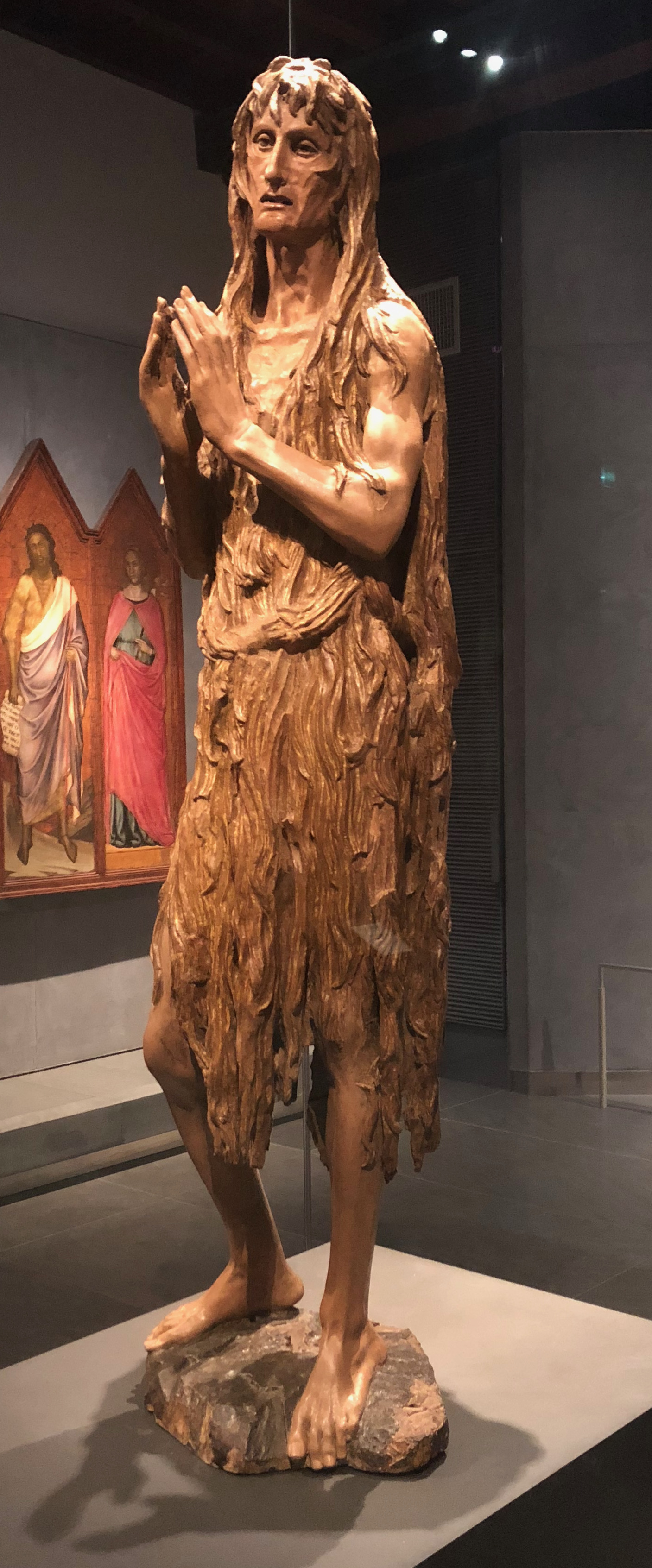
Penitent Mary Magdalene, Donatello, Museo dell’Opera del Duomo

From being unknown to being knownm

July 20, 2019

The Feast of Mary Magdalene – 2019
John 20:1:18
Marian Free

God of boundless love whose ways are not our ways and whose thoughts are not our thoughts. Amen.

In the 7th century, Pope Gregory the First made the assertion that Mary Magdalene was a prostitute. He came to this conclusion by conflating Magdalene with Mary of Bethany who anointed Jesus’ feet before his death. In turn, Mary of Bethany was confused with the unnamed ‘sinful’ woman of Luke who interrupted a dinner party in order to anoint Jesus’ head. The problem (apart from the fact that there is no reason to think that these three women are one and the same) is, that even if Magdalene could be proven to be the ‘sinful’ woman who anointed Jesus, we are not provided with a single clue that would allow us to draw a conclusion about the nature of that woman’s sin. There is nothing in our gospels, except perhaps the suggestion that Mary was a woman of independent means, to suggest that she was a prostitute. Yet, despite the lack of evidence, it has been almost impossible for Magdalene to shake that image and for centuries Mary has been depicted as a prostitute in art and in commentaries.

Indeed, our biblical evidence for Mary Magdalene is scarce. That said, she is mentioned by name on twelve occasions which is more times than any of the apostles are mentioned! She presumably came from Magdala and, according to Luke, she was one of the three women who provided for Jesus out of their own resources (8:2-3) and one from whom seven demons had gone out (cf Mark16:9). All four gospels agree that Magdalene was one of the women who went to the tomb on the first Easter Day and that with them she was commissioned to tell the disciples (who were men) that Jesus had risen. In John’s gospel, Mary’s role is even more significant. She goes to the tomb alone, and it is to Mary, and only Mary, that Jesus speaks and commissions. Mary’s place in the gospels then, and especially her position in the Gospel of John, implies that (whatever her demons may have been) she had a leadership role in the early community.

This view is supported by the position that Mary is given in the non-canonical writings – the most tantalising of which is the Gospel of Philip. In these books Mary’s closeness to Jesus is a cause of tension with other disciples – in particular with Peter. We read: “For it is by a kiss that the perfect conceive and give birth. For this reason we also kiss one another. We receive conception from the grace which is in one another.

There were three who always walked with the Lord: Mary, his mother, and her sister, and Magdalene, the one who was called his companion. His sister and his mother and his companion were each a Mary.

And the companion of the [Lord was?] Mary Magdalene. [He?] loved her more than all the disciples, and used to kiss her often on her [mouth?]. The rest of the disciples said to him “Why do you love her more than all of us?” The Savior answered and said to them, “Why do I not love you like her? When a blind man and one who sees are both together in darkness, they are no different from one another. When the light comes, then he who sees will see the light, and he who is blind will remain in darkness.”

Here and elsewhere we are told that Mary is not only given information that is given to no other disciple, but that she is particularly intimate with Jesus. The closeness of the relationship between Mary and Jesus (both in the non-canonical writings and in today’s gospel reading) has led some scholars to speculate that Mary and Jesus were married. They suggest that the wedding at Cana was in fact the celebration of the marriage between Jesus and Mary. Why else, they ask, would Mary the mother of Jesus, take such an interest in the catering and presume to have authority to instruct the servants? (No one – even today – would presume to give orders to another person’s staff and a woman in the first century had no authority, let alone in the home of someone else.)

Magdalen’s role as the apostle to the apostles in John’s gospel and her significant place in the synoptic gospels, along with the references to Magdalene in the Gospel of Philip and elsewhere combine to suggest that Mary had a significant leadership role in the early community and a closeness to Jesus not extended to anyone else. It would have been easy for the gospel writers to exclude her from the story or to downplay her part in the resurrection appearances. By the time the gospels were being written the place of women in the Christian community was being substantially diminished (but that is a story for another day). The gospel writers could have easily named members of the twelve disciples as the first to see Jesus and as those who were commissioned to tell the others of the resurrection. That Mary retains this role in the gospels suggests that her position within the community and her contribution to the life of the community was such that the memory of her was still strong and that any attempt to write her out of the story would have been met with resistance.

Of course, we will never be able to properly separate fact from fiction or speculation from evidence, but there are some things that we can say with some certainty. Mary, who was possessed by seven demons, was set free. Having been set free, she not only followed Jesus, but she supported him financially. Alone, or in the company of others, Mary went to the tomb on Easter Day, and alone, or as one of three, she was instructed to proclaim the resurrection to the disciples. She journeyed from darkness to light, from exclusion to inclusion, from being unknown to being fully known, from being held captive to demons to being captivated by Jesus’ love and from being no one, to being the bearer of the good news.

Being in relationship with Jesus is life-changing. We too are brought from darkness to light, from the outside to the inside, from isolation to relationship, from captivity to freedom and ignorance to proclaimers of the gospel.

Faith is both a privilege and a responsibility. We are called into a relationship and sent out to share the good news.

What matters is that Christ has risen!

April 14, 2018

Easter 3 – 2018

Luke 24:36b-48

Marian Free

[1]

                           Four not one

In the name of God who, through Jesus, raises us to newness of life and empowers us with the Holy Spirit. Amen.

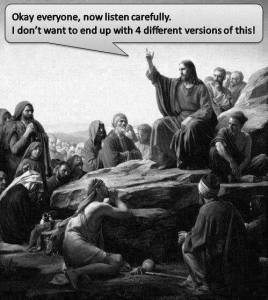
This Semester I am teaching a subject entitled the Synoptic Gospels. The course entails looking at the first three gospels to try to discern what each author is saying and why they chose to order their material in a particular way. We ask: what was it about the author’s own experience and the needs of his community that led him (we are fairly surely that the gospels were written by men) to construct the story of Jesus in the way that they did. The question of four gospels is one that has led skeptics to deny the validity of the gospels and pious believers to come up with a variety of different explanations for the differences. An explanation that I was given as a teenager was that if four different people witnessed something (a traffic accident for example) they would all report the story somewhat differently. Each eyewitness would have observed the scene from a different point of view and would have come to their own decisions as to what happened.

In reality it is unlikely that any of the evangelists were eyewitnesses to the life of Jesus.[2]We believe that the earliest gospel to be written was the gospel of Mark and that it dates to the late 60’s or early 70’s. Matthew and Luke were probably written in the next decade. Until then the early believers had been happy to use the Old Testament as their scriptures and to rely on oral tradition (and maybe the letters of Paul) as their source for the teachings of Jesus. (In fact there were some like Papias who believed that the oral tradition was more trustworthy than anything that could be written down because it was “first –hand”).

At around the time Mark’s gospel was written there were a number of differing forces that led to a desire to capture the stories of Jesus in a more permanent way. The Christian movement was becoming more and more dislocated from its roots with the destruction of the Temple and the spread of the faith into a Gentile environment. The death of the first generation of believers gave an added urgency to the task of capturing Jesus’ story. It was felt that a record should be made while there was still some connection to Palestine and before the memories became more than second-hand.

For the first forty years after Jesus’ death years, the stories of his life and teaching circulated orally. They would have been told differently by different story-tellers and have been given different emphases depending on the context in which they were told. (It is remarkable that we have only 4 gospels and not 400!)

It is not surprising then that we have several different accounts of the resurrection. Mark’s gospel (as we saw on Easter Day) leaves us up in the air telling us only that the women saw Jesus but were too afraid to tell anyone. According to Matthew the women see Jesus at the tomb and are sent to remind the disciples to return to Galilee where Jesus commissions the disciples to make disciples of all nations. Luke has a number of resurrection stories that allow the author (through Jesus) to use scripture to explain Jesus’ death and resurrection.

Despite these differences there are a number of consistencies. In all three gospels women go to the tomb at dawn on the first day of the week and find it empty. In all three instances a messenger speaks to the women and tells them that Jesus has risen. The messengers also give the women a mission. They are to remind the disciples either to go to Galilee or to remind them of what Jesus said when they were in Galilee. In all three gospels Mary Magdalene is one of the women who was at the tomb on that morning. In other words, at dawn on the first day of the week, two or three women one of whom was Mary Magdalene went to the tomb and found it empty. A heavenly messenger informed them of Jesus’ resurrection and tasked them with taking a message to the men. As a consequence of their experience and possibly of Jesus’ appearances to the disciples Jesus’ followers were convinced that he was alive – so convinced that they began to spread the message far and wide until a small movement begun in an insignificant part of the empire, spread throughout the entire world.

As an academic I am fascinated by the differences between the gospels, It excites me to try discover the motivations of the authors, the needs of the communities, the cultural setting of the first century, the distinct emphasises of each gospel, the particular message that the author is trying to get across and the unique picture of Jesus that they are trying to paint. In the end though, none of that matters. Whether there is one account of the resurrection or several. I’m not particularly concerned to know whether Jesus entered locked rooms, ate broiled fish or walked to Emmaus. What is important to me is that on that first day of the week, something happened that convinced not only the women who saw, but the men whom they told, that Jesus was not dead but alive and that as a result their lives were so dramatically changed that within two decades a movement had formed around the risen Christ and had spread beyond the bounds of Palestine to as far as Rome. What matters to me is that two thousand years later women and men are still convinced that Jesus has risen and they know their lives to be enriched, empowered and transformed as a result of that knowledge.

We don’t need to explain the differences or similarities in the stories told by the gospel writers, nor to we have to justify to others the fact that there is not one, but that there are four accounts Jesus’ life and teaching. We all have our own resurrection stories to tell. Let’s tell our story with such passion and conviction that what happened on that first day of the week will continue to inform and transform the world.

Christ is risen! He is risen indeed! Alleluia!


[1]This cartoon was sent to me via email, so unfortunately I can’t acknowledge the source.

[2]Only about 25% of the population lived beyond their mid-twenties.