Epiphany 2 – 2018
John 1:43-51 (Some thoughts)
Marian Free
In the name of God whose shoulders are broad and who will not turn a doubter away. Amen.
My father did not tell many jokes and those he did tell, he told over and over again. One that I particularly remember was about an Irishman named Paddy. Paddy was a Council worker who was working with a group of men on a road outside a village. It was a hot day and at lunchtime the group sent Paddy into the village to buy some beer. Paddy got to the pub and ordered the beer. The publican asked where he was going to put it. Paddy thought for a minute, took off his hat and said: “Put it in here.” The publican filled the hat, but there was not enough room for all the beer. He asked Paddy where he would put the rest. “No problems,” said Paddy as he swiftly turned the hat over so that the remaining beer could be poured into the crown of the hat. Walking very carefully so as not to spill the beer, Paddy made his way back to his workmates. Seeing the beer in the crown of Paddy’s hat, his astonished workmates asked him if that was all that he got for the money they had given him. “Of course not,” said Paddy, as he turned his hat over once again.
Of course, today we are careful not to cause offense and we avoid making jokes that are based on country of origin, gender and hair colour or any other stereotype. In the past though every nation and subgroup had their jokes about other cultures or sub-cultures. (Apparently if you were in France you would tell my Father’s joke but substitute a Belgian for an Irishman and so.) One of the ways that we use to set ourselves apart or distinguish ourselves from others is to demean or to make jokes about them. If Irishmen/Belgians/New Zealanders are foolish then by inference the person telling the joke is not.
In first century Palestine, a person might tell jokes about the Galileans – those unsophisticated yokels from up north who knew little to nothing of the real world. That helps us to understand Nathanael’s response to Philip. Nathanael reports that: “We have found him about whom Moses in the law and also the prophets wrote, Jesus son of Joseph from Nazareth.” To which Nathanael replies: “Can anything good come out of Nazareth?”
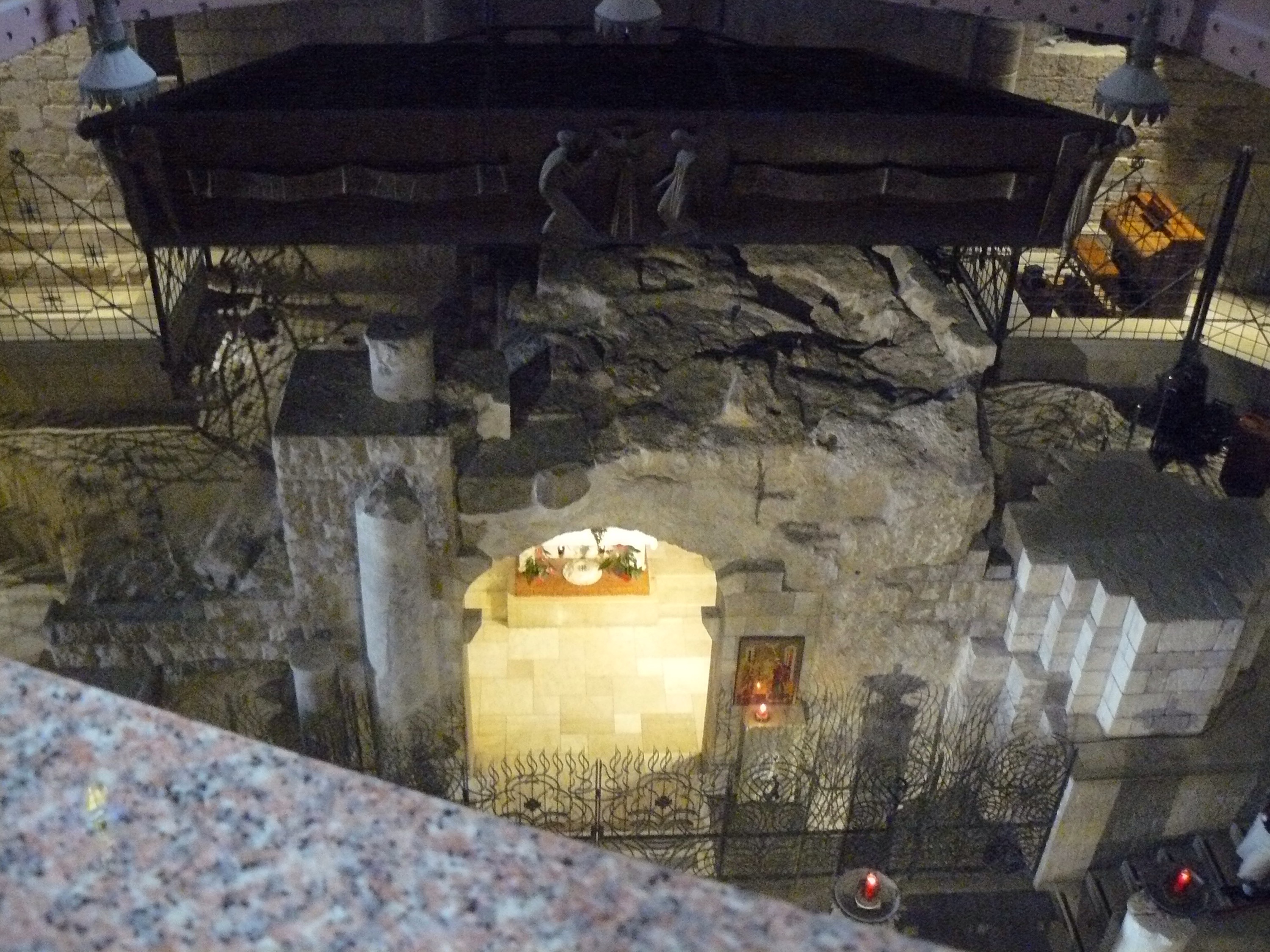
Can anything good come out of Nazareth? Nathaniel can be forgiven his skepticism. Nazareth was, archeologists think, a village of 2-300 people (and no I didn’t leave off a zero). Nazareth consisted of 40-60 families at the most. These families lived in limestone caves that dotted the hillsides (and which form warrens under modern-day Nazareth). It was extremely unlikely that anyone of any note would emerge from such an environment – let alone the long-expected Christ. Nazareth was close to many significant Roman cities including Sepharis. Nathaniel came from Bethsaida which like Capernaum was a fishing village whose residents lived in stone homes, not holes in the ground. From his point of view Nazareth, and anyone who came from Nazareth was not deserving of any attention.
Undeterred by Nathaniel’s disbelief, Philip insists that Nathaniel come and see Jesus for himself. Instead of berating Nathaniel for his doubt, Jesus commends him for his honesty – “Here is truly an Israelite in whom there is no deceit!”
There is a tendency among some Christians to believe that doubt is the antithesis of faith, that doubt suggests disbelief or a failure to truly trust in God. Those who doubt sometimes feel guilty or are made to feel guilty by those who claim certainty. Others (afraid that any form of doubt will bring the castle of belief tumbling down) hold on to their certainty in the face of evidence that contradicts all that they hold dear. They dare not ask questions or allow others to ask questions for fear that that will lead to other questions. Their confidence in God and in themselves seems to be insufficient to allow even the smallest doubt to put a chink in their armour.
The results of a closed, unquestioning faith are manifold. People who cannot or will not ask questions are sometimes left holding conflicting ideas in tension, are forced to defend positions that science has proved to be untenable or are placed in a situation that can both stultifying and stagnant. Their faith cannot grow in part because it is too weak to withstand the rigor of challenge.
Perhaps what is worst of all is that those who are too anxious to question their faith demonstrate, not their trust in God, but their fear of God. They hold on to a belief that God demands unquestioning loyalty and obedience. They are afraid that at any sign of doubt God will cast them out of God’s presence. This attitude leads to an unhealthy and often dishonest relationship with God. Someone who is afraid to question God may bury his or her discontent (because one can’t question what God does or doesn’t do), accept the unacceptable without demur (because it is God’s will) and explain away any inconsistencies with platitudes that may or may not provide real satisfaction (because everything has to be accepted on faith). This attitude can lead to a relationship with God that is constrained and limited and which, as a result, fails to benefit from the sort of relationship that benefits from honesty, from robust discussion and seeking to grow through exploration.
Jesus’ reaction to Nathaniel’s doubt demonstrates that rather than dismissing those who ask questions, Jesus/God embraces and responds to them. From the time of Adam and Eve, through Abraham, Moses and the prophets, God has made it clear that God seeks to be in a strong, honest and real relationship with God’s people. God has broad shoulders and is not easily offended or put out – certainly not to the extent of casting people off. Nathaniel’s reaction to Jesus’ acceptance was to recognise Jesus as the Son of God. Jesus’ reaction to Thomas’s doubt was to provide him with the answer that he sought. Thomas’s reaction was to worship Jesus as: “Lord and God”.
Like human relationships, our relationship with God must be built on mutual trust, a willingness to say what we think and the sort of confidence in each other that allows us to work through any difficulties.
If we truly trust God, then we must know that we can trust God with our doubts.


 Swallowsrest