Posts Tagged ‘nurture’

Feeding on Christ

August 15, 2015

Pentecost 12 – 2015

John 6:51-58

Marian Free


In the name of God who gives us life in abundance and desires that we share that life with the world. Amen. 

Most of you will have gathered by now that I experience a degree of frustration with regard to the focus on church growth and in particular the time spent in worrying why congregations are declining and the time and money spent on programmes designed to turn the decline around. My concern is that the navel-gazing of the past fifty years has achieved little and has caused us to become inward-looking rather than outward-focussed and that we are more anxious about the survival of the institution of the church than we are with the transmission of the gospel.

I am confident that God will survive with or without the church and will find new ways to make Godself known with or without our assistance. That said, thriving faith communities would ensure that for generations to come, that there will be a place or at least a group to whom people can come to hear the good news, to find spiritual refreshment and to be restored and made whole.

It was interesting therefore to attend the Arnott lecture two weeks ago and to be reminded by Bishop Stephen Cottrell that there are people in the wider community who are yearning for some spiritual connection, who have spiritual thirst that they are longing quench, a hunger they are desperate to satisfy and who are searching for answers in a world that can be isolating, confusing and even hostile.

Last week’s Clergy Conference focussed on Church Growth, but while its proponents did at times seem to be promoting growth for the sake of growth, they too expressed the belief that there are many non-church-goers who are seeking nourishment for their souls, an experience of life that is more satisfying than the material and superficial and a relationship with the utterly other.

The church as a community of faith is in an ideal position to satisfy this longing for meaning, search for depth and hunger for spiritual connection. So why is it that we are in decline? Why is it that those who are seeking turn to other faiths, explore other paths or simply give up the search? Is it because those who are looking for a connection with the sacred do not find it in the church? Is it because it is no longer evident that the church is the place in which spirituality is fed and nurtured? Is it because we have become so comfortable in our faith that we no longer make the effort to work on and to strengthen our relationship with God?

One of the speakers at the Clergy Conference challenged us to ask this question of ourselves and of our congregations: “Where are you with God?” “Where are you with God?” By this he means, “How is your relationship with God?” Are you conscious of the presence of God in your life? Do you nurture your relationship with God through regular prayer, reading God’s word or practicing some form of spiritual discipline? Is your spiritual life sufficiently full and rich that it spills over to enrich and enhance the lives of those around you? In other words are we feeding our own spiritual lives such that we have plenty with which to feed others?

In today’s gospel, Jesus reminds his listeners that he is the bread of life and he challenges them to feed on him, to so take him into themselves, into their lives, that they become a part of him and they of him.

If we really want to turn the church around perhaps we should stop looking for external reasons for the decline in numbers and begin looking at ourselves and the way we practice of our faith. We will have to stop looking back to the golden era of our past, stop believing that the faith is somehow passed on by osmosis or hoping that the right programme, the right youth leader or the ideal priest will turn things around.

The health of the church as a whole is the responsibility of every member of the church. That means that each of us needs to ask ourselves what we are doing about our own spiritual health; to question whether we are really feeding on the bread of life, continually re-fuelling our faith, allowing our relationship with Jesus to be constantly re-energised and enlivened and remind ourselves on a regular basis not only of what we believe, but of the benefits of being in a relationship with the living God.

Are we day by day allowing ourselves to abide in Jesus and allowing Jesus to abide in us?

I believe that the church will grow because we are energised by our faith, because the joy we experience is palpable, because we demonstrate in our own lives God’s unconditional love and because our experience of Jesus as the bread of life fills our longing for meaning and inspires us to share that meaning with those in our community who hunger and thirst for something more.

As you come to the altar this morning, as you take into your very selves the life-giving presence of Jesus, allow yourselves to be changed and transformed by the bread of life, let the Spirit of God burn within you and the creative energy of God inspire you. May our lives overflow with the knowledge and love of God – the Creator, Redeemer and Sanctifier – such that we cannot help but bring healing to those who are broken, provide direction to those who have lost their way and be a beacon of hope in a world that sometimes seems devoid of meaning.
A matter of heaven or hell

February 23, 2013

Lent 2 – 2013

Luke 13:1-9

Marian Free

Figs

Figs

In the name of God who created all things, and saw that they were good. Amen.

Today’s gospel reading includes two discrete parts. A couple of sayings about repentance are followed by a parable about growth.  The first sayings certainly get our attention – Galileans whose blood Pilate mixed with their sacrifices and 18 crushed by a falling tower. Shocking as these events are they are not a sign that those killed were more sinful than others. All of us need to repent. Luke follows these sayings with the parable of the fig tree. Repentance alone is not sufficient, believers are called to grow into full maturity rather than to rest on their laurels for the remainder of their lives. (Salvation is not dependent on a one off decision, but process that begins when we repent and turn to God.)

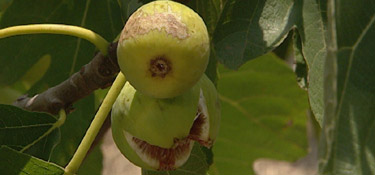
Jesus’ parable about the fig tree is often misunderstood. An emphasis on keeping the ten commandments and doing good works has led to the conclusion that if the fig tree will only be spared if it produces fruit, that we will only be spared if we can manage to build up a folio of good works that can be measured on the day of judgement. However, in this instance, as in most cases in the New Testament, fruit represents much more than external deeds or measurable goodness. As the parable implies, the fig’s bearing fruit is dependent on its receiving enough fertilizer – that is, on its internal health. Fruit trees in general are very reliant on nourishment, they cannot bear fruit unless they have been properly fed and watered. (The first and only time that my parent’s persimmon bore fruit was the year after the ’74 flood had deposited a substantial amount of fertile silt on their garden.)

Many fruit trees need to reach maturity before they bear fruit. Figs generally take two or three years to be well enough established to produce figs and then they will produce best only if they have been given a good start in life – planted in the right situation and fed and watered well. Without help, a fruit tree will probably attain a reasonable height and appear to be growing well, but without the required fertiliser, no amount of growth will produce fruit.

It is possible that Luke combined the sayings about repentance with the parable of the fig tree because he understood that a change of heart (repentance) was required before growth (maturity) could occur. Conversely, repentance alone is not enough, but is a pre-requisite for future development. A change of heart – repentance – creates the sort of internal environment that allows fruit (the external evidence of change and growth) to be produced. That being the case, it becomes clear that Jesus is speaking of fruit (behaviour) which is driven by a relationship with God that is strong and healthy and which is nurtured and developed by the presence of the Holy Spirit. Seen in this light, fruit refers much less to good deeds and much more to the characteristics that result from such a change of heart.

Paul understood this when he wrote of the fruit of the spirit. When he lists the fruit he doesn’t refer to keeping the commandments or doing good deeds but to the external signs of a person at peace with God, with themselves and with the world. Love, joy, peace, long-suffering, gentleness, patience and self-control are the fruit that we are to bear. These are the characteristics that will be a sign of our growing spiritual maturity.

Jesus’ challenge to the disciples that they are not to make the mistake of believing that their turning to him (repentance) is some simplistic, easy fix that will ensure their salvation. Turning to Jesus is only the first step in a process of development that will continue for the rest of their lives and that development, as the parable indicates, will need to be encouraged, fed and nurtured.

Richard Rohr considers spiritual development in his book Falling Upward – a spirituality for the two halves of life[1]. He argues that many people never develop beyond the superficial declaration of faith. Having come to faith, they fail to feed and nurture the depths of their being such that they bear meaningful fruit as a result of their faith. Because they do not pay enough attention to what is going on internally, their external lives never really change. They cannot bear fruit because they have not developed a healthy spirituality that can drive their behaviour.

Rohr suggests that this internal growth is at the core of all religious practice and that it is essential not only for the individual but for the world as a whole. This he claims is because: “God gives us our soul, our deepest identity, our True Self, our unique blueprint at our own ‘immaculate conception’. We are given a span of years to discover it, to choose it and to live our destiny to the full. Our True Self will never be offered again”. The unique person that is ourself has this life only to be the unique person God intends us to be, to achieve the unique goals God has in mind for us and to contribute to the world the unique gifts with which God has endowed us. Our one essential task in this life is to discover and to be that True Self, that unique part of God’s creation. Rohr believes that this task is absolutely imperative for all of us. Heaven and earth, all that is, depend upon our trying to become the person God intended us to be.

Because the implications of this task are so vast, its importance cannot be underestimated. In fact, Rohr suggests, it is because so much is dependent on our spiritual health that the discussion surrounding it is accompanied by such emotionally charged words as “heaven” and “hell”. It is why the vineyard owner threatens to uproot the tree when it is not fulfilling its purpose, why the call to repentance is set in the context of such shocking stories as the slaying of the Galileans and the fall of the Tower of Siloam. The consequence of not nurturing our souls is not something to be taken lightly – it has ramifications for the future of the whole world.

If we allow ourselves grow into our souls, to become the unique being envisaged by God at our creation, God’s purpose not only for us but for the world will be achieved. If we do not grow into our own unique being we hinder God’s purpose, we fail to make our own unique contribution and we refuse the invitation to take part in bringing about the coming of God’s Kingdom.

The purpose of the fig is to bear figs. Without fruit it is taking up space, that could be used to grow something else. It is not fulfilling the purpose for which it was created. Our purpose is to grow into our full identity, that unique self that God has given us and by doing so to share with God in bringing about the kingdom, the salvation of the world.


[1] Rohr, Richard. Falling Upward – a spirituality for the two halves of life. San Francisco: Jossey-Bass, 2011, ix. Note: I acknowledge that I have used Rohr as my starting point, but I am aware that  he may not agree with my use of his premise.