Posts Tagged ‘paradox’

Conviction or blind belief?

April 19, 2014

Easter 2014
Marian Free

In the name of God who raised Jesus Christ from the dead. Amen.

Social media has made a vast difference to the world. It is now possible to broadcast news across the globe in seconds, to announce engagements and births, to share poignant stories and funny or moving video clips, to distribute music and to maintain friendships over time and space. A quick word or photo now and then can keep a person much more connected with their friends than the annual Christmas letter. On a political level, social media can undermine authoritarian governments, gather crowds to protest movements and disseminate film clips of police or army brutality all within a matter of minutes. On an intellectual level, social media can provide people with access to stimulating articles and ideas to which they might not otherwise have access. Of course there is also a lot of rubbish and quite a deal or misleading and even mischievous information, but there is no denying that we are all much closer to each other and to what is happening in the world than we ever were before.

In the last few days for example, I have been able to read a number of interesting articles relating to child slavery and chocolate, Good Friday and Easter. I found two of these sufficiently interesting that I uploaded them on to Twitter. One by John Dickson presented: “Top Ten Tips for Atheists this Easter” and the other by Elizabeth Farrell was entitled: “A Meditation on the Cross.

(http://www.abc.net.au/news/thedrum/; http://www.smh.com.au/comment/meditation-on-the-cross-20140416-zqvdm.html)

Both articles challenge us to consider what it is that we believe, why we believe and how we might try to express that belief.

Dickson writes his article “in the interests of robust debate”. He challenges eight arguments put forward by atheists to discredit Christianity. I want to share with you just two. Atheists criticise Christians for believing things without having any evidence to support that belief. That, he points out, is not the way we use the word “faith”. Faith for a Christian is not blind belief in something for which there is not rational explanation. Rather the word “faith’ is used by Christians in the sense of “have trust in”. Christians do not blindly trust God, but have faith on the basis of a variety philosophical, historical and experiential reasons. We have faith in God, because it seems reasonable to believe that there is something behind the creation of the universe, because for millennia others have trusted this same God and because we experience God in some way in our lives. It is only on the basis of reasoned conviction that we place our trust, have faith in, God, faith in anything less substantial would be easily shaken.

A second related argument is to understand the basis on which people are persuaded. Dickson reminds his readers that Aristotle argued that few people – and that includes Christians – are convinced by purely objective evidence. With regard to a variety of different information, people are persuaded by a combination of intellectual, psychological and social factors. Even if those three factors line up, people are only really convinced if they feel that the person sharing the information with them can really be trusted. (A doctor might present information based on the latest medical research, but it might take a lot more than that to convince a patient to undergo a new and radical procedure.) New information often needs to have a personal relevance or impact before it is accepted. If a person is sure he or she is going to die, they might try to trust the doctor for example. This is as true of objective scientific discoveries as it is with regard to matters of belief. People of faith are no more or less likely to be open to persuasion that any other member of the community.

Farrell’s meditation is a reflection on why, when most of her friends are “lackadaisical or downright opposed to Christianity”, she is “impelled by a craving that the mundane world does not fill – a craving for deep time, old nature and transcendent spirit stuff.” She feels a need for a spiritual dimension not only for her own life, but for that of the world. Farrell confesses that she is “addicted to where the quest for goodness and yearnings of the spirit is accepted currency.” For her, paradox is the core mystic message – the idea that we must lose ourselves in order to win eternal life.” “Paradox”, she says, “and the parable needed to express it, lives at the heart of Christian traditions: darkness in light, poverty in riches, pain in beauty, death in renewal. Paradox is the mystery and the enchantment.”

Every Easter you and I gather to celebrate an event that had no witnesses, that cannot be supported by scientific evidence and that defies all rational explanation. We acknowledge the paradox that victory over death is won by death, and we rejoice that contrary to human logic – the Jesus who suffered a shameful, ignominious and violent death is in fact God incarnate, that what appeared to be a disaster turned our to be a triumph.

It is difficult to explain and to defend the resurrection because it is beyond explanation. Yet, for centuries people like you and I have come to the conclusion that the resurrection is a paradox that can be trusted, that it is a contradiction that somehow makes sense and that it is real because it has the power to change and renew lives. It is possible that we believe without objective evidence, but it is not true that we believe without reason. Our hearts tell us that Christ is present with us, our heads tells us that 2,147 billion people must have some basis for their belief in Jesus’ resurrection and our history books remind us that people have risked their lives and poured themselves out for others, all because they believed that Christ had been raised from the dead.

It doesn’t matter whether we use the more personal language of Farrell to explain ourselves, or whether we apply academic arguments in our discussions with atheists as does Dickson. What does matter is that when millions are elsewhere, we are here because our conviction that Christ is risen cannot be shaken by doubters or critics. We know what we know and that is all there is to it.

Christ is risen.
He is risen indeed!
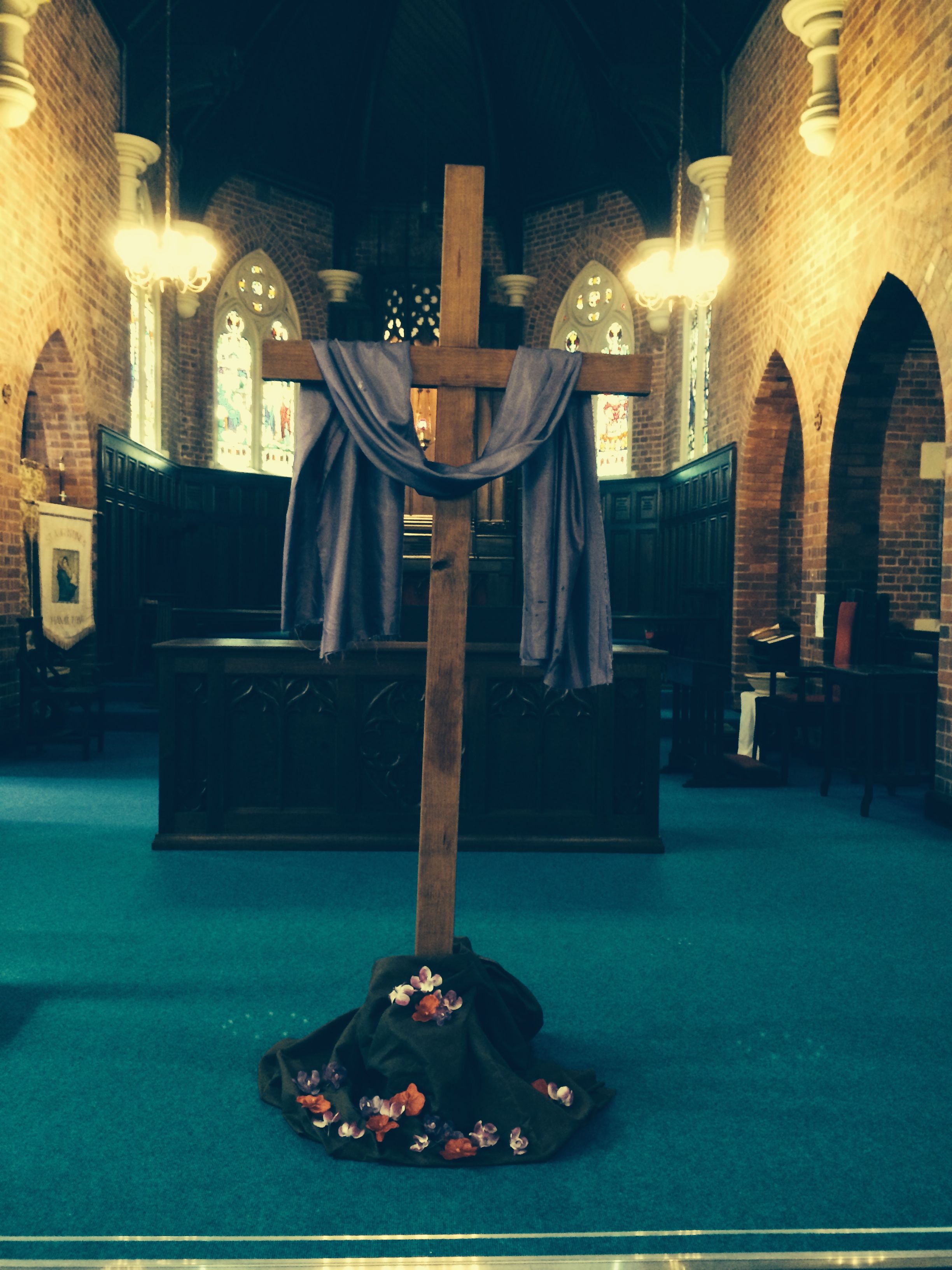
The absence of God- what makes this Friday “Good”?

April 18, 2014

Good Friday 2014Good Friday – 2014

(Read in conjunction with the Good Friday liturgy on this site

https://swallowsrest.wordpress.com/good-friday-liturgies/)

“My God, my God, why have you forsaken me?”

A bare church, an empty altar speaks to me of absence – God’s absence.

The Bible is full of God’s absence, times when people have called to God and have been met with silence. Of all the biblical images of absence, Jesus’ cry from the cross and his ultimate death are the most poignant.

If Jesus is God, where is God when Jesus hangs dying on the cross? Is there a moment when there is no God?

If Jesus is God – and we believe that he is – then God is Jesus and Jesus is dying/dead.

How can it possibly be Good Friday? The shocking failure of Jesus’ potential, Jesus’ promise, the destruction of the hopes of all who followed him, the brutality of the crucifixion are anything but “good”.

“My God, my God, why?

The paradox is this – God’s apparent absence is also God’s ultimate presence.

The cross confronts us with the uncomfortable truth that God is so intimate, so completely identified, with the human condition, that God would go so far as to share a human death. You can’t get any closer to human experience, to us than that.

This is perhaps the ultimate contradiction. Not only that Jesus’ death is God’s death, but that God’s death is a confirmation of God’s deep, unswerving, unreserved love for us – a love shown by God in Jesus who not only goes through the motions of dying, but who actually dies – dies a we will all one day die.

It is a contraction – God’s absence serves to demonstrate God’s intense, immediate, never-ending presence with us and in us.


And that is what makes this Friday “Good.”

Contradiction

March 2, 2013

Lent 3 – 2013

Luke 13:31-35 (Isaiah 55:1-9, 1 Cor 10:1-13)

Marian Free

In the name of God who turns our expectations upside down, who challenges and comforts us and who never, ever withdraws God’s love. Amen.

When you read the Bible, what are the passages that stand out for you? Are you more alert for the voice of judgement or the voice of love? Do you look out for the rules that you must not break and the specific directions that you must follow, or do you instead seek out the promises of growth and new creation? From start to finish, the Bible is full of contradiction.  In it we find both censure and approval, judgement and forgiveness, punishment and redemption, restraint and extravagance.

The Old Testament prophets threaten the Israelites with all kinds of penalties if they refuse to return to God then, almost without taking breath, they assure the people that God will never abandon them. Side by side in Isaiah, Jeremiah and Hosea and elsewhere we have evidence of God’s frustration and confirmation of God’s faithfulness. The Gospels express similar contradictions. Calls to repent are balanced by stories of the lost being restored. Jesus’ attacks on the righteous throw into relief Jesus’ acceptance of those outside the law.

This morning’s readings are a case in point. The generosity and free-spirited invitation of Isaiah 55 stands in stark contrast with the harsh, judgmental and condemnatory sentiments of 1 Corinthians 10.

How are we to make sense of the paradox – judgement and repeal, condemnation and forgiveness, law and freedom? It is my belief that both sides of the coin are necessary to sustain healthy individuals, healthy societies and healthy religions. Freedom is essential for creative energy to thrive, for people to love and be loved, for compassion and generosity. None of these things can be forced or legislated. On the other hand, lawlessness leads to disintegration, violence and repression. Without some sort of law no one can achieve their full potential.

There needs to be some sort of balance between law and freedom.  It is not healthy to be completely unrestrained, but neither is it good to be so restrained that we forget how to live. If we fence ourselves in with rules, we reduce our ability to be spontaneous and carefree. Somewhere in the middle is an equilibrium, an ability to self-regulate, to use the rules and the threats of judgement to control our baser instincts and to trust in God’s goodness and mercy to liberate our finer, more selfless characteristics.

Interestingly, in the Bible, it is not disobedience or even the breaking of the Ten Commandments which is the source of God’s anger and the pre-condition for punishment. What causes the prophets to proclaim God’s judgement and Jesus to condemn the people of Israel is a breakdown in the relationship between the people and God.

God doesn’t expect perfection. That much is clear in God’s choice of Jacob the deceiver, God’s selection of Moses the murderer and God’s continued love for David the adulterer. That God is not looking for flawless followers is demonstrated by Jesus’ choice of disciples, Jesus’ readiness to forgive and Jesus’ easy acceptance of tax collectors and sinners.

It appears that the primary safeguard against condemnation is not so much to be law-abiding (though that is good), but to accept God’s invitation to be in relationship, to trust God’s offer of a covenant, to believe in God’s faithfulness to God’s promises.

Jesus weeps over Jerusalem, not because its citizens have failed to keep the law _ if nothing else, the Pharisees were assiduous keepers of the law.  Jesus weeps because the people of Jerusalem, the leaders of the Jews, have demonstrated their inability to put their trust in God. The Pharisees, Chief Priests and Scribes have put all their trust in the law and their ability to keep the law. They are so sure that they can achieve perfection by their own effort that they have effectively locked God out of their lives. They have so little confidence in God’s love and faithfulness that they are using the law to paper over their imperfections. They are so afraid that scrutiny will find them wanting that they kill the prophets who hold a mirror to them and to their lives. They cannot have a real relationship with God because they cannot have a real relationship with themselves.

No wonder Jesus weeps, he understands that the Jerusalemites are so sure that God cannot love them as they are, that they not only try to become what they are not, but worse, they shrink from God, they refuse God’s invitation and will not be drawn into God’s loving embrace.

How different they are from Zacchaeus who has the courage to respond to Jesus’ invitation and who finds that his life is transformed as a result. How different from the woman who anointed Jesus’ feet, who could take such a risk because instinctively she knew that she was loved and accepted. “Law-breakers” and outsiders who already knew and accepted their imperfections welcomed Jesus’ love and invitation, entered into a relationship and allowed themselves to be gathered under his wings.

Law and freedom together create a necessary life-giving tension in our relationship with God. An over-reliance on law can have the effect of locking God out of our lives whereas an over-emphasis on freedom can lead us to believe that we don’t need God. It is important to relish our freedom, but to understand its bounds, to trust in God’s unconditional love, but not to use that love as an excuse to be unloveable, to recognise that law has its place, but not to use it as a replacement for relationship.

God invites us into a relationship that is based on mutual trust and respect. God offers us an unconditional love that sets us free to be ourselves. To say “yes” to God, is to say “yes” to ourselves and to know ourselves welcome in the shadow of God’s wings.