Pentecost 12 – 2020
Matthew 16:13-20
Marian Free
In the name of God who knows what we need to hear and speaks to us where we are. Amen.
Context is everything. Some years ago, the well-known broadcaster and journalist, Philip Adams was invited to address the VFL[1] Grand Final breakfast, this, despite his well-known aversion for the game. Attendees at the breakfast included die-hard fans, high-ranking officials and very often even the Prime Minister of the day. Strangely, for such an experienced writer/speaker, Adams chose that venue and that audience to mock the sport that they all held dear. Adams reports that he “explained to the crowd that Aussie Rules was, in fact, an ancient fertility rite. Like Easter”, he said, “it is all about eggs. The footy is an egg. The game is played on an egg-shaped oval. The goal posts are there to be impregnated” and so on[2]. Needless to say, no one thought that he was remotely funny. Adam’s address was met with horrified silence. He had completely misjudged his audience. There might have been a place to mock Australian Rules Football, but this was not it.
If we want to get our message across, if we want people to laugh at our jokes, or to be shocked into changing their ideas or to be comforted by our platitudes we have to be sensitive to our audience. We have to ask ourselves – what is their starting point? what can I say that will speak to their situation? what language will help them to understand what I want to say? Will my words be helpful, or will they add to someone’s pain?
The gospel writers were masters of context. Each author tailored their retelling of Jesus’ story in a way that they felt would speak directly to their listeners, that would meet them where they were in their faith journey and would draw them into a deeper understanding of that faith. Their goal, as the gospel of John specifically says: “These are written so so that you may come to believe that Jesus is the Christ, the Son of God, and that through believing you may have life in his name” (Jn 20:31).
In other words, the gospel writers knew the importance of setting out their accounts in such a way as to give the listeners the best chance of grasping the message of Jesus the Christ. At the same time, they could confront, through their re-telling of Jesus’ stories and miracles, the anxieties and the shortcomings of the communities. Matthew, Mark and Luke were writing to completely different communities – to people with different backgrounds, different experiences of the world and people whose contexts differed greatly. Being sensitive to the needs and experiences of their listeners, each author ordered his account and adapted his story-telling to ensure that the communities for whom they wrote heard what they needed to hear in their current situation – a situation that was vastly different from the time of Jesus and which had its own challenges for the emerging believers.
Mark’s version of today’s gospel with that of Matthew for this reason. Both authors place Peter’s confession in the vicinity of the city of Caesarea Philippi but there are subtle and not so subtle differences in the telling. Mark emphasises movement not place, journey not destination. His language implies movement. “Jesus was asking (the question is repeated) his disciples while they were on the way (Jesus and the disciples are moving from one place to another).” Movement is an important of Mark’s setting, but so too is his language. “On the way,” is a phrase that Mark uses repeatedly as shorthand for discipleship. Mark presents Peter’s recognition of Jesus as a stage in the journey of discipleship. As we shall see, despite Peter’s declaration that Jesus is the Christ, he has no idea what this means. His declaration is a stage in the journey, not the end of the story.
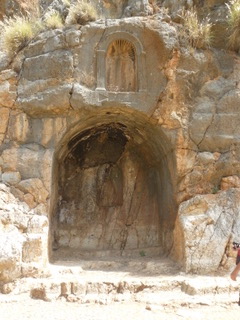
Matthew’s emphasis is primarily on place or at least the significance of place. Jesus has come into the district of Caesarea Philippi. He is stationary not moving. Caesarea Philippi was close to a cave and a spring that were dedicated to the Greek god Pan and was believed to be the entrance to the underworld. Herod the Great had built a Temple to Caesar Augustus here to curry favour with the Emperor. The region was inherited by Herod’s son Philip who made it his administrative headquarters and dedicated it to the then Caesar. Caesarea Philippi was important for other reasons. It was near a major trade route and it was the place to which the commander of the Roman army had returned to celebrate with his troops after they had crushed Jerusalem. In other words, it was a place that was redolent with symbolism – of power, religion and economic viability.
Whereas in Mark, Jesus’ question: “Who do you say that I am?” is primarily a question about Jesus’ identity, in Matthew the question has more to do with allegiance. Matthew’s readers are being challenged to ask themselves in what and in whom do they trust. Are they over-reliant on their economic security? Are they tempted by their culture’s latest fancies? Do they place their trust in the power of secular rulers? Where – in the midst of all the worldly distractions – does their loyalty lie – with earthly powers or with the power revealed by Jesus, “the Christ, the Son of the living God”?
The gospel writers knew their communities and understood their needs. They knew when to challenge and when to comfort their audience. Mark wants to move the community along the road to belief, Matthew wants them to consider where their true loyalty lies.
Context is important. If we want to share the gospel with our contemporaries we need to understand where they are coming from. We need to recognise and understand their longings and their fears, their strengths and their weaknesses so that we can speak in a way that will touch their hearts, utter a message that responds to their deepest needs and offer a word that will bring them into the presence of the living God.
[1] For overseas readers, VFL in those days highly parochial. Most Melbourne suburbs had their teams and followers were fiercely loyal even fanatical in the way of many soccer fans.
[2] Reported by Phillip Adams The Australian Magazine, August 15-16, 2020.


 Swallowsrest