Posts Tagged ‘rejection’

Elizabeth welcomes Mary

December 21, 2024

Advent 4 – 2024

Luke 1:39-35

Marian Free

In the name of God who alone can see into our hearts and who alone can judge between good and evil, right and wrong. Amen.

Many years ago, at church, I met a woman who worked as a prostitute. I’ll call her Jan. She was a remarkable person. After a powerful religious experience, she gave up drugs, alcohol and smoking! When Billy Graham came to Australia for what was to be his last visit, Jan attended a rally and was one of those who responded to the altar call. The team who were on hand to counsel and pray with those who had committed their lives to God recommended that she become a member of her nearest church. This happened to be the church where I was serving my curacy. As was the custom, the counsellor ran me to alert me to look out for Jan saying only that Jan had been at the rally and that she had made a confession of faith. 

There was no hint of judgement. No mention was made of her profession. This was something Jan shared over a meal after one of the services. She also felt safe enough to. tell the Parish Priest. You see, even though Jan had given up smoking, drinking and drugs, she was not in a position to stop working. Jan owed her drug dealers $5000 and no other way to repay them and, surprisingly, they were prepared to wait.

One day Jan rang me in tears. She was absolutely distraught. Her Christian psychologist had accused her of not being a true believer. Despite being a psychologist, he appears to have been a black and white thinker. In his mind, if Jan had truly given her life to Christ she would have given up prostitution. (He didn’t offer any advice with regard to the debt, nor did he offer to pay it for her.) Jan was made to feel worthless, worse, that she had been rejected by God.

Jan was a person of integrity. While she continued working, she refused to be baptised. (In her own mind prostitution and faith didn’t belong together.) That afternoon, it took me the best part of an hour to reassure Jan and to convince her that God knew her heart and that her faith was sincere[1].

I remember being astounded that the supporters of Billy Graham (usually from a more conservative tradition) accepted Jan just as she was and saw her as a child of God. They made no demands and withheld judgement. I was absolutely aghast that an educated, psychologist, a member of the ‘caring’ profession thought that it was in Jan’s best interest that he insinuate that she was not worthy of God’s love as long as she continued working. In so doing, this psychologist utterly undermined Jan’s confidence that she was a child of God, utterly beloved and accepted and instead left her completely bereft, uncertain of her place in the kingdom.

How different the encounter between Elizabeth and her young cousin! Mary unmarried and pregnant, a source of shame not only for Mary but for her whole family turns up unexpectedly. Elizabeth, caught up in her own untimely God-given pregnancy would have been justified in sending Mary away, or at the very least have greeted Mary with questions, cynicism and judgement. After all, if Elizabeth welcomes Mary into her home, Elizabeth is, by implication, indicating her support of Mary’s out-of-wedlock pregnancy. Instead, led by the Spirit, Elizabeth is able to see God at work in Mary’s pregnancy and to rejoice that Mary’s role was to be more significant than her own. 

We take it for granted that Elizabeth should respond to Mary in this way because that is how Luke choses to tell the story. We forget that Mary has turned up unannounced, has made a difficult journey (on her own which in itself is shocking) over a considerable distance and that Elizabeth greets her before Mary has a chance to explain herself. It would not have been at all surprising had Elizabeth thought that Mary was trying to escape her situation and her shame, hoping that her cousin would provide refuge and allow her to hide away from the prying judgement eyes of her neighbours, but Elizabeth’s openness and receptivity to the presence of God allow her to see a different story.

We live in a world that is increasing quick to judge. We are drowning in social media that provides a platform for those who want to promote their own hardline views and those who find s a sense of self-worth in condemning others. 

The encounter between Elizabeth is a reminder of how important it is that we withhold our judgement of another unless and until we are sure that we know all the circumstances behind their behaviour, more important still is to err on the side of caution unless and until we are absolutely confident that we know the mind of God. To do less might be to reject and condemn something that is the work of God or to rebuff and judge harshly someone in whom God’s will is being enacted.  

Like so many biblical accounts, the lesson to take from the meeting between two cousins is not just the miracle of recognition, but the miracle of receptivity to the work of God – in the world and in each one of us.  When we are truly open to the presence of God in ourselves and in others and when we allow our judgement to be guided by the Holy Spirit, we are better able to see all people as children of God, to love and accept them as God does, and even to recognise that God just might be teaching us something through their presence in our lives. 


[1] A year or two later Jan rang to tell me that she had given up the work and was going to be baptised.
Who infects who? Woman with a haemorrhage.

July 2, 2024

Pentecost 6 – 2024

Mark 5:21-43

Marian Free

In the name of God who sees our deepest needs and sets us free. Amen.

Thanks to Reginald and Catherine Hamlin, the prevalence of obstetric fistula in Ethiopia became known and, more importantly, addressed. Their story is well known. The medical couple responded to an advertisement for a medico to establish a midwifery school in the hospital in Addis Adiba. Once there, it was not long before they observed the huge number of untreated injuries caused by childbirth. Instead of returning to New Zealand when their contract was completed, the couple founded the Addis Adiba Fistula Hospital. It is the only hospital of its kind and has treated over 60,000 women.

The tearing of the fistula during childbirth can have devastating consequences. It is especially prevalent in places where there is inadequate access to pre-and peri-natal care and where there are no midwives to assist with birth. In countries where child marriage is allowed and in which female circumcision is practiced the situation is even more dire. Girls whose bodies are not ready for childbirth become pregnant and genital mutilation can make the birthing process even more difficult. In Ethiopia something like 100,000 women and girls live with a fistula and around 9,000 new cases occur every year (this in 2022).

An obstetric fistula is a hole or tear that is created during a long or obstructed labour.  The tear creates a hole between the bladder and/or rectum which leads to leakage of urine or faeces over which the woman has no control. This in turn results not only in physical discomfort, psychological distress and infertility but also in rejection by the spouses and families of these women and social isolation. Rejected by their communities, young women who suffer from this condition become homeless and impoverished.

The medical situation of the woman with a haemorrhage in today’s gospel is different but the resulting situation is similar – rejection, isolation and penury. In the ancient world, blood, especially menstrual blood, rendered a woman unclean, a source of contamination and therefore as someone to be avoided. The woman with a haemorrhage would not only have been unclean, but also infertile. She would have been socially isolated and her value as a woman (able to bear children) would have been seriously compromised. The woman would have been an object of fear, isolated, destitute and desperate.

No wonder she takes her chance with Jesus. No wonder that she is driven to break the law, to cause offence and to risk the wrath of the crowds.  Jesus is her last and only hope of restoration – to health and to the community.

We know nothing of the woman, but we can imagine that she had been a person of some means, because she has, over the course of twelve years, been able to seek the help of doctors. Now she has spent all that she has on doctors – to no avail. 

Jesus’ reputation has reached the woman, and while the woman dare not appeal to him openly for fear of the crowd’s reaction, she presumably knows that that Jesus has not demonstrated an unwillingness to engage with those deemed unclean. After all, he has healed lepers who, like her are considered impure and forced to separate themselves from family and community. 

So when she learns that Jesus is near the woman somehow slips into the crowd, makes her way to Jesus and touches, not him, but his cloak.  Two things happen simultaneously – the woman knows that she is healed, and Jesus feels power flow from him to another. 

In Jesus, the process of contamination is reversed. His purity is not polluted by her impurity, her uncleanness does not taint him but rather her impurity is sanitised by his purity. His ‘power’, his pureness, moves from him to her, cleansing and restoring her. In healing the woman, Jesus not only sets her free from her suffering, but restores her to her family: “Daughter” he says.

It is easy to fool ourselves into believing that notions of purity and impurity belong to another time and age, but I challenge you  to think of the ways  in which we limit and exclude those who do not fit the norms of our own time, the ways in which we judge those with health issues that we do not understand, the barriers we place between ourselves and those who are different, the ways in which we exclude people from participation in things we take for granted. 

The examples are manifold so I shall only list a few – women with endometriosis who spend years and fortunes convincing doctors that they are unwell and are made to feel that the problem lies with them, the rough sleepers who endure our discomfort rather than our compassion and who feel our discomfort, fear and revulsion, our physical environments that make it impossible for the differently abled to fully participate in the lives we take for granted and which tell them of our indifference. Consciously or unconsciously, we isolate and protect ourselves from the suffering of others. 

Consciously or unconsciously, we send the message that we are repulsed or affronted by those whose situations we do not fully understand.

Time and again, Jesus demonstrates that compassion for and engagement with the despised and rejected takes nothing from himself and gives everything to them – restoring them physically, psychologically and socially. If we are willing to learn from his example, we will create a society in which everyone is valued, included and made whole, a world infected and transformed by kingdom of God.

Graduation speech?

June 20, 2020

Pentecost 3 – 2020

Matthew 10:24-39

Marian Free

In the name of God Earth-maker, Pain-bearer, Life-Giver. Amen.

In 2015, the actor Robert de Niro addressed the graduands at the New York University Tisch School of the Arts Commencement ceremony. He began by saying: “Tisch graduates you made it and you’ve had it.[1]

The speech in full is available on Youtube. This is an excerpt.

“You’ve had it. The graduates from the College of Nursing, they all have jobs. The graduates from the College of Dentistry – fully employed. The Leonard Stern graduates of Business Studies, they’re covered. The School of Medicine graduates, each one will get a job.

Where does that leave you? Jealous? I doubt it. Those accountants they all had a choice. I suspect they used reason, logic and common sense to give them a career that would give them stability. Reason, logic and common sense at the Tisch School of Arts? – are you kidding me? But you didn’t have a choice did you. When it comes to the Arts common sense doesn’t come into it. You have a talent; a passion and you chose to pursue it.

“That’s not a bad place to start. Your place is clear – not easy, but clear. A new door is opening for you, a door to a lifetime of rejection. How do you cope? I hear that Valium and Vicodin block the pain, but you don’t want to block the pain too much – without the pain what would we talk about?” 

“Rejection may sting but my feeling is that very often it has nothing to do with you. You have to be true to yourself. I presume you didn’t pick this life because you thought it would be easy. Don’t be afraid to fail. Take chances, you have to be bold and go out there. You are not responsible for the whole project, only your part in it. You learn to trust each other and depend on each other, because you are all in this together.”

It would only take a little adaptation to turn de Niro’s words into Jesus’ graduation speech to his disciples. There are two major differences. One is that I am not entirely sure that the disciples chose their path. Sure, they have followed Jesus willingly – but he asked them, not the other way around. The second is that the Tisch graduates (judged by their wholehearted laughter) have some idea that the way ahead will not be easy – and may in fact be extraordinarily difficult.

Today’s gospel continues that begun last week – Jesus’ sending out of the disciples. Last week Jesus provided a list of instructions to the twelve – what not to take and where not to go. If these instructions weren’t daunting enough, Jesus continues by informing the disciples what they might expect. Up until now, I imagine, the disciples will have been caught up in the excitement and novelty of being followers of Jesus, with little to no thought that it might be dangerous or costly. Jesus teaching may have in parts been difficult, even harsh, but there has, up until now, been little hint that the path that they have chosen will lead to persecution or to the cross. 

And now – just before Jesus sends them out on their own – he spells out the consequences of following him. Graduates of the Tisch School of Arts might face unemployment and rejection. Disciples of Jesus can expect to be handed over to the authorities, betrayed by their own families and hated by all. They must even be prepared to lose their lives for Jesus’ sake. 

I can’t help wondering if the disciples realised that this was what they had signed up for. In fact, did they think that they had signed up for anything at all? And, even if the twelve had made a choice, if they had signed up for discipleship, did they really know what it entailed? Did they understand that one day Jesus would simply send them out (on their own) into a hostile world – a world of hatred and rejection, a world filled with violence and persecution, a world that would turn its back on them and which might even put them to death? I suspect that this was all news to them. 

At that point, I would not be surprised to discover that the disciples were frozen in fear, unable to go forwards or backwards. Our Arts graduates have their talent and their passion to fall back on. The disciples had no such resources. Only Matthew could be considered to have been a “man of the world”, someone who knew how cruel and unforgiving it could be. Thankfully, Jesus’ warnings are interspersed with assurances. Despite promising the disciples that he has come to set “a man against his father and a daughter against her mother” Jesus insists that they need not be afraid because their very association with him is the protection and strength that they will need. He may not be able to keep the disciples from harm, but he can assure them that when they are at a loss for something to say, the Spirit of the Father will speak through them. Their lives may be at risk, but Jesus can give them the affirmation that their lives are of such value that even the hairs of their head are all counted.  Jesus doesn’t promise that it will be easy, but he does promise that even if they lose their lives they will find them.

In the light of this passage, Jesus’ “graduation speech” we may all have to reconsider our understanding of discipleship. If we had thought that following Jesus comprised conformity to a code of behaviour and a peaceful coexistence with our fellow human beings, then – this passage tells us – we are very much mistaken. Jesus has come not to bring peace but a sword. His very presence was divisive and confrontational, and he expects that our presence will extract the same reaction. Where there is injustice, we are called to confront it. Where there is oppression, we are called to challenge it. When people are excluded, marginalised or stereotyped because of their race, religion, colour, gender or sexuality; we are called to stand for and with them whatever it may cost.

Disciples of Christ – you are done for! Wherever you go from here may be dangerous and frightening. It may cost you your family, your friends and your life! In the end, though, it does not depend entirely on you. You are not alone, and you are not “responsible for the whole project.” With other disciples of Christ, you are in this together and you are supported and upheld and given voice by the Spirit of the Father. 

The way ahead may not be easy, but in the end, would you have made any other choice?


[1] Not his word. He used a word that got attention, but which I didn’t feel I should repeat.

Longing to love

December 24, 2016

Midnight Mass – 2016

Marian Free

 In the name of God who longs to be in relationship with us and who willingly forsake power, glory and dominion to try to make that clear. Amen.

During the week I happened upon a movie titled: “Anywhere but here.” It tells the story of how two grown sons cope with the fact that their father is dying. The sons have been brought up in the Jewish faith, but have not been able to embrace its practices and beliefs. One son, Aidan, still has a connection with the synagogue because his father will pay his grandchildren’s school fees if they attend a Jewish school. As with many families there are unresolved issues and tensions that make the grieving process more complicated. At one point Aidan is compelled to go the synagogue and speak to a Rabbi. Aidan is confused because events in his life are leading him to the conclusion that God is trying to tell him something, but he doesn’t believe in God. Thankfully, the young Rabbi is wise. He asks Aidan if he ever feels “a spiritual presence”. Aidan replies that when he is showing his children the stars and trying to explain that the universe goes on forever and ever, that yes, he does get a sense of the spiritual.

The Rabbi responds: “Then think of that spirit leading and guiding you.” The Rabbi knows that Aidan has rejected the traditional ways of thinking about God and he is wise enough not to impose those ideas on him. Instead he asks Aidan to name how he knows and experiences God and runs with that.

Rejecting the God of one’s youth and yet having a yearning to connect with something deeper than the material is not unique to a person who has grown up in the Jewish faith. One of the problems that the church faces today is that there are many people who have walked away from the faith and yet have a sense of something other. There are many long to make contact with their spirituality but their search is blocked by language, dogma or ideas that offend or that no longer work or make sense to them.

If truth be told most of the ideas of God that people reject are ideas that we too reject, but it is possible for some to hear only one thing and a selective reading of the bible (by a preacher or by the reader) can give the impression of an angry, demanding, interventionist God, a selective God who expects conformity at least and obedience at best. It is relatively easy for to abandon this false idea of God, especially if that idea of God has been used to manipulate and control or to appear be remote from human affairs and indifferent to suffering and pain.

Christmas exposes that God for who and what it is – a false God based on a misunderstanding of both the Old Testament and the New.

At Christmas we are confronted, year after year with the God who is not strong or powerful, but who enters the world as a baby – vulnerable, helpless and utterly dependent. When God could not get through to us, when we had turned away from God or turned God into something that God is not, when we lost sight that God’s primary desire is to be in relationship with us, God in Christ came to us. God came among us not with lighting and thunder, waving a sword to condemn and destroy, but as a new-born child a child whom God hoped would demonstrate once and for all God’s love for all humankind – the good, the bad, the engaged and the indifferent, the kind and the unkind. That first Christmas God became powerless and impotent so that we would at last understand the depth and passion of God’s love and that we would see for ourselves God’s complete and total engagement with humanity and God’s participation in both our sorrows and our joys.

This is why we are here this and every Christmas. Our presence is not simply a result of habit or sentimentality. We are here, because we know that the child in the manger is God, that God chooses not to be remote, but to be an integral part of all that this life has to offer. The child in the manger and the man on the cross expose God for who and what God really is – an expression of the deepest love, the utmost compassion and the greatest longing to be in relationship, to be one with all creation.


Stand up and be counted

June 21, 2014

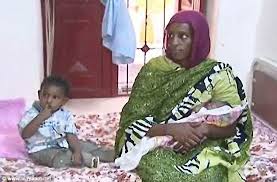
Meriam Ibrahim and her two children in jail

Meriam Ibrahim and her two children in jail

Pentecost 2 – 2014

Matthew 10:24-39

Marian Free


In that name of God who constantly reminds us that there is more to our existence than this life alone. Amen.

It is impossible not to be touched, saddened and outraged by the situation of Meriam Ibrahim a Sudanese woman sentenced to hang – ostensibly for abandoning her Muslim faith. Meriam’s Father is a member of the Islamic faith and her Mother is a Christian. Meriam claims that she has always been a Christian and that therefore she has not abandoned Islam and is not guilty of apostasy. Her claim however appears to be falling on deaf ears and it seems probable that the Mother of two small children will hang for refusing to renounce her faith. Half a world away, in the comfort of a country that has been primarily Christian since its inception, it is difficult for us to imagine the courage and the faith that would lead a young woman to risk her life rather than to deny what she believes.

We are nearly half way through the year and only now are we able to really come to grips with Matthew’s gospel. In fact, even though it is the year of Matthew, it has been three, nearly four, months since our consecutive reading of this gospel was interrupted first by Lent and then by Easter. It is then, a good time to look at the gospel as a whole so that we can begin to appreciate its parts. The Gospel attributed to Matthew appears first in the New Testament, however most scholars agree that Mark was the first to be written. The consensus is that Mark was written first and that Matthew used Mark’s work to write his own. Evidence for this is found in the fact that basic content of Matthew is the same as that of Mark. Matthew has filled out the material used by Mark in two ways. In the first instance, the author of this gospel appears to have had access to some teaching that was circulated widely enough to be known by both Luke and Matthew – they both include sayings that are not found in Mark. Secondly, as some material appears only in Matthew, it seems clear that he or his community were privy to teaching known only to them – including the parable of the ten bridesmaids and the parable of the sheep and the goats[1].

Matthew’s gospel stands out from the remainder as it is the most Jewish of the Gospels and the one that most clearly identifies Jesus as the one who fulfills the Old Testament. In Matthew Jesus is first and foremost a teacher which may be the reason that Matthew organizes Jesus’ teaching into five sermons the best known of which is the Sermon on the Mount. It is almost certain that Jesus’ preaching did not consist of a string of unrelated sayings, but rather that Matthew gathered them and placed them together. Apart from the introduction (the birth narrative) and conclusion (the passion and resurrection), Matthew’s gospel is made up of five parts each of which consists of a narrative section and a sermon. In other words, the story that Matthew is telling about the life of Jesus is punctuated with blocks of Jesus’ teaching.

Today we are reading a portion of Chapter 10 – the sermon which concludes part two of the gospel – Jesus’ ministry in Galilee. To set the sermon in context, we need to remember that at the beginning of this chapter Jesus has set apart twelve of his disciples and given them authority to cast out demons and to heal. Having done that he sends them out to proclaim that the kingdom of Heaven has come near. In other words, Jesus has shared with the twelve both his authority and his ministry. This is an enormous privilege, but it comes at a cost. If the disciples are to be Jesus’ representatives, they must expect that, like him, they will experience rejection and persecution. (“If they have called the master of the house Beelzebul, how much more will they malign those of his household!” Jesus says.)

The sermon in chapter 10 is addressed not to the crowds, or to the disciples in general – but specifically to the twelve. If they are to share his ministry they must expect to share the consequences of that ministry. Jesus says: ”I am sending you out as sheep amongst the wolves.” This does not mean that they should be timid or afraid – the Holy Spirit will give them words to say and Jesus reminds them how precious they are in the sight of God. If they remain true they may lose their life, but nothing can kill their soul – not even death can separate them from God.

For generations Jesus’ warning has seemed to be directed specifically at those early disciples or to those in the early church who faced persecution and martyrdom. How comforting it must have been to know that the Holy Spirit would be with them when they faced their accusers, that whatever situation they confronted, they were so precious to God that even the hairs of their head were numbered and that if martyrdom was to be their lot they would lose their body, but not their soul. Words such as these must have provided comfort then and they must surely offer hope and consolation to Meriam and to others in her situation today.

Times are changing. In an increasingly secular and multi-cultural Australia we can no longer take for granted the privileges and benefits that have accrued by virtue of our belonging to the predominant faith. There are challenges to our practices and beliefs on a number of fronts – religious education, the presence or not of Santa Claus in kindergartens, the presence or not of Nativity Scenes in public places and whether or not churches that provide social services are to be considered charities and receive the tax breaks associated with such practices. In some places the Christian faith is met with ridicule, in others with indifference and in yet others with outright hostility.

In a nation in which loyalties and beliefs are changing, it may be that there will be a time when we will have to defend what we believe. At best we may have to stand up and be counted and at worst we may have to consider what is more important – security in this life or in the next. Should we, like Meriam, be put to the test, let us pray that we will heed Jesus’ words to his disciples and find the strength and courage to hold fast to our faith no matter what oppositions confronts us and no matter how tempting it is to try to save our skin.

[1] An interesting exercise is to place Matthew, Mark and Luke side by side to see how they have used material known to them all, what sayings occur in Matthew and Luke and what is unique to Matthew or to Luke.